Sample Category Title
GBP/USD Mid-Day Outlook
Daily Pivots: (S1) 1.2097; (P) 1.2160; (R1) 1.2200; More...
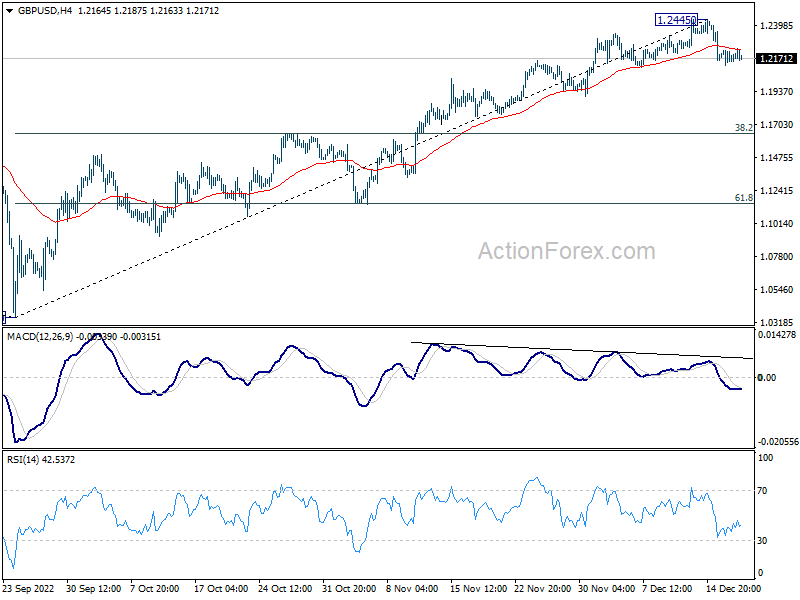
Outlook in GBP/USD remains unchanged and intraday bias stays mildly on the downside. Fall from 1.2445 short term top is in progress for 55 day EMA (now at 1.1863). Firm break there will target 38.2% retracement of 1.0351 to 1.2445 at 1.1645. For now, risk will stay on the downside as long as 1.2445 resistance holds, in case of recovery.
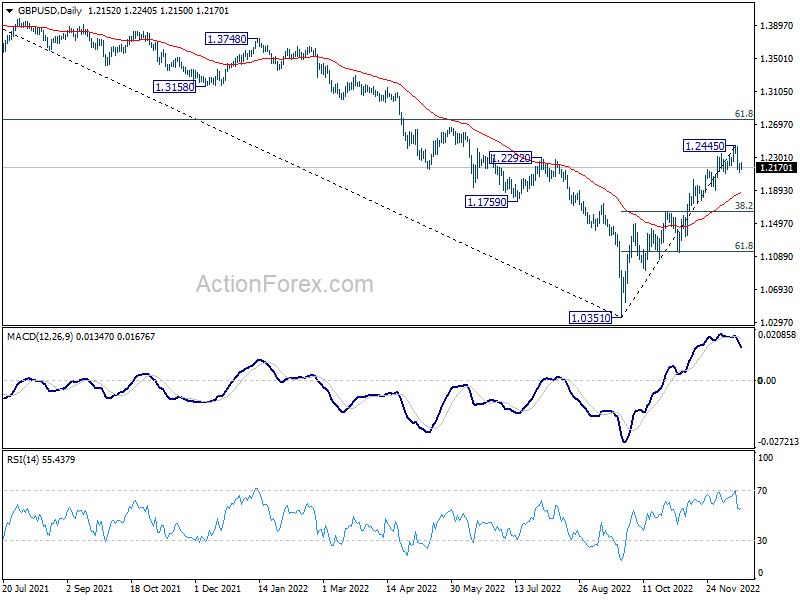
In the bigger picture, rise from 1.0351 medium term bottom is at least correcting whole down trend from 1.4248 (2021 high). Further rise is expected as long as 1.1644 resistance turned support holds. Next target is 61.8% retracement of 1.4248 to 1.0351 at 1.2759. Sustained break there will pave the way back to 1.4248. This will remain the favored case as long as 55 day EMA (now at 1.1863) holds.
USD/CHF Mid-Day Outlook
Daily Pivots: (S1) 0.9282; (P) 0.9314; (R1) 0.9373; More...
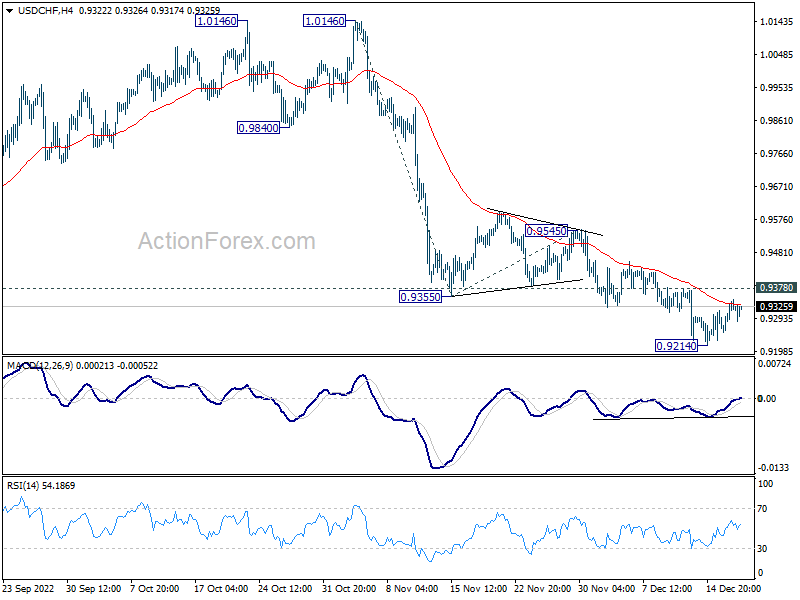
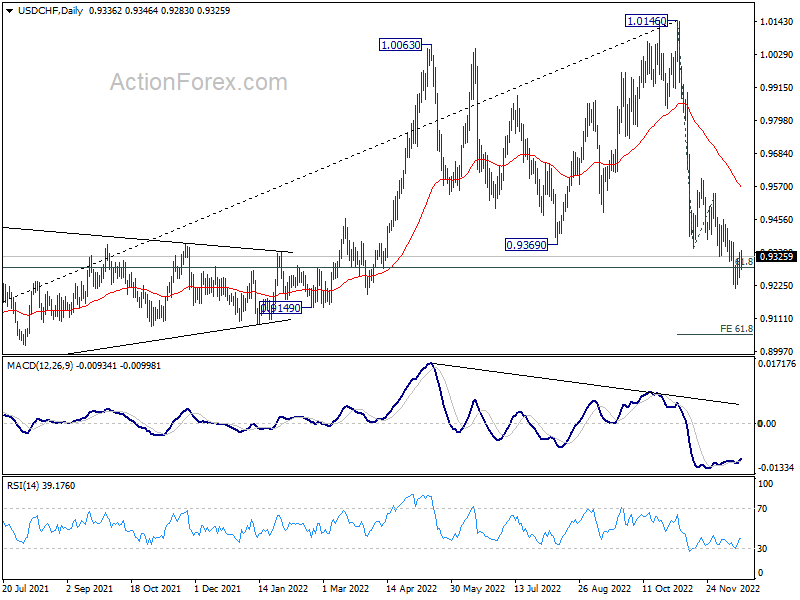
Outlook in USD/CHF is unchanged and intraday bias stays neutral. On the downside, break of 0.9214 will resume the fall and target 61.8% projection of 1.0146 to 0.9355 from 0.9545 at 0.9056. However, break of 0.9378 resistance will indicate short term bottoming and turn bias back to the upside for 0.9545 resistance instead.
In the bigger picture, rise from 0.8756 (2021 low) has completed at 1.0146, well ahead of 1.0342 long term resistance (2016 high). Based on current downside momentum, fall from 1.0146 might be a medium term down trend itself. Sustained break of 61.8% retracement of 0.8756 to 1.0146 at 0.9287 will pave the way to 0.8756. In any case, risk will stay on the downside as long as 0.9545 resistance holds.
USD/JPY Mid-Day Outlook
Daily Pivots: (S1) 136.07; (P) 136.97; (R1) 137.64; More...
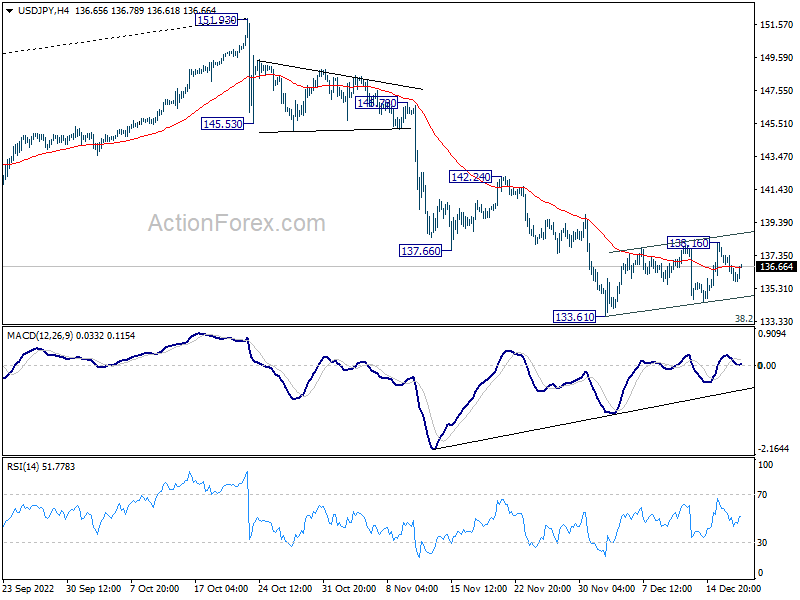
USD/JPY is staying in range below 138.16 temporary top and intraday bias stays neutral. On the upside, break of 138.16 will resume the rebound to 55 day EMA (now at 140.15). On the downside, however, firm break of 133.61 support and 133.07 medium term fibonacci level will confirm resumption of whole fall from 151.93.
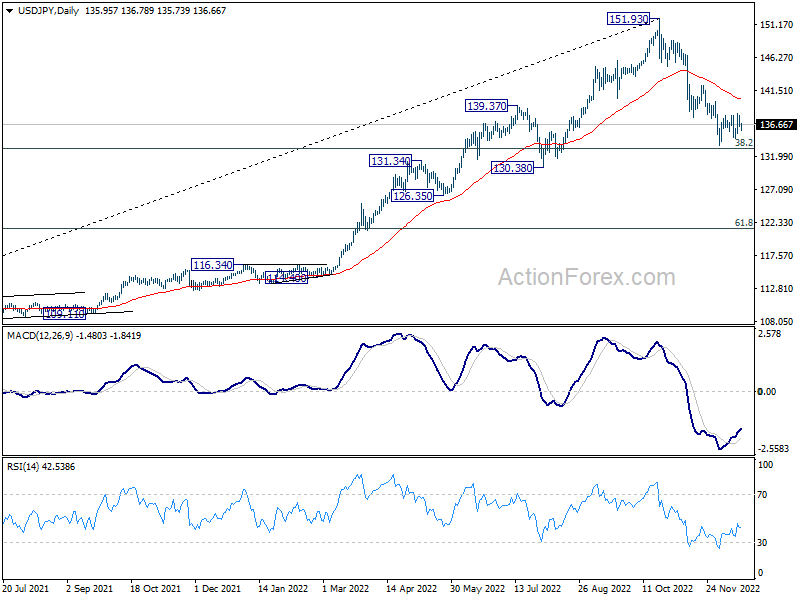
In the bigger picture, price actions from 151.93 medium term could be just a corrective pattern to up trend from 102.58 (2021 low). Strong support from 38.2% retracement of 102.58 to 151.93 at 133.07 and 55 week EMA (now at 131.85) will set the range for such corrective pattern. However, sustained break of 55 week EMA will pave the way to 61.8% retracement at 121.43.
Risk Sentiment Steady, Yen Range Bound ahead of BoJ
Overall risk sentiment is steady in the financial markets today. Aussie and Canadian Dollars are firming up slightly, while Dollar and Yen soften. The upcoming BoJ rate decision in Asia is unlikely to give Yen any special support. Euro was lifted briefly by better than expected Germany data, but buying didn't last long. European majors are generally mixed for now.
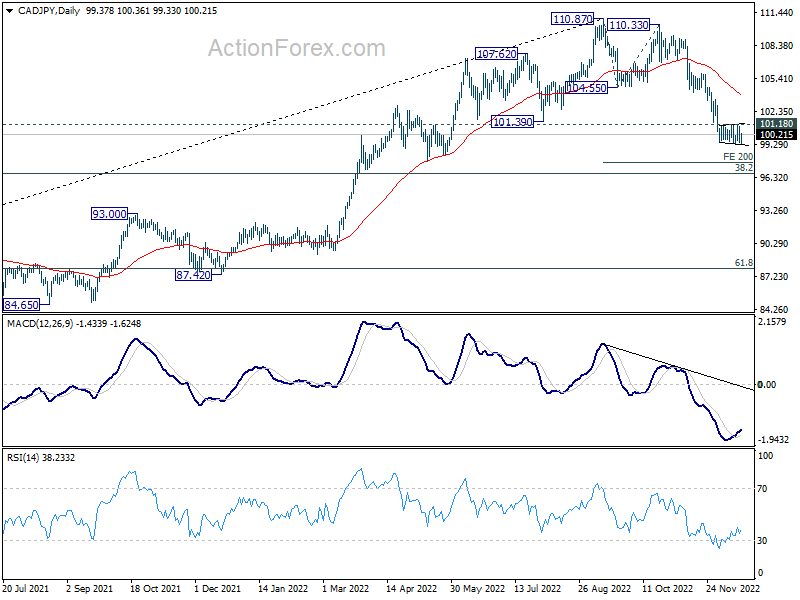
Technically, CAD/JPY is still bounded in consolidation pattern from 99.46, in form of an expanding triangle. While more sideway trading could be seen, outlook will stay bearish as long as 101.18 resistance holds. Further decline is expected expected to 200% projection of 110.87 to 104.55 from 110.33 at 97.69. But firm break of 101.18 will confirm short term bottoming and bring rebound.
In Europe, at the time of writing, FTSE is up 0.52%. DAX is up 0.42%. CAC is up 0.44%. Germany 10-year yield is up 0.064 at 2.217. Earlier in Asia, Nikkei dropped -1.05%. Hong Kong HSI dropped -0.50%. China Shanghai SSE dropped -1.92%. Singapore Strait Times rose 0.49%. Japan 10-year JGB yield dropped -0.0004 to 0.256.
Germany Ifo rose to 88.6, entering holiday with a sense of hope
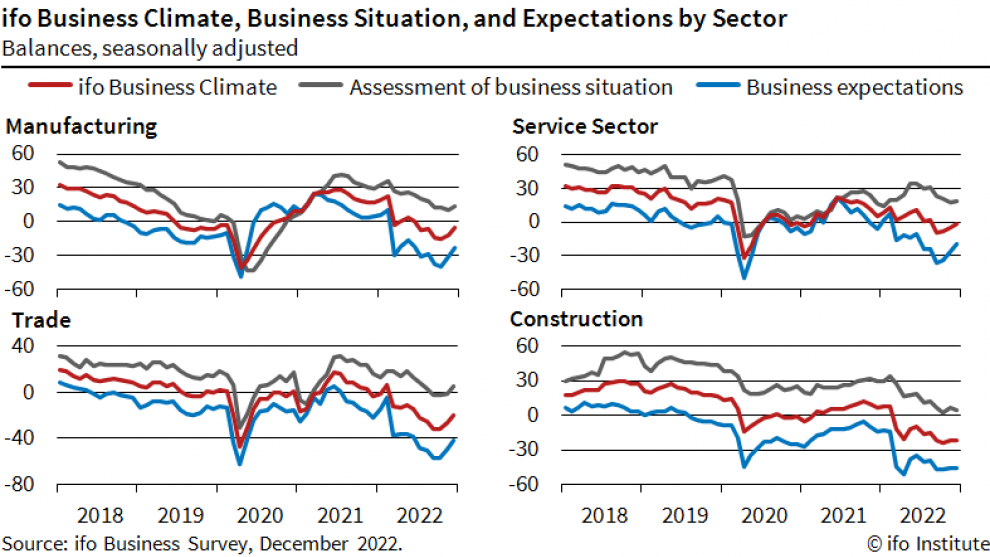
Germany Ifo Business Climate rose from 86.4 to 88.6 in December, above expectation of 87.2. Current Situation Index rose from 93.2 to 94.4, above expectation of 93.5. Expectations Index rose from 80.2 to 83.2, above expectation of 82.0.
By sector, manufacturing rose from -11.5 to -5.6. Services rose from -5.3 to -1.2. Trade rose from -26.9 to -20.0. Construction, however, dropped from -21.5 to -22.2.
Ifo said: "Sentiment in the German economy has brightened considerably. The ifo Business Climate Index rose to 88.6 points in December, up from 86.4 points (seasonally adjusted) in November. Companies assessed their current situation as better again. This comes on the heels of six consecutive falls in the indicator for the current situation. Expectations also improved noticeably. German business is entering the holiday season with a sense of hope."
ECB de Guindos: I absolutely honest don't know rate hikes will continue until when
ECB Vice-President Luis de Guindos said today, "there will be more interest rate hikes, until when, I don't know. I am absolutely honest, I don't know." He added that the central bank was committed to bring inflation down to its 2% target.
Separately, Governing Council member Gediminas Simkus said, "there will undoubtedly be a 50 bps increase in February."
NZ BNZ performance of services dropped to 53.7
New Zealand BusinessNZ Performance of Services Index declined from 57.1 to 53.7 in November, still above long-term average of 53.6. Looking at some details, activity/sales dropped from 61.0 to 58.1. Employment tumbled from 57.1 to 51.8. New orders/business declined from 59.6 to 57.3. Stocks/inventories fell from 56.1 to 55.0. Supplier deliveries fell from 52.0 to 47.3.
BusinessNZ chief executive Kirk Hope said: "With its sister survey the PMI again showing contraction in November and economic headwinds approaching, the easing of expansion in activity is not unexpected. Also, with the Global PSI result of 48.1 at a 29-month low, it will be a tall order for the New Zealand services sector to continue the overall trends experienced during the second half of 2022".
BNZ Senior Economist Craig Ebert said that "November's PSI proved, for the third month running, to be an important counterpoint to the weakening PMI. It looks as though the services industries – just like they did in Q3 – will more than make up for any weakness in manufacturing in Q4, such that GDP for that quarter manages an expansion".
USD/JPY Mid-Day Outlook
Daily Pivots: (S1) 136.07; (P) 136.97; (R1) 137.64; More...
USD/JPY is staying in range below 138.16 temporary top and intraday bias stays neutral. On the upside, break of 138.16 will resume the rebound to 55 day EMA (now at 140.15). On the downside, however, firm break of 133.61 support and 133.07 medium term fibonacci level will confirm resumption of whole fall from 151.93.
In the bigger picture, price actions from 151.93 medium term could be just a corrective pattern to up trend from 102.58 (2021 low). Strong support from 38.2% retracement of 102.58 to 151.93 at 133.07 and 55 week EMA (now at 131.85) will set the range for such corrective pattern. However, sustained break of 55 week EMA will pave the way to 61.8% retracement at 121.43.
Economic Indicators Update
| GMT | Ccy | Events | Actual | Forecast | Previous | Revised |
|---|---|---|---|---|---|---|
| 20:00 | NZD | Westpac Consumer Survey Q4 | 75.6 | 87.6 | ||
| 21:30 | NZD | Business NZ PSI Nov | 53.7 | 57.4 | ||
| 09:00 | EUR | Germany Ifo Business Climate Dec | 88.6 | 87.2 | 86.3 | |
| 09:00 | EUR | Germany Ifo Current Assessment Dec | 94.4 | 93.5 | 93.1 | |
| 09:00 | EUR | Germany Ifo Expectations Dec | 83.2 | 82 | 80 | |
| 13:30 | CAD | Industrial Product Price M/M Nov | -0.40% | 2.20% | 2.40% | |
| 13:30 | CAD | Raw Material Price Index Nov | -0.80% | 3.20% | 1.30% | |
| 15:00 | USD | NAHB Housing Market Index Dec | 34 | 33 |
USD/JPY Dips on Possible Policy Tweak
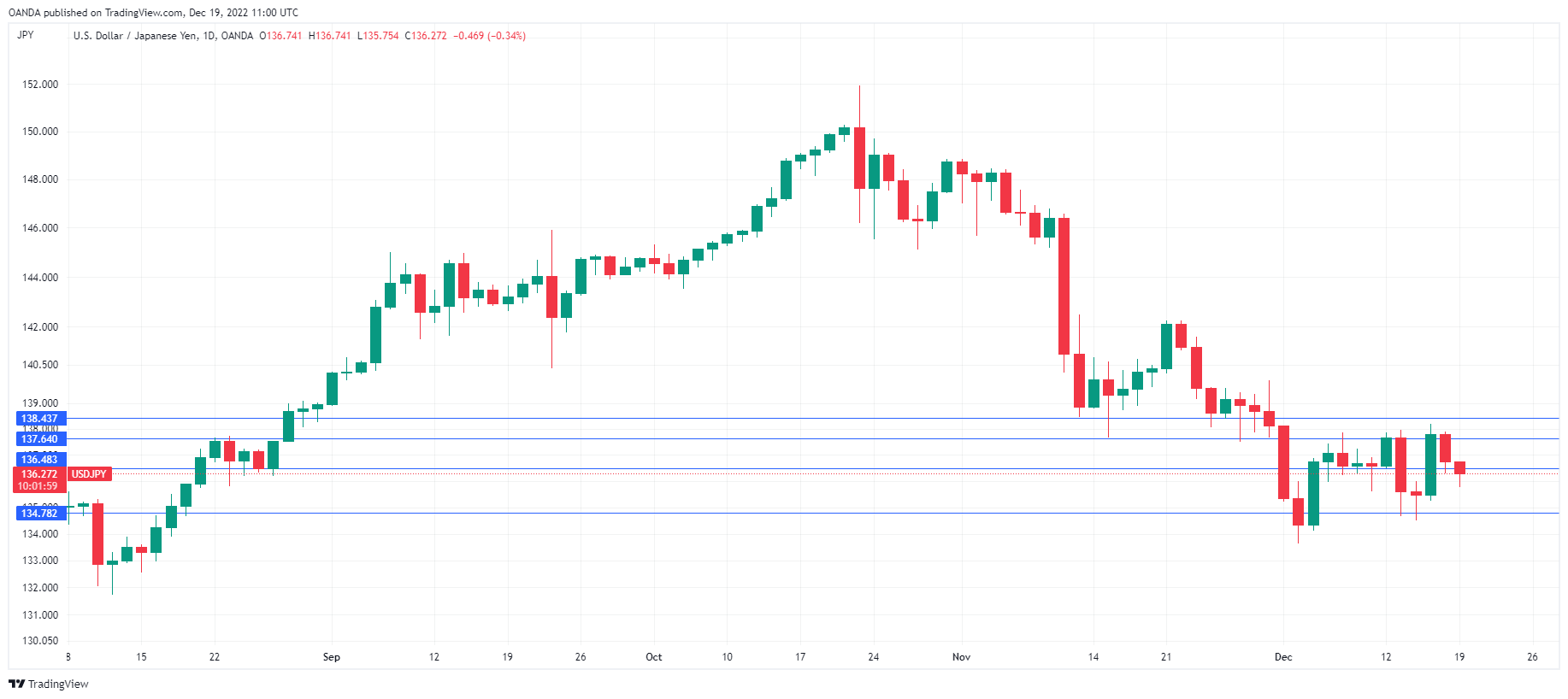
The Japanese yen has started the week in positive territory. In the European session, USD/JPY is trading at 136.22, down 0.38%. The yen is coming off a busy week, as USD/JPY traded in a 350-point range but closed the week almost unchanged.
Will Japan change its inflation stance?
The markets are keeping an eye on April 2023, when Bank of Japan Governor Kuroda retires and a new governor is appointed. This has raised speculation that the changing of the guard could lead to policy changes at the bank. There was a report today that the BoJ and the government could revise their decade-old statement, which pledges to achieve the 2% inflation target “at the earliest date possible”. This has resulted in the BoJ maintaining its radical stimulus programme and keeping interest rates ultra-low, at a time when other major central banks are busy raising rates in order to curb inflation.
This policy was initiated in 2013, when Japan’s economy was marked by deflation. With consumer prices rising and a weak yen contributing to inflation, the statement could be out of date and the new BoJ governor may feel the timing is right to revise the statement, perhaps making the inflation target more flexible. There is rising speculation that the new governor could tweak yield curve control, which has kept a cap on 10-year Japan’s government bonds and fueled the yen’s sharp descent this year. For now, however, it is likely to be business as usual – the BoJ winds up a two-day meeting on Tuesday and is not expected to make any changes to monetary policy.
USD/JPY Technical
- USD/JPY is testing support at 136.48. This is followed by support at 134.78
- There is resistance at 137.64 and 138.43
Euro Edges up as Business Climate Improves
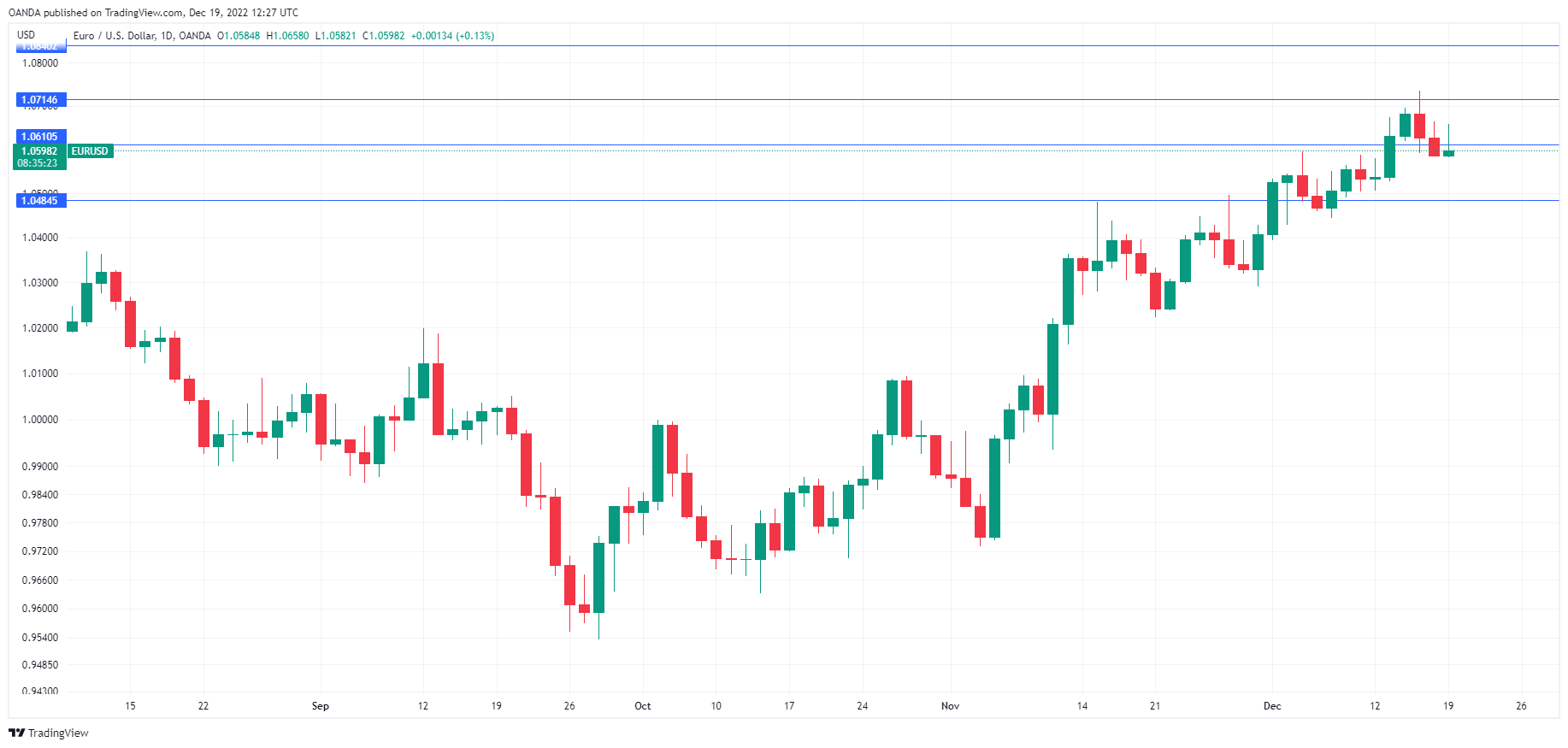
EUR/USD has edged higher on Monday. In the European session, EUR/USD is trading at 1.0610, up 0.24%.
The week started on a positive note as German business confidence climbed in December. The Ifo Business Climate index rose to 88.6, up from 86.4 in November and its highest level in five months.
Bundesbank revision – growth down, inflation up
The Bundesbank does not appear to share in the optimism. Its biannual economic forecast found that Germany’s economy will contract through the middle of 2023, and businesses and consumers will continue to be hit with high energy costs. The war in Ukraine has been weighing heavily on the German economy, and the Bundesbank’s latest economic projection sees a 0.5% decline in GDP in 2023, compared to a 2.4% gain in the June forecast. Inflation has been revised to 7.2% in 2023, up from 4.5% in June. The risk to economic growth has been tilted to the downside, due to possible shortages in energy supplies. As for inflation, the risk is tilted to the upside. The updated forecast mirrors the latest ECB projections for the eurozone, which raised inflation while lowering growth.
With the Bundesbank and the ECB projecting that inflation will accelerate, we can expect further rate hikes from the ECB, which delivered a 50-bp increase last week. The ECB rate statement said rates would have to “rise significantly” in order to curb inflation, and ECB President Lagarde said that the central bank could deliver up to three more rate hikes. Lagarde was hawkish, saying that the 50-bp hike, which came after two 75-bp hikes was not a pivot and that the ECB would not be slowing down.
EUR/USD Technical
- EUR/USD tested resistance at 1.0610 earlier today. Above, there is resistance at 1.0714
- 1.0610 and 1.0484 are providing support
Gold Price Started a Fresh Increase from $1,772
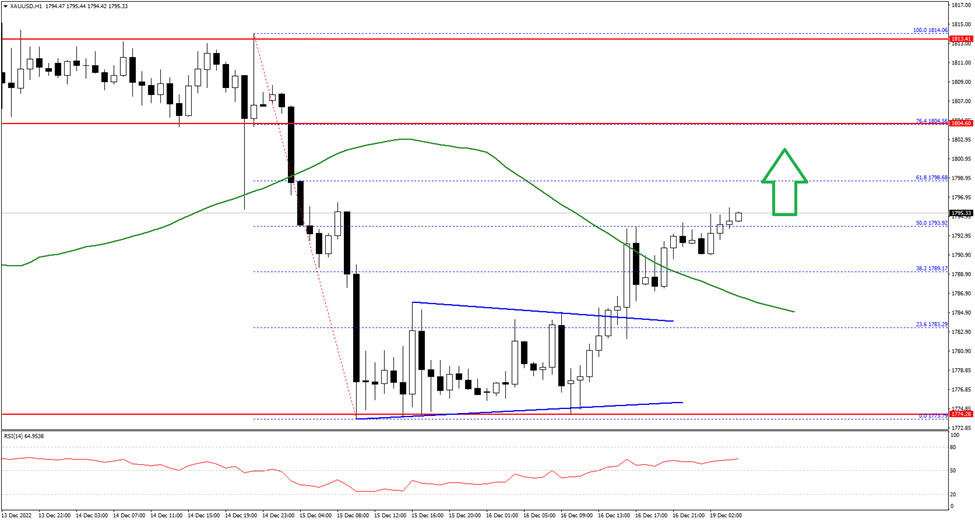
Gold price started a fresh increase from the $1,772 support zone against the US Dollar. The price gained pace above the $1,780 resistance to move into a positive zone.
The pair even climbed above the $1,790 resistance and settled well above the 50 hourly simple moving average. It is now showing positive signs above the 50% Fib retracement level of the downward move from the $1,814 high to $1,773 low.
On the upside, the first major resistance is near $1,800 on FXOpen. The next main resistance could be near the $1,805 level, above which the price could start a steady increase towards the $1,815 level.
On the downside, an immediate support is near the $1,788 level. The next major support is near the $1,785 level, below which the price might decline towards the $1,780 support level in the near term. Any more losses might call for a test of $1,772.
ECB de Guindos: I absolutely honest don’t know rate hikes will continue until when
ECB Vice-President Luis de Guindos said today, "there will be more interest rate hikes, until when, I don't know. I am absolutely honest, I don't know." He added that the central bank was committed to bring inflation down to its 2% target.
Separately, Governing Council member Gediminas Simkus said, "there will undoubtedly be a 50 bps increase in February."
Germany Ifo rose to 88.6, entering holiday with a sense of hope
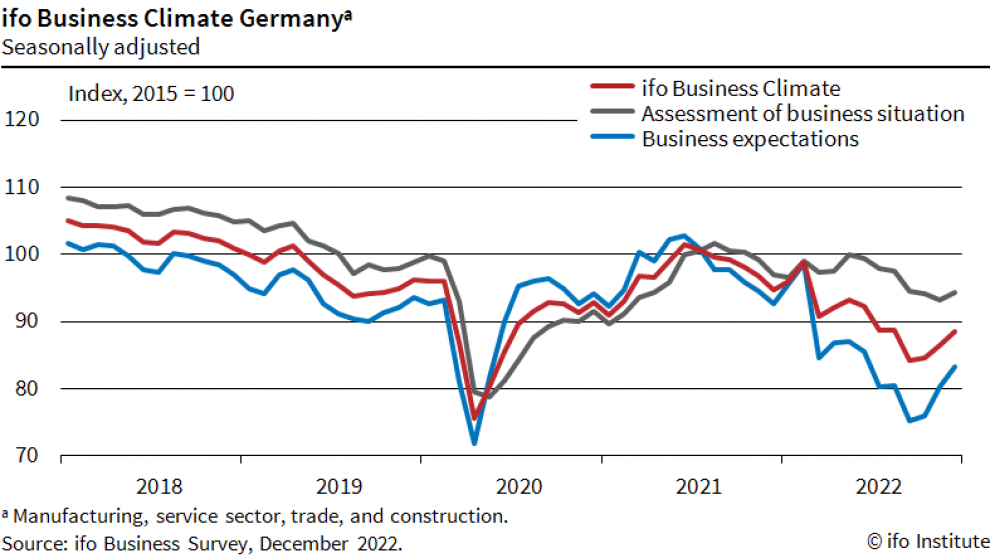
Germany Ifo Business Climate rose from 86.4 to 88.6 in December, above expectation of 87.2. Current Situation Index rose from 93.2 to 94.4, above expectation of 93.5. Expectations Index rose from 80.2 to 83.2, above expectation of 82.0.
By sector, manufacturing rose from -11.5 to -5.6. Services rose from -5.3 to -1.2. Trade rose from -26.9 to -20.0. Construction, however, dropped from -21.5 to -22.2.
Ifo said: "Sentiment in the German economy has brightened considerably. The ifo Business Climate Index rose to 88.6 points in December, up from 86.4 points (seasonally adjusted) in November. Companies assessed their current situation as better again. This comes on the heels of six consecutive falls in the indicator for the current situation. Expectations also improved noticeably. German business is entering the holiday season with a sense of hope."
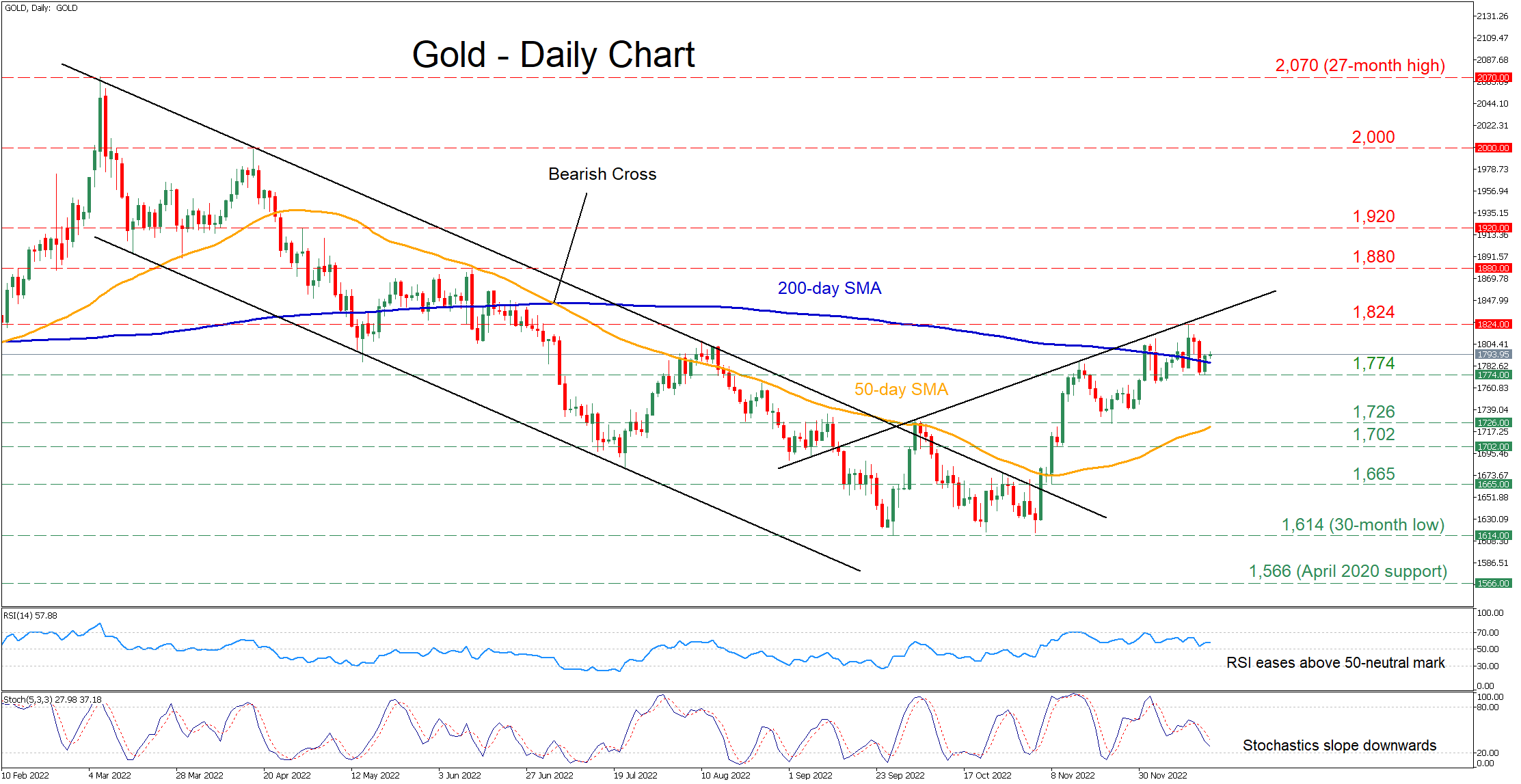
Gold Hovers Around 200-day SMA, Diverging Signals Arise
Gold had been trading within a descending channel for the most part of 2022 but managed to stage a moderate rebound since early November. Even though bullion has recovered significant ground, its recovery seems to be on hold as the price failed to profoundly surpass the 200-day simple moving average (SMA).
The fact that gold is stuck between opposing directional forces is also reinforced by the momentum indicators. Specifically, the RSI remains comfortably above its 50-neutral mark, while the stochastic oscillator is descending near the 20-oversold zone.
If sellers manage to seize control and push the price below its 200-day SMA, the recent low of 1,774 may act as the first line of defence. Breaking below that zone, the commodity could test the November support of 1,726, which lies very close to the 50-day SMA. Failing to halt there, the 1,702 barrier could prove to be a tough one for the price to violate.
Alternatively, bullish actions could propel the price towards the recent high of 1,824. If that level is breached, the bulls might aim for the June peak of 1,880. Even higher, the spotlight could turn to 1,920 before the crucial 2,000 psychological mark comes under examination.
Overall, gold’s recovery appears to be fading, while short-term oscillators fail to provide a clear directional signal. Hence, a clear break above or below the 200-day SMA could trigger a decisive move towards the same direction.