Sample Category Title
EUR/AUD Daily Outlook
Daily Pivots: (S1) 1.5269; (P) 1.5393; (R1) 1.5513; More...
Intraday bias in EUR/AUD stays neutral for the moment. Correction from 1.5704 could extend lower, but downside should contained by 55 day EMA (now at 1.5209) to bring rebound. On the upside, break of 1.5704 will resume the rally from 1.4281.
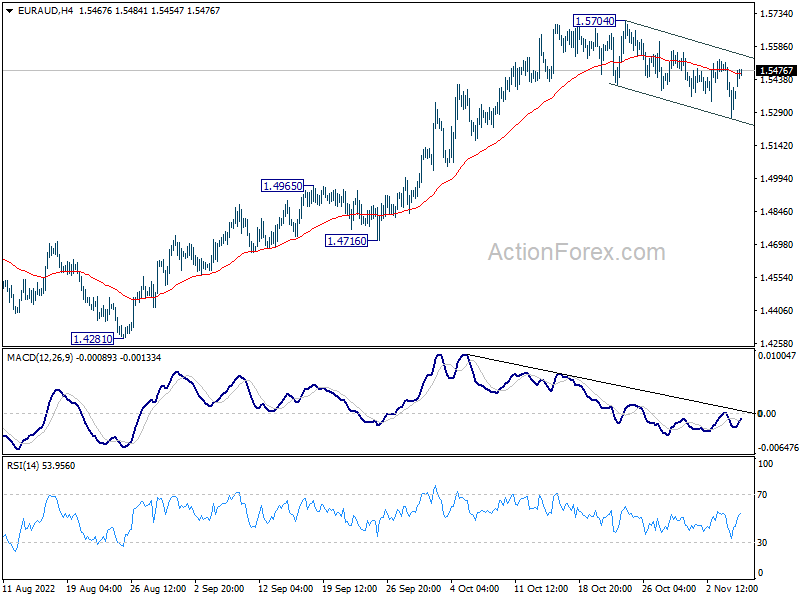
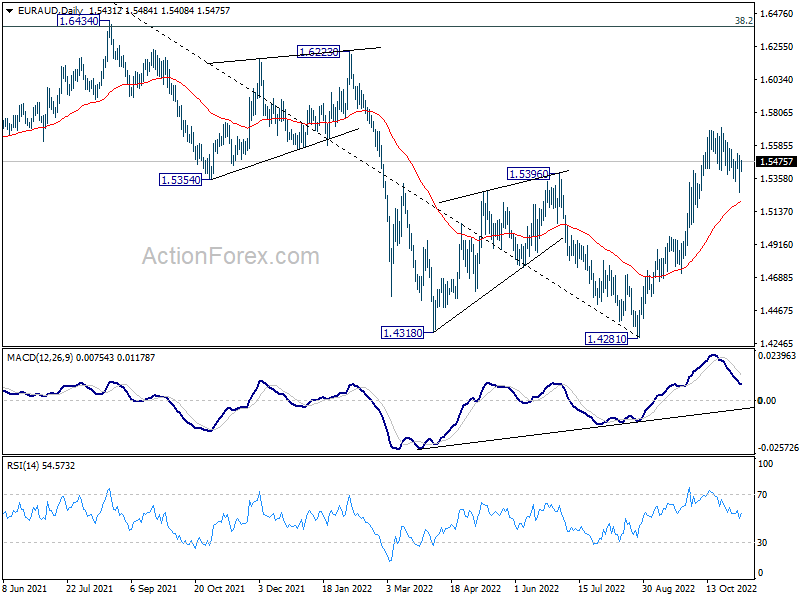
In the bigger picture, a medium term bottom should be in place at 1.4281, on bullish convergence condition in daily MACD. Further rise would be seen back to 1.6434 key resistance next. Break of 1.4965 resistance turned support is needed to indicate reversal. Otherwise, further rally will remain in favor.
EUR/CHF Daily Outlook
Daily Pivots: (S1) 0.9864; (P) 0.9885; (R1) 0.9922; More....
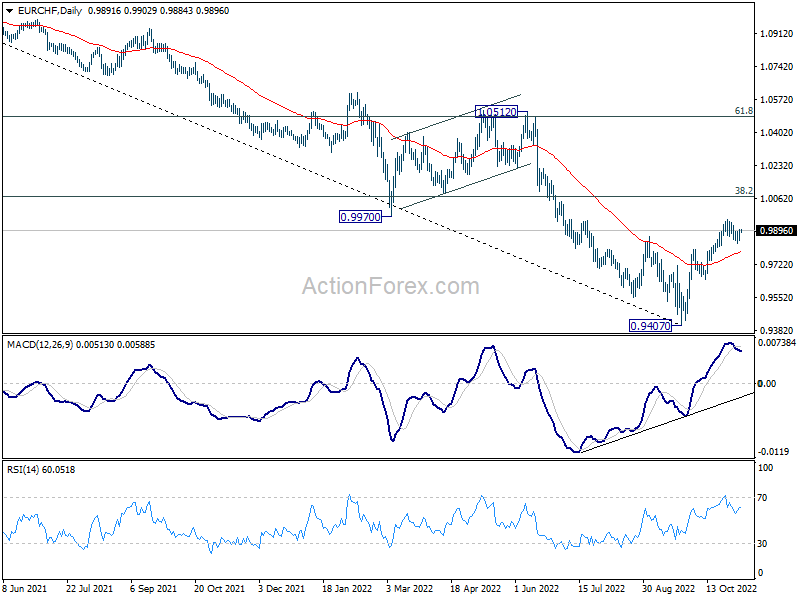
Intraday bias in EUR/CHF stays neutral for consolidation below 0.9953. Downside of retreat should be contained by 0.9798 resistance turned support to bring rebound. On the upside, break of 0.9953 will resume the rise from 0.9407 to 1.0072 fibonacci level.
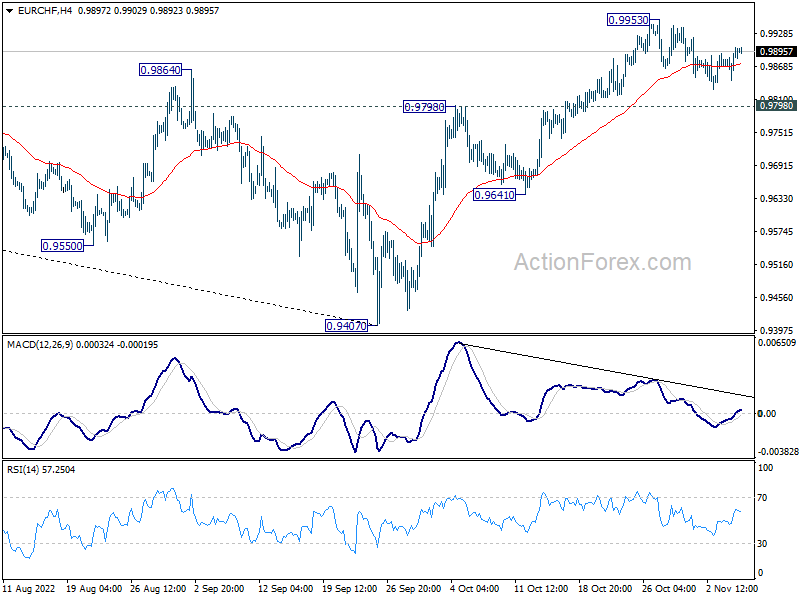
In the bigger picture, a medium term bottom should be in place at 0.9407. Further rally is expected as long as 0.9641 support holds, even as a corrective rebound. Next target 38.2% retracement of 1.1149 to 0.9407 at 1.0072. Reaction from there, as well as 55 week EMA (now at 1.0121) will reveal whether the trend is reversing.
Mixed Sentiment into US CPI and Midterms
Week starts with blurred sentiment on the back of mixed US jobs data, and soft Chinese trade figures.
Chinese exports and imports unexpectedly shrank in October; this was the first synchronized drop since May 2020. The strict Covid curbs in China, combined to rising global inflation and tightening monetary conditions hit both global and domestic demand. A far lower-than-expected trade surplus confirmed how Xi Jinping’s stubborn zero Covid fight is hurting the country’s economy.
And it’s not over. Despite optimism last week that the Covid measures could be wined down slowly to let people and the economy breath, the Chinese officials reiterated that they will ‘unswervingly’ stick to the Covid zero approach. Therefore, expect last week’s gains in Chinese stocks to be given back.
Nasdaq’s Golden China index jumped more than 30% since October dip, but the latest bullish action could simply be another flash in the pan. In fact, China is not expected to ease the Covid curbs at least until the end of this winter…
Then, let’s talk about what happened with the jobs data in the US last Friday
At the first glance, the data was strong, stronger-than-expected, but the market reaction was unexpectedly, surprisingly positive.
NFP printed that the US economy added 261’000 new nonfarm jobs in October versus 200’000 expected by analysts. The wages also grew more than expected last month, by 0.4%, versus 0.3% penciled.
Both data points were unideal for inflation and the Fed expectations, so you would’ve expected a panic selloff, rather than joyful rally in the market.
But the uptick in unemployment number - which rose to 3.7%, from 3.6% printed a month earlier, and the fact that 261’000 job additions was the slowest number since January this year - combined to all the layoff news which could ‘hopefully’ pull next month’s figure below 200’000 – triggered buying.
US equities first rally on the data, then give back gains as the hawkish Fed feelings came back in charge, but then the buyers came back in to lead to a 1.36% advance in the S&P500 before the closing bell. Nasdaq closed 1.56% higher, while the Dow Jones added 1.26%.
But overall, all three of them closed last week with losses. The Dow ended the week 1.4% down, S&P 500 3.4% down and Nasdaq 5.7% down – and the US futures are in the negative at the time of writing.
US midterms and inflation
Let’s admit… Joe Biden didn’t have an easy mandate. First the pandemic, and then the war in Ukraine, and the energy crisis, and the rising inflation, and the rising interest rates, the turmoil in financial markets, skyrocketing mortgage rates, gas prices… it has been a terrible mix for hoping to see a stunning support for these midterms.
Statistically speaking, markets have performed better in the six months following voting, than six months prior to it. The expectation for this week’s midterms is a divided government between the White House and Congress, that could, in return lead to more political impasse and tighter maneuver margin for policies, and a slower economic growth.
But historical data tells us that the stock markets performed better with a divided government in the years following a same party controlling the Senate, the House and the Presidency. This is what we hope will happen this time around, as there is not much juice left to be squeezed after the massive selloff we experienced so far this year in the stock markets, anyway.
On the economic data front, US inflation is expected to have eased from 8.2% to 8.0% in October, core inflation is seen down to 6.5% from 6.6% printed a month earlier.
Stronger-than-expected inflation data could send global stocks lower by the end of this week. Therefore, gains, if any, will likely be vulnerable to a potentially unpleasant US inflation data by Thursday.
And if the data is better than expected? Then, we could see a market rally. Investors are impatient to buy the dip at the current levels. Even if the data beats expectations slightly, it should be enough to send stocks higher.
October Jobs Report Sends Mixed Signals
Market movers today
This week is quiet in terms of data. Hence, focus will be on central bank speeches and on the US mid-term elections on Tuesday.
Today, we get German industrial production data for September. Consensus expects a moderate recovery at 0.2% m/m compared to -0.8% in August. We also have a few ECB speakers on the wires, most notably President Lagarde.
Later in the week, the US vote in the mid-term election on Tuesday. Republicans are favoured to win control of both house and senate, although the Senate race remains a close call. We expect quite a muted market reaction even in case the vote results in a divided Congress.
On Thursday, we will get US CPI for October where we are looking for another high print at 0.7% m/m and 8.0% y/y.
On Friday, we get the Q3 GDP print for UK which we expect to signal that Britain is already in a recession.
The 60 second overview
US Jobs Report: While the headline October NFP beat expectations (261k; Consensus 200k) and September figures were revised higher, markets focused more on the weaker household survey, which signalled a 328k decline in employment. Risk markets rallied, and EUR/USD moved higher back above 0.99. Despite the uptick in unemployment rate (to 3.7%), wage growth accelerated further (0.4% m/m, from 0.3%) and labour force participation declined, suggesting overall labour market conditions remain tight. Fed's Barkin and Evans highlighted later in the evening that even if slowing growth warrants moderating the pace of rate hike in December, the terminal rate level will likely be higher than expected in the September projections. We agree and stick to our call of Fed Funds rate reaching 5.00-5.25% in February.
China: Chinese markets rallied sharply on Friday following some rumours that China might be considering easing the strict Covid-policies. However on Sunday, the National Health Commission stated that: "Previous practices have proved that our prevention and control plans and a series of strategic measures are completely correct", dampening hopes of a rapid change. Overnight, the October trade data highlighted how Chinese economy is being hit by both weak domestic activity and the global slowdown, as both imports and export declined against expectations.
Equities: The equity rally lost its steam last week, but recouped some of its losses on Friday. Fed played both the good and the bad cop last week, with Powell guiding hawkishly (sending equities lower) but Fed speeches striking dovish tones (thereby lifting equities). While equities have done okay in this tug of war (S&P 500 -3% for the week), growth stocks have suffered. Growth underperformed value by 4 percentage points last week globally, which marks the worst 5-day session for growth this year. Equities generally higher on Friday, with S&P 500 closing up 1.4% led by cyclicals including materials, banks and tech stocks rising.
FI: A string of comments on Friday from various Federal Reserve officials suggest that the policy rate is likely to be higher than 5% in 2023 on the back of the solid U.S. labour market report on Friday. This week there will be more Fed speeches as well as the US inflation data released on Thursday.
FX: EUR/USD rallied on Friday, from the 0.97's towards the 0.99's. This seemed to be driven by US payrolls that showed an increase in US unemployment rates and thus implicitly that Fed might be closer to its end goal(s). Equally, speculation that China is ending its zero-Covid policy fuelled CNH, EUR and others.
Credit: Credit spreads as measured by CDS indices were slightly tighter on Friday, with iTraxx Europe tighter by 3bp to 110bp, while Crossover tightened by 16bp to 535bp.
Nordic macro
Sweden: This morning we get the monthly budget numbers from the Swedish National Debt Office. The SNDO forecasts a budget surplus of SEK14bn, which can be decomposed into a negative primary balance (SEK-19bn) that is compensated by large deposit inflows (SEK34bn), primarily related to Svenska Kraftnät capacity fees from the electricity market. Given that the SNDO forecast is just a couple of weeks old we would not expect to see any significant deviation.
ECB Villeroy: Hiking pace more flexible, possibly slower beyond neutral rate
ECB Governing Council member Francois Villeroy de Galhau said in an interview, "as long as underlying inflation has not clearly peaked, we shouldn't stop on rates,"
"It's too early to tell where the end point in interest rates, or the so-called terminal rate, could be," Villeroy said. "That said we are not far from the neutral rate, beyond which our hiking pace could be more flexible and possibly slower."
"We can raise interest rates without provoking significant unemployment," Villeroy said. "To determine the level of growth next year, energy is more important than monetary policy. Our aim is not to provoke a recession but to tame inflation."
EUR/USD Daily Outlook
Daily Pivots: (S1) 0.9812; (P) 0.9890; (R1) 1.0036; More...
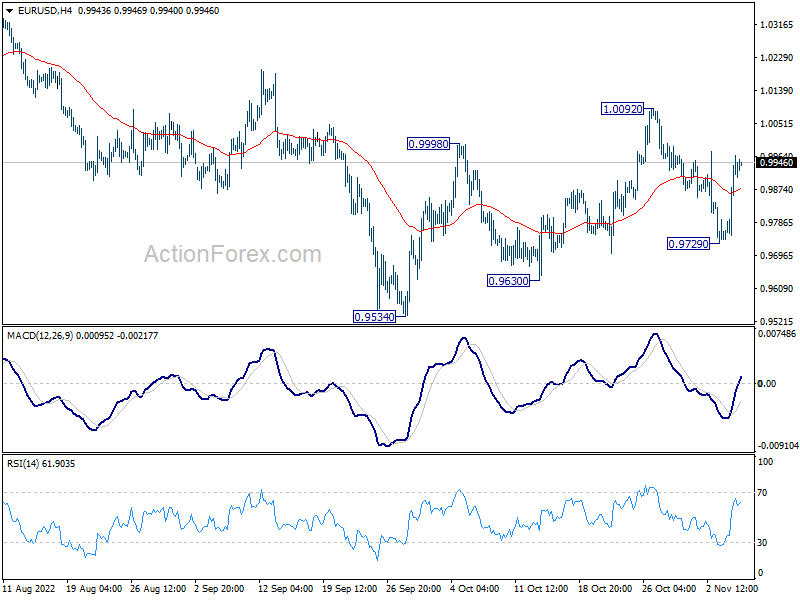
Intraday bias in EUR/USD remains neutral at this point. On the downside, break of 0.9729 will reaffirm the case the corrective rise from 0.9534 has completed at 1.0092. Deeper fall would then be seen to retest 0.9534 resistance next. However, break of 1.0092 will resume the rebound towards 1.0368 resistance instead.
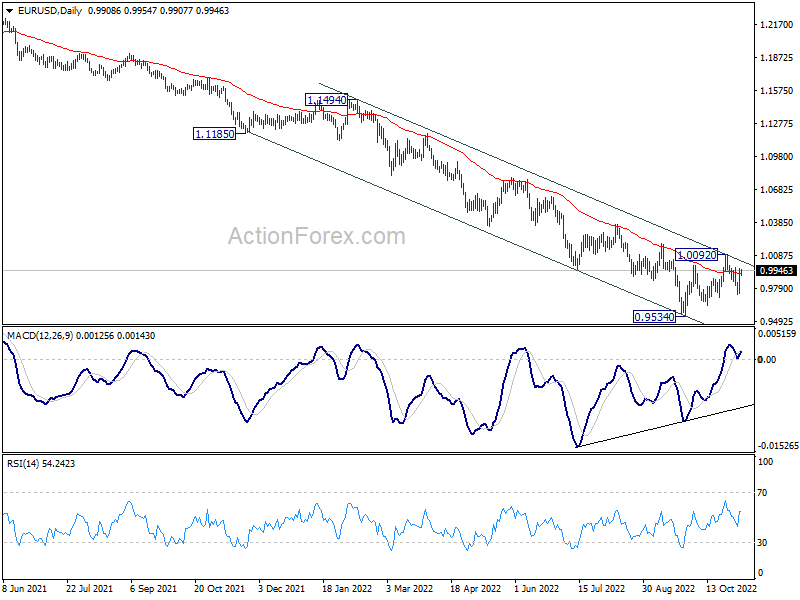
In the bigger picture, medium term outlook stays bearish with trading inside the falling channel. That is larger down trend from 1.2348 (2021 high) is still in progress. Firm break of 0.9534 low will confirm this bearish case. However, break of 1.0092 will add to the case of medium term bottoming, on bullish convergence condition in daily MACD, and bring further rally towards 55 week EMA (now at 1.0583).
USD/CHF Daily Outlook
Daily Pivots: (S1) 0.9868; (P) 1.0006; (R1) 1.0081; More...
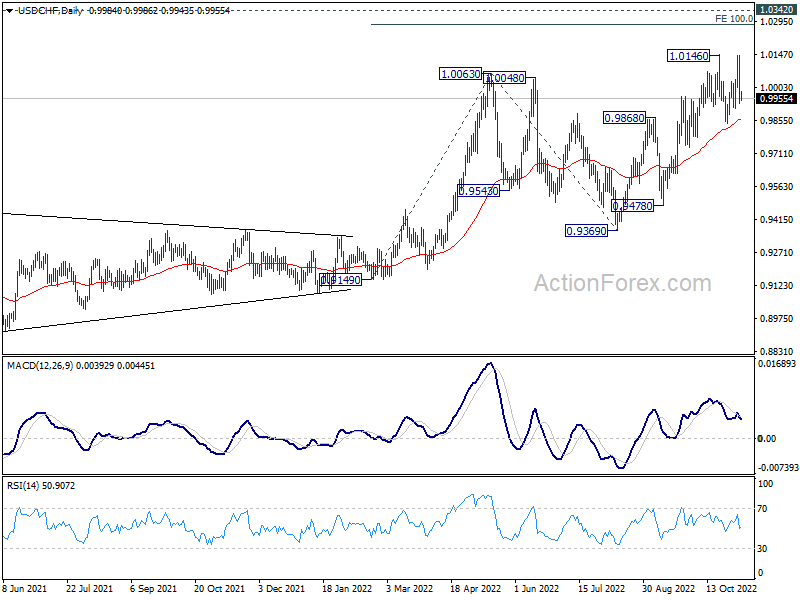
Intraday bias in USD/CHF remains neutral for the moment. Consolidation from 1.0146 could extend further, but further rally is expected as long as 0.9840 support holds. Break of 1.0146 will resume larger up trend to 1.0283 projection level. However, sustained break of 0.9840 will now complete a double top pattern, and turn bias back to the downside for 0.9478 support instead.
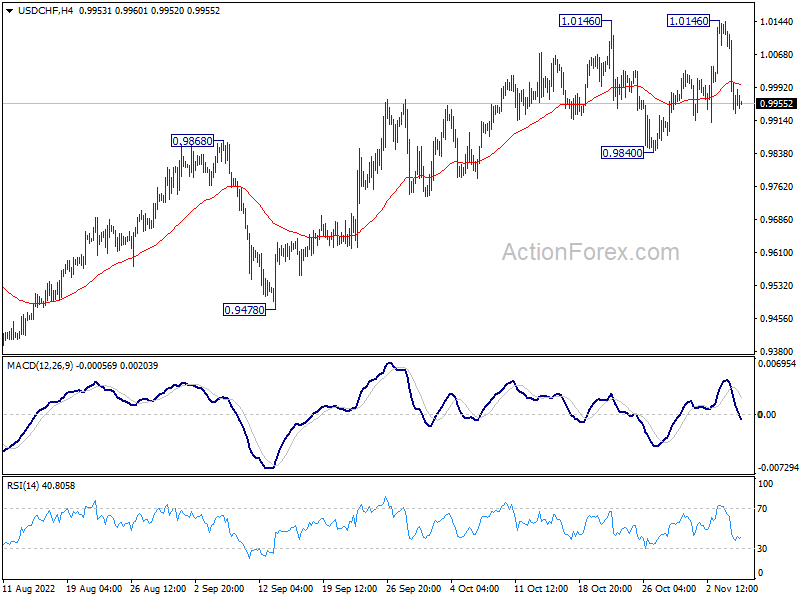
In the bigger picture, up trend from 0.8756 (2021 low) is still in progress. Next target is 100% projection of 0.9149 to 1.0063 from 0.9369 at 1.0283, and then 1.0342 (2016 high). For now, this will remain the favored case as long as 0.9779 support holds, even in case of deep pull back.
GBP/USD Daily Outlook
Daily Pivots: (S1) 1.1223; (P) 1.1302; (R1) 1.1455; More...
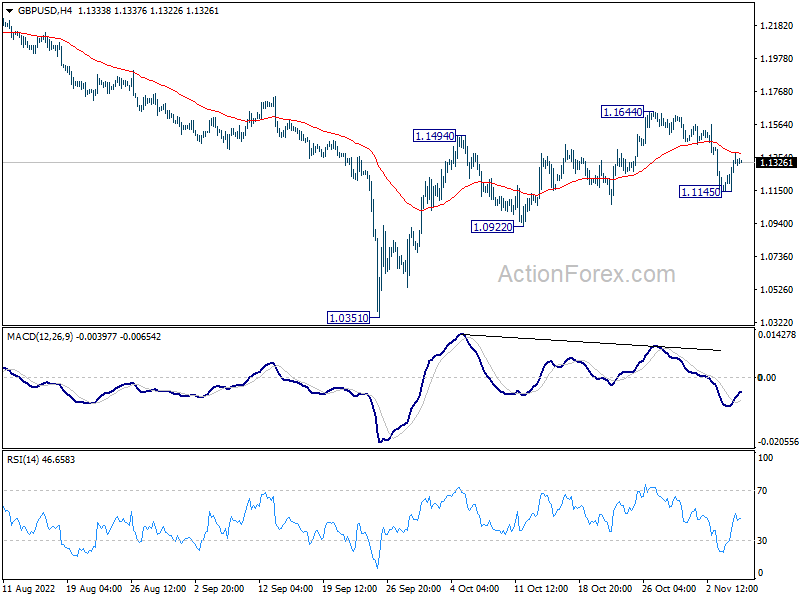
Intraday bias in GBP/USD remains neutral for the moment. On the downside, break of 1.1145 temporary low will reaffirm the case that corrective rise from 1.0351 has completed at 1.1644. Deeper fall would then be seen back to 1.0922 support and below. On the upside, break of 1.1644 resistance will resume the rise from 1.0351 instead.
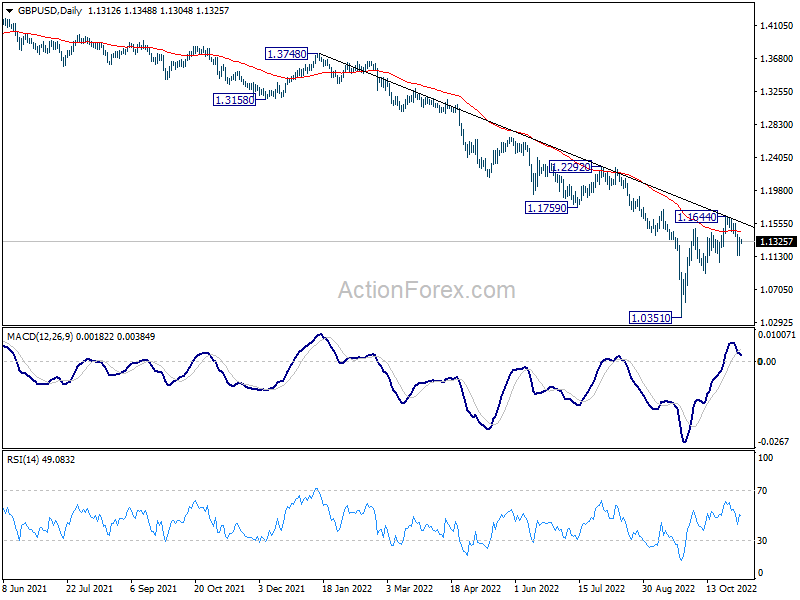
In the bigger picture, fall from 1.4248 (2018 high) is part of the long term down trend from 2.1161 (2007 high). Outlook will stay bearish as long as 1.1759 support turned resistance holds. Parity would be the next target on resumption. Nevertheless, firm break of 1.1759 will confirm medium term bottoming, and open up stronger rise back to 55 week EMA (now at 1.2357).
USD/JPY Daily Outlook
Daily Pivots: (S1) 146.02; (P) 147.21; (R1) 147.86; More...
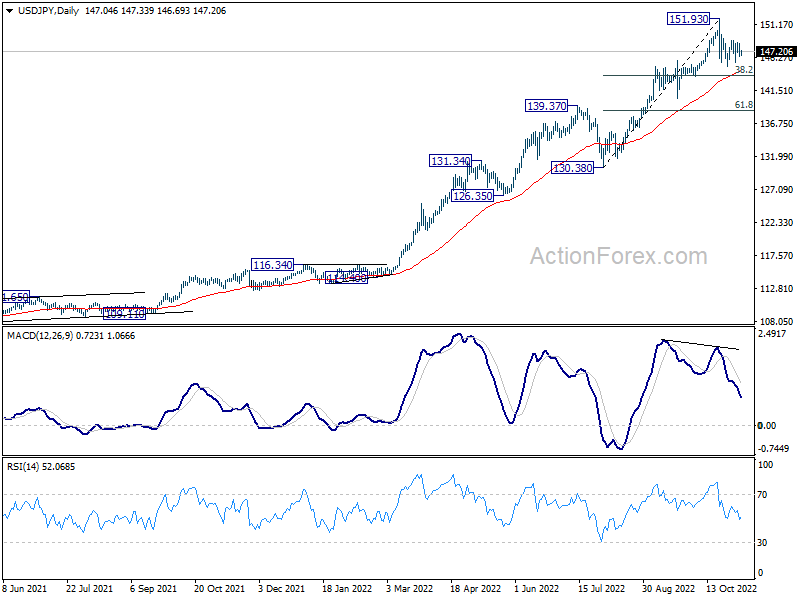
Intraday bias in USD/JPY stays neutral and outlook is unchanged. Consolidation from 151.93 should extend further. In case of deeper fall, downside should be contained by 38.2% retracement of 130.38 to 151.93 at 143.69 to bring rebound. On the upside, above 149.69 minor resistance will bring stronger rebound back towards 151.93 high. But upside should be limited there to continue the corrective pattern.
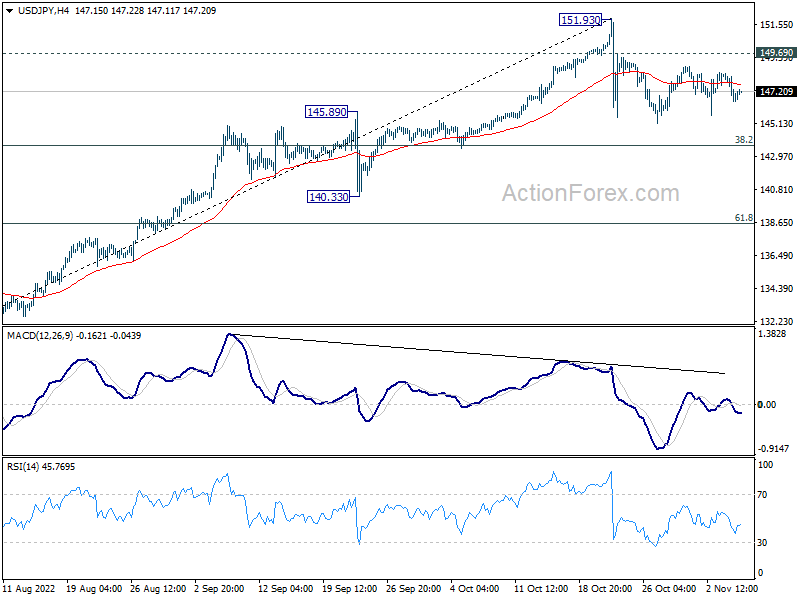
In the bigger picture, up trend from 101.18 is still in progress, as part of the whole up trend from 75.56 (2011 low). 147.68 (1998 high) was already met and there is no clearly sign of topping yet. In any case, break of 140.33 support is needed to be the first sign of medium term topping. Otherwise, further rise is in favor to next target at 160.16 (1990 high).
AUD/USD Daily Report
Daily Pivots: (S1) 0.6341; (P) 0.6412; (R1) 0.6539; More...
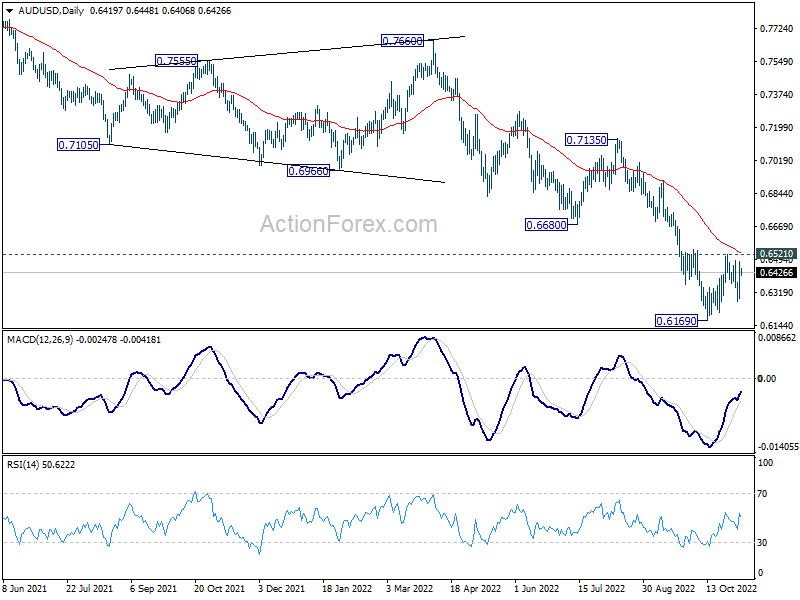
Intraday bias in AUD/USD remains neutral at this point. On the upside, decisive break of 0.6521 resistance will now complete a head and shoulder bottom pattern (ls: 0.6362; h: 0.6169; rs: 0.6271). That would also come with sustained trading above 55 day EMA (now at 0.6529). Further rally should then be seen to 0.6680/7315 resistance zone next. On the downside, however, break of 0.6271 will bring retest of 0.6169 low instead.
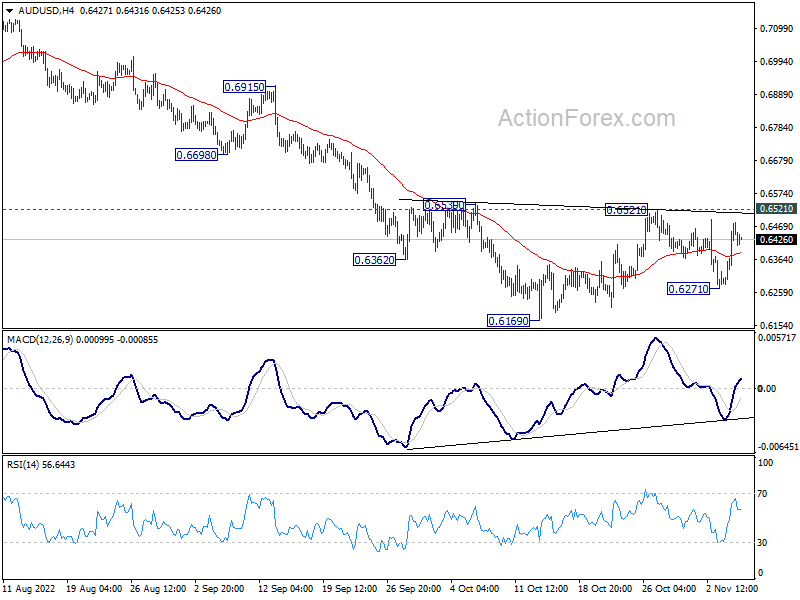
In the bigger picture, down trend from 0.8006 (2021 high) is expected to continue as long as 0.6680 support turned resistance holds. Medium term momentum remains strong and retest of 0.5506 (2020 low) cannot be ruled out. But firm break of 0.6680 will be the first sign of reversal, and bring stronger rebound back to 0.7135 resistance.