

Sample Category Title
Japan’s CPI core falls to 2.4% with sharp energy drag, limited core-core cooling
Japan’s December CPI report showed sharp moderation in headline inflation, largely reflecting energy relief rather than broad-based disinflation. Headline CPI slowed to 2.1% yoy from 2.9%, the weakest pace since early 2022. Core CPI (ex-fresh food) fell from 3.0% to 2.4%, helped by government measures to stabilize gasoline prices.
However, the decline was far less pronounced beneath the surface. Core-core CPI (ex-fresh food and energy) edged down just 0.1pp to 2.9% yoy, highlighting the stickiness of domestic inflation. Food prices excluding fresh items remained elevated at 6.7% yoy, though the pace eased slightly from 7.0%. Rice prices were still up 34.4%, even as inflation in the staple continued to cool gradually from prior peaks.
Energy prices were the key drag, reversing into a -3.1% yoy decline as gasoline prices fell -7.1%, reflecting higher subsidies and preparation for a gasoline tax cut late in the month. While these policy measures are temporarily easing inflation readings, the modest pullback in core-core CPI suggests underlying price pressures remain too firm to ignore.
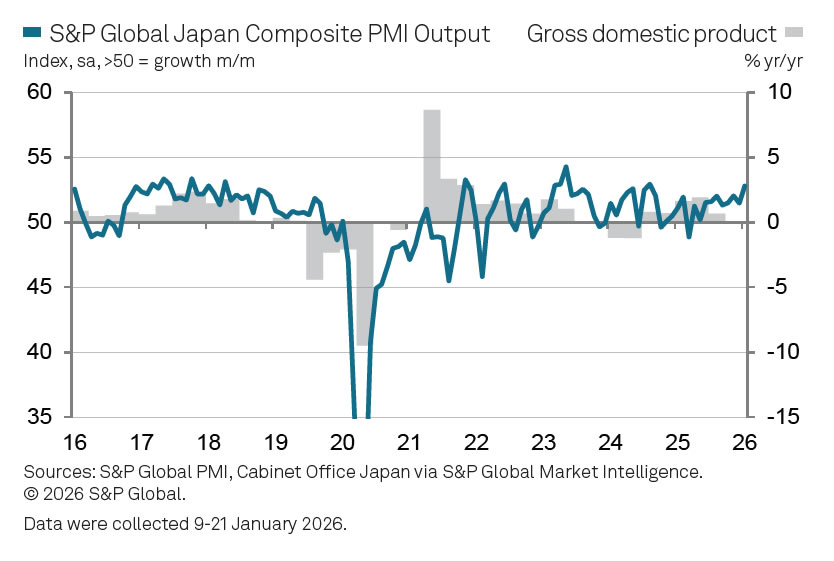
Japan PMI composite jumps to 52.8, manufacturing returns to growth
Japan’s January PMI readings delivered an upbeat signal, indicating a broadening recovery across the private sector, with PMI data pointing to the strongest expansion in 17 months. Manufacturing PMI rose from 50.0 to 51.1, returning to expansion. Services PMI jumped from 51.6 to 53.4. As a result, Composite PMI climbed from 51.1 to 52.8, signaling broad-based growth momentum.
According to Annabel Fiddes of S&P Global Market Intelligence, the data show a "solid start" to the year, supported primarily by accelerating services activity. Also, manufacturing output rose for the first time since June 2025, marking an important shift after a prolonged period of weakness.
The improvement was reinforced by the first increase in manufactured goods sales in more than three-and-a-half years, alongside rise in new export orders for the first time since early 2022.
However, business optimism weakened, reflecting concerns over rising costs, global uncertainty, labour shortages, and Japan’s ageing population, suggesting growth momentum may face headwinds later in the year.
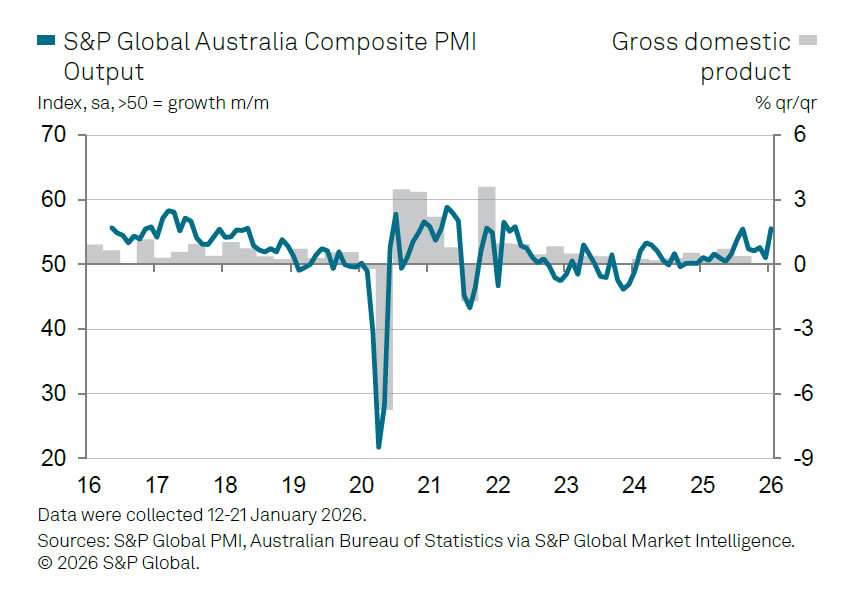
Australia PMI composite surges to 55.0, manufacturing and services in solid expansion
Australia’s business activity accelerated sharply in January, pointing to a strong start to 2026. PMI Manufacturing rose from 51.6 to 52.4, while PMI Services surged from 51.1 to 56.0. As a result, PMI Composite jumped from 51.0 to 55.0, marking the joint-highest level since April 2022 and signaling a broad-based expansion.
According to Jingyi Pan of S&P Global Market Intelligence, the flash PMI data show that growth has become "more balanced", with "solid expansions evident across both manufacturing and services". The readings reflect resilient domestic demand and improving momentum entering the new year.
That said, forward-looking indicators were mixed. Faster new order growth contrasted with declining business confidence, particularly among service providers.
While output price inflation eased, driven by softer service-sector charges, rising manufacturing input costs remain a risk factor, suggesting inflation pressures could re-intensify later in the quarter.
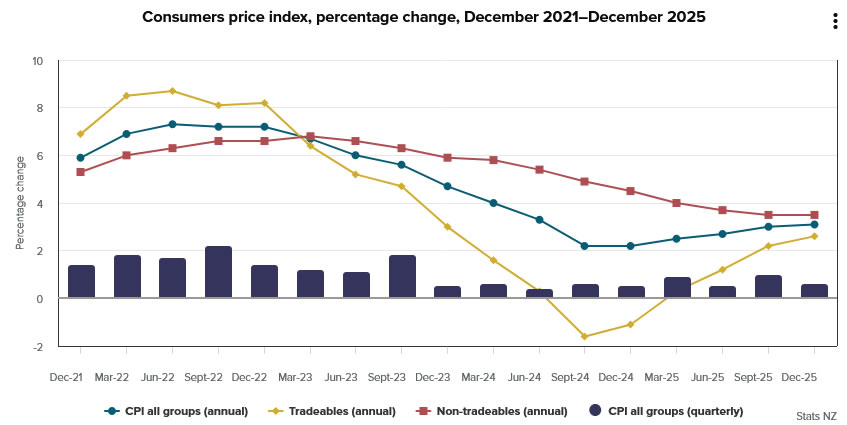
NZ CPI pushes above target as RBNZ Breman’s tone shifts
New Zealand inflation accelerated again. Headline CPI rose 3.1% yoy, up from 3.0% and above expectations of 3.0%, pushing inflation back above the RBNZ’s 1–3% target band. It marked the highest annual rate since Q2 2024.
The composition of inflation showed renewed pressure from tradeable prices. Tradeable CPI jumped from 2.2% yoy to 2.6% yoy, while non-tradeable CPI held steady at 3.5% yoy.
On a quarterly basis, CPI rose 0.6% q/q, exceeding expectations of 0.5%, with both tradeable (0.7% qoq) and non-tradeable (0.6% qoq) components contributing.
Notably, RBNZ Governor Anna Breman struck a firmer in a Bloomberg interview, pledging that policymakers will ensure inflation returns to the midpoint of the target band. She declined to push back against market pricing for a rate hike, saying policy decisions would be based on a "holistic view" of incoming data at the February meeting—marking a clear shift from her more neutral comments earlier this month.
Gold Spikes Past $4,950 as Risk Appetite Struggles to Return
It took the US president a single minute to flip sentiment from fear to greed. That came during Wednesday’s Davos speech, when he said he is not considering military action to take Greenland by force — even though he could (!) — and that discussions with NATO allies on Greenland had led to a framework that justified rolling back the latest tariffs imposed on a handful of European countries.
A relief rally followed, BUT didn’t last long. As we enter the second year of the Trump administration, it is increasingly clear — even for those who still had doubts — that US deals and agreements offer little guarantee of stability. New tariffs could be announced at any time, and they could be as ambitious as US objectives themselves — regardless of whether they make sense, are legal, or are accepted by the rest of the world.
This broader understanding of risk likely cast a shadow over yesterday’s relief rally. The S&P 500 gained, but by less than 1% on Thursday, and remains below its weekly opening level. The same is true for the Nasdaq 100.
Gold spiked past $4950 per ounce this morning. It looks like we’ll be hitting the $5000 before we thought! That move is a clear sign that the risk appetite is not fully restored!
Within tech, Nvidia also failed to meaningfully extend gains on Thursday. Appetite above the 50-day moving average — currently just below $185 per share — remains limited. Even CEO Jensen Huang’s comments that AI adoption will require several more trillions of dollars in investment, and reports that OpenAI’s Sam Altman is seeking $50bn in Middle Eastern funding — some of which would ultimately flow to Nvidia as a GPU supplier — failed to whet investor appetite.
Fresh news is instead boosting appetite in what used to be considered “boring tech”: memory chip makers — companies few investors could even name until the last quarter of last year. These are the stocks attracting inflows right now. And how! SanDisk, for example, is up more than 1’000% since last August; Western Digital has gained more than 250%, while Micron — which has made a few headlines — is up around 245% over the same period. The rally reflects a memory chip shortage that is being exacerbated by the soaring demands of AI infrastructure. And while the memory chip market is historically defined by boom-and-bust cycles, there is growing consensus that this time a structural shift is underway, meaning the current upswing could prove longer — and more memorable — than previous ones.
Looking deeper, however, such sharp price gains have pushed valuations to extremes. SanDisk now trades on a PE ratio of around 720 — meaning investors are paying 720 times current earnings. While this multiple should compress as demand explodes and pricing power lifts revenues and profits significantly, a ratio of this magnitude still places the stock firmly in bubble territory. Memory chip manufacturing remains capital-intensive, capacity constraints persist and while pricing power is clearly the main upside, and a longer-lasting cycle may justify higher forward valuations, current levels leave no room for disappointment. After such a powerful rally, a pullback would not be surprising. Samsung for comparison trades at a PE ratio of around 32, after an impressive rally as well. And SK Hynix’s PE ratio is less than 15. Just saying.
One final point on the sector. Intel — which jumped 11% on Wednesday amid the Greenland-driven relief rally — fell roughly 11% in after-hours trading yesterday after disappointing earnings. The company reported a net loss of $600m, or 12 cents per diluted share, compared with a $100m loss, or 3 cents per share, a year earlier. To make matters worse, Intel delivered soft guidance for the current quarter, citing insufficient supply to meet seasonal demand, though it expects conditions to improve in the second quarter. There remains hope that Intel will eventually benefit from the AI investment wave — but when?
Zooming out, the surge in AI investment continues to underpin strong US growth. According to the latest GDP update released yesterday, the US economy expanded by 4.4% in Q3 last year, up from 3.8% the previous quarter and above the 4.3% Bloomberg consensus. Price pressures picked up as well, with core PCE inflation rising from 2.6% to 2.9%, in line with expectations. While the Federal Reserve (Fed) has been out of focus recently, strong growth and above-target inflation have sharply reduced the probability of near-term rate cuts. Fed funds futures now imply just a 16% chance of a March cut, down from around 50% at the start of the year. The US 2-year yield pushed above 3.60% for the first time in more than six weeks, while the 10-year yield stabilized after dipping to around 4.25%.
Elsewhere, stress in Japanese government bond markets, sparked by Sanae Takaichi’s expansive fiscal ambitions, appears to be easing as a hectic week draws to a close. Still, her proposals — including suspending the consumption tax on food for two years as part of a campaign platform ahead of a snap general election — are difficult to square with Japan’s public debt, which sits near 215% of GDP. The measure alone would cost roughly ¥5 trillion per year (around $30bn), and crucially, no clear financing plan has been outlined! Does this remind you of another lady? And all this is happening at the same time, the Bank of Japan (BoJ) is willing to normalize policy and is no longer absorbing bonds at the pace it once did.
Why does this matter? Because Japanese investors are among the largest holders of US Treasuries. As yield differentials between the US and Japan narrow, incentives to repatriate capital increase — potentially draining global liquidity and triggering broader market sell-offs. This risk surfaced several times last year without fully materialising, likely thanks to ample global liquidity. The open question is for how long that buffer can last.
Time will tell.
Euro Area PMIs Cap an Eventful Week for Markets
In focus today
In the euro area, flash PMIs for January are set for release. In December, both services and manufacturing PMIs declined but from levels that still suggest quite modest growth in the final quarter of the year. We expect that growth momentum continued into January, with PMIs little changed compared to December, aligning closely with consensus. Specifically, we forecast the PMI composite to come in at 51.6 (cons: 51.8, prior: 51.5), PMI manufacturing at 49.0 (cons: 49.1, prior: 48.8), and PMI services at 52.4 (cons: 52.6, prior: 52.4).
In Sweden, focus turns to the Labour Force Survey (LFS) unemployment figures for December and the fourth quarter. Indicators for the labour market have shown clear signs of improvement, but the official LFS data is lagging. Unemployment, as measured by Sweden's public unemployment agency, has improved, as well as indicators for labour demand. However, our assessment is that the Public Employment Service's statistics are once again leading the way for the LFS, just as they did after the pandemic. Our forecast for the LFS unemployment is 8.7% SA and 8.2% NSA.
Economic and market news
What happened overnight
In Japan, as widely expected, the Bank of Japan kept the overnight call rate at 0.75% following the recent hike in December. The new outlook report reveals a hawkish bias, as the central bank has revised its core inflation expectations somewhat higher across the forecast horizon running until 2027. The market reaction has been very muted. Further fiscal stimulus looks inevitable, as election campaigns have been kicked off with VAT cut promises from all major players. This has propelled Japanese government bonds higher at fast pace, and a still weaker yen is threatening to exacerbate inflation problems. Overnight data shows December core inflation declined slightly to 2.9%, while PMIs indicate a strong start to the year in both service and manufacturing, bringing composite PMI to 52.8 in January, the highest level in 17 months. We will listen in to the press conference later this morning for potential more hawkish tunes.
What happened yesterday
In the euro area, the ECB minutes from the December meeting revealed no major new insights, with most members viewing inflation risks as two-sided. Overall, while the ECB is in a solid position from a monetary policy perspective, the stance was not considered static. The softening of downside risks since September supports the view that maintaining current interest rates represented a solid path under the baseline outlook. An extended period of steady rates appears likely, assuming December inflation projections for both headline and core figures materialise.
Additionally, January consumer confidence improved more than expected to -12.4 (cons: -13.0, prior: -13.2). While the improvement is encouraging for the economic outlook, as consumption is expected to drive growth this year, the historically low level calls for caution in overinterpreting this trend.
In Norway, Norges Bank's interim meeting unfolded as expected, with the policy rate remaining unchanged at 4.00% and no new signals on future policy direction. We still expect the third 25bp rate cut to come in June and pencil in four quarterly cuts from June 2026 to March 2027. The market reaction upon announcement was non-existent.
In Denmark, consumer confidence rose for the second consecutive month in January to -13.4 from -17.3, marking the highest level in a year. The improvement was driven by better perceptions of personal finances and a more optimistic view of the national economy. This progress is surprising given recent concerns over Trump's interest in Greenland, which caused significant economic worry a year ago. However, confidence remains negative, with expectations of worsening personal and national finances over the coming year.
In the Ukraine war, President Zelenskiy announced after 'positive' talks with President Trump in Davos that security guarantees for Ukraine have been finalised. However, the critical territorial dispute with Russia remains unresolved - a key point for Kremlin. Diplomatic efforts continue with upcoming trilateral peace talks in Abu Dhabi today and Saturday.
In the Greenland debate, no significant new details surfaced about the NATO-brokered framework that led to Trump's U-turn on Wednesday. At an extraordinary summit, EU leaders stressed 'respect' in transatlantic relations, with Denmark reiterating Greenland's sovereignty as a red line. However, they voiced concerns over Europe's reliance on the US and the broader implications of the deal.
Equities: Global equities moved higher yesterday across regions and sectors, led by cyclicals in what still looks like a geopolitical relief trade. Notably, small caps once again outperformed large caps. Year-to-date, small caps are now roughly 6% ahead of large caps after just the first three weeks of the year. Worth highlighting that this comes in a week when equities overall are still marginally lower, yet small caps stand out as the best-performing style. There is a strong underlying signal in the ongoing rotations, across sectors, regions, and particularly in style allocation preferences. In the US yesterday, Dow +0.6%, S&P 500 +0.6%, Nasdaq +0.9%, Russell 2000 +0.8%. This morning, Asian equities are higher. European futures are marginally lower, while US futures are marginally higher.
FI and FX: As we enter the final session of an eventful week the "Sell US"-theme has gotten increased traction with general EM, Scandies and Antipodeans being the clear winners while the greenback has continued to trade on the backfoot. EUR/USD has decoupled from short-end rate spreads and is on track for its best week since August. The JPY has also had a rough week amid focus on the upcoming elections, the likelihood of considerably more expansionary fiscal policy and subsequently higher yields. This morning Bank of Japan stayed put but lifted its inflation forecast underpinning expectations that the central bank is far from done in its hiking cycle. The general underperformance of Japanese fixed income has also impacted global markets this week with Japanese investor flight weighing on long duration portfolios. Finally, precious metals continue to rally while European natural gas prices have hit the highest level in almost a year amid cold weather and market concerns as to the potential geopolitical vulnerability of US LNG exports.
Chart Alert: Gold (XAU/USD) Eyeing $5,000 and Beyond as Bullish Acceleration Intact
Key takeaways
- Gold’s bullish acceleration remains intact: XAU/USD has broken above key supports, hit new all-time highs near US$4,970, and is now eyeing the US$5,000–5,150 zone, with momentum indicators confirming upside continuation.
- Geopolitics are the dominant macro driver: Rising US–NATO tensions and “sell America/de-dollarization” narratives are lifting geopolitical risk premiums, reinforcing gold’s role as a preferred safe haven.
- Technical structure supports further upside: A breakout from a medium-term ascending channel, strong RSI/MACD signals, and support holding above US$4,775 keep the near-term bias skewed toward further gains unless that level fails.
The precious yellow metal has staged the expected bullish impulsive up move sequence above the highlighted US$4,512 short-term pivotal support and hit the short-term intermediate resistance of US$4,780 (printed a new intraday all-time high of US$4,967 on Friday, 23 January 2026 at the time of writing).
Rising geopolitical risk premiums due to expansionary US foreign policy
The recent rise in Gold (XAU/USD) from last Friday, 16 January 2026 swing low of US$4,536 has been reinforced by the “sell America/de-dollarization/debasement” narrative due to the current US expansionary and aggressive foreign policy, where US President Trump threatened long-time NATO allies of the US over the control of Greenland.
The escalating confrontation between the US and NATO members signals a potential rupture in the post–World War II global order, with Washington increasingly perceived as stepping away from its traditional role as a responsible anchor of the rules-based, consensus-driven system.
As a result, global asset allocators that have heavily overweighted US assets over the past two decades may begin to reassess and trim such exposures amid rising geopolitical risk premiums. This repricing dynamic is reinforcing a positive feedback loop for gold (XAU/USD), as demand for safe-haven assets accelerates in response to an increasingly fragmented and unpredictable geopolitical landscape.
Let us now decipher the latest short-term (1 to 3 days) trend trajectory of Gold (XAU/USD) from a technical analysis perspective
Short-term trend (1 to 3 days): Bullish acceleration extends
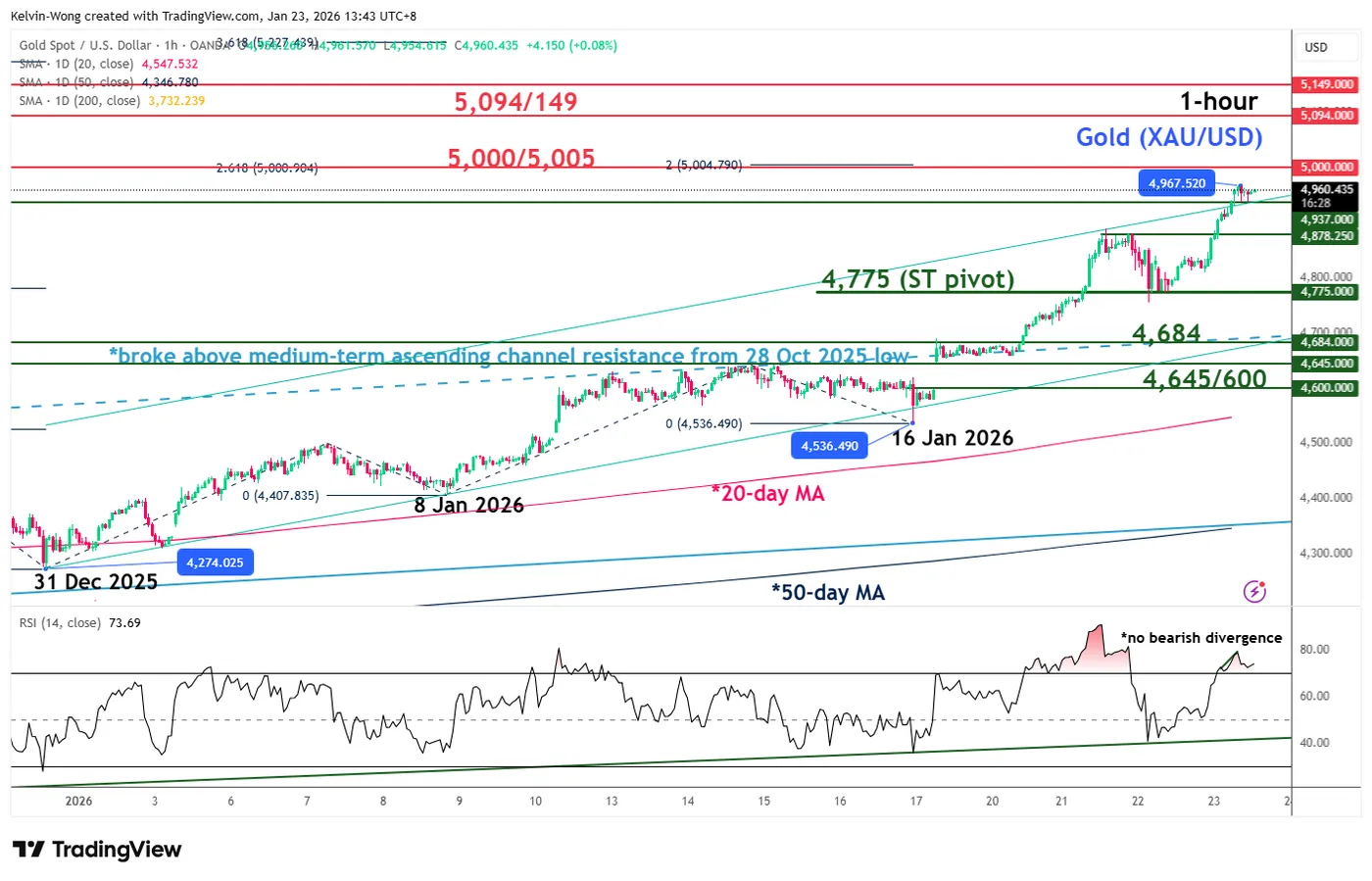
Fig. 1: Gold (XAU/USD) minor trend as of 23 Jan 2026 (Source: TradingView)
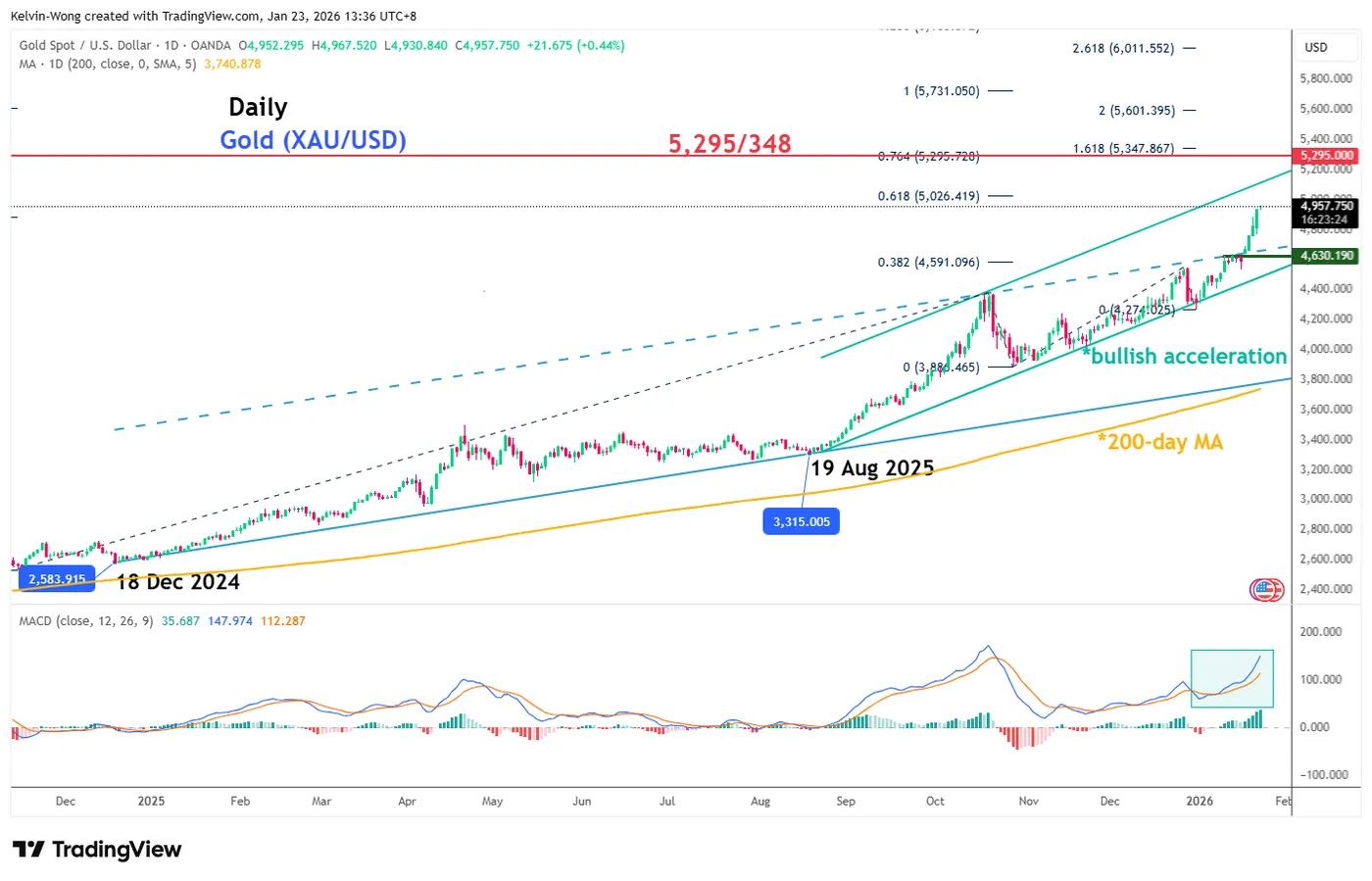
Fig. 2: Gold (XAU/USD) medium-term & major trends as of 23 Jan 2026 (Source: TradingView)
Watch the US$4,775 short-term pivotal support on Gold (XAU/USD) to maintain the minor bullish acceleration phase for the next intermediate resistances to come in at US$5,000/5,005 and US$5,049/5,149 in the first step (see Fig. 1).
On the other hand, a break with an hourly close below US$4,775 invalidates the direct rise scenario, allowing a minor corrective decline sequence to unfold and expose the next intermediate supports at US$4,684 and US$4,645/4,600 before another potential bullish upleg materializes.
Key elements to support the bullish bias
- Since its key low of US$4,536 on 16 January 2026, Gold (XAU/USD) has staged a gap-up and broken above the upper boundary of a medium-term ascending channel from its 28 October 2025 low, which suggests a transition into a bullish acceleration phase.
- The hourly RSI momentum indicator has not flashed out any bearish divergence condition while it continues to hover in its overbought region.
- The daily MACD trend indicator has continued to trend upwards above its centreline, which supports the ongoing medium-term uptrend phase in Gold (XAU/USD) with its first medium-term resistance at US$5,295/5,348 (see Fig. 2).
Cliff Notes: Distilling the Trend
Key insights from the week that was.
The December Labour Force Survey was the only major release for Australia this week. After falling 28.7k in November, employment surged +65.2k, well above consensus (+27k) and even surpassing Westpac’s above-market forecast (+40k). We had expected the rebound in employment to occur alongside a bounce-back in labour force participation; but the participation rate only lifted marginally to 66.7%. This combination meant the unemployment rate surprised, falling from 4.3% to 4.1%.
Looking through the monthly volatility, the past few months results suggest the ‘gradual softening’ narrative, which prevailed through much of 2025, may have paused or come to an end. Jobs growth may be near or at its trough now the rapid deceleration in ‘care economy’ hiring has largely played out, and market sector hiring is starting to pick up. We still think the unemployment rate will drift higher over 2026, as labour force growth outpaces employment at the margin. There could also be some seasonal volatility in the mix, as has typically been the case through summer post-COVID. The next few months will be key to confirming the trend.
Given December’s stronger labour market read and evidence of a moderate consumer upswing, next week’s Q4 inflation data will once again be the deciding factor for the RBA’s February decision. We are forecasting trimmed mean inflation to print 0.7%qtr / 3.1%yr which should be enough to warrant the Board remain on hold. In this week’s essay, Chief Economist Luci Ellis discusses the risk of an upside surprise for inflation and the implications for the RBA.
Offshore, China’s Q4 GDP report showed the economy met its 5.0% target in 2025. However, the growth was narrowly based, with investment in high tech manufacturing capacity and consequent strong growth in exports driving the result as the construction sector continued to contract and consumer demand remained weak. December’s partial activity data makes clear that risks to growth are skewed to the downside into 2026, with retail sales growth slowing to 3.7%ytd in December and fixed asset investment contracting 3.8%ytd, driven primarily by weakness in the private sector. With active fiscal support, China can achieve growth circa 4.5% in 2026. But additional stimulus must focus on households, bolstering the outlook for both income and confidence. Decisive support to end construction’s long and deep contraction is also necessary.
In the US, the PCE price index rose 0.2% in November to be 2.8% higher over the year, broadly consistent with outcomes in October and September. Inflation remains above the FOMC’s 2% target and is expected to remain elevated as tariff effects slowly pass through to the consumer. Survey anecdotes suggest businesses are hesitant to pass on higher costs given heightened price sensitivity among consumers. While inflation is unlikely to re-accelerate meaningfully in 2026, it will remain materially above target and warrant modestly restrictive monetary policy. We expect the Committee to hold rates steady next week, followed by one last rate cut in March and an on-hold stance for the rest of the year.
Across the pond, the UK CPI rose 0.4% in December after a 0.2% fall in November. Annual inflation accelerated to 3.4%, supported by a 4.5% rise in services prices. The monthly gain was driven by volatile components, including a 5.5% month-on-month jump in airfares and a 1.0% lift in food prices. Fiscal measures, such as energy bill reductions and a freeze on rail fares, should contribute to disinflation in coming months. The unemployment rate meanwhile held steady at 5.1% in November, while average weekly earnings slowed slightly to 4.7%yr from a revised 4.8%yr. Employment declined, reflecting ongoing softness in hiring across retail and hospitality. We expect the Bank of England to continue easing through Q1 and Q2 to guard against downside risks to growth.
Consumers at a Crossroads
A genuine cyclical upswing in consumer spending is underway. This follows a long period of weakness and should not be assumed to be signalling a runaway inflationary boom.
- A genuine cyclical upswing in consumer spending is underway, and has been for most of the past year. December quarter looks to have been particularly strong, and not just a blip related to shifting patterns of pre-Christmas shopping.
- This upswing should not be interpreted as necessarily signalling a problematic inflationary boom. The weak growth in consumption of recent years would be the wrong basis of comparison for the subsequent recovery. If consumer demand really were straining against supply, the pattern of increases in inflation would be different, and consumption imports and credit growth would be stronger. But that is not what the latest data show.
- There are several possible scenarios for the outlook for consumption, some more benign than others. The key driver will be household income, which has (finally) recovered enough to allow people to spend more.
A genuine cyclical upswing in consumer spending is underway. It has been building since early last year, and the final quarter of 2025 looks to have been particularly strong, if the timely indicators are a guide. The ABS Household Spending Indicator (HSI) increased by 1% in the month of November, and October had been even stronger. While the HSI only covers a subset of total consumption, the timelier Westpac–DataX Card Tracker more closely matches total nominal spending and suggests the strength continued into December. We estimate quarterly growth in consumption to have been 2% in nominal terms, and 1% in real terms, and believe that there is upside risk to these estimates. Over the past 15 years or so, rates of growth of this magnitude have been rare outside post-lockdown bounce-backs.
The question is whether this is a lasting strong trend or a blip related to holiday spending. Seasonal adjustment processes are meant to adjust for pre-Christmas shopping, allowing observers to focus on underlying trends. When those seasonal patterns change, though, as they have been with the increasing popularity of Black Friday sales, this adjustment will not be complete. As in recent years, we therefore cannot be sure that all of the recent strength is true trend rather than a ‘head fake’ from shifting seasonality.
Despite these uncertainties, something genuine does seem to be going on. Real consumption growth has picked up. Even consumption per person is rising, after several years of stagnation. The fundamentals are consistent with this. Incomes are also recovering after languishing at 2018 levels until recently. Real disposable income per person is now back close to the pre-pandemic trend. Lower inflation and the Stage 3 tax cuts reduced the squeeze on real incomes; lower interest rates also helped a little. Wealth effects from higher housing prices would also have been supporting spending over and above these income effects.
Nor is this a ‘K-shaped’ economy story where the recovery is narrowly based on spending by the already well-off. Data from our Westpac–DataX Consumer Panel to December show that the recovery in spending has been broad-based across income groups. Even consumers in the lowest tax bracket, whose spending had previously lagged, are now seeing a turnaround. Nominal spending is growing at a reasonable clip across age groups, too. The pattern seen in 2023, when spending growth lagged and even turned negative for the under-35s while older consumers’ spending remained strong, has long since passed.
We are cautious about interpreting the current upswing as a new, inflationary boom. Context is important: the gains come after several years of weakness. Interpreting that period of weakness as the new trend would be the wrong basis for comparison. The latest outcomes are not necessarily a story of rampant demand straining against stagnant supply. Leave aside our longstanding view that trend growth in supply capacity is a bit faster than the RBA and some others seem to think: the downstream effects that you would expect to see in a weaker-supply scenario are simply not in evidence.
If consumer demand really were outstripping supply, one should expect to see the effect on inflation more or less immediately; the effect of actual spending on prices is not the ‘long and variable lags’ that apply to monetary policy. While inflation did kick up in Q3 2025, the monthly data (such as they are) for Q4 so far have been less clear-cut. If this really were a demand boom, one should also expect to see the pick-up in inflation being more skewed to categories where domestic demand might play a role, like market services and some retail goods, rather than the administered prices (water, council rates) and obvious global supply shocks (meat, coffee) that dominated the list of inflation components with the highest inflation rates in recent months.
Nor do we see much of a pick-up in consumption import volumes, which would be a normal release valve in the face of a sudden upswing in domestic demand. Even overseas travel is lagging the levels it would have reached had pre-pandemic trend growth continued. One might also expect to see stronger household credit growth relative to household incomes than has been the case until recently.
This upswing in spending, though genuine, poses something of a conundrum: consumer sentiment remains pessimistic, even as people spend more. Only outright homeowners – those without mortgages – are net optimistic as a group. Renters and households with mortgages are mostly pessimistic, and increasingly so in recent months as the interest rate outlook has turned.
Is this disconnect a case of false consciousness, with people feeling worse off even though they are spending more? There is evidence to suggest that people react badly to the way past inflation lifts price levels, even after the inflation itself has passed. We also know that it is usual for most people to say that they are not better off than before, but be more optimistic about their future finances.
Or is the disconnect between spending and sentiment telling us something about the recovery, i.e. that it is more fragile than it looks? It is hard to escape the conclusion that consumption has been able to recover only because real incomes have recovered. There is a pathway where solid employment and income growth, and thus consumption, continues to recover. But that is a pathway where overall GDP growth is decent, not one where demand challenges stagnant supply.
Less benign is the scenario that sees spending growth realign with weak sentiment: the one where the recovery in spending starts to fade. For most of 2025, the labour market was easing gradually, as the economy pivoted from growth driven by the jobs-rich ‘care economy’ to the more dynamic, but less employment-intensive, market sector. The December labour data went the other way, putting into question whether that trend will continue. If it does, income growth will moderate by more than we currently expect, especially given wages growth has been relatively benign so far this cycle. And with growth in housing prices already softening in the two largest cities as the outlook for rates shifted, any positive wealth effects in play could also peter out. Suffice to say that this scenario, of a return to sluggish growth in consumer spending, is not our base case or even a major risk, but it is plausible.
Before reaching for a particular narrative to explain an outcome, be sure to guard against getting stuck in the past. It isn’t 2023 anymore. Australia is neither just emerging from a period of disrupted supply chains nor contending with a temporary surge in population growth to catch up from the effects of closed borders. It is also important to triangulate against multiple data sources, to ask, “if this were true, what else would we expect to see?”, and “what would we need to see to change our minds?”. And to be fair, it is possible that the current upswing evolves into something more exuberant over the course of this year. That is not what the latest consumption data imply, though. Consumers have been spending more because they (finally) have more income to spend. We expect this to continue – even with some moderation in income growth back towards pre-pandemic averages – and do not necessarily see it as cause for alarm.
Silver (XAGUSD) Elliott Wave: Strong Impulsive Rally Unfolding
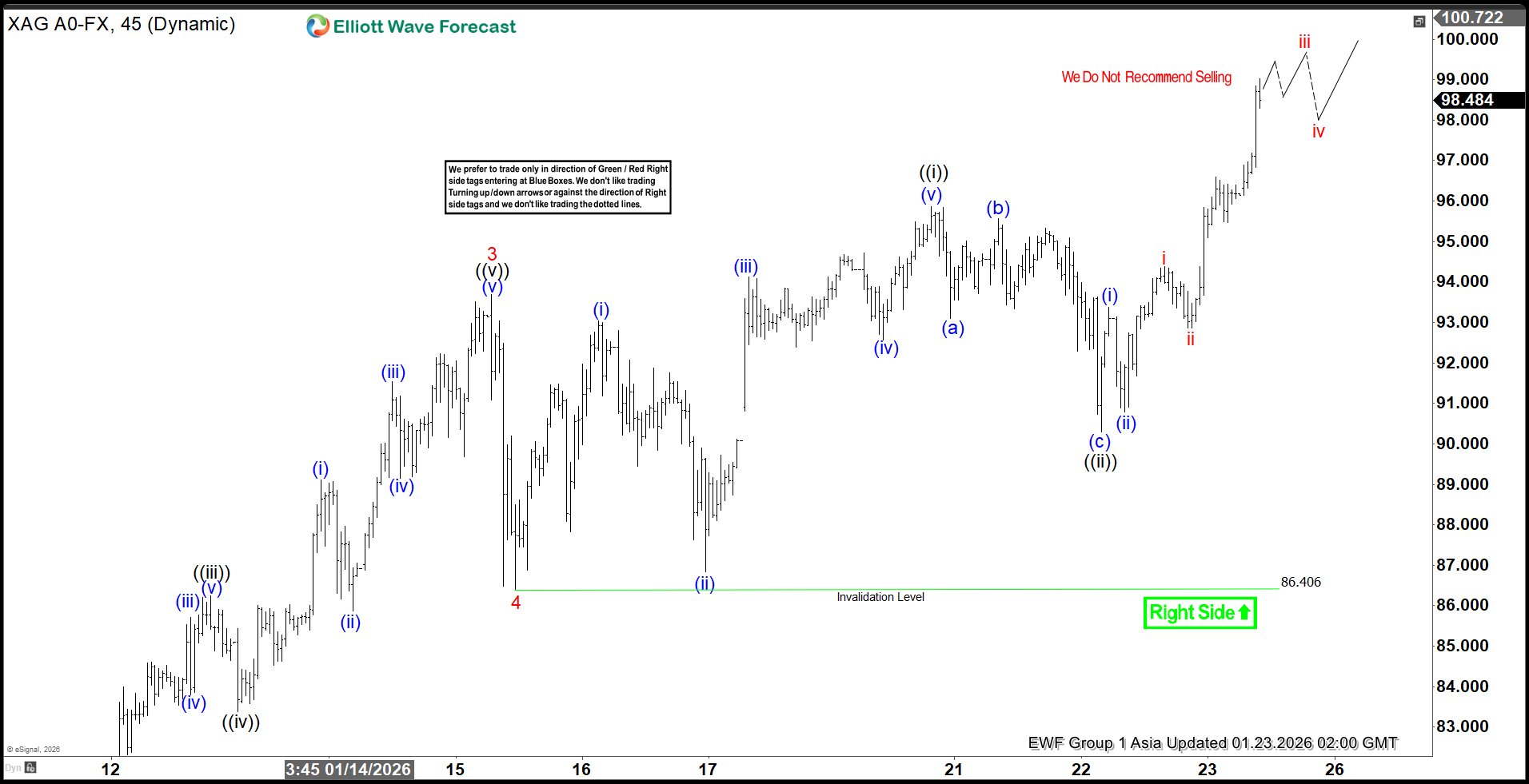
Silver (XAGUSD) continues to demonstrate a powerful impulsive rally, advancing steadily toward new all-time highs. The short-term cycle that began from the January 15, 2026 low is unfolding as a clear impulse five-wave rally. From that date, wave (i) concluded at $93.03, followed by a corrective pullback in wave (ii) that ended at $86.83. Momentum then carried the market higher, with wave (iii) reaching $94.12 before another modest retracement in wave (iv) down to $92.56. The final leg higher, wave (v), extended to $95.86, thereby completing wave ((i)) of a higher degree structure.
After this initial advance, silver entered a corrective phase in wave ((ii)), forming a zigzag pattern. From the peak of wave ((i)), wave (a) declined to $93.09, while wave (b) rallied back to $95.56. The market then resumed its downward move in wave (c), reaching $90.29 and completing wave ((ii)) at the higher degree. With this correction finished, silver has resumed its upward trajectory in wave ((iii)), signaling renewed strength in the impulsive sequence.
The potential upside target for wave ((iii)) is projected using the 100% to 161.8% Fibonacci extension of wave ((i)). This range lies between $99.75 and $105.6, offering a significant zone of interest for traders and investors. In the near term, as long as the pivot at $86.4 remains intact, dips are expected to attract buyers. Market participants should anticipate renewed demand in sequences of three, seven, or eleven swings, reinforcing the bullish outlook and supporting further upside momentum.
Silver (XAGUSD) 45 minute chart
XAGUSD Elliott Wave video:
https://www.youtube.com/watch?v=S99JkLpZ-N4