Sample Category Title
Fed Waller and Mester not seeing case for slower rate hike
Fed Governor Christopher Waller said in a speech yesterday, "Inflation is far from the FOMC's goal and not likely to fall quickly. This is not the inflation outcome I am looking for to support a slower pace of rate hikes or a lower terminal policy rate"
Separately, Cleveland Fed President Loretta Mester echoed and said, "We have to bring interest rates up to a level that will get inflation on that 2% path, and I have not seen the compelling evidence that I need to see that would suggest that we could start reducing the pace at which we're going,"
Chicago Fed President Charles Evans said, "We have to look at the momentum in sort of that central component of inflation, and that's really the part that I believe has most of my colleagues and myself nervous about." Be he declined to comment on whether Fed would continue with 75bps hike and noted, we "will have a discussion about that."
BoC Macklem: Simply put, there is more to be done
BoC Governor Tiff Macklem said in a speech yesterday, "We know we are still a long way from the 2% (inflation) target. We know it will take some time to get there. We also know there could be setbacks along the way, and we can't afford to let high inflation become entrenched."
"Simply put, there is more to be done. We will need additional information before we consider moving to a more finely balanced decision-by-decision approach," he noted.
"We can't control global developments. But we can use monetary policy to influence the balance between demand and supply in the Canadian economy and therefore ease domestic inflationary pressures over time," Macklem also said.
Cliff Notes: A Turning Point for Policy
Key insights from the week that was.
The RBA surprised markets this week by slowing the pace of rate hikes, opting for a 25bp move against expectations of a 50bp increase. Meanwhile, the RBNZ continued to show a heavy hand against domestic inflation pressures, having delivered a fifth consecutive 50bp rate hike.
In explaining their decision to raise the cash rate by only 25bp to 2.60% at their October policy meeting, the RBA referenced the considerable amount of financial tightening that has already been implemented, a total of 250bps to date. While the Board were cognisant of the domestic risks around inflation; consumer spending; housing and the labour market, a greater emphasis was placed on concerns around the deterioration in the global economy, likely in response to recent volatility within financial markets. As discussed by Chief Economist Bill Evans, we saw that developments in the global economy actually favoured a larger increase at the October meeting, given the strength of US consumer inflation and it’s expected consequences of a more aggressive tightening cycle from the Federal Reserve, and hence further upward pressure on global interest rates.
The Board has clearly signalled the need for further increases in the cash rate over the period ahead, the pace of which will remain at 25bp increments given that policy has now reached a broadly neutral level. This will allow the RBA to more closely assess the impacts of the cumulative rate hikes to date as monetary policy continues to lift further into contractionary territory. We continue to expect a peak cash rate of 3.60%, to now be achieved with 25bp rate hikes over the next four policy meetings, reaching that level by March 2023 (prev. February 2023).
Having said that, we believe that the effects of financial tightening will be much greater than the RBA expects. This will materialise in 2023 as a slowdown in consumer spending to an anaemic rate (1.2%yr), a sharp turnaround in business investment (-1.0%yr) and a notable decline in dwelling construction (-4.0%). Ultimately, growth is expected to decelerate sharply in 2023 (to 1.0%yr) and the unemployment rate will continue to rise through 2023 and 2024 (to around 5%). A detailed exploration of our own views on Australia and the global economy will be released today in the October edition of Westpac’s Market Outlook available on Westpac IQ.
Housing data released for Australia this week was mixed but consistent with our overall view of the economy. The correction in house prices was shown to have deepened and broadened across the country, with capital city prices falling by 1.4% in September, rounding out a 4.3% decline in Q3. Indeed, housing finance approvals also continued to mirror the broader correction to date, with further declines across investor and owner-occupier loans signalling a clear moderation in housing credit moving into year-end. In contrast, the often volatile dwelling approvals data surprised to the upside in September, more than reversing July’s 17.2% decline with a 28.1% rebound. Given the extreme volatility of this series, the focus needs to be on quarterly trends. The September result was not only driven by a surge in the volatile high-rise units segment, but also an unexpected resilience among non-high rise segments which are at the centre of many cost and profitability issues facing the housing sector. Pipeline delays are likely providing some near-term support to building activity, though the RBA’s tightening cycle will begin to act as a drag on new dwelling investment into the medium-term.
Across in New Zealand, the RBNZ’s laser-focus on domestic inflationary pressures was again evident at their October policy meeting, having delivered a fifth consecutive 50bp rate hike. As detailed by our New Zealand economics team, despite the lack of clarity around the expected peak in the Official Cash Rate, the Committee noted a debate between a 50bp or 75bp rate hike, a more hawkish shift which signals a higher peak for the cycle. Westpac continues to expect a peak in the Official Cash Rate of 4.50%, involving two further 50bp rate increases in November and February.
On the international front, data releases were relatively light. Markets’ attention was therefore centred on the US labour market in anticipation of September’s employment report, due for release later tonight. Partial data received this week produced relatively mixed signals though: JOLTS job openings posted a sharp decline in August, albeit from still elevated levels; meanwhile, the ISM services PMI reported a strengthening in employment in services, a sector which constitutes a consistently significant portion of the payrolls data. On balance, broader labour market indicators suggest that momentum in the labour market has begun to ease from the considerable strength seen earlier this year. However, with the FOMC set to deliver a further 150bps of tightening to a peak fed funds rate of 4.625% that will be held through next year, the labour market will exhibit a clear weakening in 2023 and 2024 with the unemployment rate to rise in the order of 2ppts.
USD/JPY Could Start Fresh Rally Above 146.00
Key Highlights
- USD/JPY started a fresh increase above the 144.50 resistance.
- It broke a key declining channel with resistance near 144.80 on the 4-hours chart.
- EUR/USD started a fresh decline after it failed to clear the 1.0000 resistance.
- The US nonfarm payrolls could increase 250K in Sep 2022, down from 315K.
USD/JPY Technical Analysis
The US Dollar remained well bid above the 142.00 zone against the Japanese Yen. USD/JPY formed a base and started a fresh increase above the 142.50 resistance.
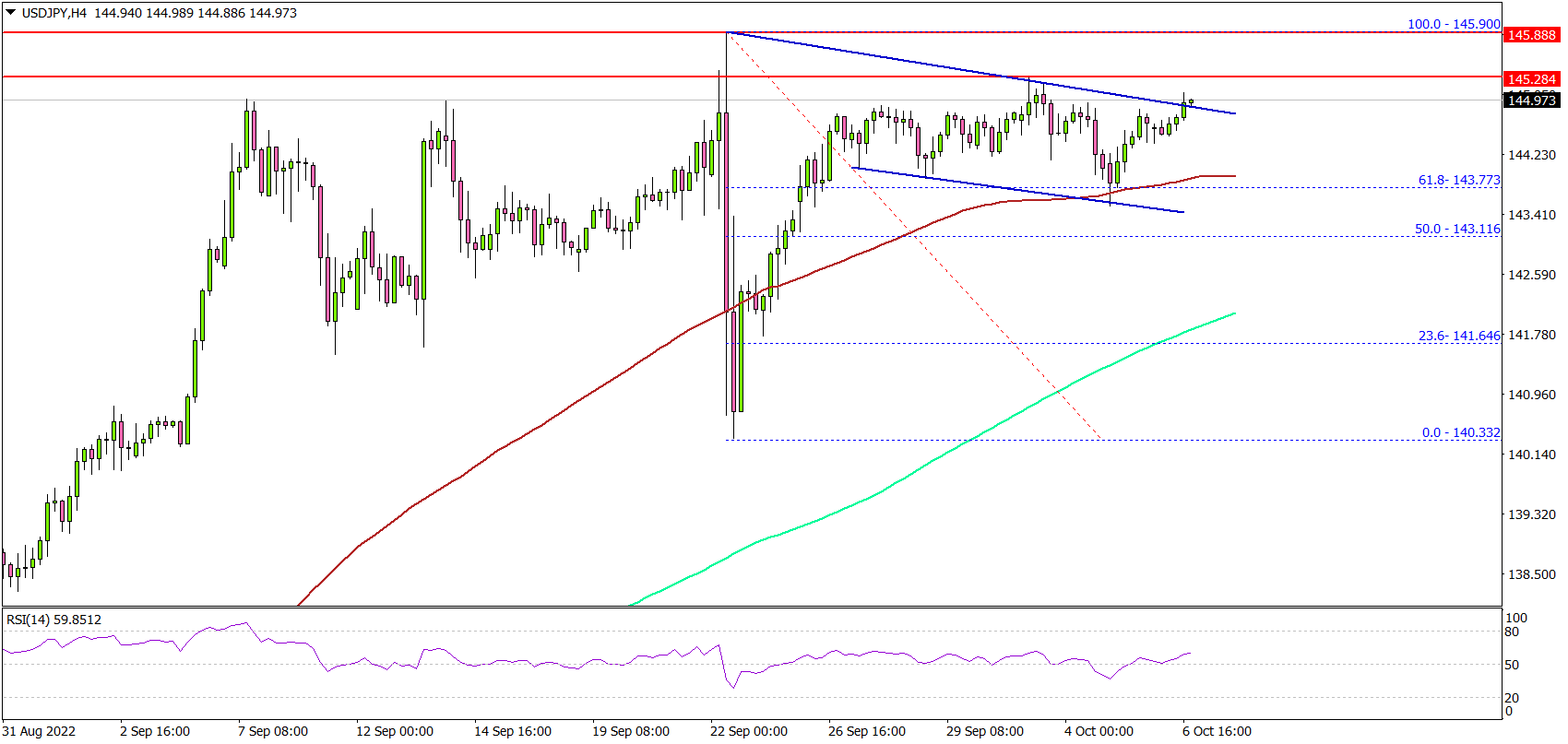
Looking at the 4-hours chart, the pair was able to climb above the 143.20 and 144.00 resistance levels. There was a clear move above the 50% Fib retracement level of the downward move from the 145.90 swing high to 140.33 low.
Besides, there was a break above a key declining channel with resistance near 144.80 on the same chart. The pair is now trading above the 144.50 resistance and the 100 simple moving average (red, 4-hours).
An immediate resistance is near the 145.40 level. The next major resistance is near the 146.00 level. A clear move above the 146.00 level might send the pair towards the 147.50 level.
The next major hurdle could be near the 148.00 level. On the downside, an initial support is near the 144.20 level. The main support sits at the 143.50 level. A downside break below the 143.50 zone might send the pair towards the 142.50 level.
The next major support is near the 141.20 level, below which the pair could even test the 140.00 support zone.
Looking at EUR/USD, the pair failed to clear the key 1.0000 resistance zone and started a downside correction.
Economic Releases
- US nonfarm payrolls for Sep 2022 – Forecast 250K, versus 315K previous.
- US Unemployment Rate for Sep 2022 - Forecast 6.8%, versus 7.0% previous.
- Canada’s employment Change payrolls for Sep 2022 – Forecast 20K, versus -39.7K previous.
- Canada’s Unemployment Rate for Sep 2022 - Forecast 5.4%, versus 5.4% previous.
Fed Kashkari: We’re quite a ways away from a pause
Minneapolis Fed President Neel Kashkari said, "Until I see some evidence that underlying inflation has solidly peaked and is hopefully headed back down, I'm not ready to declare a pause. I think we're quite a ways away from a pause."
"I fully expect that there are going to be some losses and there are going to be some failures around the global economy as we transition to a higher-interest rate environment, and that's the nature of capitalism," Kashkari said.
"We need to keep our eyes open for risks that could be destabilizing for the American economy as a whole. But to me, the bar to actually shifting our stance on policy is very high," he said. "It should not be up to the Federal Reserve or the American taxpayer to bail people out."
US September NFP: More Reasons for the Fed
Nonfarm Payrolls in the US are expected to come in above “normal” once again. That would affirm the notion that the US employment situation remains "hot", and that the Fed can focus on getting inflation down.
The total number of people employed in the US is higher now than it was before the pandemic, suggesting that the jobs market has at least nominally recovered. However, the participation rate, and the share of the population holding down a full time job is less than it was at the start of 2020.
The main drivers
According to the latest BLS report, there were over 10.1M job openings, but just 6.0M people looking for a job. The labor market remains extremely tight, but the gap continues to narrow. The implication is that the labor market is heading towards being balanced, though there is still some time to go. The Fed, therefore, has room to keep raising rates, but that room isn't unlimited.
Crucially, in August there were 344K jobs created, but the number of open jobs dropped by 1.1M. Meaning that demand destruction is the larger component of the labor market rebalancing. Translated to non-economic speak, that means that more job openings are being closed because businesses are no longer seeking, than because they've hired someone.
What it means for the markets
A tight labor market is generally understood to push wages higher, as employers try to attract talent. However, so far this cycle, wage increases have been slower than inflation. Which means that the average real wage has been falling for several months. This could contribute to demand destruction as the average American has less purchasing power. According to the most common economic theory among central bankers and the government, this implies an increased risk of a recession.
In fact, because wages aren't growing as fast as inflation, this could motivate the Fed to be even more aggressive in tightening. As long as wages aren't significantly outpacing inflation, then the Fed actually likes labor market tightness, because it supports economic growth, according to them.
What to look out for
September US NFP are forecast at 250K compared to 344K in August. As usual, the prior month could be revised, and also affect market outlook. Since a "normal" NFP is around 200K, any figure above that is likely to support further Fed tightening and weigh on the stock market.
The unemployment rate is expected to remain stable at 3.7%. But, that was also the case last month, when analysts were surprised with an increase in the unemployment rate driven by increased labor force participation. With pocketbooks coming under pressure from inflation, it's not surprising that more people would be out looking for work, which could once again distort the projections.
Sunset Market Commentary
Markets
UK gilts underperformed German Bunds and US Treasuries today. Fitch’s decision to lower the outlook on the country’s AA- rating from stable to negative triggered the move. The rating agency cited increased fiscal risks coming from the government’s lavish spending plans. UK yields add 10.2 bps (2-yr) to 14.3 bps (30-yr) with intraday dynamics at the very long end suggesting some meddling by the Bank of England. Sterling underperformed marginally with EUR/GBP setting and intraday high near 0.8790 from an open at 0.8720. US yield changes vary between -0.2 bps (30-yr- and +2.3 bps (5-yr). It’s a relative quite day for US investors following ISM’s and ADP employment earlier this week. Weekly jobless claims increased slightly more than expected (190k to 219k), but remain near historically low levels. US markets today clearly trade with tomorrow’s payrolls in mind. The German yield curve steepens with yield changes ranging between -2.5 bps (30-yr) and 4.7 bps (2-yr). There’s again a strong outperformance of bonds compared to swaps. The European swap rate curve rises up to 9.3 bps at the front end. Moves at the shorter tenors aren’t related to the publication of ECB Minutes. On the contrary. Yields temporary dipped as they revealed that some officials proposed a 50 bps rate hike instead of 75 bps given recession risks. The overall tone remained more hawkish though. Growth concerns shouldn’t prevent forceful rate hikes. Even chief economist Lane warned that price pressures are likely to persist. The euro failed to profit from the interest rate support with EUR/USD losing the 0.99 big figure again to currently change hands below 0.9850. Overall risk sentiment is sluggish with European indices losing around 0.5% after a positive open and the UK FTSE underperforming (-1%). Yesterday’s big OPEC production cut grabs a lot of attention, but Brent crude trades flat near $93.25/b. The commodity rallied the days ahead of the decision as the 2mn barrels/day production cut was rumoured.
News Headlines
Momentum in retail sales in Hungary and the Czech Republication is deteriorating quite substantially. The Czech statistical offices reported that sales in retail trade (real terms) in August declined 0.7% M/M to be 8.8% lower compared to the same period last year. (Real) sales of non-food goods decreased 10.3% Y/Y, sales of automotive fuels declined 9.2%. Real food sales were 6.6% lower compared to last year. In a comment, the CZSO indicated that sales declined across all categories except for chemist, medical and orthopedic goods. Retail trade in Hungary also slowed substantially more than expected to 2.4% Y/Y from 4.3% Y/Y in august. Sales of food decreased by 2.4% Y/Y. Non-food sales increased slightly (+0.5%). Automotive fuel sales were 18.4% higher compared to the same period last year. Data suggest that domestic demand in both countries is slowing. Both the Czech central bank and the Hungarian central bank will take this into account when assessing the supply and demand balance in their economies as they look for a deceleration of price growth.
In a letter to the Chair of the UK Treasury Committee, Deputy BoE Governor for Financial Stability Cunliffe provided an explanation for the Bank’s unusual market intervention as the BoE deployed a £65bn program to stabilize the market in long dated Gilts last week. The letter describes how this market destabilized after the announcement of the Mini budget by Treasury secretary Kwarteng on September 23. Especially the likelihood that liability-driven investments funds (LDI’s) that are used by pension funds would be forced to further sell huge amounts of long term Gilts caused to BoE to step in. The BoE also clearly stated that the program only aimed at restoring financial stability. The “operations are not intended to create central bank money on a lasting basis, nor are they designed to cap or control long-term interest rates”. Once the purchase program is completed and risks to market functions are judged by the BoE to have subsided, the operation will be unwound in a smooth and orderly fashion.
EURGBP Wave Analysis
- EURGBP reversed from support level 0.8675
- Likely to rise to resistance level 0.8800
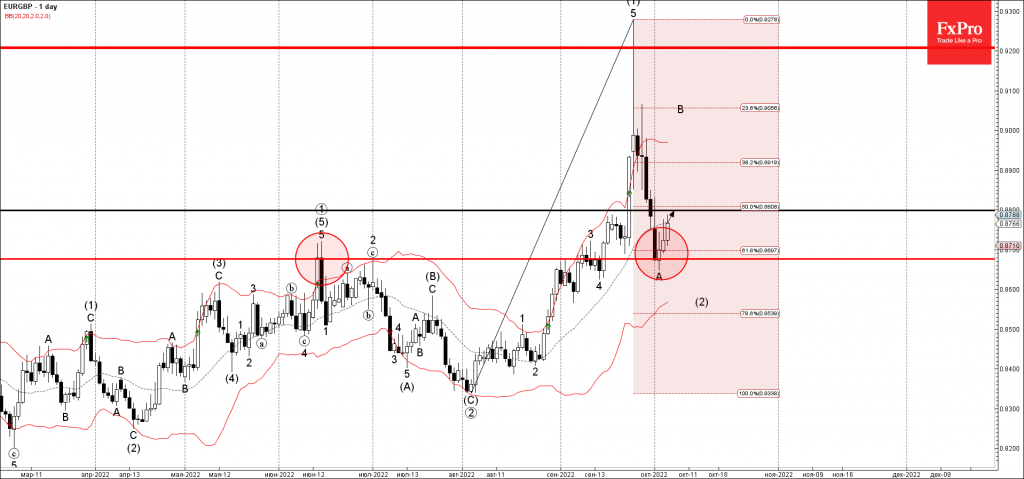
EURGBP currency pair recently reversed up from the key support level 0.8675 (previous monthly high from June), intersecting with the 61.8% Fibonacci correction of the upward impulse from August.
The upward reversal from this support level 0.8675 stopped the earlier short-term impulse wave A.
Given the clear daily uptrend, EURGBP currency pair can be expected to rise further toward the next resistance level 0.8800.
GBPUSD Wave Analysis
- GBPUSD reversed from resistance level 1.1490
- Likely to fall to support level 1.1000
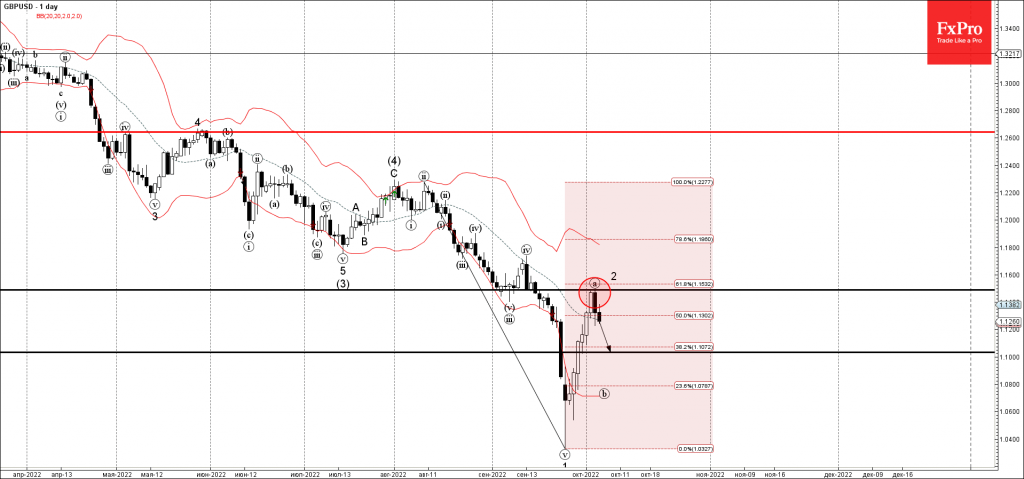
GBPUSD currency pair recently reversed down from the key resistance level 1.1490 (former strong support from the start of September), intersecting with the 61.8% Fibonacci correction of the earlier sharp downward impulse from August.
The downward reversal from this resistance level 1.1490 stopped the earlier short-term impulse wave (a) of the higher order ABC correction 2.
Given the clear daily downtrend, GBPUSD currency pair can be expected to fall further toward the next support level 1.1000.