

Sample Category Title
Fed Bostic: Lowering rates in 2023? Not so fast
Atlanta Fed president Raphael Bostic said yesterday, "I would like to reach a point where policy is moderately restrictive --between 4 and 4 1/2 percent by the end of this year -- and then hold at that level and see how the economy and prices react,"
There is "considerable speculation already that the Fed could begin lowering rates in 2023 if economic activity slows and the rate of inflation starts to fall," Bostic said. "I would say: not so fast."
"We should not let the emergence of (economic) weakness deter our push to lower inflation," he added. "We must remain vigilant because this inflation battle is likely still in early days."
NZD/USD Recovery Stalls While Oil Price Climbs Higher
Key Highlights
- NZD/USD failed to recover above the 0.5800 resistance zone.
- A major bearish trend line is forming with resistance near 0.5750 on the 4-hours chart.
- Crude oil price started a steady increase above the $85.00 resistance zone.
- The US Initial Jobless Claims could increase from 193K to 200K.
NZD/USD Technical Analysis
The New Zealand Dollar found support near 0.5565 after a strong decline against the US Dollar. NZD/USD formed a base and started a recovery wave above 0.5600.
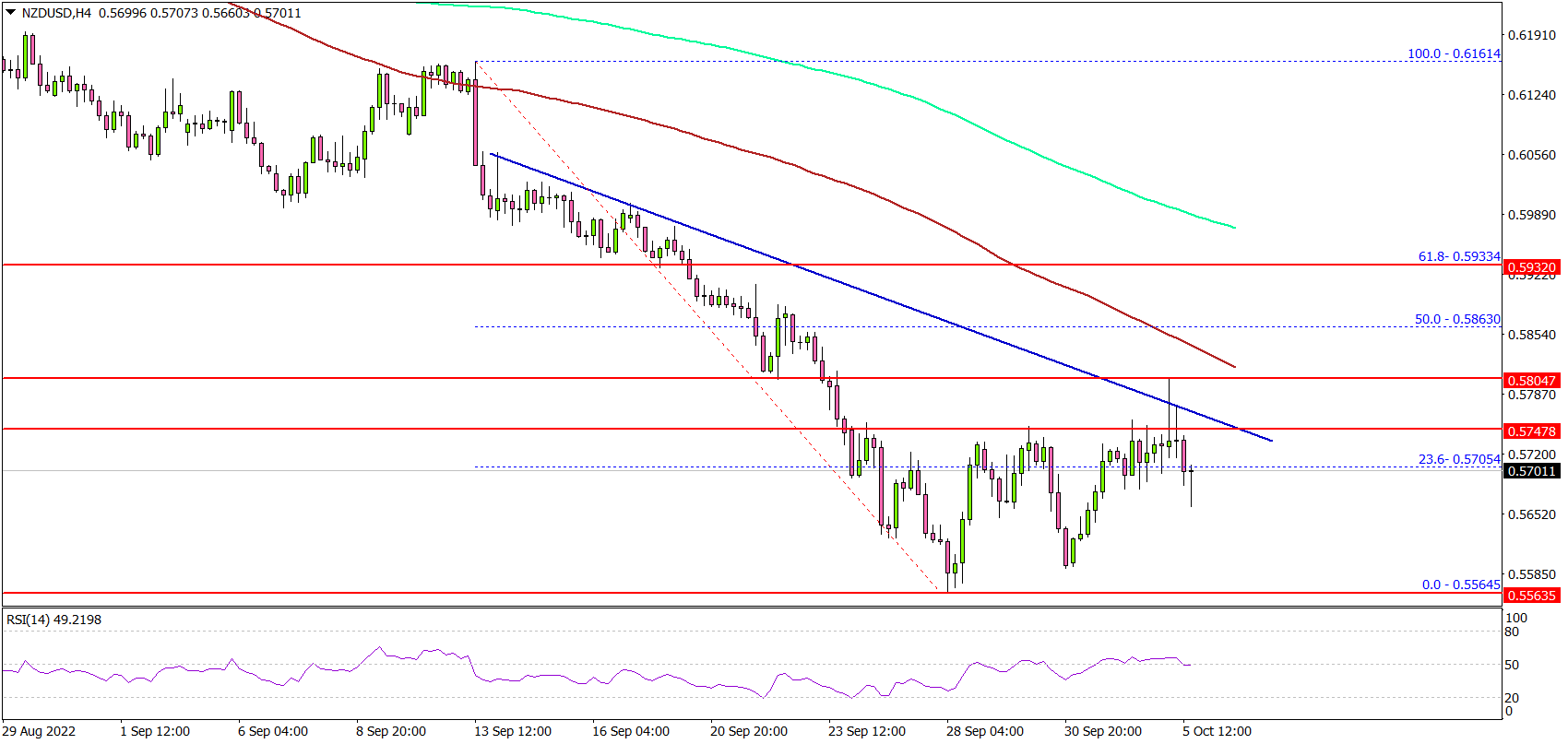
Looking at the 4-hours chart, the pair was able to recover above the 0.5620 and 0.5640 resistance levels. The pair even spiked above the 23.6% Fib retracement level of the downward move from the 0.6161 swing high to 0.5564 low.
However, the pair failed to recover above the 0.5800 resistance zone. There is also a major bearish trend line forming with resistance near 0.5750 on the same chart.
An immediate resistance is near the 0.5750 level and the trend line, above which the pair could test the 100 simple moving average (red, 4-hours).
The next major resistance is near the 0.5860 level. It is near the 50% Fib retracement level of the downward move from the 0.6161 swing high to 0.5564 low. A clear move above the 0.5860 level might send the pair towards the 0.5900 level.
The next major hurdle could be near the 200 simple moving average (green, 4-hours). On the downside, an initial support is near the 0.5640 level. The main support sits at the 0.5600 level.
A downside break below the 0.5600 zone might send the pair towards the 0.5565 level. The next major support is near the 0.5500 level, below which the pair could even test the 0.5420 support zone.
Looking at crude oil price, there was a decent increase above the $85 level and it seems like the bulls are aiming a move towards $90.
Economic Releases
- Euro Zone Retail Sales for August 2022 (YoY) - Forecast -1.7%, versus -0.9% previous.
- Euro Zone Retail Sales for August 2022 (MoM) - Forecast -0.4%, versus +0.3% previous.
- US Initial Jobless Claims - Forecast 200K, versus 193K previous.
Elliott Wave View: DAX Looking for 3 Waves Rally
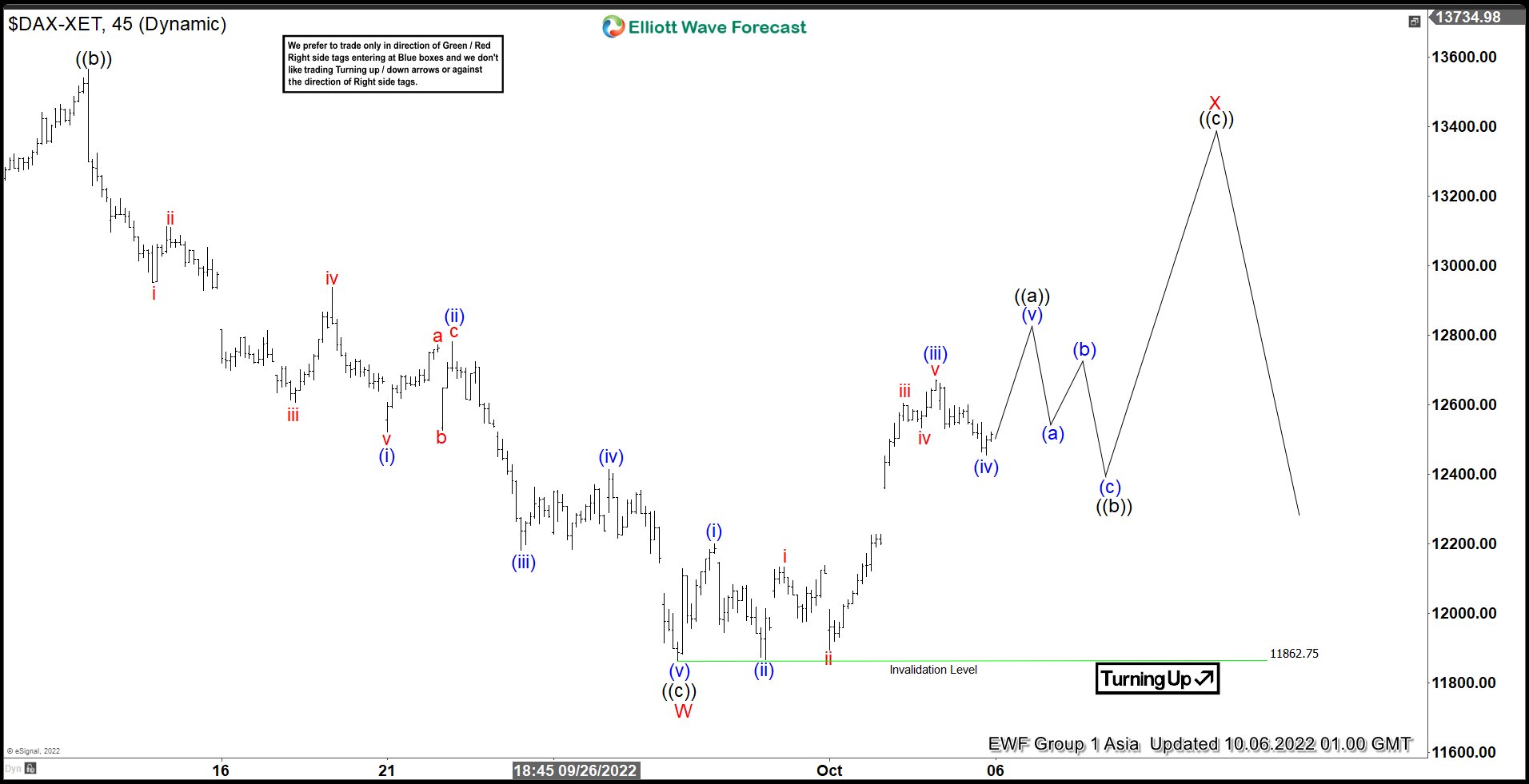
DAX shows incomplete bearish sequence from 11.18.2021 high and 3.29.2022 high favoring further downside. Decline from 3.29.2022 high is unfolding as a double three Elliott Wave structure. Down from 3.29.2022 high, wave (W) ended at 12390.95 and wave (X) rally ended at 13947.85. Wave (Y) decline is now in progress with subdivision as another double three WXY in lesser degree. Down from wave (X), wave ((a)) ended at 12603.58. Wave ((b)) rally ended at 13564.83 and the 45 minutes chart below starts from here. Wave ((c)) lower ended at 11862.75 and this completed wave W of (Y).
Wave X of (Y) rally is now in progress as a zigzag Elliott Wave structure. Up from wave W, wave (i) ended at 12198.37 and wave (ii) ended at 11866.98. Index then extends higher in wave (iii) towards 12669.53 and wave (iv) ended at 12455.36. Expect 1 more rally higher in wave (v) to end wave ((a)). Index should then pullback in wave ((b)) to correct cycle from 9.28.2022 low before the next leg higher in wave ((c)) to end wave X. Near term, as far as pivot at 11862.75 low stays intact, expect dips to find support in 3, 7, 11 swing for further upside.
DAX 45 Minutes Elliott Wave Chart
GBPAUD Wave Analysis
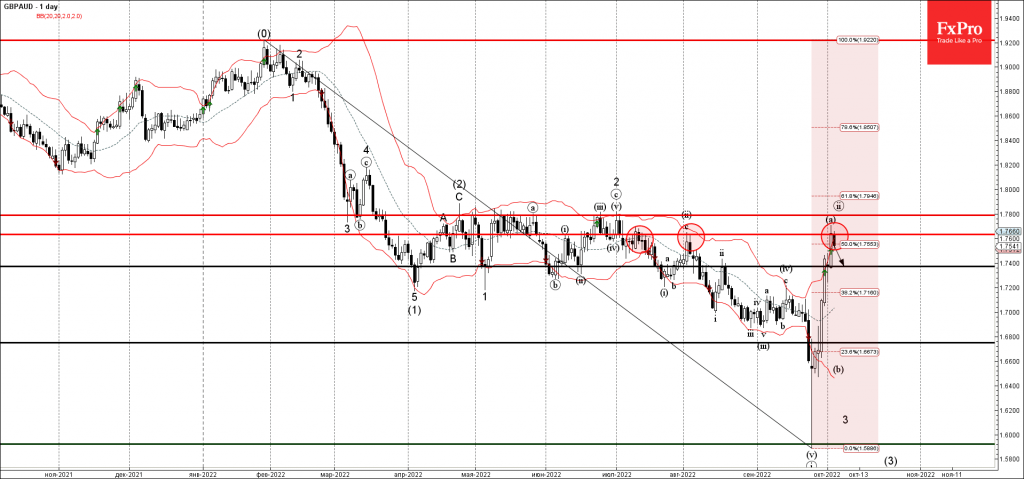
- GBPAUD reversed from resistance level 1.7650
- Likely to fall to support level 1.7400
GBPAUD currency pair recently reversed down from the multi-month resistance level 1.7650 (previous monthly high from August), intersecting with the upper daily Bollinger Band and the 50% Fibonacci correction of the downward impulse from January.
The downward reversal from the resistance level 1.7650 stopped the earlier short-term impulse wave (a).
Given the clear daily downtrend, GBPAUD currency pair can be expected to fall further toward the next support level 1.7400 (former resistance from August).
EURJPY Wave Analysis
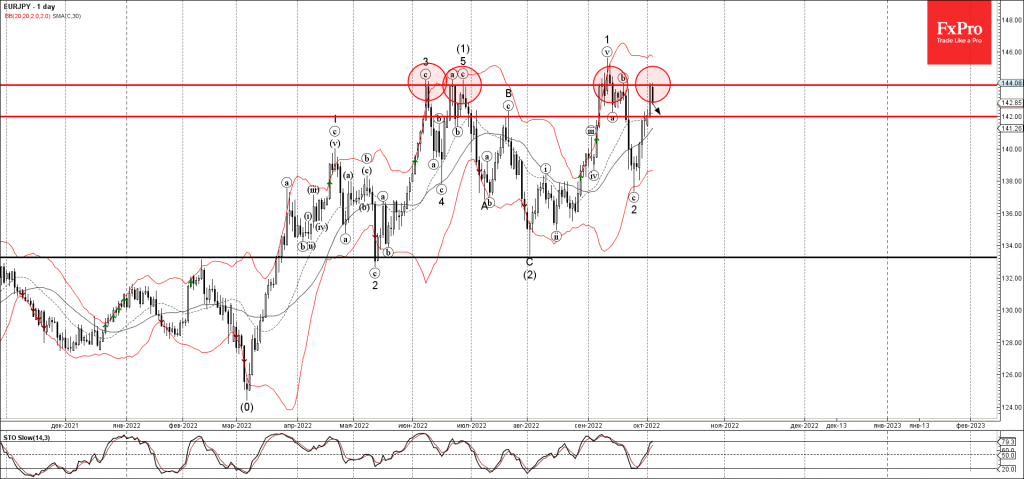
- EURJPY reversed from resistance level 144.00
- Likely to fall to support level 142.00
EURJPY currency pair recently reversed down from the key resistance level 144.00 (which has been reversing the price from the start of June).
The downward reversal from the resistance level 144.00 stopped the earlier short-term impulse wave 3. Given the strength of the resistance level 144.00, EURJPY currency pair can be expected to fall further toward the next support level 142.00.
Euro Area PMIs Fall Pressed Euro Down
The final estimates of business activity in the euro region were weaker than expected and indicated a further business activity drop. The composite index fell to 48.1 in September from 48.9 a month earlier. Values below 50 indicate the eurozone has slipped from slowing growth to contracting economies after April’s growth peaks.
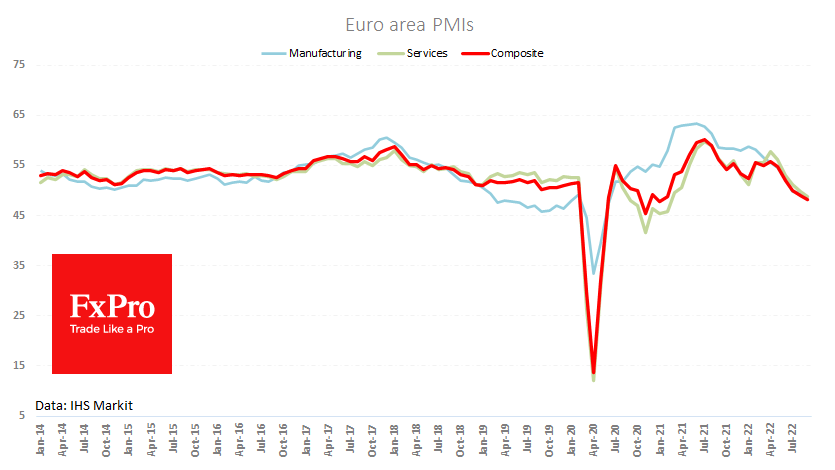
This indicator is good at predicting Eurozone economic cycles, which is why markets often react to its publication. Today EURUSD has come under pressure and is losing almost 1% since the first publication of the final PMIs that were first published for the individual major economies.
A sharp slowdown in business activity could call into question the ECB’s resolve to fight inflation as quickly as possible. In addition, the release of an unexpectedly weaker German trade surplus for August is working against today’s single currency. It is also prompting a reassessment of speculations about capital inflows into the region.
The bad news came just when EURUSD was one step away from testing its 50-day moving average, which has often acted as a resistance line to the downtrend of the last 15 months.
Sunset Market Commentary
Markets
The bond-equity short-squeeze/risk rally from yesterday and Monday petered out in Europe this morning as markets reassessed chances of major central banks nearing the end of their tightening cycle. Today’s ‘hawkish’ 50 bps RBNZ hike for sure wasn’t the main driver. Bond yields in New Zealand even eased further after the RBNZ policy decision. At the same, time RBNZ even pondering a 75 bps rate hike illustrated that central bankers still have divergent views on what path they have to walk to bring inflation sustainably back to target. Yesterday, yields already rebounded off intraday lows and this move continued today. The US ADP labour market report was the next data set potentially guiding the debate whether Fed tightening is gradually cooling US excess aggregate demand. However, the 208k September private job growth was very close to expectations. A 53k upward revision for last month’s figure suggests that a slowdown in hiring, if any is developing at a very gradual pace. The US August trade deficit at $67.4 bln was also exactly in line with market expectations. Admittedly, the data release with most market potential, the US non-manufacturing ISM, still has to be published after finishing this report. In what probably should be characterized as a technical rebound, US yields are rising between 6 bps (2-y) and 10 bps (10-y). EMU swap yields in a similar move gain between 5 bps (2-y) and 10 bps (10-y). On intra-EMU bond markets, the Italian 10-y spread versus Germany widened 12 bps. Maybe some investors expected some news on QT from today’s ECB non-monetary policy meeting. PEPP reinvestment data published today also showed that net purchases of Italian bond were slightly negative during the August 22/September 22 period (-1.243 mln). The rebound in core yields also blocked this week’s impressive equity rebound. The EuroStoxx50 is ceding 1.15%. US indices opened with a similar loss. For now, the sell-on upticks dynamics apparently hasn’t halted yet. Oil extends its rebound with Brent trading at $93 p/b as markets await the outcome of the OPEC+ meeting in Vienna. The group is reported to discuss a big 2 mln p/b production cut. For now there is no formal decision yet. The EU also agreed on sanctions including an price cap for Russian oil to be transported to third countries.
On FX markets, the dollar show the logical comeback in line with core yields as the risk rally is running into resistance. DXY regains the 111 handle. EUR/USD yesterday evening and early this morning almost touched parity but in a gradually but protracted move currently already returned below the 0.99 big figure. USD/JPY is still locked in a very narrow short-term trading range (144.5). Sterling weakens further even as UK yields rise more than their EMU counterparts. UK PM Liz Truss at the Conservative party conference confirmed the government’s aim to maintain a growth supportive policy. EUR/GBP extends gains beyond the 0.8721 previous top (currently 0.874).News Headlines
EC President von der Leyen welcomed Member States’ agreement on the 8th sanctions package against Russia. “We have moved quickly and decisively. We will never accept Putin’s sham referenda nor any kind of annexation in Ukraine. We are determined to continue making the Kremlin pay.” The new package prohibits maritime transport of Russian oil to third countries above an oil price cap. Bans on goods including steel products and providing IT, engineering and legal services to Russian entities will be extended. There are also restrictions on Russian access to aviation items, electronic components and specific chemical substances.
The World Trade Organization (WTO) updated its April forecasts. World trade is expected to lose momentum in H2 2022 and remain subdued in 2023 as multiple shocks weigh on the global economy. The WTO now predicts global merchandise trade volumes will grow by 3.5% in 2022 (from 3% in April). For 2023they foresee a 1.0% increase (from 3.4%). World GDP at market exchange rates will increase by 2.8% in 2022 and by 2.3% in 2023 (from 3.2%). Trade and output will be weighed down by several related shocks, including the war in Ukraine, high energy prices, inflation, and monetary tightening.
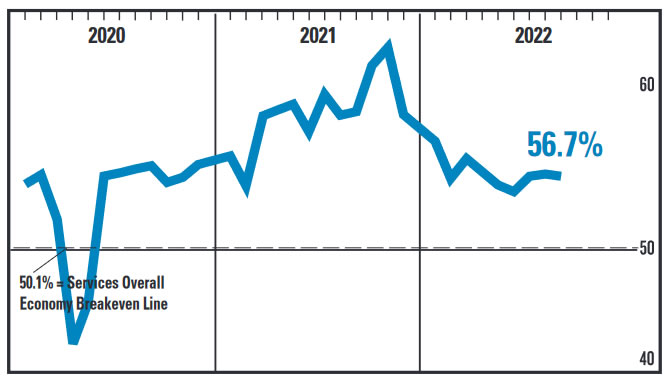
US PMI services dropped slightly to 56.7
US ISM Services PMI dropped slightly from 56.9 to 56.7 in September, above expectation of 56.0. Looking at some details, business activity/production dropped from 60.9 to 59.1. New orders dropped from 61.8 to 60.6. Employment rose from 50.2 to 53.0. Prices dropped from 71.5 to 68.7.
ISM said: "The services sector had a slight pullback in growth for the month of September due to decreases in business activity and new orders. Employment improved and supplier deliveries slowed at a slightly slower rate.
"Based on comments from Business Survey Committee respondents, there have been improvements regarding supply chain efficiency, operating capacity and materials availability; however, performance remains less than ideal. Employment continued to improve despite the restricted labor market."
Euro Outlook: Why Price Caps Don’t Matter
In the last couple of days, the Euro has been drifting higher, back towards parity. It comes at a somewhat curious juncture, considering the context in the UK. Though, it should be pointed out that yesterday markets jumped higher on expectations that the Fed would pivot sooner than previously expected.
This isn't an unusual phenomenon for the markets, to get a dose of optimism after trending downward for over a month. US stocks hit a new low for the year, and bounced back. The dollar weakness would naturally help the Euro. But there's more going on here.
Not all spending is the same
Last week, the pound took a dive after the Chancellor announced plans for a fuel price cap that could cost up to £200B, and tax incentives that would potentially reduce the UK's tax revenue by £45B. This sent shockwaves through the market, affecting even the rate decision by the RBA, citing turmoil in the UK as one of the reasons for its surprise move to raise rates lower than anticipated.
Yet at the end of the week, Germany announced an energy price cap in the order of €200B, while the EU struggles to deal with surging prices. Yet there was no proportional reaction in the markets. Germany reaffirmed its commitment to the debt brake, suggesting possible austerity measures next year. In fact, the Euro got stronger, and there was no hint that the ECB would have to step in.
Germany can spend more
The debt-to-GDP ratio is an important aspect in how inflationary government spending is likely to be. Germany has a ratio just below the Maastricht guidelines of 59.8% (that's before the pandemic). The UK was much higher at 85.4%. This puts a limit on how high the central bank can raise rates without the cost to service the government's debt significantly impacting the budget. Thus, traders aren't as worried about German government spending.
The issue for the Euro, however, is the latest round of negotiations about expanding the capacity of other countries to maintain debt. Most EU countries are not only far from complying with Maastricht rules, but some are also over twice the allowed debt-to-GDP rate, such as Italy. When taken together, the Eurozone’s debt-to-GDP is higher than the UK's.
The future trends
While the ECB maintains a lower interest rate than the BOE, the debt issue isn't as noticeable. However, there are several indicators that rates will continue to rise, potentially more than in the UK. Inflation is still on the rise, the ECB is worried about "de-anchoring" expectations, and the Euro Zone's GDP grew by a healthy 4.1% last quarter, giving the central bank more headroom.
In other words, depending on how the economy evolves, the Euro is not immune from a market reaction similar to what happened to the cable. Probably not in the near term. But, if through the winter the economic situation worsens, governments could seek to increase spending to support consumers and businesses.
The EU likely won't have the same chaotic announcement with lack of details that drove a sudden drop in confidence, such as what happened in the UK. In other words, the move might not be as sudden, but it could be as large, and require intervention from the ECB.