Sample Category Title
Cautious Post-Jobs Report
A relatively slow start to the week as investors continue to digest Friday's jobs report and what it means for financial markets just as some optimism was returning.
The report itself was strong almost across the board, with participation being the only outlier, but Fed officials will not have been quite so enthused which makes it a tough one for investors to get too excited about.
On the one hand, it strengthens the argument that the economy is not really experiencing a recession as the labour market is simply too strong. On the other, it's also extremely tight and wages are continuing to rise at a fast rate which will make the task of fighting inflation that much harder.
With another 75 basis point rate hike next month now the favoured outcome, although a lot can change in that time, it could be a nervy couple of days for investors ahead of Wednesday's inflation report. It turns out the shift to data-dependency isn't all it was cracked up to be.
Another record Chinese trade surplus but also more lockdowns
It's a relatively quiet day, and the economic calendar continues to look very thin. How traders continue to respond to Friday's report will be key in how we start the week. Asia is off to a mildly positive start but it's nothing to write home about.
Cities on the Chinese resort island of Hainan have been placed in lockdown following another Covid outbreak, reminding investors once more of the country's commitment to its zero-Covid policy at all costs. At the same time, Hong Kong has sought to appease residents and the business community by cutting quarantine periods from seven days to three. While still very restrictive compared to much of the world at this point, it was a bolder move than anticipated and highlighted the pressure to return to normal life.
Chinese trade data highlighted the struggles of the domestic economy, with imports rising 2.3% annually last month while exports remained surprisingly strong up 18%, delivering another record trade surplus. The numbers aren't expected to remain quite so favourable in the months ahead as reopening momentum fades, leaving the import numbers a concern.
Iran talks resume as oil makes small gains
Oil prices are a little higher today, recovering from the lows on Friday. The jobs report highlighted how strong the economy remains although traders are now increasingly nervous about more aggressive tightening sending the economy into a deeper recession further down the road. It really is a lose-lose.
The resumption of Iran nuclear talks today is one potential downside risk for the oil price, given the ability of the country to quickly ramp up production if a deal is struck. Not to mention its reportedly large oil and gas reserves. A deal could apparently be struck within days although we have heard that a lot at times this year.
Gold nervously eyeing inflation data
Gold is flat today after Friday's jobs report took the wind out of its sails. The recovery trade was being fueled by the belief that data-dependency meant a slower pace of tightening but that's now clearly not the case (nor was it ever, in fairness). We may see some nervy trading in the yellow metal ahead of Wednesday's inflation report although it still seems to have an eye on $1,780-1,800 which is the next major test to the upside.
A swift recovery
Sentiment across the markets looks a little fragile this morning and yet crypto appears to have shrugged off Friday's shock much more quickly. Up more than 3% this morning and climbing once more with its sights set on $25,000 it seems. The momentum indicators will be fascinating here as the recovery appeared to be losing steam during the last ascent in late July.
When Good News is Bad News
On Friday, US Non-Farm Payrolls came in over twice what was expected. The unemployment rate dropped as well, if only by a decimal point. Yet US stocks (as measured by the S&P 500 and Nasdaq) dropped. Why would it be a "bad" thing for US businesses that more Americans have jobs, and have more disposable income?
This is a recurring phenomenon in financial markets that can disrupt trading strategies. It's not exclusive to the US. in Europe, indices have been responding differently, but that could change. Since there is a direct correlation between equities, commodities, and forex, this could affect us currency traders as well.
What's going on?
When central banks get involved in the economy, this changes the dynamic of the markets. Because most day-to-day trading is conducted on margin, the cost of credit plays an important role in trader decisions. And central banks try to influence the economy by manipulating the interest rate, which in turn manipulates financial markets.
Generally, central banks aren't interested in the short-term ups and downs of financial markets. They only care in terms of price fluctuations being a sign of liquidity in the markets, which could have broader economic effects. So, if the Fed, for example, raises rates, this could make it more expensive to invest on margin. Which in turn means traders will buy and sell less stocks. In general, that means the stock market goes down. The Fed doesn't really care about a slight drop in stock prices caused by less liquidity, because part of the reason for raising rates is to cut back on "excess" liquidity that could be driving inflation.
The markets are most sensitive
Inflation, of course, is rising prices and that concept also applies to the stock market. If stock prices are increasing above the valuations of the companies, then prices are getting "inflated". Last year, companies were reporting disappointing earnings because of the lockdowns, but stock prices were rising. Meaning that stock prices were getting inflated.
The Fed's move to raise rates is the driving force behind lower stock prices, and that's what the Fed is trying to achieve in the broader market. The stock market is simply the quickest to respond.
Interpreting the data
Better economic data is a sign that prices will keep rising, and more effort by central banks is necessary to control inflation. The stock market responds to that first, meaning that the good economic news ends up being bad news for the stock market. Even if companies themselves have good news, like Tesla's stock split, they could still be pushed down by the broader market. In turn, currencies get stronger, as the market behaves in a risk-off pattern.
As long as central banks are highly active, markets are likely to have an inverse news pattern. That bad news makes the market behave in a more risk-on way, and good news leads to a more risk-off behavior pattern. This might mean trading strategies need to be inverted. But traders need to be wary of when central banks will step back from intervening, and the usual "good news is good news" dynamic suddenly returns.
Eurozone Sentix improved to -25.2, but recession still very likely
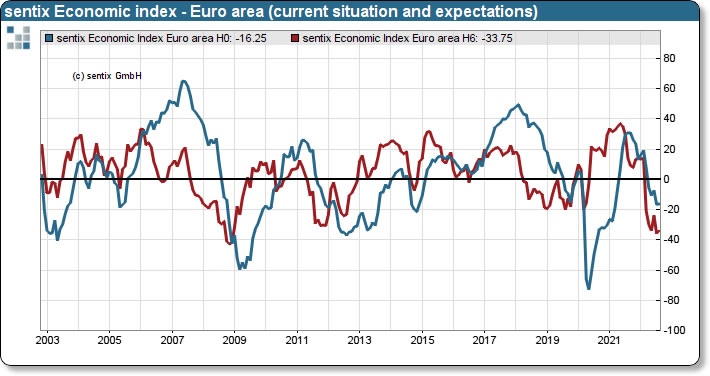
Eurozone Sentix Investor Confidence improved slightly from -26.4 to -25.2 in August, better than expectation of -26.3. Current Situation index ticked up from -16.5 to -16.3. Expectations index also edged up from -35.8 to -33.8.
However, Germany Investor Confidence dropped from -24.2 to -24.4, lowest since May 2020. Current Situation index dropped from -13.0 to -14.8, lowest since February 2021. Expectations index, on the other hand, ticked up from -34.8 to -33.5.
Sentix said, the improvement in Eurozone "does not mean that the all-clear has been given". And, "a recession in the Eurozone is still very likely."
Daily Technical Analysis
EUR/USD
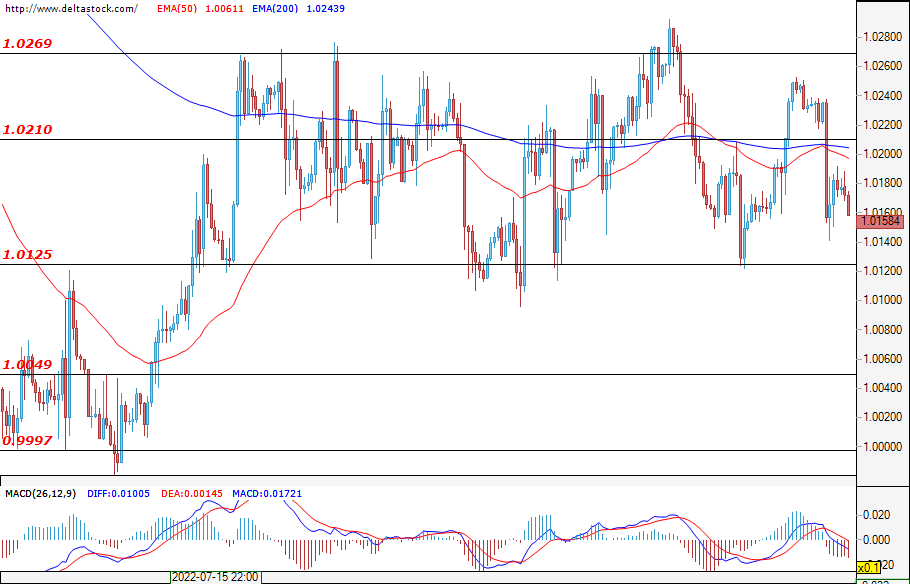
Last week, the single European currency ended with strong bearish pressure. After the announcement of the non-farm payroll numbers on Friday, the bears managed to breach the key support at 1.0210. Their attempt to reach the next one at 1.0125, however, was limited. Today, the bears once again put pressure on the market, and at the time of writing, they managed to record a move of about 10 pips in their favour. If the bulls manage to recover their positions, then they will have to deal with the next resistance at 1.0269. It seems that this week will be calm in terms of macroeconomic news, with the only news that could potentially influence the currency pair being the U.S. consumer price index data on Wednesday at 12:30 GMT.
USD/JPY
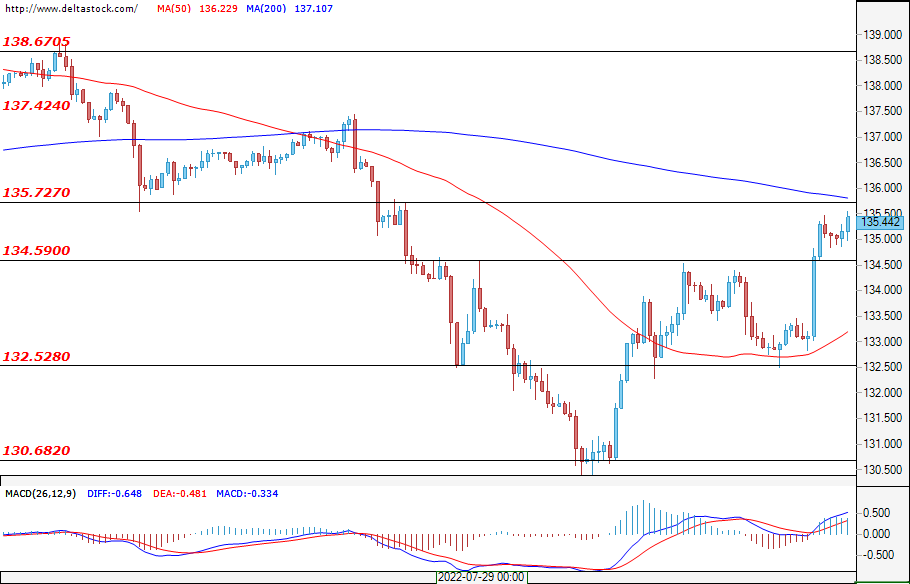
The dollar managed to assert itself even more strongly in the "land of the rising sun" at the end of last week. The bulls managed to overtake the resistance at 134.60 and are now headed for the next one at 135.72. If the bears manage to recover their lost positions, then they will have to deal with the support at 132.52 as well.
GBP/USD
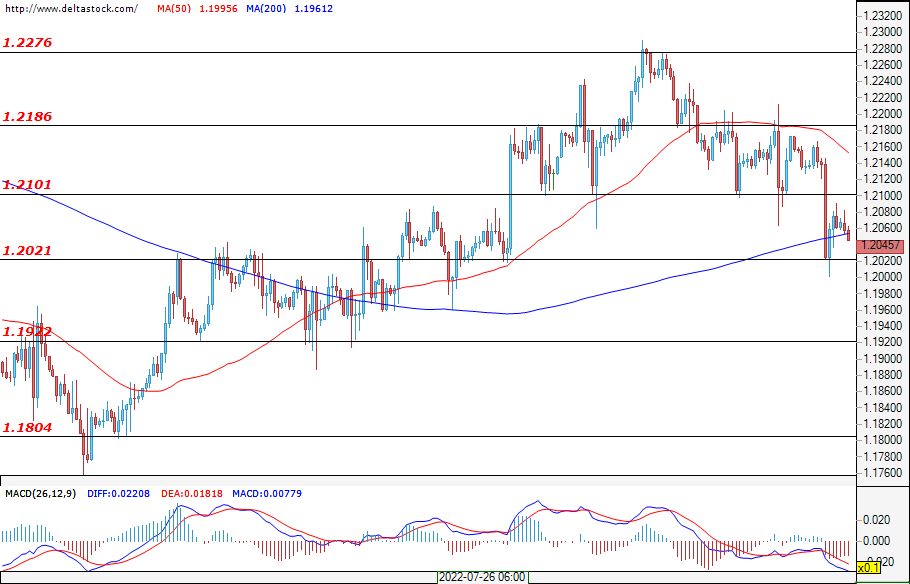
After the release of the non-farm payroll numbers last Friday, not even the pound was able to buck the dollar's momentum. The bears broke through the support at 1.2100 and made an unsuccessful attempt to breach the next one at 1.2020. If the bulls manage to resist the pressure, then they would have to deal with the resistances at 1.2100 and at 1.2186, respectively.
EUGERMANY40
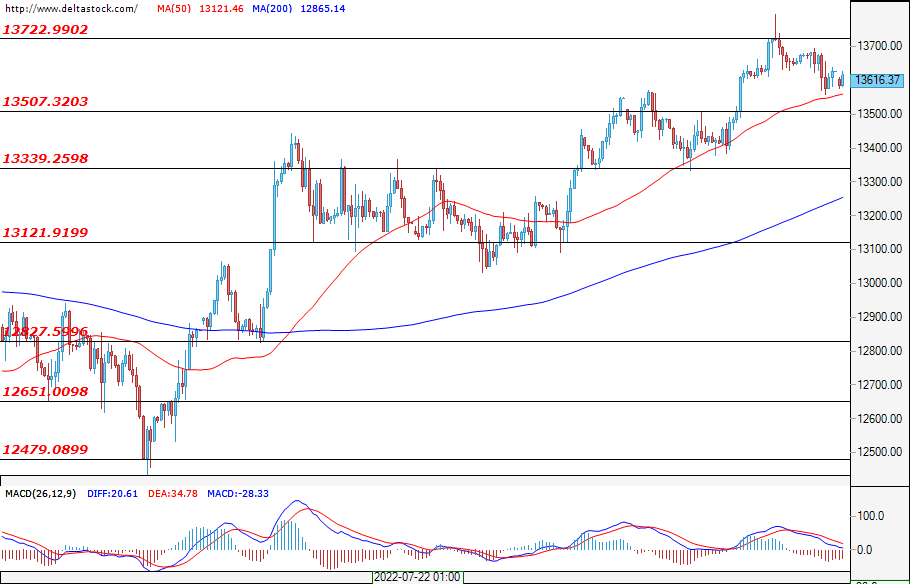
The German index continues to trade in the narrow range between the levels of 13507 and 13720, however neither the bears, nor the bulls are currently managing to gain momentum. No macroeconomic news that would cause sharp changes in the index is expected during this week. If the bears manage to strengthen the sell-offs and break away from the range-bound trading, then they could test the next support at 13339.
US30
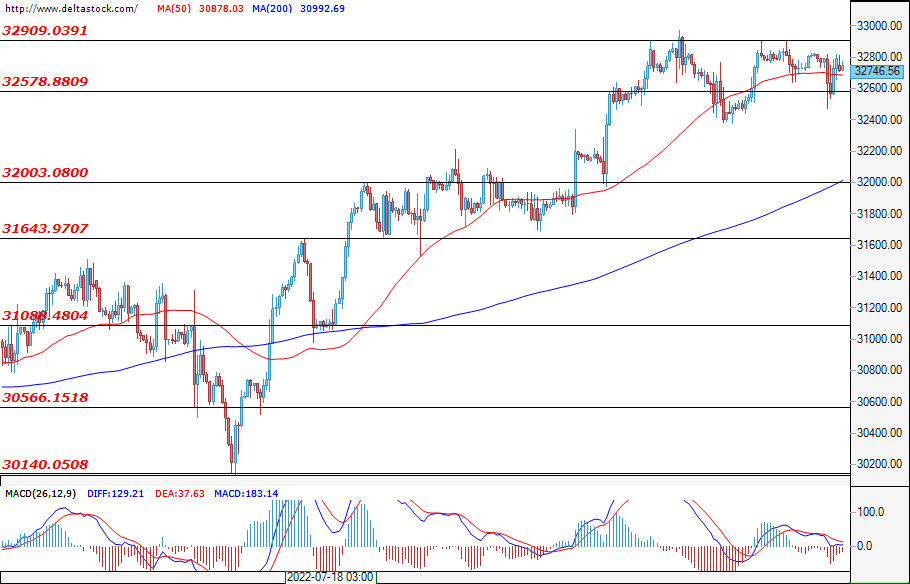
In the last 10 days, the U.S. blue-chip index consolidated in a range between the levels of 32580 – 32910. During this period of consolidation, the bears made several attempts to breach the lower boundary of the range, but failed to hold onto their positions. If their third attempt is successful, then bearish investors could try to increase the sell-offs down to the psychological support of 32000.
DAX 40 Tests Rising Trendline
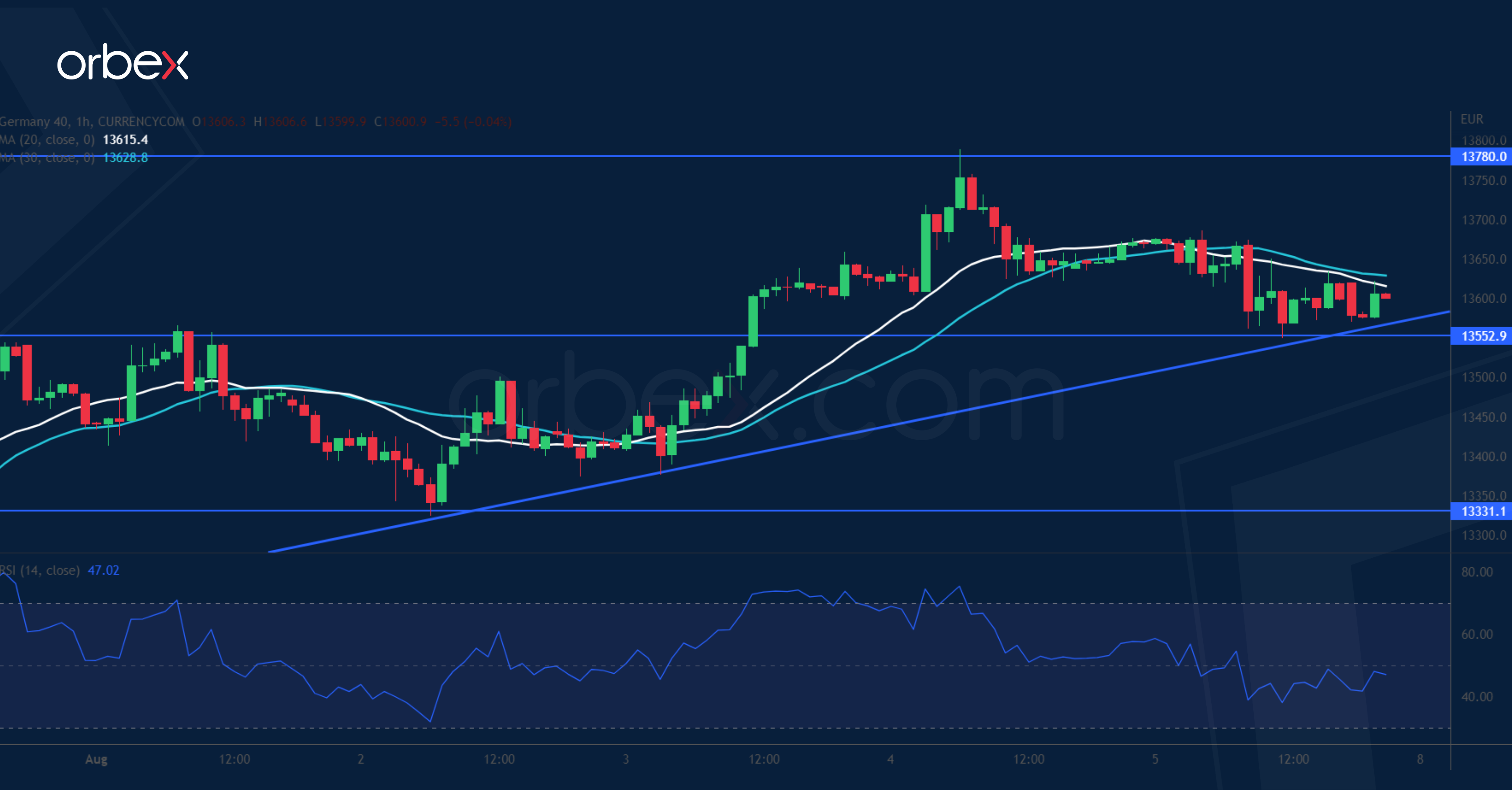
Stock markets fall as a robust US labour market may stir up the Fed’s hawkishness. The rising trendline is a sign of improved sentiment and a close above 13650 at the tip of a faded rebound in mid-June indicates a strong bullish bias. However, the RSI’s repeated overbought situation signals an overextension and could cause a pullback. 13550 on the trendline is the first support and 13330 could test buyers’ commitment. A bounce above 13780 may attract more momentum buying, sending the Dax towards 14050.
USD/CAD Bounces Back
The Canadian dollar softened after weaker-than-expected jobs data. The US dollar has been resilient despite its break below the daily support at 1.2480. This suggests that the pair is still in a consolidation phase. 1.2770 saw strong buying interest and a close above 1.2900 on the 30-day moving average prompted sellers to cover their bets, easing the downward pressure. A break above 1.3000 may help the bulls regain control, paving the way for a rally towards 1.3200. The former resistance at 1.2880 has become a fresh support.

EUR/USD Tests Support
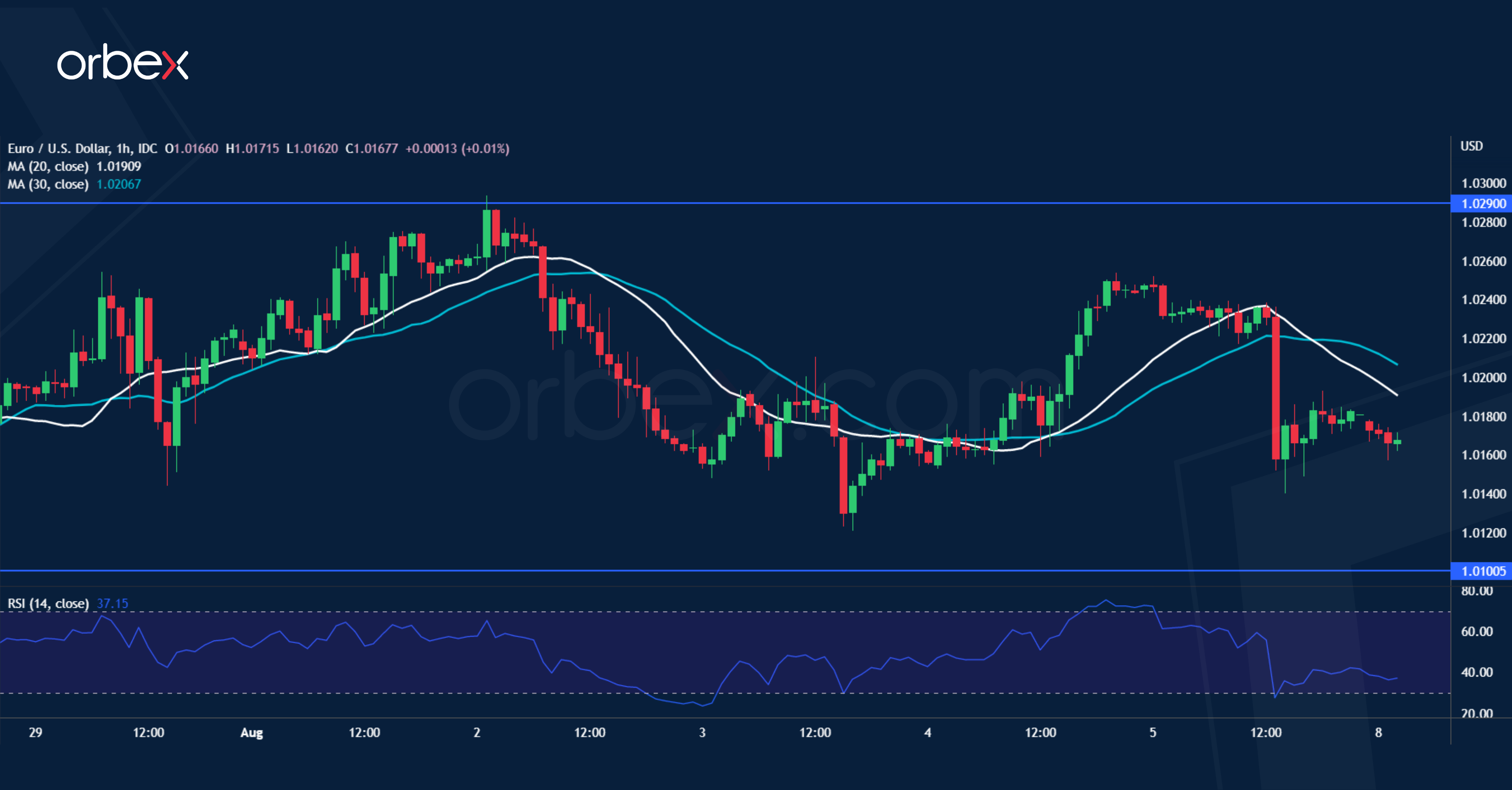
The US dollar surged after July’s nonfarm payrolls more than doubled the market’s expectations. Multiple tests of the demand zone around 1.0100 suggests solid interest in keeping the rebound intact. 1.0290 next to the 30-day moving average is a key hurdle ahead. A bullish breakout would put the single currency back on track as short-term sellers capitulate. Then 1.0450 at the start of the July sell-off would be the next target. However, a fall below the said support could send the pair back to parity, putting the recovery at risk.
USD/CAD Daily Outlook
Daily Pivots: (S1) 1.2871; (P) 1.2928; (R1) 1.2994; More...
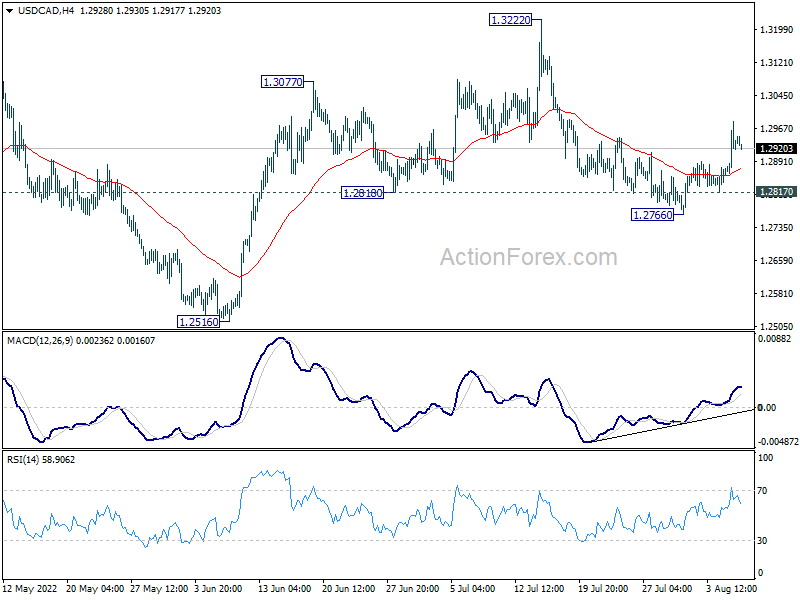
Intraday bias in USD/CAD stays mildly on the upside at this point. Pull back from 1.322 could have completed at 1.2766 already. Further rise would be seen back to retest 1.3222 high. On the downside, however, break of 1.2817 minor support will suggest that the fall from 1.3222 is resuming through 1.2766.
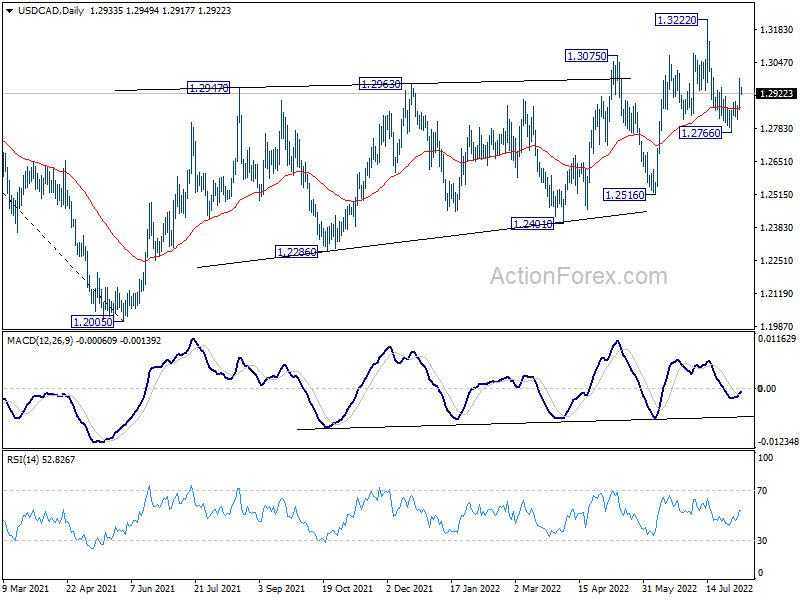
In the bigger picture, down trend from 1.4667 (2020 high) should have completed at 1.2005, after defending 1.2061 long term cluster support. Rise from there should target 61.8% retracement of 1.4667 to 1.2005 (2021 low) at 1.3650. This will remain the favored case now as long as 1.2516 support holds.
AUD/USD Daily Report
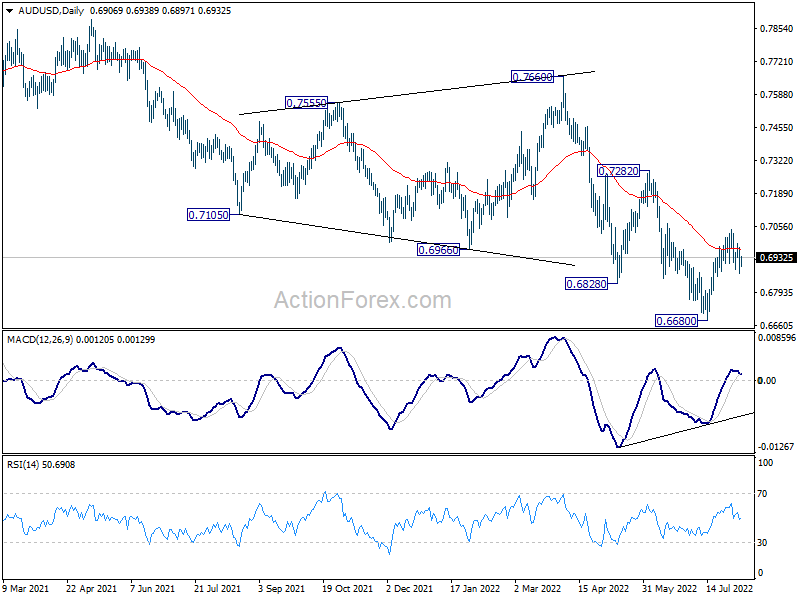
Daily Pivots: (S1) 0.6863; (P) 0.6919; (R1) 0.6968; More...
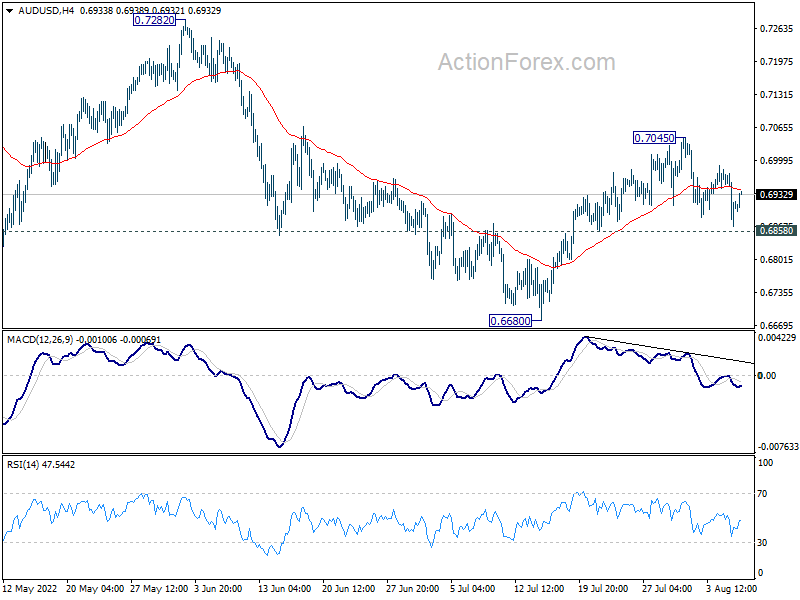
Intraday bias in AUD/USD remains neutral for the moment. On the upside, break of 0.7045 will resume the rebound from 0.6680 to 0.7282 key resistance next. On the downside, however, break of 0.6858 minor support will argue that the rebound is over. Intraday bias will then be back on the downside for retesting 0.6680 low.
In the bigger picture, price actions from 0.8006 (2021 high) is seen more as a corrective pattern to rise from 0.5506 (2020 low). Or it could be a bearish impulsive move. In either case, outlook will remain bearish as long as 0.7282 resistance holds. Next target is 61.8% retracement of 0.5506 to 0.8006 at 0.6461.
EUR/USD Daily Outlook
Daily Pivots: (S1) 1.0130; (P) 1.0191; (R1) 1.0240; More...
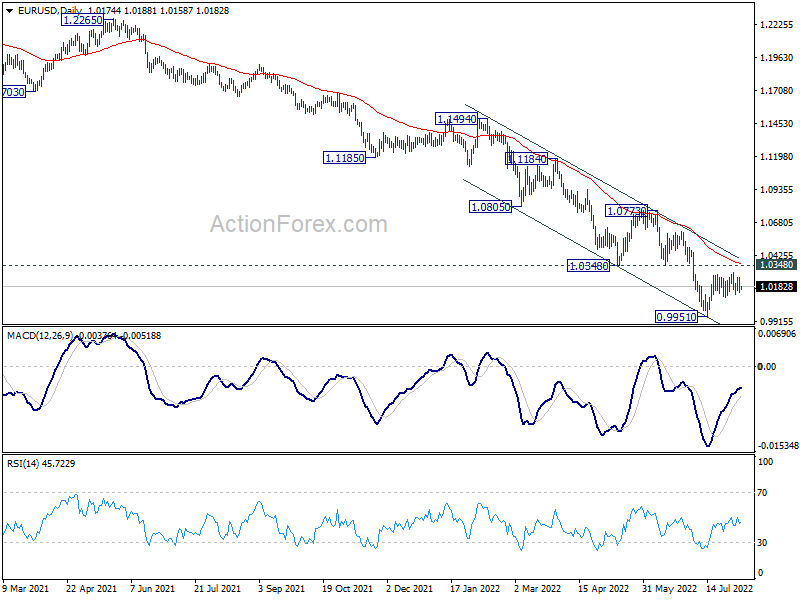
Range trading continues in EUR/USD and intraday bias stays neutral. On the downside, break of 1.0095 minor support will argue that larger down trend is ready to resume. Intraday bias will be back to the downside for retesting 0.9951 low first. For now, outlook will stay bearish as long as 1.0348 support turned resistance holds, even in case of another rise.
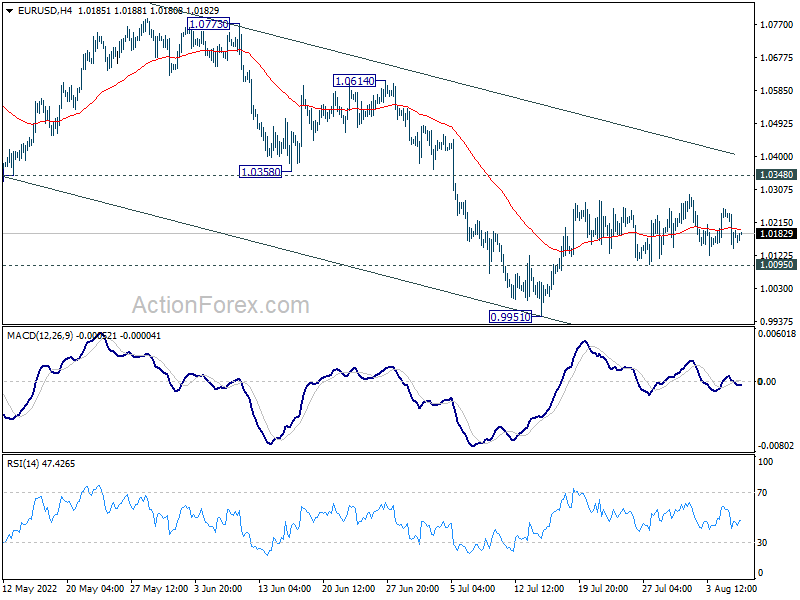
In the bigger picture, down trend from 1.6039 (2008 high) is still in progress. Next target is 100% projection of 1.3993 to 1.0339 from 1.2348 at 0.8694. In any case, outlook will stay bearish as long as 1.0773 resistance holds, in case of strong rebound.