Sample Category Title
U.S. Jobs Lift Markets as Stocks Rise and Yen Stays Weak
The focus of the week was U.S. employment data, which came in slightly weaker than expected. Nonfarm payrolls increased by around 50,000 jobs, while October and November figures were revised lower. However, markets paid more attention to the lower-than-expected unemployment rate, which supported the U.S. dollar and helped U.S. equity markets reach new record highs. As a result, expectations shifted toward the next U.S. interest rate cut taking place in April.
In Europe, the EU unemployment rate also came in below expectations, pointing to continued strength in the labor market. At the same time, rising geopolitical risks—linked to developments in Venezuela and Greenland—supported safe-haven demand. Gold remained strong throughout the week as investors looked for protection against growing political uncertainty.
In Japan, political developments also drew attention. Following her recent rise in support, Sanae Takaichi is believed to be considering calling a snap election in mid-February, as the market continued to worry about rising 10-year Japanese government bond yields.
Markets This Week
U.S. Stocks
The Dow has started the year on a positive note, extending last year’s momentum. U.S. employment data was viewed as supportive for equities, and the short-term trend is pointing higher. Buying pullbacks appears to be the preferred strategy for now, as long as prices remain above the 10-day moving average. However, unexpected policy actions from Trump remain a key risk that could disrupt the uptrend. Resistance is seen at 49,500 and 50,000, while support is located at 48,750, 48,000, 47,500, and 47,000.
Japanese Stocks
The Nikkei 225 surged after U.S. employment data boosted U.S. equities and the yen weakened further, pushing the index to fresh record highs. Some profit-taking may appear early in the week, but with the trend remaining strong and the yen staying weak, buying pullbacks continues to look like the preferred strategy. Resistance is seen at 54,000円, 55,000円, and 56,000円, while support is located at 52,500円, 51,500円, and 51,000円.
USD/JPY
USD/JPY returned to the key 158 level after U.S. employment data showed the U.S. economy remains strong. The weak-yen trend continues as concerns over Japan’s long-term debt persist. Volatility may increase this week as markets push higher and watch whether the Bank of Japan intervenes at current levels or waits until 160. For short-term traders, buying pullbacks toward the 10-day moving average or a clear break above 158 may offer opportunities. Resistance is seen at 158, 159, and 160, while support is located at 156, 155, and 154.5.
Gold
Gold remained strong throughout the week as rising geopolitical risks encouraged buyers to return to the market. Increased uncertainty linked to Trump’s activity in Venezuela and discussions around Greenland supported safe-haven demand. With prices now trading close to record highs, the uptrend remains intact and buying pullbacks continues to look like the preferred strategy in the current environment. Resistance is seen at $4,550, $4,600, and $4,700, while support is located at $4,450, $4,400, and $4,350.
Crude Oil
WTI crude tested support near $55 before rebounding and finishing the week close to resistance at $60, supported by ongoing unrest and protests in Iran that could threaten supply from key producers. Technical indicators continue to point to sideways movement, making range trading the preferred approach while prices remain between $55 and $60. However, a further rise in Middle East tensions could trigger a break above $60. Resistance is seen at $60, $65, $66.50, $70, and $75, while support remains at $55 and $50.
Bitcoin
Bitcoin had a strong start to the week as traders positioned for 2026, but selling emerged near the $95,000 resistance level, pushing prices back toward the middle of the range. With equities rallying strongly, Bitcoin underperformed, making for a somewhat disappointing week. In the current environment, range trading continues to look like the preferred strategy. Resistance is seen at $95,000 and $100,000, while support is located at $85,000, $80,000, and $75,000.
This Week’s Focus
- Monday: None
- Tuesday: U.S. CPI and New Home Sales
- Wednesday: Australia Building Approvals, U.S. PPI, Retail Sales and Existing Home Sales
- Thursday: Japan PPI, U.K. GDP, Industrial Production and Trade Balance, E.U. Trade Balance, U.S. Philadelphia Fed Manufacturing Index and S&P Global Manufacturing PMI
- Friday: E.U. German CPI, U.S. Industrial Production
It is expected to be a busy week, with the yen and gold near key levels. U.S. inflation and retail sales data may cause market swings, while rising geopolitical tensions are keeping traders active. Markets will also be watching the Bank of Japan closely for any signs of intervention if the yen continues to weaken.
Gold, Silver, and the S&P 500: Navigating the New Correlation
For decades, investors viewed Gold and Silver as the ultimate insurance policy. Traditionally, precious metals and equities moved in opposite directions, providing a natural hedge for portfolios. However, the market dynamics of 2024 and 2025 completely rewrote the rulebook. As we navigate the first quarter of 2026, understanding this new “direct correlation” is vital for protecting your wealth.
The Foundation: Why Metals Traditionally Oppose Stocks
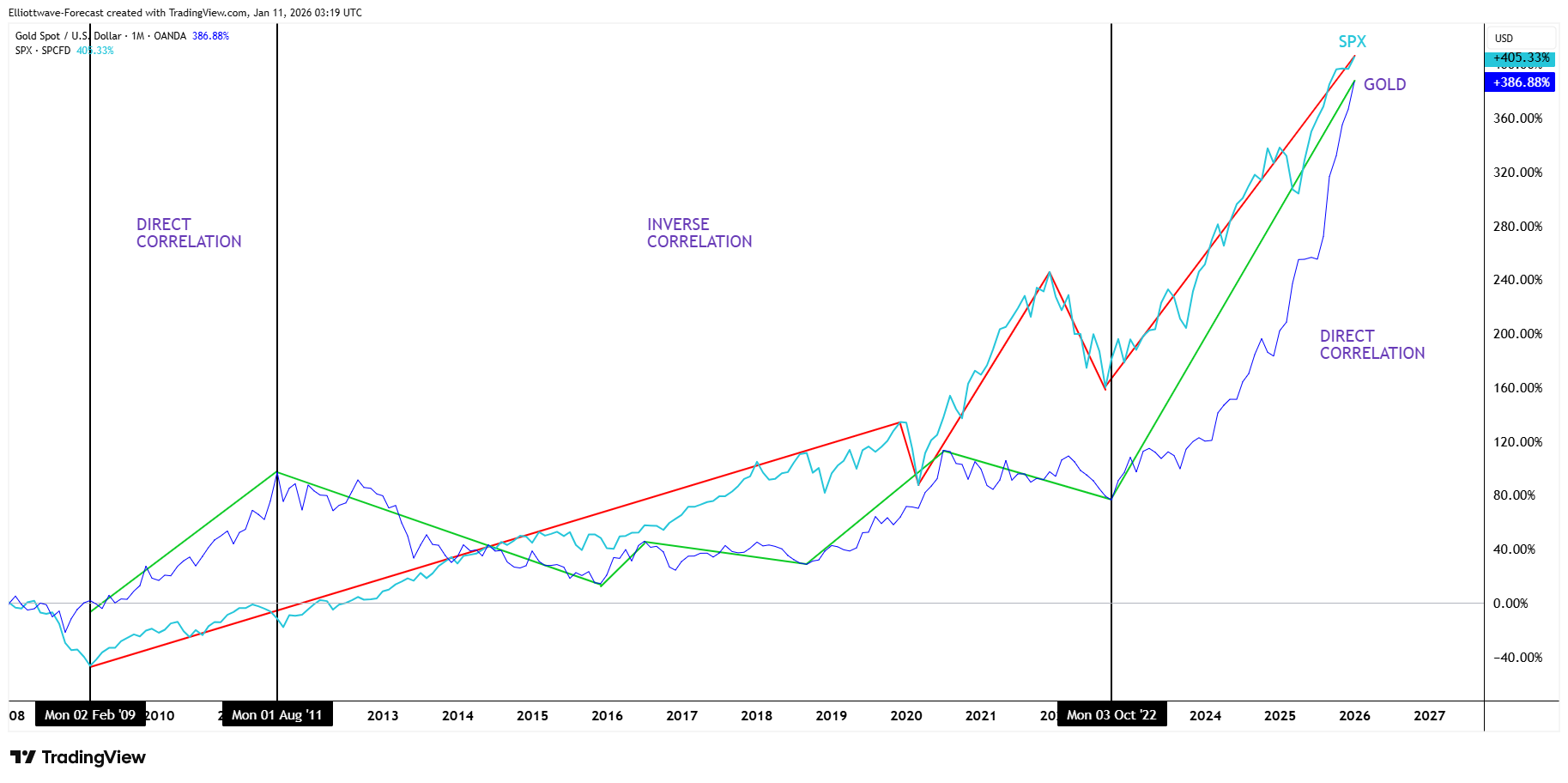
Historically, Gold (1$XAU$) and the S&P 500 (2$SPX$) maintained a strong inverse correlation.3 When the stock market thrived, gold prices usually stalled or fell. This “tug-of-war” occurred for three main reasons:
- Risk Sentiment: Investors aggressively pursue growth (stocks) during “risk-on” periods and flee to gold (safety) during “risk-off” cycles.
- Opportunity Cost: Because gold pays no dividends, high stock returns make holding the metal “costly” in terms of missed gains.
- Monetary Stability: Gold acts as a hedge against a weak dollar. Consequently, a currency crisis typically hurts stocks while simultaneously boosting gold.
The Great Breakdown of Gold in 2024 and 2025
The investment playbook broke recently. This was not a sudden shift, but rather an acceleration that consolidated a new, aggressive trend:
- The 2024 Anomaly: For the first time in the modern era, Gold and the S&P 500 both gained over 25% in the same year. In August 2024, their correlation hit a record 0.91, as they moved in almost total synchrony.
- The 2025 Consolidation: Last year, the market witnessed simultaneous all-time highs. Stocks rose on the AI boom, while Gold climbed due to mounting fears regarding the massive US fiscal deficit.
Why Did This Happen?
In a startling turn for early 2026, the traditional rulebook has been discarded. We are currently seeing a positive correlation, where both Gold and the S&P 500 reach all-time highs simultaneously (with gold hovering around $4,500 – $5,000 per ounce). This breakdown is driven by three modern forces:
- Global Debt & Dollar Debasement: National debt has reached levels that trigger fears of permanent inflation. As a result, institutions buy the S&P 500 for earnings growth and Gold to protect against a devaluing currency. They no longer choose one or the other; they buy both.
- Central Bank Dominance: Central banks worldwide are diversifying their reserves away from Treasuries at a record pace. This “non-cyclical” buying pressure keeps gold prices high, regardless of how well Wall Street performs.
- Interest Rate Expectations: Anticipation of Fed rate cuts in Q1 2026 has reduced real yields. This makes stocks more valuable (cheaper debt) and gold more attractive (lower opportunity cost) at the same time.
Q1 2026 Outlook: What Should We Expect?
As we advance through the first quarter of 2026, the market sits at a critical junction. The primary question is: will this direct correlation persist, or will we return to the old dynamics?
The Case for Continued Direct Movement
Analysts expect this direct correlation to hold through most of Q1. Specifically, as long as the AI-driven earnings boom continues and central banks keep accumulating gold, both assets will benefit from the massive global liquidity in the system.
The Return to Decoupling
Conversely, we will likely see a “Grand Decoupling” toward the end of the year. Historically, periods where “everything rallies” mark the final stage of a market cycle. If a sudden economic shock occurs, investors will liquidate winning stock positions to cover losses, while Gold will separate to become the only remaining safety net.
Strategic Summary for Investors
The current movement “in unison” is an anomaly fueled by debt and liquidity. While it is profitable now, astute investors must prepare for an eventual return to the mean. Once the market realizes that corporate growth cannot outrun structural currency debasement forever, the traditional inverse correlation will reclaim its throne.
CHFJPY Wave Analysis
CHFJPY: ⬆️ Buy
- CHFJPY reversed from support area
- Likely to rise to resistance level 198.50
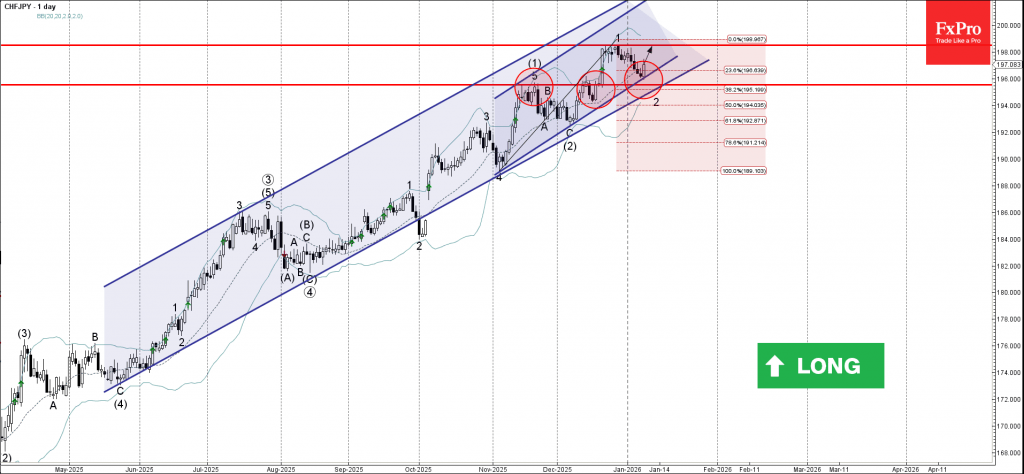
CHFJPY currency pair recently reversed from the support area between the pivotal support level 196.00 (former resistance from November and December) and the 38.2% Fibonacci correction of the upward impulse from November.
The upward reversal from this support area continues the active intermediate impulse wave (3).
Given the strong daily uptrend and bullish Swiss franc sentiment seen today, CHFJPY currency pair can be expected to rise to the next resistance level 198.50 (top of the previous impulse wave 1).
Eco Data 1/12/26
| GMT | Ccy | Events | Act | Cons | Prev | Rev |
|---|---|---|---|---|---|---|
| 09:30 | EUR | Eurozone Sentix Investor Confidence Jan | -1.8 | -5.1 | -6.2 |
| 09:30 | EUR |
| Eurozone Sentix Investor Confidence Jan | |
| Actual | -1.8 |
| Consensus | -5.1 |
| Previous | -6.2 |
Test
Monday, Jan 12, 2026
| GMT | Ccy | Events | Cons | Prev |
|---|---|---|---|---|
| 09:30 | EUR | Eurozone Sentix Investor Confidence Jan | -5.1 | -6.2 |
| 09:30 | EUR |
| Eurozone Sentix Investor Confidence Jan | |
| Consensus | -5.1 |
| Previous | -6.2 |
Tuesday, Jan 13, 2026
| GMT | Ccy | Events | Cons | Prev |
|---|---|---|---|---|
| 21:00 | NZD | NZIER Business Confidence Q4 | 18 | |
| 22:50 | AUD | Westpac Consumer Sentiment Jan | -9.00% | |
| 23:50 | JPY | Bank Lending Y/Y Dec | 4.10% | 4.20% |
| 23:50 | JPY | Current Account (JPY) Nov | 3.04T | 2.48T |
| 05:00 | JPY | Eco Watchers Survey: Current Dec | 48.8 | 48.7 |
| 11:00 | USD | NFIB Business Optimism Index Dec | 99.5 | 99 |
| 13:30 | CAD | Building Permits M/M Nov | -6.50% | 14.90% |
| 13:30 | USD | CPI M/M Dec | 0.30% | 0.30% |
| 13:30 | USD | CPI Y/Y Dec | 2.70% | 2.70% |
| 13:30 | USD | CPI Core M/M Dec | 0.30% | 0.20% |
| 13:30 | USD | CPI Core Y/Y Dec | 2.70% | 2.60% |
| 21:00 | NZD |
| NZIER Business Confidence Q4 | |
| Consensus | |
| Previous | 18 |
| 22:50 | AUD |
| Westpac Consumer Sentiment Jan | |
| Consensus | |
| Previous | -9.00% |
| 23:50 | JPY |
| Bank Lending Y/Y Dec | |
| Consensus | 4.10% |
| Previous | 4.20% |
| 23:50 | JPY |
| Current Account (JPY) Nov | |
| Consensus | 3.04T |
| Previous | 2.48T |
| 05:00 | JPY |
| Eco Watchers Survey: Current Dec | |
| Consensus | 48.8 |
| Previous | 48.7 |
| 11:00 | USD |
| NFIB Business Optimism Index Dec | |
| Consensus | 99.5 |
| Previous | 99 |
| 13:30 | CAD |
| Building Permits M/M Nov | |
| Consensus | -6.50% |
| Previous | 14.90% |
| 13:30 | USD |
| CPI M/M Dec | |
| Consensus | 0.30% |
| Previous | 0.30% |
| 13:30 | USD |
| CPI Y/Y Dec | |
| Consensus | 2.70% |
| Previous | 2.70% |
| 13:30 | USD |
| CPI Core M/M Dec | |
| Consensus | 0.30% |
| Previous | 0.20% |
| 13:30 | USD |
| CPI Core Y/Y Dec | |
| Consensus | 2.70% |
| Previous | 2.60% |
Wednesday, Jan 14, 2026
| GMT | Ccy | Events | Cons | Prev |
|---|---|---|---|---|
| 21:45 | NZD | Building Permit Nov | -0.90% | |
| 03:00 | CNY | Trade Balance (USD) Dec | 114.2B | 111.7B |
| 06:00 | JPY | Machine Tool Orders Y/Y Dec P | 14.20% | 14.20% |
| 13:30 | USD | Current Account (USD) Q3 | -240B | -251B |
| 13:30 | USD | Retail Sales M/M Nov | 0.40% | 0.00% |
| 13:30 | USD | Retail Sales ex Autos M/M Nov | 0.40% | 0.40% |
| 15:00 | USD | Existing Home Sales Dec | 4.20M | 4.13M |
| 15:00 | USD | Business Inventories Oct | 0.30% | 0.20% |
| 15:30 | USD | Crude Oil Inventories (Jan 9) | -1.7M | -3.8M |
| 19:00 | USD | Fed's Beige Book |
| 21:45 | NZD |
| Building Permit Nov | |
| Consensus | |
| Previous | -0.90% |
| 03:00 | CNY |
| Trade Balance (USD) Dec | |
| Consensus | 114.2B |
| Previous | 111.7B |
| 06:00 | JPY |
| Machine Tool Orders Y/Y Dec P | |
| Consensus | 14.20% |
| Previous | 14.20% |
| 13:30 | USD |
| Current Account (USD) Q3 | |
| Consensus | -240B |
| Previous | -251B |
| 13:30 | USD |
| Retail Sales M/M Nov | |
| Consensus | 0.40% |
| Previous | 0.00% |
| 13:30 | USD |
| Retail Sales ex Autos M/M Nov | |
| Consensus | 0.40% |
| Previous | 0.40% |
| 15:00 | USD |
| Existing Home Sales Dec | |
| Consensus | 4.20M |
| Previous | 4.13M |
| 15:00 | USD |
| Business Inventories Oct | |
| Consensus | 0.30% |
| Previous | 0.20% |
| 15:30 | USD |
| Crude Oil Inventories (Jan 9) | |
| Consensus | -1.7M |
| Previous | -3.8M |
| 19:00 | USD |
| Fed's Beige Book | |
| Consensus | |
| Previous | |
Thursday, Jan 15, 2026
| GMT | Ccy | Events | Cons | Prev |
|---|---|---|---|---|
| 23:50 | JPY | PPI Y/Y Dec | 2.40% | 2.70% |
| 00:00 | AUD | Consumer Inflation Expectations Jan | 4.70% | |
| 07:00 | GBP | GDP M/M Nov | 0.00% | -0.10% |
| 07:00 | GBP | Manufacturing Production M/M Nov | 0.50% | 0.50% |
| 07:00 | GBP | Manufacturing Production Y/Y Nov | -0.30% | -0.80% |
| 07:00 | GBP | Industrial Production M/M Nov | 0.10% | 1.10% |
| 07:00 | GBP | Industrial Production Y/Y Nov | -0.80% | -0.80% |
| 07:00 | GBP | Goods Trade Balance (GBP) Nov | -20.4B | -22.5B |
| 10:00 | EUR | Eurozone Trade Balance (EUR) Nov | 15.2B | 14.0B |
| 10:00 | EUR | Eurozone Industrial Production M/M Nov | 0.50% | 0.80% |
| 13:30 | CAD | Manufacturing Sales M/M Nov | -1.10% | -1% |
| 13:30 | CAD | Wholesales Sales M/M Nov | 0.10% | 0.10% |
| 13:30 | USD | Initial Jobless Claims (Jan 9) | 208K | 208K |
| 13:30 | USD | Empire State Manufacturing Jan | 1 | -3.9 |
| 13:30 | USD | Philadelphia Fed Manufacturing Jan | -5 | -10.2 |
| 13:30 | USD | Import Price Index M/M Nov | -0.20% | 0.00% |
| 15:30 | USD | Natural Gas Storage (Jan 9) | -89B | -119B |
| 23:50 | JPY |
| PPI Y/Y Dec | |
| Consensus | 2.40% |
| Previous | 2.70% |
| 00:00 | AUD |
| Consumer Inflation Expectations Jan | |
| Consensus | |
| Previous | 4.70% |
| 07:00 | GBP |
| GDP M/M Nov | |
| Consensus | 0.00% |
| Previous | -0.10% |
| 07:00 | GBP |
| Manufacturing Production M/M Nov | |
| Consensus | 0.50% |
| Previous | 0.50% |
| 07:00 | GBP |
| Manufacturing Production Y/Y Nov | |
| Consensus | -0.30% |
| Previous | -0.80% |
| 07:00 | GBP |
| Industrial Production M/M Nov | |
| Consensus | 0.10% |
| Previous | 1.10% |
| 07:00 | GBP |
| Industrial Production Y/Y Nov | |
| Consensus | -0.80% |
| Previous | -0.80% |
| 07:00 | GBP |
| Goods Trade Balance (GBP) Nov | |
| Consensus | -20.4B |
| Previous | -22.5B |
| 10:00 | EUR |
| Eurozone Trade Balance (EUR) Nov | |
| Consensus | 15.2B |
| Previous | 14.0B |
| 10:00 | EUR |
| Eurozone Industrial Production M/M Nov | |
| Consensus | 0.50% |
| Previous | 0.80% |
| 13:30 | CAD |
| Manufacturing Sales M/M Nov | |
| Consensus | -1.10% |
| Previous | -1% |
| 13:30 | CAD |
| Wholesales Sales M/M Nov | |
| Consensus | 0.10% |
| Previous | 0.10% |
| 13:30 | USD |
| Initial Jobless Claims (Jan 9) | |
| Consensus | 208K |
| Previous | 208K |
| 13:30 | USD |
| Empire State Manufacturing Jan | |
| Consensus | 1 |
| Previous | -3.9 |
| 13:30 | USD |
| Philadelphia Fed Manufacturing Jan | |
| Consensus | -5 |
| Previous | -10.2 |
| 13:30 | USD |
| Import Price Index M/M Nov | |
| Consensus | -0.20% |
| Previous | 0.00% |
| 15:30 | USD |
| Natural Gas Storage (Jan 9) | |
| Consensus | -89B |
| Previous | -119B |
Friday, Jan 16, 2026
| GMT | Ccy | Events | Cons | Prev |
|---|---|---|---|---|
| 21:30 | NZD | Business NZ PMI Dec | 51.4 | |
| 07:00 | EUR | Germany CPI M/M Dec F | 0.00% | 0.00% |
| 07:00 | EUR | Germany CPI Y/Y Dec F | 2.00% | 2.00% |
| 14:15 | USD | Industrial Production M/M Dec | 0.20% | 0.20% |
| 14:15 | USD | Capacity Utilization Dec | 76% | 76% |
| 15:00 | USD | NAHB Housing Market Index Jan | 40 | 39 |
| 21:30 | NZD |
| Business NZ PMI Dec | |
| Consensus | |
| Previous | 51.4 |
| 07:00 | EUR |
| Germany CPI M/M Dec F | |
| Consensus | 0.00% |
| Previous | 0.00% |
| 07:00 | EUR |
| Germany CPI Y/Y Dec F | |
| Consensus | 2.00% |
| Previous | 2.00% |
| 14:15 | USD |
| Industrial Production M/M Dec | |
| Consensus | 0.20% |
| Previous | 0.20% |
| 14:15 | USD |
| Capacity Utilization Dec | |
| Consensus | 76% |
| Previous | 76% |
| 15:00 | USD |
| NAHB Housing Market Index Jan | |
| Consensus | 40 |
| Previous | 39 |
Geopolitics Everywhere, Panic Nowhere in Resilient Global Markets
The first full week of 2026 delivered a barrage of geopolitical shocks that would normally be expected to rattle global markets. Instead, investors largely looked through the noise, producing a market outcome that appears counterintuitive at first glance.
The most dramatic development came from Latin America, where the US carried out a direct military intervention that resulted in the capture of Venezuela’s President. Washington subsequently moved to take control of Venezuela’s vast oil reserves, for selling previously sanctioned crude, marking a decisive escalation in US involvement in the region.
Shortly after, geopolitical tensions widened further as the White House doubled down on rhetoric around Greenland, describing its acquisition as a “national security priority” to counter Russian and Chinese influence in the Arctic. While the likelihood of outright annexation remains remote, the language alone was enough to keep geopolitical risk firmly in focus.
At the same time, Iran entered one of its most significant periods of domestic unrest in years, with nationwide protests met by a violent crackdown. The deterioration in internal stability added further to an already crowded geopolitical picture, particularly given Tehran’s strained relationship with Washington.
Despite this heavy backdrop, global risk appetite proved remarkably resilient. Major equity indices including S&P 500, FTSE and DAX all pushed to fresh record highs, sending a clear signal that markets were unwilling to price in systemic risk from geopolitical headlines alone.
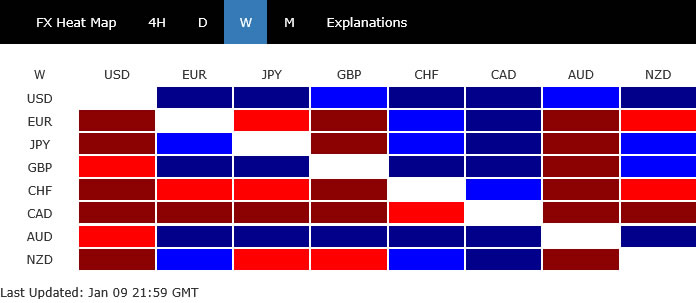
Instead, the adjustment occurred primarily in currencies. Dollar emerged as the strongest performer of the week, supported both by its hegemonic role during periods of global tension and by a shift in Fed expectations following a full slate of US data releases.
Aussie followed as the second-best performer, buoyed by firm risk appetite and reinforced by RBA rhetoric that ruled out near-term rate cuts. Sterling also benefited from the broader risk-on tone.
At the other end of the spectrum, Loonie stood out as the weakest major currency, followed by Swiss Franc and Euro. Kiwi and Yen finished the week mixed in the middle, highlighting that geopolitics did matter — but only selectively.
Dollar Leads But Lacks Intermarket Confirmation
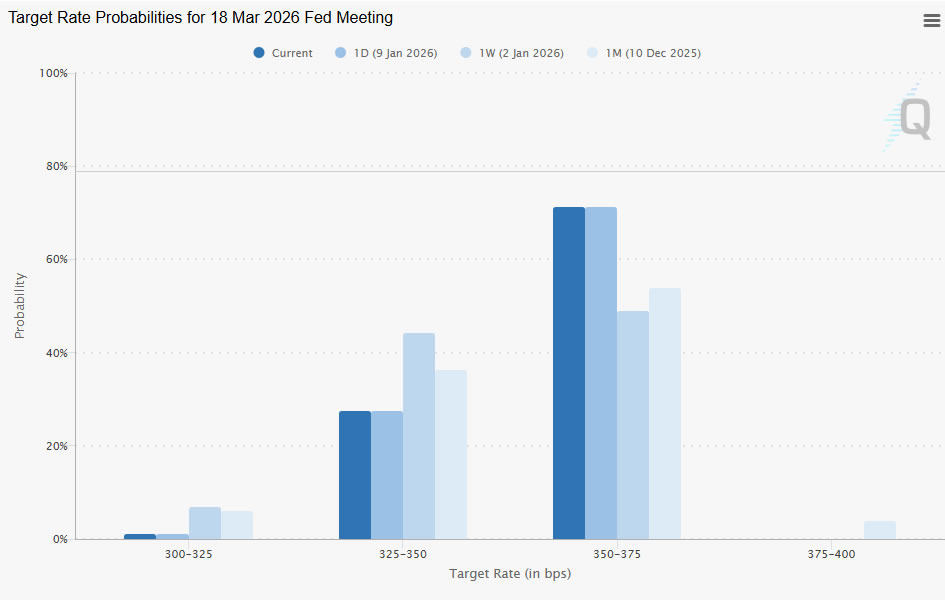
Dollar finished last week as the strongest major currency, extending gains after some hesitation. Following a string of mixed but generally resilient US economic releases, markets have moved swiftly to price out the chance of near-term easing. Fed funds futures now imply over a 70% probability that rates will be held at 3.50–3.75% at the March FOMC meeting, a sharp reversal from less than 50% just a week earlier.
A key anchor for that repricing was the labor market. While December payroll growth was modest at 50k, the unemployment rate fell from a revised 4.5% in November to 4.4%, reinforcing the view that labor conditions remain tight despite slowing hiring momentum. That combination leaves the Fed with little incentive to rush into another “insurance cut.” With wage growth still firm and unemployment low, policymakers can afford to wait for clearer signs of deterioration before shifting stance.
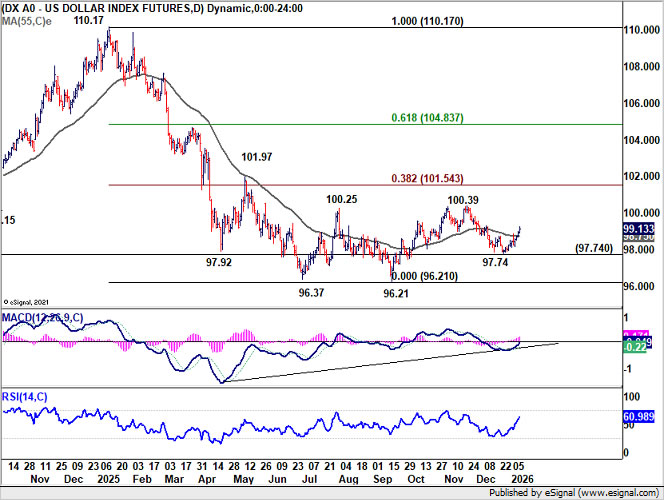
Technically, Dollar Index’s rebound extended with firm break of 55 D EMA (now at 98.75). That move suggests the pullback from 100.39 has completed at 97.74 as a correction. Further rally is now in favor back to 100.39 resistance, and possibly above.
Even so, the broader structure remains corrective. The advance from 96.21 is still viewed as a counter-trend move within the longer-term decline from 110.17. As such, upside potential is expected to be capped near 38.2% retracement of 110.17 to 96.21 at 101.54, absent substantial shift in underlying developments.
For Dollar to transition from a corrective rebound to sustained medium-term strength, intermarket confirmation is required. Specifically, markets would need to see a meaningful correction in equities and a decisive upside break in Treasury yields — ideally occurring in tandem. But that confirmation has yet to materialize.
DOW extended its uptrend to fresh record highs last week, suggesting that risk appetite remained intact. As long as 47,853 support holds, near-term bias remains bullish, with attention on 50,000 psychological level, which coincide with medium term rising channel ceiling. Decisive break above that 50,000 zone would likely accelerate gains towards 100% projection of 41,981.14 to 48,431.57 from 45,728.93 at 52,179.36. Such development would cap momentum of any Dollar rally.

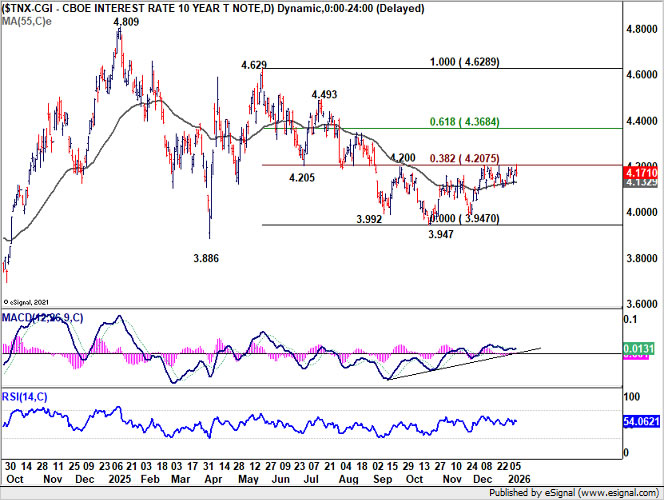
Treasury yields is also a critical missing link in determining whether Dollar’s rebound can evolve into something more durable. For now, US 10-year yield is locked in a narrowing range, repeatedly finding support at the 55 D EMA (now at 4.136), while failing to generate enough momentum to clear the 4.200 cluster resistance (38.2% retracement of 4.629 to 3.947 at 4.207) decisively.
On the one hand, decisive break above 4.200, would confirm that the fall from 4.629 has completed already. That would open the way to 61.8% at 4.63. However, sustained break of the 55 D EMA will argue that recent rebound from 3.947 has completed, and bring deeper fall back to 4.000 round number. If realized, that could also mark the completion of Dollar Index's corrective bound, and drag it lower back towards 96.21 support.
Venezuela Shock Exposes CAD’s Strategic Vulnerability
Among the major currencies, Canadian Dollar emerged as the clear underperformer of the week. Its weakness stood out not only against US Dollar, but also relative to other commodity-linked peers, highlighting that this was not a generic risk move but a distinctly Canada-specific repricing.
At the heart of the selloff was the US military intervention in Venezuela and the subsequent decision by Washington to take control of the country’s oil output. President Donald Trump announced that Venezuela’s interim authorities would transfer an estimated 30–50 million barrels of sanctioned crude to the US, with shipments expected to arrive directly at US unloading facilities.
In the near term, the mechanics and timing of these deliveries remain unclear. But markets wasted little time in pricing the implications. Any influx of Venezuelan crude into the US market would compete directly with Canadian oil exports.
Beyond the immediate supply impact, the longer-term strategic consequences weighed even more heavily on Loonie. Increased Venezuelan oil flows weaken Canada’s leverage ahead of this year’s review of the CUSMA trade agreement, which has so far shielded much of Canada’s exports from US tariffs.
Even though most Canadian crude enters the US through the Midwest rather than the Gulf Coast, markets are forward-looking. The prospect of Washington having alternative oil supply options reduces Ottawa’s negotiating power at a sensitive political juncture.
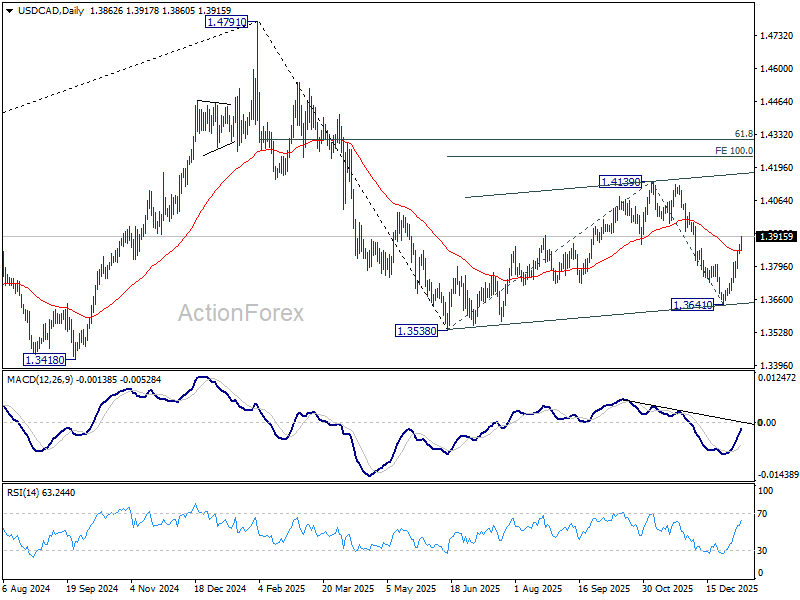
Technically, price action in USD/CAD mirrors that fundamental shift. Last week’s strong rally suggests decline from 1.4139 has completed as a correction at 1.3641. The advance from there is now seen as the third leg of a broader corrective pattern originating from 1.3538. That opens the scope for a retest of 1.4139, and possibly further to 100% projection of 1.3538 to 1.4139 from 1.3641 at 1.4242.
Whether this move evolves into a full bullish reversal could ultimately hinge on the outcome of the CUSMA review and how aggressively Washington reshapes continental energy flows.
Snap Election Speculation Lifts Nikkei, Undermines Yen
Yen failed to play its traditional safe-haven role last week. Instead, USD/JPY staged a clear upside breakout during, supported partly by firmer US data and Fed repricing. But more importantly, the selloff in Yen was fueled by a sharp shift in sentiment toward Japanese assets. The catalyst came from local political reporting rather than macro data.
According to the Yomiuri Shimbun's late report on Friday, Prime Minister Sanae Takaichi is weighing a snap election as early as February. The strategy would allow her to leverage high approval ratings to secure a more stable governing majority.
For markets, the election narrative is significant because it strengthens expectations of fiscal expansion. A renewed mandate would give Takaichi greater freedom to pursue growth-supportive spending policies, reinforcing Japan’s equity story.
That prospect drove Nikkei futures sharply higher to new records after the local market close. The rally, in turn, accelerated outflows from Yen, which once again behaved as a funding currency rather than a haven.
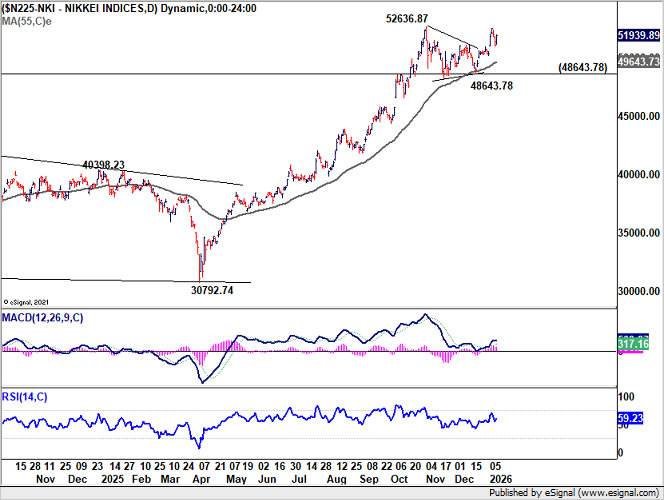
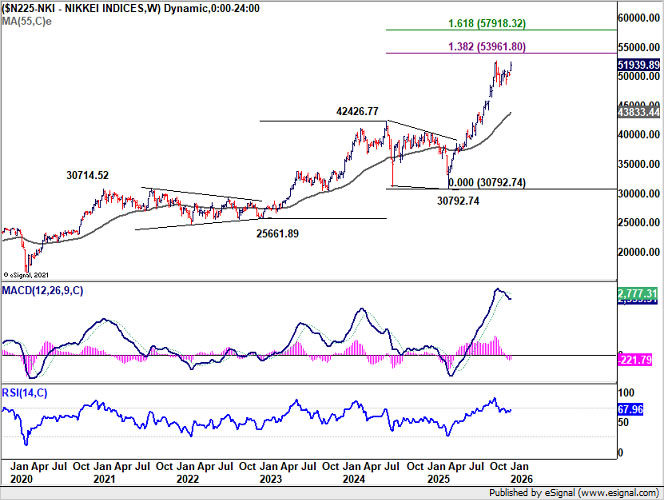
Technically, immediate attention now turns to whether Nikkei 225 can gap cleanly above 52,636.87 on Monday and sustain momentum. If it does, the next focus will be 138.2% projection of 25,661.89 to 42,426.77 from 30,792.74 at 53,961.80. Firm break there will pave the way to 161.8% projection at 57,918.32.
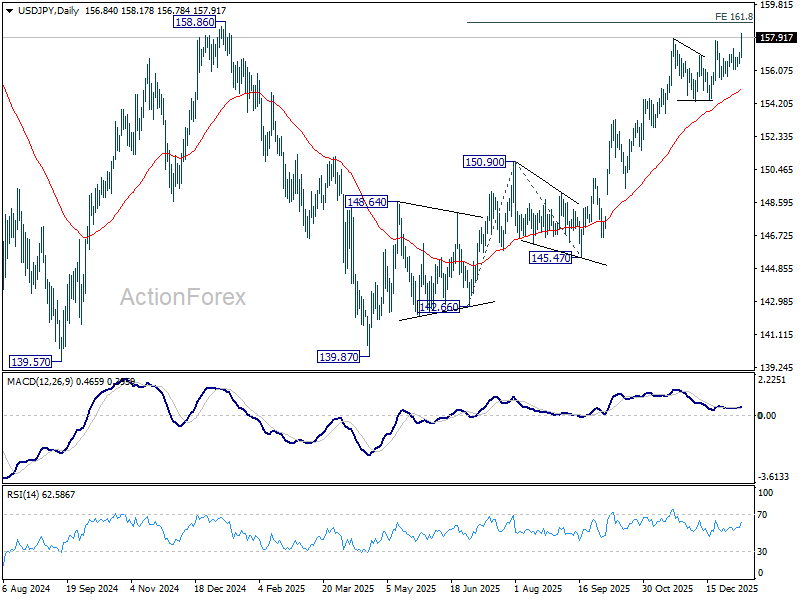
If Nikkei does push toward 58k region, USD/JPY is likely to follow toward the 161.94 high. The key risk then becomes policy response: whether Japanese authorities intensify verbal warnings, or ultimately move toward direct intervention should the pair break above 158.86 structural resistance zone.
EUR/USD Weekly Outlook
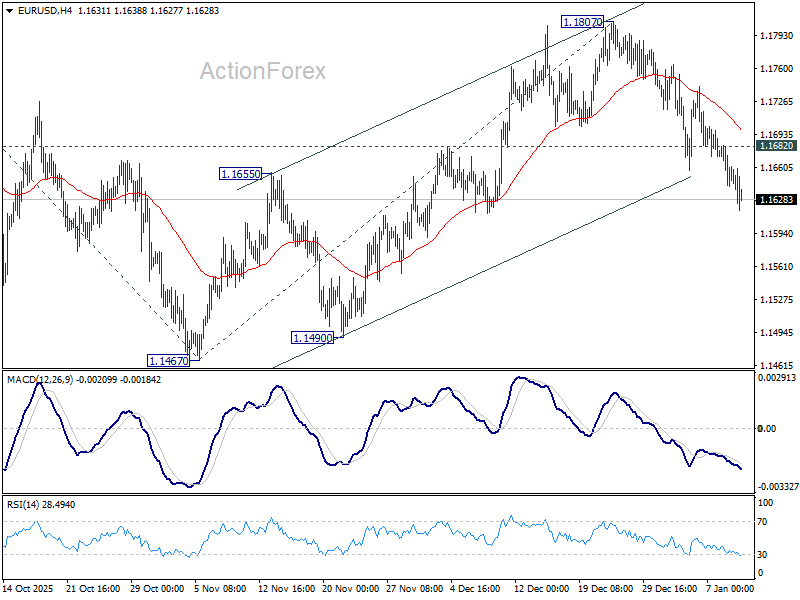
EUR/USD's extended fall last week suggests that rise from 1.1467 has completed at 1.1807 already. Fall from there is seen as the third leg of the corrective pattern from 1.1917. Initial bias stays on the downside this week for retesting 1.1467. Break there will pave the way to 100% projection of 1.1917 to 1.1467 from 1.1807 at 1.1357. ON the upside, above 1.1682 minor resistance will turn intraday bias neutral first. But risk will stay on the downside as long as 1.1807 resistance holds, in case of recovery.
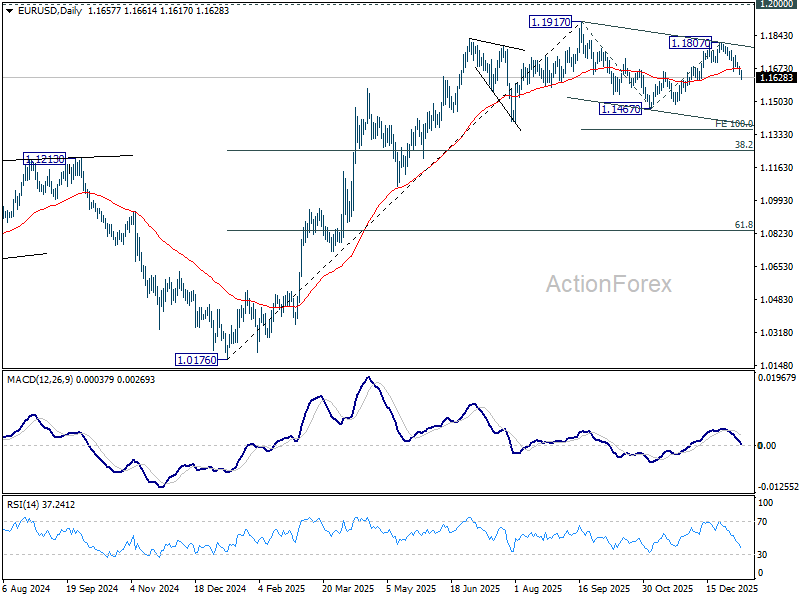
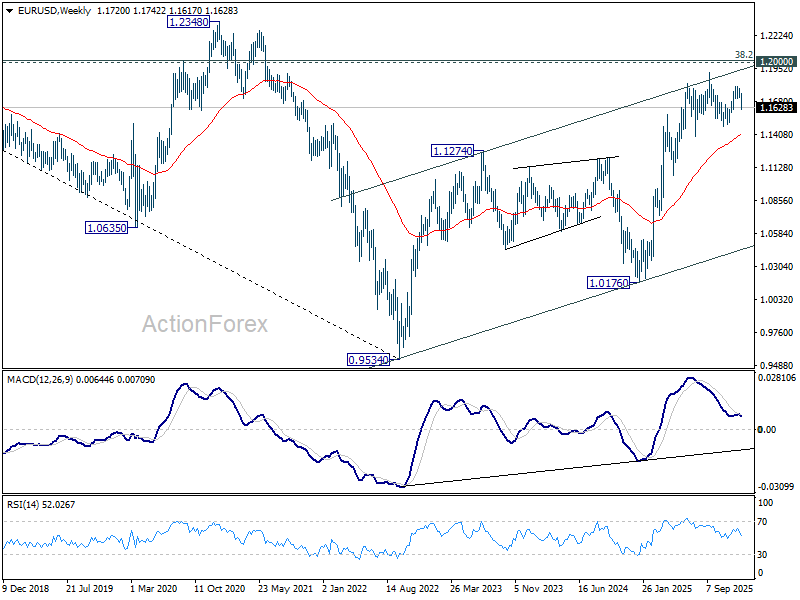
In the bigger picture, as long as 55 W EMA (now at 1.1406) holds, up trend from 0.9534 (2022 low) is still in favor to continue. Decisive break of 1.2 key psychological level will carry larger bullish implication. However, sustained trading below 55 W EMA will argue that rise from 0.9534 has completed as a three wave corrective bounce, and keep long term outlook bearish.
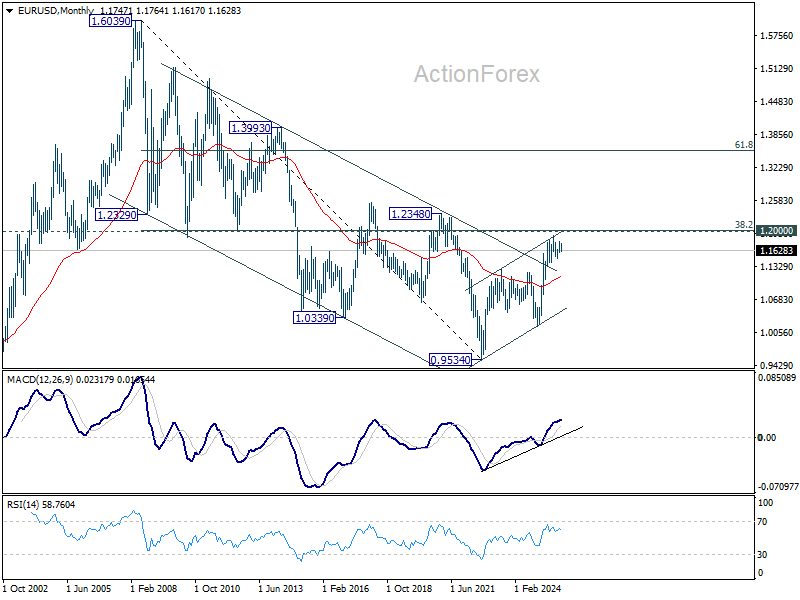
In the long term picture, 38.2% retracement of 1.6039 to 0.9534 at 1.2019, which is close to 1.2000 psychological level is the key for the outlook. Rejection by this level will keep the multi decade down trend from 1.6039 (2008 high) intact, and keep outlook neutral at best. However, decisive break of 1.2000/19, will suggest long term bullish trend reversal, and target 61.8% retracement at 1.3554.
EUR/USD Weekly Outlook
EUR/USD's extended fall last week suggests that rise from 1.1467 has completed at 1.1807 already. Fall from there is seen as the third leg of the corrective pattern from 1.1917. Initial bias stays on the downside this week for retesting 1.1467. Break there will pave the way to 100% projection of 1.1917 to 1.1467 from 1.1807 at 1.1357. ON the upside, above 1.1682 minor resistance will turn intraday bias neutral first. But risk will stay on the downside as long as 1.1807 resistance holds, in case of recovery.
In the bigger picture, as long as 55 W EMA (now at 1.1406) holds, up trend from 0.9534 (2022 low) is still in favor to continue. Decisive break of 1.2 key psychological level will carry larger bullish implication. However, sustained trading below 55 W EMA will argue that rise from 0.9534 has completed as a three wave corrective bounce, and keep long term outlook bearish.
In the long term picture, 38.2% retracement of 1.6039 to 0.9534 at 1.2019, which is close to 1.2000 psychological level is the key for the outlook. Rejection by this level will keep the multi decade down trend from 1.6039 (2008 high) intact, and keep outlook neutral at best. However, decisive break of 1.2000/19, will suggest long term bullish trend reversal, and target 61.8% retracement at 1.3554.
USD/JPY Weekly Outlook
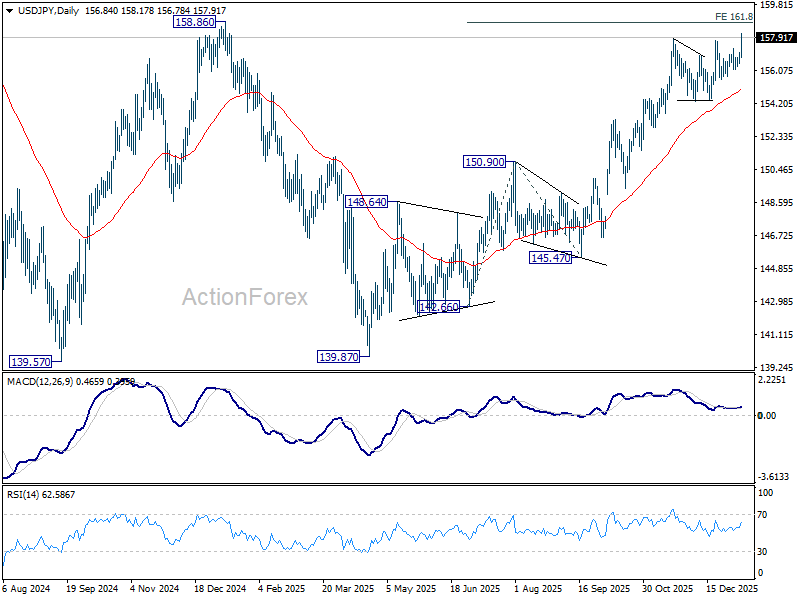
USD/JPY's rise from 139.87 resumed by breaking through 157.88 last week. Initial bias stays on the upside this week for 161.8% projection of 142.66 to 150.90 from 145.47 at 158.80. Firm break there will pave the way to 200% projection at 161.95, which is close to 161.94 high. For now, outlook will stay bullish as long as 156.10 support holds, in case of retreat.
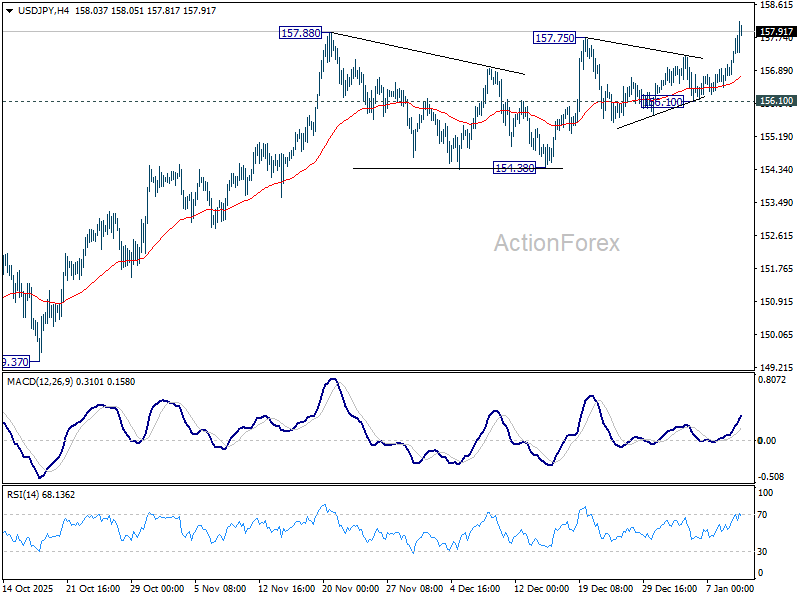
In the bigger picture, corrective pattern from 161.94 (2024 high) could have completed with three waves at 139.87. Larger up trend from 102.58 (2021 low) could be ready to resume through 161.94. Decisive break of 158.85 structural resistance will solidify this bullish case and target 161.94 for confirmation. On the downside, break of 154.38 support will dampen this bullish view and extend the corrective range pattern with another falling leg.
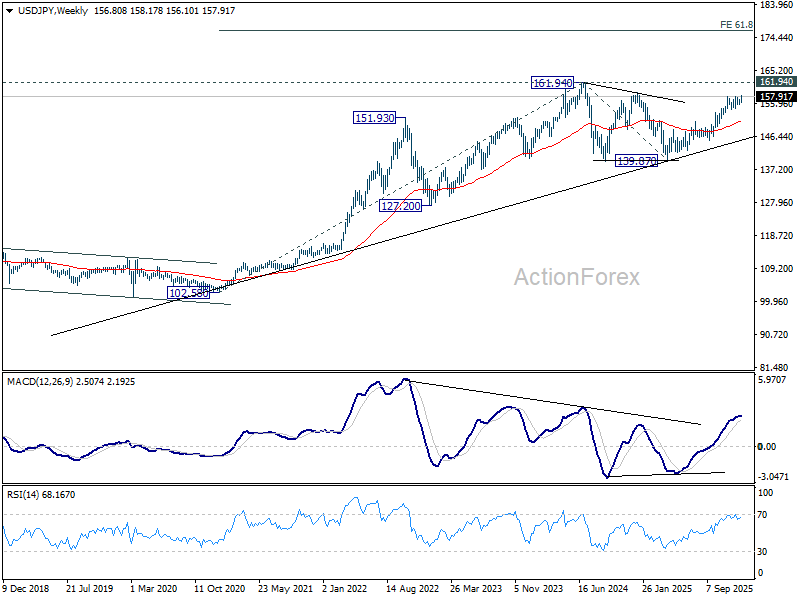
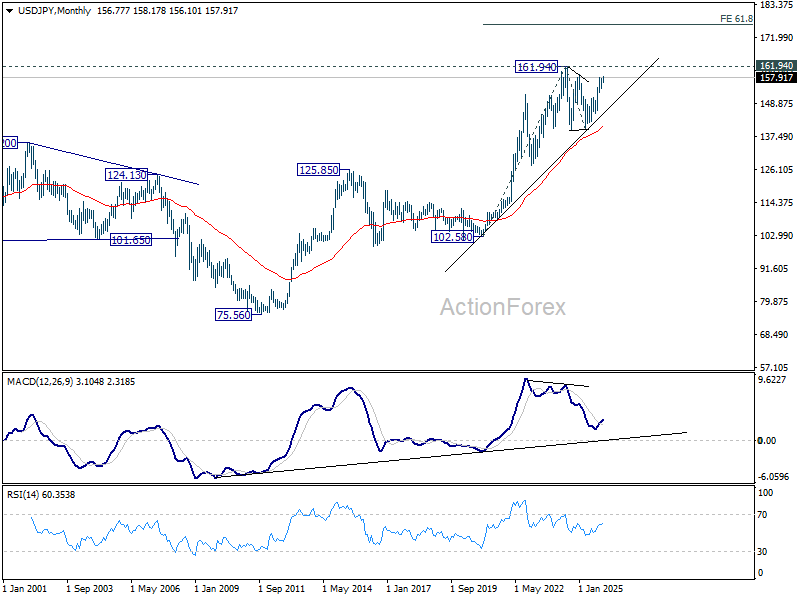
In the long term picture, up trend from 75.56 (2011 low) is still in progress and might be ready to resumption. Firm break of 161.94 will target 61.8% projection of 102.58 (2020 low) to 161.94 (2024 high) from 139.87 at 176.55 in the medium term.
GBP/USD Weekly Outlook
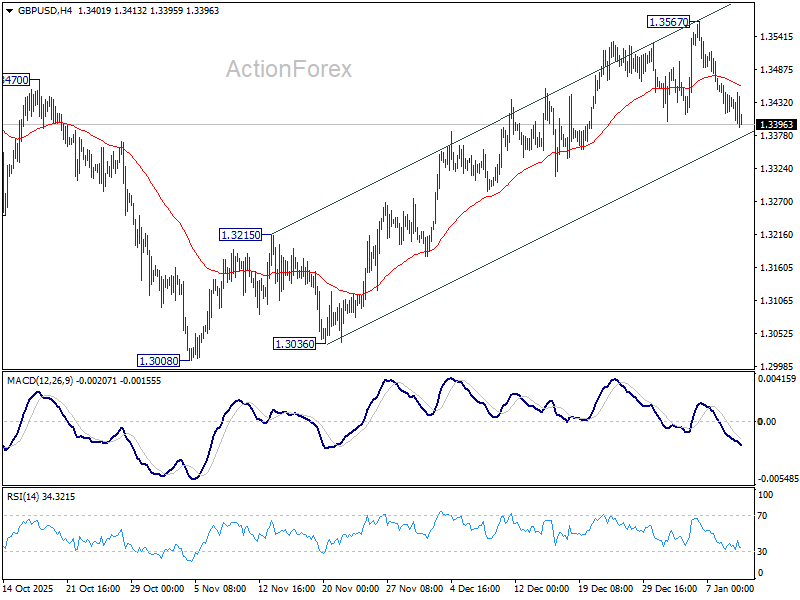
GBP/USD edged higher to 1.3567 last week but formed a short term top there and reversed. Initial bias is mildly on the downside this week for 55 D EMA (now at 1.3366). Sustained break there will argue that the decline is another falling leg in the corrective pattern from 1.3787. In this case, deeper fall should be seen back to 1.3008 support. For now, risk will stay mildly on the downside as long as 1.3567 holds, in case of recovery.
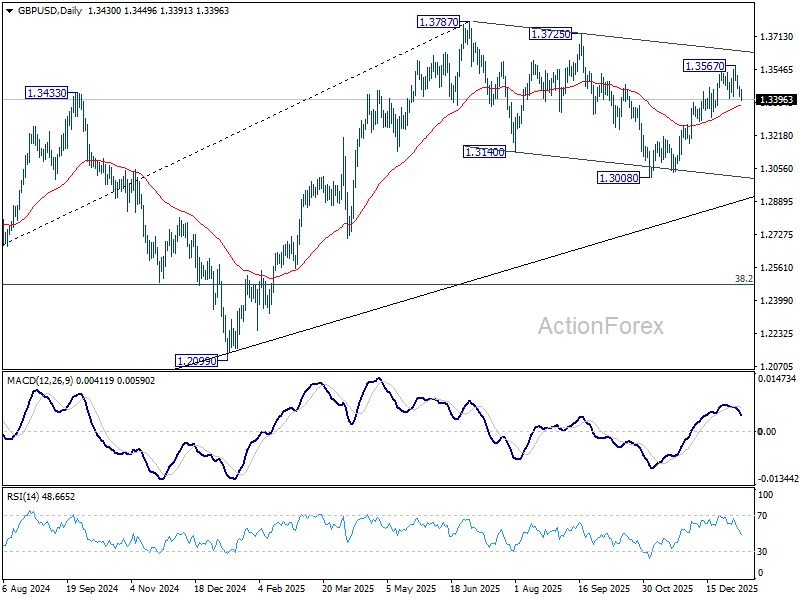
In the bigger picture, price actions from 1.3787 (2025 high) are seen as a correction to the larger up trend from 1.3051 (2022 low). Deeper decline could be seen as the pattern extends, but downside should be contained by 38.2% retracement of 1.0351 to 1.3787 at 1.2474 to bring rebound. Break of 1.3787 for up trend resumption is expected at a later stage.
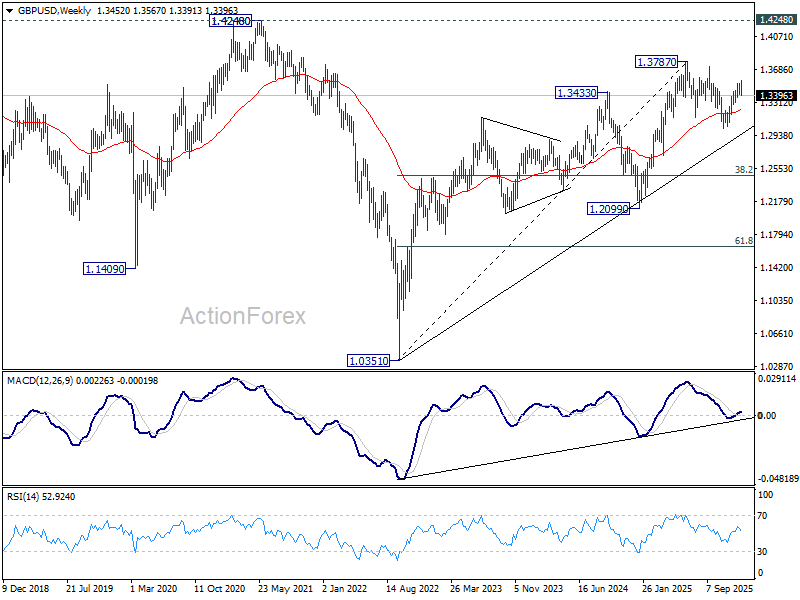
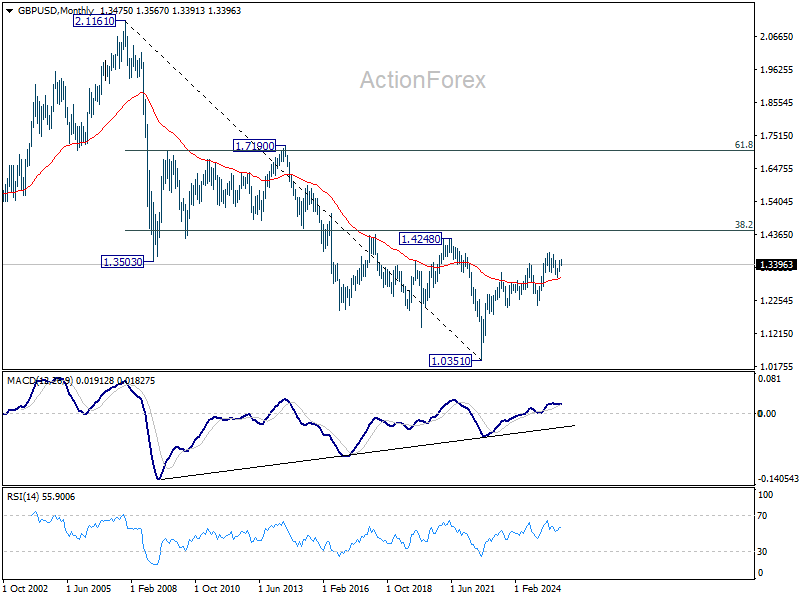
In the long term picture, as long as 1.4248/4480 resistance zone holds (38.2% retracement of 2.1161 to 1.0351 at 1.4480), the long term outlook will remain bearish. That is, price actions from 1.3051 are seen as a corrective pattern to down trend from 2.1161 (2007 high) only. Nevertheless, decisive break of 1.4248/4480 will be a strong sign of long term bullish reversal.
USD/CHF Weekly Outlook
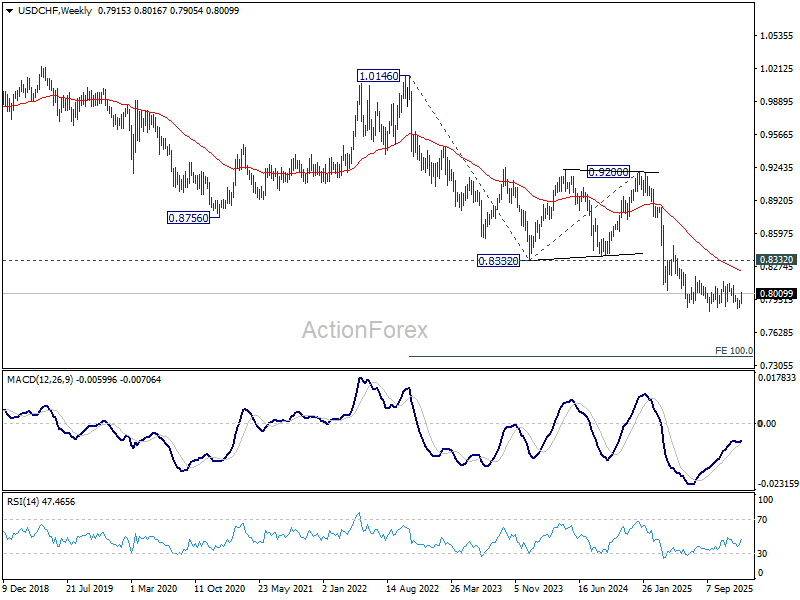
USD/CHF's strong rally last week suggests that fall from 0.8123 has completed at 0.7860 already. Rise from there is seen as another leg in the corrective pattern from 0.7828 low. Initial bias stays on the upside this week for 0.8123 resistance. On the downside, below 0.7967 minor support will turn intraday bias neutral again first.
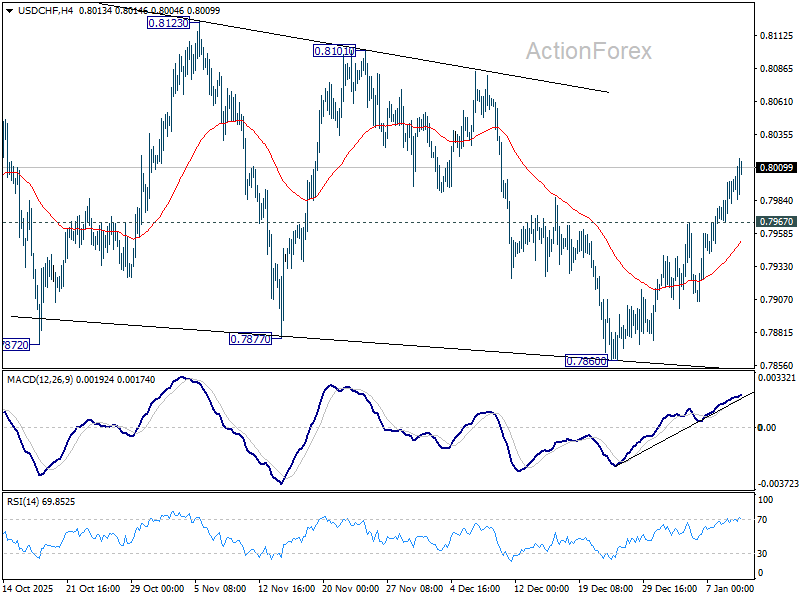
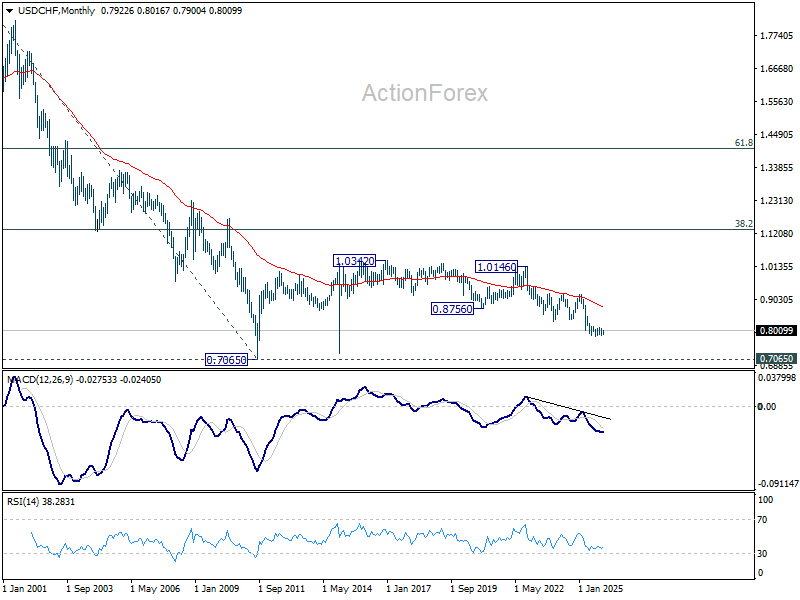
In the bigger picture, price actions from 0.7828 are seen as a correction. Larger down trend from 1.0342 (2017 high) is in still in progress. Break of 0.7828 will target 100% projection of 1.0146 (2022 high) to 0.8332 from 0.9200 at 0.7382. In any case, outlook will stay bearish as long as 0.8332 support turned resistance holds (2023 low).
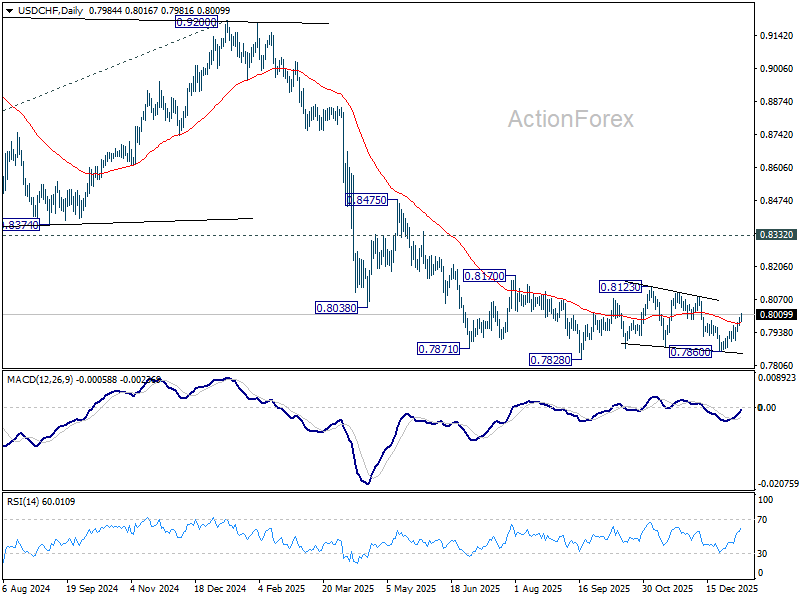
In the long term picture, price action from 0.7065 (2011 low) are seen as a corrective pattern to the multi-decade down trend from 1.8305 (2000 high). It's uncertain if the fall from 1.0342 is the second leg of the pattern, or resumption of the downtrend. But in either case, outlook will stay bearish as long as 0.8756 support turned resistance holds (2021 low). Retest of 0.7065 should be seen next.