Sample Category Title
Natural Gas Wave Analysis
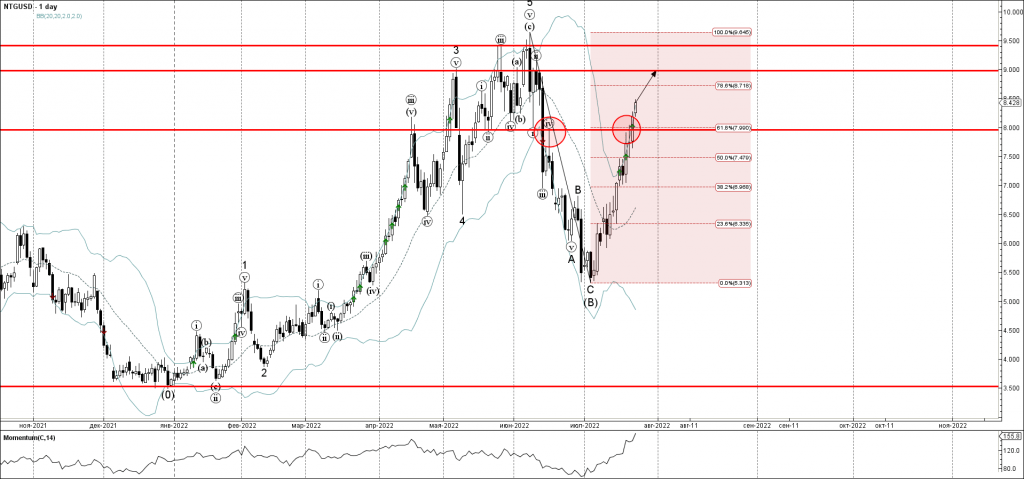
- Natural gas broke resistance level 7.960
- Likely to rise to resistance level 9.000
Natural gas recently broke through the resistance level 7.960 (top of the previous wave (iv) from the middle of June) intersecting with the 61.8% Fibonacci correction of the earlier downward correction (B) from last month.
The breakout of the resistance level 7.960 accelerated the active intermediate impulse wave (C).
Given the clear daily uptrend, Natural gas can be expected to rise further toward the next round resistance level 9.000.
Canadian Dollar Higher After Solid Retail Sales
The Canadian dollar has started the week with gains. USD/CAD is trading at 1.2852 in the North American session, down 0.54% on the day.
Canada’s retail sales sparkle
Canada released June retail sales on Friday, and the data was stronger than expected. Retail sales surged to 2.2%, up from 0.7% in May (1.6% exp.). Core retail sales also accelerated, with a gain of 1.9%, up from 1.1% in May (1.6% exp.). The June numbers mark a fifth consecutive increase and points to solid consumer spending.
The Bank of Canada will take a long break after its 1% mega-hike earlier in July. The next meeting doesn’t take place until September 7th which will give the central bank plenty of time to monitor economic data and consider its next move. We can expect further rate hikes in the second half of the year, with inflation rising to 8.1% in June, up from 7.7% in May.
The question facing policy makers is how much to tighten at upcoming meetings. There are serious concerns about a possible recession, but the strong retail sales data shows that consumers are spending despite inflation and higher rates, which means that the BoC may feel that the economy is resilient enough to absorb additional supersize hikes in order to reel in inflation.
After last week’s inflation release, BoC Governor Tiff Macklem said that inflation is likely to remain above 7% for the rest of the year which is “painfully high”. Macklem added that the bank is front-loading its interest rate hikes in order to curb inflation, and the Bank will be raising rates again “pretty quickly”.
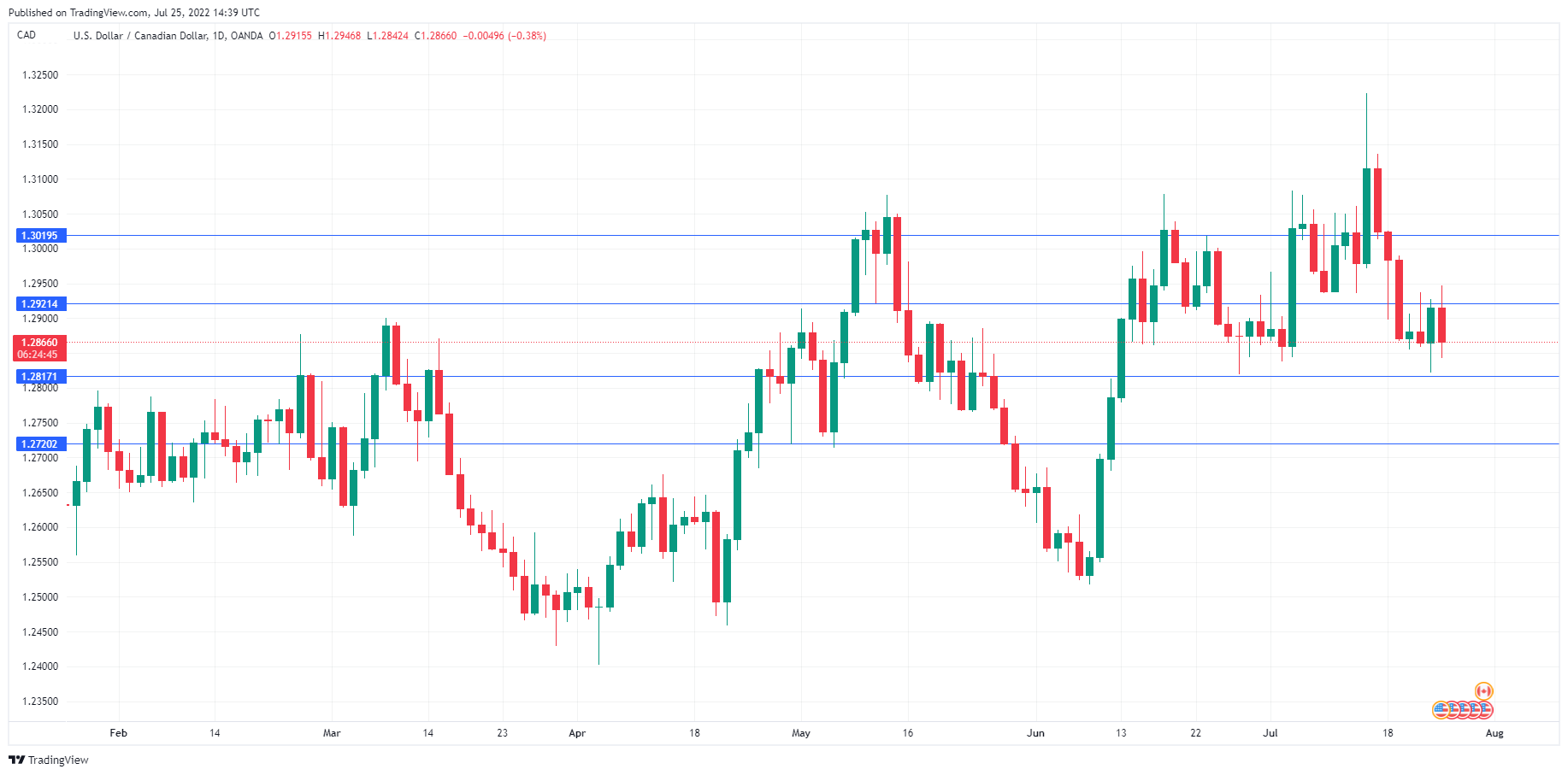
USD/CAD Technical
- There is resistance at 1.2921 and 1.3019
- USD/CAD has support at 1.2817 and 1.2719
Reserve Bank of Australia’s Comments Support AUD
AUD/USD is balancing at 0.6083 on Monday. The bulls managed to break the descending channel and they stand a good chance of starting a new ascending tendency in the near future.
The RBA Governor is ready to tighten the regulator’s monetary policy by doubling the benchmark interest rate. The reason for this announcement is simple – it’s necessary to push inflation back to its target of 2-3%. Market players tend to respond to such comments, that’s why the AUD got significant support.
The quarterly CPI report is scheduled to be released as early as Wednesday and it is expected to show further growth in inflation, which has already reached its 20-year highs. Another important report, Retail Sales, will be published on Thursday and no positive dynamics are expected here as well. If this indicator is also far below expectations, the risks of a rate-hike by the RBA will increase, helping the AUD to continue its uptrend.
It should be noted that early in the year Philip Lowe wasn’t ready for monetary policy tightening and said that he couldn’t see the rate going up in 2022. However, high inflation forced the regulator to take emergency measures and start raising the rate.
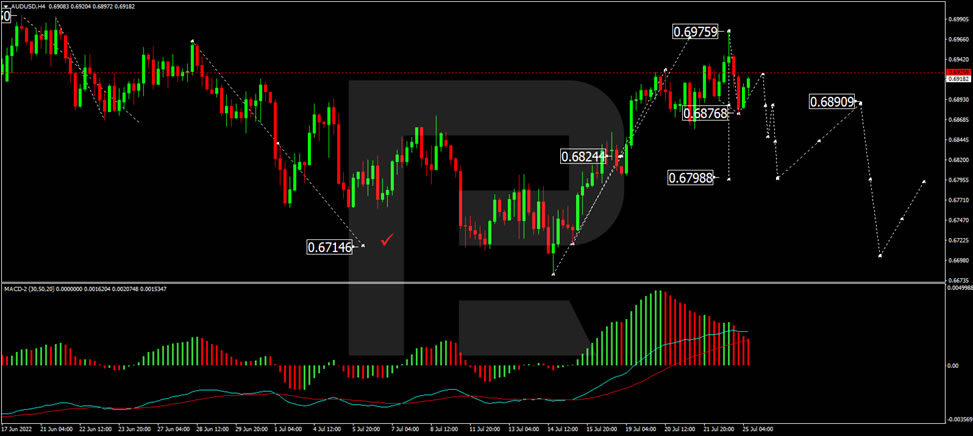
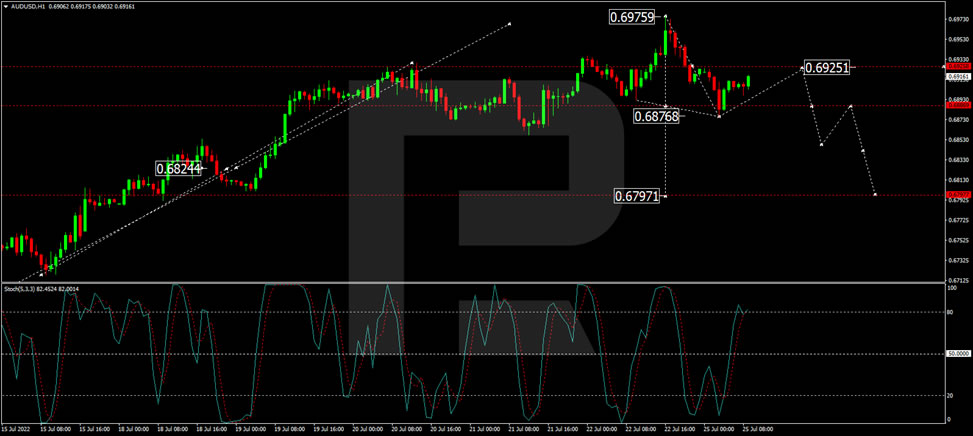
As we can see in the H4 chart, after finishing the first descending impulse at 0.6876, AUD/USD is correcting upwards to reach 0.6925 and may later form another descending impulse towards 0.6886. Later, the market may break the latter level and continue trading within the downtrend with the target at 0.6850, or even extend this structure down to 0.6798. From the technical point of view, this scenario is confirmed by the MACD Oscillator: after leaving the histogram area, its signal line is about to fall and reach 0.
In the H1 chart, having completed the five-wave structure of the first descending impulse at 0.6875, AUD/USD is correcting upwards to reach 0.6925 and may later fall towards 0.6888, thus forming a new consolidation range between the two latter levels. After that, the instrument may break the range to the downside and form a new descending structure with the target at 0.6850. From the technical point of view, this scenario is confirmed by the Stochastic Oscillator: its signal line is moving above 80 and may soon start falling to break 50. Later, it may continue moving down to 20.
Sunset Market Commentary
Markets
European and US yields tanked on Friday after PMIs suggested the economy on both continents is contracting. Those market moves happened against the backdrop of the ECB ending an era of negative rates by a 50 bps hike on Thursday and the Fed on track to deliver another massive-sized 75 bps hike on Wednesday. The economic calendar was rather empty at the start of this week though and it allowed core bond yields to lick their wounds. Data was confined to the German Ifo indicator undershooting analysts’ expectations. The headline number came in at 88.6 vs 90.1 expected, with the decline mainly pushed by the expectations component falling more than 5 points to 80.3. It was the lowest reading since June 2020 and confirmed the bad-news-show that the PMIs brought last week. As such the data didn’t really affect markets even if they were below consensus. An interview with ECB’s Kazaks instead helped German yields bottom out a tad. He said that the central bank may not be done with big interest rate hikes and favours another such move in September. Visco was a bit more balanced in a similar Bloomberg interview but even the Italian ECB governor didn’t express opposition to another 50 bps move. Money markets seem to agree, still discounting a high probability of a 50 bps step in September. The Bund yield curve steepened with changes ranging from 2.8 bps in the 5y to 3.5 bps for the 30y. Support in the 10y yield at around 1.03% survives for the time being. Peripheral spreads narrow with Greece (-19 bps) outperforming peers. Italian spreads trade unchanged. US yields recover from the double end-of-week whammy. Increases vary between 4.2 bps (2y) and 7.9 bps (30y) in a more or less neutral risk setting.
Momentum for the dollar is fading somewhat further. The trade-weighted variant (DXY) edged south to 106.34. EUR/USD, helped by Kazaks’ comments as well, eked out a small gain to 1.024. The Japanese yen is under general selling pressure, losing both against the USD (136.56) and the euro (EUR/JPY trying to recoup the 140 barrier). UK CBI data was mixed today, with total manufacturing orders easing more than expected from 18 to 8 on faltering export but business optimism recovering from the lowest level since April 2020 (from -34 to -21). Average selling prices expected for the next three months continued to ease from 58 to 48. Sterling is overall better bid. EUR/GBP loses the 0.85 area again (0.848). Cable (GBP/USD 1.207) is trying to leave the 1.20 zone behind. News Headlines
The composite economic sentiment indicator of the Czech Republic deteriorated further in July easing 2.6 ppts to 95.7. The decline was both due to weaker consumer and business confidence. Consumer confidence dropped the fifth consecutive month with the index reaching the second lowest reading since the start of the series in 2003 (73.6). Business confidence also worsened with confidence in the Industry falling from to 98.9 (from 106.1). Still, confidence was at the same level Y/Y. Entrepreneurs saw the lack of materials (39% of respondents), the lack of employees (19%) and insufficient demand (15%) as the main barriers to production growth. Capacity utilization in manufacturing rose slightly from Q1 to reach 83.2%, but remains significantly lower in a Y/Y perspective. In other the parts of the economy, confidence in trade eased slightly while construction and services saw a limited improvement. Czech ST yields since last week gradually eased of cycle peak levels as markets pondered further (modest/gradual) CNB rate hikes. EUR/CZK trades little changed in the 24.53 area.
Elsewhere in the region business confidence in Hungary showed a similar picture, easing to 2.0 from 3.7. Consumer confidence fell to -41.9 from -39.4, but is holding north of the 2020 corona low. Hungarian wage growth slowed slightly in May from 15.2% Y/Y to 14,9%. Lower core yields and a better sentiment on the country after a more decisive MNB approach recently gradually helped the forint to rebound back below EUR/HUF 400 (currently 396.25).
Falling Business Sentiment in Germany Does Not Hinder Euro’s Technical Rebound
The financial market is moving slightly against the main news flow, showing signs of recovery in demand for risky assets while data is getting worse.
According to the latest Ifo report, business sentiment in Germany is falling harder than expected, but that is not stopping euro buying in European trading on Monday. The same can be said for purchases of European equities, which are also rising on Monday.
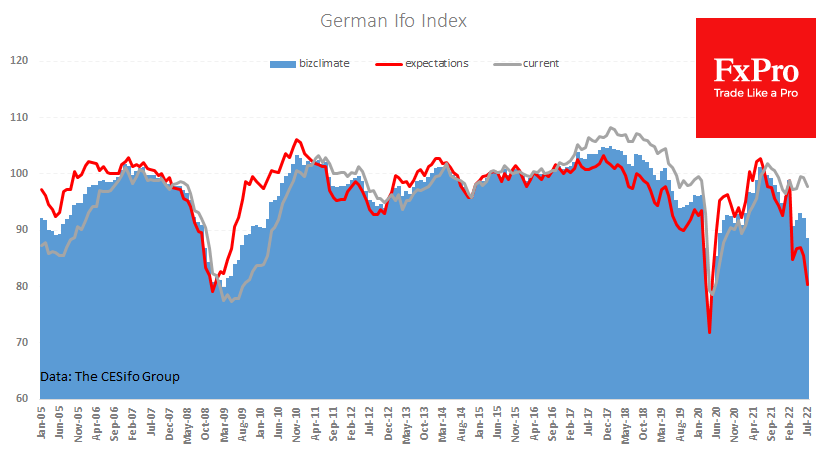
The Ifo reports a drop in the business conditions index to 88.6 in July from 92.2 a month earlier. The index was below the current values for four months in 2020, and before that, from October 2008 to July 2009. These have been the most challenging times for the German economy with high uncertainty and credit market conditions.
Extremely low expectations are pulling the indicator down. The respective Ifo index is close to the extremes, seems in a financial crisis and is only a couple of steps away from the lows of the pandemic.
The markets are probably starting to speculate that too much negativity is already priced in. So, the authorities and the central bank might begin to slow down the pace of tightening the screws.
The US debt market is pricing in more and more chances of a recession, and politicians are shifting the emphasis away from the word recession, pointing out that two consecutive quarters of GDP decline should not automatically be called a recession.
This is reminiscent of the ‘temporary’ inflation story a year earlier when politicians softened the agenda by giving events other definitions. This temporarily relieved markets but contributed to an accumulation of alarming trends. As a result, central banks now must do more to fight inflation than it took them to start earlier.
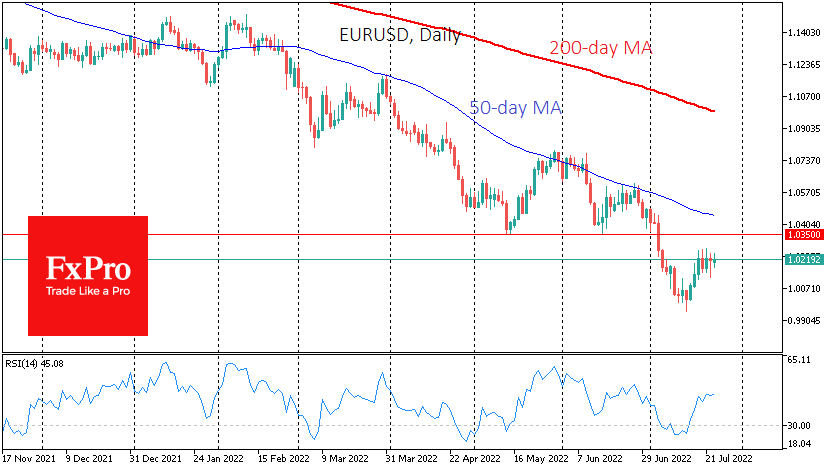
Good or bad in the long run, EURUSD is now enjoying solid buying on the decline to the 1.0200 area, although not failing on attempts to climb above 1.0270 since last week. We will only get a meaningful bullish victory signal when EURUSD rises above 1.0350. Until then, we can only talk about a technical correction after oversold conditions.
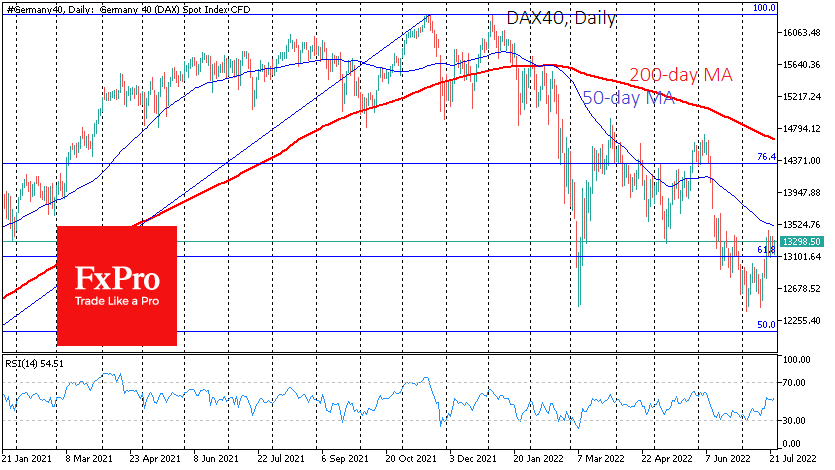
The German DAX40 is buying back from the 13000 level, but it gets too heavy when it rises above 13400, where the 50-day moving average is now running.
US Dollar Index: Recession Fears and Risk Mode Weigh on Dollar
The dollar index came under pressure on fresh risk mode and weighed by recession fears amid Fed’s aggressive rate hike path that threatens of further slowdown of the economy.
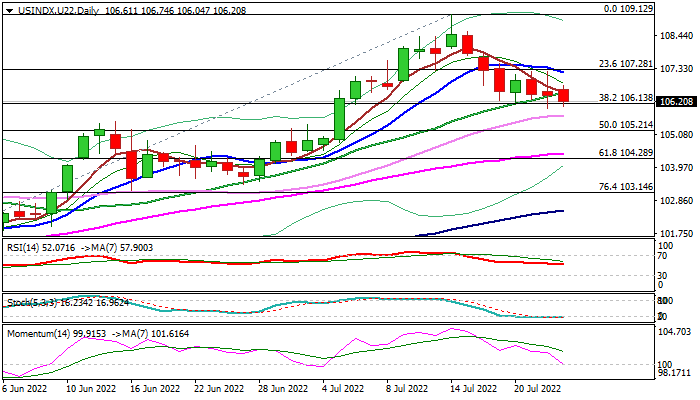
Fresh bears pressure last Friday’s two-week low (105.97) on renewed probe through pivotal Fibo support at 106.13 (38.2% retracement of 103.40/109.12 ascend) which repeatedly contained attacks last week.
Daily techs are weakening as 10/20DMA’s turned to bearish setup and south-heading 14-d momentum is at the border of the negative territory, while last week’s bearish close formed a reversal pattern on weekly chart.
Firm break of 106.13 pivot would generate fresh bearish signal for dip towards next significant supports at 105.21/104.97 (50% retracement/trendline support).
Conversely, repeated failure at 106.13 would keep the price action within existing congestion and await for stronger signals from Fed decision and US GDP data.
Res: 106.50; 106.74; 107.18; 107.92.
Sup: 105.97; 105.54; 105.21; 104.97.
Euro Shrugs as German Confidence Slips
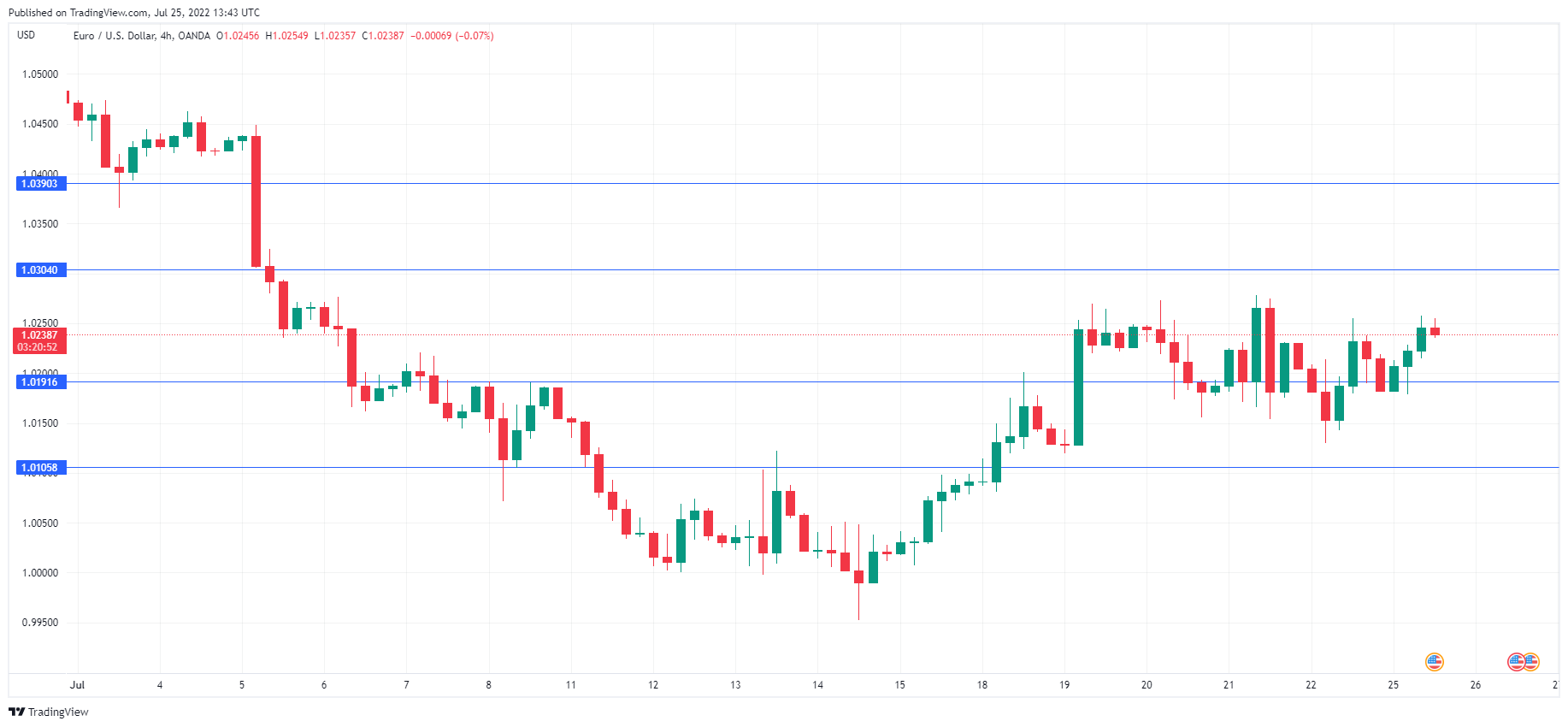
The euro is in positive territory at the start of the week. In the North American session, EUR/USD is trading at 1.0245, up 0.30%.
German business confidence sinks
The US dollar lost some of its lustre last week and the euro took advantage. EUR/USD posted its first winning week in a month and pulled some distance away from the parity line.
The euro has posted gains today but there was some alarming data out of Germany. Ifo Business Sentiment dropped to 88.6 in June, down sharply from 92.2 in May and shy of the consensus estimate of 90.2. The reading marked the lowest level in more than two years and was accompanied by an unusually grim message from the head of the Ifo Institute. Klaus Wohlrabe said that a recession in Germany was “knocking on the door” due to high energy prices and the possibility of gas shortages faced by Germany.
The Nord Stream 1 pipeline opened on Thursday as scheduled after being shut for maintenance but only at about 40% capacity, which was the case before it shut down. At that level, Germany may need to ration gas in order to reach its target of 90% storage capacity before winter sets in. The EU has suggested that member countries scale back their gas needs by 15% starting August 1st, but already some members are pushing back and demanding exemptions, making it uncertain if this voluntary plan will get off the ground. The EU is clearly worried that Russia will weaponise its energy exports to Europe, which has implemented sanctions against Moscow due to the invasion of Ukraine. With each member state having to worry about its own citizens having sufficient gas in the winter, we could see cracks appear in the EU’s attempt to have a unified stance against Russia.
EUR/USD Technical
- EUR/USD continues to test support at 1.0191. The next support level is 1.0105
- There is resistance at 1.0304 and 1.0390
USD/JPY Mid-Day Outlook
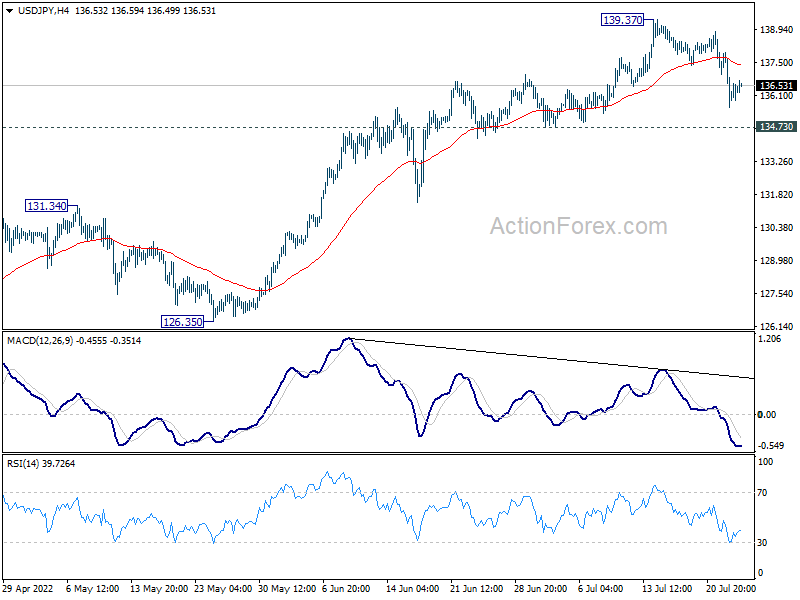
Daily Pivots: (S1) 135.11; (P) 136.54; (R1) 137.50; More...
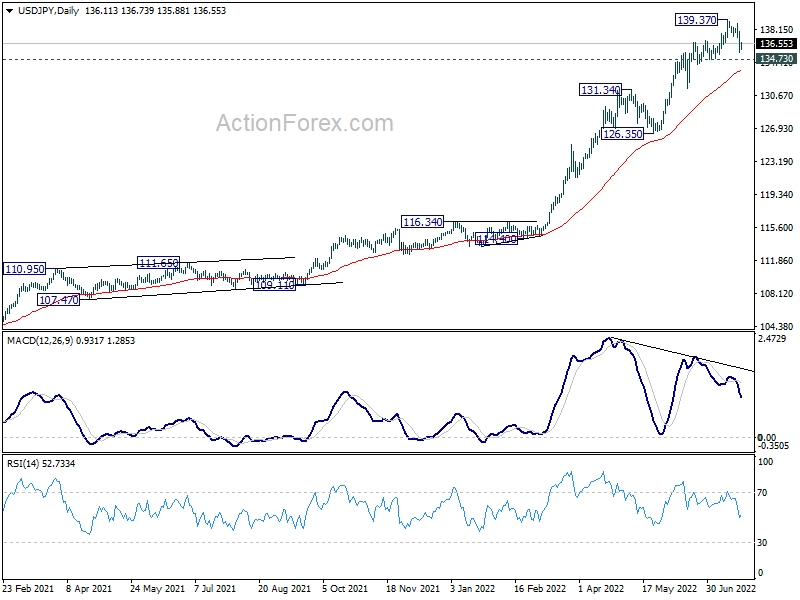
Intraday bias in USD/JPY stays neutral at this point. On the downside, firm break of 134.73 will confirm short term topping, on bearish divergence condition in 4 hour and daily MACD. Deeper fall would be seen through 55 day EMA to 126.35/131.34 support zone. On the upside, break of 139.37 will resume larger up trend.
In the bigger picture, current rally is seen as part of the long term up trend from 75.56 (2011 low). Next target is 100% projection of 75.56 (2011 low) to 125.85 (2015 high) from 98.97 at 149.26, which is close to 147.68 (1998 high). This will remain the favored case as long as 126.35 support holds.
USD/CHF Mid-Day Outlook
Daily Pivots: (S1) 0.9575; (P) 0.9640; (R1) 0.9679; More...
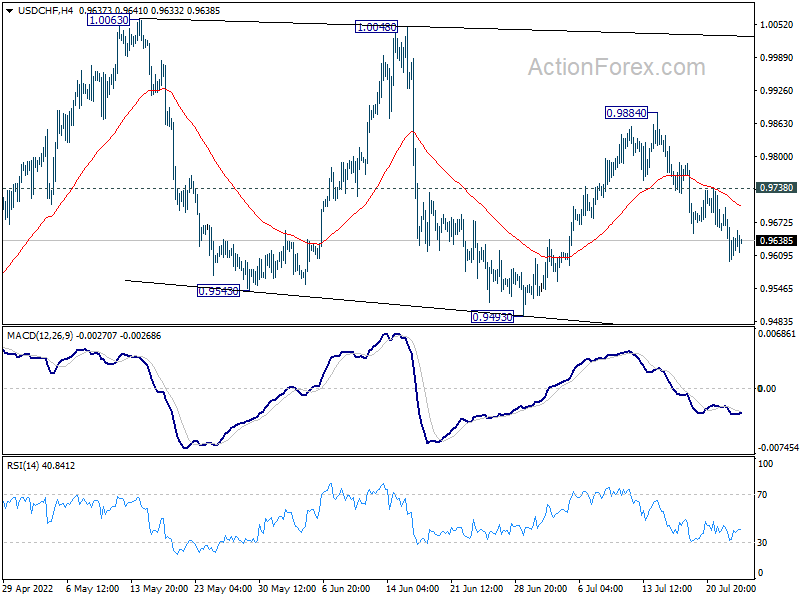
Outlook in USD/CHF is unchanged and intraday bias stays on the downside. Fall from 0.9884 is seen as a falling leg of the consolidation from 1.0063. Deeper decline would be seen to 0.9493 support. On the upside, though, above 0.9738 minor resistance will turn bias back to the upside for 0.9884 resistance.
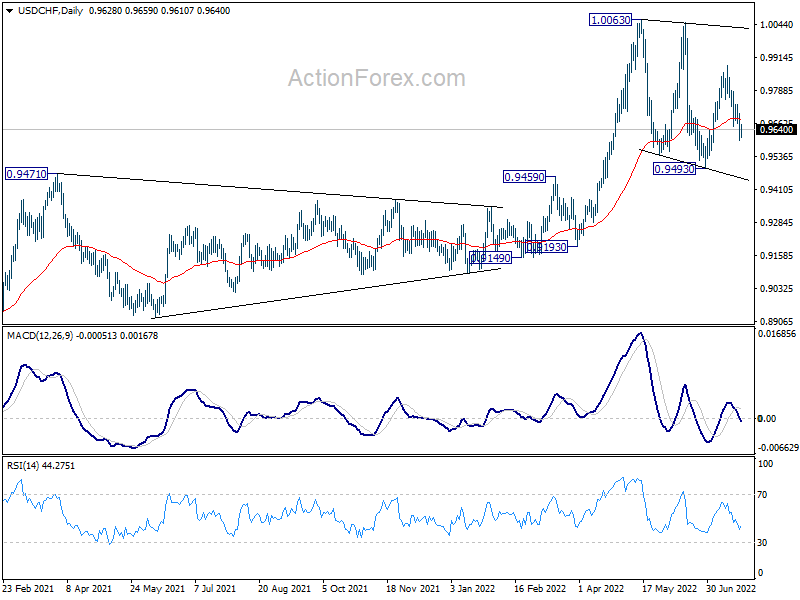
In the bigger picture, medium term up trend from 0.8756 (2021 low) is still in progress. On resumption, next target is 1.0342 (2016 high). Sustained break there will resume long term up trend from 0.7065 (2011 low). This will remain the favored case as long as 0.9471 resistance turned support holds.
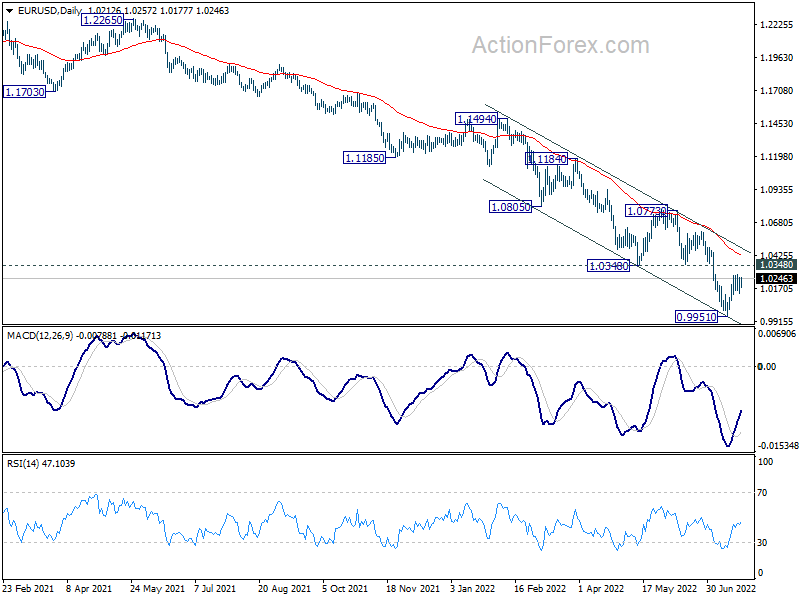
EUR/USD Mid-Day Outlook
Daily Pivots: (S1) 1.0146; (P) 1.0201; (R1) 1.0271; More...
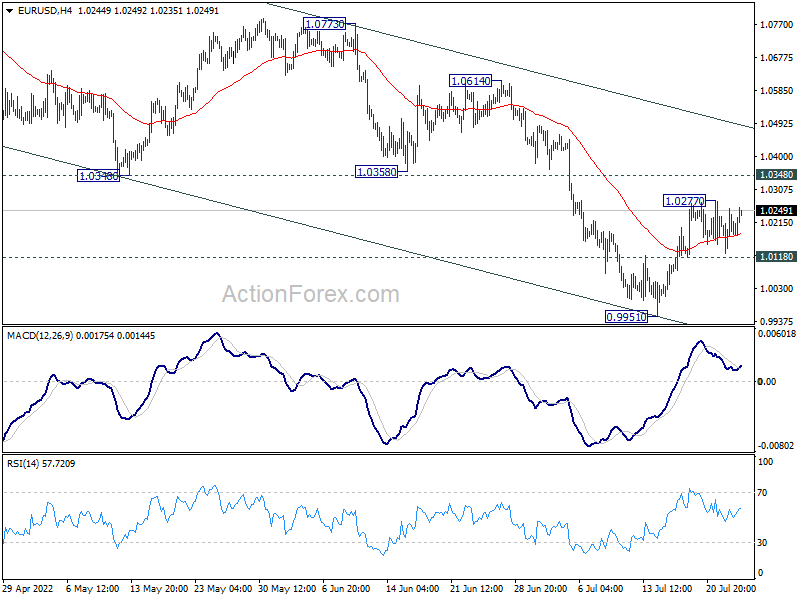
Intraday bias in EUR/USD remains neutral as range trading continues. Further rise is in favor as long as 1.0118 minor support holds. Above 1.0277 minor resistance will target 1.0348 support turned resistance. Sustained break there will bring stronger rebound back to channel resistance (now at 1.0493). On the downside, below 1.0118 will bring retest of 0.9951 low instead.
In the bigger picture, down trend from 1.6039 (2008 high) is still in progress. Next target is 100% projection of 1.3993 to 1.0339 from 1.2348 at 0.8694. In any case, outlook will stay bearish as long as 1.0773 resistance holds, in case of strong rebound.