

Sample Category Title
AUD/USD Daily Report
Daily Pivots: (S1) 0.6679; (P) 0.6702; (R1) 0.6723; More...
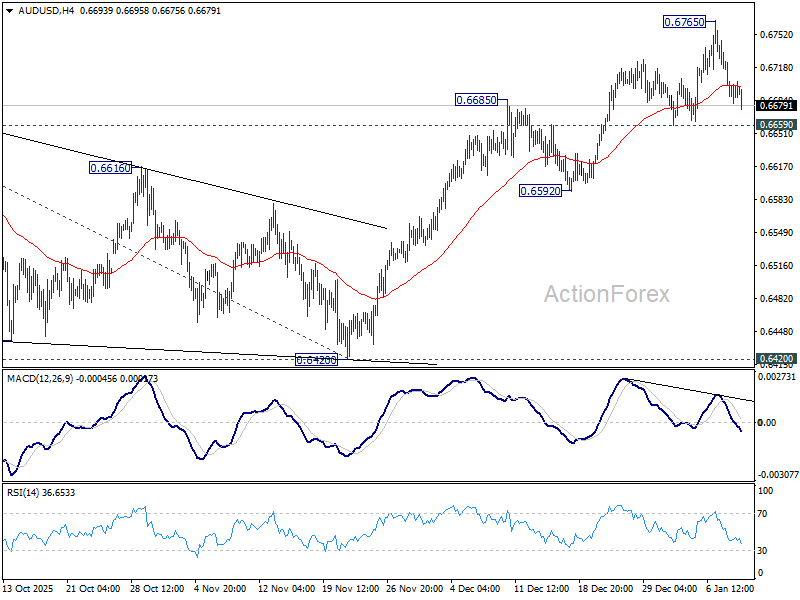
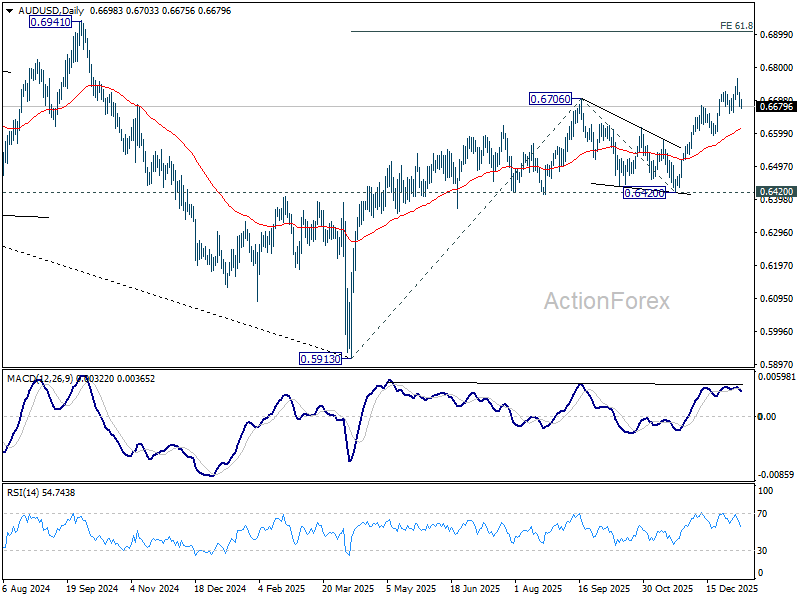
AUD/USD is holding above 0.6659 support despite current retreat. Intraday bias remains neutral and further rise is still in favor. Above 0.6765 will resume the whole rise from 0.5913 and target 61.8% projection of 0.5913 to 0.6706 from 0.6420 at 0.6910. However, considering bearish divergence condition in 4H MACD, firm break of 0.6659 will confirm short term topping, and bring deeper correction back towards 0.6592 support.
In the bigger picture, current development argues that rise form 0.5913 (2024 low) is reversing whole down trend from 0.8006 (2021 high). Further rally should be seen to 61.8% retracement of 0.8006 to 0.5913 at 0.7206. This will remain the favored case as long as 0.6420 support holds.
USD/CAD Daily Outlook
Daily Pivots: (S1) 1.3848; (P) 1.3869; (R1) 1.3886; More...
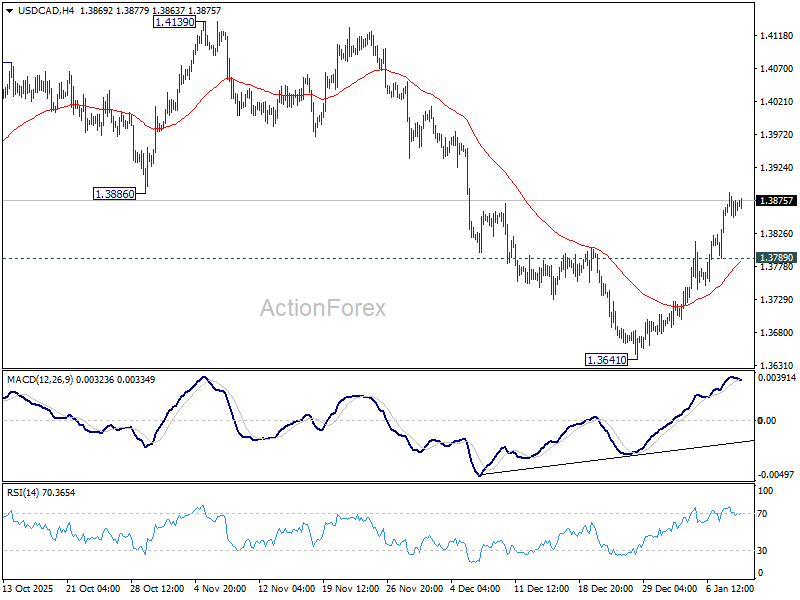
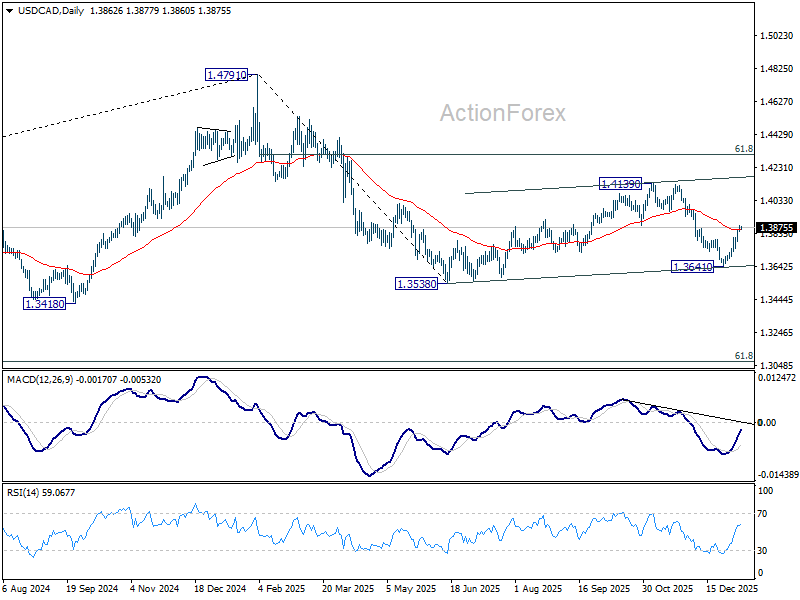
Intraday bias in USD/CAD remains on the upside as rise from 1.3641 is in progress. Corrective pattern from 1.3538 is extending, in its third leg. Sustained trading above 55 D EMA (now at 1.3859) will pave the way to 1.4139 resistance next. On the downside, below 1.3789 minor support will turn intraday bias neutral first.
In the bigger picture, 1.4791 is likely developing into a deeper, larger scale correction. In the less bearish case, it's just correcting the rise from 1.2005 (2021 low). But even so, break of 1.3538 will pave the way to 61.8% retracement of 1.2005 to 1.4791 at 1.3069. This will remain the favored case as long as 1.4139 resistance holds, in case of rebound.
EUR/USD Daily Outlook
Daily Pivots: (S1) 1.1642; (P) 1.1663; (R1) 1.1682; More….
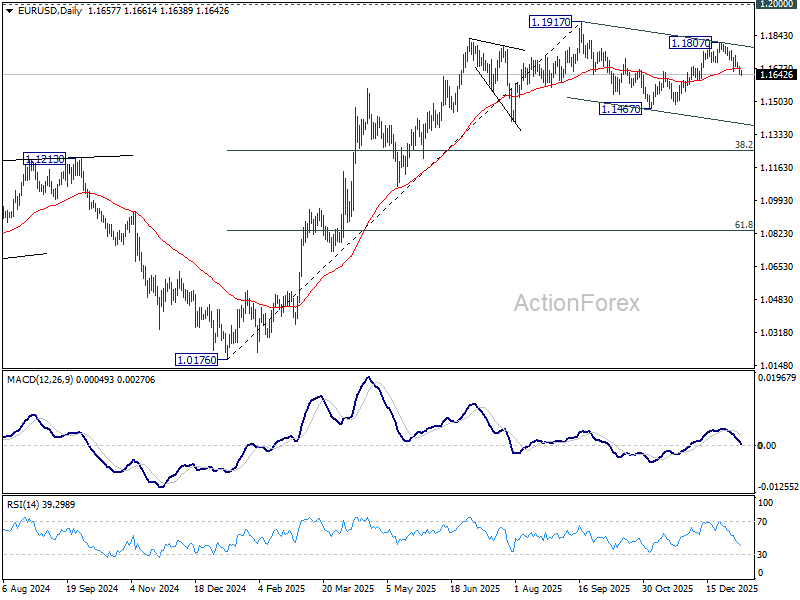
EUR/USD's decline from 1.1807 resumed by breaking through 1.1658 temporary low. The break of 55 D EMA (now at 1.1671) suggests that rebound from 1.1467 has already completed. Overall development indicates that corrective pattern from 1.1917 is already in the third leg. Intraday bias is back on the downside for 1.1467 support, and below. On the upside, though, break of 1.1742 will turn bias back to the upside for 1.1807 resistance instead.
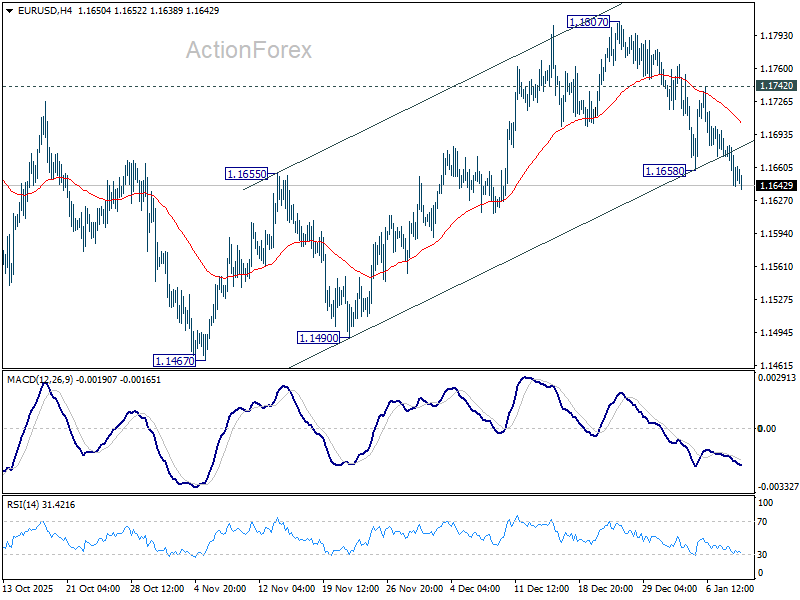
In the bigger picture, as long as 55 W EMA (now at 1.1408) holds, up trend from 0.9534 (2022 low) is still in favor to continue. Decisive break of 1.2 key psychological level will carry larger bullish implication. However, sustained trading below 55 W EMA will argue that rise from 0.9534 has completed as a three wave corrective bounce, and keep long term outlook bearish.
GBP/USD Daily Outlook
Daily Pivots: (S1) 1.3416; (P) 1.3440; (R1) 1.3465; More...
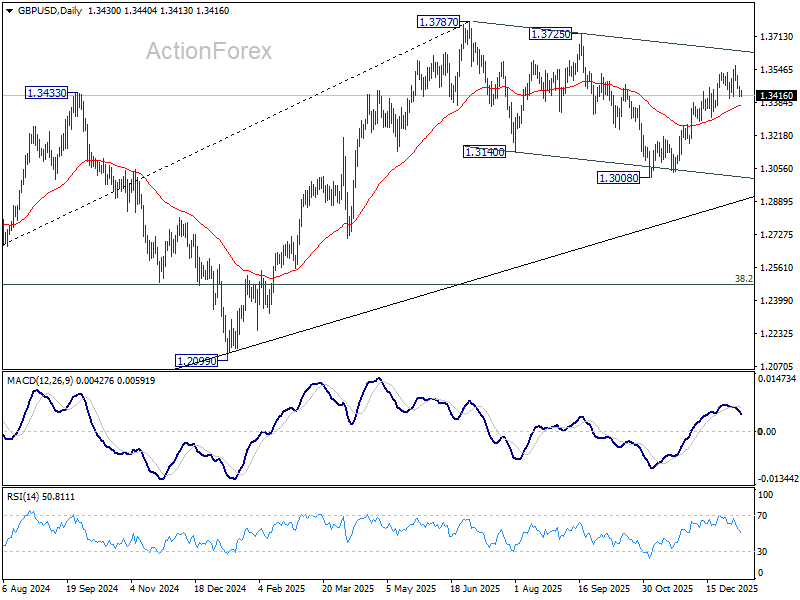
GBP/USD is still holding above 1.3401 support despite current retreat. Intraday bias stays neutral and further rise is in favor. On the upside, break of 1.3567 will resume the rise from 1.3008 to retest 1.3787 high. However, firm break of 1.3401 will confirm short term topping, and bring deeper fall back to 55 D EMA (now at 1.3367). Sustained break of 55 D EMA will argue that corrective pattern from 1.3787 is already extending with another falling leg, and target 1.3008.
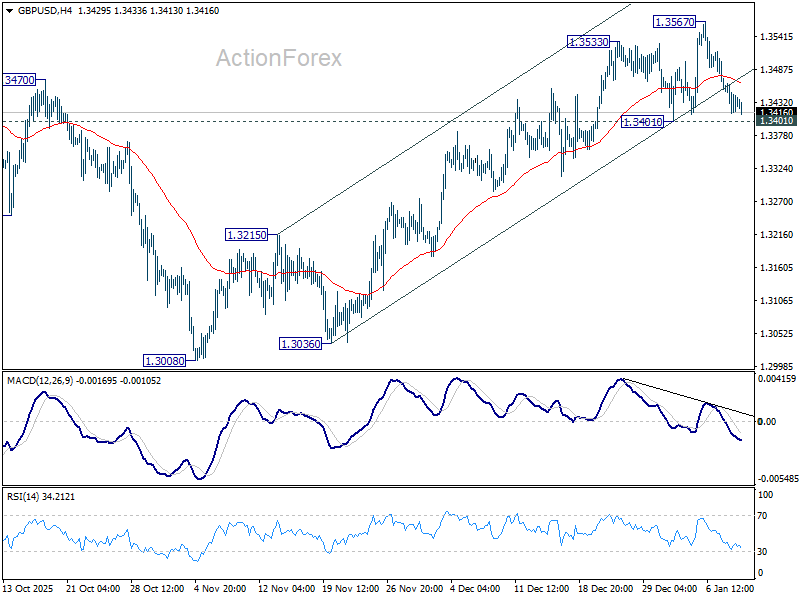
In the bigger picture, current development suggests that fall from 1.3787 is merely a corrective move, and larger rise from 1.0351 (2022 low) is still in progress. Firm break of 1.3787 will target 1.4248 (2021 high) key structural resistance. This will remain the favored case as long as target 38.2% retracement of 1.0351 to 1.3787 at 1.2474 holds, in case of another fall.
USD/CHF Daily Outlook
Daily Pivots: (S1) 0.7966; (P) 0.7983; (R1) 0.8005; More….
USD/CHF's break of 0.7986 resistance suggests that fall from 0.8123 has completed at 0.7860. The corrective pattern from 0.7828 is probably in another rising leg. Intraday bias is back on the upside for 0.8123 resistance. On the downside, below 0.7943 minor support will flip bias back to the downside for 0.7860 instead.
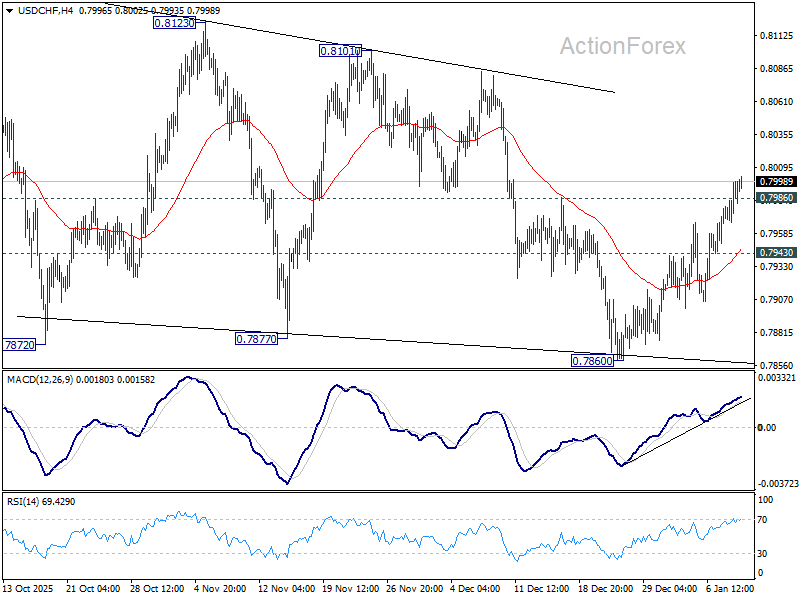
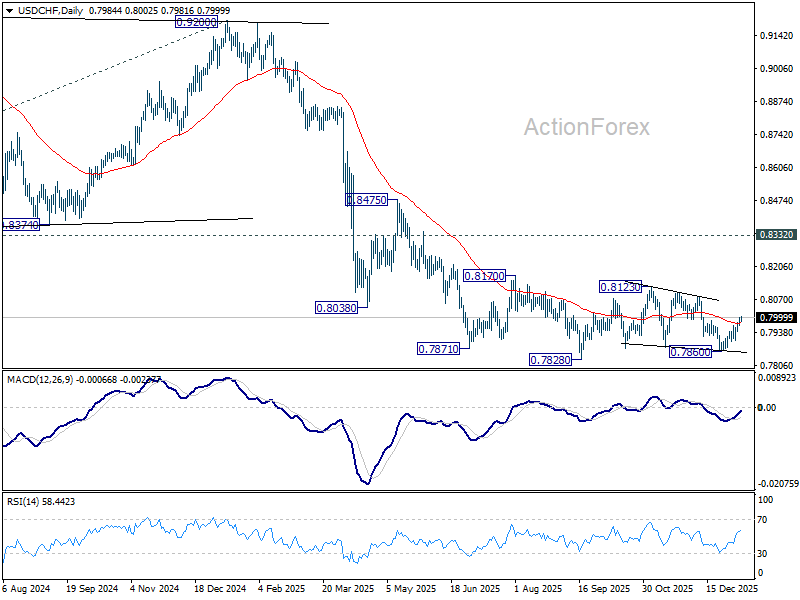
In the bigger picture, outlook will stay bearish as long as 0.8332 support turned resistance holds (2023 low). Long term down trend from 1.0342 (2017 high) is still in progress. Next target is 100% projection of 1.0146 (2022 high) to 0.8332 from 0.9200 at 0.7382.
Geopolitics Will Destroy Euro
- EURUSD falls due to geopolitics and expectations of tariff removal
- Gold returns to debasement trading.
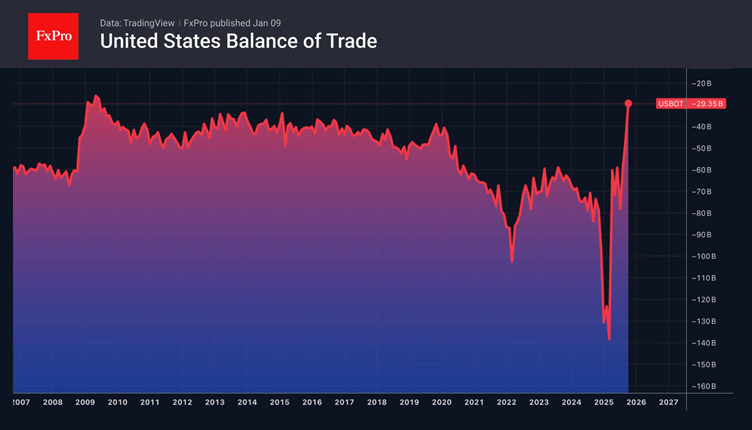
The US dollar continued its advance on Forex thanks to a new batch of strong macro statistics. Jobless claims rose less than expected. Productivity rose to a two-year high, and the US trade deficit unexpectedly narrowed to its lowest level since 2009. Donald Trump’s plan to balance foreign trade with import tariffs is working. However, the Supreme Court may rule the tariffs illegal by the end of the week on 9 January.
The cancellation of import duties would return funds to American companies and households, which have largely absorbed the cost of tariffs that previously weighed on economic growth. The US economy has continued to expand, supported by investment in artificial intelligence, rising productivity, and the wealth effect created by record equity markets that have boosted household prosperity. The return of tariff revenues would effectively act as a fiscal stimulus, increasing disposable income and corporate cash flow. As a result, GDP growth and inflationary pressures are likely to accelerate.
This combination will create another barrier to lowering the federal funds rate. Stephen Miron’s calls to cut it by 150 basis points in 2026 seem like a voice crying in the wilderness. Most FOMC members understand perfectly well what the return of money from tariffs could lead to. The hawks will gain a strong trump card, the pause in the monetary expansion cycle will be prolonged, and the US dollar will benefit from this.
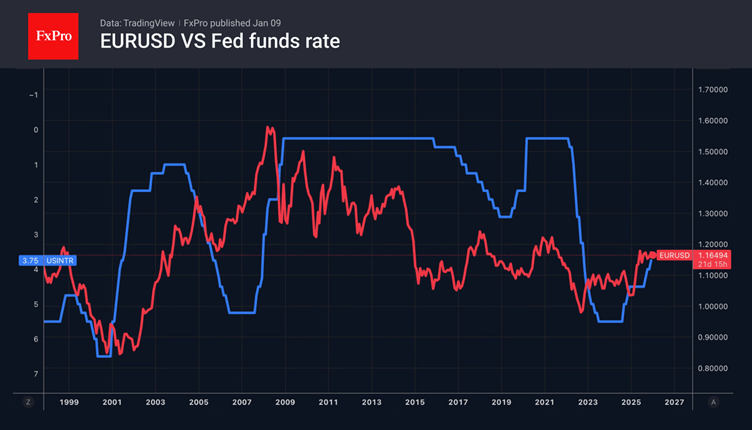
Rumours of additional sanctions against Russia are putting pressure on the EURUSD. Diplomatic efforts to bring peace to Ukraine are not yielding results, and the continuation of the armed conflict will continue to hold back the eurozone economy. Events in Venezuela and talk of Greenland joining the US are increasing geopolitical tensions. According to ECB Vice-President Luis Guindos, this could hurt business, and increased household savings will slow GDP growth.
Despite the strengthening of the US dollar, gold has managed to counterattack. The precious metal is able to benefit from the Supreme Court’s repeal of tariffs. The return of money will lead to an increase in the US budget deficit and public debt. These processes underlie debasement trading. In 2025, it became one of the key drivers of the 65% rally in XAUUSD.
USD/JPY Daily Outlook
Daily Pivots: (S1) 156.54; (P) 156.80; (R1) 157.15; More...
Intraday bias in USD/JPY stays neutral, but immediate focus is now on 157.88 resistance with today's rally. Decisive break there will extend the up trend from 138.98. Further break of 158.85 key structural resistance will be an important medium term bullish sign. Next target will be 161.94 high. In any case, outlook will continue to stay bullish as long as 154.33 support holds.
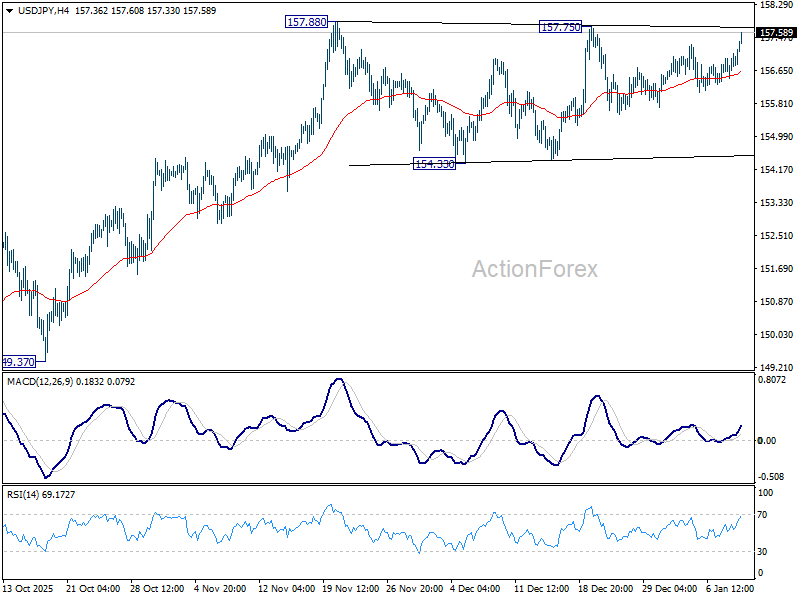
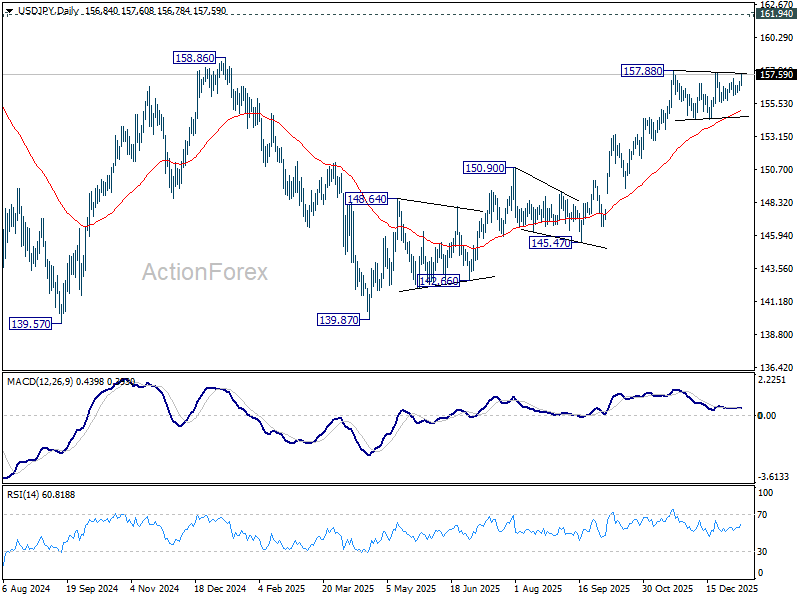
In the bigger picture, corrective pattern from 161.94 (2024 high) could have completed with three waves at 139.87. Larger up trend from 102.58 (2021 low) could be ready to resume through 161.94 high. Decisive break of 158.85 structural resistance will solidify this bullish case and target 161.94 for confirmation. On the downside, break of 154.33 support will dampen this bullish view and extend the corrective range pattern with another falling leg.
Dollar Leads into NFP as USD/JPY Nears Breakout
Dollar is trading broadly higher in Asian session today, and remains the strongest performer of the week, as markets head into the December US non-farm payrolls report. Within FX, USD/JPY stands out as a pair to watch, with the pair edging closer to levels that would confirm an upside break.
This week's price action suggests markets may be positioning for upside risk in the jobs data, rather than bracing for disappointment. That bias is understandable. That narrative is supported by this week’s indicators, which collectively point to a jobs market that remains resilient. Hiring may be subdued, but layoffs remain contained, reinforcing the view that the US economy is slowing only gradually.
The backdrop points to resilience rather than fragility, setting the stage for a payrolls print that could surprise modestly to the upside. Such an outcome would reinforce a wait-and-see stance at the Fed. Markets may continue to debate the timing of the next rate cut, but a decisive shift toward March easing would look premature.
Still, the sustainability of Dollar’s rally hinges on more than the headline payrolls number. Market reactions across equities and Treasury yields will be critical in determining whether USD gains can extend or begin to fade after the event.
Beyond data, legal risk is also on the radar. Markets are bracing for a ruling from the US Supreme Court on the legality of President Donald Trump’s global tariffs imposed under the International Emergency Economic Powers Act. A decision could arrive as early as today. Expectations that the court may strike down the tariffs have grown since November arguments, when justices across the ideological spectrum questioned whether the law grants such sweeping authority. A ruling against the administration could trigger refund claims estimated at up to US 150B, with implications for Treasury issuance and market volatility.
Trade tensions are also resurfacing elsewhere. US–India negotiations are stalled after talks collapsed last year, prompting Trump to double tariffs on Indian goods to 50% in August. US officials have since suggested the breakdown stemmed from a lack of direct engagement from Indian leadership. According to Commerce Secretary Howard Lutnick, the deal was effectively ready but required a direct call from Prime Minister Narendra Modi to close it — a step that never materialized.
On weekly FX performance, Dollar leads, followed by Aussie and Sterling. Loonie lags, ahead of Swiss Franc and Euro. Yen and Kiwi trade in the middle.
NFP Preview: DOW 50k and yield 4.2% decide Dollar path
Dollar has taken the driving seat in FX markets this week, supported by firmer US data and a modest repricing of Fed expectations. Bets on a March rate cut have dipped to around 41%, following the upside surprise in ISM Services earlier in the week, which reinforced the view that US economic momentum remains intact. Nevertheless, hat strength now faces a critical test from Friday’s December non-farm payrolls report. How markets respond across equities, Treasuries and rate pricing will be key in determining whether the Dollar can extend its gains.
Consensus expectations point to a 66k increase in payrolls, broadly in line with November’s 64k gain. Earnings are seen rising 0.3% mom, while the unemployment rate is expected to edge lower to 4.5%. Such an outcome would reinforce the prevailing “low hiring, low firing” narrative.
However, several leading indicators suggest upside risk to the headline payroll number. The ISM Services employment index jumped back from 48.9 into expansion at 52.0, while the Manufacturing employment sub-index also improved from 44.9 to 44.0. The ADP report showed a rebound to 41k jobs from November’s negative print. Four-week moving average of initial jobless claims fell to 212k, its lowest level in months. Together, the data point to resilience rather than deterioration.
Market reaction, however, is unlikely to be straightforward. Strong payrolls could be interpreted positively, reinforcing confidence in a soft-landing scenario. Equally, they could be seen as reducing the scope for aggressive easing, triggering a risk-off response that ultimately supports Dollar. The most bullish outcome for the greenback, ideally, would involve equity markets rolling over alongside a sustained rise in Treasury yields.
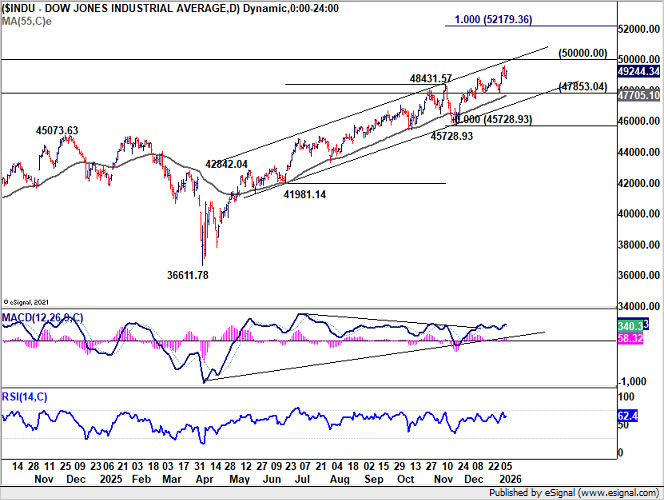
Technically, DOW is facing a key inflection zone, with 50,000 marking both a psychological level and the upper boundary of a medium-term channel. A break below 47,853 support would suggest a correction is already underway, opening the door to a deeper pullback toward 45,728. Conversely, decisive push above 50,000 could accelerate gains toward 52,179, potentially within January. That, if realized, would be bearish for the greenback.
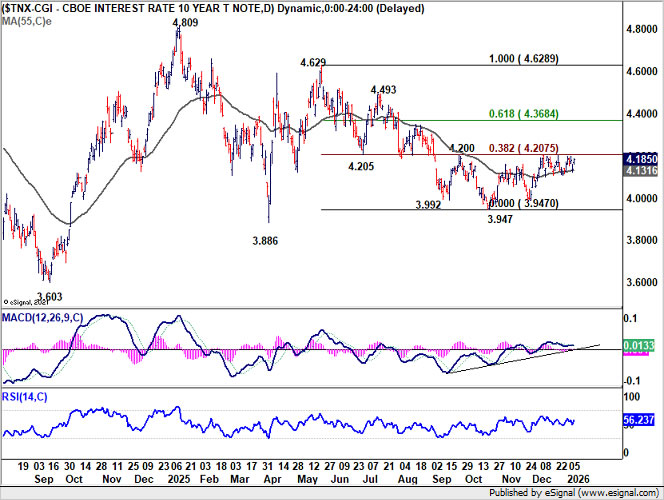
Meanwhile, 10-year yield continues to find support at its 55 D EMA (now at 4.131). Yet, upside is capped by 4.200 cluster resistance (38.2% retracement of 4.629 to 3.9047 at 4.207). On the upside, clean break above the 4.200 key level resistance cluster would argue that whole fall from 4.629 has already completed 3.947. That would set up stronger rise to 61.8% retracement at 4.368, and take Dollar higher.
China CPI surprises to upside at 0.8%, but full-year picture weak
China’s consumer inflation accelerated in December, with CPI rising from 0.7% to 0.8% yoy, above expectations of 0.6% and marking a 34-month high. The increase was driven mainly by food prices, as fresh vegetables surged 18.2% and beef prices rose 6.9%, supported by pre-New Year holiday demand.
However, price pressures remained uneven. Pork prices continued to fall sharply, down -14.6% yoy, while prices of gold jewelry jumped 68.5%, reflecting strong investment and gifting demand rather than broad-based consumption. According to National Bureau of Statistics, holiday shopping and supportive policies helped lift prices, but the improvement remains selective.
Looking beyond December, the broader deflationary challenge persists. Full-year CPI growth in 2025 was flat, the weakest in 16 years and well below policymakers’ “around 2%” target.
At the producer level, deflation moderated only slightly. PPI improved to -1.9% yoy in December from -2.2%, aided by rising non-ferrous metal prices and capacity discipline in key industries. Still, PPI fell 2.6% for the full year.
USD/JPY Daily Outlook
Daily Pivots: (S1) 156.54; (P) 156.80; (R1) 157.15; More...
Intraday bias in USD/JPY stays neutral, but immediate focus is now on 157.88 resistance with today's rally. Decisive break there will extend the up trend from 138.98. Further break of 158.85 key structural resistance will be an important medium term bullish sign. Next target will be 161.94 high. In any case, outlook will continue to stay bullish as long as 154.33 support holds.
In the bigger picture, corrective pattern from 161.94 (2024 high) could have completed with three waves at 139.87. Larger up trend from 102.58 (2021 low) could be ready to resume through 161.94 high. Decisive break of 158.85 structural resistance will solidify this bullish case and target 161.94 for confirmation. On the downside, break of 154.33 support will dampen this bullish view and extend the corrective range pattern with another falling leg.
China CPI surprises to upside at 0.8%, but full-year picture weak
China’s consumer inflation accelerated in December, with CPI rising from 0.7% to 0.8% yoy, above expectations of 0.6% and marking a 34-month high. The increase was driven mainly by food prices, as fresh vegetables surged 18.2% and beef prices rose 6.9%, supported by pre-New Year holiday demand.
However, price pressures remained uneven. Pork prices continued to fall sharply, down -14.6% yoy, while prices of gold jewelry jumped 68.5%, reflecting strong investment and gifting demand rather than broad-based consumption. According to National Bureau of Statistics, holiday shopping and supportive policies helped lift prices, but the improvement remains selective.
Looking beyond December, the broader deflationary challenge persists. Full-year CPI growth in 2025 was flat, the weakest in 16 years and well below policymakers’ “around 2%” target.
At the producer level, deflation moderated only slightly. PPI improved to -1.9% yoy in December from -2.2%, aided by rising non-ferrous metal prices and capacity discipline in key industries. Still, PPI fell 2.6% for the full year.
Paralysis Struck Equity, FI and FX Markets
Markets
Paralysis struck equity, FI and FX markets yesterday. Stocks hovered near their record highs, posting small losses in Europe and printing mixed in the US (tech slightly down, industrials up). Core bond yields’ recent corrective move lower grinded to a halt by recouping a technically insignificant 0.5-2 bps both in the US and Europe. The limited data available, if anything, supported this modest recovery. Aside from higher but still-low US weekly jobless claims, a surge in German factory orders is worth the mention. That was driven by large-scale (government) orders in the defense-related pockets (finally one may say) but even when excluding those, the German statistics agency noted an improvement. Actual production for November published this morning also surprised to the upside with an unexpected 0.8% m/m increase. Gilts outperformed with front end yields still easing some 2 bps. The US dollar held the advantage against most of its advanced counterparts. The greenback simply extended a mid-December upleg rather than actually responding to news. EUR/USD slid to 1.166 with the slide continuing this morning to 1.165, the lowest in a month but still some distance away from first meaningful support at 1.1392. DXY is currently testing the 99 big figure while USD/JPY after a calm day yesterday takes a leap today. Currently trading at 157.4 the Nov-Dec highs just shy of 158 are closing in fast.
We’ll get more fireworks today, hopefully. Some housing data, the University of Michigan consumer confidence indicator and most importantly, US December payrolls are scheduled for release. Consensus expects job growth to come in at 70k, picking up slightly from November’s 64k. The unemployment rate would ease to 4.5% from the four year high of 4.6%. We think it’ll take a major downside surprise – which is not our base scenario - for markets to meaningfully change their status quo expectations for the January Fed policy meeting, especially because earlier data this week wasn’t that bad at all (eg. services ISM). Numbers in line or perhaps a bit stronger (employment component in services ISM) would extend the dollar’s current momentum and lift (short-term) US yields further away from their recent lows/support zones but unlikely have technical implications. Another potentially big event risk is concentrated at the Supreme Court today. It’ll issue an opinion on Trump’s reciprocal tariffs that may or may not result in actual rulings to either keep them in place or strike them down. The latter would undoubtedly introduce new uncertainty: What will happen to the current trade deals? What other tariff routes are there for the US government? How quickly can these get implemented and how different are the tariff rates going to be? Rising risk premia would probably lift long-term US bond rates but the jury remains out whether and how it’ll affect other US asset classes (equities, the dollar) as well.
News & Views
The NY Fed’s December survey of consumer expectations showed labor market expectations worsening. The mean perceived probability of finding a job if one’s current job were lost fell by 4.2 ppts to 43.1%, reaching a new series low. The mean perceived probability of losing one’s job in the next twelve months increased by 1.4 ppts to 15.2%. The reading is above the series’ 12-month trailing average of 14.3%. Median inflation expectations increased from 3.2% to 3.42% at the 1-year horizon, the highest level since April of last year. They were unchanged at the 3-yr and 5-yr horizons, both at 3%. Households’ perceptions about their current financial situation compared to a year ago and year-ahead expectations both improved.
In an effort to restoring US housing affordability, US president Trump wants government-sponsored enterprises (GSE) Fannie Mae (Federal National Mortgage Association) and Freddie Mac (Federal Home Loan Mortgage Corporation) to step up purchases of mortgages from lenders by the tune of $200bn. The GSE’s convert them into MBS. The bond buying programme should help squeeze credit risk premia, that way driving mortgages rates and monthly payments down. The average rate on a 30-yr mortgage in the US is currently 6.16%. Trump’s latest initiative follows a ban earlier this week for institutional investors to buy single-family homes.