Sample Category Title
Chart Alert: Silver (XAG/USD) Intraday Rally is Fast Approaching Key Resistance
Key takeaways
Rebound looks corrective, not impulsive: Silver’s ~6% intraday bounce from US$73.84 appears to be a countertrend rebound after a sharp 10.7% sell-off, with technical patterns suggesting a “dead cat bounce” rather than a trend resumption.
Key resistance and downside risk: The US$79.86 level is a critical inflection point. Failure there, followed by a break below US$74.07, would likely open another corrective leg toward US$70.52 and potentially the 50-day moving average zone.
Bullish structure intact but delayed: While the long-term secular uptrend remains intact, near-term momentum is fading, and a deeper mean-reversion decline may be needed before the next sustainable bullish impulsive move.
The earlier 10.7% drop in Silver (XAG/USD) from its 7 January 2026 high of US$82.77 to yesterday, Thursday, 8 January 2026 low of US$73.84 has started to evolve to see an intraday rally of 6% (low to high) to trade higher at US$78.05 at the time of writing ahead of today’s key risk event; the release of US non-farm payrolls and unemployment rate for December 2025.
However, technical analysis suggests that the short-term corrective decline structure of Silver (XAG/USD) may not have ended, with more potential weakness ahead to shape a mean reversion decline towards its 50-day moving average (around US$62.75/61.91 zone) before the start of a new bullish impulsive up move sequence within its long-term secular uptrend phase that remains intact since the 18 March 2020 low.
Short-term trend bias (1 to 3 days): Reaching the inflection point for another potential down leg
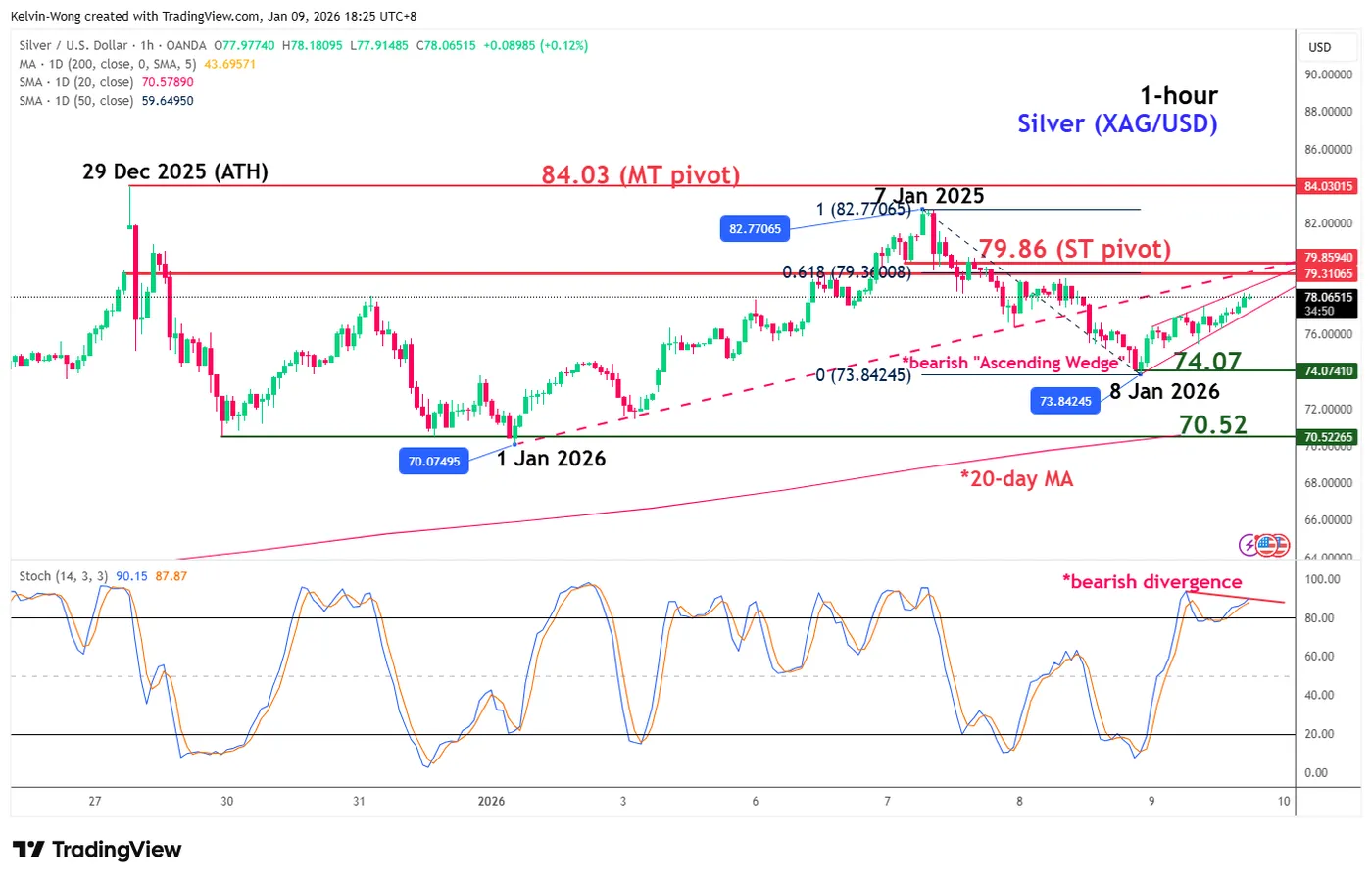
Fig. 1: Silver (XAG/USD) minor trend as of 9 Jan 2026 (Source: TradingView)
Watch the US$79.86 key short-term pivotal resistance on Silver (XAG/USD). A break below US$74.07 increases the odds of another corrective down leg towards the next intermediate support at US$70.52 (also the 20-day moving average) in the first step.
Key elements to support the bearish bias
- Today’s rally from Thursday, 8 January 2026, low of US$73.84 has taken the form of a minor bearish “Ascending Wedge” configuration, which suggests a potential “dead cat bounce”.
- The hourly Stochastic oscillator has flashed out an impending bearish divergence condition at its overbought region, which implies that the upside momentum of the rebound may be fading.
- The US$79.86 key short-term resistance (potential inflection level to end the rebound) is defined by the pull-back resistance of the former ascending support from 1 January 2026 low and close to the 61.8% Fibonacci retracement of the prior decline from 7 January 2026 high to 8 January 2026 low.
Alternative trend bias (1 to 3 days)
A clearance with an hourly close above US$79.86 key short-term resistance invalidates the bearish tone for a squeeze up to retest the US$84.03 key medium-term pivotal resistance (current all-time high of 29 December 2025).
US-China Relations Take a Hit After Venezuela Raid, PMIs Recover, CNY Strengthening Continues
Geopolitics and tech:
US capture of Maduro adds a new front in US-China rivalry: Much has already been said about the US raid in Venezuela but below are my two cents on the implications for China:
US-China relations: The Trump administration has supposedly told interim leader of Venezuela Delcy Rodriquez to kick out China, Russia, Iran and Cuba to avoid continued blockade of oil sales. However, China who has investments in the Venezuelan oil sector, is unlikely to accept its investment in the country basically being seized by the US. Foreign ministry spokesperson Mao Ning said on Wednesday that "Let me stress that China and other countries have legitimate rights in Venezuela, which must be protected."
It very much looks like the US has opened a new front in the US-China rivalry in its' pursuit of dominating the Western Hemisphere as set out in its National Security Strategy. China has major investments in other Latin American countries as well such as Chile, Peru and Bolivia and rely on access to resources from the region. More than 20 countries in Latin America and Caribbean have signed on to China's Belt and Road Initiative. This sets the stage for new confrontation between the US and China and puts renewed uncertainty over Trump's visit to Beijing in April. For now China is likely to take a wait-and-see stance and see how the Trump administration implements this policy across the region. But they are unlikely to bow to US pressure and stop investing in Latin America and they will aim to protect the investments they have already done.
It is uncertain Latin American countries react. Will they seek more investments from China (to reduce exposure to US) or less investments (out of fear of US response)? Mexico, being under strong pressure from Trump, leans towards the second option with a new 50% tariff on Chinese goods.
China and the Global South: The US raid fits perfect into what China has been saying for years: that US is a hegemon and imperialist willing to use ruthless power, economically and militarily, to hurt countries that don't walk to the beat of US drums. It could [RJ1] galvanize desires across the Global South to become less dependent on US, financially, militarily and technologically. This is a clear positive for China that will provide an alternative in all these areas.
Implications for Taiwan issue: My view on this topic, is that it makes little if any difference to Chinese leaders. China already sees the island as Chinese territory and an invasion would be protecting its' own sovereignty rather than breaching another nation's sovereignty. Hence, from China's point of view it would not be a breach of the UN Charter. Seen from Beijing, they do not need external legitimacy to protect what is already theirs, contrasting it to the US raid which was a clear violation of sovereign territory.
USD/CAD Bulls Gear Down Near 1.3900
- USD/CAD stabilizes ongoing recovery near 1.3900.
- Short-term bias is positive, but bulls may soon lose steam.
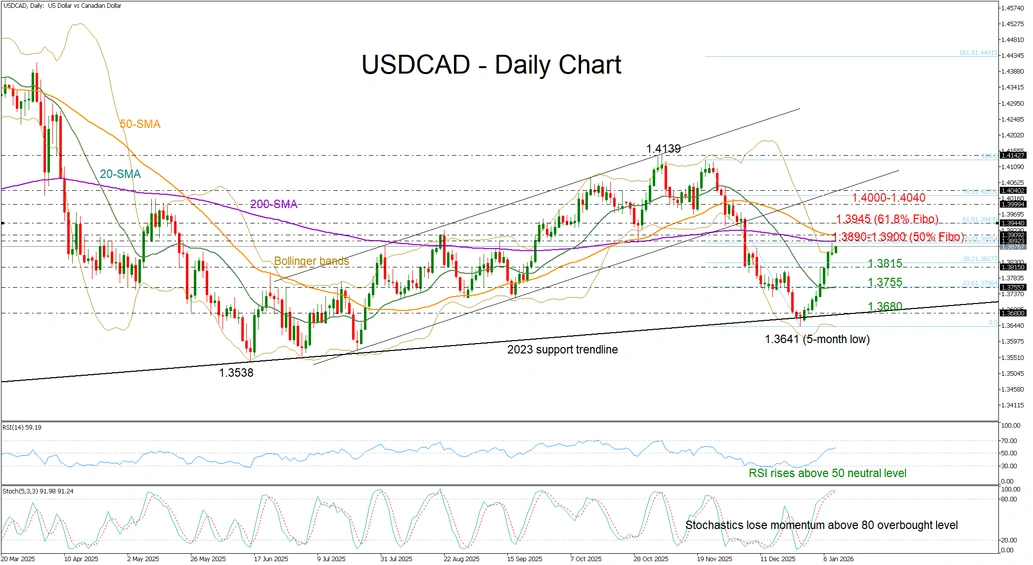
USD/CAD extended its post-Christmas rally to a one-month high of 1.3887 on Thursday, retracing half of the November–December decline as the US dollar strengthened and traders reduced exposure to risk-sensitive currencies such as the loonie.
With attention shifting to the US and Canadian jobs data and a possible Supreme Court ruling on Trump’s import tariffs, traders are watching the 1.3890–1.3900 zone, where the 50- and 200-day simple moving averages (SMAs) are converging. A break higher could target the 61.8% Fibonacci level at 1.3945 and potentially the 1.4000 psychological mark, with the broken support trendline at 1.4040 likely coming next on the radar.
However, upside momentum may fade as the stochastic oscillator is leaning to the downside in the overbought territory and the price itself is trading around the upper Bollinger band. Failure to clear 1.3900 could see support tested at 1.3815, with further losses exposing the 20-day SMA at 1.3755. If the latter gives way too, the bears may next head for the crucial 2023 support trendline seen near 1.3680.
Overall, USD/CAD is maintaining a positive short-term bias, though profit-taking may limit gains near the 1.3900 area.
Eurozone retail sales rise 0.2% mom in November, as non-food demand improves
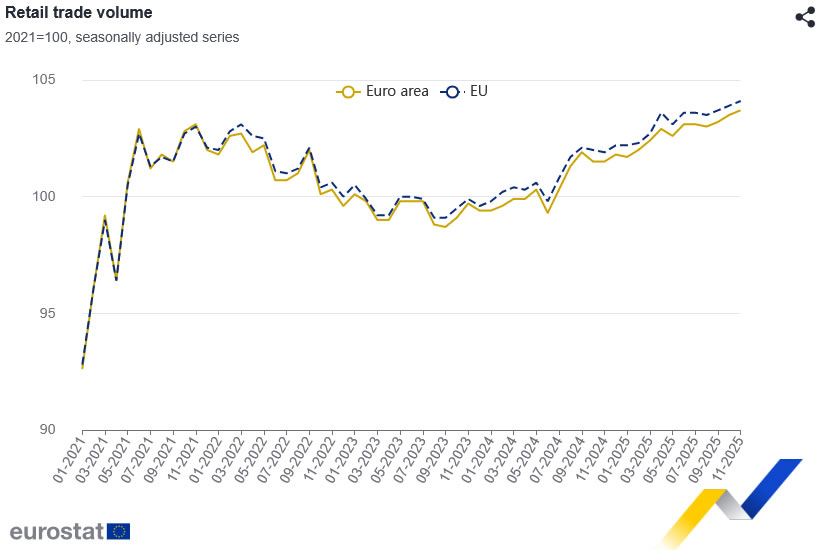
Eurozone retail sales volumes rose 0.2% mom in November, slightly above expectations of 0.1% increase. The improvement was driven primarily by non-food products, where sales increased 0.4% mom, offsetting weakness elsewhere. Sales of food, drinks and tobacco slipped -0.2%, while automotive fuel volumes fell -0.1%.
Across the broader EU, retail sales also rose 0.2% mom, but national divergences were stark. Luxembourg posted a sharp 5.8% surge, followed by Portugal (2.2%) and Denmark (1.9%). Croatia (-2.2%), Belgium (-1.6%) and Slovakia (-1.5%) recorded notable declines.
Full Eurozone retail sales release here.
AUD/USD Under Bearish Pressure
As indicated by the AUD/USD chart, the Australian dollar has fallen below the 0.6680 level today, with the decline from Wednesday’s high (A) exceeding 1.1%.
Key bearish drivers include:
→ Declining inflation expectations. Data released on Wednesday showed a sharp slowdown in Australian inflation to 3.4%. This has removed the likelihood of a February rate hike by the Reserve Bank of Australia, which had previously maintained a hawkish stance.
→ Uncertainty surrounding China. The economy of Australia’s main trading partner is failing to deliver the expected strong growth, with today’s PMI data coming in mixed. This raises doubts about Chinese demand for Australian commodities and weighs on the AUD, which is often viewed as a proxy for the Chinese economy.
→ NFP-related risk aversion. Ahead of today’s US labour market report, investors are shifting into risk-reduction mode and increasing demand for so-called safe-haven US dollars amid concerns over potential negative surprises.
Technical Analysis of AUD/USD
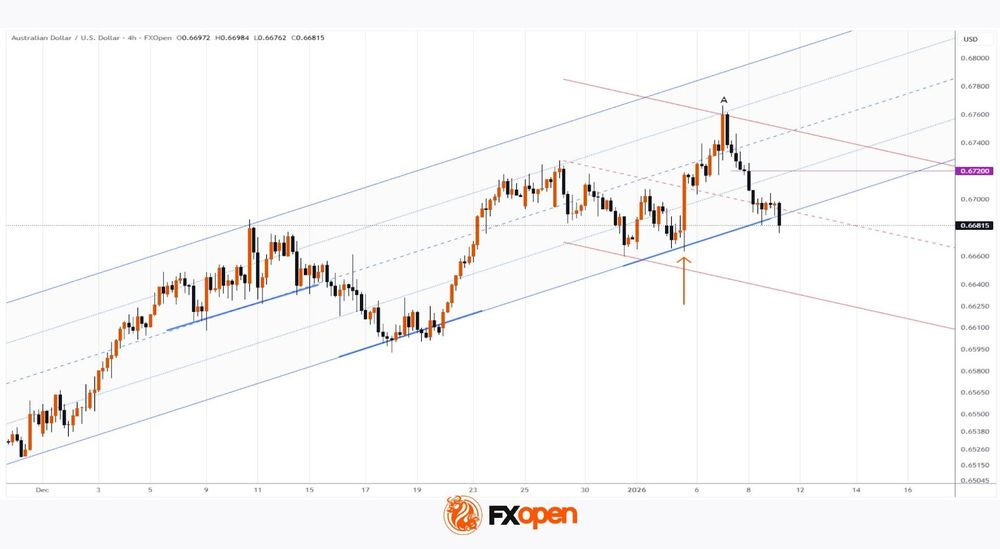
On 26 December, we drew an ascending channel, which remained in place at the start of 2026. However, the following developments should be noted:
→ the current downward move represents a bearish breakout below the lower boundary of the channel;
→ the bullish impulse that began on 5 January (marked by the arrow) has been fully neutralised.
These signals point to a meaningful shift in market sentiment, clearly reflected in price action. Should bulls attempt to bring AUD/USD back within the ascending channel, resistance might emerge near 0.6720, where the sharp sell-off began on 8 January, highlighting the dominance of sellers.
The release of high-impact news could fuel further downside momentum, opening the way for the continuation of the descending trajectory (highlighted in red).
Trade over 50 forex markets 24 hours a day with FXOpen. Take advantage of low commissions, deep liquidity, and spreads from 0.0 pips (additional fees may apply). Open your FXOpen account now or learn more about trading forex with FXOpen.
This article represents the opinion of the Companies operating under the FXOpen brand only. It is not to be construed as an offer, solicitation, or recommendation with respect to products and services provided by the Companies operating under the FXOpen brand, nor is it to be considered financial advice.
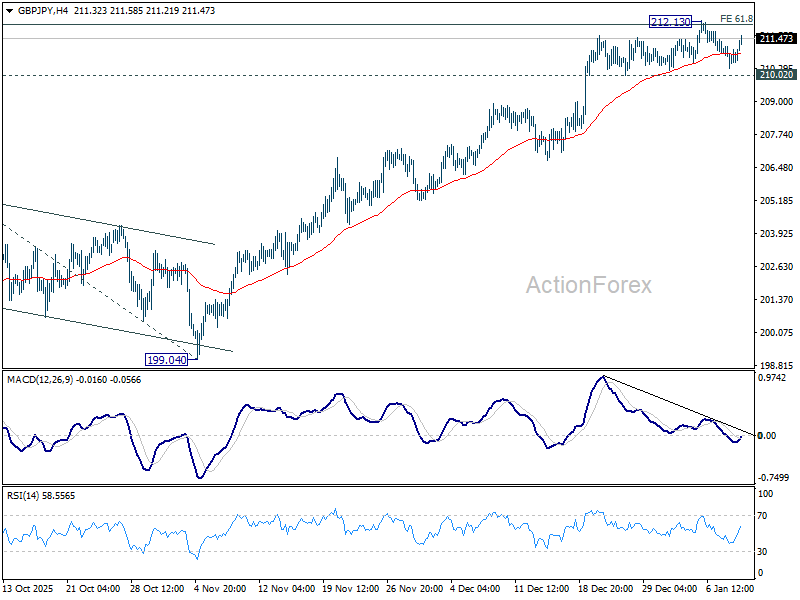
GBP/JPY Daily Outlook
Daily Pivots: (S1) 210.39; (P) 210.77; (R1) 211.24; More...
Intraday bias in GBP/JPY stays neutral at this point. Considering bearish divergence condition in 4H MACD, firm break of 210.02 support should confirm short term topping. Deeper decline would be seen to 55 D EMA (now at 207.19) as a correction. Nevertheless, sustained break of 61.8% projection of 184.35 to 205.30 from 199.04 at 211.98 will extend current up trend to 100% projection at 219.99 next.
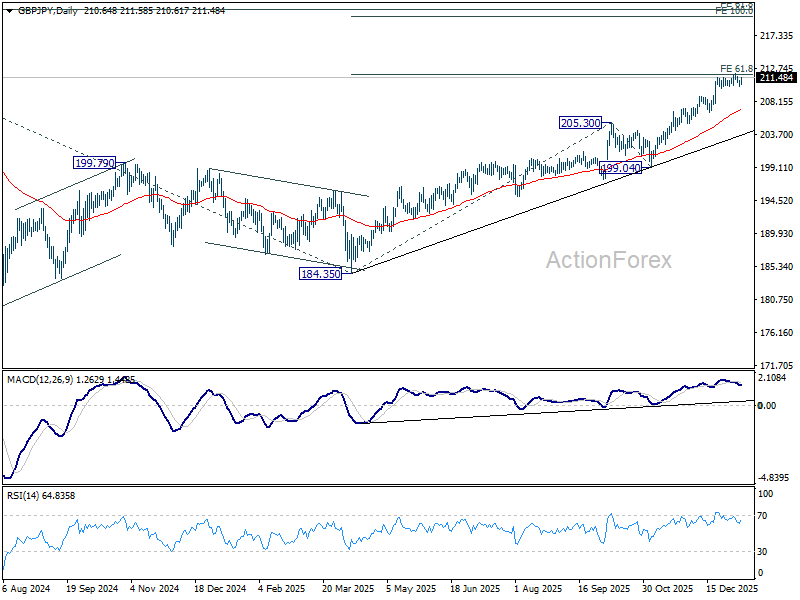
In the bigger picture, up trend from 123.94 (2020 low) is in progress. Next target is 61.8% projection of 148.93 to 208.09 from 184.35 at 220.90. On the downside, break of 205.30 resistance turned support is needed to indicate medium term topping. Otherwise, outlook will stay bullish even in case of deep pullback.
EUR/JPY Daily Outlook
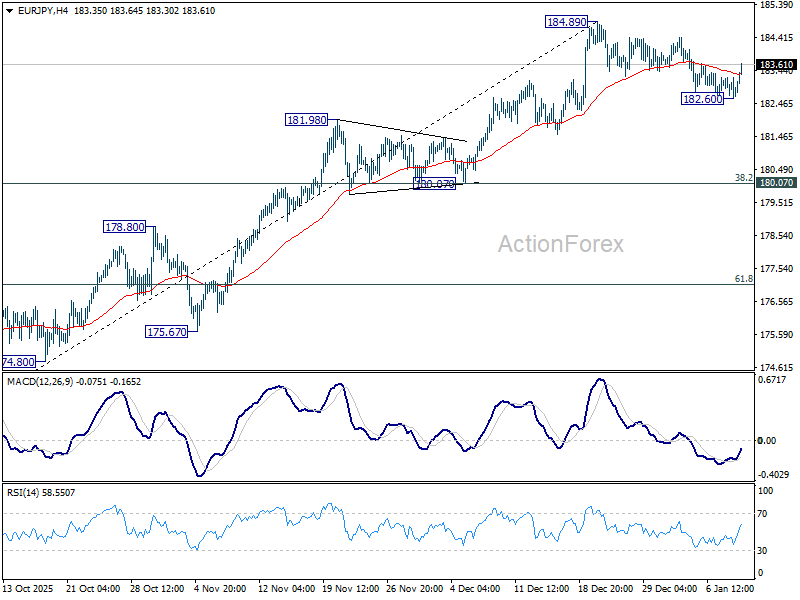
Daily Pivots: (S1) 182.61; (P) 182.93; (R1) 183.23; More...
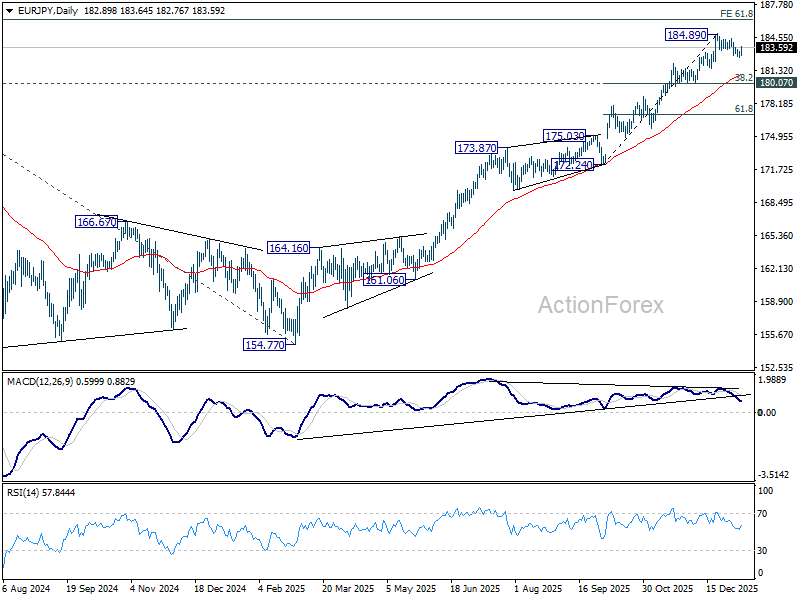
Intraday bias in EUR/JPY is turned neutral with current recovery. Price action from 184.89 is seen as a corrective pattern. Below 182.60 will target 55 D EMA (now at 180.82) and below . But strong support should emerge from 180.07 cluster (38.2% retracement of 172.24 to 184.89 at 180.05) to bring rebound. On the upside, firm break of 184.89 will resume larger up trend to 186.31 fibonacci level.
In the bigger picture, up trend from 114.42 (2020 low) is in progress and should target 61.8% projection of 124.37 to 175.41 from 154.77 at 186.31. Considering bearish divergence condition in D MACD, upside could be capped by 186.31 on first attempt. Still, outlook will stay bullish as long as 55 W EMA (now at 172.16) holds, even in case of deep pullback. Sustained break of 186.31 will pave the way to 100% projection at 205.81 next.
EUR/GBP Daily Outlook
Daily Pivots: (S1) 0.8666; (P) 0.8678; (R1) 0.8687; More…
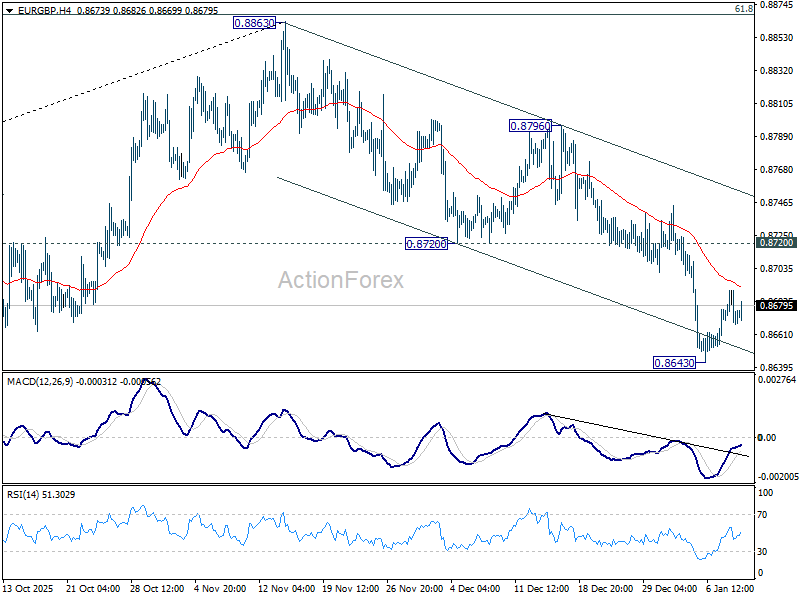
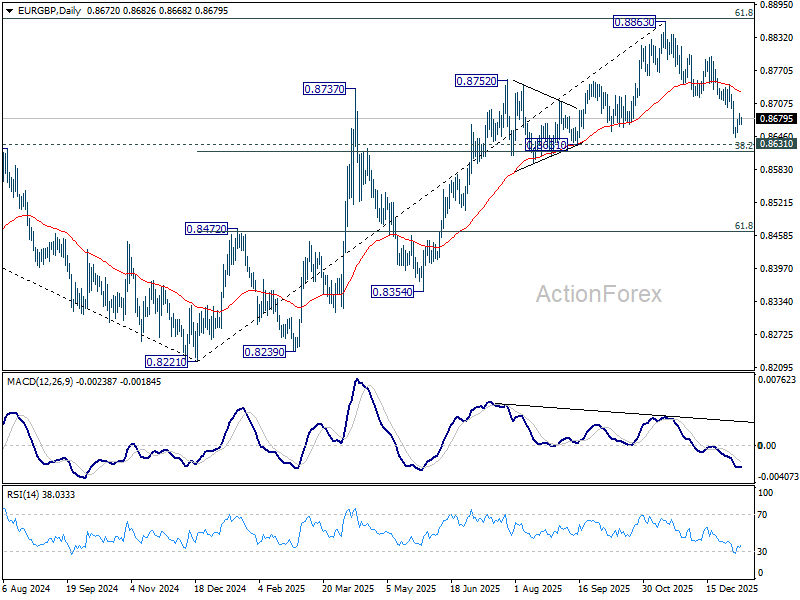
Intraday bias in EUR/GBP remains neutral for consolidations above 0.8643 temporary low. But further decline is expected as long as 0.8720 support turned resistance holds. On the downside, decisive break of 0.8631 cluster support (38.2% retracement of 0.8221 to 0.8663 at 0.8618) will carry larger bearish implications. Nevertheless, sustained break of 0.8720 will bring stronger rally back to 0.8796 resistance instead.
In the bigger picture, rise from 0.8221 medium term bottom is still seen as a corrective move. Upside should be limited by 61.8% retracement of 0.9267 to 0.8221 at 0.8867. Sustained trading below 55 W EMA (now at 0.8617) should confirm that this corrective bounce has completed. However, decisive break of 0.8867 will suggest that EUR/GBP is already reversing whole decline from 0.9267 (2022 high). That should pave the way back to 0.9267.
EUR/AUD Daily Outlook
Daily Pivots: (S1) 1.7356; (P) 1.7406; (R1) 1.7451; More...
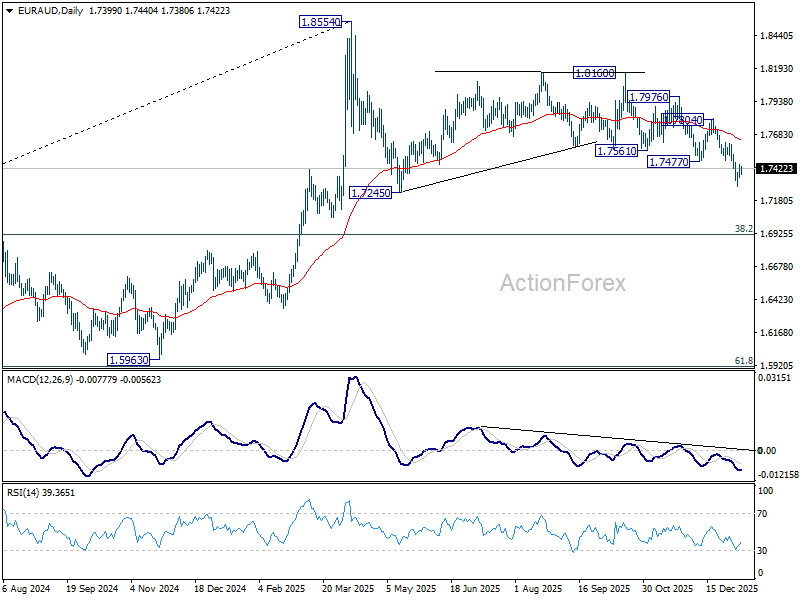
Intraday bias in EUR/AUD remains neutral and more consolidations could be seen above 1.7287 temporary low. Further decline is expected as long as 1.7477 support turned resistance holds. Fall from 1.8160 is seen as the third leg of the pattern from 1.8554. Break of 1.7245 support will target 1.6922 fibonacci level. However, firm break of 1.7477 will turn bias back to the upside for stronger rebound.
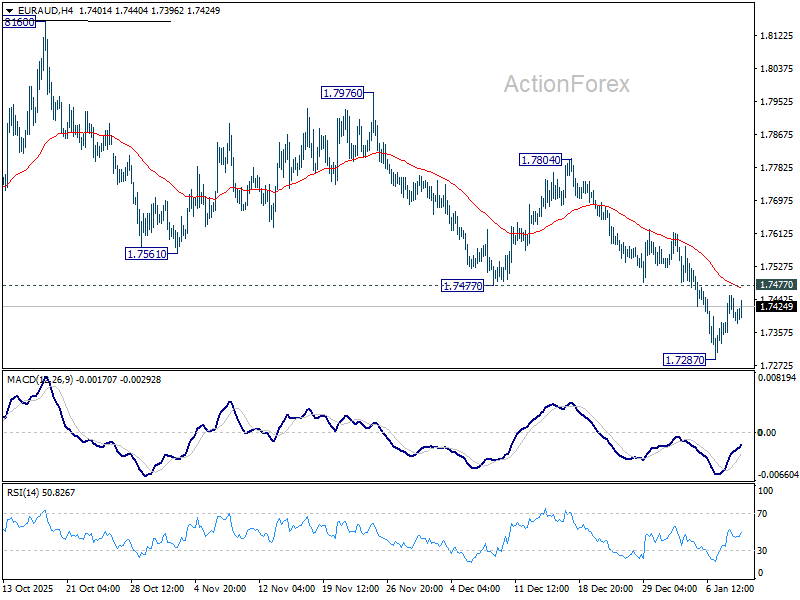
In the bigger picture, as long as 55 W EMA (now at 1.7472) holds, price actions from 1.8554 could still be a correction to rise from 1.5963 only. However, sustained break of the EMA will argue that it's already correcting the whole up trend from 1.4281 (2022 low). In this case, deeper decline would be seen to 38.2% retracement of 1.4281 to 1.8554 at 1.6922.
EUR/CHF Daily Outlook
Daily Pivots: (S1) 0.9307; (P) 0.9313; (R1) 0.9320; More....
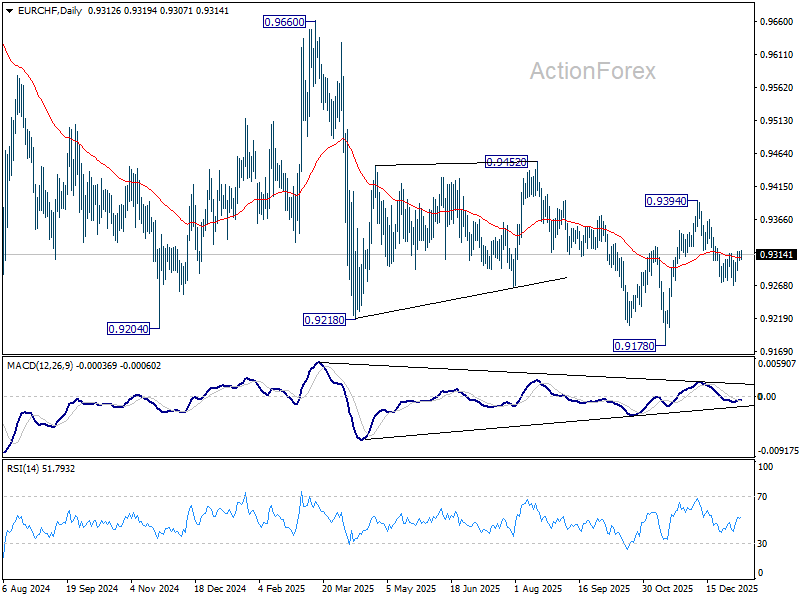
Intraday bias in EUR/CHF stays neutral at this point, and immediate focus remains on 0.9315 resistance. Firm break there will argue that pullback from 0.9394 has completed at 0.9268 already. Intraday bias will then be back on the upside for retesting 0.9394. Nevertheless, rejection by 0.9315 will keep near term risk on the downside. Break of 0.9268 will resume the fall from 0.9394 to retest 0.9178 low.
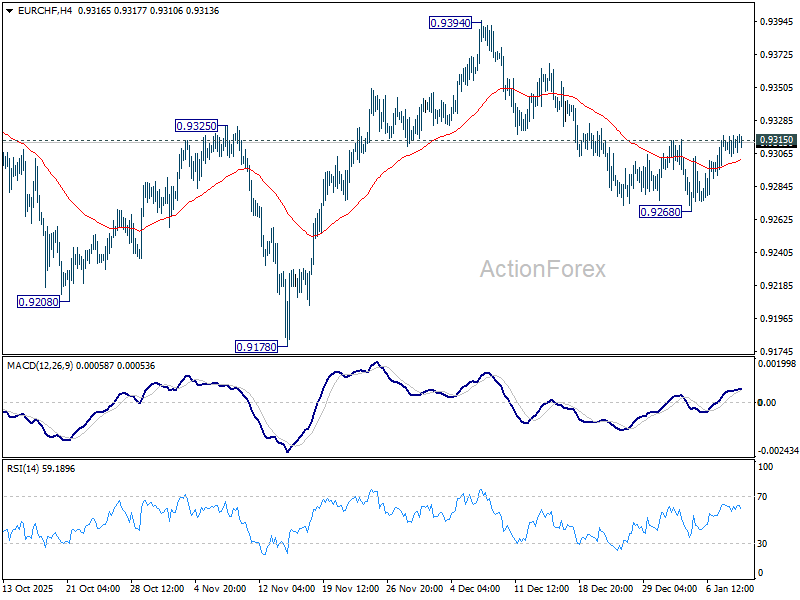
In the bigger picture, EUR/CHF has breached long term falling channel resistance as the rebound from 0.9278 extends. Considering bullish convergence condition in W MACD, sustained trading above 55 W EMA (now at 0.9366) will indicate medium term bottoming at 0.9178, and suggests that it's already in larger scale rebound. Further break of 0.9452 resistance will bring stronger medium term rally towards 0.9928 resistance next. Nevertheless, rejection by 55 W EMA will retain bearishness for another fall through 0.9178 at a later stage.