

Sample Category Title
Fed Barkin expects inflation to come down, but not immediately, not suddenly, and not predictably
Richmond Fed President Thomas Barkin said yesterday, "I definitely see signs of softening" in the economy, with evidence "most pronounced in lower income households".
"I expect inflation to come down but not immediately, not suddenly, and not predictably," he said. "My expectations are it will be a slower path rather than an immediate path down to 2%."
Barkin also said he's open to a 50bps or 75bps hike in July. "I am one of the guys who like the option value of deciding the week of the meeting as opposed to two weeks before the meeting. But I thought Jay's (Fed Chair Jerome Powell) guidance the last time was very sound," he added.
First Impressions: RBNZ Monetary Policy Review, July 2022
The Reserve Bank lifted the OCR another 50 basis points to 2.50% as expected, and it remains focused on the risks of persistent inflation in a capacity-constrained economy.
RBNZ Monetary Policy Review, July 2022
- The Reserve Bank raised the OCR by 50 basis points to 2.50%, as widely expected.
- The key language in the statement was largely identical to the May review.
- The RBNZ still intends to raise interest rates “at pace”, and remains “resolute” in its commitment to bring inflation back within target.
- The RBNZ indicated that the OCR path projected in the May Monetary Policy Statement was still appropriate.
- The RBNZ noted upside risks to inflation and downside risks to activity in the near term.
- However, its concern remains with the risk of persistent inflation over the medium term, reflecting the pervasive capacity pressures in the economy.
Implications
The main signal to take from today’s statement was the lack of a signal – there is no change in the RBNZ’s plans to get on top of inflation through assertive action. As such, there is no reason to change our view of a further 50 basis point hike at the August Monetary Policy Statement. That would be entirely in line with the RBNZ’s May projections.
The August review itself may be an opportunity to review the situation. For one, the OCR will have reached 3% by that point, much closer to the endpoint that the RBNZ envisages. Secondly, it will have the benefit of a full set of economic forecasts, along with additional time to consider the weakening global backdrop. We still expect further, though more modest, rate hikes beyond that, reaching a peak of 3.50%.
More detail in our bulletin later today.
RBNZ media release
Monetary Tightening Continues
The Monetary Policy Committee today increased the Official Cash Rate (OCR) to 2.50 percent. The Committee agreed it remains appropriate to continue to tighten monetary conditions at pace to maintain price stability and support maximum sustainable employment. The Committee is resolute in its commitment to ensure consumer price inflation returns to within the 1 to 3 percent target range.
The level of global economic activity, combined with the ongoing supply disruptions largely driven by both COVID-19 persistence and the Russian invasion of Ukraine, continue to generate global inflation pressures. Food and energy prices are especially affected by geopolitical tension. However, the pace of global economic growth is slowing. The broad-based tightening in global monetary and financial conditions is acting to reduce spending growth. Asset prices have also declined due to higher interest rates and a weaker earnings outlook.
In New Zealand, domestic spending remains supported by high employment levels, resilient household balance sheets in aggregate, continued fiscal support, and a strong terms of trade. The reduction in COVID-19 health-related restrictions is also enabling increased demand. Labour and resource scarcity are also contributing to upward price pressures which are currently exacerbated by seasonal illness, a resurgence in COVID-19 cases, and a net outflow of labour abroad.
In these circumstances, spending and investment demand continues to outstrip supply capacity, with a broad range of indicators highlighting pervasive inflation pressures. Employment remains above its maximum sustainable level and the Reserve Bank’s core inflation measures are around 4 percent. The Committee acknowledged there is a near-term upside risk to consumer price inflation and emerging medium-term downside risks to economic activity.
The Committee agreed to continue to lift the OCR to a level where it is confident consumer price inflation will settle within the target range. The Committee is comfortable that the projected path of the OCR outlined in the recent May Monetary Policy Statement remains broadly consistent with achieving its primary inflation and employment objectives - without causing unnecessary instability in output, interest rates and the exchange rate. Once aggregate supply and demand are more in balance, the OCR can then return to a lower, more neutral, level.
AUDCAD Wave Analysis
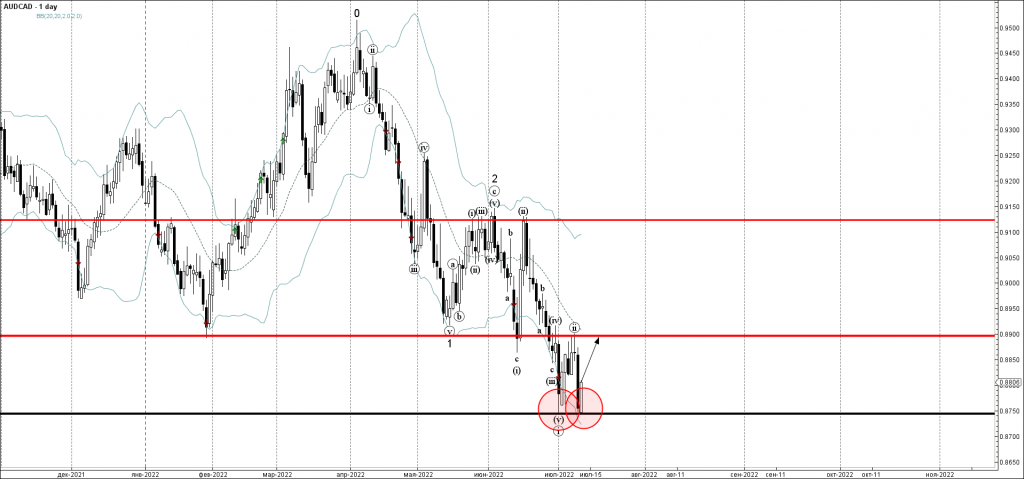
- AUDCAD reversed from key support level 0.8750
- Likely to rise to resistance level 0.8900
AUDCAD currency pair recently reversed up from the key support level 0.8750 (low of the previous minor impulse wave (i) from the end of last month), intersecting with the lower daily Bollinger Band.
The upward reversal from the support level 0.8750 stopped the previous minor downward impulse wave (i) of wave 3 from June.
AUDCAD can be expected to rise further toward the next resistance level 0.8900 (former strong support from January and June).
USDCAD Wave Analysis
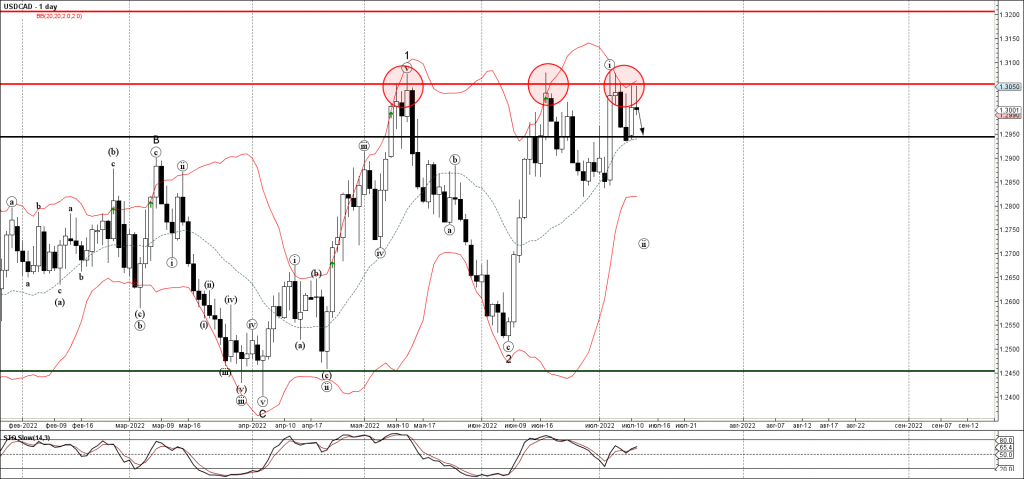
- USDCAD reversed from resistance level 1.3055
- Likely to fall to support level 1.2950
USDCAD currency pair recently reversed down from the pivotal resistance level 1.3055 (which has been repeatedly reversing the pair from the start of May, as can be seen below).
The resistance area near the resistance level 1.3055 was strengthened by the upper daily Bollinger Band.
Given the strength of the resistance level 1.3055, USDCAD can be expected to fall further toward the next support level 1.2950.
Bank of Canada to Speed Up Rate Hikes, But Can it Lift the Loonie?
The Bank of Canada is widely anticipated to raise interest rates again on Wednesday, but expectations are high that it will be a super-sized increase this time when the decision is announced at 14:00 GMT. With inflation expectations running at a record and the labour market still tight, the BoC could signal more big rate hikes are on the way. But will policymakers voice some concerns about the growth outlook amid rising recession risks globally, and can the Canadian dollar find its feet against the mighty greenback?
BoC poised for jumbo rate hike
The Canadian economy is in a relatively good place right now. It isn’t facing a severe energy crunch like Europe, it isn’t as exposed to China’s on-and-off lockdowns as Australia and New Zealand are, and it may even have more momentum than the US economy, which has lost substantial steam lately. The comparably upbeat picture can be backed by a red-hot labour market and an inflation rate fast approaching 8%.
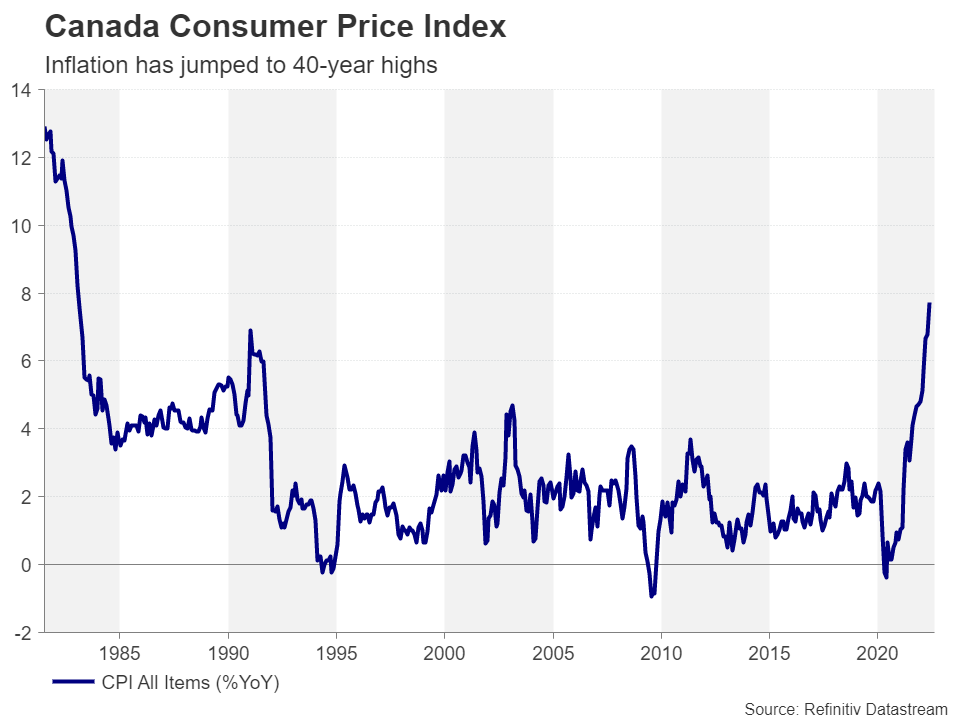
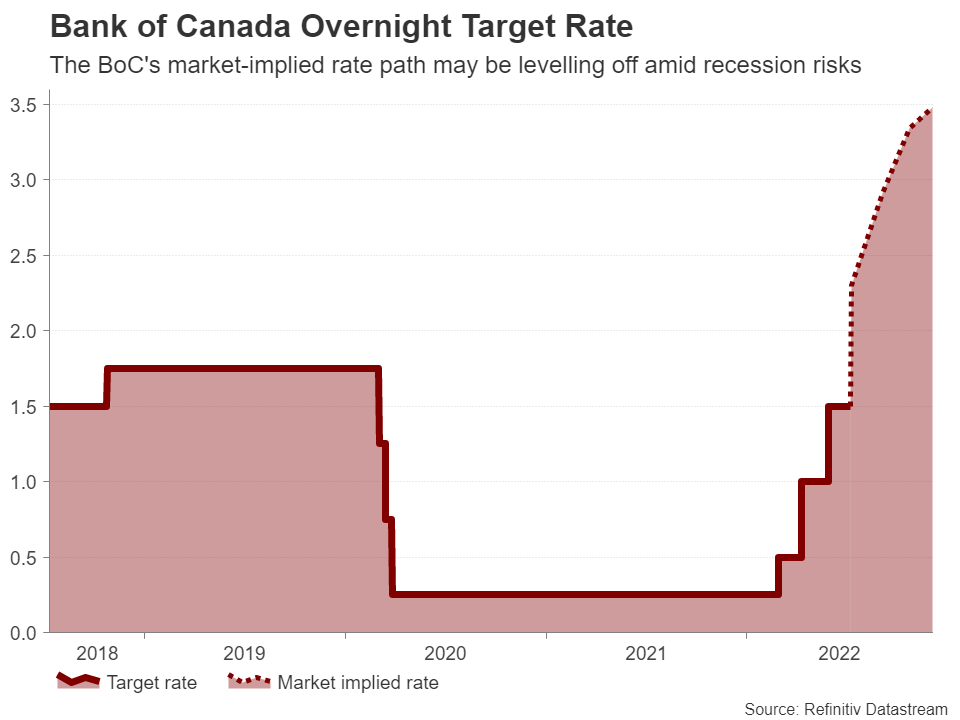
This has left investors in no doubt that the Bank of Canada will press on the brakes harder at its July meeting, having hinted in June that it is “prepared to act more forcefully if needed”. Hence, market pundits are fully convinced that the overnight target rate will be raised from 1.50% to 2.25%, with some even predicting a 100-basis-point hike.
That then puts the spotlight on what the BoC’s intentions are after July: will policymakers maintain the quicker pace of tightening at subsequent meetings, or will they be wary of a possible downturn in the economy towards the end of the year?
Canada’s economy could be slowing
The risk of a recession is growing in the UK and Eurozone and there is speculation that America is already in one. There is no immediate danger in Canada, especially as its economy is being shored up by high oil prices, but there has been some deterioration in the data.
Economic activity slowed to a four-month low in June according to the Ivey PMI and employment fell unexpectedly during the same month. The drop isn’t seen as too worrying just yet and the unemployment rate continued to decline, reaching an all-time low of 4.9%. But there are also concerns about the housing market, which appears to be cooling and home prices likely peaked in February.
Inflation expected to stay high
But like other central banks, the BoC has to balance growth risks with its 2% inflation target. Although oil prices have been under pressure ever since mid-June when the recession panic set in, supply remains very tight and could get even tighter in the coming months, meaning there doesn’t seem to be any significant let-up in energy prices in the medium-term horizon. Hopes for an easing in supply shortages are diminishing too as major industrial regions in China keep being placed under lockdown orders, creating knock-on effects on global supply chains.
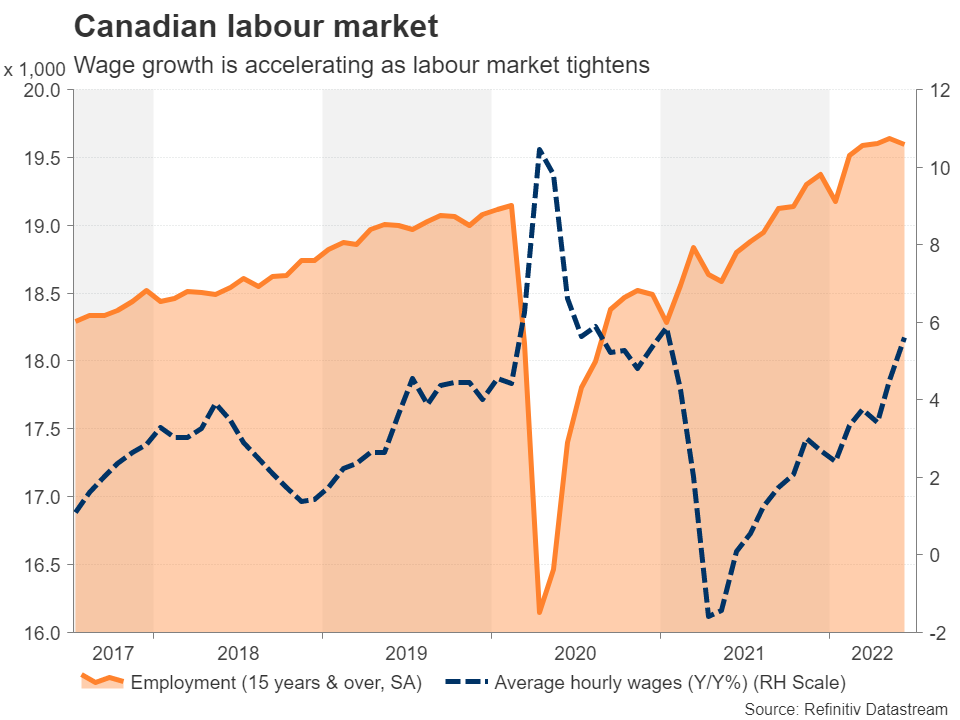
The BoC’s own business outlook survey published last week showed inflation expectations have surged over the last quarter. But what likely set off alarm bells for policymakers is that short-term expectations for inflation by consumers have risen to a record high, while many firms are planning to increase wages at a faster rate in a bid to retain staff. Wage growth accelerated to 5.6% y/y in June, reflecting how widespread labour shortages are becoming.
Can the loonie gain from a hawkish decision?
All this will probably keep the BoC leaning towards the hawkish side on Wednesday and Governor Tiff Macklem could well flag more ‘forceful’ action at the September meeting in his press conference. But investors will also be sifting through the Bank’s quarterly economic forecasts due to be published the same day for clues on the growth outlook. If the latest projections aren’t too pessimistic and the risk of a recession in Canada is seen as quite low, that could provide some much-needed upside for the loonie.
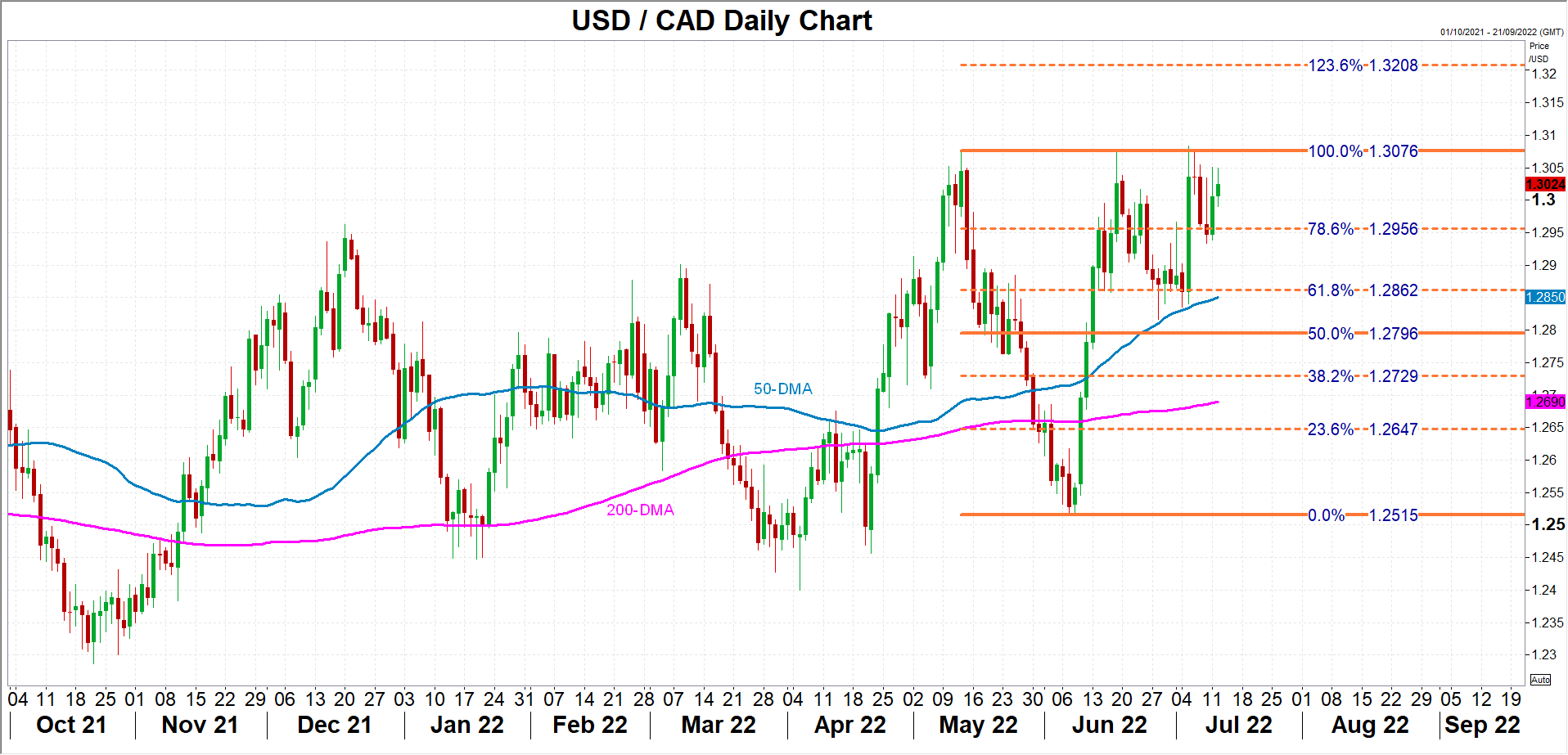
The US dollar is currently trading near the strong C$1.3075 resistance region. A hawkish statement and not so gloomy growth forecasts would reinforce this barrier and potentially push dollar/loonie down towards the 50-day moving average, which is close to converging with the 61.8% Fibonacci retracement of the May-June downleg at C$1.2862.
A strong US dollar is an obstruction
However, if the BoC is reluctant to signal another 75-bps rate hike and expresses some serious doubts about the growth prospects over the next year, dollar/loonie might finally be able to break above the C$1.3075 resistance and head towards the 123.6% Fibonacci extension of C$1.3208.
Overall, out of all the big central banks, the odds of a dovish tilt are probably the lowest for the Bank of Canada, and while the loonie has enjoyed solid gains versus all other majors over the last 12 months, it looks set to continue to struggle against its US rival due to the greenback’s status as the preferred safe-haven currency in the current uncertain economic environment.
Gold Fell to Support But Unlikely to Turn Higher Soon
The price of gold fell to a new nine-month low on Tuesday, at one point falling below $1725. In the region of $1720-1740, gold has been finding support in the declines of the last 15 months, and the daily charts clearly show that gold sellers have been slowing down lately.
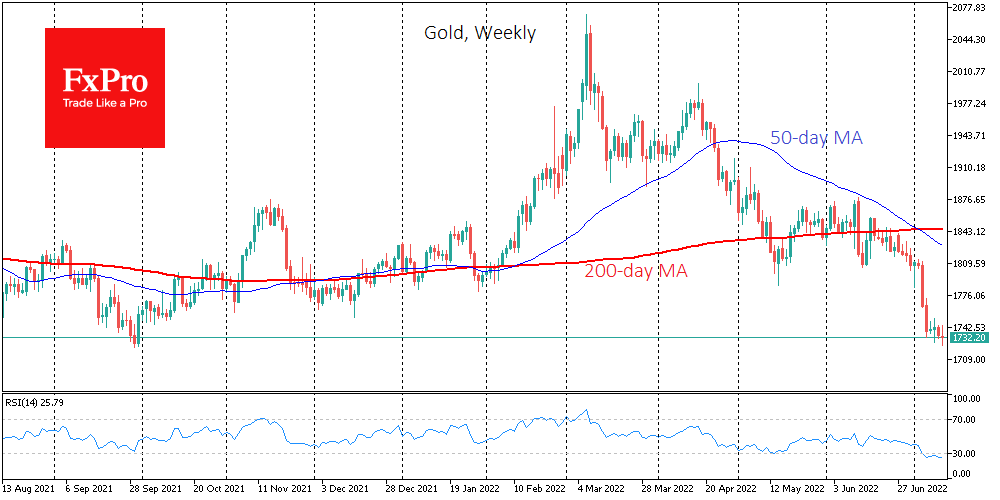
Interestingly, gold has been living its life in the last few days, experiencing a sharp drop earlier in the month, but gaining support last week. Judging by the market dynamics, the most aggressive decline of the single currency in the previous week has supported gold buying.
Since March, the euro gold price has already found support on several occasions at the approach of the €1700 area, an important milestone, and the area of the high in August 2020, maintaining a substantial downside potential.
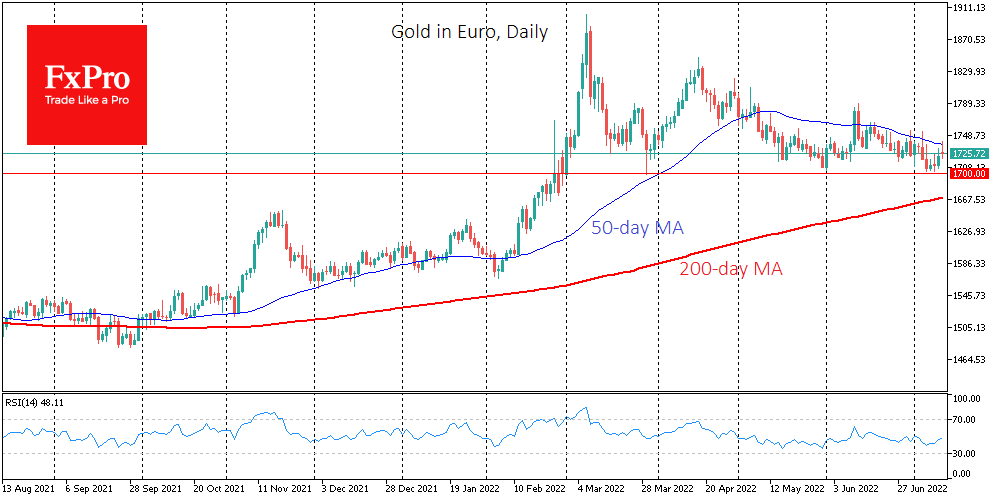
It would be naive to assume that buying gold now would protect capital in the event of existential problems in the Eurozone. But this assumption is difficult to confirm with history.
In 2012, gold was losing with the euro, and it only reversed upwards in the second half of the year following the recovery of the eurozone confidence.
Gold has reached the 61.8% of the 2018-2020 growth wave with accumulated local oversold. In such an environment, a short-term rebound is highly likely, which would be true if the dollar also loosens its grip.
However, a rebound in the coming days could prove to be a bull trap or not at all. Towards the most pessimistic scenario, seasonality and downside potential on higher timeframes is in favour.
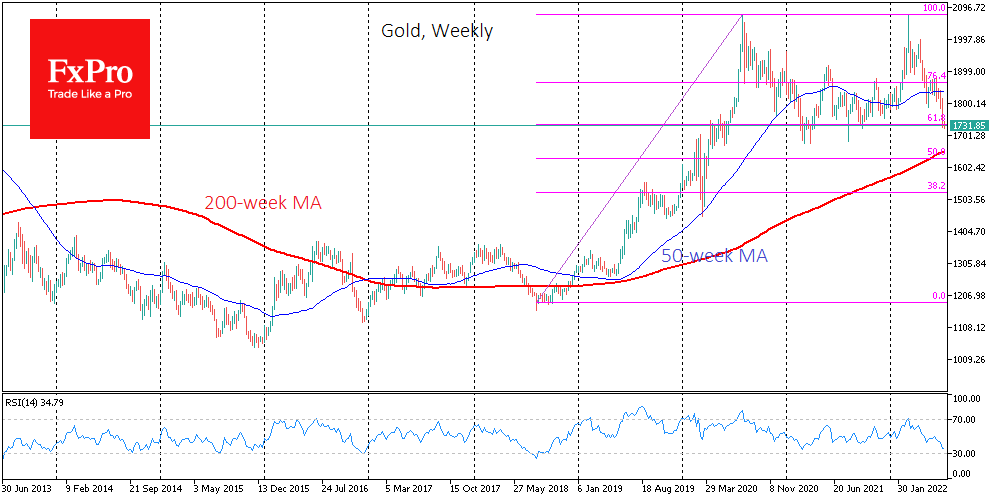
Gold rarely changes its chosen trend in March-April, but it often does so in August-September. On the weekly candlesticks, the gold is far from the oversold area, and it is easy to see that we have seen reversals on these intervals when the oversold area is touched.
A potential target for the bears could be the 200-week moving average, pointing upwards and now passing through $1650.
Sunset Market Commentary
Markets
EUR/USD is a highly frequented chart these days. With yesterday’s slide at the start of the week, the pair was less than a whisker away from parity. The decline extended in Asian and most of European dealings, leading EUR/USD to hit 1.00 exactly at 11:46 am according to the Bloomberg terminals. This 20-year low was immediately followed by some technical return action higher, suggesting it serves as a strong psychological barrier to break. At the time of writing, EUR/USD is changing hands in the 1.005 area. We fear it’s only a matter of time before a break occurs. If not today, then perhaps tomorrow with the release of US CPI that may bring back the focus to the Fed and its aggressive tightening campaign. We suspect a lot of stop-losses will be triggered in case EUR/USD goes sub 1, causing the downleg to accelerate. The test of parity happened against the same background as yesterday, i.e. risk aversion. This was visible in other currency crosses as well with the Japanese yen outperforming peers. USD/JPY is taking a step back to 136.79, EUR/JPY extends a series of declines to 137.34. Unlike yesterday, sterling is trading a bit more in the defense. EUR/GBP (0.846) recoups part of Monday’s losses but still falls way short of returning to the upward sloping trend channel. Fallout on equity markets stayed limited today. The EuroStoxx50 erased losses of as much as 1.3% to trade flat currently. US markets open with minor gains (up to 0.8% in the Nasdaq). Core bonds surged. German Bunds continue to outperform US Treasuries. German yields/European swap yields drop between 8/9 bps at the front end and 15+ bps at the long(est) tenors. Germany’s 10y yield is testing the critical 1.12%/1.15% support level. The European 10y swap yield (-13bps) is struggling and currently failing to retain the 2% barrier. US bond yields shed 7.2 bps (2y) to 8.8 bps (20y) in a bull flattener. Testament to recessionary risk aversion is a further decline in the likes of oil, even as OPEC’s first 2023 outlook shows no relief in the oil market squeeze. A barrel of Brent eases almost $5 to $102.2. The limited batch of data available today told the same story. Germany’s ZEW dropped way more than expected with the current situation gauge falling from -27.6 to -45.8. Expectations fell off a cliff, from -28 to -53.8 (-40.5 expected), the lowest since the sovereign debt crisis in 2011.
News Headlines
The National Bank of Poland (NBP) in its July economic forecasts again revised the central path for inflation sharply higher from the March forecast. The NBP now expects 2022 inflation at 14.2% (from 10.8% in March) and at 12.3% next year (from 9.0%). Inflation is still expected at 4.1% in 2024. According to the new forecast Y/Y inflation is expected to peak in the first quarter of next year (18.8%). The NBP has an inflation target of 2.5% (+/-1.0ppt). At the same time, growth for this year was upwardly revised to 4.7% Y/Y (from 4.4%), but is expected to slow to 1.4% next year (from 3.0%), also reaching a bottom in Q1 next year (0.5% Y/Y). The ‘stagflationary outlook’ comes as the NBP last week raised its policy rate by a smaller than expected 50bps to 6.50% and as NBP governor Glapinski signaled that the NBP is nearing the end in its tightening cycle. Polish rates are rising sharply today in line with regional (risk-off) momentum (2-y swap +25bps). The zloty weakened to EUR/PLN 4.85 intraday, but currently trades near 4.80.
The central bank of Hungary today raised the base rate by 2.0% to 9.75%. The MNB last week indicated that it intended to close the gap between the 1W week deposit rate and the base rate after it hiked the 1W rate to support the forint. The MNB today reiterated it stands ‘ready to respond quickly and flexibly by setting the interest rate on the one-week deposit instrument if warranted by the rise in short-term risks in financial and commodity markets’. ‘The further rise in inflation and persistent inflation risks warrant the decisive continuation of the tightening cycle. The MNB continuously monitors developments in financial market risks as well and stands ready to intervene in a decisive manner using every instrument in its monetary policy toolkit, if necessary’. Until now, the MNB rate hikes were no game-changer for the forint. The forint this morning traded at EUR/HUF 414.5, within reach of the all-time low, but gained modestly after the MNB interest rate decision (currently 408). Short-term rates in Hungary continue to rise. The market now sees the top in the rate hike cycle only a tad below 13%.
Dollar Goes on a Rampage ahead of US Inflation Report
The US dollar has been trading like a rocket lately, crushing every other major currency as recession concerns pushed investors into the safety of the reserve currency. The latest inflation numbers at 12:30 GMT Wednesday and retail sales on Friday will be crucial in determining whether this trend still has some miles left in the tank as euro/dollar battles with parity.
All weather currency
A unique dynamic has been playing out over the past few months - all news has been good news for the US dollar. Either economic data is strong and traders become more confident the Fed will raise interest rates at a faster clip to control inflation, or disappointing data magnifies recession concerns and the reserve currency attracts safe-haven flows.
Either way, the dollar tends to benefit. This is also because there is no alternative, as every other major currency is wrestling with its own problems. The euro has been smothered by the energy crisis, the Bank of Japan’s refusal to consider higher rates has wrecked the yen, while abysmal risk sentiment has left its marks on sterling and commodity currencies.
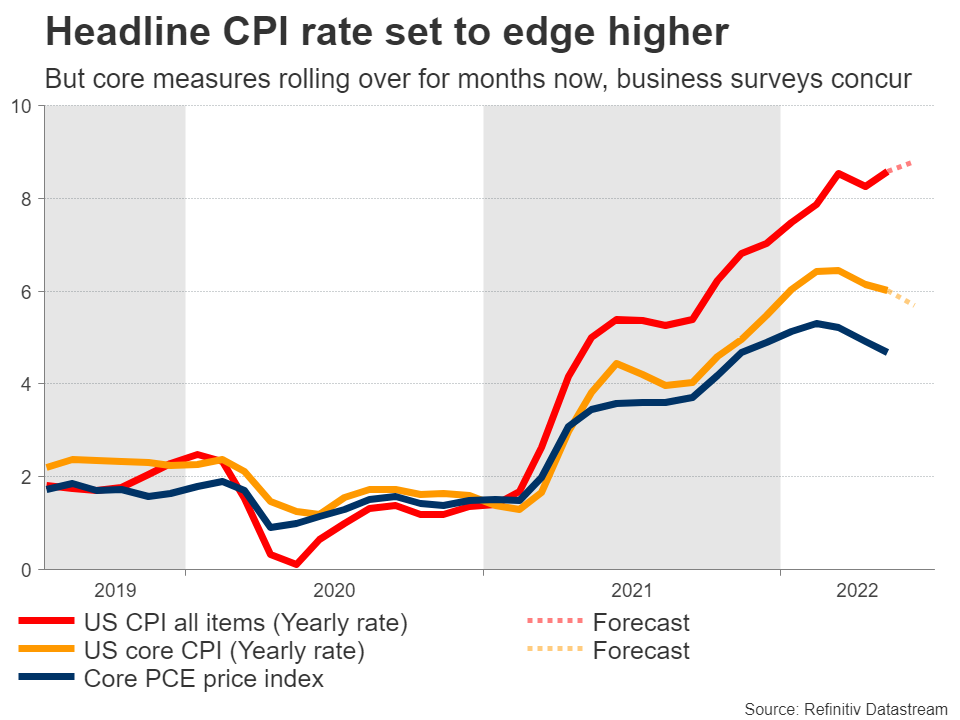
One of the few elements that can change this ‘strong dollar’ dynamic is a serious slowdown in inflation that lessens the pressure on the Fed to hike rates ferociously, elevating the importance of the upcoming data.
Inflation and retail sales
The show will get started with CPI inflation stats on Wednesday. The forecast is for the monthly rate to clock in at 1.1%, an acceleration from the 1.0% in May. This would propel the yearly rate higher to 8.8%, from 8.6% previously.
That said, some signs suggest inflation has started to lose its punch. For instance, the S&P Global PMI survey reported that service sector companies raised their selling prices at the softest pace since last September because demand has started to falter. Similarly, used car prices and various commodity prices have started to roll over.
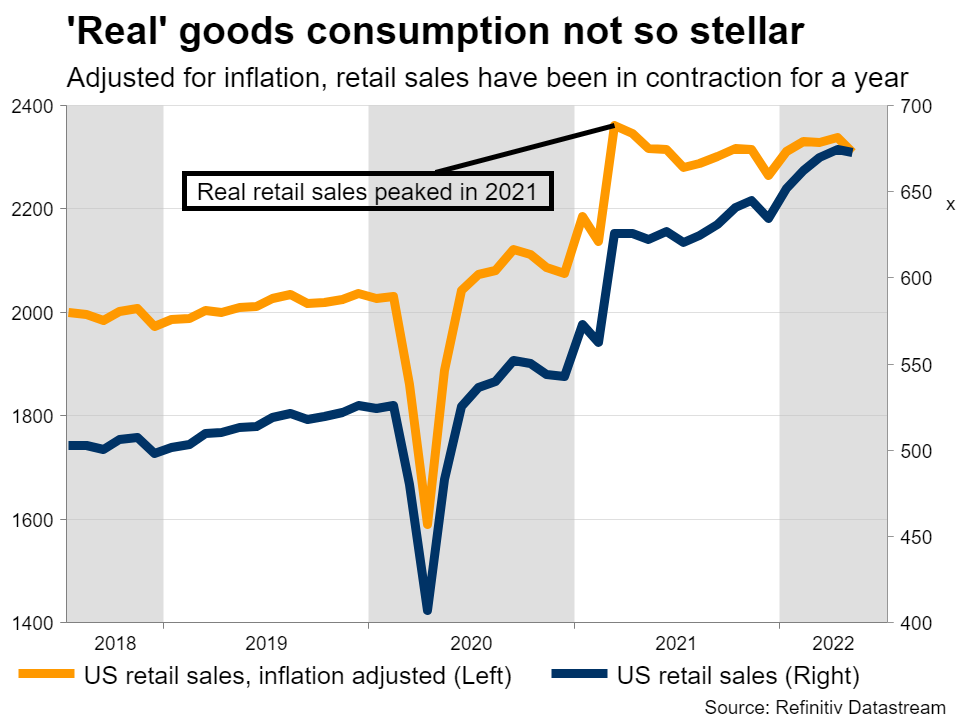
This would suggest that the risks surrounding the inflation report are tilted toward a slight disappointment, although the catch is that it might be too soon for the retreat in commodity prices to have a meaningful impact on inflation. It will probably be more visible next month.
Then on Friday, retail sales for June will hit the markets. Expectations are for a rebound in monthly terms, although it is the yearly rate that tells the story. It currently stands at 8.1%, below the inflation rate, showing that real consumption of goods has essentially been stagnant.
What’s next
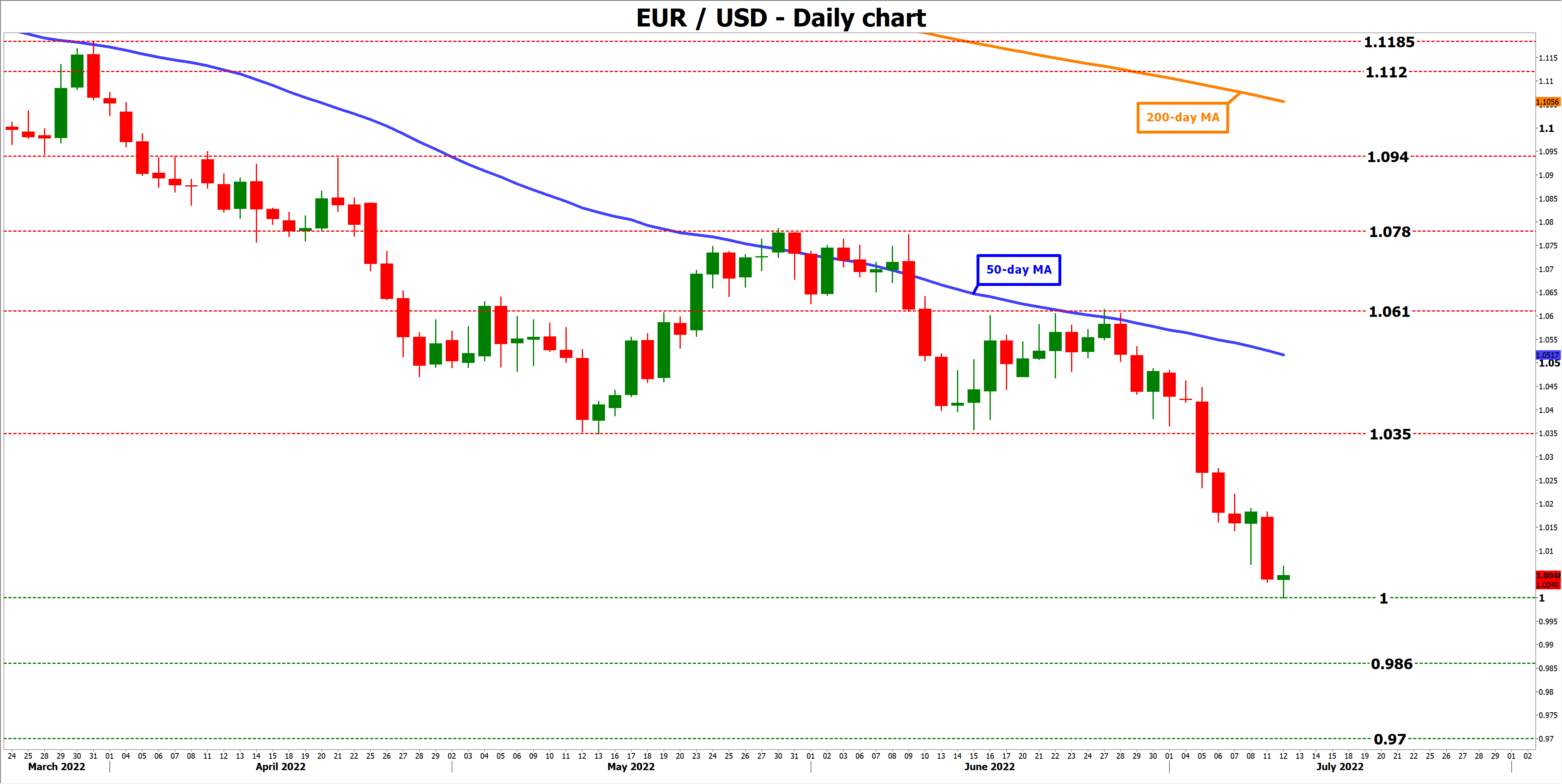
In the markets, any disappointment in the upcoming data would likely lead to some profit-taking in the dollar. Taking a technical look at euro/dollar, there is not much resistance until the 1.0350 zone, which is quite far from current prices. Perhaps 1.0180 might come into play before that - an area that is more visible on the four-hour chart.
In the bigger picture, it’s difficult to envision any trend reversal in the dollar until the situation in the rest of the world begins to improve. For instance, if some more energy production comes back online, that would lessen the pressure on the euro and yen. Some good news from Ukraine could have the same effect.
A persistent slowdown in US inflation might also do the trick, although the reason why inflation drops will also matter for the dollar. If inflation is cooling because demand is falling apart and markets are panicking about recession, safe haven demand could continue to support the reserve currency even if some Fed hikes are priced out.
What is needed is a supply-driven improvement in inflation, before the dollar can really retreat. That’s not on the radar yet, which suggests the rally might still have legs. A decisive move below the parity level in euro/dollar could signal a resumption of the trend, opening the door towards the 0.9860 region.
US: NFIB Small Business Optimism Index drops further in June
The NFIB's small business optimism index dropped in June to 89.5 from 93.1 in May, below the consensus forecast, which expected the index to dip marginally to 92.5. The index has been below the historical average since the beginning of the year.
All ten subcomponents declined. Firms, expecting higher real sales collapsed by 13 points, while those expecting the economy to improve and planning to increase employment fell 7 points each. Small businesses believing that now is a good time to expand fell by 3 points and so did those reporting inventories "too low" and planning to add more inventories. The remaining sub-components deteriorated marginally by 1 or 2 points.
Labor market indicators were mixed in June. A net 48% of firms raised compensation to attract workers (down 1 point over May), but 28% of firms are planning to raise compensation in the next 3 months (up from 25% in May). Firms planning to increase employment dropped by 7 points to 19%, while the number of firms with unfilled job openings declined by 1 point to 50% - still relatively high by historical standards.
Key Implications
This was a glass more than half empty report as a greater share of small business owners are becoming increasingly bearish on the economy. Firms expecting better business conditions dropped to the lowest level in the history of the survey, with a smaller proportion of firms expecting higher real sales and fewer firms able to raise prices. This suggests that business are not confident they will be able to pass rising costs to consumers going forward.
Despite this, demand for labor remains high with a much higher than average share business owners unable to fill job vacancies. Firms continue to raise red flags about the quality of labor supply, with roughly a quarter of them reporting it as the single most important factor. Businesses may be able to attract higher quality workers by raising wages and, indeed, many firms are doing or planning to do so.
Higher costs are expected to erode profits and is the reason business optimism is deteriorating. And so it may continue until we see further easing in the current labor demand-supply mismatch accompanied by softer price gains. We'll report on the latter tomorrow morning. Stay tuned!