Sample Category Title
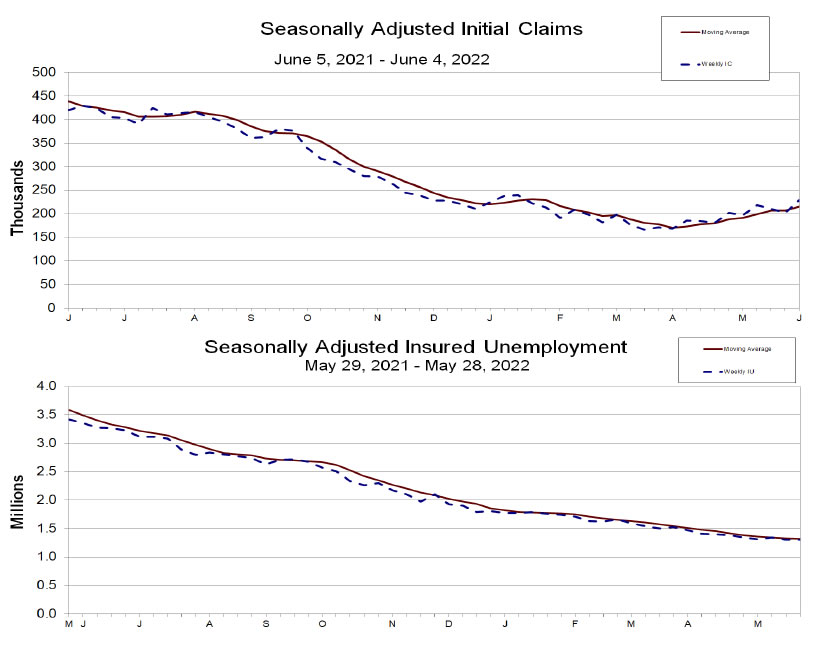
US initial jobless claims rose to 229k, continuing claims unchanged at 1.3m
US initial jobless claims rose 27k to 229k in the week ending June 4, above expectation of 208k. Four-week moving average of initial claims rose 8k to 215k.
Continuing claims was unchanged at 1306k in the week ending May 28. Four-week moving average of continuing claims dropped -9k to 1318k, lowest since January 10, 1970 when it was 1310k.
ECB ends net APP purchase, to hike 25bps in Jul, again and maybe larger in Sep
ECB leaves interest rates unchanged today as widely expected. That is, The main refinancing rate, marginal lending facility rate and deposit rate are held at 0.00%, 0.25% and -0.50% respectively. However, it explicitly said, "the Governing Council intends to raise the key ECB interest rates by 25 basis points at its July monetary policy meeting."
Besides, ECB said is expects to "raise the key ECB interest rates again in September". The size would depend on the updated medium-term inflation outlook by then. "If the medium-term inflation outlook persists or deteriorates, a larger increment will be appropriate at the September meeting," it added. Beyond September, "a gradual but sustained path of further increases in interest rates will be appropriate."
Also as expected, ECB decided to end net asset purchases as of July 1, 2022. It will "continue reinvesting, in full, the principal payments from maturing securities purchased under the APP for an extended period of time past the date when it starts raising the key ECB interest rates and, in any case, for as long as necessary to maintain ample liquidity conditions and an appropriate monetary policy stance."
In the new economic projections, annual inflation will hit 6.8% in 2022, then decline to 3.l5% in 2023 and then 2.1% in 2024. Excluding energy and food, inflation is projected to it 3.3% in 3022, then slow to 2.8% in 2023 and then 2.3% in 2024. Inflation projections were revised up "significantly" due to surging energy and food prices, including due to the impact of war".
GDP growth is projected at 2.8% in 2022, 2.1% in 2023 and 2.1% in 2024 (revised down slightly for 2022 and 2023, but up for 2024).
(ECB) Monetary policy decisions
High inflation is a major challenge for all of us. The Governing Council will make sure that inflation returns to its 2% target over the medium term.
In May inflation again rose significantly, mainly because of surging energy and food prices, including due to the impact of the war. But inflation pressures have broadened and intensified, with prices for many goods and services increasing strongly. Eurosystem staff have revised their baseline inflation projections up significantly. These projections indicate that inflation will remain undesirably elevated for some time. However, moderating energy costs, the easing of supply disruptions related to the pandemic and the normalisation of monetary policy are expected to lead to a decline in inflation. The new staff projections foresee annual inflation at 6.8% in 2022, before it is projected to decline to 3.5% in 2023 and 2.1% in 2024 – higher than in the March projections. This means that headline inflation at the end of the projection horizon is projected to be slightly above the Governing Council's target. Inflation excluding energy and food is projected to average 3.3% in 2022, 2.8% in 2023 and 2.3% in 2024 – also above the March projections.
Russia's unjustified aggression towards Ukraine continues to weigh on the economy in Europe and beyond. It is disrupting trade, is leading to shortages of materials, and is contributing to high energy and commodity prices. These factors will continue to weigh on confidence and dampen growth, especially in the near term. However, the conditions are in place for the economy to continue to grow on account of the ongoing reopening of the economy, a strong labour market, fiscal support and savings built up during the pandemic. Once current headwinds abate, economic activity is expected to pick up again. This outlook is broadly reflected in the Eurosystem staff projections, which foresee annual real GDP growth at 2.8% in 2022, 2.1% in 2023 and 2.1% in 2024. Compared with the March projections, the outlook has been revised down significantly for 2022 and 2023, while for 2024 it has been revised up.
On the basis of its updated assessment, the Governing Council decided to take further steps in normalising its monetary policy. Throughout this process, the Governing Council will maintain optionality, data-dependence, gradualism and flexibility in the conduct of monetary policy.
Asset purchase programme (APP) and pandemic emergency purchase programme (PEPP)
The Governing Council decided to end net asset purchases under its asset purchase programme (APP) as of 1 July 2022. The Governing Council intends to continue reinvesting, in full, the principal payments from maturing securities purchased under the APP for an extended period of time past the date when it starts raising the key ECB interest rates and, in any case, for as long as necessary to maintain ample liquidity conditions and an appropriate monetary policy stance.
As concerns the pandemic emergency purchase programme (PEPP), the Governing Council intends to reinvest the principal payments from maturing securities purchased under the programme until at least the end of 2024. In any case, the future roll-off of the PEPP portfolio will be managed to avoid interference with the appropriate monetary policy stance.
In the event of renewed market fragmentation related to the pandemic, PEPP reinvestments can be adjusted flexibly across time, asset classes and jurisdictions at any time. This could include purchasing bonds issued by the Hellenic Republic over and above rollovers of redemptions in order to avoid an interruption of purchases in that jurisdiction, which could impair the transmission of monetary policy to the Greek economy while it is still recovering from the fallout from the pandemic. Net purchases under the PEPP could also be resumed, if necessary, to counter negative shocks related to the pandemic.
Key ECB interest rates
The Governing Council undertook a careful review of the conditions which, according to its forward guidance, should be satisfied before it starts raising the key ECB interest rates. As a result of this assessment, the Governing Council concluded that those conditions have been satisfied.
Accordingly, and in line with the Governing Council's policy sequencing, the Governing Council intends to raise the key ECB interest rates by 25 basis points at its July monetary policy meeting. In the meantime, the Governing Council decided to leave the interest rate on the main refinancing operations and the interest rates on the marginal lending facility and the deposit facility unchanged at 0.00%, 0.25% and -0.50% respectively.
Looking further ahead, the Governing Council expects to raise the key ECB interest rates again in September. The calibration of this rate increase will depend on the updated medium-term inflation outlook. If the medium-term inflation outlook persists or deteriorates, a larger increment will be appropriate at the September meeting.
Beyond September, based on its current assessment, the Governing Council anticipates that a gradual but sustained path of further increases in interest rates will be appropriate. In line with the Governing Council's commitment to its 2% medium-term target, the pace at which the Governing Council adjusts its monetary policy will depend on the incoming data and how it assesses inflation to develop in the medium term.
Refinancing operations
The Governing Council will continue to monitor bank funding conditions and ensure that the maturing of operations under the third series of targeted longer-term refinancing operations (TLTRO III) does not hamper the smooth transmission of its monetary policy. The Governing Council will also regularly assess how targeted lending operations are contributing to its monetary policy stance. As announced previously, the special conditions applicable under TLTRO III will end on 23 June 2022.
***
The Governing Council stands ready to adjust all of its instruments, incorporating flexibility if warranted, to ensure that inflation stabilises at its 2% target over the medium term. The pandemic has shown that, under stressed conditions, flexibility in the design and conduct of asset purchases has helped to counter the impaired transmission of monetary policy and made the Governing Council's efforts to achieve its goal more effective. Within the ECB's mandate, under stressed conditions, flexibility will remain an element of monetary policy whenever threats to monetary policy transmission jeopardise the attainment of price stability.
The President of the ECB will comment on the considerations underlying these decisions at a press conference starting at 14:30 CET today.
Euro Unchanged ahead of ECB Meeting
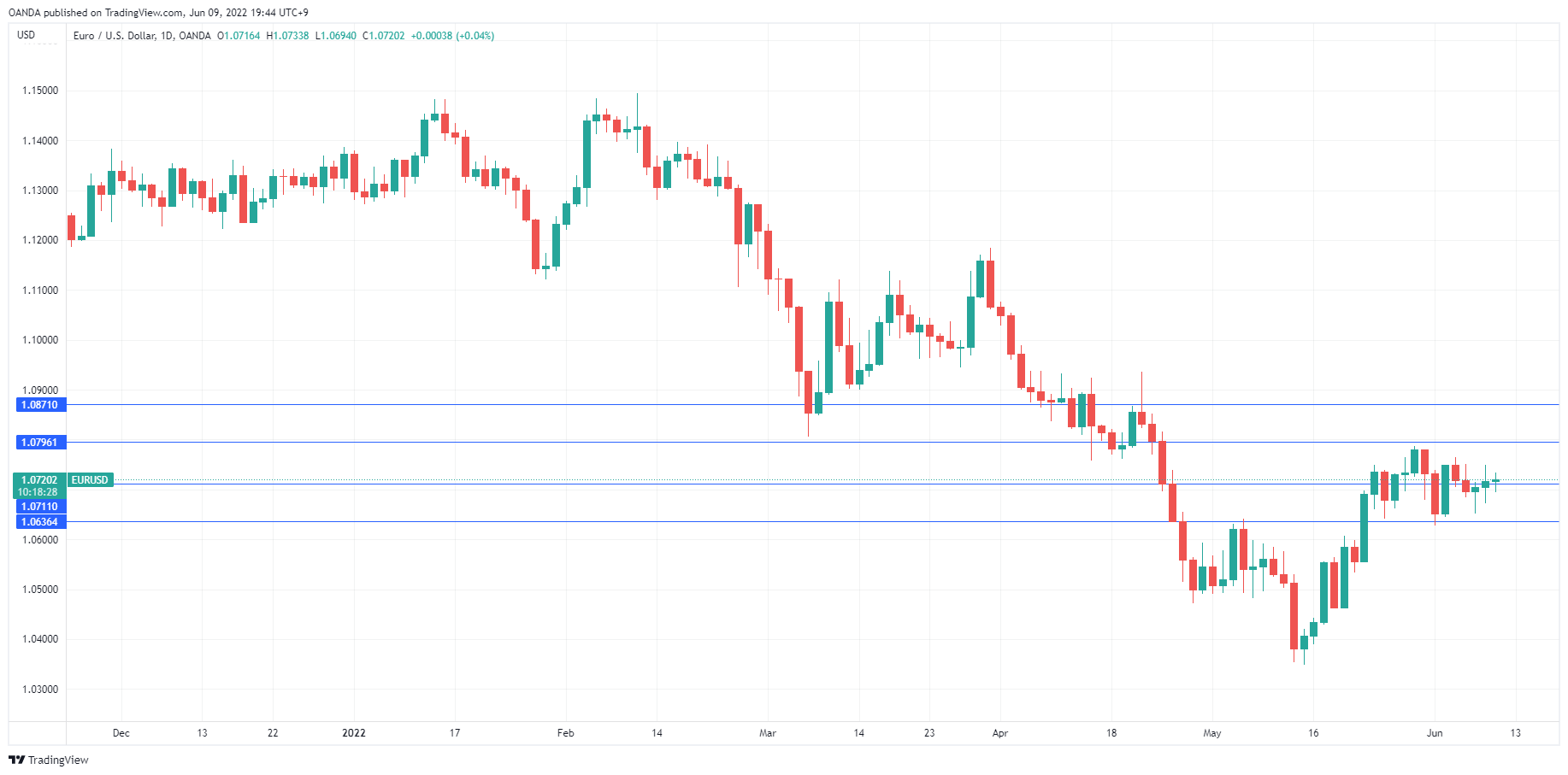
It has been a quiet week for the euro, and that trend has continued today, as EUR/USD is unchanged at 1.0718.
All eyes on ECB
The ECB is poised to end its accommodative policy at today’s meeting, but there is plenty of uncertainty and anticipation ahead of the announcement. The central bank has signalled that it plans to tighten policy but has been short on details. ECB President Lagarde has stated that rates will lift off after its asset purchase programme ends. With a rate hike widely expected at the July meeting, that adds up to QE winding up at the end of June. That still leaves plenty of variables in play. Will the ECB hike by a moderate 25bp or a massive 50bp? What will be the pace of the rate-hike cycle?
As for today’s meeting, a rate hike is unlikely but cannot be ruled out, with inflation continuing to accelerate. If the ECB doesn’t raise rates today and suffices with terminating QE, the driver for euro movement in today’s session will be Lagarde’s press conference. A hawkish tone could give the euro a lift, while if Lagarde sounds more dovish than the markets were expecting, the euro could lose ground.
Key to the size of the rate hike in July will be today’s updated inflation and GDP forecasts. The war in Ukraine and supply bottlenecks make it likely that inflation will be revised upwards and growth downwards, raising fears of staglation. If the inflation report is worse than expected, there will be more pressure on the ECB to consider a 50bp hike in July.
EUR/USD Technical
- EUR/USD faces resistance at 1.0796 and 1.0871
- There is weak support at 1.0711, followed by support at 1.0636
GBPUSD Has Lost its Recovery Momentum. How Low Can it Go?
The British Pound is retreating for a second day, returning below the 1.25 level, failing to build on the positive momentum at the start of the week.
The pressure appears to be driven by rising government bond yields in global markets, starting with but not limited to the US.
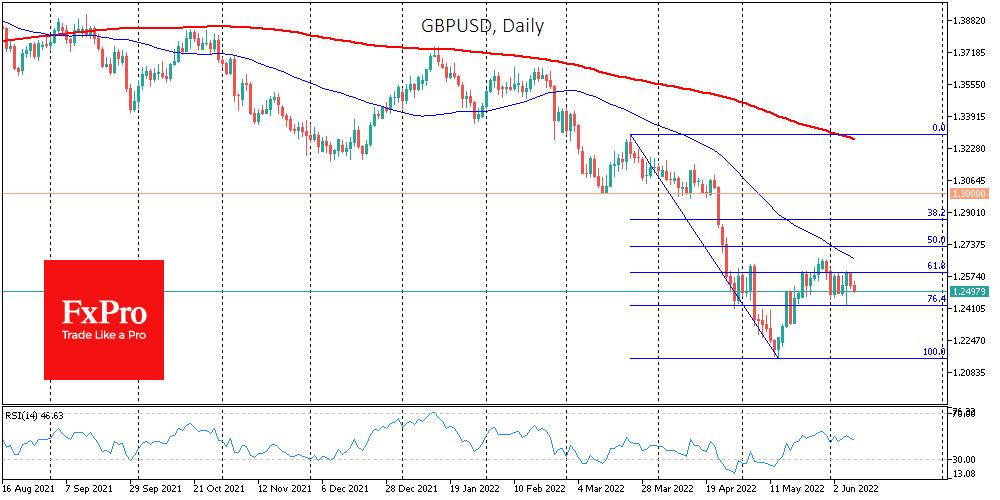
The intraday dynamics of GBPUSD show methodical intraday selling. This is another sign of the rebound’s local exhaustion, and we might expect a new round of declines later.
A pullback of the FTSE100 from the local highs above 7600 is also working against the Pound. The British currency often has a positive correlation to the demand for risks, and its reduction contributes to selling the Pound in forex.
The final point of a new move down could be the 1.1500 area – near the March 2020 low. But before directing the pair to these historical levels, the bears have yet to prove their strength. The first test of the sellers’ intentions may be in this week’s low, at 1.2430.
Should it fail below May’s low at 1.2150, there may be a more meaningful signal. The GBPUSD could make its first move today in case of a sell-off in the equity markets. A move to test 1.2150 could take a couple of weeks.
Cryptocurrency’s Lingering Lull
Bitcoin was down 3.7% on Wednesday, ending the day near the $30.2K level, which it remains near on Thursday morning. The overall subdued sentiment towards cryptocurrencies coincided with a pullback in stock indices. However, the dynamics of the previous days suggest that this is more of a coincidence than a correlation.
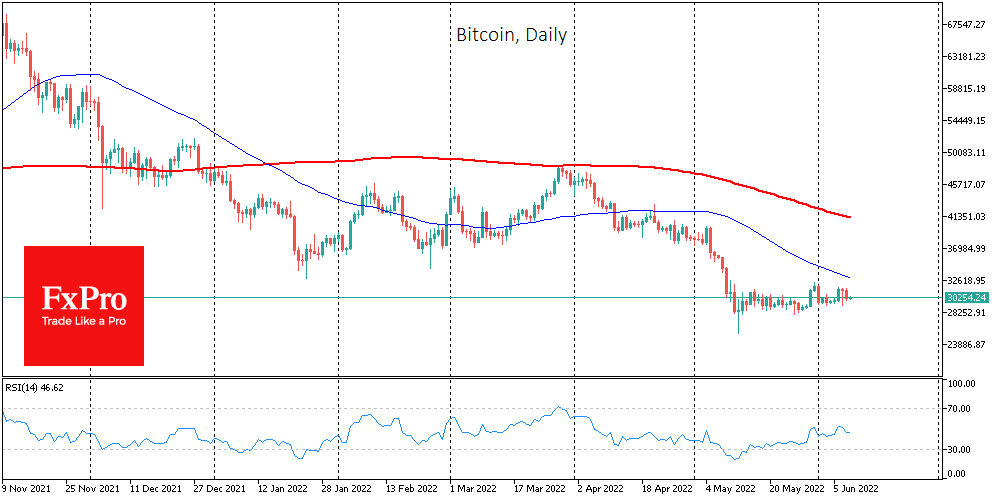
Cryptocurrencies have entered a period of the most pronounced and prolonged lull since late 2020, as the total cryptocurrency cap hovers between $1.2 and $1.3 trillion for almost a month. This lull is also reducing trading volumes, as the entire cryptocurrency industry often attracts the attention of lovers of solid moves.
In the past 24 hours, Ethereum has lost 0.5%, hovering around $1800 at writing. Altcoins from the top 10 show small multidirectional movements from a 0.75% decline (BNB, Solana) to a 0.7% rise (Polkadot).
The cryptocurrency fear and greed index were down 6 points to 11 by Thursday and remains in “extreme fear”.
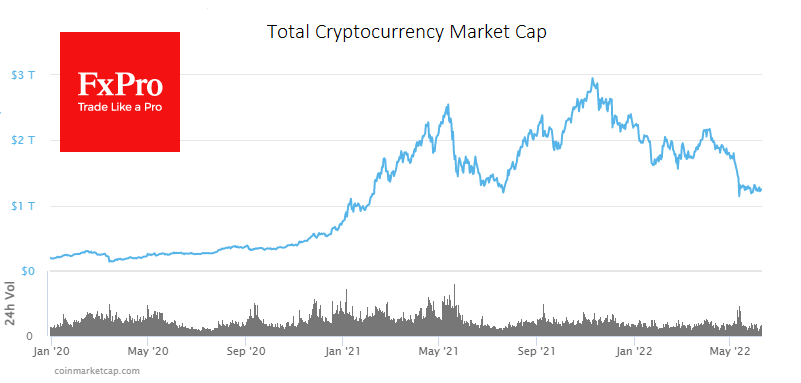
The nature of the cryptocurrency market, built on hype, convinces us that a lack of movement is the worst news for cryptocurrencies. Perhaps only strong moves can attract interest. Crypto traders anxiously recall the “crypto winter” of 2018. However, a crypto summer lull that started a month ago may not be any easier. It’s a worrying lull that risks quickly turning into a selloff. We still believe that the bear market for Bitcoin and the entire cryptocurrency market has yet to play its final act, and that should be expected before the end of the year.
MicroStrategy CEO Michael Saylor believes bitcoin will never fall to zero as international regulators look for ways to control crypto assets rather than impose a total ban on them.
Anne Boden, CEO of UK bank Starling, said cryptocurrencies are too often linked to fraud and money laundering, making them a threat to traditional payment systems.
PayPal said it would allow its customers to transfer BTC, ETH, BCH and LTC to external addresses, including exchanges and hardware wallets. Mining company Marathon Digital said that bitcoin miners do not incur losses even in a falling market, as the cost to mine 1 BTC is about $6,250.
WTI Oil Futures Approach Crucial Territory; Bias Bullish
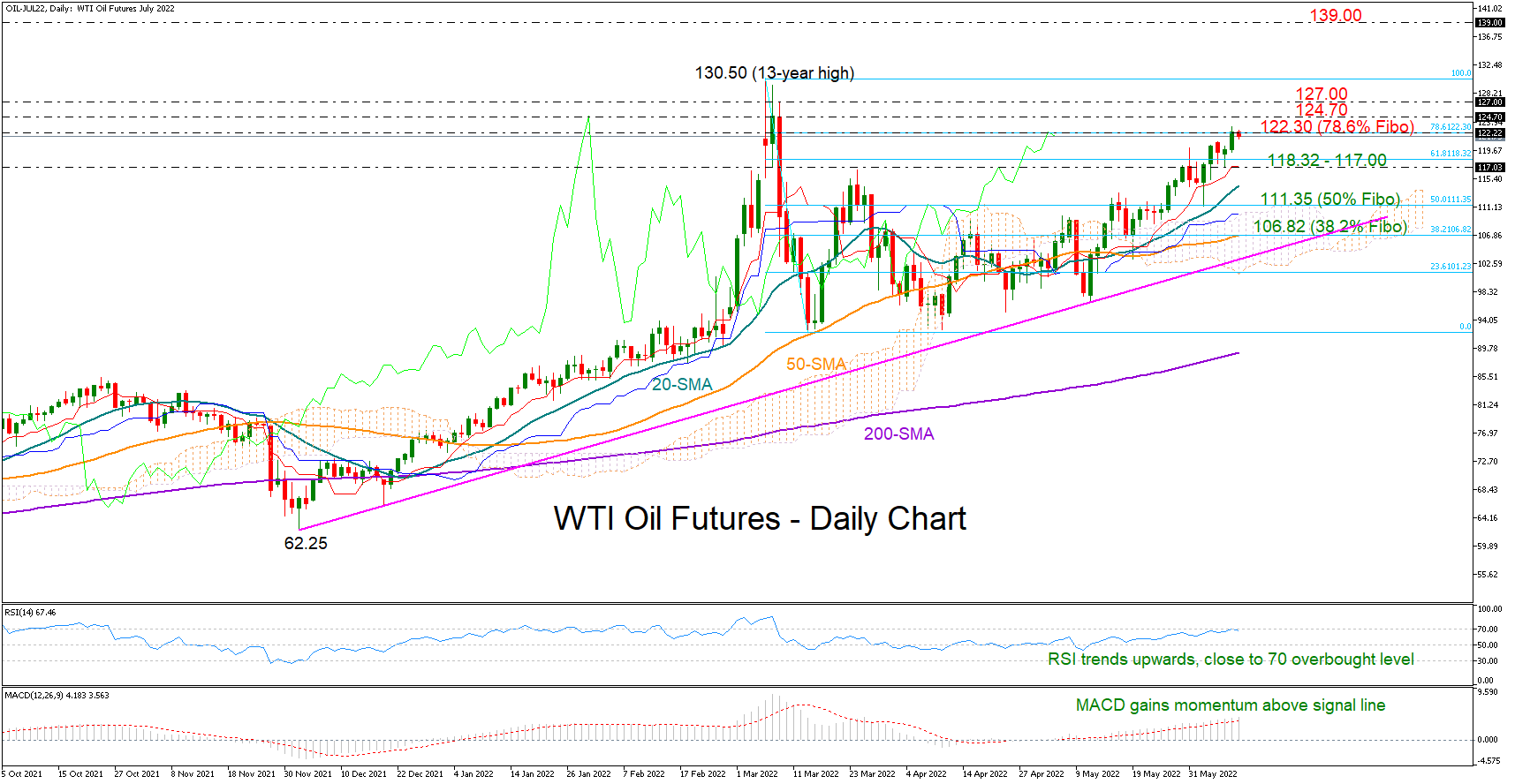
WTI oil futures (July delivery) extended their series of higher highs up to $123.15 on Wednesday before easing a bit - the highest in three months - aiming to mark a fourth consecutive week of wins.
The 78.6% Fibonacci retracement of the previous downleg is currently capping upside moves at $122.30, though a bigger challenge is expected to be the crucial $124.70 bar, which the bulls could not successfully claim last March despite surging to 13-year highs.
Technically, upside pressures could dominate in the short term as the RSI maintains a clear positive trend well above its 50 neutral number, while the MACD has yet to show any sign of abating, remaining elevated within the positive region and above its red signal line. The former, though, is not far below its 70 overbought level, suggesting that any potential advances in the price could come at a softer pace.
Should the price successfully cross above the $124.70 barricade, the rally may initially pause within the $127.00 – $130.50 constraining zone, which was somewhat of a hurdle during the second half of 2008. Breaching that wall, the next resistance could develop near $139.00, while higher, the bulls will attempt to stretch the broad positive trend beyond the 2008 top of $147.27.
In the event the $122.30 level stands firm, the price could ease to test the area between the 61.8% Fibonacci of $118.32 and the red Tenkan-sen line at $117.00. Moving lower, the 20-day simple moving average (SMA) currently at $114.18 may attract some attention before the key 50% Fibonacci of $111.35 comes under examination. The 38.2% Fibonacci of $106.82, which is currently intersecting the 50-day SMA, could be the next destination, while the ascending trendline drawn from the low of $62.25 will provide the last opportunity for a rebound before traders lose confidence on the seventh-month-old uptrend.
Summarizing, WTI oil futures look to have some bullish fuel in store, though only a sustainable extension above $124.54 would motivate fresh buying in the market.
US Oil Tests Resistance
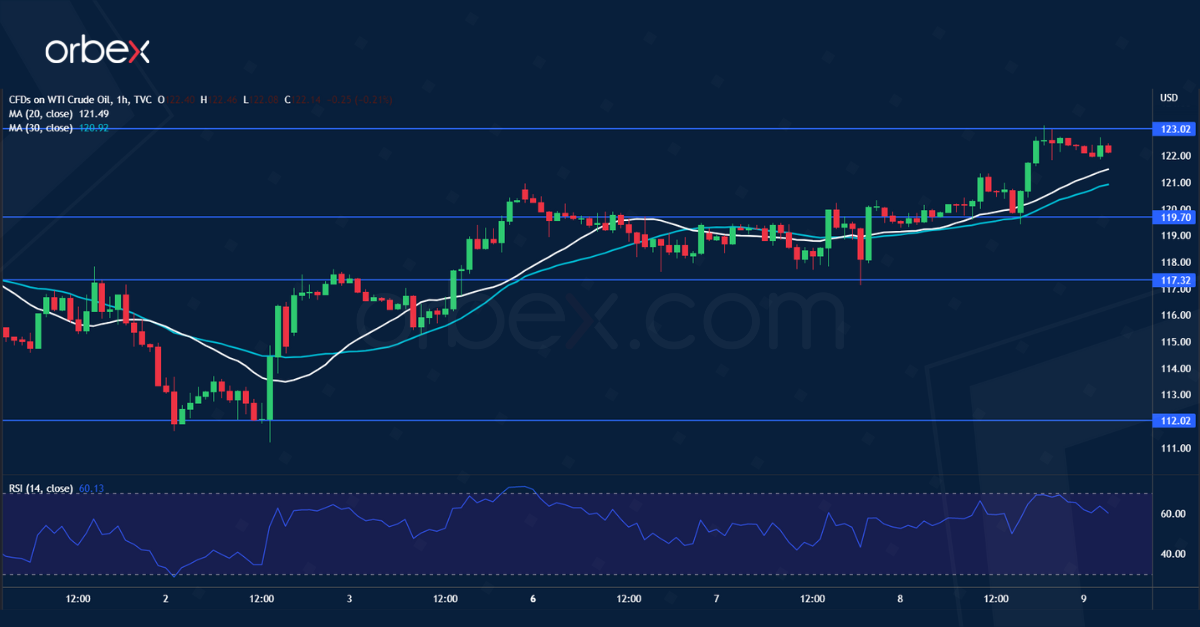
WTI crude finds support from tight spare capacity. A close above the recent peak at 119.20 has put the price action back on track after a short-lived retracement. The former resistance at 117.30 has turned into a support where trend followers are likely to place their bids. A surge above 123.00 would confirm that the path of least resistance is still up and may extend the rally to March’s high at 129.00. On the downside, 119.70 is the immediate support and 117.30 a second line of defence for the bulls.
EUR/GBP Awaits Breakout
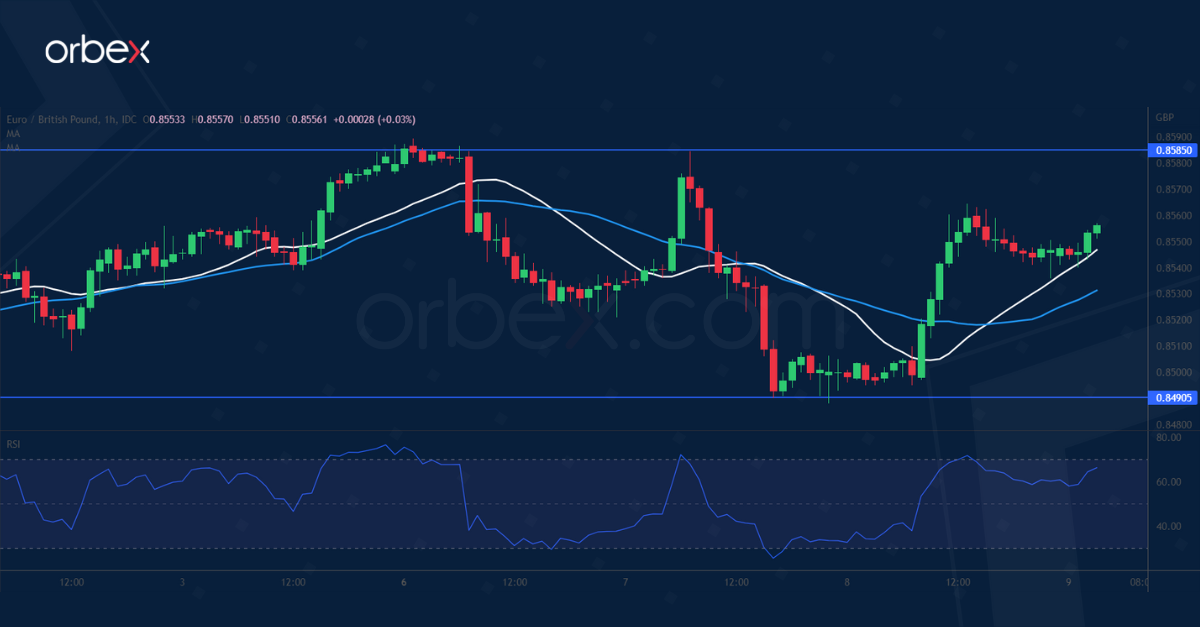
The euro clawed back losses after solid GDP growth in the eurozone in Q1. On the daily chart, the pair is in an ascending triangle pattern, foreshadowing a breakout that would dictate the direction in the weeks to come. The pair’s choppy path may have shaken out some weak hands, but the latest retreat has found support in the demand zone (0.8490) over the 30-day moving average. The triple top at 0.8585 is a major resistance and its breach could end a four-week long consolidation and resume the rally towards 0.8660.