Sample Category Title
USD/CAD Daily Outlook
Daily Pivots: (S1) 1.2597; (P) 1.2651; (R1) 1.2753; More...
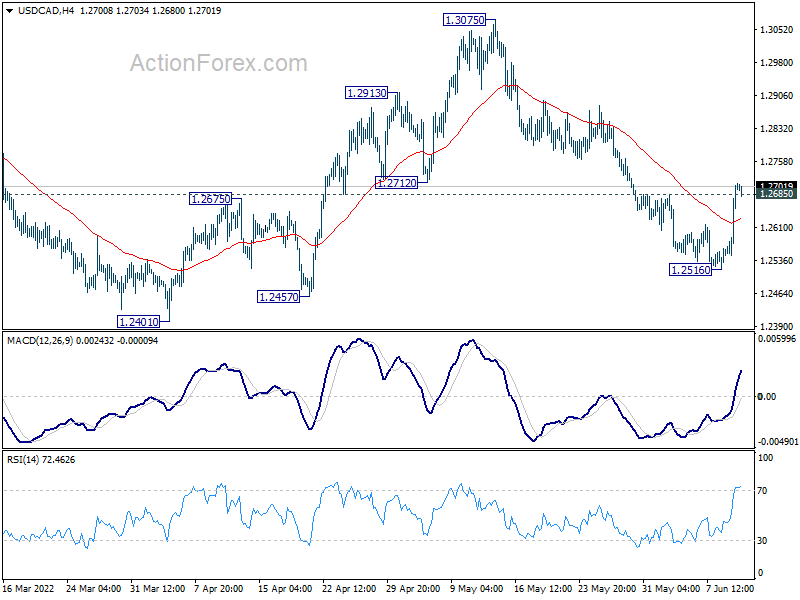
USD/CAD's break of 1.2685 minor resistance suggest that a short term bottom is formed at 1.2516, well ahead of 1.2401 support. Intraday bias is back on the upside for rebound. Sustained trading above 55 day EMA (now at 1.2714) will bring further rally to retest 1.3075 high. On the downside, break of 1.2516 will target 1.2401 support instead.
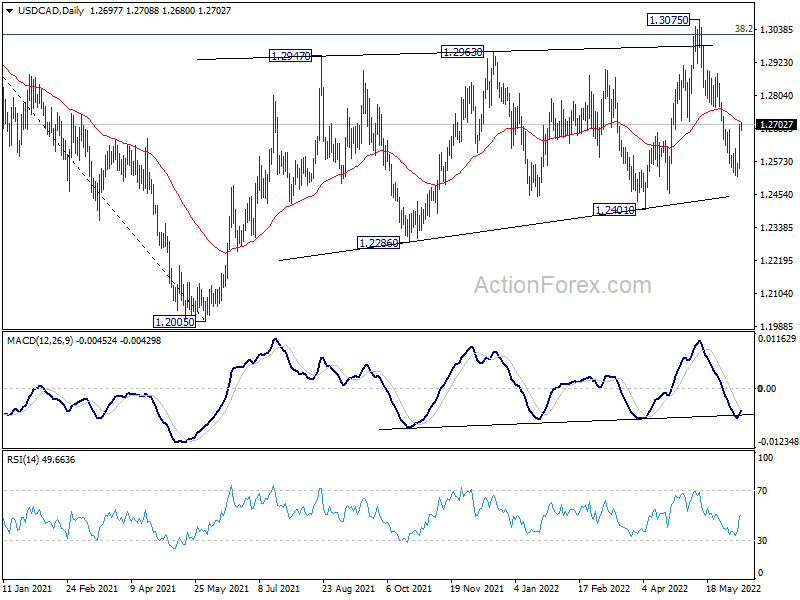
In the bigger picture, focus stays on 38.2% retracement of 1.4667 (2020 high) to 1.2005 (2021 low) at 1.3022. Sustained break there should confirm that the down trend from 1.4667 has completed after defending 1.2061 long term cluster support. Further rise would then be seen towards 61.8% retracement at 1.3650. However, rejection by 1.3022 will maintain medium term bearishness. Break of 1.2005 will resume the down trend from 1.4667 and that carries larger bearish implications too.
AUD/USD Daily Report
Daily Pivots: (S1) 0.7059; (P) 0.7132; (R1) 0.7169; More...
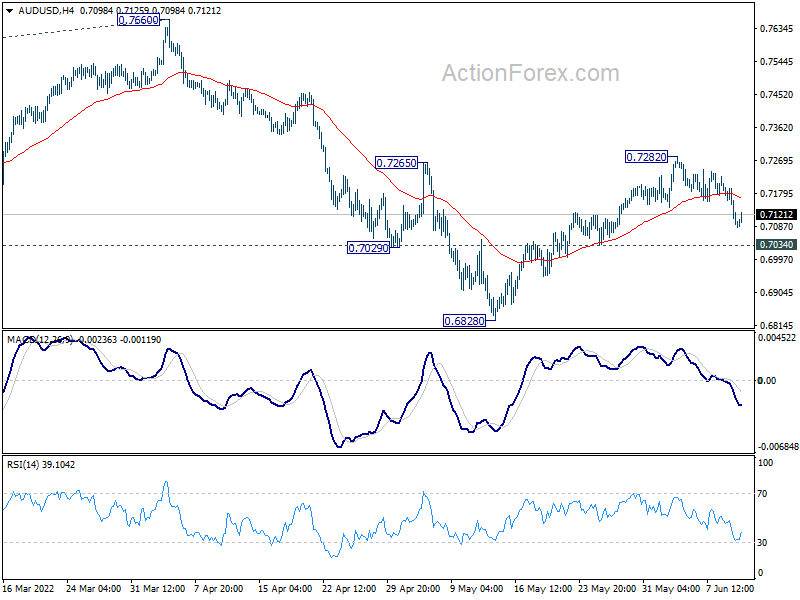
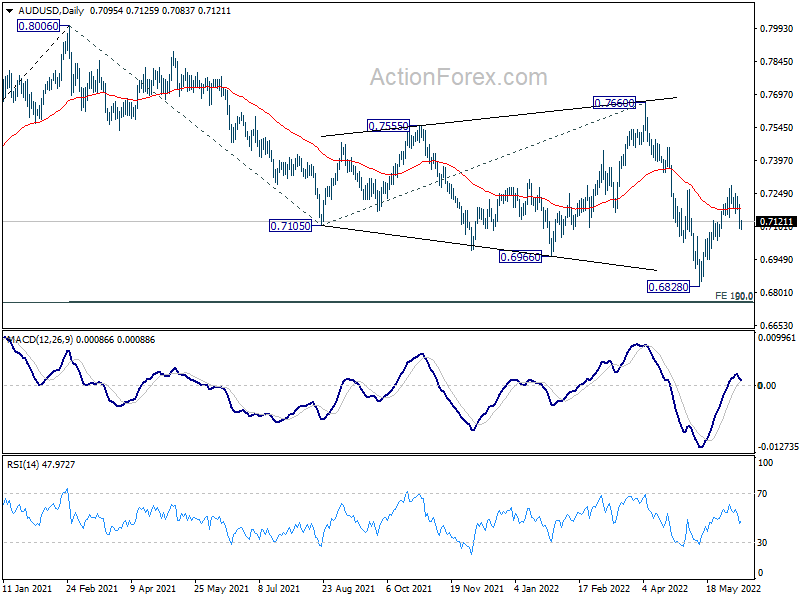
Intraday bias in AUD/USD stays neutral for the moment. Outlook is unchanged that further rise will remain in favor as long as 0.7034 support holds. Current development raised the chance that whole fall corrective fall from 0.8005 has completed at 0.6828. Above 0.7282 will extend the rebound to 0.7660 resistance for confirmation. However, break of 0.7034 will dampen this bullish view and bring retest of 0.6828 low instead.
In the bigger picture, price actions from 0.8006 are seen as a corrective pattern to rise from 0.5506 (2020 low). Deeper fall could be seen to 50% retracement of 0.5506 to 0.8006 at 0.6756. This coincides with 100% projection of 0.8006 to 0.7105 from 0.7660 at 0.6760. Strong support is expected from 0.6756/60 cluster to contain downside to complete the correction. Meanwhile, firm break of 0.7660 resistance will confirm that such corrective pattern has completed, and larger up trend is ready to resume.
USD/JPY Daily Outlook
Daily Pivots: (S1) 133.53; (P) 134.04; (R1) 134.90; More...
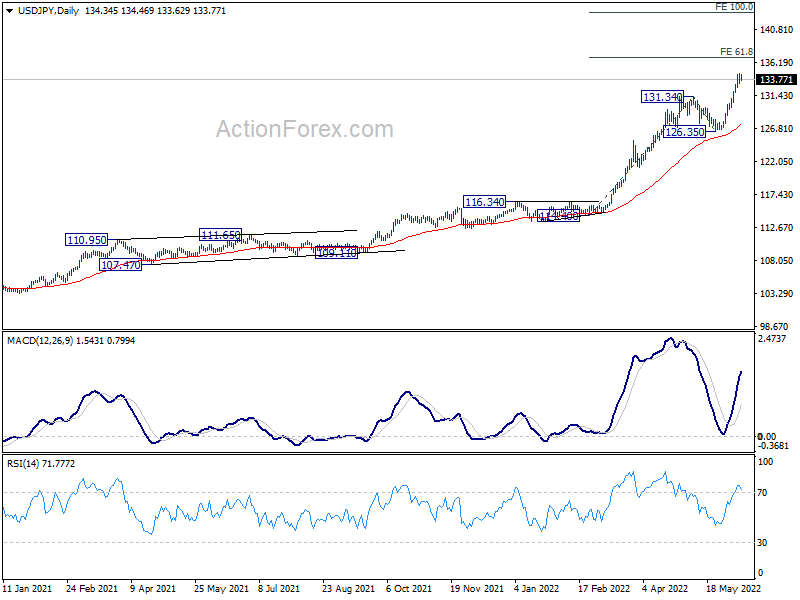
Intraday bias in USD/JPY remains neutral as consolidation from 134.55 temporary top would extend. But downside should be contained above 131.34 resistance turned support. Break of 134.55 will resume larger up trend to 61.8% projection of 114.40 to 131.34 from 126.35 at 136.81. Firm break there will target 100% projection at 143.29.
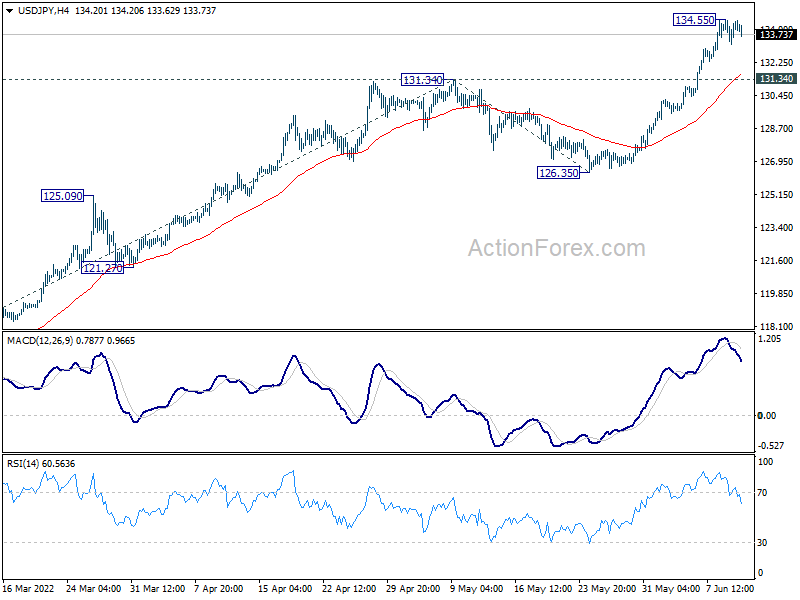
In the bigger picture, current rally is seen as part of the long term up trend form 75.56 (2011 low). Next target is 100% projection of 75.56 (2011 low) to 125.85 (2015 high) from 98.97 at 149.26, which is close to 147.68 (1998 high). This will remain the favored case as long as 126.35 support holds.
USD/CHF Daily Outlook
Daily Pivots: (S1) 0.9745; (P) 0.9781; (R1) 0.9839; More...
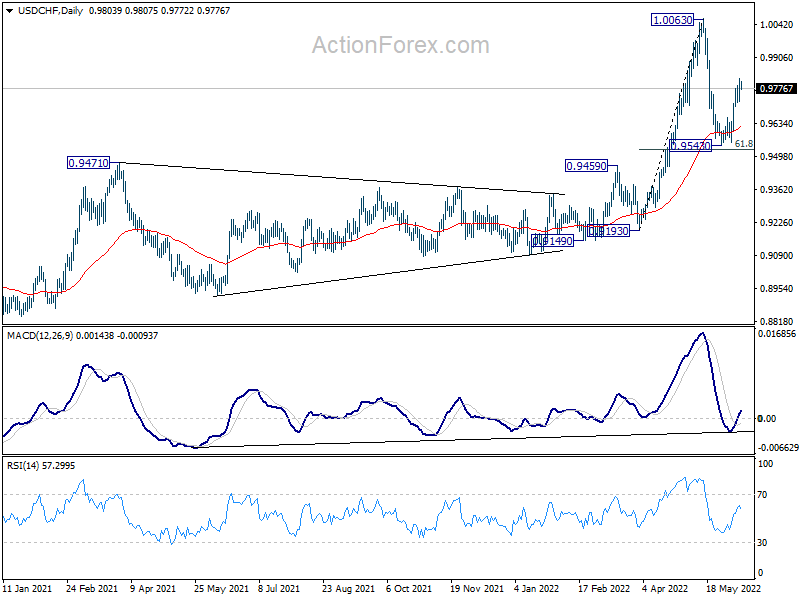
USD/CHF's rebound form 0.9543 resumes after brief consolidation and intraday bias back on the upside. Further rally would be seen to retest 1.0063 high. Firm break there will resume larger up trend. However, break of 0.9714 minor support will extend the correction from 1.0063 with another leg, and turn bias to the downside for 61.8% retracement of 0.9193 to 1.0063 at 0.9525.
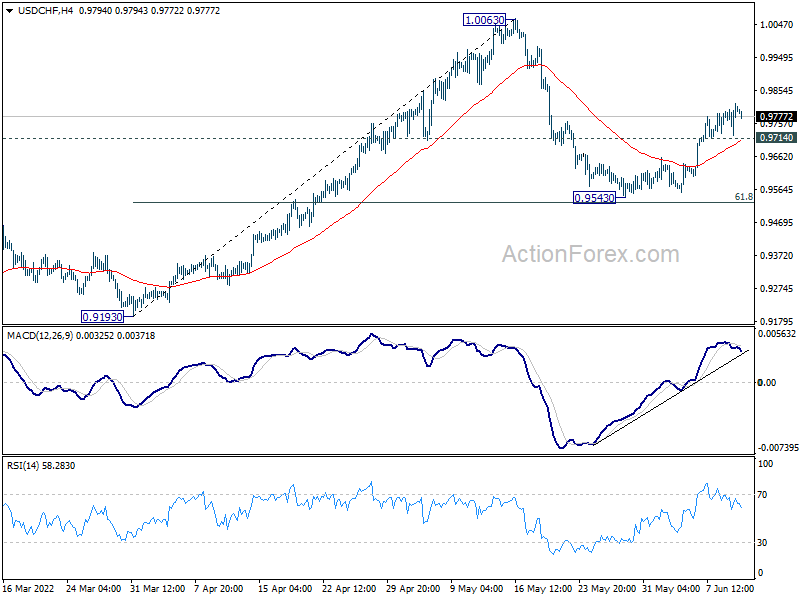
In the bigger picture, down trend from 1.0342 (2016 high) should have completed with three waves down to 0.8756 (2021 low) already. Rise from 0.8756 is likely a medium term up trend of its own. Next target is 1.0237/0342 resistance zone. This will remain the favored case as long as 0.9471 resistance turned support holds. However, sustained break of 0.9471 will extend long term range trading with another falling leg.
GBP/USD Daily Outlook
Daily Pivots: (S1) 1.2469; (P) 1.2514; (R1) 1.2540; More...
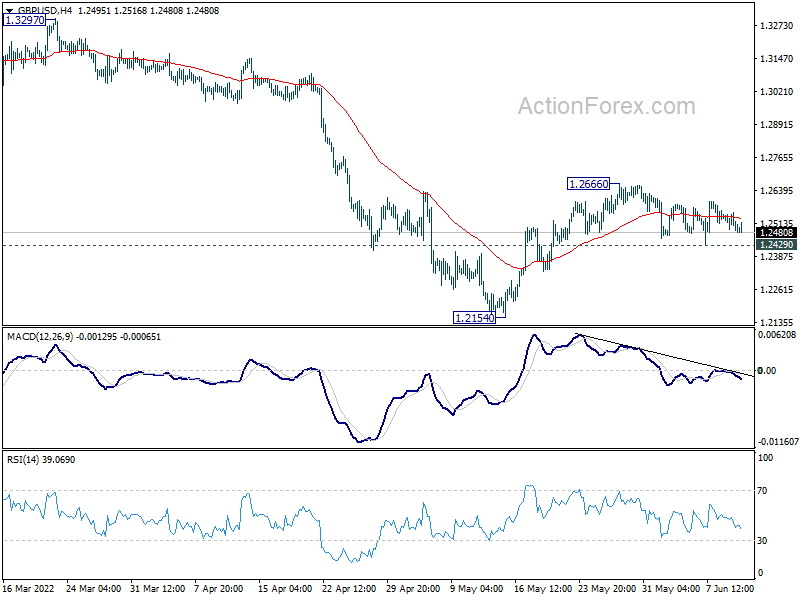
Intraday bias in GBP/USD remains neutral and outlook is unchanged. On the downside, break of 1.2429 support suggest that rebound from 1.2154 has completed. Intraday bias will be back on the downside for resting this low. On the upside, above 1.2666 will target 55 day EMA (now at 1.2698) and above.
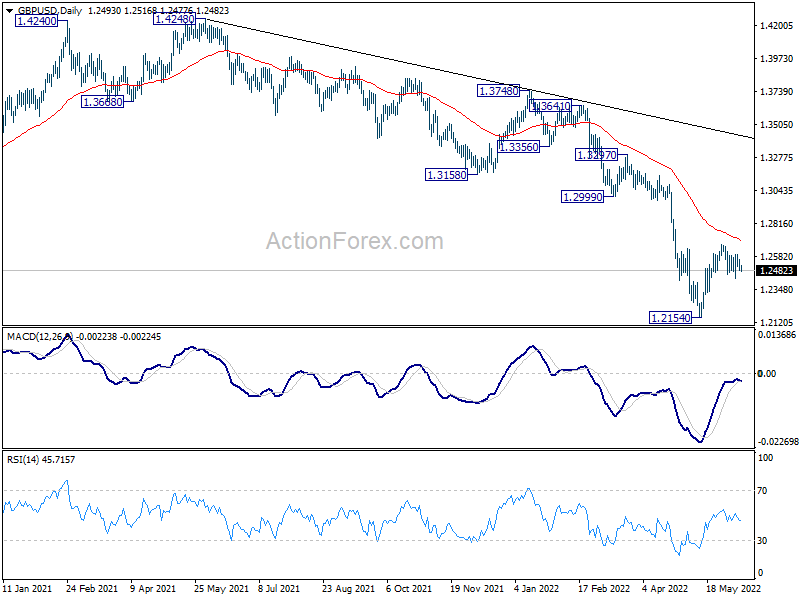
In the bigger picture, fall from 1.4248 (2018 high) could be a leg inside the pattern from 1.1409 (2020 low), or resuming the longer term down trend. Deeper decline is expected as long as 1.2999 support turned resistance holds. On resumption, next target is 1.1409 low.
Markets Want Hard Evidence of a Slowdown in Inflation Dynamics
Markets
Yesterday, the ECB turned a page. With new staff projections forecasting both core and headline inflation to stay above the 2.0% target over the bank’s policy horizon, the ECB couldn’t but formally give the highest priority to address the inflation challenge, even as growth was downwardly revised for this and next year. APP asset purchases will end in July, opening the door for a 25 bps lift-off rate hike in July. However, the ECB’s anti-inflation commitment goes further. If the inflation outlook persists or deteriorates, a bigger hike will be appropriate at the September meeting. After September, the ECB expects that a further gradual but sustained path of rate hikes will be needed. Even as decisions will be data dependent, this looks like quite a strong ‘precommitment’. EMU yields recently already anticipated the start of ECB policy normalization. Still, the prospect of one (and potentially more) 50 bps hikes forced a new break higher. The German curve bear flattened with yields rising between 13.4 bps (2-y) and 3.4 bps (30-y). European swap rates set new cycle highs across the curve. US yields rises were more modest. The belly of the curve underperformed (5-y +6.3 bps). Even so, the 2-y (2.83%) and 5-y (3.05%) are also testing cycle top levels. The change in the ECB inflation narrative didn’t help the euro, on the contrary. A new sharp risk-off correction favored the dollar. The DXY index regained the 102.73 resistance (close 103.22). EUR/USD (close 1.0617) is at risk of falling back below the 1.0627/42 support. US equities lost between 1.94% (Dow) and 2.75% (Nasdaq). The EuroStoxx 50 ceded 1.70%. Intra-EMU spreads versus Germany widened (10-y Italy + 15 bps) even as the ECB signaled to adjust PEPP reinvestments in a flexible manner to avoid market fragmentation.This morning, losses on Asian equity markets (about 1.0% on average) are more modest compared the US and Europa yesterday. Even so sentiment remains fragile. Later today, the focus turns to US May inflation. Headline CPI is expected at 0.7% M/M and 8.3% Y/Y (was 8.3 in April). Core is seen at 0.5% M/M and 5.9% Y/Y (was 6.2%). Yesterday’s price action suggests that markets want hard evidence of a slowdown in the (monthly) inflation dynamics. If not, expectations for the Fed to keep a pace of 50 bps rate hikes in September (or even beyond) might be reinforced. This might push 2 & 5-yields to new cycle highs. The top in the 10-y yield (3.20%) is further away but also comes on the radar. Inflation moderating too slowly also might support further dollar gains both via higher yields and a further risk-off. EUR/USD falling below the 1.06 area, suggests further losses in the 1.0341/1.0806 trading range. This morning, the yen regains modest ground (USD/JPY 133.74) on headlines of a meeting between the Japanese Ministry of Finance and the BOJ. However, in case of higher US yields, a test of the 135.15 multi-year top might still occur, unless there comes decisive action from Japanese authorities.
News Headlines
Chinese inflation fell 0.2% m/m in May to stabilize at 2.1% y/y, the National Bureau of Statistics revealed. A slight rise to 2.2% was expected. The first monthly decline of 2022 came as Chinese consumers’ spending and sentiment was dampened by Covid restrictions. Food and energy remain two key price drivers in the yearly figure. Excluding both, inflation only rose by 0.9% y/y. Factory gate inflation eased further from 8% y/y to 6.4% y/y, the slowest pace since March 2021. Prices of mining and raw materials maintained double digit y/y gains though. Unchanged (core) CPI and the ongoing slowdown in PPI may ease policymaker’s concerns about inflation and could allow them to focus more on how to support growth. The Chinese yuan trades unchanged just south of USD/CNY 6.70.
Inflation and Recession Fears
European and US stocks declined yesterday and the futures hint at a bearish start in Europe.
Inflation and recession fears take the upper hand, after the European Central Bank (ECB) raised its inflation significantly from 5.1% to 6.8% for this year, and cut the growth forecast, significantly as well, for this year and the next.
The ECB confirmed it will end the bond purchases as of July 1st, and intends to raise the interest rates by 25 bps in July. Christine Lagarde also said that the bank will consider another rate hike in September, and the size of the September hike will depend on inflation.
Yesterday’s ECB decision first sent the EURUSD toward the May highs of around 1.0775. But the single currency gave back gains, and the EURUSD returned below the 1.07 mark before the end of Lagarde’s press conference.
This morning, the EURUSD trades around 1.0630, meaning that yesterday’s ECB meeting sparked nothing but a quick optimism. Slashing the expectation of a 50bp hike in July gave cold feet to euro bulls. As a result, the EURUSD strength will likely remain limited for now.
In the medium run, the ECB will likely take further hawkish measures to pave the way for a stronger euro, toward 1.10 against the US dollar.
On the index level, the ECB decision triggered a fresh selloff in European equities, as the ugly growth projections came as a slap to investors. The DAX which was consolidating gains above the 100-DMA slipped below this level. The soft euro could limit the selloff, but whether it could reverse the negative trend is hard to tell. With a slowing world economy, the DAX could get back to its bearish trend building since the beginning of this year, which would imply a fall below the 14000 mark deep into this summer.
Inflation may not look good
The US stocks have been battered yesterday, with the S&P500 losing up to 2.40%, as the US 10-year yield consolidated above the 3.05 mark. The US dollar index rose above the 103 level, again.
Investors are holding their breath into today’s CPI reading. Analysts expect the US inflation to stabilize around last month’s 8.3% level, but we could see a bad surprise today, as the positive pressure on food and energy prices and the unexpected uptick in secondhand car prices in May could prevent the index to ease for a second consecutive month.
A stronger-than-expected inflation figure would revive the Federal Reserve (Fed) hawks, and eventually push the S&P500 below the 4000 mark before the weekly closing bell. A softer inflation read on the other hand, would resuscitate hope that inflation has peaked two months ago, and the worst is behind.
Don’t get your expectations too high, though
For inflation to ease persistently, we need to see energy prices soften. US crude topped above the $123pb this week. The recession fear certainly limited the upside potential. But the United Arab Emirates’ energy minister said that ‘if we continue consuming with the pace of consumption we have, we are nowhere near the peak, because Chine is not back just yet’, and that ‘China will come with more consumption’. Hopefully, they will tap into the Russian oil…
But the US LNG chaos, triggered by a fire at a Texas facility will halt 20% of US oil exports, and could push LNG prices higher in the short run.
EUR/USD Declines on Hawkish ECB
Market movers today
With ECB's meeting behind us, the markets will remain sensitive to potential sources stories, which may indicate the difference on views on the size of rate hikes at the September meetings and onwards.
The big market mover today is however, the US CPI print for May. Given that base effects are playing into the annual numbers, key focus is on the monthly momentum where expectations are for further increases in the headline inflation while monthly increase in core inflation should remain around 0.6% which would be equivalent to 6-7% in annual terms, way above the Fed's comfort zone.
In both Denmark and Norway, we also get CPI data for May (see Nordic section for further detail).
Another interesting release is the Michigan consumer survey, where the overall index should stabilise after months of sharp drops. A key thing to watch out for in the report is the inflation expectations especially in the long term.
At today's policy meeting, the Russian central bank is expected to reduce its policy rate from 11% to 10% on the back of abating inflation pressures.
The 60 second overview
ECB: Yesterday's ECB meeting ended with wider spreads and flatter curves as ECB is beginning its hiking cycle where 50bp is the baseline for September in our reading. ECB guided for a rate hike of 25bp in July. We believe that it will take significant upside or downside surprise for ECB to deviate from this guidance. Net asset purchases will end on 1 July in line with previous guidance of Q3. We keep our rate hike expectations of a sequence of 25bp, with the exception of September where a 50bp hike is our baseline. Risks are still skewed for more than one 50bp rate hike, but with the current very uncertain outlook we expect the economic outlook will dampen the medium inflation pressure, making our preference for 25bp hike. Markets are now pricing in 148bp by year end (+14bp on the day).
EUR/USD fell on hawkish ECB: In our view, this ECB meeting confirms our view that rate hikes are a global phenomenon intended to make markets rotate towards less risky positions and a lower EUR/USD spot is part of such rotation. For Europe, widening spreads is also crucial to why EUR/USD heads south as we price in higher rates and as explained in, the ECB is fighting strong valuation forces when trying to strengthening the single currency. Looking ahead, we continue to see EUR/USD towards parity.
Getting towards the end of rate hikes in Eastern Europe? At the press conference yesterday following Wednesday's expected decision to hike its benchmark rate by 75bp to 6%, the Polish central bank governor signalled that a rate cut could come into play towards the end of 2023 and that NBP is "certainly closer to the end than to the beginning of the tightening cycle".
Equities: Another day with equities lower and both European and US equities finishing close to day-lows. Reasoning being ECB deciding to hit the brakes and thereby joining the increasing group of central banks around the world implicitly acknowledging they are behind the curve. Equity investors are trying to figure out whether central banks can super charge the tightening cycle and still manage a soft landing. Increased uncertainty is the primary result of this and hence the reason why cyclicals underperformed defensive by less than 50bp although MSCI world was down almost 2% yesterday. In US Dow -1.9%, S&P 500 -2.4%, Nasdaq -2.8% and Russell 2000 -2.1%. Most markets are lower in Asia this morning but much less than one could have expected on the back of the Wall Street session yesterday. European futures are down as result of the weak US performance yesterday while US futures are slightly higher this morning.
FI: Yesterday's ECB meeting ended with wider spreads and flatter curves as ECB is beginning its hiking cycle where 50bp is the baseline for September in our reading.
FX: Cyclically sensitive currencies took a hit in yesterday's session with AUD, NOK and ZAR leading losses in major space. The USD was the general top performer while the ECB meeting failed to deliver any meaningful support to EUR with EUR/USD falling back towards the 1.06 threshold level.
Credit: Credit markets were weak from the morning and the weakness intensified on the back of the ECB meeting, which made iTraxx Xover close almost 16bp wider and Main 3.4bp wider. Following the last days' widening, both indices are now close to 2022 highs, with Xover currently at 470bp and Main 94bp.
Nordic macro
Norwegian core inflation has been trending upwards since late last year, and we expect a new lift from 2.6 % to 2.8 % in May. This is clearly in the lower end of the forecasts, which ranges from 2.8-3.2% with an average of 3.1%, as we expect some of the typical Easter effects from April to be at least partly reversed. That said, we acknowledge the fact that the risk is tilted to the upside as global inflation clearly is trending upwards, as illustrated by the recent European and even Swiss figures. This will anyway be above Norges Bank's forecast of 2.6% in the March monetary policy report, so the question is whether it would be enough to confirm the market's aggressive expectations of the central bank ahead of the June rate meeting.
US Inflation Friday at Last
The roller coaster activity on US stock markets continued overnight, with Wall Street deciding that inflation and recessions were an issue for two days in a row. A tiny rise in US Initial Jobless Claims probably tilted Wall Street over the edge, following the European Central Bank’s tilt to a hawkish bias at their policy meeting earlier in the day.
Thankfully, Friday is here on a number of levels, but most especially because we will see the release of US Inflation and Core Inflation data. Markets have been tying themselves up in knots over this all week, thanks to a thin data calendar. Like last Friday’s Non-Farm Payrolls, I am expecting a very binary outcome this evening with median forecasts for the headline at 8.30%, and core inflation at 5.90% YoY. A number at 8.40% or higher probably sparks a risk aversion sell-off across asset markets with the US Dollar winning. Conversely, a print at 8.20% or lower probably sees a buy everything, sell US Dollars rally, as Fed hiking expectations are pared ahead of next week’s FOMC.
China inflation this morning has passed without incident this morning. Inflation YoY for May was just under expectations at 2.10%. Inflation MoM fell to -0.20%, slightly higher than forecasts of -0.30%. The covid-led consumer and industrial led slowdown continues acting as a brake on inflation. Markets in China today have their eyes focused elsewhere. President Xi Jinping sent out mixed messages overnight, exhorting officials to maintain covid-zero, while also supporting economic growth. Good luck with that.
A potential on again, off again Ant Financial IPO is also doing the rounds. Bloomberg ran a story yesterday saying Chinese officials had indicated a willingness for it to go ahead. Alibaba ADRs rallied 7.0% in New York before reversing all those gains after Chinese officialdom denied the report. Today, Reuters is also running an exclusive the IPO had received a tentative blessing from officialdom as well. Hong Kong equity markets though are showing no signs of taking the bait this time. Where there’s smoke there’s fire I suppose, but with a valuation of around half of what it was around the abortive 2020 date, you’d probably ask why Alibaba and Ant would bother right now. Perhaps the main message would be that China was moving past “peak crackdown” as the economy slows.
Far more front and centre for Mainland China markets, and Asian ones and sentiment, in general, are developments from Shanghai. One district was locked down yesterday and today it was announced that mass testing would take place in seven of its 16 districts, so basically half the city. Markets have naively assumed that China was “one and done” with Beijing and Shanghai, ignoring the experience of Covid-zero nations elsewhere. That reality might finally be permeating the most ardent dip-buyers now, and the prospect of a wave of renewed covid lockdowns in Shanghai would have subdued Asian sentiment today, even without the bonfire on Wall Street last night.
The overnight ECB policy meeting outcome has already been analysis paralysis’ ed to death already. What stands out to me is the price action of EUR/USD, which after the hawkish pivot overnight, still closed 100 points lower at 1.0620. The devil is in the detail I suppose. ECB projections on growth and inflation suggest two years of stagflation ahead. A hike of 0.25% next month and one in September (they left the door open to a larger one), isn’t earth-shattering. It is telling that despite a pedestrian hiking schedule to errrr 0.0%, the Bund/BTP spread still blew out.
But I think the kicker is that the ECB will keep rolling over maturing bond purchases even if they stop adding more from July 1st. So effectively, their answer to stagflation is raising interest rates to 0.0%, while at the same time continuing quantitative easing under the surface. In their defence, the war in Ukraine has thrown a stagflation spanner in the works, but they would have arrived at this point to some degree anyway. Given the ECB’s response, I’d sell Euro and European equities as well.
Shanghai nerves weigh on Asian equities.
US markets couldn’t shake off the inflation/recession hoodoo last night after European markets endured a torrid session as the ECB swung to a hawkish stance. The S&P 500 slumped by 2.38%, the Nasdaq tumbled by 2.75%, and the Dow Jones lost 1.95%. In Asia, US futures have seen some modest short covering, lifting the S&P and Dow futures 0.20% higher, with Nasdaq futures gaining 0.35%.
In Asia, the overnight Wall Street performance was never going to give local markets a good start. But with US data and weekend risk ahead, as well as lockdown nerves around widening mass testing in Shanghai this weekend, regional markets are almost all in the red today. Japan’s Nikkei 225 has fallen by 1.35% today, with South Korea’s Kospi falling by 1.15%.
In Mainland China, equity markets have reversed earlier losses and are in modest positive territory. The Shanghai Composite is now 0.22% higher, while the CSI 300 is flat. I suspect that the authorities' “national team” might be “smoothing” today. Hong Kong is performing better than expected, perhaps lifted by Ant Financial IPO hopes. Nevertheless, it remains 0.55% lower.
In regional markets, Singapore has fallen by 0.65%, with Taipei losing 0.85%. Kuala Lumpur has dropped by 1.0%, with Jakarta just 0.15% lower. Bangkok is 0.45% lower as it removes its last covid restrictions on inbound travellers, but Manila has slumped by 1.90%. Australian markets are tracking Wall Street and China nerves, the All Ordinaries falling 1.0%, with the ASX 200 losing 0.85%.
The tone in Asia, ahead of crucial US inflation data, means that European equities are poised to open lower once again this afternoon. If Bund/BTP spreads widen once again today, nerves will be further frayed. Only a lower US inflation number this evening is likely to bring any solace to European markets. US markets are a 100% binary outcome of the US inflation data.
US Dollar strengthens overnight.
Pre US inflation nerves triggered a wave of risk aversion in equity markets overnight, which translated into haven inflows to the US Dollar, which booked gains in the DM and EM space. The dollar index leapt 0.74% higher to 1.0330 overnight, although the rally’s scope was flattered by the Euro sell-off, the index's largest component. How the Euro performs today will dictate whether we have seen a low put in place or not. Higher US inflation tonight should lift the US Dollar, with a lower print seeing renewed selling as Fed hiking expectations are pared. The index is almost unchanged in Asia, and has resistance at 104.00, with support at 1.0285.
EUR/USD slumped by 0.91% to 1.0620 post-ECB, adding a modest 0.13% to 1.0630 in Asia. EUR/USD may come under further pressure today if Eurozone sovereign spreads widen, or if US inflation prints above forecast. Support at 1.0650 overnight becomes nearby resistance, while the 1.0770 and 1.0830 zone remains as formidable as ever. Support is between 1.0610 and 1.0600, and failures signal a retest of 1.0500 early next week.
Sterling fell 0.32% to 1.2500 overnight, where it remains in Asia. Economic worries, leadership concerns, and the Northern Island protocol continue weighing on the Sterling. Resistance is at 1.2600 and 1.2670. Support is still at 1.2460 and 1.2400.
USD/JPY endured a torrid session overnight, selling off from 134.10 to near 133.20 at one stage, likely on EUR/YEN selling. Firm US bond yields saw it recover all those losses to finish almost unchanged at 134.35. Some long-covering today has seen it ease back to 134.15 in Asia. The Bank of Japan is unlikely to change policy next Friday post-FOMC, which will have hiked another 0.50%. The US/Japan rate differential should ensure that USD/JPY does not fall much further than 133.00 today, with its next target being 135.00. Soft US inflation though, could spur a US bond rally and see an abrupt fall by USD/JPY.
The price action on the Australian and New Zealand Dollars was ugly overnight. AUD/USD fell 1.30% to 0.7100, where it remains in Asia. NZD/USD fell by 1.0% to 0.6385, before edging up to 0.6400 in Asia. A combination of US inflation concerns and renewed mass testing in Shanghai seem to have created a toxic risk sentiment cocktail for the Australasians. Both remain acutely vulnerable to negative developments on both fronts. AUD/USD support resistance is at 0.7050 and 0.7200. NZD/USD support/resistance is at 0.6300 and 0.6450.
USD/Asia strengthened overnight with the KRW the worst performer, losing over 0.55% to 1263.80. Asian currencies are steady in Asia after the PBOC set a neutral USD/CNY fix at 6.6994, but several currencies are near their recent lows versus the US Dollar. USD/MYR is near 4.4000, USD/PHP is just below 53.00, USD/THB is 0.20% higher today at 34.640, and USD/INR is once again testing resistance at the 77.80 region. A high US inflation number today likely spurs another wave of Asian FX weakness to round out the week.
Oil eases in Asia on China fears.
Oil prices consolidated their recent gains overnight, with Brent crude edging 0.70% lower to $122.85, and WTI easing by 0.80% to $121.45 a barrel. Oil has continued retreating in Asia, driven by China slowdown fears after widened covid mass testing was announced for Shanghai this weekend. Brent crude is 0.53% lower at $122.20, and WTI is 0.60% lower at 120.70 a barrel.
Oil markets probably have more downside risk in the short-term, with another wave of China slowdown fears capping the upside. Somewhat counterintuitively, higher than forecast US inflation tonight may also spur more selling as markets price in a higher recession likelihood. Any losses are going to be limited though, as the physical tightness of both crude and refined products globally remain powerful supportive factors. Weekend event risk should also limit pullbacks.
Brent crude has traced out a series of highs at $124.25 marking initial resistance. After that, the road opens to $125.00 and $128.00 a barrel, bringing the Ukraine invasion highs back into sight. Support is at $120.50 and $118.50 a barrel. WTI has resistance at $123.15, the overnight high, and then $125.00 and $127.00 a barrel. Support is at $119.35 and $117.50 a barrel.
Gold remains in a coma.
Gold remains confined to a narrow $1840.00 to $1860.00 an ounce range, comfortably continuing to move in an inverted manner to US Dollar moves. Gold’s main hope for a directional breakout rests with US Inflation data moving the US Dollar materially one way or the other. In the meantime, bring a good book.
Gold has resistance at $1870.00, followed by the 100-DMA at $1890.00, and then $1900.00, where I expect there to be options-related sellers in the first instance. Support is at $1837, $1830.00, and then $1780.00 an ounce. I do not discount a disorderly retreat if the latter fails. The wider $1830.00 to $1870.00 range seems set to continue until the US data.
EUR/USD Daily Outlook
Daily Pivots: (S1) 1.0561; (P) 1.0668 (R1) 1.0724; More...
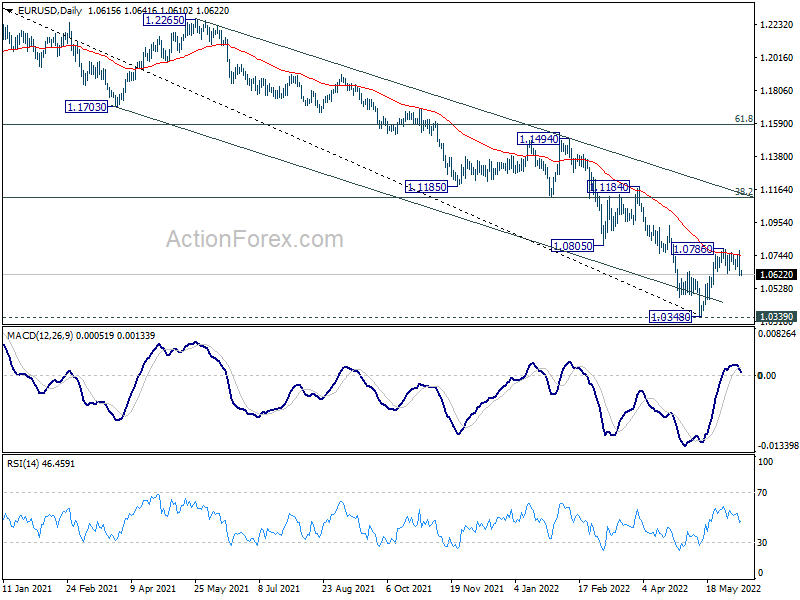
EUR/USD's breach of 1.0626 minor support argues that rebound from 1.0348 has completed at 1.0786 already, after multiple rejection by 55 day EMA. Intraday bias is back on the downside for retesting 1.0348 low, and more importantly 1.0339 long term support. On the upside, though, break of 1.0786 will resume the rebound from 1.0348 to 1.1112 fibonacci resistance.
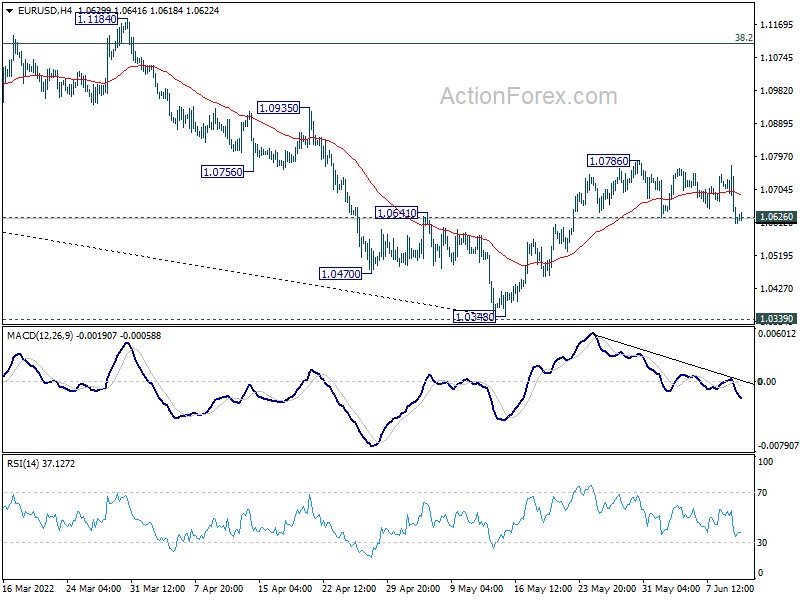
In the bigger picture, focus stays on 1.0339 long term support (2017 low). Decisive break there will resume whole down trend from 1.6039 (2008 high). Next target is 61.8% projection of 1.3993 to 1.0339 from 1.2348 at 1.0090. However, firm break of 1.0805 support turned resistance will delay this bearish case. Rise from 1.0348 is at least a correction to the down trend from 1.2348. Stronger rebound would be seen to 38.2% retracement of 1.2348 to 1.0348 at 1.1112.