Sample Category Title
Eurozone Inflation to Heat Up Again, Can It Add More Fuel to Euro’s Rally?
The Eurozone’s flash estimates for May inflation are scheduled to be released on Tuesday (09:00 GMT) as the European Central Bank ponders how quickly to exit negative rates. The June 9 policy meeting is fast approaching and with some Governing Council members arguing for a 50 basis point rate hike, the data could influence how speedily the ECB moves to normalize policy. It could also be important for the euro, which has rebounded impressively against the US dollar but may struggle to make additional gains without fresh impetus.
Inflation to accelerate again in May
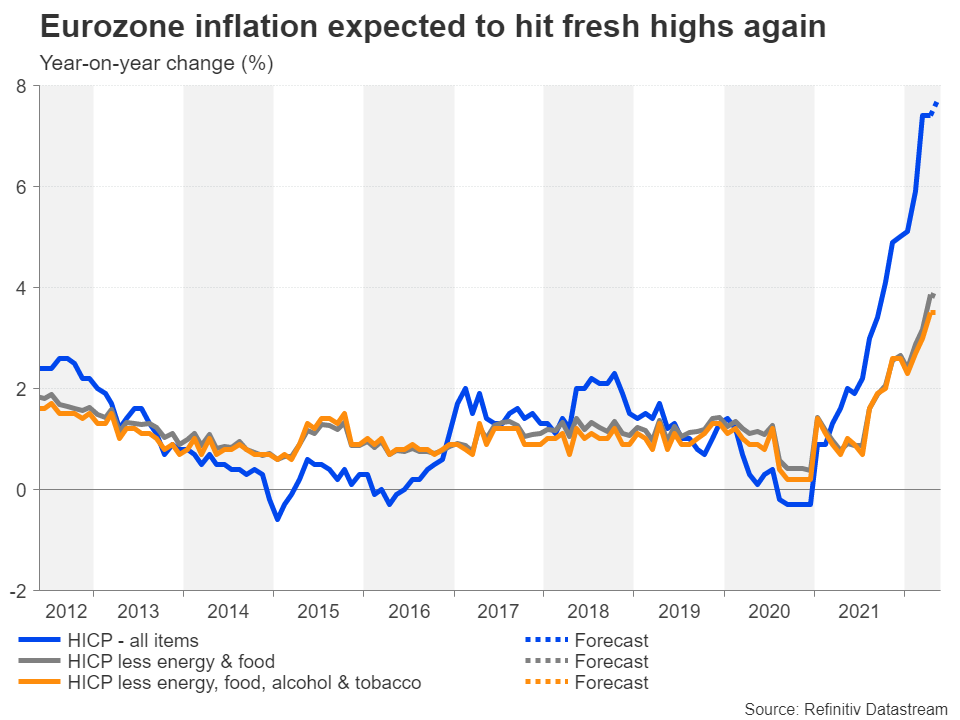
There can be no doubt the ECB is behind the curve when it comes to taming inflation as euro area prices are rising at a record pace, and even underlying measures of inflation have jumped well above the 2% target. Like the Fed, the ECB had hopes that the surge in prices, driven mostly by supply constraints and the energy crisis, would subside after a few months. But that hasn’t happened. The harmonised index of consumer prices (HICP) stood at 7.4% higher in April compared to a year ago. Although this was unchanged from the prior month, headline inflation is expected to have accelerated again in May. It’s forecast to edge up to 7.7% in the flash estimate.
The core measures of inflation remain a lot lower but they are without a doubt also spiralling higher, casting doubt on President Christine Lagarde’s long held argument that the inflation problem in the Eurozone is mainly an energy one. However, there might be some signs of moderation in the pace of increase in May. HICP excluding food and energy hit 3.9% y/y in April and is forecast to have dipped slightly to 3.8% in May. When excluding alcohol and tobacco as well, HICP is expected to have stayed unchanged at 3.5% y/y.
It's the 25 bps vs 50 bps question
In recent weeks, key ECB officials have been busy publicly airing their views on when and how the central bank should halt its asset purchases and begin raising rates. Although there seems to be some difference of opinions, policymakers appear to have largely converged towards the idea of completely ending QE in early July and hiking rates later that month. The only remaining niggle between some policymakers is whether or not the ECB should opt for a 25-bps rate rise or a more aggressive 50-bps one.
The latter option is unlikely. However, the fact that some Governing Council members are pushing for this suggests that bigger-sized rate increases could be on the cards later in the year, especially if inflation keeps shooting higher. At the moment, the probability of a 50-bps move in money markets is quite low, but the odds could pick up substantially if Tuesday’s inflation data is a lot stronger than anticipated.
Euro rebound gaining traction
This would of course provide another tailwind for the euro, which has already gathered quite a bit of positive momentum on the back of all the rate hike talk. The timing of the ECB’s liftoff has coincided with growing speculation that inflation in the US is peaking and that the Fed may subsequently pause its tightening cycle later in the year, and this is bolstering the euro/dollar dynamic in the euro’s favour.
The single currency is currently attempting to break above its 50-day moving average and has scaled a fresh one-month high of $1.0779. However, the $1.08 region slightly above might prove to be a tougher resistance point for the pair so a strong set of inflation numbers could help it to overcome this barrier. Further up, the next major obstacle for euro/dollar is the 61.8% Fibonacci retracement of March upleg at $1.0949.
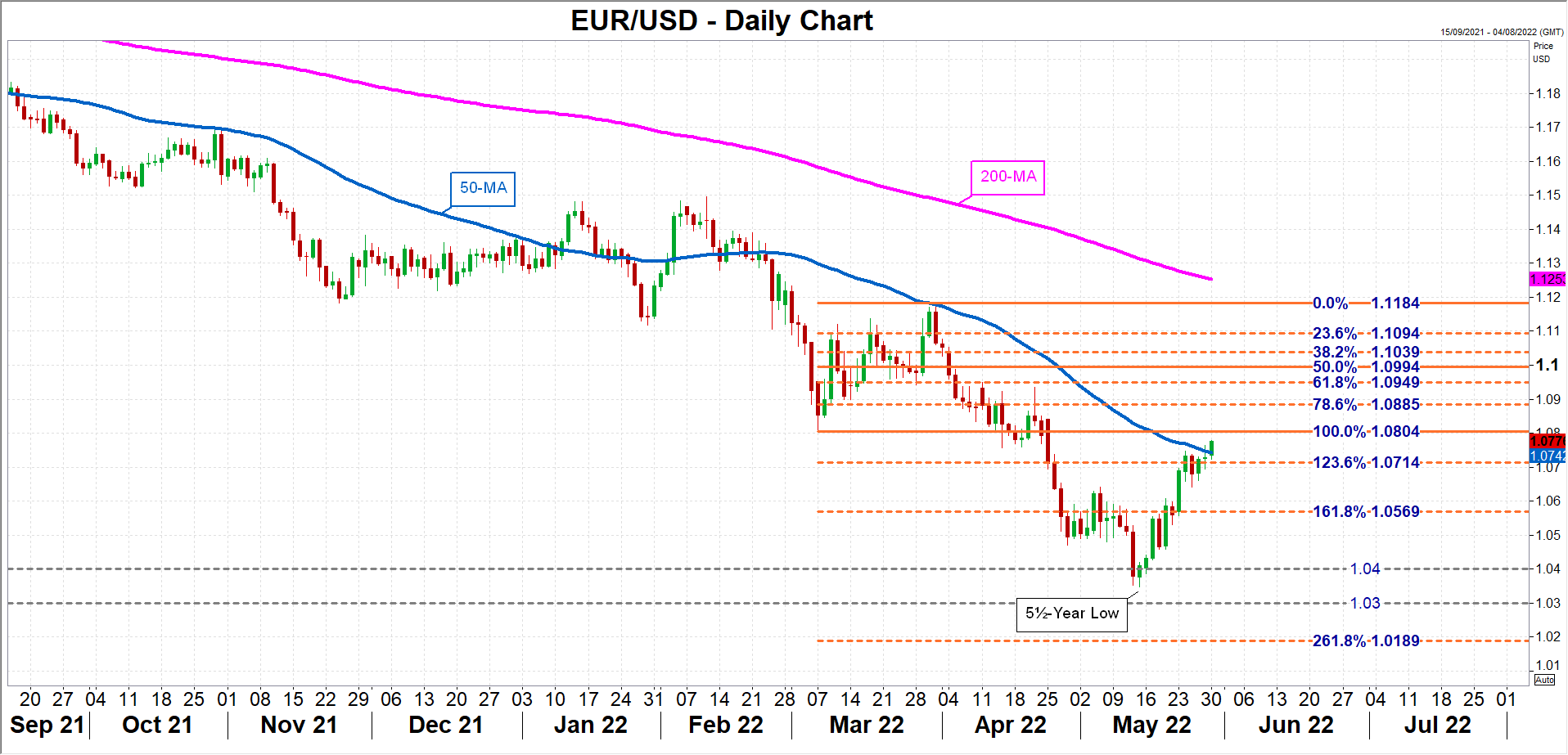
If, though, the euro rally begins to lose steam, a pullback towards the 161.8% Fibonacci extension of $1.0569 is probable. A drop below this level, however, could pave the way for a re-test of the almost 5½-year trough of $1.0348 set on May 13.
In the somewhat bigger picture, the euro should remain supported as the focus for the ECB shifts towards tightening and as investors pare back some of their more aggressive bets for Fed rate hikes. But the bullish bias is at risk of faltering if Eurozone growth data, which for the time being is holding up surprisingly well, starts to turn south in the coming weeks.
GBP/USD Outlook: Recovery Loses Steam after Two-Week Rally But Bulls Remain in Play
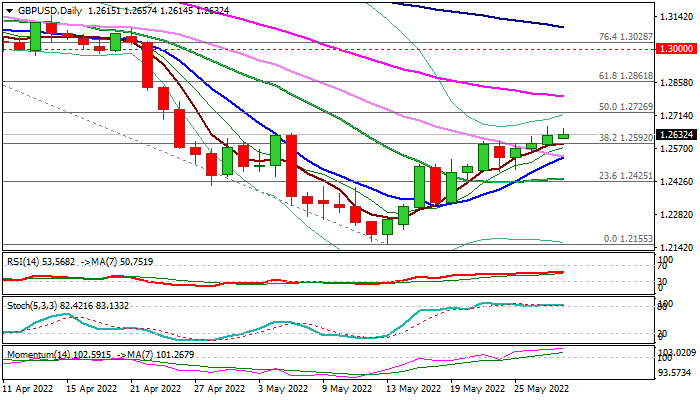
Cable keeps positive tone at the start of the week following strong rally in past two weeks (3.1%) but bulls face headwinds from falling weekly Tenkan-sen (1.2661) which capped recovery last Friday and continues to limit the action today.
Today’s narrow range generates initial signs of stall as overbought stochastic on overall bullishly-aligned daily studies suggests bears may pause here for consolidation.
Repeated daily close above broken Fibo 38.2% of 1.3298/1.2155 bear-leg (1.2592) would add to positive signals, though extended dips are not ruled out, but need to stay above rising 10DMA (1.2533) to keep near-term bias with bulls.
Break of 10DMA support would weaken near-term structure and add to signs of recovery stall.
On the other side, lift above 1.2726 (50% retracement of 1.3298/1.2155) is needed to signal bullish continuation.
Res: 1.2666; 1.2700; 1.2726; 1.2772.
Sup: 1.2592; 1.2533; 1.2471; 1.2440.
USD/JPY Mid-Day Outlook
Daily Pivots: (S1) 126.78; (P) 127.01; (R1) 127.35; More...
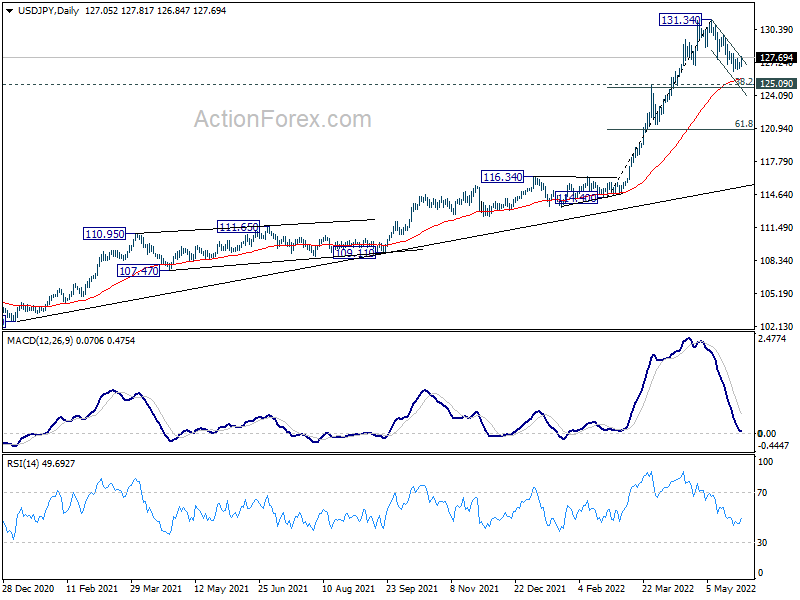
USD/JPY's correction from 131.34 could still extend lower. But downside should be contained by 125.09 cluster support (38.2% retracement of 114.40 to 131.34 at 124.86) to bring rebound. On the upside, break of 129.77 minor resistance will suggest that the correction is finished and bring retest of 131.34.
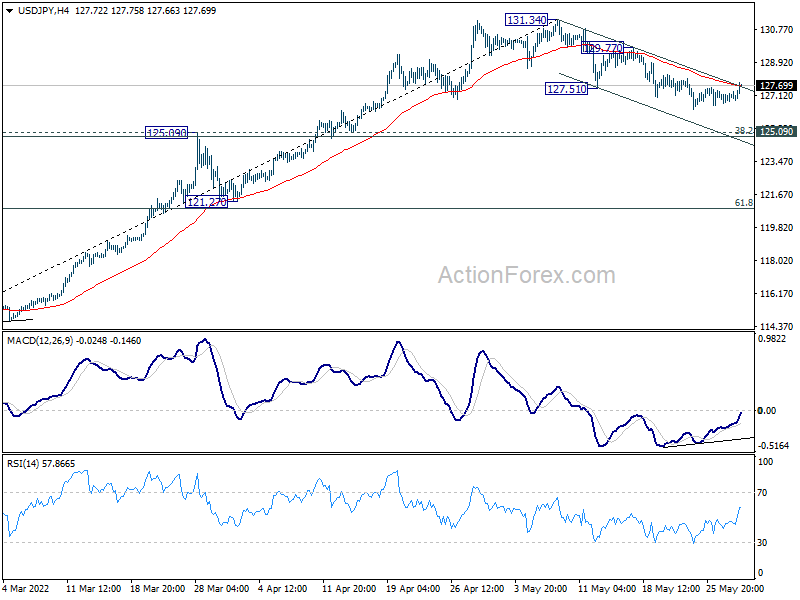
In the bigger picture, current rally is seen as part of the long term up trend form 75.56 (2011 low). Sustained trading above 61.8% projection of 75.56 (2011 low) to 125.85 (2015 high) from 98.97 at 130.04 will pave the way to 100% projection at 149.26, which is close to 147.68 (1998 high). For now, this will remain the favored case as long as 121.27 support holds.
USD/CHF Mid-Day Outlook
Daily Pivots: (S1) 0.9546; (P) 0.9575; (R1) 0.9605; More...
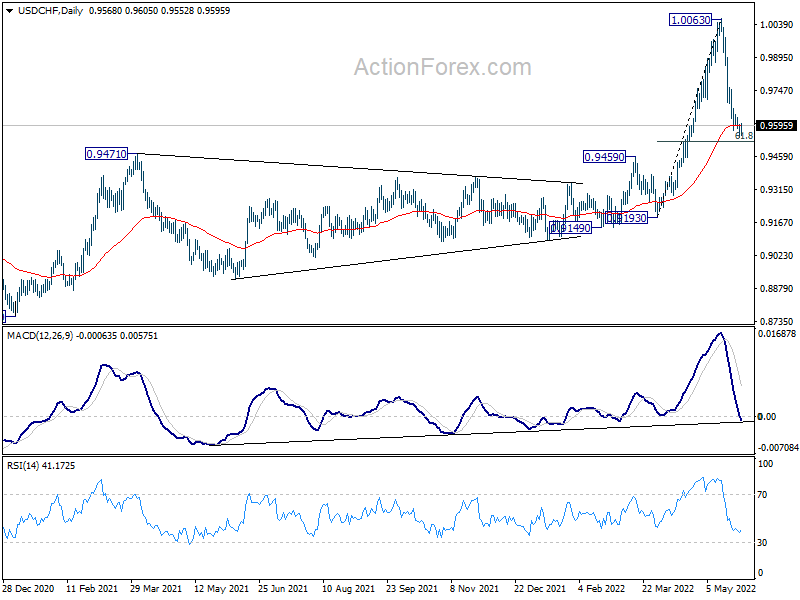
No change in USD/CHF's outlook and fall from 1.0063 could extend lower. But should be contained by 61.8% retracement of 0.9193 to 1.0063 at 0.9525 to bring rebound. On the upside, above 0.9763 minor resistance will turn bias back to the upside for recovery. However, sustained break of 0.9525 will bring deeper decline to 0.9193 support.
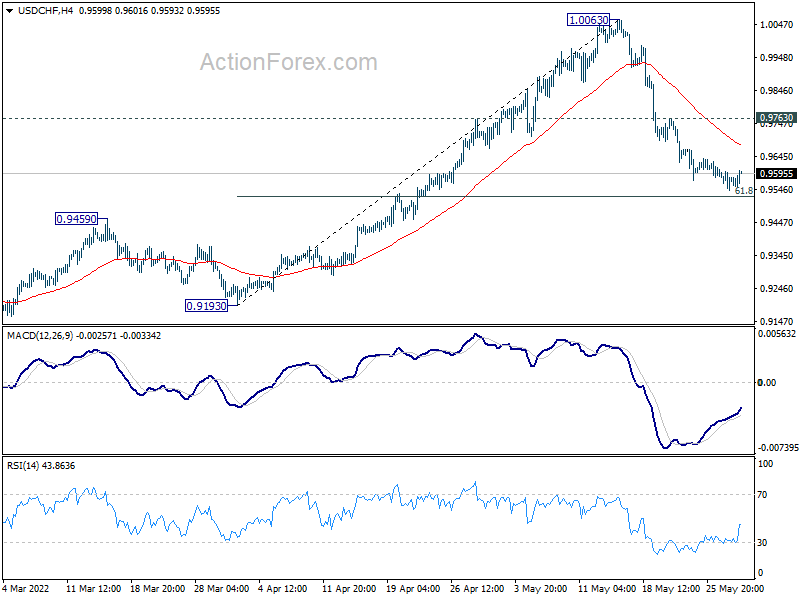
In the bigger picture, down trend from 1.0342 (2016 high) should have completed with three waves down to 0.8756 (2021 low) already. Rise from 0.8756 is likely a medium term up trend of its own. Next target is 1.0237/0342 resistance zone. This will remain the favored case as long as 0.9471 resistance turned support holds. However, sustained break of 0.9471 will extend long term range trading with another falling leg.
GBP/USD Mid-Day Outlook
Daily Pivots: (S1) 1.2567; (P) 1.2594; (R1) 1.2636; More...
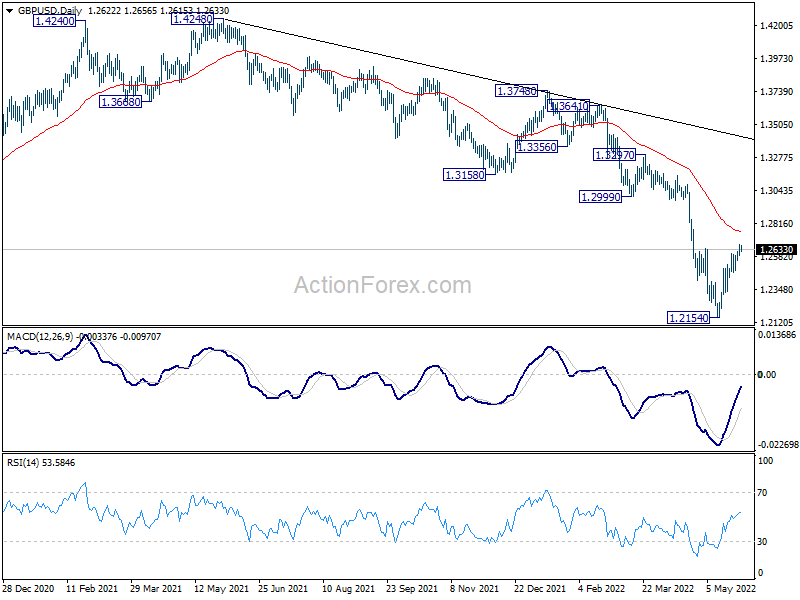
GBP/USD's rise from 1.2154 is still in progress and intraday bias remains on the upside for 55 day EMA (now at 1.2756). Sustained break there will target 1.2999 support turned resistance. On the downside, though, break of 1.2480 minor support will turn bias back to the downside for retesting 1.2154 low instead.
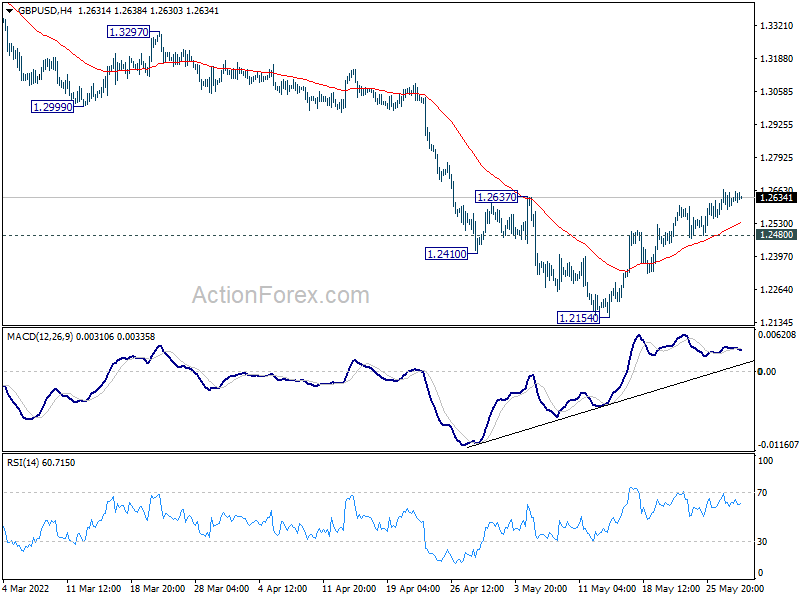
In the bigger picture, fall from 1.4248 (2018 high) could be a leg inside the pattern from 1.1409 (2020 low), or resuming the longer term down trend. Deeper decline is expected as long as 1.2999 support turned resistance holds. On resumption, next target is 1.1409 low.
EUR/USD Mid-Day Outlook
Daily Pivots: (S1) 1.0699; (P) 1.0732 (R1) 1.0767; More...
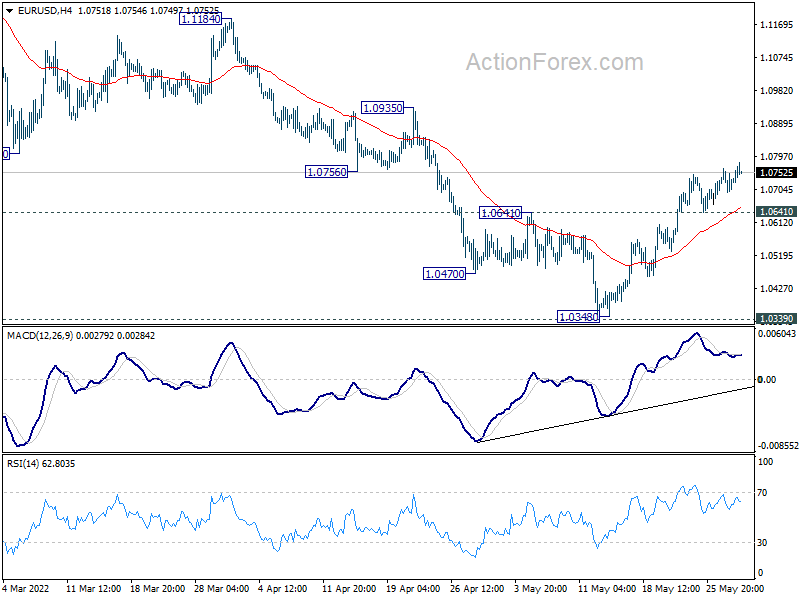
Intraday bias in EUR/USD remains on the upside at this point. Sustained trading above 55 day EMA (now at 1.0757) will target 1.0935 resistance next. On the downside, however, break of 1.641 minor support will turn bias back to the downside for retesting 1.0348 low instead.
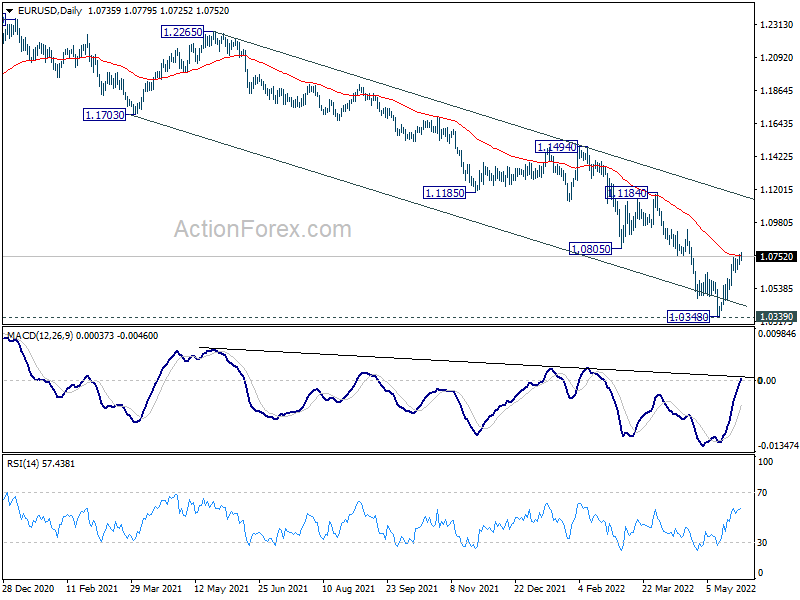
In the bigger picture, focus stays on 1.0339 long term support (2017 low). Decisive break there will resume whole down trend from 1.6039 (2008 high). Next target is 61.8% projection of 1.3993 to 1.0339 from 1.2348 at 1.0090. However, firm break of 1.0805 support turned resistance will delay this bearish case and bring medium term corrective rebound first.
Yen Crosses Rise on Risk-On Sentiment
Commodity currencies are trading broadly higher today, with help from risk-on sentiment, with Aussie and Loonie competing for the first place. Selloff are mainly centered Yen and Swiss Franc, and to a lesser extent Dollar. Euro and Sterling are mixed for the moment. The moves could intensify further on relatively lower liquidity with US on bank holiday.
Technically, the rally in Yen crosses (including AUD/JPY below) is picking up momentum. There are some levels to pay attention to, including 129.77 resistance in USD/JPY, 138.33 resistance in EUR/JPY and 101.34 resistance in CAD/JPY. Break of these levels will argue that medium term up trends in Yen crosses are ready to resume in general. If happens, that would likely come with extended rebound in global stock indexes.
In Europe, at the time of writing, FTSE is down -0.02%. DAX is up 0.45%. CAC is up 0.56%. Germany 10-year yield is up 0.099 at 1.063. Earlier in Asia, Nikkei rose 2.19%. Hong Kong HSI rose 2.06%. China Shanghai SSE rose 0.60%. Singapore Strait Times rose 0.26%. Japan 10-year JGB yield rose 0.0038 to 0.234.
AUD/JPY rises on risk-on sentiment, ready for up trend resumption?
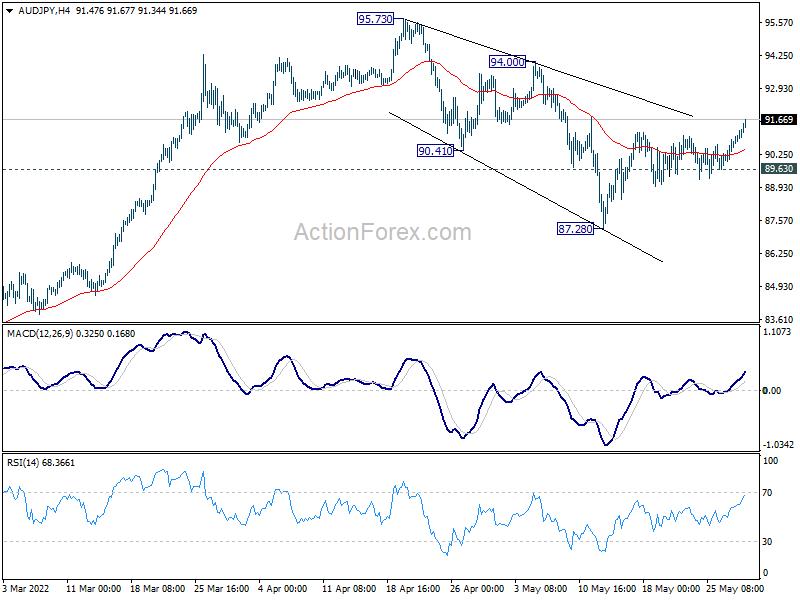
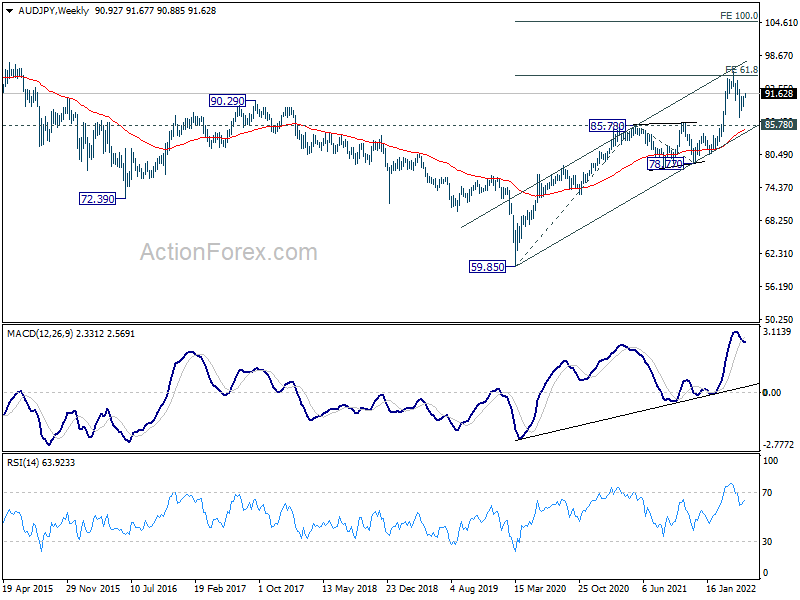
On the back of risk-on sentiment, AUD/JPY rally resumed the rally from 87.28 today, and hit as high as 91.67 so far. The development affirms the case that correction from 95.73 has completed with three waves down to 87.28. Further rally should be seen as long as 89.63 support holds. Next target is 94.00 resistance.
Also, while the pull back from 95.73 was deep, it was held above 85.78 resistance turned support, as well as 55 week EMA. Medium term bullishness is maintained. Firm break of 94.00 will argue that whole up trend from 59.85 (2020 low) is ready to resume through 95.73. In that case, next medium term target will be 100% projection of 59.85 to 85.78 from 78.77 at 104.70.
Eurozone economic sentiment ticked up to 105 in May, EU down to 104.1
Eurozone Economic Sentiment Indicator ticked up from 104.9 to 105.0 in May. Employment Expectations Indicator rose from 112.6 to 112.9. Industrial confidence dropped from 7.7 to 6.3. Services confidence rose from 13.6 to 14.0. Consumer confidence rose from -22.0 to -21.1. Retail trade confidence dropped from -3.9 to -4.0. Construction confidence rose from 7.0 to 7.2.
EU Economic Sentiment dropped from 104.6 to 104.1. Amongst the largest EU economies, the ESI rose markedly in Spain (+4.1) and, to a lesser extent, in France (+1.5) and Italy (+0.8), while it remained
Swiss KOF dropped to 96.8, below long-term average
Swiss KOF Economic Barometer dropped from 103.0 to 96.8 in May, below expectation of 102.3. The indicator is now below its long-term average. KOF said, "the Swiss economy is thus likely to develop moderately over the next few months."
The decline was "driven by indicator bundles of almost all branches of the economy", except financial and insurance services sector, and foreign demand.
RBNZ Conway: Probably some more 50 points hikes coming
RBNZ chief economist Paul Conway said today that 50bps rate hikes are the way forward, and he's confident of soft landing as the labor market is strong.
"75 wasn't seriously on the table because we are pretty convinced that we can get to where we need to get with 50-point increments," he said. Also, the central bank was "signaling there's probably some more 50 points coming over the next little while."
On the economy, Conway said "it's difficult to engineer a soft landing -- typically a significant reduction in inflation is accompanied by negative economic growth -- but there's reasons to believe New Zealand is well placed to pull it off this time around."
"The labor market is strong and that's the underlying reason why the New Zealand economy is well placed to weather the storm," he added.
BoJ Kuroda: Yen's rapid weakening not because of monetary policy
BoJ Governor Haruhiko Kuroda told the parliament today, "I don't think the BoJ's monetary policy was the factor behind a rapid yen weakening. The recent yen weakening may have been driven by an abnormal situation where oil prices topped $130 per barrel."
He also said that the rapid depreciation of Yen was "undesirable". But the situation was improving with Dollar easing back to around 127 Yen.
Meanwhile, Kuroda also repeated the pledge to maintain powerful monetary easing to help the economy from recovering.
EUR/USD Mid-Day Outlook
Daily Pivots: (S1) 1.0699; (P) 1.0732 (R1) 1.0767; More...
Intraday bias in EUR/USD remains on the upside at this point. Sustained trading above 55 day EMA (now at 1.0757) will target 1.0935 resistance next. On the downside, however, break of 1.641 minor support will turn bias back to the downside for retesting 1.0348 low instead.
In the bigger picture, focus stays on 1.0339 long term support (2017 low). Decisive break there will resume whole down trend from 1.6039 (2008 high). Next target is 61.8% projection of 1.3993 to 1.0339 from 1.2348 at 1.0090. However, firm break of 1.0805 support turned resistance will delay this bearish case and bring medium term corrective rebound first.
Economic Indicators Update
| GMT | Ccy | Events | Actual | Forecast | Previous | Revised |
|---|---|---|---|---|---|---|
| 06:00 | EUR | Germany Import Price Index M/M Apr | 1.80% | 2.00% | 5.70% | |
| 07:00 | CHF | KOF Leading Indicator May | 96.8 | 102.3 | 101.7 | 103 |
| 09:00 | EUR | Eurozone Economic Sentiment Indicator May | 105 | 104.9 | 105 | 104.9 |
| 09:00 | EUR | Eurozone Industrial Confidence May | 6.3 | 7.5 | 7.9 | 7.7 |
| 09:00 | EUR | Eurozone Services Sentiment May | 14 | 14.3 | 13.5 | 13.6 |
| 09:00 | EUR | Eurozone Consumer Confidence May F | -21.1 | -21.1 | -21.1 | |
| 12:00 | EUR | Germany CPI M/M May P | 0.90% | 0.50% | 0.80% | |
| 12:00 | EUR | Germany CPI Y/Y May P | 7.90% | 7.60% | 7.40% | |
| 12:30 | CAD | Current Account (CAD) Q1 | 5.0B | -0.2B | -0.8B | -0.1B |
AUD/JPY rises on risk-on sentiment, ready for up trend resumption?
On the back of risk-on sentiment, AUD/JPY rally resumed the rally from 87.28 today, and hit as high as 91.67 so far. The development affirms the case that correction from 95.73 has completed with three waves down to 87.28. Further rally should be seen as long as 89.63 support holds. Next target is 94.00 resistance.
Also, while the pull back from 95.73 was deep, it was held above 85.78 resistance turned support, as well as 55 week EMA. Medium term bullishness is maintained. Firm break of 94.00 will argue that whole up trend from 59.85 (2020 low) is ready to resume through 95.73. In that case, next medium term target will be 100% projection of 59.85 to 85.78 from 78.77 at 104.70.
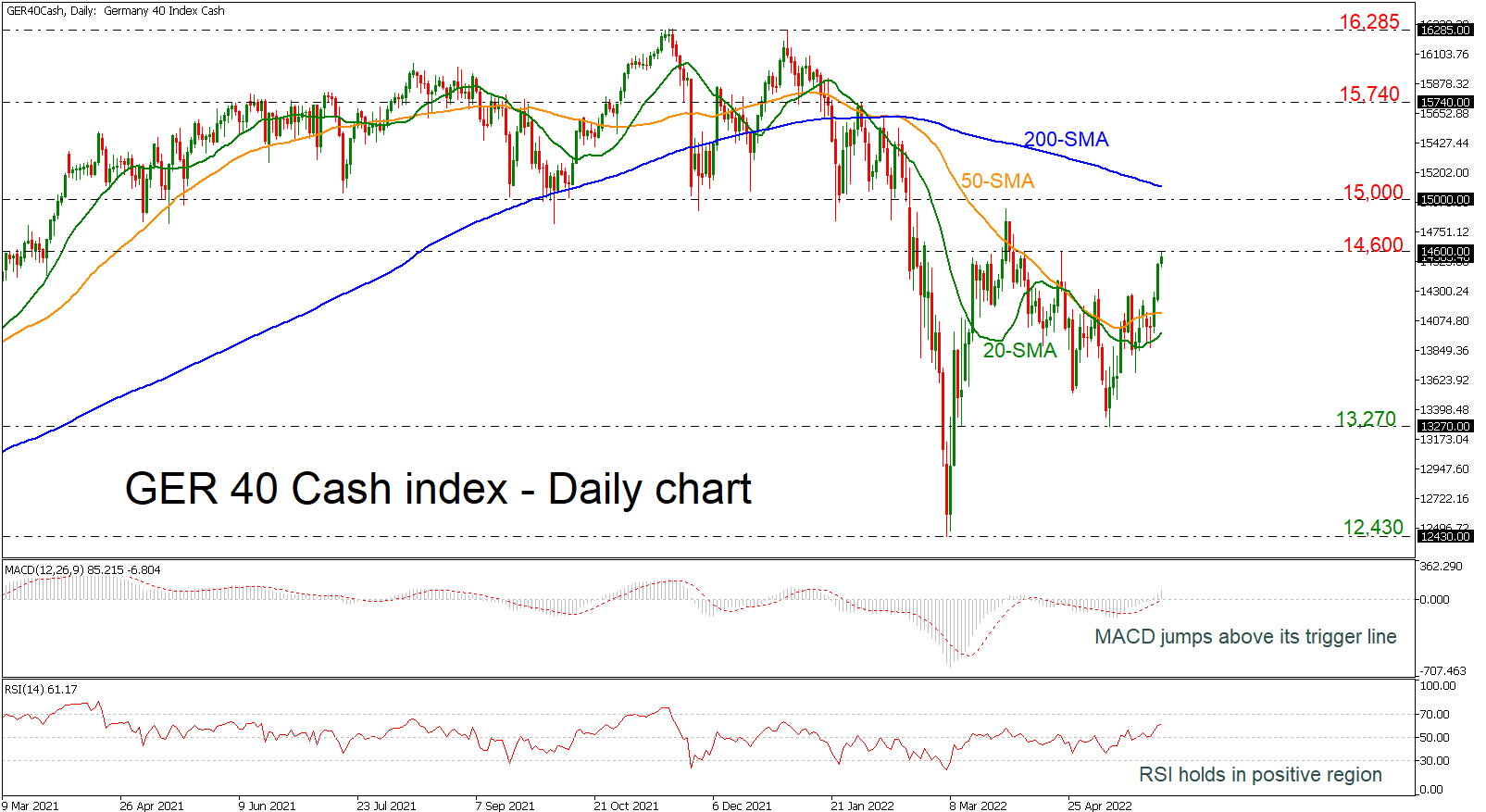
GER 40 Index Posts 5-Week High after Rebound off 13,270
The German 40 cash index is continuing last week’s rebound but with slower momentum, reaching a five-week high near 14,600. The short-term bias looks positive as the MACD keeps gaining ground above its trigger line, while the RSI seems to be making its way up above its 50-neutral mark, though more progress is needed from the latter.
The 15,000 could be a trigger point for steeper bullish action if the index manages to break the 14,600 line. Even higher, the 200-day simple moving average (SMA) at 15,100 should attract some attention ahead of the 15,740 barrier.
However, if the price reverses back to the downside, investors could meet first at the 50- and then at the 20-day SMAs at 14,138 and 13,980 respectively. If the index continues to drop, support could next come somewhere between the latest lows at 13,270.
In the medium-term picture, the bounce off 13,270 turned the outlook from negative to neutral again. Chances for another bullish move are still rising as the short-term SMAs are pointing upwards.
NZ Dollar Shines as US Dollar Retreats
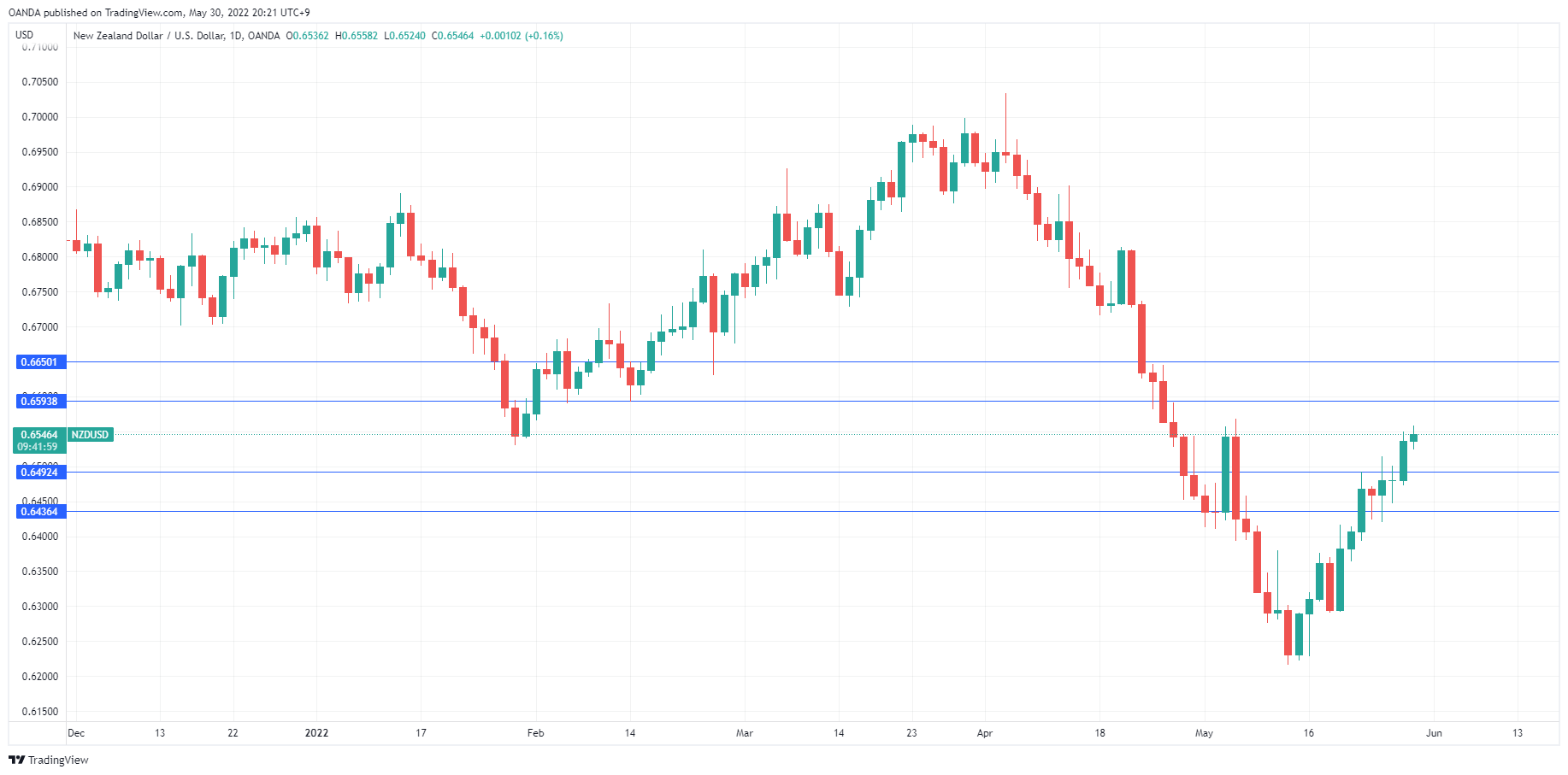
The New Zealand dollar continues to take advantage of US dollar weakness. NZD/USD posted sharp gains last week, climbing 2.01%.
Will Business Confidence improve?
The week kicks off with ANZ Business Confidence, which has been in deep-freeze for months. The indicator was almost unchanged at -42.0 in April, which means that close to half of New Zealand businesses expect economic conditions to worsen during the next 12 months.
The government has eased Covid restrictions, which is good news for the business sector, in particular for services such as hospitality and recreation. The upcoming survey is likely to show that businesses continue to struggle with two main issues – surging inflation and shortages of materials and workers.
Businesses have seen their operating costs, including wages, accelerate rapidly and this is forcing them to pass on higher costs. Inflation has hit 30-year highs and no ‘inflation peak’ appears in sight, despite aggressive rate hikes from the RBNZ. Perhaps as important, business expect CPI to remain high. Two-year expectations have risen to 3.29% and five-year expectations have risen to 2.42%, well above the RBNZ’s inflation target of 1%-3%.
The RBNZ has repeatedly said that its hawkish policy is aimed at curbing both inflation and inflation expectations. Governor Orr said last week that it was crucial that inflation expectations remain “anchored” and that a situation where higher inflation expectations become persistent had to be avoided “at all costs”.
Orr added that he expects the cash rate, which is currently at 2%, to rise to 4% in mid-2023. This means that the RBNZ will continue be aggressive and we can expect further 50-bps rate hikes, if the central bank feels that the economy is strong enough for aggressive rate therapy.
NZD/USD Technical
- NZD/USD is testing resistance at 0.6475. Above, there is resistance at 0.6540
- There is support at 0.6352 and 0.6287