

Sample Category Title
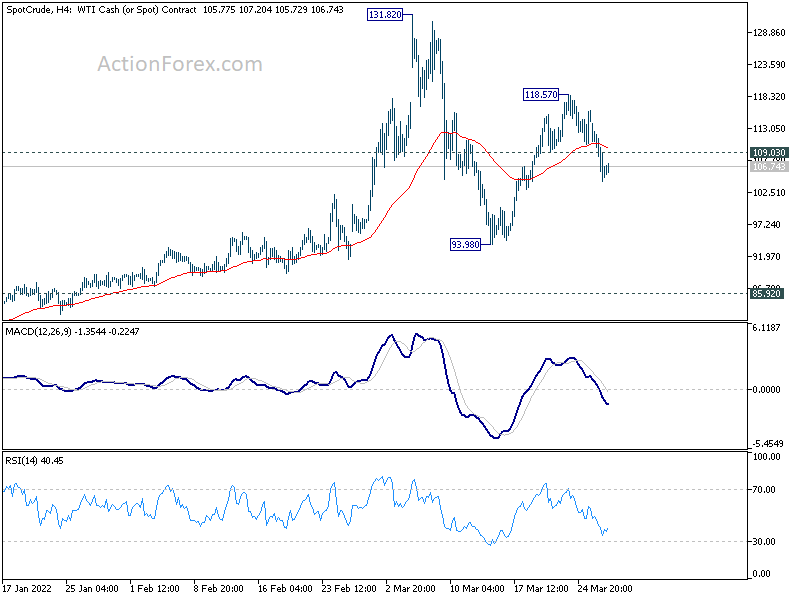
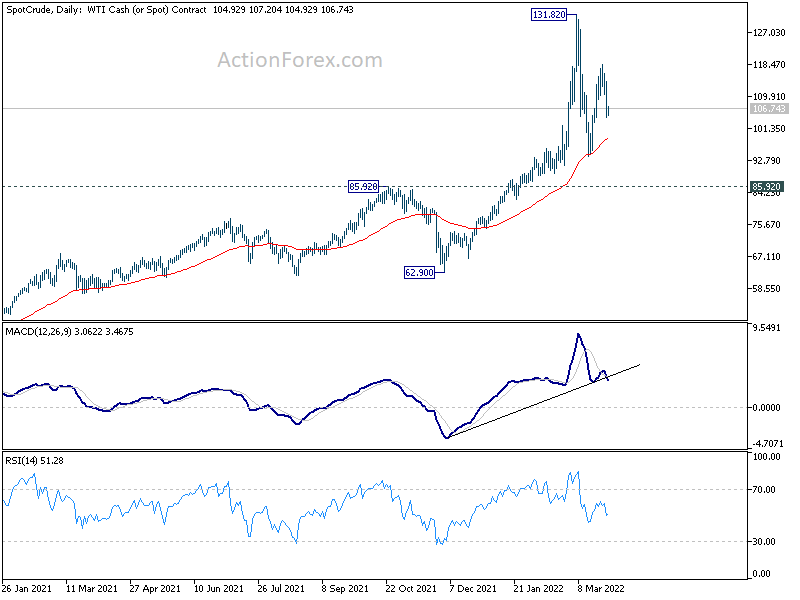
WTI crude oil completed rebound, heading back towards 93.98 support
WTI crude oil's break of 109.03 support earlier this week argues that rebound from 93.98 has completed at 118.57 already. Fall from there is seen as the third leg of the corrective pattern from 131.82. Deeper decline would be seen back to 93.98, and possibly below. But still, firm break of 85.92 resistance turned support is needed to indicate trend reversal. Otherwise, medium term outlook is just neutral for range trading.
ECB Holzmann: Rise deposit rate to zero by year end important
ECB Governing Council member Robert Holzmann said, "an increase to the deposit rate to zero by the end of the year would be important for monetary policy because it increases optionality."
"If, towards the end of the year, we were to find that inflation will remain higher for longer, we would have to tighten monetary policy more and raise interest rates more significantly," he added.
ECB Lane: There are mixed signals coming through
ECB Chief Economic Philip Lane said in an interview, "right now, clearly inflation is a huge issue across Europe, absolutely." But he added, "this essentially is an imported inflation shock, it's a supply shock... we would still maintain ... most of this inflation will fade away".
"We do think that inflation will decline later this year and will be a lot lower next year and the year after compared to this year," he added.
"There are mixed signals coming through... some indices are showing upside concern for energy prices and other indices are showing downside concern for activity levels through the sentiment channel."
"In March we had an inflation outlook which was getting close to 2 per cent. If that outlook is maintained, we will be looking to end net purchases in the third quarter. If it weakens, or if financing conditions deteriorate, that would be inconsistent with delivering that action. Then we would have to think again," Lane added.
Ceasefire Talks Lift Stock Markets
Stock markets across Europe are rallying on Tuesday, buoyed by positive noises coming from Turkey where Ukraine and Russia may be nearing a ceasefire agreement.
While there are reportedly still plenty of gaps in the demands of the two teams, there appear to have been compromises found on some big issues including Ukraine's previous ambitions of NATO membership. The next couple of days could be crucial but the signs are promising which we're seeing reflected in the markets today.
There has been no shortage of optimism in the markets since the talks began, which has looked premature at times but may now be paying off. Europe is up around 2% and US futures are making small gains also, a reflection of how much more exposed the bloc is to the invasion and the knock-on effects of a prolonged war.
Sanctions have sought to wreak havoc on the Russian economy while shielding oil and gas, which Europe is heavily reliant on, but as the war has intensified, talk of weaponising this mutually dependent relationship has increased. This is still being rejected by those most exposed in Europe but the longer the war rages, the more likely it is that their position will change.
Russian demands to pay for gas in roubles may effectively take both sides down the same path though. The G7 has fiercely rejected Kremlin demands for unfriendly nations to settle in roubles and believe the contracts are in their favour. It's not clear how the Kremlin plans to enforce such a demand but if neither side blinks, it could have massive consequences for all concerned.
BoJ continues to push back against YCC challenges
There remains a massive focus on rising yields and the impact on the US yield curve in particular. Flashing recession signals are the last thing we need right now but some are sounding the alarm as parts of the curve invert. The Fed, as ever, doesn't appear particularly concerned but further inversions may change that at which point a more cautious approach may be considered.
One consequence of global yields (and inflation) rising as aggressively as they have is being seen in Japan, where BoJ's yield curve control policy is being tested. The central bank is buying unlimited bonds at 0.25% in an attempt to protect the cap but with limited success so far.
The yen has come under heavy pressure again as a result of the BoJ purchases, prompting speculation that currency interventions may be warranted due to the risks of rapid depreciation. Or, of course, a tweak to the YCC policy allowing more flexibility as the market pushes back against the current limits. The yen is paring losses today.
Oil higher as political OPEC+ prepares to continue gradual output increases
Oil prices are a little higher today, slightly paring heavy losses on Monday sustained on the back of intensifying lockdowns in China. The country remains committed to its zero-Covid policy which will ultimately weigh on crude demand in the near term. No doubt it comes at a good time given current supply/demand dynamics but we're only talking short-term relief.
Longer-term pressures remain and OPEC+ looks unlikely to do anything to alleviate those this week. The group has repeatedly stated its desire to remain apolitical and base its decisions purely on achieving a balanced market. Given how unbalanced the market is and the fact that at the center of the alliance is the country to blame for the most recent surge in oil prices, it's hard to view a decision to not increase output targets as anything but political.
Gold eases further as risk appetite improves
Gold prices are easing again as risk appetite improves on reported progress in talks between Ukraine and Russia. The yellow metal was in strong demand as Russian troops crossed the border and hope of a ceasefire is seeing that unwind. There will remain a certain amount of support for gold still given the inflationary, geopolitical, and risk environment but we could see it ease a little further in the near term. The next key level for gold will be $1,900 where it saw strong support earlier this month.
Bitcoin pares gains after smashing resistance
Bitcoin is paring gains today after breaking free at the start of the week. It finally broke through $45,500 resistance and it just took off from there, peaking just above $48,000. The outlook is suddenly looking far more promising after a long period of consolidation, with the next tests coming at around $50,000 and $52,000.
USD/JPY Mid-Day Outlook
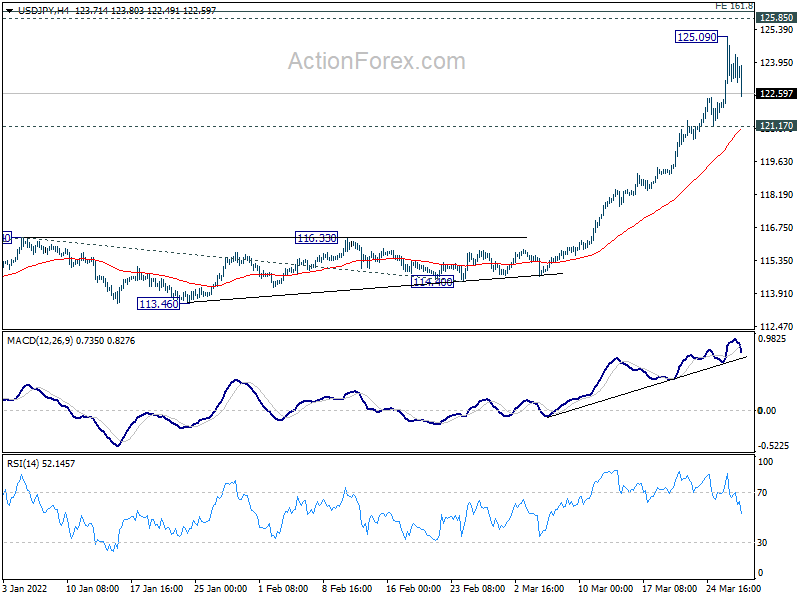
Daily Pivots: (S1) 122.26; (P) 123.68; (R1) 125.33; More...
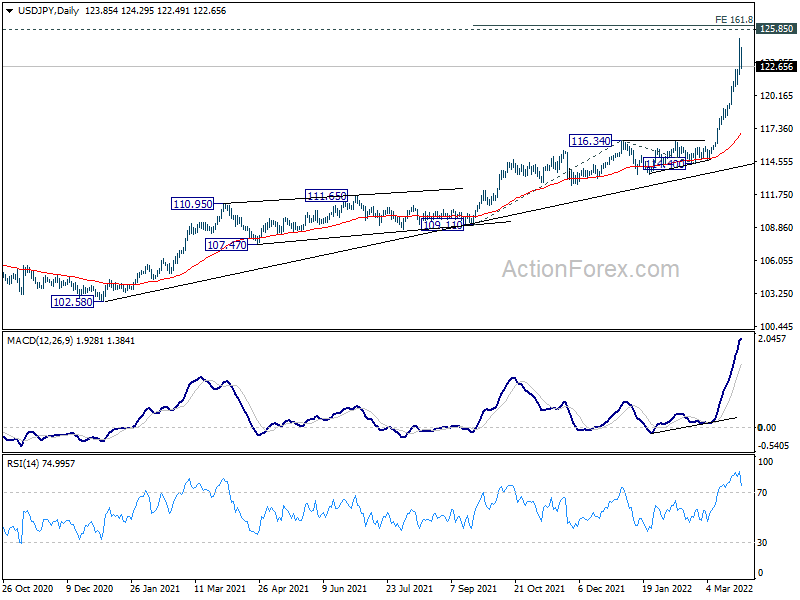
Intraday bias in USD/JPY remains neutral for consolidation below 125.09 temporary top. But downside should be contained by 121.17 minor support to bring another rally. On the upside, above 125.09 will target 161.8% projection of 109.11 to 116.34 from 114.40 at 126.09, which is close to 125.85 long term resistance. However, break of 121.17 will indicate short term topping, and bring deeper pull back.
In the bigger picture, up trend from 98.97 (2016 low) in in progress for retesting 125.85 (2015 high). Sustained break there will confirm long term up trend resumption. Next target will be 61.8% projection of 75.56 (2011 low) to 125.85 (2015 high) from 98.97 at 130.04. This will now remain the favored case as long as 116.34 resistance turned support holds.
USD/CHF Mid-Day Outlook
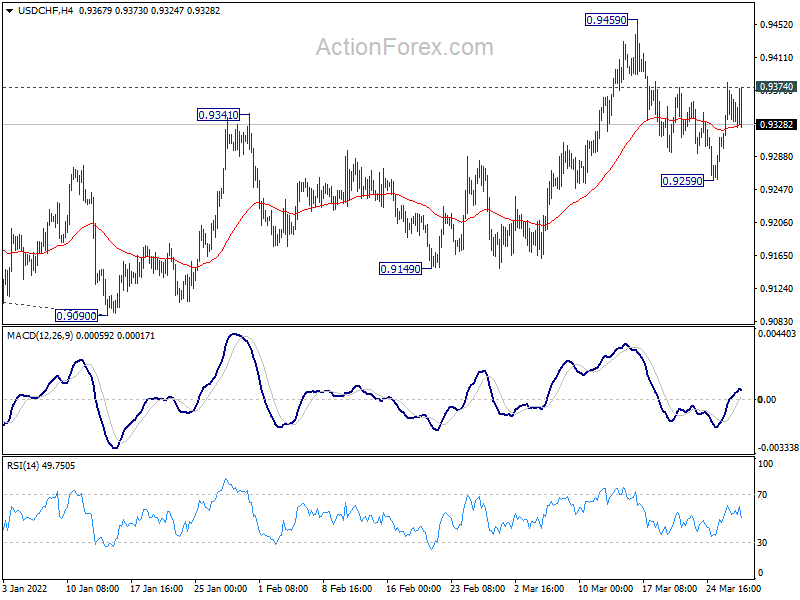
Daily Pivots: (S1) 0.9304; (P) 0.9343; (R1) 0.9385; More....
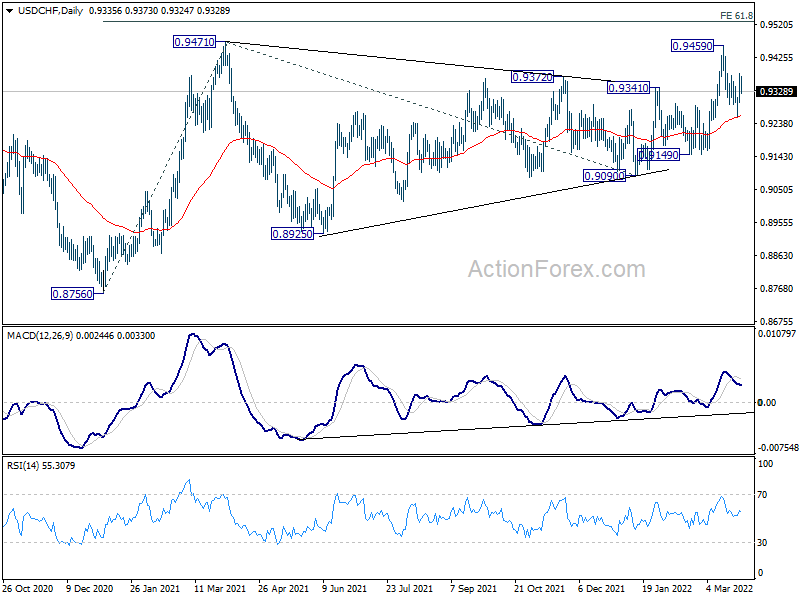
Intraday bias in USD/CHF remains neutral for the moment. On the upside, break of 0.9374 minor resistance will suggest that the pull back from 0.9459 has completed. Support from 55 day EMA will also retain near term bullishness. Intraday bias will be back on the upside for 0.9459 first. Break will resume the rise from 0.8756 to 61.8% projection of 0.8756 to 0.9471 from 0.9090 at 0.9532. However, sustained break of 55 day EMA (now at 0.9261) will target 0.9149 support.
In the bigger picture, medium term outlook will be neutral at best as long as 0.9471 resistance holds. Larger down trend could still extend through 0.8756 (2021 low). However, firm break of 0.9471 will argue that whole down trend form 1.0342 (2016 high), has completed with waves down to 0.8756. A medium term up trend should be set up to target 1.0237/0342 resistance zone.
GBP/USD Mid-Day Outlook
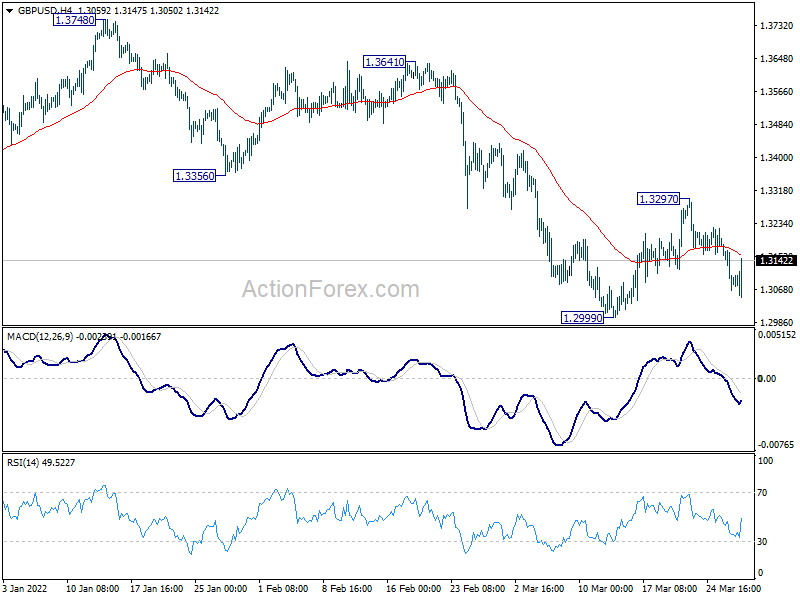
Daily Pivots: (S1) 1.3045; (P) 1.3117; (R1) 1.3168; More...
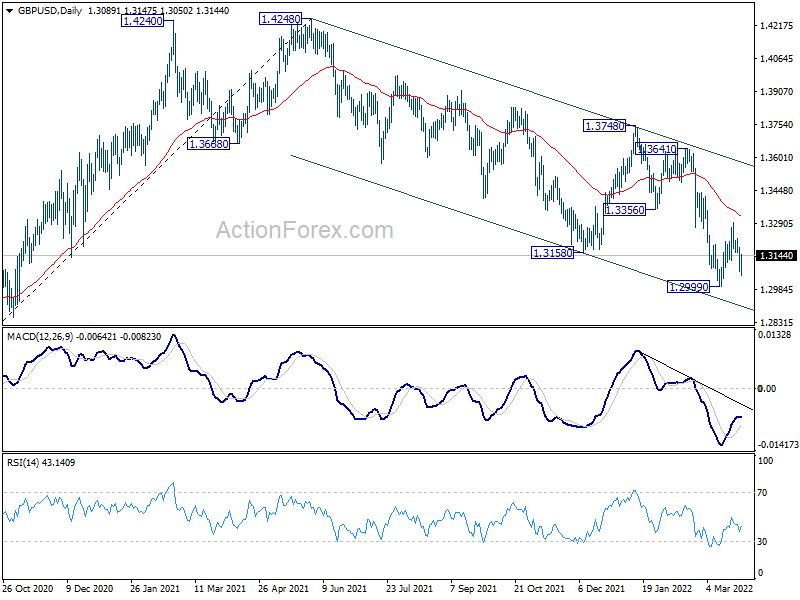
Intraday bias in GBP/USD is turned neutral with current recovery. Overall outlook stays bearish as long as 1.3297 resistance holds. Break of 1.2999 low will resume larger down trend from 1.4248. However, firm break of 1.3297 will bring strong rebound through 55 day EMA (now at 1.3325) and above.
In the bigger picture, current development suggests that the up trend from 1.1409 (2020 low) has completed at 1.4248. Decline from 1.4248 could still be a corrective move, or it could be the start of a long term down trend. In either case, deeper decline would be seen back to 61.8% retracement of 2.1161 to 1.1409 at 1.2493. In any case, break of 1.3748 resistance is needed to indicate medium term bottoming, or outlook will stay bearish.
EUR/USD Mid-Day Outlook
Daily Pivots: (S1) 1.0954; (P) 1.0977 (R1) 1.1008; More...
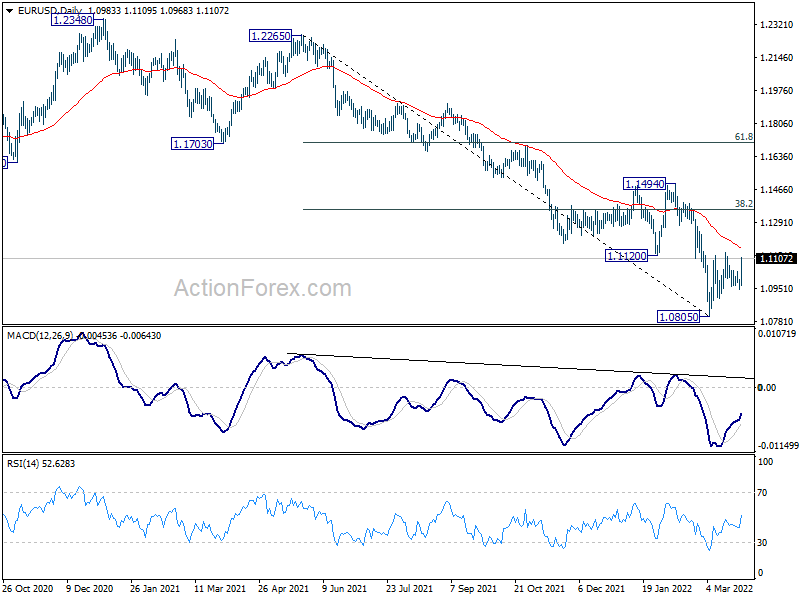
EUR/USD rebounds strongly today and immediate focus is now on 1.1120 support turned resistance. Sustained break there will argue that it's at least correcting the decline from 1.2265. Intraday bias will be back to the upside for 38.2% retracement of 1.2265 to 1.0805 at 1.1363. On the downside, however, break of 1.0943 support will retain near term bearishness, and bring retest of 1.0805 low.
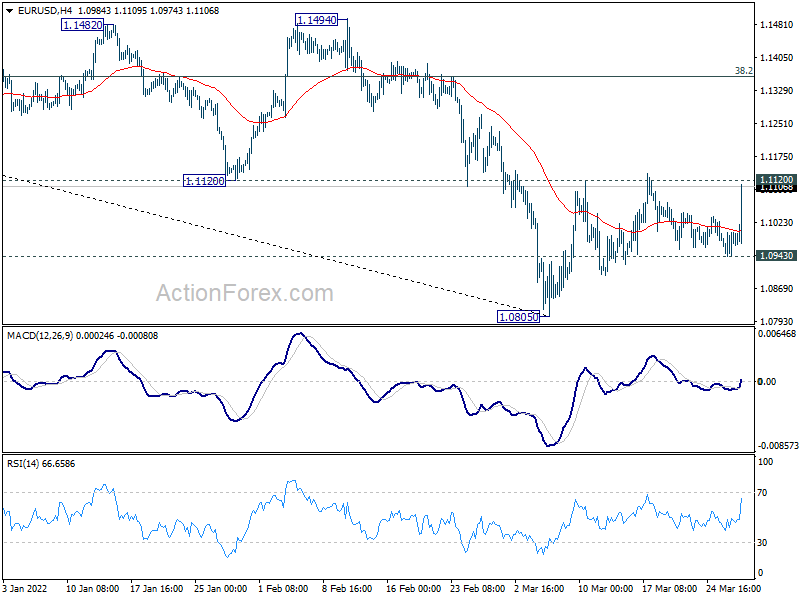
In the bigger picture, the decline from 1.2348 (2021 high) is expected to continue as long as 1.1494 resistance holds. Firm break of 1.0635 (2020 low) will raise the chance of long term down trend resumption and target a retest on 1.0339 (2017 low) next. Nevertheless, break of 1.1494 will maintain medium term neutral outlook, and extending term range trading first.
Euro Rebounds on Peace Hope, Surging German Yield
Euro rebounds strongly today on hope of positive development out of negotiation between Ukraine and Russia. Top Russian negotiator Vladimir Medinsky was quoted saying that talks were constructive and a Putin-Zelenskyy meeting is possible. BBC also quoted Russian deputy defence minister Alexander Fomin saying they will "radically reduce" military activity outside Kyiv and Chernihiv. Additionally, the common currency is lifted by rising German 10-year bund yield, which is above 0.7% handle for the first time since 2018. On the other hand, Swiss Franc is sold off broadly on reverse safe-haven flow, followed by Dollar.
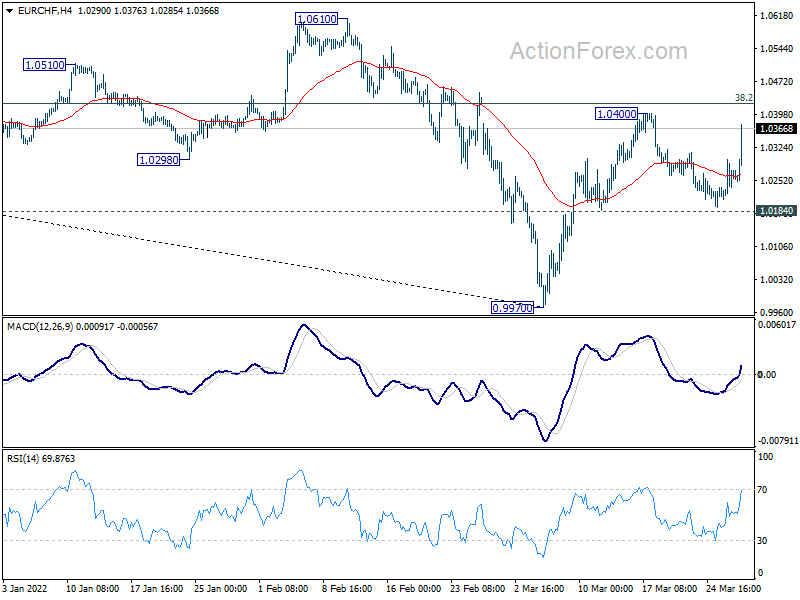
Technically, immediate focus in now on some levels in Euro pairs to confirm the underlying rebound. The levels include 1.1120 resistance in EUR/USD, 0.8456 temporary top in EUR/GBP. More importantly, break of 1.0400 resistance in EUR/CHF will resume the rebound from 0.9970 to 1.0610 key structural resistance. Further break there will be a sign of larger bullish reversal.
In Europe, at the time of writing, FTSE is up 1.33%. DAX is up 2.67%. CAC is up 2.99%. Germany 10-year yield is up 0.118 at 0.700. Earlier in Asia, Nikkei rose 1.10%. Hong Kong HSI rose 1.12%. China Shanghai SSE dropped -0.33%. Singapore Strait Times rose 0.06%. Japan 10-year JGB yield dropped -0.0072 to 0.252.
Germany Gfk consumer sentiment dropped to -15.5, hopes vanished into thin air
Germany Gfk consumer sentiment for April dropped sharply from -8.5 to -15.5. In March, economic expectations dived from 24.1 to -8.9, lowest since May 2020 during the first lockdown at -10.4. Income expectations tumbled from 3.9 to -22.1, hitting the lowest value since 2009, which was at -22.9. Propensity to buy dropped slightly from 1.4 to -2.1.
"In February hopes were still high that consumer sentiment would recover significantly with the foreseeable easing of pandemic-related restrictions. However, the start of the war in Ukraine caused these hopes to vanish into thin air. Rising uncertainty and sanctions against Russia have caused energy prices in particular to skyrocket, putting a noticeable strain on general consumer sentiment," explains Rolf Bürkl, GfK consumer expert.
Also released, import price index rose 1.3% mom in February, below expectation of 2.1% mom.
BoJ opinions emphasize importance to maintain monetary easing
In the Summary of Opinions of the March 17-18 meeting, BoJ noted, "unlike the United States and the United Kingdom, Japan is not in a situation where the inflation rate will likely exceed the price stability target of 2 percent in a continuous manner." Hence, "it is important for the Bank to continue with monetary easing to support the economic recovery from the pandemic."
Situations surrounding Ukraine have "caused price rises of energy and other items", and this will "push down domestic demand while raising the CPI." Under these circumstances, it is "necessary to improve labor market conditions and provide stronger support for wage increases".
One member warned that "if downward pressure on economic activity and prices increases, the economy may instead be in danger of falling into deflation again. If it becomes difficult to achieve the price stability target, the Bank should act nimbly and without hesitation."
Released from Japan, unemployment rate dropped from 2.8% to 2.7% in February, better than expectation of 2.8%.
Australia retail sales rose 1.8% mom in Feb, hitting second highest on record
Australia retail sales rose 1.8% mom to AUD 33.09B in February, well above expectation of 1.0% mom.
Director of Quarterly Economy Wide Statistics, Ben James, said February's result saw retail sales reach their second highest level on record after November 2021 and turnover continuing to regain lost momentum caused by the peak of the Omicron outbreak in January.
"Lower COVID-19 case numbers in February, alongside the further easing of restrictions over the month, saw consumer spending return to similar behaviour seen previously as states and territories come out of a COVID-19 wave," James said.
EUR/USD Mid-Day Outlook
Daily Pivots: (S1) 1.0954; (P) 1.0977 (R1) 1.1008; More...
EUR/USD rebounds strongly today and immediate focus is now on 1.1120 support turned resistance. Sustained break there will argue that it's at least correcting the decline from 1.2265. Intraday bias will be back to the upside for 38.2% retracement of 1.2265 to 1.0805 at 1.1363. On the downside, however, break of 1.0943 support will retain near term bearishness, and bring retest of 1.0805 low.
In the bigger picture, the decline from 1.2348 (2021 high) is expected to continue as long as 1.1494 resistance holds. Firm break of 1.0635 (2020 low) will raise the chance of long term down trend resumption and target a retest on 1.0339 (2017 low) next. Nevertheless, break of 1.1494 will maintain medium term neutral outlook, and extending term range trading first.
Economic Indicators Update
| GMT | Ccy | Events | Actual | Forecast | Previous | Revised |
|---|---|---|---|---|---|---|
| 23:30 | JPY | Unemployment Rate Feb | 2.70% | 2.80% | 2.80% | |
| 23:50 | JPY | BoJ Summary of Opinions | ||||
| 00:30 | AUD | Retail Sales M/M Feb | 1.80% | 1.00% | 1.80% | |
| 06:00 | EUR | Germany Gfk Consumer Confidence Apr | -15.5 | -12 | -8.1 | -8.5 |
| 06:00 | EUR | Germany Import Price Index M/M Feb | 1.30% | 2.10% | 4.30% | |
| 08:30 | GBP | Mortgage Approvals Feb | 71K | 73K | 74K | |
| 08:30 | GBP | M4 Money Supply M/M Feb | 1.00% | 0.50% | 0.10% | |
| 13:00 | USD | S&P/Case-Shiller Home Price Indices Y/Y Jan | 18.40% | 18.60% | ||
| 13:00 | USD | Housing Price Index M/M Jan | 1.40% | 1.20% | ||
| 14:00 | USD | Consumer Confidence Mar | 107.9 | 110.5 |
Aussie Shrugs Despite Strong Retail Sales
Australian retail sales outperform
Australian retail sales posted a 1.8% gain for a third straight month. The February release beat the consensus estimate of 1.0% and is a further indication that the economic recovery continues.
The Australian dollar has sparkled in March, gaining 3.20%. The risk-sensitive currency is flying high despite plenty of risk apprehension in the markets. The Russia-Ukraine war has resulted in millions of refugees in the middle of Europe and relations between Russia and the West haven’t been this frosty in decades.
In China, the government continues to resort to extreme measures in order to contain an upsurge in Covid cases. The government has imposed rolling lockdowns on Shanghai, which has a population of some 25 million. The property crisis has faded from the headlines, but it hasn’t gone away. Since Evergrande’s default last year, Chinese property developers are finding themselves locked out of the global debt market, and the country’s third-largest developer missed two bond payments last week.
In this turbulent environment, the driver behind the Australian dollar’s impressive performance has been the resource-based economy, as the range of commodities that Australia exports has been in huge demand as prices continue to head higher. Despite friction with China, Australia’s largest trading partner, the export sector is booming.
The Morrison government released its annual budget earlier today, and as expected, the response from the Australian dollar was a yawn. With the government trailing in the polls and an election expected in May, the budget had some goodies for voters, such as tax cuts and a temporary reduction in the fuel tax. With inflation on the rise, the government as well as the RBA are under pressure to relieve the surging cost of living.
AUD/USD Technical
- 0.7414 is the first line of support. Below, there is support at 0.7313
- There is resistance at 0.7577 and 0.7639