

Sample Category Title
EURUSD is Going Down
The major currency pair continues falling. On Monday 28 March, EUR/USD is trading at 1.0951.
The currency market is still interested in the “greenback” as a “safe haven” asset – investors need to hedge risks amid both global geopolitical tensions and the US Fed’s policy.
Earlier, Fed Chairman Jerome Powell said that the benchmark interest rate might leap up 50 basis points if the regulator couldn’t handle inflation.
There will be six more Fed meetings this year and the rate might be raised after each of them.
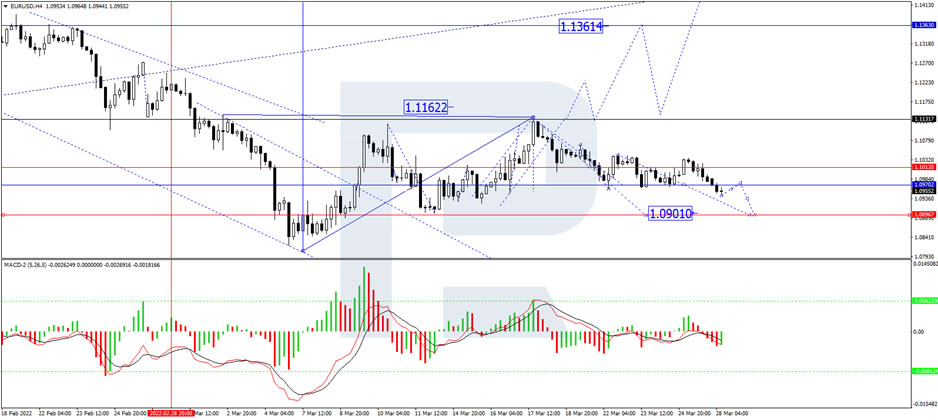
In the H4 chart, having formed a new consolidation range around 1.1010 and broken it to the downside, EUR/USD is expected to test 1.0970 and then complete the correction at 1.0901. Later, the market may form one more ascending wave the target at 1.1133. From the technical point of view, this scenario is confirmed by MACD Oscillator: its signal line is falling below 0 and may soon update the lows.
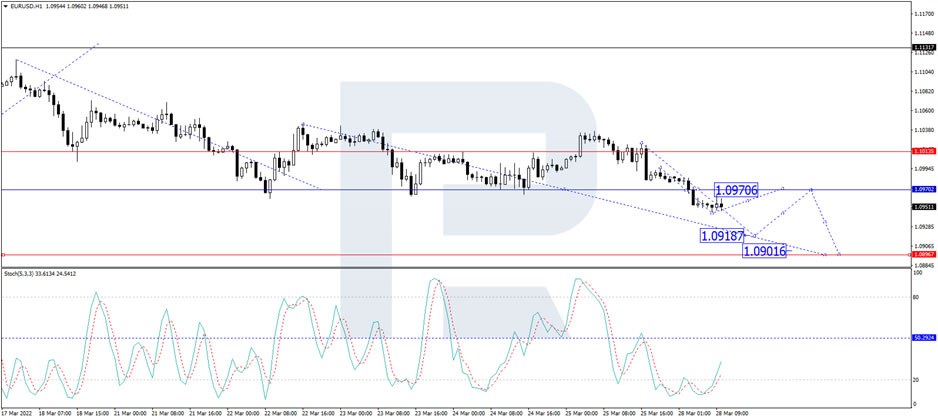
As we can see in the H1 chart, after breaking 1.0970 to the downside, EUR/USD is expected to test it from below and may later form a new ascending structure with the short-term target at 1.0919. After that, the instrument may grow to re-test 1.0970 from below and then resume trading downwards with the target at 1.0900. From the technical point of view, this idea is confirmed by the Stochastic Oscillator: after breaking 20 to the upside, its signal line may continue moving to reach 50. Later, the line may rebound from 50 and start a new decline towards 20.
Aussie Dips ahead of Retail Sales
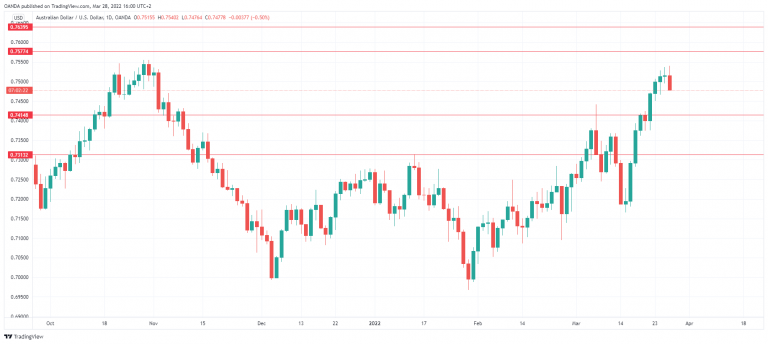
Aussie slips below 0.75 line
After a strong week, the Australian dollar has reversed directions and dropped below the 0.75 line on Monday. Investors will be keeping an eye on Australian retail sales, which will be released on Tuesday. The markets are expecting a gain of 1.0%, down from 1.8% in January.
The month of March has been kind to the Australian dollar, with sharp gains of 3.47%. The risk currency has not been affected by the tumultuous reaction in the markets to Russia’s invasion of Ukraine, although risk apprehension is certainly higher since the war began.
Investors are also uneasy over the situation in China, which continues to battle an upsurge in Covid cases. The government has imposed rolling lockdowns on Shanghai, which has a population of some 25 million. The property crisis has been overshadowed by the Ukraine crisis, but it hasn’t gone away. Since Evergrande’s default last year, Chinese property developers are finding themselves locked out of the global debt market, and the country’s third-largest developer missed two bond payments on Friday.
There is plenty of risk apprehension to go around, but the Aussie’s savior has been the resource-based economy of the Lucky Country, as the range of commodities that Australia exports have been in huge demand as prices continue to head higher.
Australia releases its annual budget on Tuesday, and the surge in commodities will allow the Morrison government to narrow its budget deficit and also give out some goodies, as it eyes a federal election later this year. The budget is expected to include help for homeowners and a temporary reduction in the tax on petrol.
AUD/USD Technical
- 0.7414 is the first line of support. Below, there is support at 0.7313
- There is resistance at 0.7577 and 0.7639
Dollar May be Giving Up Reserve Positions, But Not the Price
There has been a lot of talk lately about the decline of the US dollar’s reserve status. However, investors and traders should separate long-term trends from short-term market impulses.
Reserve fund managers often prefer to refrain from active selling so as not to cause unnecessary market turbulence, so all reserve trends are stretched out over decades.
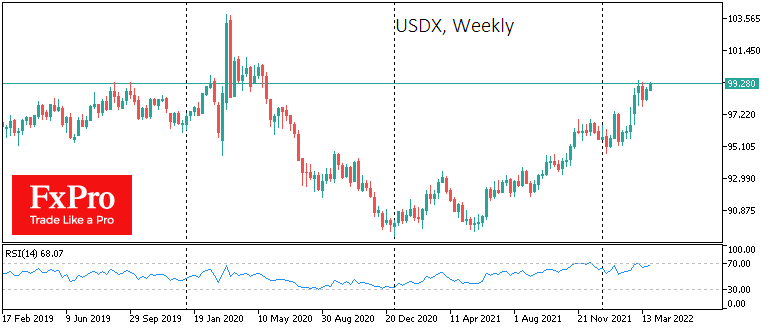
As long as there is no real threat to the existence of the dollar and the solvency of the US government, managers will avoid making active moves to sell dollar assets. And all the revolutionary changes, such as switching to national currencies, will only result in CBs buying fewer new dollars. But it has little effect on the exchange rate.
Right now, we are seeing the opposite picture, as the main competitors are under pressure.
Investors are getting rid of the Japanese yen as the Bank of Japan accelerates its currency printing to buy bonds out of the market to stem rising yields. The local government is overburdened with debt, and the economy is still stalling. The only market solution is a devaluation of the yen, which would make exports from Japan more competitive and boost domestic spending.
The single currency is suffering from a spike in energy prices and economic problems related to the war in Ukraine. Trading below 1.1000, the EURUSD pair is now where it was heading for the last six months before the pandemic.
The medium-term outlook for the dollar is largely influenced by the extent to which the Fed will be able to implement policy tightening. More accurately, how Fed policy compares with the policy of the Bank of Japan, the ECB, or another major central bank.
The Fed is clearly acting with greater amplitude, setting itself up for 7 rate hikes this year, which is far more than one would expect from Japan or the eurozone. Moreover, the US remains much further away from the war in Ukraine in business and trade terms than its biggest competitors, which means it can continue to benefit from capital inflows as a haven.
USD/JPY Mid-Day Outlook
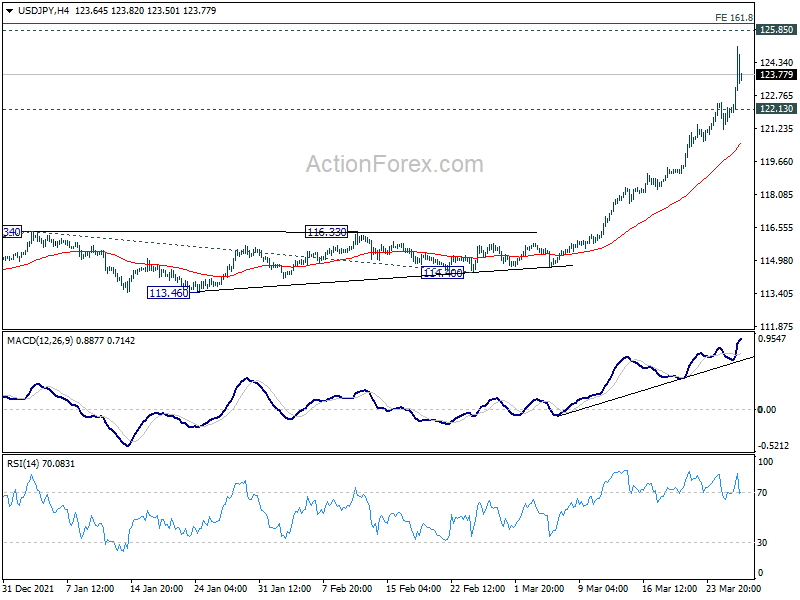
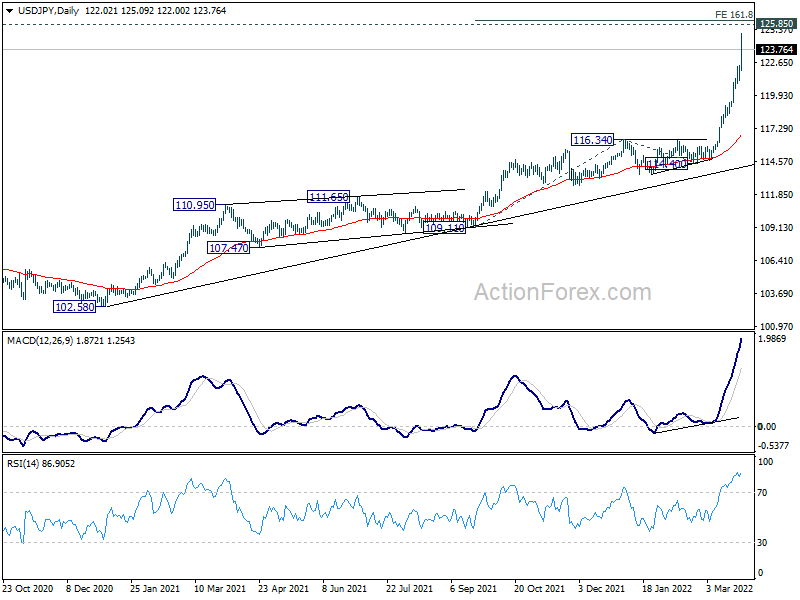
Daily Pivots: (S1) 121.37; (P) 121.90; (R1) 122.63; More...
Intraday bias in USD/JPY stays on the upside at this point. Current up trend should target 161.8% projection of 109.11 to 116.34 from 114.40 at 126.09, which is close to 125.85 long term resistance. On the downside, below 122.13 minor support will turn intraday bias neutral and bring consolidations first, before staging another rally.
In the bigger picture, up trend from 98.97 (2016 low) in in progress for retesting 125.85 (2015 high). Sustained break there will confirm long term up trend resumption. Next target will be 61.8% projection of 75.56 (2011 low) to 125.85 (2015 high) from 98.97 at 130.04. This will now remain the favored case as long as 116.34 resistance turned support holds.
USD/CHF Mid-Day Outlook
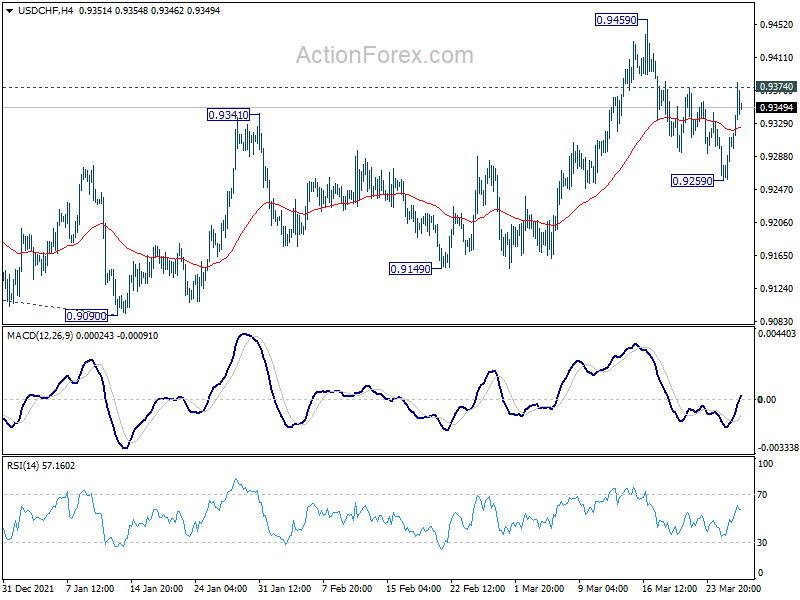
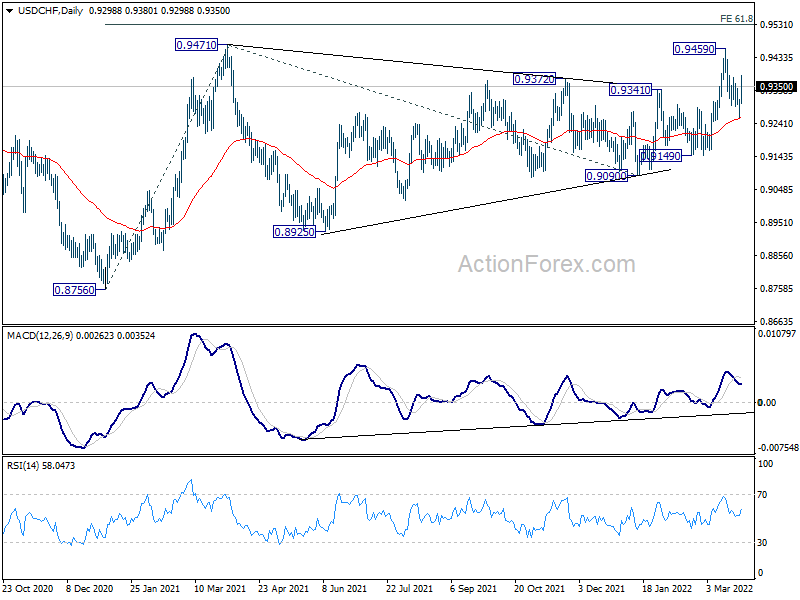
Daily Pivots: (S1) 0.9273; (P) 0.9294; (R1) 0.9327; More....
Intraday bias in USD/CHF remains neutral for the moment. On the upside, break of 0.9374 minor resistance will suggest that the pull back from 0.9459 has completed. Support from 55 day EMA will also retain near term bullishness. Intraday bias will be back on the upside for 0.9459 first. Break will resume the rise from 0.8756 to 61.8% projection of 0.8756 to 0.9471 from 0.9090 at 0.9532. However, sustained break of 55 day EMA (now at 0.9256) will target 0.9149 support.
In the bigger picture, medium term outlook will be neutral at best as long as 0.9471 resistance holds. Larger down trend could still extend through 0.8756 (2021 low). However, firm break of 0.9471 will argue that whole down trend form 1.0342 (2016 high), has completed with waves down to 0.8756. A medium term up trend should be set up to target 1.0237/0342 resistance zone.
EUR/USD Mid-Day Outlook
Daily Pivots: (S1) 1.0964; (P) 1.1001; (R1) 1.1021; More...
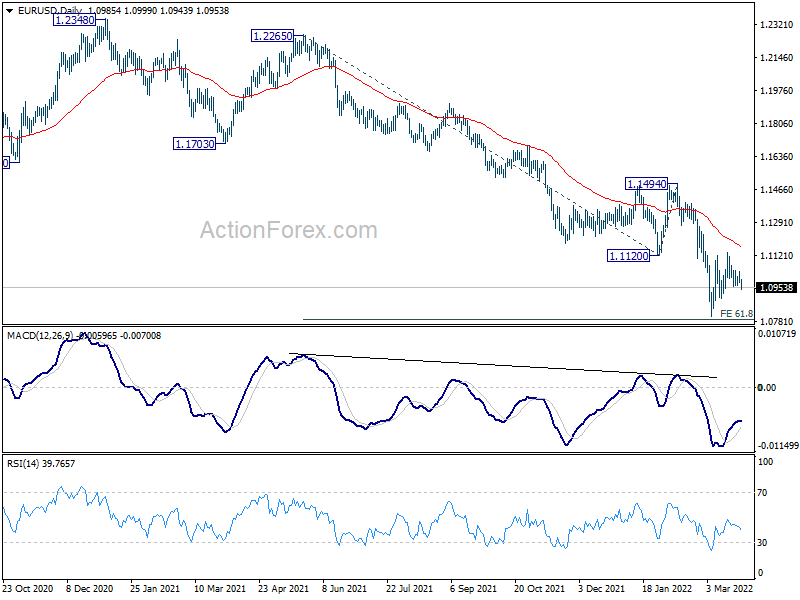
Intraday bias in EUR/USD remains neutral and outlook is unchanged. Further decline is still in favor with 1.1120 support turned resistance intact. On the downside, break of 1.0899 minor support will target 61.8% projection of 1.2265 to 1.1120 from 1.1494 at 1.0786. However, firm break of 1.1120 will confirm short term bottoming at 1.0805. Bias will be back on the upside for 55 day EMA (now at 1.1178) and above.
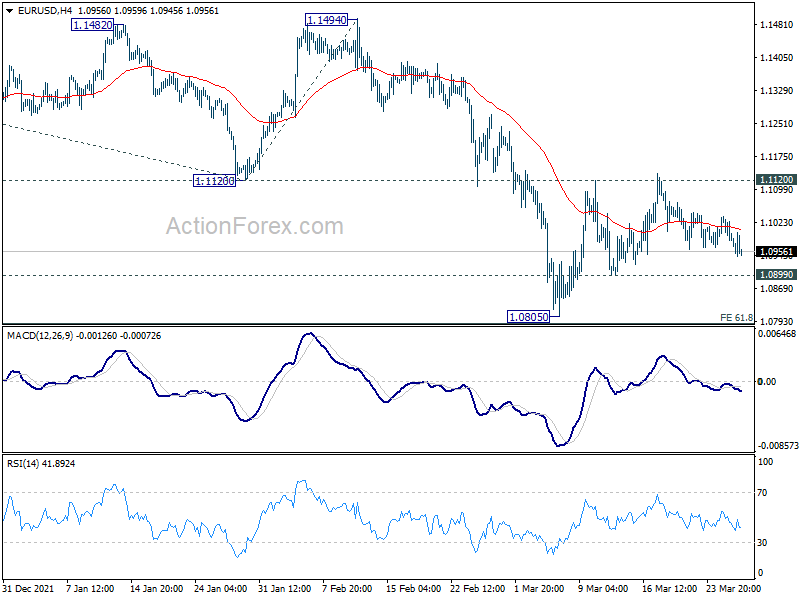
In the bigger picture, the decline from 1.2348 (2021 high) is expected to continue as long as 1.1494 resistance holds. Firm break of 1.0635 (2020 low) will raise the chance of long term down trend resumption and target a retest on 1.0339 (2017 low) next. Nevertheless, break of 1.1494 will maintain medium term neutral outlook, and extending term range trading first.
GBP/USD Mid-Day Outlook
Daily Pivots: (S1) 1.3153; (P) 1.3189; (R1) 1.3219; More...
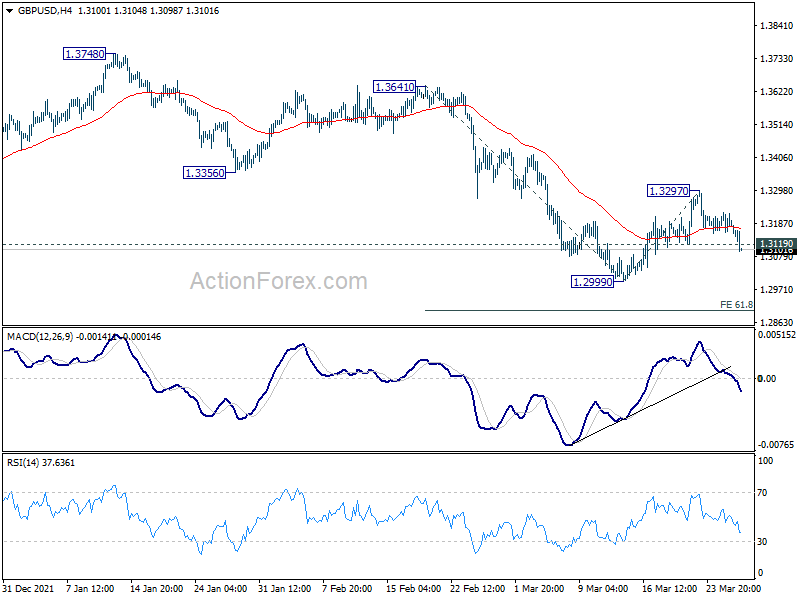
GBP/USD's break of 1.3119 minor support argues that corrective rebound from 1.2999 has completed at 1.3297 already. Failure to hit 55 day EMA keeps near term outlook bearish. Intraday bias is back on the downside for 1.2999 low first. Break will resume larger down trend from 1.4248. Next near term target is 61.8% projection of 1.3641 to 1.2999 from 1.3297 at 1.2900, and then 100% projection at 1.2655. For now, risk will stay on the downside as long as 1.3297 resistance holds, in case of recovery.
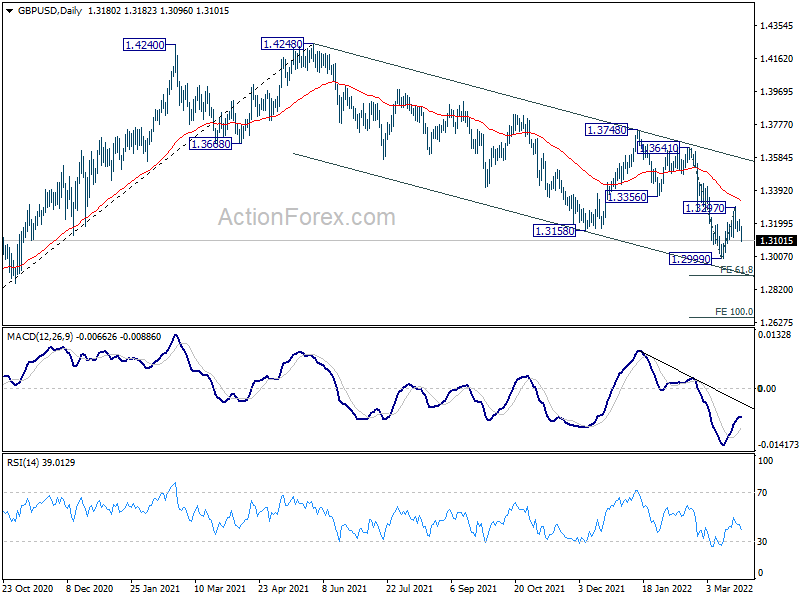
In the bigger picture, current development suggests that the up trend from 1.1409 (2020 low) has completed at 1.4248. Decline from 1.4248 could still be a corrective move, or it could be the start of a long term down trend. In either case, deeper decline would be seen back to 61.8% retracement of 2.1161 to 1.1409 at 1.2493. In any case, break of 1.3748 resistance is needed to indicate medium term bottoming, or outlook will stay bearish.
Selling Focus Turns to Sterling as Yen Digests Losses
Yen remains the weakest one today, but there is some short covering as global benchmark treasury yields also retreat. Selling focus is turning Sterling instead. For now, Aussie and Dollar are the strongest one for the day, followed by Canadian. Euro is mixed, helped by recovery against Swiss Franc. Gold recovers quickly after initial dip and it's struggling to get a clear direction. WTI oil is trying to defend 110 handle.
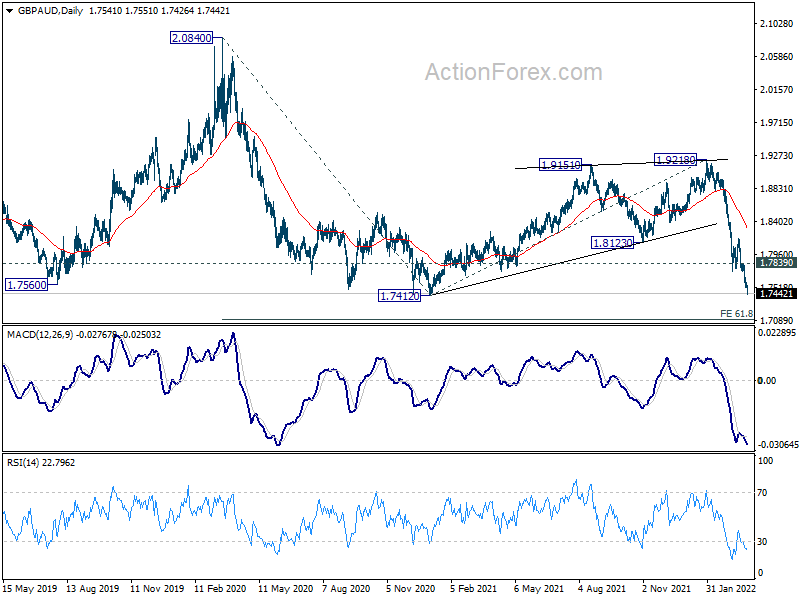
Technically, GBP/AUD is breaking through 1.7412 low to resume the down trend from 2.0840 (2020 high). Near term outlook will stay bearish as long as 1.7839 resistance holds. Next medium term target is 61.8% projection of 2.0840 to 1.7412 from 1.9218 at 1.7099. GBP/USD might also trying to catch up and break through 1.2999 near term support to resume larger down trend.
In Europe, at the time of writing, FTSE is up 0.43%. DAX is up 1.41%. CAC is up 1.34%. Germany 10-year yield is down -0.019. Earlier in Asia, Nikkei dropped -0.73%. Hong Kong HSI rose 1.31%. China Shanghai SSE rose 0.07%. Singapore Strait Times rose 0.54%. Japan 10-year JGB yield rose 0.0196 to 0.260.
US exports rose $1.9B in Feb, imports rose $0.9B
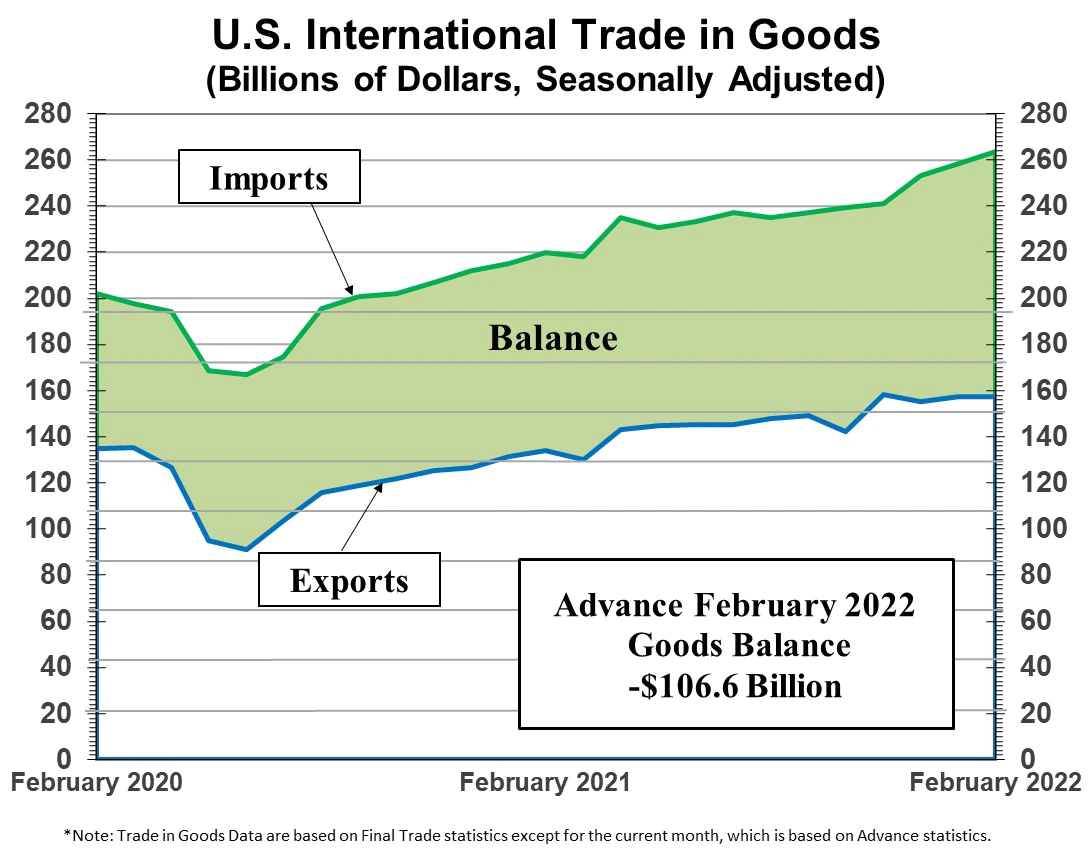
US exports of goods rose USD 1.9B to USD 157.2B in February. Imports of goods rose USD 0.9B to USD 263.7B. Trade deficit narrowed from USD -107.6B to USD -106.6B, still larger than expectation of USD -106.0B.
Wholesales inventories rose 2.1% mom to USD 814.7B. Retail inventories rose 1.1% mom to USD 665.6B.
BoE Bailey: Takes time to properly assessment join experience of COVID and Ukraine
BoE Governor Andrew Bailey said today, the forward guidance language was "very cautious" because of the high uncertainty. And it will take time to properly assessment how the "joint experience of COVID and Ukraine invasion causes world economy to emerge into new steady state."
"Liquidity conditions have deteriorated in many commodity markets, margining costs have risen, which is of course a reflection of much higher volatility and risks in these markets," he said. "We can't take resilience, in particular in that part of the market, for granted. There's a strong need to work together on this," he said.
Bailey added that he's starting to see evidence of an economic slowdown in business and consumer surveys. "We expect that this pressure on demand will weigh down on domestically generated inflation, other things equal at the moment," he said.
GBP/USD Mid-Day Outlook
Daily Pivots: (S1) 1.3153; (P) 1.3189; (R1) 1.3219; More...
GBP/USD's break of 1.3119 minor support argues that corrective rebound from 1.2999 has completed at 1.3297 already. Failure to hit 55 day EMA keeps near term outlook bearish. Intraday bias is back on the downside for 1.2999 low first. Break will resume larger down trend from 1.4248. Next near term target is 61.8% projection of 1.3641 to 1.2999 from 1.3297 at 1.2900, and then 100% projection at 1.2655. For now, risk will stay on the downside as long as 1.3297 resistance holds, in case of recovery.
In the bigger picture, current development suggests that the up trend from 1.1409 (2020 low) has completed at 1.4248. Decline from 1.4248 could still be a corrective move, or it could be the start of a long term down trend. In either case, deeper decline would be seen back to 61.8% retracement of 2.1161 to 1.1409 at 1.2493. In any case, break of 1.3748 resistance is needed to indicate medium term bottoming, or outlook will stay bearish.
Economic Indicators Update
| GMT | Ccy | Events | Actual | Forecast | Previous | Revised |
|---|---|---|---|---|---|---|
| 12:30 | USD | Goods Trade Balance (USD) Feb P | -106.6B | -106.0B | -107.6B | |
| 12:30 | USD | Wholesale Inventories Feb P | 2.10% | 1.30% | 0.80% | 1.10% |
US exports rose $1.9B in Feb, imports rose $0.9B
US exports of goods rose USD 1.9B to USD 157.2B in February. Imports of goods rose USD 0.9B to USD 263.7B. Trade deficit narrowed from USD -107.6B to USD -106.6B, still larger than expectation of USD -106.0B.
Wholesales inventories rose 2.1% mom to USD 814.7B. Retail inventories rose 1.1% mom to USD 665.6B.
BoE Bailey: Takes time to properly assessment join experience of COVID and Ukraine
BoE Governor Andrew Bailey said today, the forward guidance language was "very cautious" because of the high uncertainty. And it will take time to properly assessment how the "joint experience of COVID and Ukraine invasion causes world economy to emerge into new steady state."
"Liquidity conditions have deteriorated in many commodity markets, margining costs have risen, which is of course a reflection of much higher volatility and risks in these markets," he said. "We can't take resilience, in particular in that part of the market, for granted. There's a strong need to work together on this," he said.
Bailey added that he's starting to see evidence of an economic slowdown in business and consumer surveys. "We expect that this pressure on demand will weigh down on domestically generated inflation, other things equal at the moment," he said.