

Sample Category Title
Euro Looking for Direction
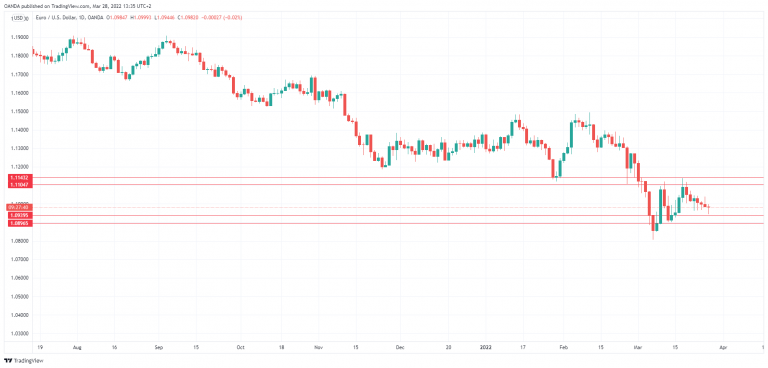
The euro has shown limited movement over the past several days and that trend has continued on Monday. EUR/USD is almost unchanged, trading at 1.0985 in the European session. There are no eurozone releases on the calendar today and only minor events out of the US, so I expect an uneventful Monday session.
The Ukraine conflict continues to be a key driver for the euro, with the war on the doorstep of Western Europe. There haven’t been many developments of late, with a stalemate between the Russian and Ukraine armies. The biggest headline over the weekend was President Biden’s (mis)statement that President Putin “cannot remain in power”. US officials quickly explained that Biden didn’t mean that Putin should be removed from office, but that Putin shouldn’t exercise power over his neighbors. It sounds like damage control to me, as Biden’s comments were quite clear, but in the extremely unstable situation in Ukraine, US officials don’t want to escalate matters with Putin. This is a relief for the Europeans, who are on board with severe sanctions against Moscow but are at the same time dependent on Russian energy imports.
The war in Ukraine is weighing on the German economy, the bellwether of the eurozone. Germany’s recovery is in danger of being derailed by the surge in energy prices and possible disruptions in natural gas imports from Russia. The emergence from Covid has resulted in supply chain disruptions, which will only worsen with a war being waged in Europe.
Germany could report a contraction in growth in the first quarter, which would mean that technically the country is in recession since Q4 showed negative growth. If Germany continues to post weak numbers, it will weigh on the eurozone and on the euro, which has declined by 2% in the month of March.
EUR/USD Technical
- EUR/USD has support at 1.0940, followed by 1.0896
- There is resistance at 1.1049, followed by 1.1114
Dollar Yen – Up, Up and Away
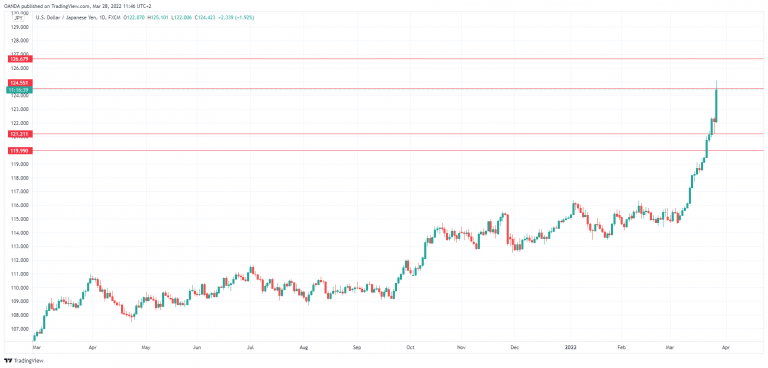
The misery continues for the Japanese yen, which has plummeted at the start of the week USD/JPY is trading at 124.62 in the European session, up 2.06%.
BoJ move sinks yen
USD/JPY broke above the symbolic 125 line in the European session, as the yen is seeing all red today. The yen was hammered after the BoJ rushed to defend its yield target today, making two offers to buy unlimited 10-year JGBs at 0.25%, an implicit ceiling for 10-year bonds. The Bank’s unusual move to intervene in order to maintain its ultra-accommodative policy has pushed the yen to its lowest level since August 2015.
The yen has plunged in March, with USD/JPY soaring 8.45%. The weakening currency is adding to inflation by making imports more expensive, which could make it difficult for the BoJ to continue trying to cap yields at ultra-low rates. The yen has been walloped by the US/Japan rate differential, which continues to widen. US Treasury yields remain on an upswing, with the 10-year yield inching higher to 2.50% today.
Aside from the Bank of Japan, another key player which is monitoring the yen’s movement is the Ministry of Finance (MOF). On Friday, in an attempt to shore up support for the woozy yen, Minister of Finance Suzuki said that “Exchange-rate stability is important, and sharp volatility is undesirable.” No doubt that Suzuki is in a sour mood on Monday, with the yen extending its slide against the dollar.
Will the MOF become more forceful if the yen continues to weaken? The MOF is uncomfortable with the yen’s sharp downswing, and a BofA note on Monday said that if the yen falls below 125, the ministry could warn speculators against intervention. If USD/JPY breaks above 1.30, there is the possibility of actual intervention by the MOF, according to BofA.
USD/JPY Technical
- 124.55 is a weak resistance line. Above, there is resistance at 1.2666
- There is support at 121.21 and 119.98
EURUSD Continues to Slide as Positive Hopes Fade
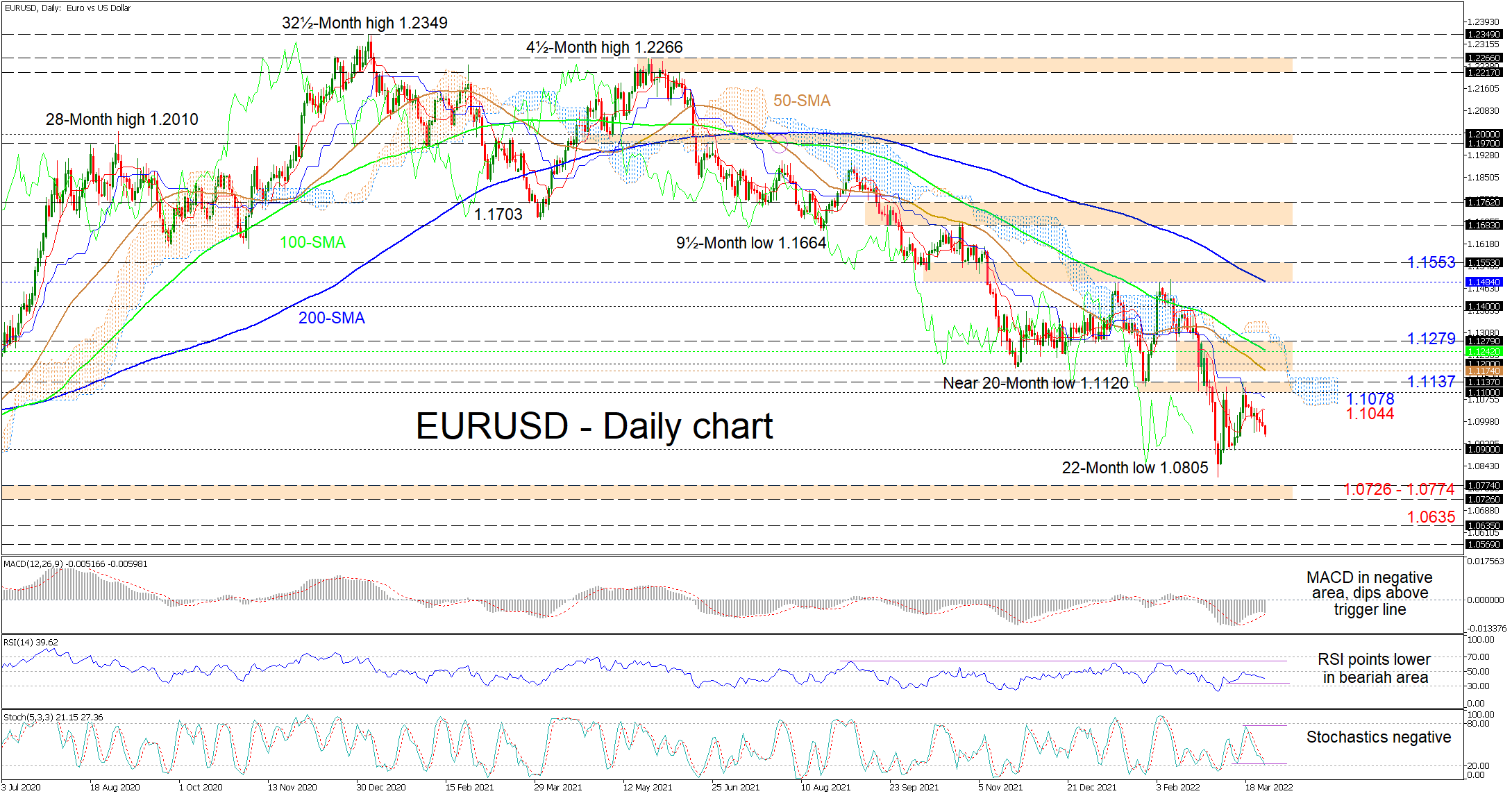
EURUSD is edging lower toward the 1.0900 handle after bullish developments in the pair were unable to overpower the 1.1100 hurdle. The falling simple moving averages (SMAs) are endorsing the 10-month bearish trend from the May 2021 high of 1.2266.
Currently, the Ichimoku lines indicate that bearish forces remain active, while the short-term oscillators are skewed to the downside. The MACD is south of the zero threshold and looks set to return beneath its red trigger line, while the RSI is gliding towards the 30 oversold level. Moreover, the negatively charged stochastic oscillator is promoting additional downward price action in the pair.
To the downside, preliminary support could occur at the 1.0900 border, while moving lower, the 22-month trough of 1.0805 may contest sellers’ efforts to uphold the decline. For sellers to resuscitate the broader descent, downward pressures would need to not only crush the key 1.0805 trough, but subsequently the 1.0726-1.0774 support barrier, linked to the April until mid-May 2020 area of lows. Should the pair surrender extra ground, the critical 1.0635 bottom resulting from the March 2020 collapse could then draw traders’ attention.
On the other hand, if buying interest picks up, resistance could originate from the nearby Ichimoku lines at 1.1044 and 1.1078, along with the neighbouring 1.1100-1.1137 resistance band. Nonetheless, should buyers’ triumph, a successive tough region of resistance from the 50-day SMA at 1.1174 until the 1.1279 obstacle may prove to be more challenging for buyers to surpass. However, successfully piloting above the cloud, the bulls could then jump towards the 1.1400 boundary before eyeing the 1.1484-1.1553 resistance border.
Summarizing, EURUSD is sustaining a sturdy bearish bias below the 1.1100-1.1137 hurdle and the SMAs. A dive beyond the 1.0726-1.0774 barricade is likely to renew strong negative tendencies. Meanwhile, a climb in the price extending past the 1.1279 barrier may inject some optimism in the pair.
EUR/USD Looks Down for a Bottom: Elliott Wave analysis
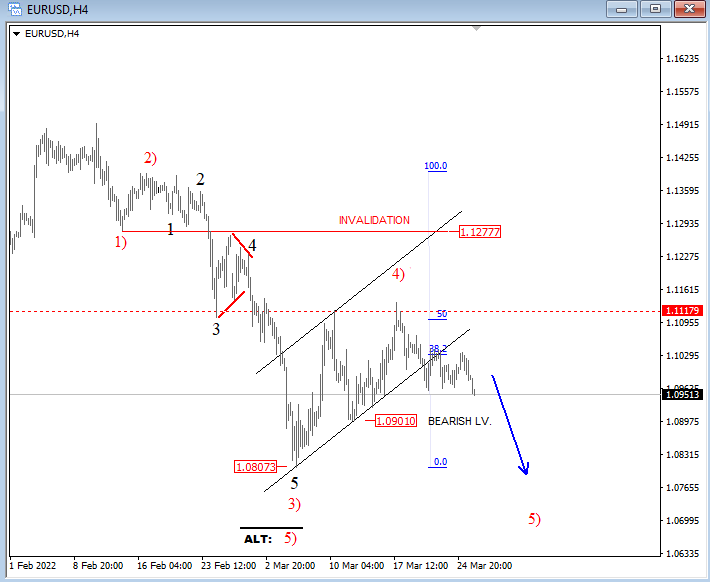
Welcome back to the new trading week, which may stay volatile due to the situation in Ukraine, EU inflation data, and US jobs figures on Friday. We see 10 years US notes still trading lower, now in the fifth wave of five so DXY can be finally breaking out from a triangle and towards 100. Keep in mind that this move on DXY can be final within a higher degree uptrend, so at some point, the price will stop at resistance, ideally later this week.
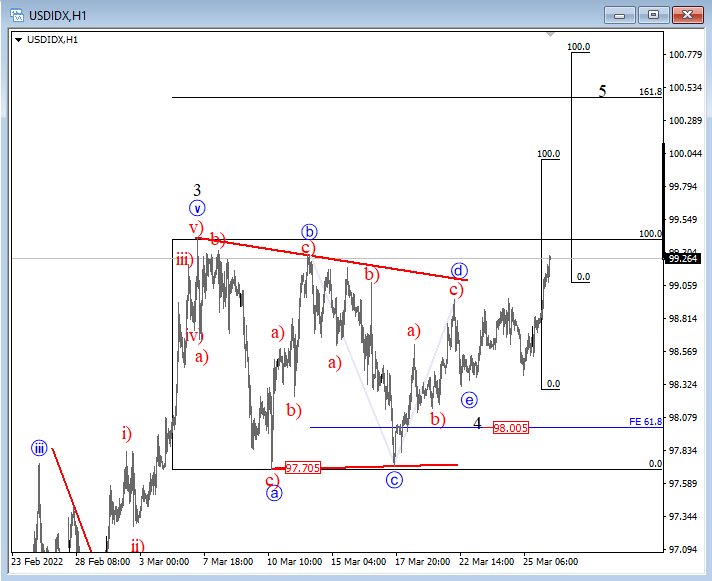
EURUSD found some support recently, but move from the low is not in five waves for now, so we are still tracking a higher degree downtrend, currently with a pause that appears like a wave 4), now zigzag back to 50% Fib resistance from where price came down at the end of the week. So ideally, the pair is making now another turn south for wave 5).
EUR/USD 4h Elliott Wave analysis
Bitcoin and Other Altcoins Rise as Momentum Accelerates
The price of crude oil continued rising on Monday morning as the war of words between the US and Russia escalated during the weekend. In a speech, Joe Biden said that Putin cannot remain in power and called him a butcher. The State Department walked back the statement and said that it was not calling for a regime change in the country. It said that such a decision will only be made by Russians. Still, analysts believe that such claims will only worsen the situation in Ukraine, which will lead to lower oil supplies. Some oil traders have already started halting purchases from the Russian market.
American futures tilted higher even as risks to the market continued. The main indices have already risen in the past two straight weeks and are approaching their year-to-date highs. This performance comes even as the Federal Reserve embraces a more hawkish tone. In statements last week, analysts at Citigroup and Bank of America warned that they see the bank delivering several 50 basis points this week. Some of the top stocks to watch this week will be Xpeng, Micron, Jefferies, Five Below, and Walgreens Boots Alliance.
Cryptocurrency prices continued rising during the weekend as demand from investors kept rising. Bitcoin rose above $47,000 while Ethereum jumped above $3,000. The total market cap of all digital currencies rose to over $2.2 trillion. There are some catalysts for this price action. For example, there are signs that many Russians are turning to Bitcoin. Last Friday, there were also rumours that the Russian economy will start accepting BTC for natural gas and oil purchases.
XBRUSD
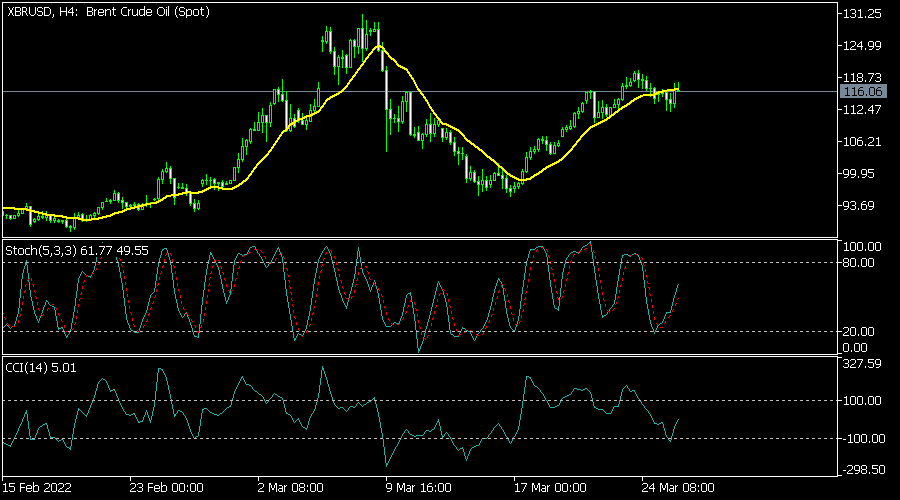
The XBRUSD pair maintained a bullish trend on Monday morning as concerns about demand remained. It is trading at 116, which is sharply higher than where it started the year. It has moved above the 25-day and 50-day moving averages while the MACD and the Stochastic Oscillator have pointed upwards. Therefore, the pair will likely keep rising as bulls target the next key resistance level at 120.
EURUSD
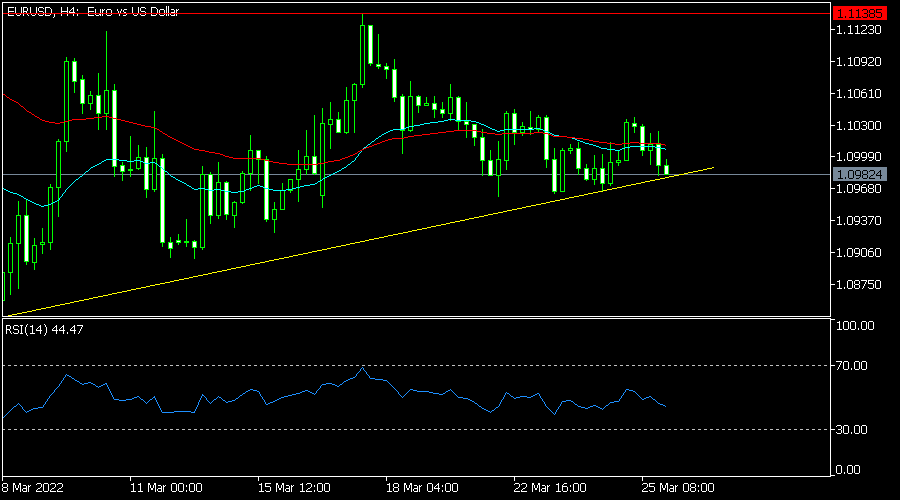
The EURUSD pair has been under intense pressure in the past few days. It is trading at 1.0982, which is significantly lower than this month’s high of 1.1138. The pair has moved slightly below the 25-day moving average and is along the ascending trendline shown in yellow. The Relative Strength Index (RSI) has pointed lower. Therefore, the pair will likely keep falling as bears target the next key support at 1.0900.
USDCAD
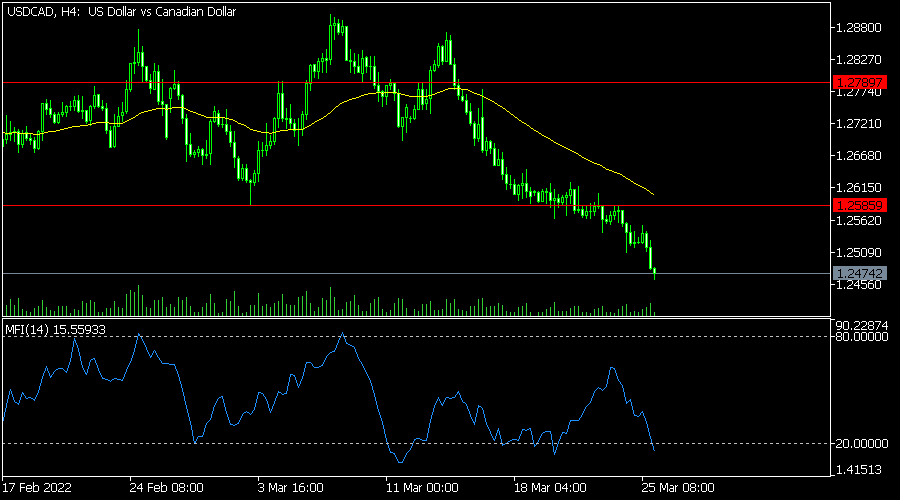
The USDCAD pair has been in a strong bearish trend and is now trading at the lowest level since January 18. The pair has moved below the 25-day and 50-day moving averages while the Relative Strength Index (RSI) has moved below the oversold level. It has also moved below the important support level at 1.2585, which was the lowest level in March. Therefore, the pair will likely maintain the bearish momentum on Monday.
Are Bond Markets Predicting a Recession?
Investing in 2022 has proved to be challenging for many investors. Inflation has been skyrocketing in almost all developed and emerging economies, central banks are racing towards raising interest rates, China continues to impose lockdowns to contain surging Covid-19 cases, and no one seems to know when and how the Ukrainian conflict will end. These factors combined have led to sharp selloffs in equity and bond markets, wiping trillions of dollars from the financial system.
However, many investors have seen the steep selloff in stocks as an opportunity to buy again at reasonable valuations. After falling by almost 15% from its record high, the S&P 500 is now up 10.4% from its February trough and the Nasdaq Composite has rallied 12.6% over the past two trading weeks.
Investors are now challenged by the latest inversion of part of the US yield curve for the first time since 2006. The 5-year / 30-year Treasury yield spread has turned negative following the inversion of the 5-year / 10-year spread earlier this month. Futures markets are now anticipating an increase in interest rates by 218 basis points by year-end, suggesting nine 25-basis point rate hikes over the next six FOMC policy meetings. That alone explains a lot of the movement in US bond yields as the shorter end reflects the trajectory in monetary policy, and the longer end reflects economic growth expectations.
When yield curves begin to invert, it's usually a signal that investors have lost their confidence in the economic recovery story and are now preparing for a slowdown or possibly a recession over the next few quarters. The only reason you’d buy a long-term bond at a lower yield than a short-term one was if you thought yields were going to fall.
However, the US Federal Reserve has also played an essential role in the shape of the curve as it bought massive amounts of Treasuries during its bond-buying program, keeping the longer end of the curve under pressure. The 3-month / 10-year yield curve is at its steepest level since early 2017, and this tells us a different story.
The shape of the curve is likely to change when the Federal Reserve begins shrinking its balance sheet, so we could likely see steepening of the curve all over again in the upcoming months. While the risks of a recession have increased, it's not likely to be a 2022 story but rather one that takes place in 2023 or 2024. So, investors need to ignore the noise in bond markets and keep focusing on economic fundamentals and corporate earnings which so far remain solid.
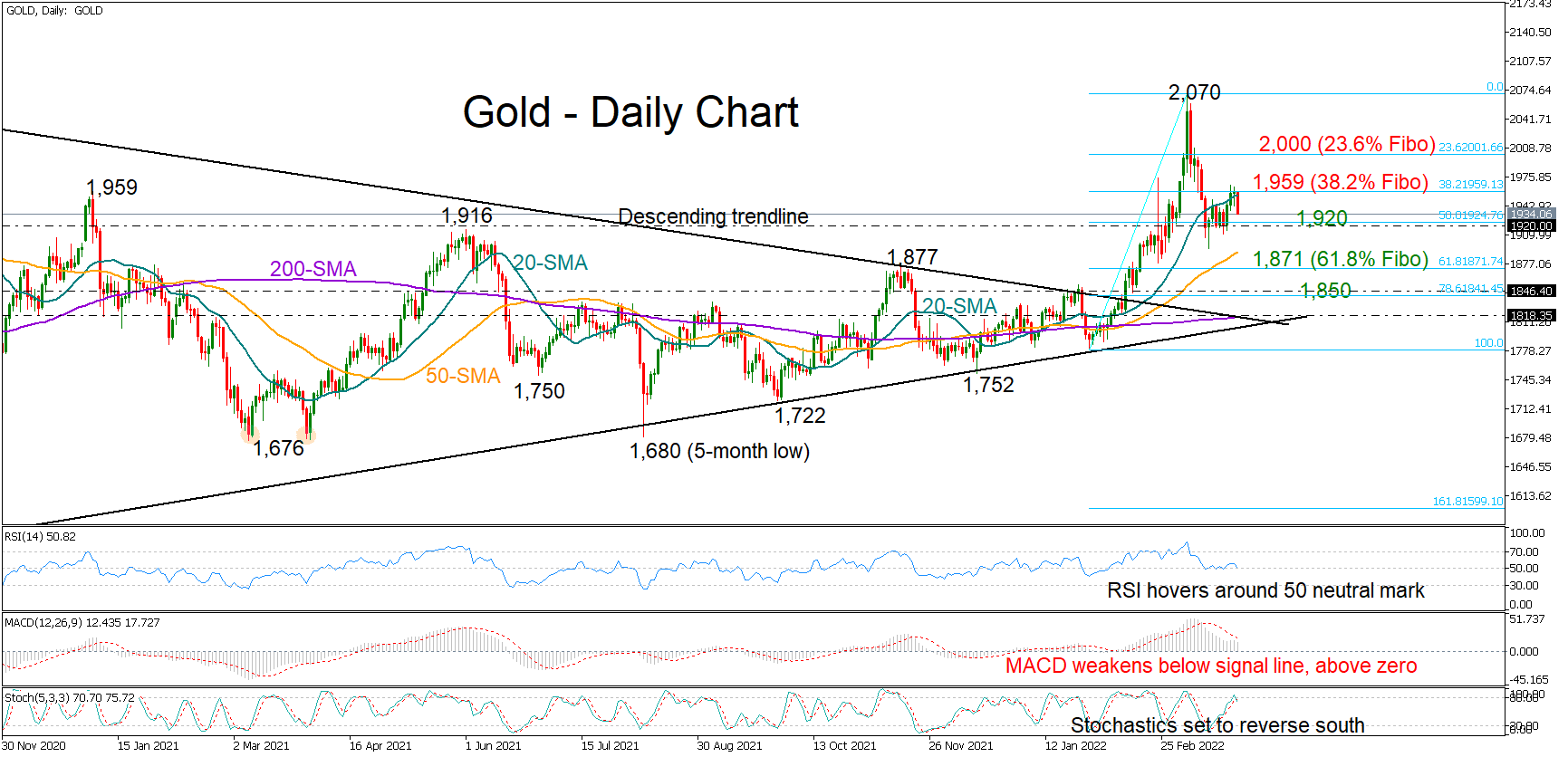
Gold Loses Steam Near 1,959 Resistance; Bias Neutral-to-Bearish
Gold could not find enough buyers to cross the key resistance of 1,959 last week, with the price tumbling to 1,933 early on Monday.
The short-term bias is looking neutral-to-bearish as the RSI keeps fluctuating around its 50 neutral mark. The Stochastics have lost steam and are set for a downside reversal, while the MACD remains negatively charged between its signal and zero lines.
If sellers manage to breach the 1,920 floor, where the 50% Fibonacci retracement of the 1,780 – 2,070 upleg happens to be, the spotlight will immediately turn to the 50-day simple moving average (SMA) at 1,890. The 61.8% Fibonacci level of 1,870 is within breathing distance and may delay any declines towards the 1,850 handle.
Alternatively, for bullion to touch the crucial 2,000 number, upside pressures will need to successfully speed above the 1,959 bar. If the aforementioned levels prove easy to overcome, the bulls may attempt to print fresh record highs above the 2020 top of 2,079. In this case, the 161.8% Fibonacci extension of the latest downfall at 2,178 will be closely watched.
Summarizing, the precious yellow metal has started the week on the back foot, but the nearby support of 1,920 is still intact. A clear close below that base could strengthen selling tendencies.
US Dollar Rises in Asia
Yen, euro start week with losses
The US dollar moved sideways in New York on Friday, the dollar index finishing almost unchanged at 98.80. However, with the Bank of Japan standing in the JGB market today to cap rises in yields the dollar index has risen sharply, boosted by a weaker yen and euro. The dollar index is 0.33% higher at 99.13. In the bigger picture, 99.50 and 97.75 remain the levels to watch.
USD/JPY has surged 0.80% higher to 123.05 this morning, a 100 point gain. Short of a spectacular reversal lower by US yields, USD/JPY is now on track to retest 125.00, potentially this week, with the BOJ having now shown its hand. Attempts by Japanese officials to talk down USD/JPY will have a short-lived impact and are likely to be dips to buy.
The Biden, Putin must go, rhetoric over the weekend is weighing heaving on the euro today as it sparks fears of wider escalation from Russia. EUR/USD has fallen 0.30% to 1.0950, and rallies above 1.1000 are going to be challenging to sustain at the start of the week. The fall today leaves EUR/USD mid-range between longer-term support at 1.0800, and resistance at 1.1150.
Weak Retail Sales data weighed on GBP/USD into the end of the week, and it has moved lower in sympathy with the euro today. GBP/SD has fallen 0.25% to 1.3145, mid-range between major support/resistance at 1.3000 and 1.3300.
AUD/USD and NZD/USD continue defying a stronger US dollar as markets price in a faster pace of rate hikes on both, and commodity prices remain in space. Also helping is a relatively quiet Ukraine news ticker, reducing risk aversion sentiment for now. Both currencies continue to consolidate at the top of their ranges, at 0.7325 and 0.6950. A rise through 0.7550 and/or 0.7000 signals more gains ahead.
Asian currencies are modestly weaker across the board today as USD/JPY soars, amid worries about a covid slowdown in China. In the bigger picture, rising US interest rates and soaring commodity prices will weigh on Asian currencies. As we start the week though, Asian currencies prefer to wait for directional inputs from the northern hemisphere heavyweights.
Shanghai Surprise
It seems appropriate on Oscar’s day that one of the worst films ever made according to critics, Shanghai Surprise, is also dominating Asian markets today. In what was really not much of a Shanghai surprise, Chinese authorities announced over the weekend that Shanghai the city, would enter a two-stage lockdown to stymie surging covid cases and allow mass testing. Half of the city will lockdown from today through to April 1st. The other half will lockdown from April 1st through to April 5th.
As China’s financial centre and an economic powerhouse in its own right, the impact has been immediate. Tesla has halted production at its factory there and other major manufacturers are sure to follow. Mainland China equity markets have fallen today along with Taipei which has a high manufacturing beta to the region. The impact on growth and consumption had also seen oil prices, at least temporarily, sink by around 2.0%.
That has drowned out an improved China Industrial Profits number that was released over the weekend. Industrial Profits for a combined January and February rose by 5.0% YoY, an improvement on December’s 4.0%. Dig below the surface though, and the gains were concentrated, unsurprisingly, in the energy and raw materials sectors.
Additionally, it looks like China’s third-largest property developer missed two bond payments on Friday. This soft underbelly of the China economy has been shifted from the front pages by the Ukraine conflict but hasn’t gone away. The cost-push inflation from the Russian sanctions won’t make the sector any more appealing. China still has work to do on the stimulus front, despite its obvious reluctance to do so. RRR and LPR rate cuts, and a weaker yuan, should be on the way, especially as China’s attempt to jawbone the stock market higher two weeks ago has quickly run out of steam.
Friday’s main data points haven’t done much to dispel economic nerves around inflation dampening demand, or the downstream effects of the Ukraine conflict. UK Retail Sales and Germany’s IFO both missed badly to the downside. US Pending Home Sales slumped by 4.10% versus a 1.0% gain expected. Michigan Consumer Expectations for March also eased to 54.3. They say the best cure for high prices is high prices. Be that the cost of goods or rising mortgage rates. It seems that the signs of that are increasing while inflation shows no sign of abating. Unsurprisingly, the US yield curve moved higher again on Friday. Even more surprisingly, US equities recorded modest gains. You must think one of them has to lose eventually, I know which one my money is on.
The news stream around the Ukraine conflict was relatively light over the weekend, allowing markets to temporarily focus on fundamentals. The main headlines surrounded President Biden saying President Putin had to go. That was greeted by European allies’ face-slapping as they try to negotiate the delicate nuances of not escalating an already very unstable situation on their doorstep. US officials have gone to great lengths to walk back those comments, and the market impact has been limited.
One thing that is moving today in Asia is USD/JPY, which has shot 0.70% to 122.90 this morning. As one of the few dovish central banks left in the world, the Bank of Japan placed an unlimited offer to buy 10-year JGBs at 0.25% this morning, capping yields as they move to the top of the BOJ’s acceptable rate corridor. We can expect some more “watching forex moves closely” comments as well, but I expect their impact to be much less potent than last week. Japan and the USD/JPY are a microcosm of the stresses much of Asia will face this year, with the propensity to tighten monetary policy with the US very low.
The heavy-weight data releases this week are skewed towards the end of the week. We have Australian Retail Sales and US JOLTS Jobs Openings tomorrow and German Inflation on Wednesday. Asia’s highlight will be the release of China’s official Manufacturing and Non-Manufacturing PMIs on Thursday, with the Caixin PMIs on Friday. Thursday also features US Personal Income and Spending before we hit US Non-Farm Payrolls on Friday, with the early betting on a 475,000 gain. I don’t know about you, but the Non-Farms seems to have come around again very quickly.
I’ll be watching the US bond market this week, and another strong US Non-Farms is likely to spark more upside pain for yields. The China covid situation and the Ukraine conflict will keep the news tickers busy, as will more Talking Heads than Stop Making Sense from the Federal Reserve.
Bank of Japan Offered to Buy Unlimited Amount of 10-Y Government Bonds
Markets
The Interfax report on Friday suggesting Russia may be refocusing on the “complete liberation of Donbas” caused yet another sharp core bond selloff. Markets believe such de-scaling of the conflict to the eastern regions of Ukraine is the first step in ending it. This would ultimately result in less economic uncertainty and allow central banks to push through with policy normalization.
It explains the hefty bear flattening in both the US and Europe. US yields jumped 4.6 bps (30y) over 13.2 bps (2y) to 14.7 bps (5y). German/European yields added between 2.5-8.5 bps. US stocks fell initially but staged a comeback throughout the session. The S&P 500 and DJI managed a close of about 0.5% in the green. Oil prices rose with Brent crude sticking near $120/b after Europe announced a deal with the US that allows the continent to cut reliance on Russian fossil energy (a little).
The US dollar wasn’t in great shape but held the upper hand against the euro still. EUR/USD headed into the weekend below 1.10. EUR/GBP closed marginally lower at 0.833. The Japanese yen recouped a tad of the whopping losses in recent weeks in a move that didn’t convince anyone. USD/JPY and EUR/JPY still closed above 122 and 134 respectively and surge further this morning. USD/JPY (123.12) is closing in on the 2015 high (125.86).
The Bank of Japan announced unlimited bond buying this morning (see below), in an increasingly contrasting move with other central banks to keep policy as easy as possible. Japanese yields continue to rise nevertheless, as do core (US) bonds.
The short end adds another 10bps+ with more segments of the US yield curve inverting (30s5s for the first time since 2006). US money markets expect well more than 200 bps of additional tightening by year-end in the meantime. The peak policy rate is slowly being pulled forward in time (now 2H2023).
Overall risk sentiment is fragile, more so than on Friday, allowing the greenback this time to bank on yield support. EUR/USD eases further south to 1.095. The trade-weighted dollar rises to YtD highs at 99.21.The economic calendar this week is particularly backloaded with, amongst others, payrolls and ISM business confidence for the US and European inflation figures both due on Friday. Speeches by Bank of England governor Bailey and UK’s finance minister Sunak (in the wake of the spring budget) are worth mentioning for today.
Our main attention goes to the development of Asian market trends going into European dealings though. The European 10y swap yield is attacking the 2018 high of 1.192%. In case of a break, the 2015 (intraday) high is not that very far off (1.37%). The US 10y yield takes out 2.50% and is already looking at resistance of 2.56% (76.4% recovery of the 2018-2020 decline). The combo of a vulnerable equity sentiment with monetary policy frontrunning in theory gives the advantage to the USD.
News Headlines
The Bank of Japan this morning offered to the buy an unlimited amount of 10-y government bonds to cap the yield of the bonds at 0.25%. The bank took a similar fixed rate buying operation on February 14. The BoJ under its yield curve control wants to keep the 10-y near 0.0% with a deviation allowed up to 25 bps. For now the action had hardly any downward impact on yields. The offer comes after BoJ’s Kuroda pledged that, contrary to several other major central banks, the BoJ wants to keep an easy monetary policy even as inflationary risks are building. The BoJ is allowing more flexibility in yields of bonds with a longer maturity than 10-y. The 30-y yield this morning is testing the 1.0% barrier, the highest level in more than six years.In a speech Bank of Canada (BoC) deputy governor Sharon Kozicki indicated that the bank is prepared to act forcefully to bring inflation back to target. "Inflation in Canada is too high, labor markets are tight and there is considerable momentum in demand", Kozicki was quoted. In this context, she expects ‘the pace and magnitude of interest rate increases and the start of QT to be active parts of our deliberations at our next decision in April’. The hawkish comments are also raising expectations that the BoC could move to steps of 50 bps rate hikes at one of the coming meetings. The 10-y Canadian government bond yield on Friday jumped 15 bps to reach 2.55%. The 2-y yield jumped 20 bps to 2.35%.