

Sample Category Title
Sunset Market Commentary
Markets
Europe’s aspiration to cut reliance on Russian fossil energy by two-thirds end 2022 and almost completely by 2024 became a little bit more concrete today. The continent announced an agreement with the US under which Europe will receive at least 15 billion cubic meters of additional LNG supplies. That amount may go up to 50bn by 2025, when new projects are scheduled to come online, until at least 2030. For now, the extra 15bn would only replace Russian LNG flows though while the country also ships about 150bn cubic meters of gas to Europe every year. The decision is thus politically symbolic more than something else. Yet, oil and gas prices do decline. Brent eases 2% to $117/b, Dutch gas futures lose 6% to €106/MWh. European stock markets are in slightly better shape today. They erased opening losses to trade about 0.8% higher. US stocks trade 0.6% higher with the Nasdaq underperforming (flat) after US/core bond yields suddenly spiked higher. Press agency Interfax reported the Russian “forces will focus on the main thing – the complete liberation of Donbas”. Markets took it as a hint Russia may be backing away from taking over other pieces of Ukraine. Such de-escalation of the conflict may ultimately result in a less cloudy economic outlook, allowing central banks to move ahead with normalization without looking back. US money markets all but price in 200 bps additional tightening by year-end. This would align with two 50 bps hikes in May and June, followed by four regular 25 bps hikes at each of the remaining policy meeting. US yields add 9 to 14 bps in a bear flattener. The report also sharpened ECB expectations, though less intense. European swap yields add 4-5 bps across the curve. A first full hike is priced in for September with a second one discounted for December.
Rising US/EMU interest rate differentials fail to support the dollar. The resilient risk climate helps EUR/USD to keep the 1.10 dry although we must admit it looks vulnerable. USD/JPY almost completely retraced morning weakness (down one big fig) to trade near multi-year highs of 122.1. EUR/CHF tested 1.02 but prevented a break lower even as the SNB yesterday signaled not to be in a hurry for FX interventions. Sterling’s weakness after disappointing retail sales this morning didn’t last. EUR/GBP is trading only marginally higher at 0.834. Central-European currencies enjoy some risk-on bids. The forint (EUR/HUF down to 373.85) and the zloty (EUR/PLN 4.73) outperform the Czech koruna (EUR/CZK 24.66). Most of today’s gains occurred before the Interfax story though – its impact was contained to rates markets.
News Headlines
Belgian business confidence as published by the National Bank of Belgium declined for the fourth consecutive month from 2.3 in February to 0.4 this month. However, according to the assessment of the NBB: ‘the current context does not seem to be weighing too heavily on confidence in the business world. The decline in the business barometer that began last December has gained momentum, although still only moderate’. The sharpest loss of confidence was registered in the trade sector -6.5 from -2.6) and the manufacturing sector (-2.7 from 0.3). The building industry is less affected (1.2 from 2.3). Morale as even picked up in the sector of business related services (15.1 from 13.1).
Today, the International Monetary Fund (IMF) meets to decide on a new $ 45 bln deal/programme with Argentina. The new programme would replace a previous one agreed upon in 2018 under which Argentina still had to repay over $40 bln. The 2018 deal with Argentina was the largest in the IMF’s history. According to sources, the country might receive funds worth of $9.8 bln once the deal is approved by the Board. Additional payments will be subject to quarterly reviews over a 30 month horizon.
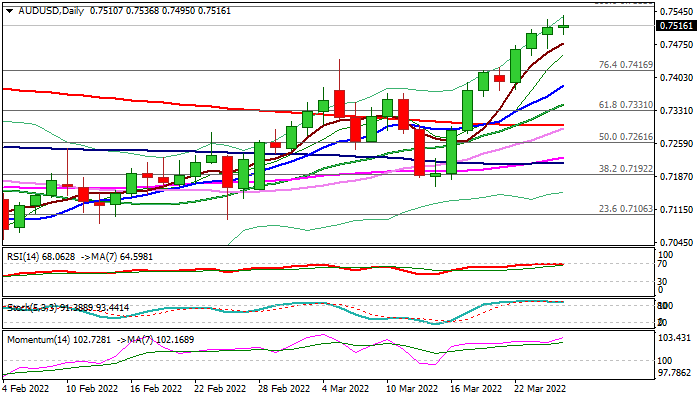
AUD/USD outlook: Bulls are losing traction on approach to key resistance
The Australian dollar remains well supported, with strong gains against Japanese yen, underpinning the AUDUSD pair.
Aussie advanced around 5% vs the US dollar and 10% vs yen in past almost two weeks, as Japanese currency remains under pressure on dovish BoJ and soaring prices of commodities and energy, as the country heavily depends on imports.
The daily chart shows that AUDUSD price action is slowly running out of steam, on approach to key resistance at 0.7555 (28 Oct 2021 high) as the bodies of daily candles are getting smaller, while shadows are longer on both sides.
Although the bullish momentum continues to strengthen, overbought stochastic adds to signals stall.
Correction is likely to be shallow, as weekly studies are in full bullish configuration and the pair is on track for the second strong weekly gains and close above weekly cloud top that generates bullish signal.
Good supports lay at 0.7441/17 (Mar 7 spike high / broken Fibo 76.4% of 0.7555/0.6967) with extension towards rising 10DMA (0.7385) not ruled out and expected to offer better levels to re-enter bullish market.
Break of 0.7555 pivot would expose net key barrier at 0.7634 (Fibo 38.2% of 1.1079/0.5514, 2011/2020 downtrend).
Res: 0.7536; 0.7555; 0.7600; 0.7634.
Sup: 0.7477; 0.7441; 0.7417; 0.7385.
EUR/USD Mid-Day Outlook
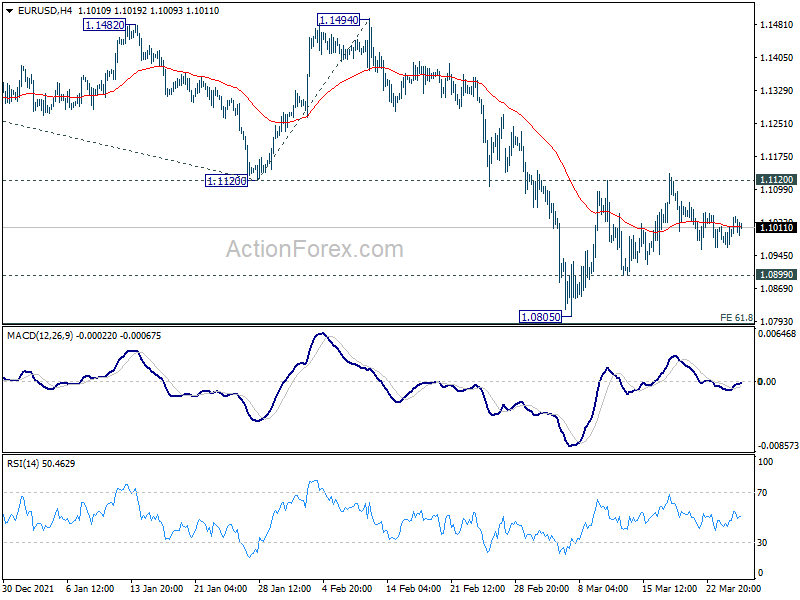
Daily Pivots: (S1) 1.0971; (P) 1.0993; (R1) 1.1019; More...
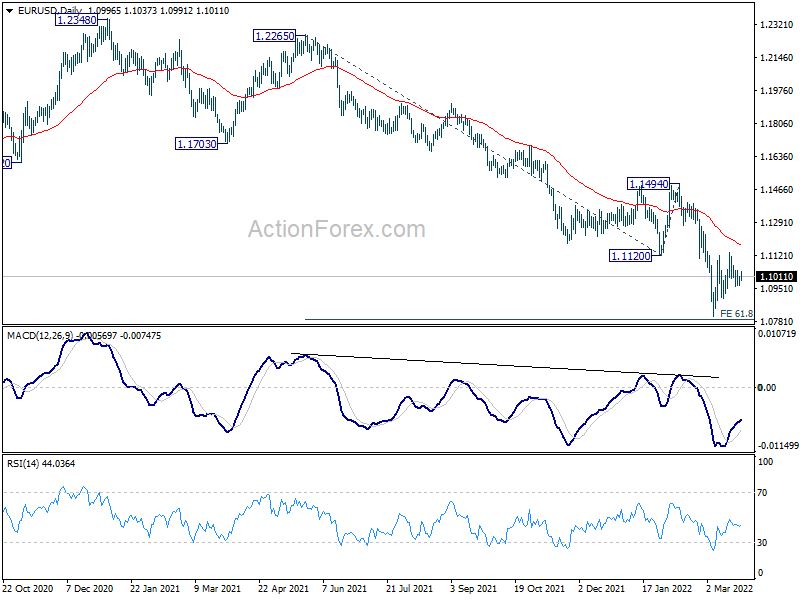
Intraday bias in EUR/USD remains neutral and outlook is unchanged. On the downside, below 1.0899 minor support will turn bias back to the downside for 61.8% projection of 1.2265 to 1.1120 from 1.1494 at 1.0786. However, firm break of 1.1120 will confirm short term bottoming at 1.0805. Bias will be back on the upside for 55 day EMA (now at 1.1173) and above.
In the bigger picture, the decline from 1.2348 (2021 high) is expected to continue as long as 1.1494 resistance holds. Firm break of 1.0635 (2020 low) will raise the chance of long term down trend resumption and target a retest on 1.0339 (2017 low) next. Nevertheless, break of 1.1494 will maintain medium term neutral outlook, and extending term range trading first.
GBP/USD Mid-Day Outlook
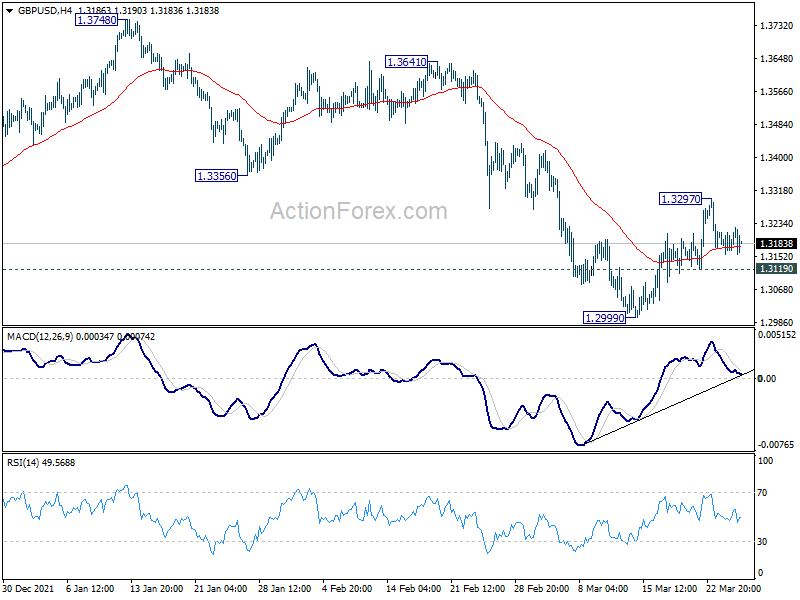
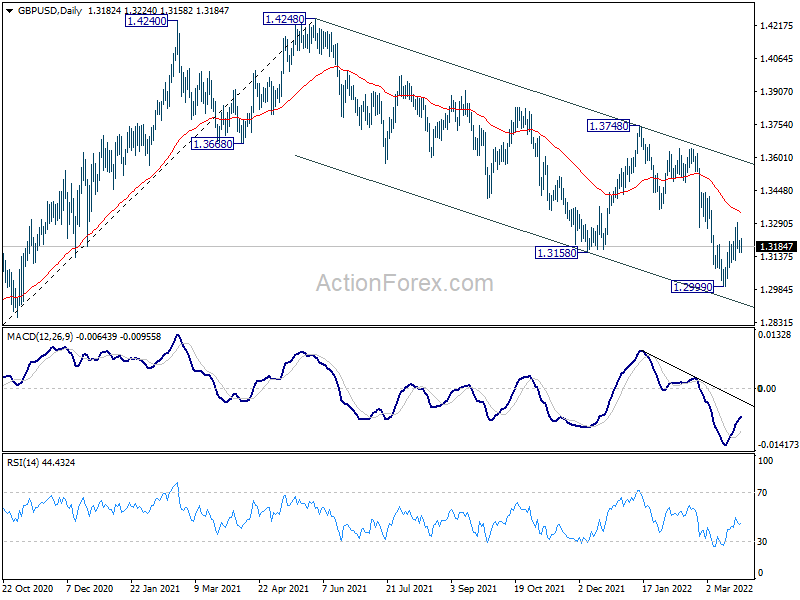
Daily Pivots: (S1) 1.3158; (P) 1.3186; (R1) 1.3215; More...
GBP/USD is staying in range trading and intraday bias remains neutral at this point. On the downside, break of 1.3119 minor support will turn bias back to the downside for retesting 1.2999. Firm break there will resume larger down trend from 1.4248. On the upside, above 1.3297 will resume the rebound to 55 day EMA (now at 1.3341). Sustained break there will target medium term channel resistance (now at 1.3590).
In the bigger picture, current development suggests that the up trend from 1.1409 (2020 low) has completed at 1.4248. Decline from 1.4248 could still be a corrective move, or it could be the start of a long term down trend. In either case, deeper decline would be seen back to 61.8% retracement of 2.1161 to 1.1409 at 1.2493. In any case, break of 1.3748 resistance is needed to indicate medium term bottoming, or outlook will stay bearish.
USD/CHF Mid-Day Outlook
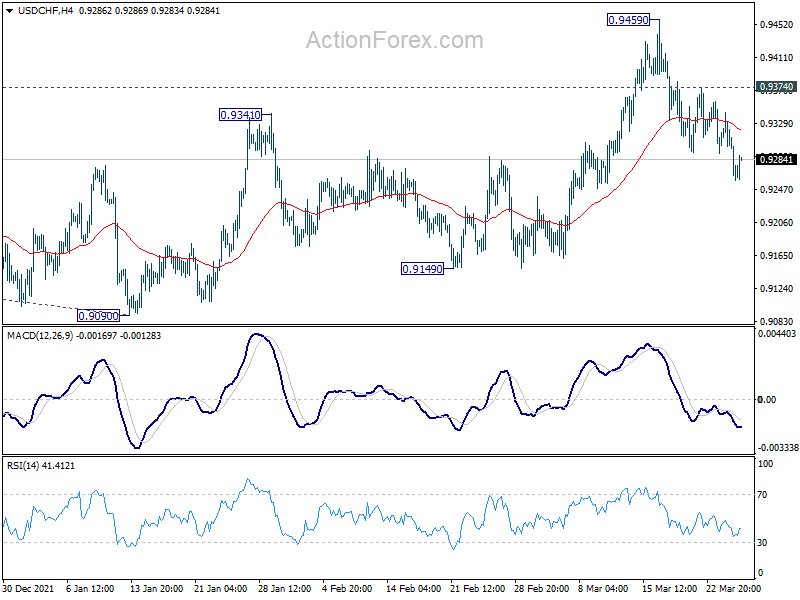
Daily Pivots: (S1) 0.9283; (P) 0.9314; (R1) 0.9333; More....
Intraday bias in USD/CHF remains on the downside as fall from 0.9459 is in progress. Sustained break of 55 day EMA (0.9255) will target 0.9149 structural support. On the upside, break of 0.9374 minor resistance will flip bias back to the upside for 0.9459 resistance instead.
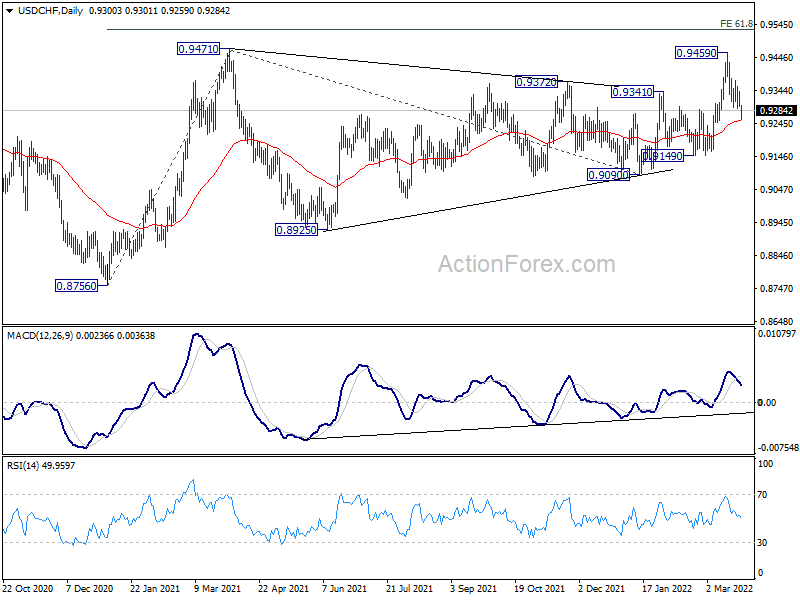
In the bigger picture, medium term outlook will be neutral at best as long as 0.9471 resistance holds. Larger down trend could still extend through 0.8756 (2021 low). However, firm break of 0.9471 will argue that whole down trend form 1.0342 (2016 high), has completed with waves down to 0.8756. A medium term up trend should be set up to target 1.0237/0342 resistance zone.
USD/JPY Mid-Day Outlook
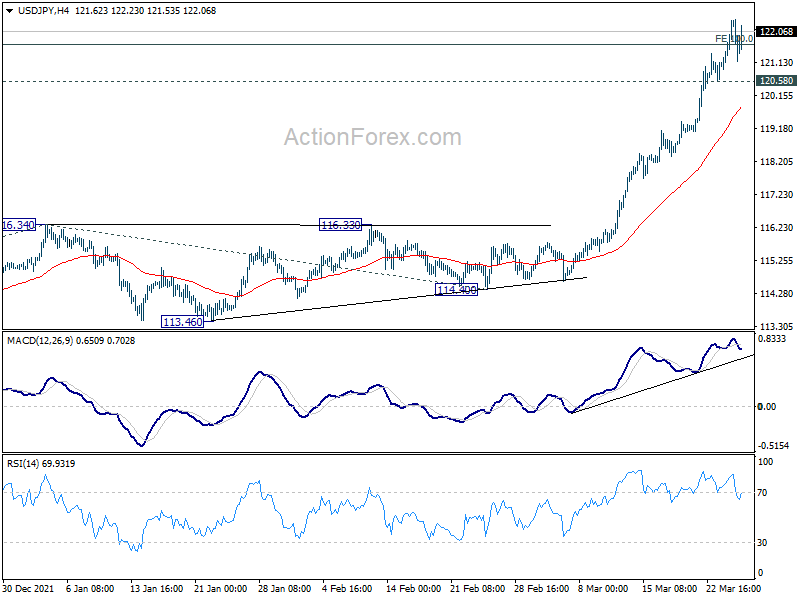
Daily Pivots: (S1) 121.41; (P) 121.91; (R1) 122.86; More...
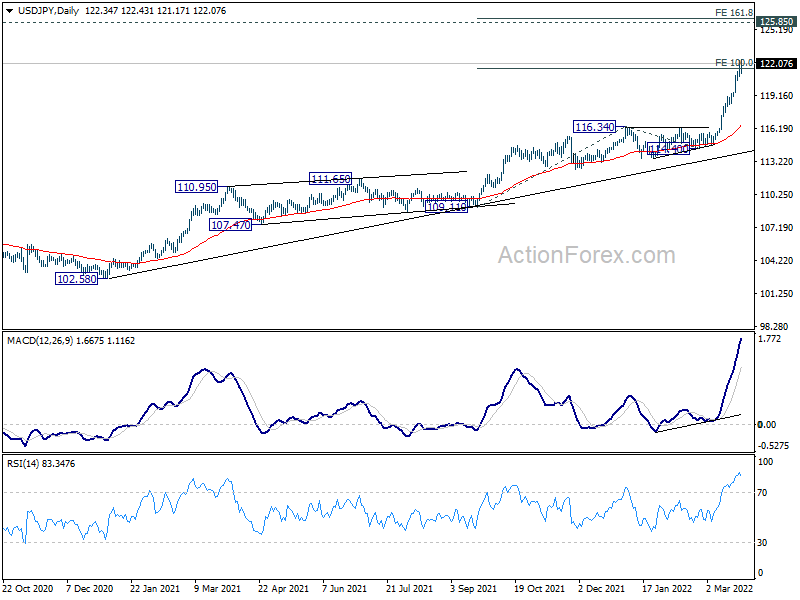
USD/JPY is losing some upside momentum as seen in 4 hour MACD. But with 120.58 minor support intact, intraday bias stays on the upside. Sustained trading above 100% projection of 109.11 to 116.34 from 114.40 at 121.63, will pave the way to 125.85 long term resistance. On the downside, however, below 120.58 minor support will turn intraday bias neutral and bring consolidations first, before staging another rally.
In the bigger picture, the break of 118.65 resistance (2016 high) suggest that up trend from 98.97 (2016 low) is resuming, with rise from 101.18 (2020 low) as the third leg. Medium term outlook will remain bullish as long as 116.34 resistance turned support holds. Next target is 125.85 (2015 high).
Euro Weakens after Poor Germany Business Climate, Yen Struggles to Recover
Euro turns slightly softer after poor German business climate reading, in particular against Swiss Franc, Aussie and Loonie. Dollar is also weak except versus Yen. Yen is trying to recover but there is no clear follow through buying. It's the the runaway loser of the week. Overall, Aussie is set to end as the week as the best performer.
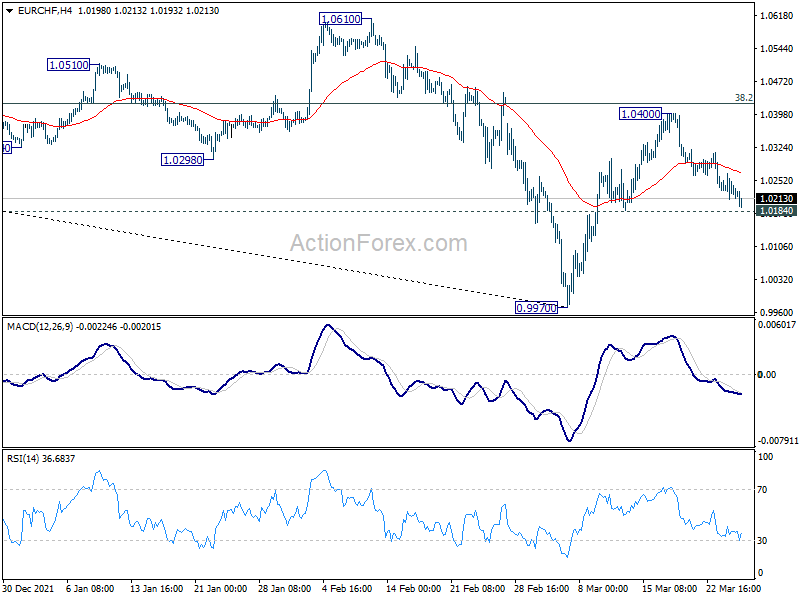
Technical, 1.0815 support in EUR/CHF is worth a watch early next week. Firm break there should confirm completion of the rebound from 0.9970, and retest of this low should be seen next. The development could be accompanied by downside breakout in both EUR/CAD and EUR/AUD for down trend resumption too.
In Europe, at the time of writing, FTSE is up 0.15%. DAX is up 0.87%. CAC is up 0.68%. Germany 10-year yield is up 0.0268 at 0.561. Earlier in Asia, Nikkei rose 0.14%. Hong Kong HSI dropped -2.47%. China Shanghai SSE dropped -1.17%. Singapore Strait Times rose 0.41%. Japan 10-year JGB yield closed flat at 0.240.
Germany Ifo business climate dropped to 90.8, record collapse in expectations
Germany Ifo Business Climate dropped from 98.5 to 90.8 in March, below expectation of 94.5. Current Situation index dropped from 98.6 to 97.0, below expectation of 97.3. Expectations index dropped from 98.4 to 85.1, well below expectation of 97.2, and a record collapse.
By sector, manufacturing dived from 23.1 to -3.3. Services dropped from 13.6 to 0.7. Trade dropped from 6.6 to -12.0. Construction dropped from 8.0 to -12.2.
UK retail sales dropped -0.3% mom in Feb, ex-fuel sales down -0.7% mom
UK retail sales volume dropped -0.3% mom in February, much worse than expectation of 1.0% mom rise. On a 12-month basis, sales rose 7.0% yoy, below expectation of 7.8% yoy. Also, sales volume was 3.7% above pre-pandemic level in February 2020.
Ex-fuel sales volume dropped -0.7% mom, below expectation of 0.5% mom. On a 12-month basis, sales rose 4.6% yoy, below expectation of 5.0% yoy. Ex-fuel sales volume was 4.0% above pre-pandemic level in February 2020.
Auto fuel sales volume rose 3.6% mom, above pre-pandemic level (by 0.9%) for the first time, on lifting of restrictions and increased travel.
UK Gfk consumer confidence dropped to -31, a wall of worry is confronting
UK Gfk Consumer Confidence Index dropped from -26 to -31 in March. That's the lowest level since November 2020. Personal Financial Situation over last 12 months dropped from -11 to -13. Personal Financial Situation over next 12 months dropped from -14 to -18. General Economic Situation over last 12 months dropped slightly from -50 to -51. Genera Economic Situation over next 12 months dropped from -43 to -49.
Joe Staton, Client Strategy Director GfK, says: "A wall of worry is confronting consumers this month and there is an unmistakable sense of crisis in our numbers. Consumers across the UK are experiencing the impact of soaring living costs with 30-year-high levels of inflation, record-high fuel and food prices, a recent interest-rate hike and the prospect of more increases to come, and higher taxation too – all against a background of stagnant pay rises that cannot compensate for the financial duress. This is the fourth month in a row that UK consumer confidence has dropped."
BoJ Kuroda: Weak yen is generally positive for Japan's economy
BoJ Governor Haruhiko Kuroda told the parliament, "there's no change now to my view a weak yen is generally positive for Japan's economy."
He also reiterated the view that "cost-push inflation that is not accompanied by wage hikes will hurt Japan's economy." And as such, "it won't lead to sustained achievement of our price target. That's why the BOJ will continue to maintain powerful monetary easing."
Released from Japan, Tokyo CPI core rose from 0.5% yoy to 0.8% yoy in March, above expectation of 0.7% yoy. Corporate service price index rose 1.1% yoy in February, below expectation of 1.2% yoy.
USD/JPY Mid-Day Outlook
Daily Pivots: (S1) 121.41; (P) 121.91; (R1) 122.86; More...
USD/JPY is losing some upside momentum as seen in 4 hour MACD. But with 120.58 minor support intact, intraday bias stays on the upside. Sustained trading above 100% projection of 109.11 to 116.34 from 114.40 at 121.63, will pave the way to 125.85 long term resistance. On the downside, however, below 120.58 minor support will turn intraday bias neutral and bring consolidations first, before staging another rally.
In the bigger picture, the break of 118.65 resistance (2016 high) suggest that up trend from 98.97 (2016 low) is resuming, with rise from 101.18 (2020 low) as the third leg. Medium term outlook will remain bullish as long as 116.34 resistance turned support holds. Next target is 125.85 (2015 high).
Economic Indicators Update
| GMT | Ccy | Events | Actual | Forecast | Previous | Revised |
|---|---|---|---|---|---|---|
| 23:30 | JPY | Tokyo CPI Core Y/Y Mar | 0.80% | 0.70% | 0.50% | |
| 23:30 | JPY | Corporate Service Price Index Y/Y Feb | 1.10% | 1.20% | 1.20% | |
| 00:01 | GBP | GfK Consumer Confidence Mar | -31 | -30 | -26 | |
| 07:00 | GBP | Retail Sales M/M Feb | -0.30% | 1.00% | 1.90% | |
| 05:30 | GBP | Retail Sales Y/Y Feb | 7.00% | 7.80% | 9.10% | 9.40% |
| 07:00 | GBP | Retail Sales ex-Fuel M/M Feb | -0.70% | 0.50% | 1.70% | |
| 05:30 | GBP | Retail Sales ex-Fuel Y/Y Feb | 4.60% | 5.00% | 7.20% | 7.50% |
| 09:00 | EUR | Germany IFO Business Climate Mar | 90.8 | 94.5 | 98.9 | 98.5 |
| 09:00 | EUR | Germany IFO Current Assessment Mar | 97 | 97.4 | 98.6 | |
| 09:00 | EUR | Germany IFO Expectations Mar | 85.1 | 97.2 | 99.2 | 98.4 |
| 09:00 | EUR | Eurozone M3 Money Supply Y/Y Feb | 6.30% | 6.30% | 6.40% | |
| 14:00 | USD | Pending Home Sales M/M Feb | 1.40% | -5.70% | ||
| 14:00 | USD | Michigan Consumer Sentiment Index Mar F | 59.7 | 59.7 |
GBP/USD Outlook: Cable Remains Directionless Between Pivotal Fibo Levels
Cable holds in a choppy and directionless mode for the second straight day and remained resilient despite downbeat UK retail sales data for February.
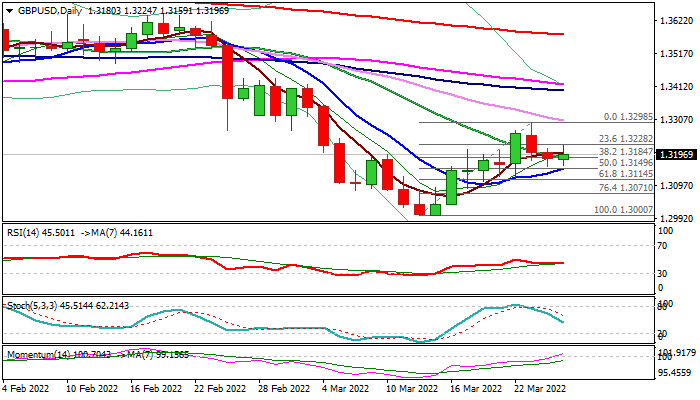
Weaker dollar in European trading on Friday helped sterling ahead of pivotal support at 1.3150 (50% retracement of 1.3000/1.3298, reinforced by 10DMA), after the action was already rejected at this zone on Thursday.
Technical studies on daily chart lack clearer direction signal as bullish momentum is rising but stochastic is heading south and 10/20DMA’s are in mixed mode.
Watch the action around 1.3150, as firm break here would encourage sellers and risk test of Fibo supports at 1.3114 and 1.3071 (Fibo 61.8% and 76.4% of 1.3000/1.3298 respectively) which guard key 1.30 level.
At the upside, initial barrier lays at 1.3245 (Fibo 38.2% of 1.3642/1.3000) followed by 1.3298 (Mar 23 recovery peak), violation of which would bring bulls back to play.
Res: 1.3245; 1.3282; 1.3298; 1.3321.
Sup: 1.3150; 1.3114; 1.3071; 1.3034.
Japanese Yen Rebounds
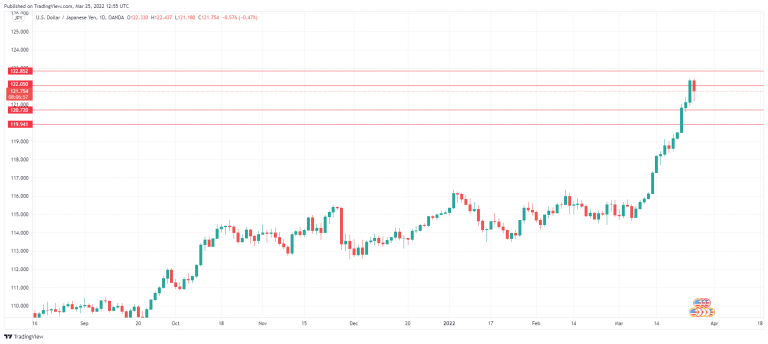
The Japanese yen has managed to stem the bleeding today, as USD/JPY is trading at 121.66, down 0.54%. USD/JPY climbed almost 1% on Thursday, breaking above the 122 line for the first time since December 2015.
Yen pummelled by rate differential
March has been miserable for the Japanese yen, which is down a staggering 5.83% this month. The yen has been walloped by the US/Japan rate differential, which continues to widen. US Treasury yields have been on an upswing, with the 10-year yield rising to 2.38% on Thursday. Higher yields have been weighing on the yen while also giving some support to the US dollar. If the uptrend continues, USD/JPY could push above the 123 line and keep moving north.
The yen received some strong backup on Friday, as BoJ Governor Kuroda and Minister of Finance Suzuki both made statements in parliament aimed at shoring up the yen, which has been on a dreadful slide. Suzuki said that “Exchange-rate stability is important, and sharp volatility is undesirable,” while Kuroda stated that it was important that currency rates remain stable. The comments had their desired effect, as the yen clawed back some gains today, but I would expect these gains to be temporary, as the yen will be under strong downward pressure from a hawkish Fed and a dovish BoJ, which is a one-two punch to the guts that will likely lead to a resumption of the yen’s decline.
Governor Kuroda talked about stability in the exchange rate, but also stated that “There’s no change now to my view a weak yen is generally positive for Japan’s economy”. Perhaps Kuroda doesn’t mind a weak yen, as long as the currency doesn’t fall into a disorderly decline. If I’m an investor, and the head of the central bank is saying he likes a weak yen, that kind of comment doesn’t fill me with an iota of confidence that the yen will rebound from its massive slide.
USD/JPY Technical
- 122.04 is a weak resistance line. Above, there is resistance at 1.2286
- There is support at 120.72 and 119.94
War in Ukraine Leads to German Business Climate Collapse
According to fresh Ifo estimates, business sentiment in Germany fell in March to its lowest level since January 2021. The business climate index fell from 98.5 to 90.8 following a collapse in business expectations amid war in Ukraine and the associated surge in energy and several other commodity prices.
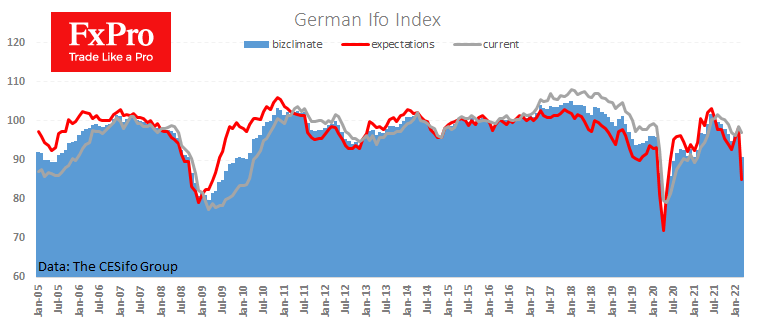
The drop in economic expectations was comparable to what we saw exactly two years ago at the start of the pandemic. New sentiment data may prove to be the first indication of the depth of the economic losses in the next quarter or two from ongoing events. They could wipe out as much as 1% of GDP in the outgoing quarter and another 2% in the next.
However, the current scenario is already priced in the financial markets. The Eurozone stock indices, which often outperform the economic cycle, are now more than 15% above their lows of March 7th. The same can be said for the euro, which is firmly based around USD 1.10, which has been stable for the last three months against the pound and strengthened by more than 8% against the Japanese yen.