

Sample Category Title
British Pound Slips after BoE Rate Hike
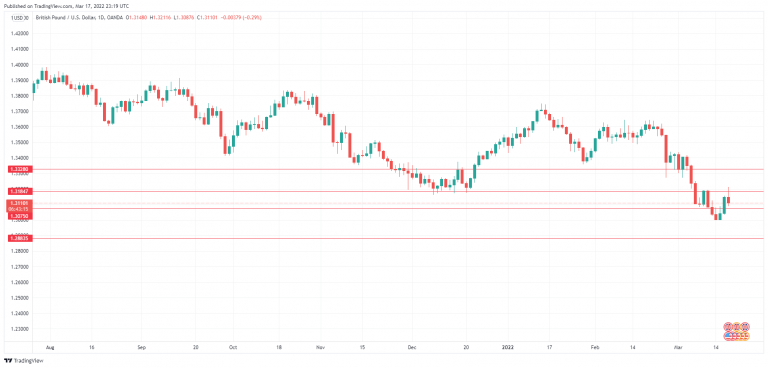
GBP/USD is down 0.28% on Thursday, trading just above the 1.31 line in the North American session.
BOE raises rates but sterling falters
The Bank of England raised rates by 0.25%, as was widely expected. This was an unprecedented third straight hike from the BoE, but the new record failed to impress investors, as the pound rose steadily prior to the hike, only to fall by 0.8% after the rate move.
Why the sour grapes from the markets after a rate hike? Investors were likely looking for more from the central bank, such as a 50-basis point hike, or at least more support for such a move. The fact that only one MPC member voted for a 50-basis point (the other eight voted for the 0.25% hike) has left the markets under the impression that the BoE is not hawkish enough in the face of soaring inflation. The Bank’s policy monetary summary noted that inflation is expected to hit 6% in February and March and peak at 7.25% in April. Clearly, there is a long way to go before inflation falls to the Bank’s target of 2% and the markets are looking for an aggressive response from the BoE. With the war in Ukraine and surging oil prices, however, BoE policymakers may opt to raise rates to a lesser extent than the markets would like to see.
As expected, the Federal Reserve raised rates by 0.25%, the first hike since December 2018. The FOMC dot plot, projected another six rate hikes this year and forecasted that rates would rise to 2.8% by the end of 2023, sharply higher than the 1.60% estimate in December. The rate statement said that a tapering of the balance sheet would start at a “coming meeting”, but Chair Jerome Powell removed some of the uncertainty at his press conference, hinting at a reduction in May. This double-tightening is a clear indication that the Fed plans to be aggressive in its monetary policy, with the aim of wrestling red-hot inflation back to the Fed target range of 2%-3%.
GBP/USD Technical
- 1.3075 is a monthly support line. Below, there is support at 1.2962
- There is resistance at 1.3184 and 1.3328
Chinese Market Has Probably Bottomed Out
Chinese indices are experiencing their sharpest rally yet on Wednesday amid reassurances from officials that the stock market is going to be supported. Hong Kong’s Hang Seng jumped 12%, China’s China A50 is gaining more than 8.5%, while China H-share is soared over 20% in less than two days.
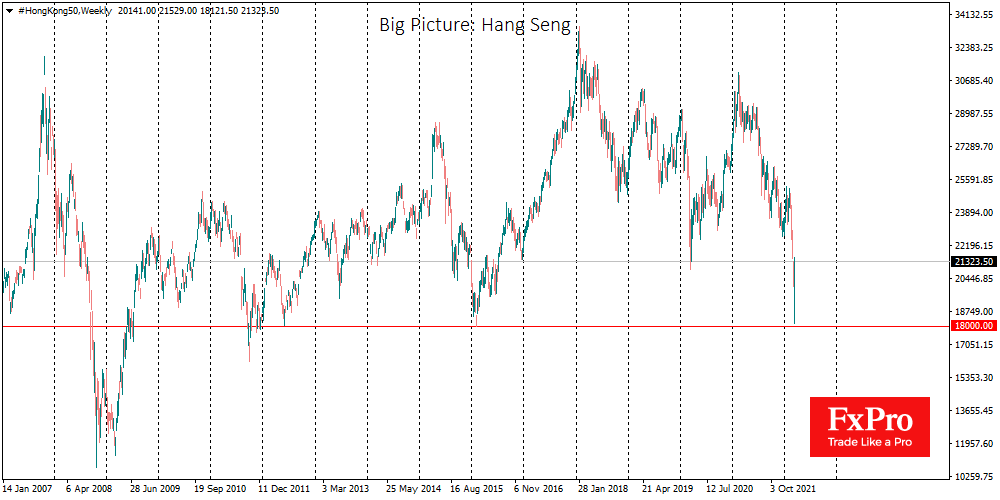
These indices have been under increased pressure in recent weeks, getting maximum pressure this week. On Tuesday, major Chinese indices fell fastest since March 2020, rewriting multi-year lows.
Market support from officials came a day after the release of upbeat macro data, indicating a jump in retail sales and industrial production. At the same time, stock market dynamics fundamentally diverged from the economy, and there was a near point where stock volatility was already causing material disruption to the economy.
The China H-shar gained support today after sinking to the lows of late 2008, losing more than half of its price in just over a year of steady decline.
The Hans Seng index touched lows since 2016 and areas of market support in 2012 at the peak of Tuesday’s decline.
However, Chinese policymakers have worked hard to prevent the sell-off from turning into a self-sustaining spiral over the past two days. Yesterday’s China-US talks saw a positive reaction from the sides, forming a more than 4.5% bounce for the Hang Seng during the European trading session. This momentum was boosted on Wednesday morning after Vice Premier Liu He indicated that China is considering a package of measures to support the economy and financial markets. Soon the People’s Bank of China stated that it would help the stock market with other agencies.
Such words send a message to the market that the levels reached yesterday are a pain point for the Chinese authorities, from where they are ready to step up efforts to support the markets.
Yesterday we likely saw the bottom of the Chinese indices for many months to come, despite potentially negative for stock prices rate hikes by the Fed and other major central banks for the equity market. There seems to be too much pessimism and wariness embedded in Chinese valuations after more than a year of declines.
Stocks Drop, Gold and Oil Rally as Risk Appetite Sours amid Ukraine Crisis
Volatility continues! Here’s what’s happening in the markets today:
Stock market
- Equity markets have gone in reverse, after Russia said that reports of major progress in peace talks are wrong. Ukrainian Defence Minister has said that so far there is nothing to satisfy his government in negotiations with Russia. Russia has said that their delegation is putting colossal energy into Ukraine peace talks, but Ukraine is simply wasting time.
- So, sentiment continues to be driven almost entirely by geopolitics, with the market quick to forget or ignore everything else. As we saw yesterday, the markets have been eager to rally on any positive news… but then sells off as investors realise that the two sides remain far apart in terms of a ceasefire and end of the war.
- The pound lost a big chunk of its earlier gains after the Bank of England raised interest rates by 25 basis points to 0.75%, in an 8-1 vote. Cunliffe surprised, backing no change, and this caused the pound to dip. This was a surprise given that the BoE has also warned that inflation will be around 8% in the second quarter and may even climb higher. Thus, I don’t think the weakness will last long, as investors prepare for some further modest tightening, which “may be appropriate.”
- The US dollar has weakened so far in today’s session, although it made a good come back against the pound on the back of the BoE decision. The dollar’s weakness against other currencies suggests the market had already priced in the rate hike and the Fed’s projection of 6 more hikes for this year.
- Oil prices have surged around 6% higher today, with Brent rising above $104 and WTI climbing back above $100. Crude was always going to rebound after it’s big slump last week, given that market is still very tight. It appears that the trigger behind today’s gains is related to the ongoing Russia-Ukraine situation. We have also seen stocks come sharply off their earlier highs, while safe-haven gold and government bonds have rallied. Fears over potential supply disruptions have thus been rekindled, as the longer the war continues, the more likely it is we will see further sanctions on Russia’s energy sector.
- Gold’s status as a haven asset is plain to see. The precious metal has once again responded positively to negative headlines regarding Ukraine situation, with prices also helped by a weaker US dollar and a drop in bond yields.
Australian Dollar Punches Above 73 Line
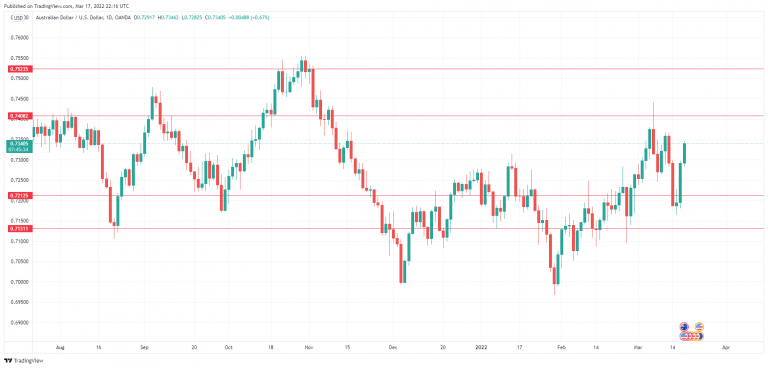
The Australian dollar has posted strong gains for a second straight day. In the European session, AUD/USD is trading at 0.7338, up 0.65% on the day.
We continue to see strong volatility from the Australian dollar. The currency started the week with a tumble of 1.44% but has recouped those gains and then some. AUD/USD rose 1.35% on Tuesday on the coattails of risk-positive developments in China and Ukraine and has posted additional gains today, courtesy of strong Australian employment numbers.
Australia’s employment data outperforms
Australia’s economy created 77.4 thousand new jobs in February, crushing the estimate of 37.0 thousand and above the January reading of 12.9 thousand. The unemployment rate fell from 4.2% to 4.0%, better than the forecast of 4.1%. This is the lowest unemployment rate since 2008. As well, the participation rate rose to 66.4%, up from 66.2% ahead of the estimate of 66.3%. All in all, an impressive performance that points to a robust labour market.
The Chinese government has intervened after the meltdown in the country’s stock markets. Beijing announced on Tuesday it planned to boost the economy through monetary and loan policies which would spur growth. The announcement sent Chinese equity markets higher on Wednesday, with the Hong Kong soaring 9.1%. The news was bullish for the Aussie, as China is Australia’s number one trading partner.
The risk-sensitive Australian dollar also was buoyed by news that Russia-Ukraine peace talks are showing progress. We’ve been down this path before, as markets have risen on reports of a possible ceasefire, only to be disappointed. This time may be different, as the sides are apparently working on a detailed peace plan, which would include a Russian withdrawal of forces from Ukraine and Ukraine declaring neutrality.
Fed raises rates, projects 6 hikes
The Federal Reserve did not surprise anyone with its 0.25% hike, the first rise in rates since 2018. What was more of interest to the markets was the FOMC dot plot, which projected another six rate hikes this year. The dot plot also forecasted that rates would rise to around 3% by the end of 2023, sharply higher than the 1.60% estimate in December. Fed Chair Powell said that a taper of the balance sheet could start as early as May. This double-tightening is a clear indication that the Fed plans to be aggressive in its monetary policy, with the aim of wrestling red-hot inflation back to the Fed target range of 2%-3%.
AUD/USD Technical
- 0.7212 is under pressure as support. Below, there is support at 0.7131
- There is resistance at 0.7327 and 0.7408
USD/JPY Mid-Day Outlook
Daily Pivots: (S1) 118.25; (P) 118.69; (R1) 119.19; More...
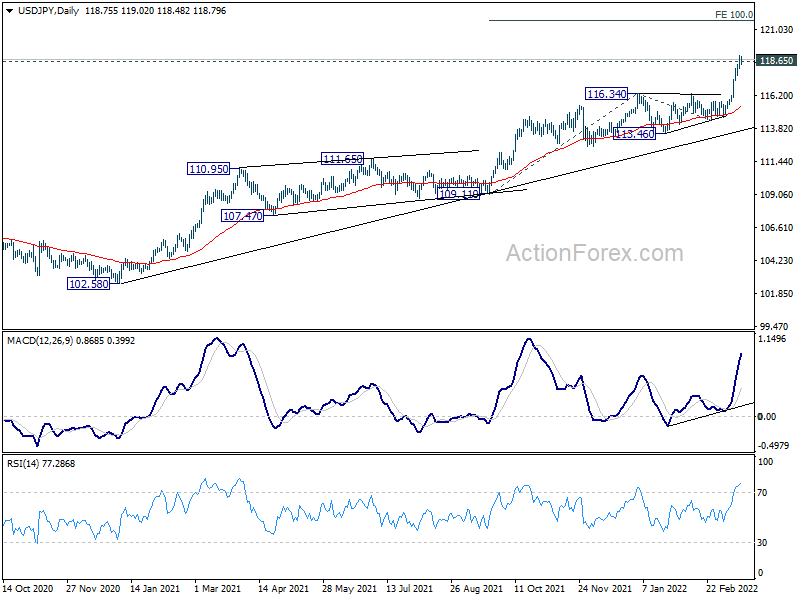
Intraday bias in USD/JPY remains on the upside at this point. Current rally should target 100% projection of 109.11 to 116.34 from 114.40 at 121.63. On the downside, break of 117.68 support is now needed to indicate short term topping. Otherwise, outlook will stay bullish in case of retreat.
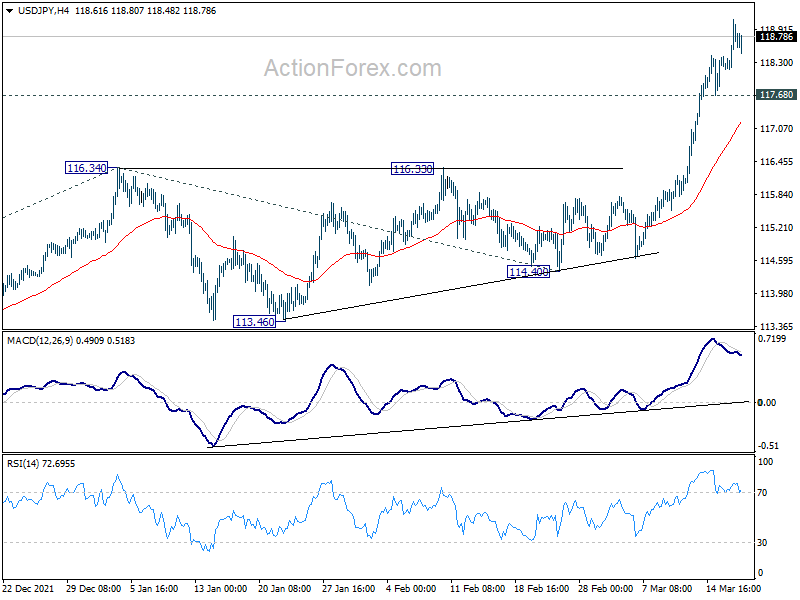
In the bigger picture, no change in the view that rise from 102.58 is the third leg of the up trend from 101.18 (2020 low). Sustained break of 118.65 (2016 high) will pave the way to 125.85 (2015 high) and raise the chance of long term up trend resumption. This will remain the favored case as long as 113.46 support holds, even in case of deep pull back.
USD/CHF Mid-Day Outlook
Daily Pivots: (S1) 0.9379; (P) 0.9419; (R1) 0.9449; More....
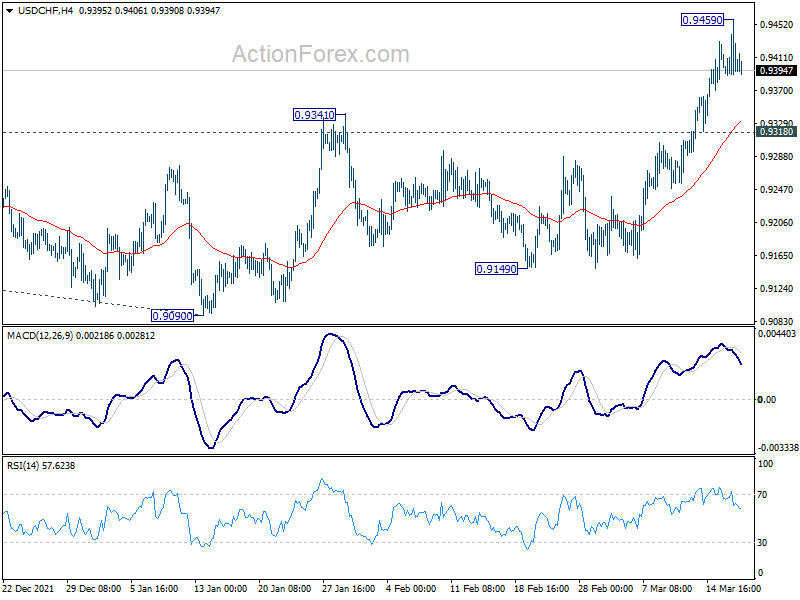
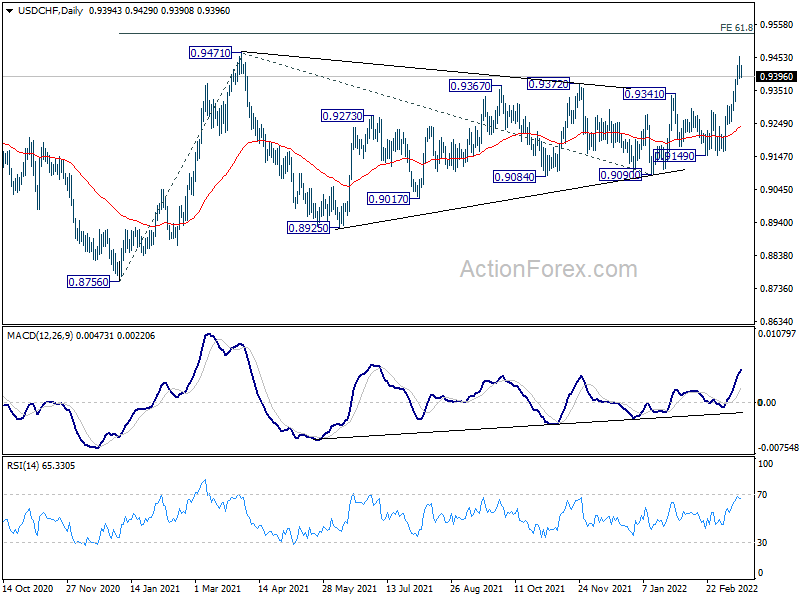
Intraday bias in USD/CHF remains neutral for consolidation below 0.9459 temporary top. Downside of retreat should be contained by 0.9318 support to bring another rally. On the upside, above 0.9459 will target 0.9471 resistance first. Break there will resume whole rally from 0.8756 to 61.8% projection of 0.8756 to 0.9471 from 0.9090 at 0.9532.
In the bigger picture, medium term outlook will be neutral at best as long as 0.9471 resistance holds. Larger down trend could still extend through 0.8756 (2021 low). However, firm break of 0.9471 will argue that whole down trend form 1.0342 (2016 high), has completed with waves down to 0.8756. A medium term up trend should be set up to target 1.0237/0342 resistance zone.
EUR/USD Mid-Day Outlook
Daily Pivots: (S1) 1.0972; (P) 1.1010; (R1) 1.1072; More...
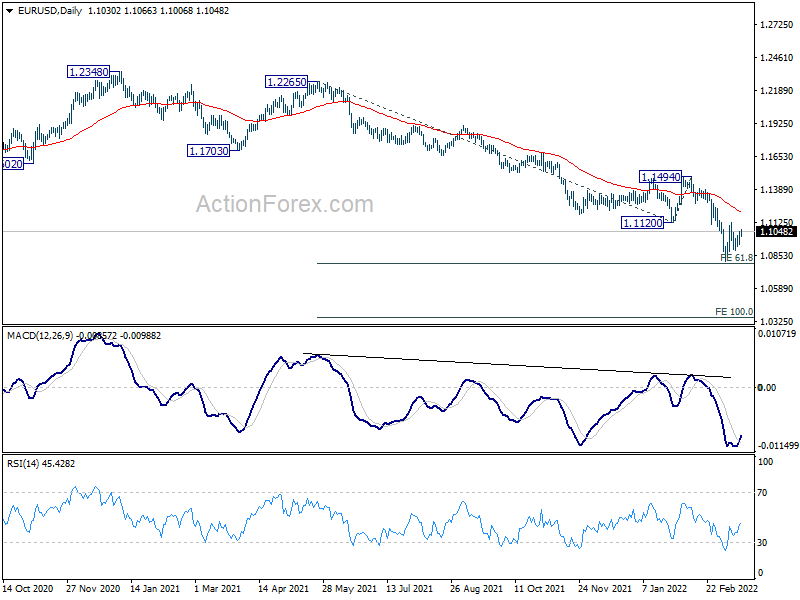
EURUSD is staying in range of 1.0805/1120 and intraday bias remains neutral. Further decline is still expected with 1.1120 support turned resistance intact. On the downside, firm break of 61.8% projection of 1.2265 to 1.1120 from 1.1494 at 1.0786 will pave they way to 100% projection at 1.0349 next. However, strong break of 1.1120 will confirm short term bottoming, at least, and bring stronger rebound back towards 1.1494 structural resistance instead.
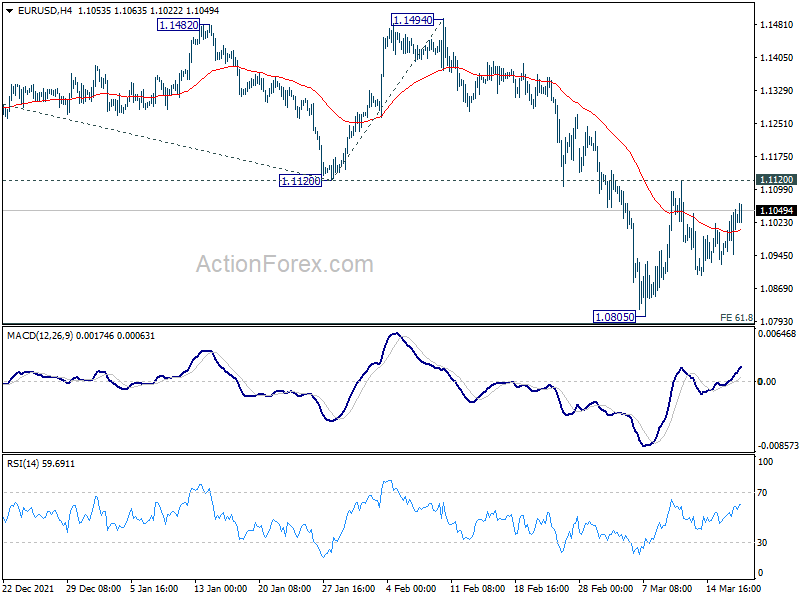
In the bigger picture, the decline from 1.2348 (2021 high) is expected to continue as long as 1.1494 resistance holds. Firm break of 1.0635 (2020 low) will raise the chance of long term down trend resumption and target a retest on 1.0339 (2017 low) next. Nevertheless, break of 1.1494 will maintain medium term neutral outlook, and extend range trading first.
GBP/USD Mid-Day Outlook
Daily Pivots: (S1) 1.3068; (P) 1.3112; (R1) 1.3193; More...
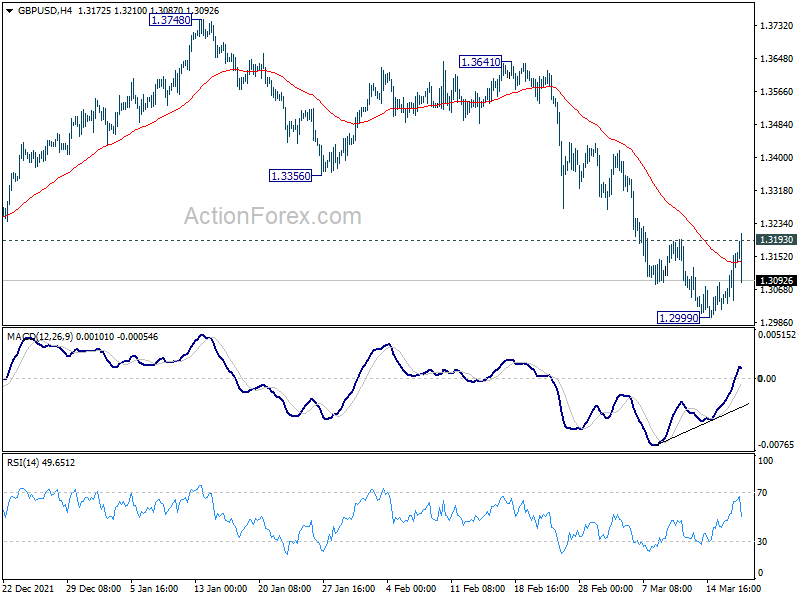
GBP/USD reversed after breaching 1.3193 resistance, but stays above 1.2999 support. Intraday bias remains neutral first and further decline is still in favor. On the downside, break of 1.2999 will resume larger down trend from 1.4248. However, on the upside, firm break of 1.3193 will confirm short term bottoming. Intraday bias will be turned back to the upside for 55 day EMA (now at 1.3374).
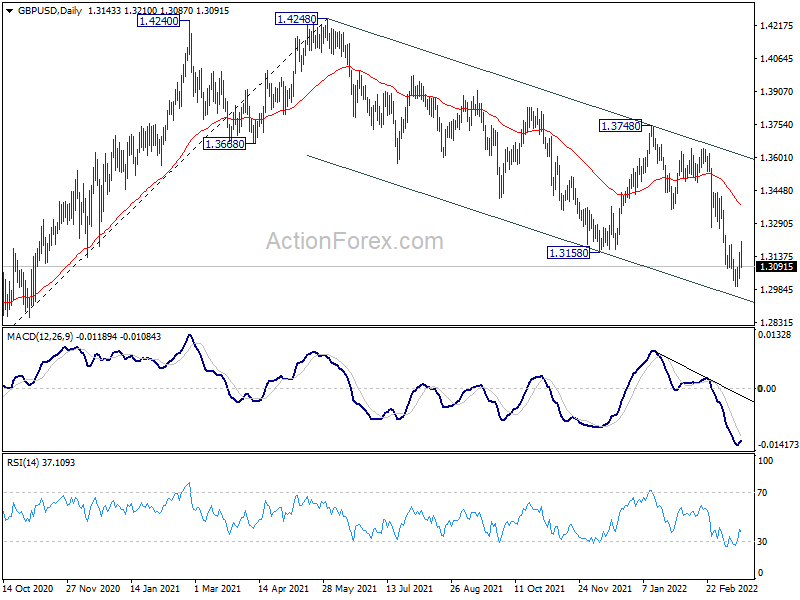
In the bigger picture, current development suggests that the up trend from 1.1409 (2020 low) has completed at 1.4248. Decline from 1.4248 could still be a corrective move, or it could be the start of a long term down trend. In either case, deeper decline would be seen back to 61.8% retracement of 2.1161 to 1.1409 at 1.2493. In any case, break of 1.3748 resistance is needed to indicate medium term bottoming, or outlook will stay bearish.
Sterling Dips after Dovish BoE Hike, Euro Mixed
Sterling dips notably after the dovish rate hike by BoE. Yen is following as second worst for the day, then Dollar. On the other hand, Aussie is leading other commodity currencies higher, support by strong job data. Euro is mixed with Swiss Franc, closely watching developments in Ukraine. In other markets, Gold is attempting a recovery but still kept well below 2000 handle. WTI crude oil is also recovering and it's back above 100 handle.
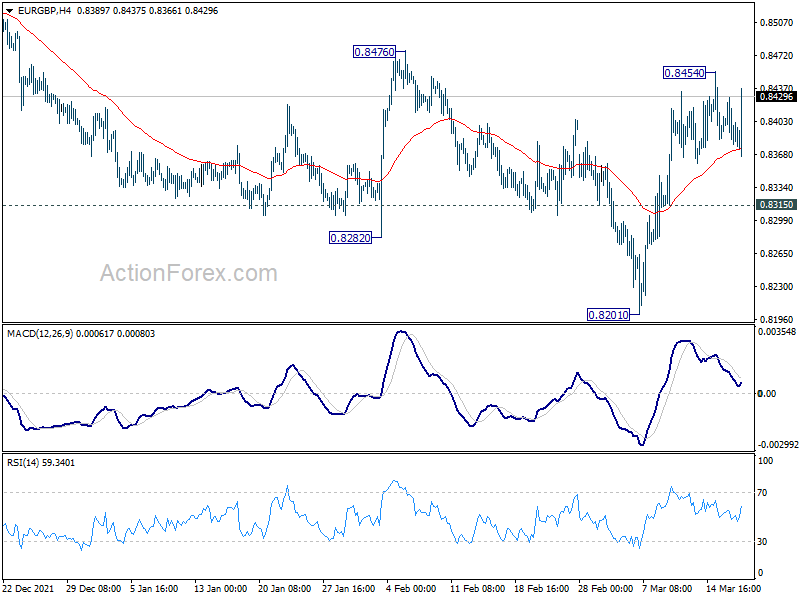
Technically, with the weakness in Euro, focus will be on EUR/GBP. Above 0.8454 temporary top will resume the rebound from 0.8201. Further break of 0.8476 resistance will be the first sign of bullish trend reversal and bring even stronger rise to 0.8598.
In Europe, at the time of writing, FTSE is up 0.44%. DAX is down -1.04%. CAC is down -0.32%. Germany 10-year yield is up 0.009 at 0.401. Earlier in Asia, Nikkei rose 3.46%. Hong Kong HSI rose 7.04%. China Shanghai SSE rose 1.40%. Singapore Strait Times rose 0.97%. Japan 10-year JGB yield dropped -0.0002 to 0.204.
US initial jobless claims dropped to 214k, continuing claims dropped to 1.419m
US initial jobless claims dropped -15k to 214k in the week ending March 12, better than expectation of 221k. Four-week moving average of initial claims dropped -9k to 223k. Continuing claims dropped -71k to 1419k in the week ending march 5, lowest since February 21, 1970. Four-week moving average of continuing claims dropped -42.5k to 1463k, lowest since March 21, 1970.
Housing starts rose to 1.77m annualized rate in February. Building permits dropped to 1.86m. Philly Fed manufacturing survey jumped from 16 to 27.4 in March.
BoE raises bank rate to 0.75%, but Cunliffe voted for no change
BoE raises Bank Rate by 25bps to 0.75% as widely expected. But surprisingly, it was done by a 8-1 vote, with Jon Cunliffe voting for no change at 0.50%. In the statement, BoE said, "some further modest tightening in monetary policy may be appropriate in the coming months, but there are risks on both sides of that judgement depending on how medium-term prospects for inflation evolve."
"The invasion of Ukraine by Russia has led to further large increases in energy and other commodity prices," BoE said. "Global inflationary pressures will strengthen considerably further over coming months, while growth in economies that are net energy importers, including the United Kingdom, is likely to slow."
ECB Lagarde: Inflation to exceed 7% this year in severe scenario
ECB President Christine Lagarde said in a speech the central has given itself some "extra space" in monetary policy by stating that rate hike will come only "some time" after ending net asset purchases.
"This maintains our traditional sequencing logic, but also gives us extra space if needed after we stop purchasing bonds and before we take the next step towards normalization," she said. "This will allow us to test whether the convergence of inflation to our target that we project today is robust to current and potential new shocks,"
Lagarde also said the outbreak of war has " introduced new uncertainty into the outlook", with " the short-term factors pushing up inflation are likely to be amplified." Inflation out hit 5.1% on average hits year, and even exceed 7% in the "severe scenario".
ECB Knot: Normalization the appropriate response with dominant worry in inflation
ECB Governing Council member Klaas Knot said, "At this point, the dominant worry is inflation. That is why normalization of policy, the withdrawal of stimulus is the appropriate policy response."
He expected the asset purchases to end by the end of the year. "That means September should be available (for a rate hike)," Knot said. "Not that I expect rates will have to go up in September."
"A rate hike in the fourth quarter to me still is a realistic expectation… but by no means a certainty, he added.
Eurozone CPI finalized at 5.9% yoy in Feb, EU at 6.2% yoy
Eurozone CPI was finalized at 5.9% yoy in February, up from January's 5.1% yoy. The highest contribution to the annual euro area inflation rate came from energy (+3.12%), followed by services (+1.04%), food, alcohol & tobacco (+0.90%) and non-energy industrial goods (+0.81%).
EU CPI was finalized at 6.2% yoy, up from January's 5.6% yoy. The lowest annual rates were registered in Malta, France (both 4.2%), Portugal, Finland and Sweden (all 4.4%). The highest annual rates were recorded in Lithuania (14.0%), Estonia (11.6%) and Czechia (10.0%). Compared with January, annual inflation fell in two Member States and rose in twenty-five.
BoJ Kuroda: Too early to debate specifics on stimulus exit
BoJ Governor Haruhiko Kuroda told the parliament today, "it will take more time to achieve our 2% inflation target in a stable manner, so it's too early to debate specifics on how to exit from easy policy."
Core consumer inflation in Japan is generally expected to climb up in the months ahead, with prospect of hitting the 2% target. But Kuroda talked down the significance of such development. "I don't think Japan is in a condition where inflation stably hits 2%, even when the impact of cellphone fee cuts taper off and energy prices rise further," he said.
Kuroda just reiterated that BoJ will consider stimulus exit when 2% inflation is achieved. And, "in doing so, we will guide monetary policy to ensure markets including those for Japanese government bonds remain stable."
Australia employment rose 77.4k in Feb, unemployment rate dropped to 4%
Australia employment grew 77.4k in February, nearly double of expectation of 40.0k. Full-time jobs rose 121.9k while part-time jobs dropped -44.5k. Employment was around 202k above pre-Delta high of June 2021.
Unemployment rate dropped from 4.2% to 4.0%, better than expectation of 4.1%. That's the lowest level since August 2008. Participation rate rose 0.2% to 66.2%. Monthly hours worked rose 8.9%, or 149m, to 1813m hours.
From New Zealand, GDP grew 3.0% qoq in Q4, below expectation of 3.2% qoq.
GBP/USD Mid-Day Outlook
Daily Pivots: (S1) 1.3068; (P) 1.3112; (R1) 1.3193; More...
GBP/USD reversed after breaching 1.3193 resistance, but stays above 1.2999 support. Intraday bias remains neutral first and further decline is still in favor. On the downside, break of 1.2999 will resume larger down trend from 1.4248. However, on the upside, firm break of 1.3193 will confirm short term bottoming. Intraday bias will be turned back to the upside for 55 day EMA (now at 1.3374).
In the bigger picture, current development suggests that the up trend from 1.1409 (2020 low) has completed at 1.4248. Decline from 1.4248 could still be a corrective move, or it could be the start of a long term down trend. In either case, deeper decline would be seen back to 61.8% retracement of 2.1161 to 1.1409 at 1.2493. In any case, break of 1.3748 resistance is needed to indicate medium term bottoming, or outlook will stay bearish.
Economic Indicators Update
| GMT | Ccy | Events | Actual | Forecast | Previous | Revised |
|---|---|---|---|---|---|---|
| 21:45 | NZD | GDP Q/Q Q4 | 3.00% | 3.20% | -3.70% | -3.60% |
| 23:50 | JPY | Machinery Orders M/M Jan | -2.00% | -2.20% | 3.60% | 3.10% |
| 00:30 | AUD | Employment Change Feb | 77.4K | 40.0K | 12.9K | 28.3K |
| 00:30 | AUD | Unemployment Rate Feb | 4.00% | 4.10% | 4.20% | |
| 07:00 | CHF | Trade Balance (CHF) Feb | 5.95B | 4.20B | 3.18B | 3.07B |
| 10:00 | EUR | Eurozone CPI Y/Y Feb F | 5.90% | 5.80% | 5.80% | |
| 10:00 | EUR | Eurozone CPI Core Y/Y Feb F | 2.70% | 2.70% | 2.70% | |
| 12:00 | GBP | BoE Interest Rate Decision | 0.75% | 0.75% | 0.50% | |
| 12:00 | GBP | MPC Official Bank Rate Votes | 8--0--1 | 9--0--0 | 9--0--0 | |
| 12:30 | USD | Initial Jobless Claims (Mar 11) | 214K | 221K | 227K | 229K |
| 12:30 | USD | Housing Starts Feb | 1.77M | 1.70M | 1.64M | 1.66M |
| 12:30 | USD | Building Permits Feb | 1.86M | 1.87M | 1.90M | |
| 12:30 | USD | Philadelphia Fed Manufacturing Survey Mar | 27.4 | 15 | 16 | |
| 13:15 | USD | Industrial Production M/M Feb | 0.50% | 1.40% | ||
| 14:30 | USD | Natural Gas Storage | -71B | -124B |