

Sample Category Title
US inflation accelerates, but the Fed’s hands are tied
Consumer prices in the USA rose by 0.8% in February as expected. Inflation for the same month a year earlier was 7.9% compared to 7.5% a month earlier and in line with average forecasts.
Over the last 12 months, the actual data has exceeded the forecast ten times, so the stabilisation seen in February is regarded as cautiously good news. Previously, market participants had assumed that inflation would peak in February, but the latest round of commodity prices makes these forecasts overly optimistic.
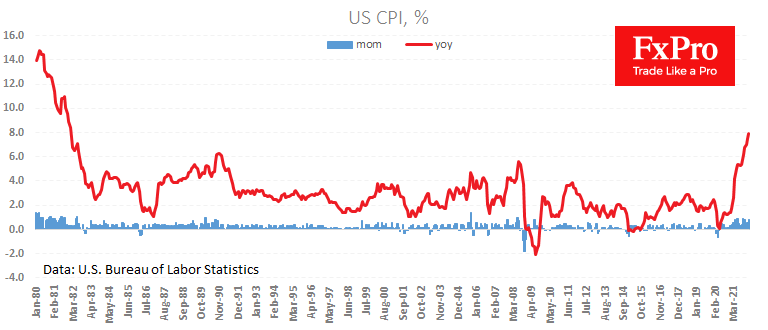
In peacetime, markets would have priced in more decisive monetary policy tightening moves by the Fed. However, investors have recently discounted expectations of a rate hike by 50 points, contrary to a jump in commodity prices. The markets assume that the Fed will be much more cautious in tightening policy. This thesis is doubly true against the background of falling government bond yields and widening spreads between them and high-yield bonds.
When the Fed has limited capacity to respond to inflation, this is bad news for the dollar because it undermines its long-term prospects for maintaining purchasing power. In this regard, the impulsive pressure on the US currency immediately after the release should not be surprising.
Long term, this is also good news for bitcoin, which is not subject to inflation. However, the short-term reaction could well be mixed, as fears of a new stock market decline are also added to this cocktail, as stocks “don’t like” accelerating inflation.
Dollar Pushes Wobbly Yen to 116
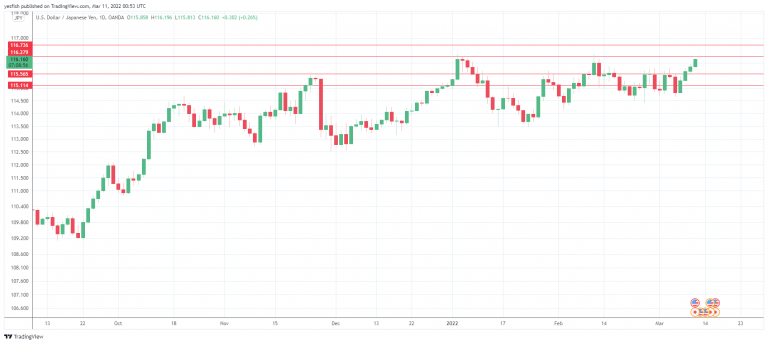
The Japanese yen continues to lose ground to the US dollar. USD/JPY has climbed above the 116 line for the first time since early February. The yen is on its heels, as USD/JPY is within striking distance of 116.35, which has held since January 2017.
With risk apprehension at high levels due to the Ukraine crisis and the staggering surge in oil prices, financial markets have been volatile and investors have snapped up safe-haven assets, such as the US dollar. The yen is also considered a safe-haven currency, but with the US economy in much better shape than that of Japan, the US dollar has been the big winner from the recent turbulence.
US inflation jumps to 7.9%
In the US, headline CPI continued to accelerate, with a gain of 7.9% for February YoY. This matched the forecast and was up from 7.5% beforehand. With inflation running close to 8%, a rate hike is a virtual given at next week’s meeting. What happens after that is less clear, as the Fed has to worry about stagflation, given the massive upswing in oil prices.
The markets are expecting positive numbers from Japan on Friday, which could give the beleaguered yen a shot in the arm. Household Spending, a key driver of the economy, is expected to show a strong gain of 3.6% YoY for January, following a 0.2% decline in December. The BSI Manufacturing Index is forecast to accelerate to 8.2 for Q1, up from 7.9 beforehand.
On the Ukraine front, a meeting between the foreign ministers of Russia and Ukraine earlier today did not result in any breakthroughs, although the sides agreed to continue to meet. The fighting continues, and with the Russian invasion force appearing to have stalled, there are fears that Russian President Putin could barrel down in frustration and hit more civilian targets. This would exacerbate the massive humanitarian crisis, which has displaced millions of Ukrainians.
For Japan, the crisis in Ukraine could further muddy the outlook for the county’s fragile economy. Oil has pushed has risen as high as USD 130 and a disruption in Russian oil and gas deliveries to world markets will send energy prices even higher, which will raise prices and dampen consumer spending.
USD/JPY Technical
- USD/JPY has support at 114.71. Next, the 100-DMA at 114.37 is providing support
- There is resistance at 116.06 and 116.59
Sunset Market Commentary
Markets
Markets yesterday staged a broad risk-on repositioning since the start of the Russian invasion in Ukraine, hoping that mutual economic retaliations at least would come to a pause. There was even hope that a high level meeting between the foreign ministers of Ukraine and Russian could yield some progress. That didn’t materialize as Russia still urges that its demands will need to be fulfilled first. After yesterday’s impressive rise, European equities, the euro and yields corrected mostly lower even before the headlines of the failure of the talks hit the screens.
The ECB as expected left policy rates unchanged. However, even the ECB can’t ignore runaway inflation anymore. The recalibration of the APP program in order to guarantee a smooth transition after the end of PEPP was changed before it at even started. APP buying will be raised to €40 bln in April, but will immediately being scaled back to €30 bln in May and €20 bln in June. The statement then reads that ‘If the incoming data support the expectation that the medium-term inflation outlook will not weaken even after the end of our net asset purchases, the Governing Council will conclude net purchases under the APP in the third quarter.’ According to the December roadmap, the ECB only expected APP to be reduced to € 20 bln in Q4. The bank also amended the sentence that ‘it expects the key ECB interest rates to remain at their present or lower levels’ by scrapping “or lower”. The ECB now guides that ‘Any adjustments to the key ECB interest rates will take place some time after the end of the Governing Council’s net purchases under the APP’. Growth and inflation evidently are subject to a high degree of uncertainty. Even so, the new ECB roadmap opens the door for a first rate hike at the September or October meeting. According to the ECB forecasts growth is downwardly revised to 3.7% in 2022 (from 4.2% in December) for 2022, to 2.8% (from 2.9%) and left unchanged at 1.6% for 2024. On the other hand inflation is once again upwardly revised to 5.1% this year (from 3.2%), to 2.1% in 2023 (from 1.8%) and to 1.9% in 2024 (from 1.8%). So, the ECB forecast puts inflation above or near the 2.0% target over the whole policy horizon, opening the way to more protracted policy normalization. EMU interest rate markets are reacting accordingly. Markets now again expect positive money market rates at the end of the year. The German curve bear flattens with yields rising 11/12 bps for the 2/5-y sector, down to 1.7 bps for the 30-y. The 10-y EMU swap almost touched the 1.0% barrier for the first time since October 2018. The 2-y surpassed 0.25% first time since 2014. Faster phasing out of APP bond buying widened the intra-EMU bond spreads with the 10-y Italian spreads rising 15 bps. European equities are ceding up to 3.0% after yesterday’s astonishing rally, but most of this correction occurred before the ECB policy announcement.
Moves on the FX market are again less pronounced (and less sustained) compared to what happens on interest rate markets. The euro briefly touched EUR/USD 1.11+ levels, but currently even trades in the red (1.1020). The dollar reversed post-ECB softness with DXY at 98.20, near intraday highs. Post ECB euro strength against sterling also evaporates, with EUR/GBP (0.8385)n returning near opening levels.
News Headlines
US inflation in February perfectly matched analyst consensus, quickening from 0.6% m/m to 0.8% to be up 7.9% y/y (from 7.5% in January). And it probably hasn’t peaked yet. Core inflation also rose from 6% to 6.4%. Owing to the sharpest price increase in four decades is exceptionally strong energy inflation (3.5% m/m) in particular. However, price pressures are broad-based with key-component shelter (with a 32% basket weight) costs growing an above-average 0.5% m/m. The food price is also on the rise (1%) as is transportation (1.9%). With inflation rising as expected, US money markets have little reason to ramp up bets for an aggressive hiking cycle (ie 50 bps) that will take off in March. US yields are higher since the CPI release but that was the result of knock-on effects by the ECB publishing its policy statement. US yields are rising between 3 bps (5-y) and 1.5 bp (30-y).
U.S. Inflation Reaches New Post-Pandemic High in February
Consumer prices continued to heat up in February, jumping 0.8% month-on-month (m/m). That marks an acceleration from the prior two months' pace. That drove the year-on-year (y/y) pace of inflation to 7.9%, the fastest pace in over 40 years.
Not surprising to anyone who has filled up their tank this winter, the 6.6% m/m jump in gasoline prices was a key driver, accounting for almost a third of the headline increase. Food price gains also accelerated, rising 1.0% m/m. Food prices were up 7.9% versus a year ago in February.
Core inflation (ex. food and energy) also jumped up 0.5% m/m, tiptoeing down from January's 0.6% gain. As a result, the year-on-year rate of core inflation picked up to 6.4%, also a new post-pandemic high.
Shelter costs were once again a key contributor to monthly inflation, rising 0.5% m/m and accounting for 40% of the increase in core prices. Shelter inflation is up 4.7% year-on-year, the fastest pace since 1991. But prices were also up strongly elsewhere: recreation (+0.7% m/m), household furnishings and operations (+0.6% m/m), motor vehicle insurance (+1.2% m/m), personal care (+1.2% m/m), airline fares (+5.2% m/m), and apparel (+0.7% m/m).
Notably, used vehicle prices fell 0.2% m/m and new vehicle prices were up 0.3% m/m – a modest gain compared to recent history. Vehicle prices have been a key source of inflation over the past year.
Core goods inflation rose 0.4% m/m in February, a big step down from the 1% monthly gains they had averaged since October. Unfortunately, as core goods inflation cools, core services inflation picked up, rising 0.5% m/m.
Key Implications
Another month, another new high for inflation. Unfortunately, things are about to get worse before they get better. Russia's war in Ukraine has pushed prices for many commodities sky high, and these will boost headline inflation in the coming months. Headline CPI inflation will almost certainly top 8% in March, how long it will remain there depends on the highly volatile path of oil prices and to what degree higher agricultural commodity prices are passed on at the grocery store.
We still expect inflation to move downward over the course of 2022. With food and energy prices likely to see continued upward pressure due to the war, easing inflation will show up in core prices first. We are starting to see inflation for one previously problematic area (new and used vehicle prices) ease. And, as we move into the spring, base effects will pull the annual rate of core inflation lower. Core inflation rose 7.8% annualized in the second quarter of 2021 (or 0.8% m/m on average) as a rapidly reopening economy saw prices surge for many travel-related goods and services. Core prices would need to exceed that pace this spring to prevent the pace from decelerating.
Economists focus on core inflation to gauge underlying price pressures in the economy, because food and energy prices are volatile and often mean revert. But consumers pay for the full basket of goods. Even with healthy wage gains due to a tight labor market, inflation is going to weigh on consumer spending in real terms, slowing growth in the broader economy. The Fed is set to raise interest rates next week, but how many hikes we ultimately see depends on how much the war tightens financial conditions and slows economic growth in the coming months.
USD/JPY Mid-Day Outlook
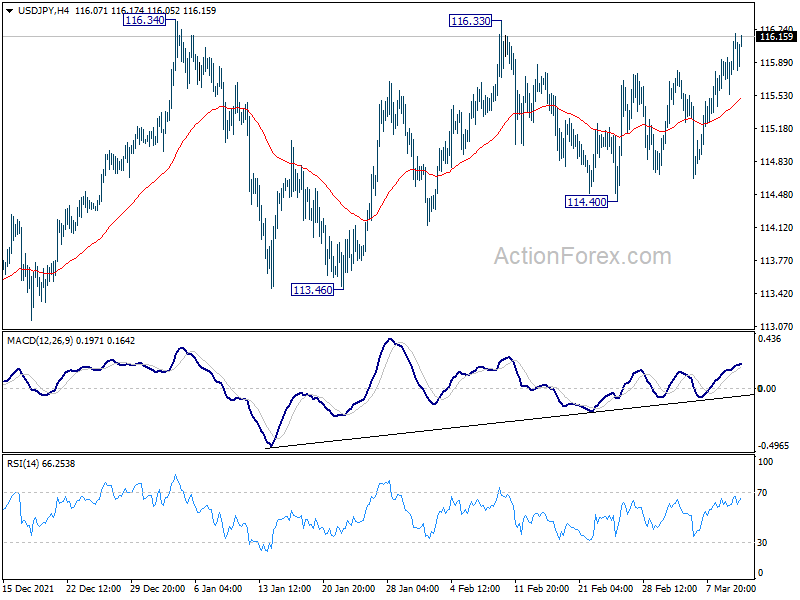
Daily Pivots: (S1) 115.36; (P) 115.58; (R1) 115.88; More...
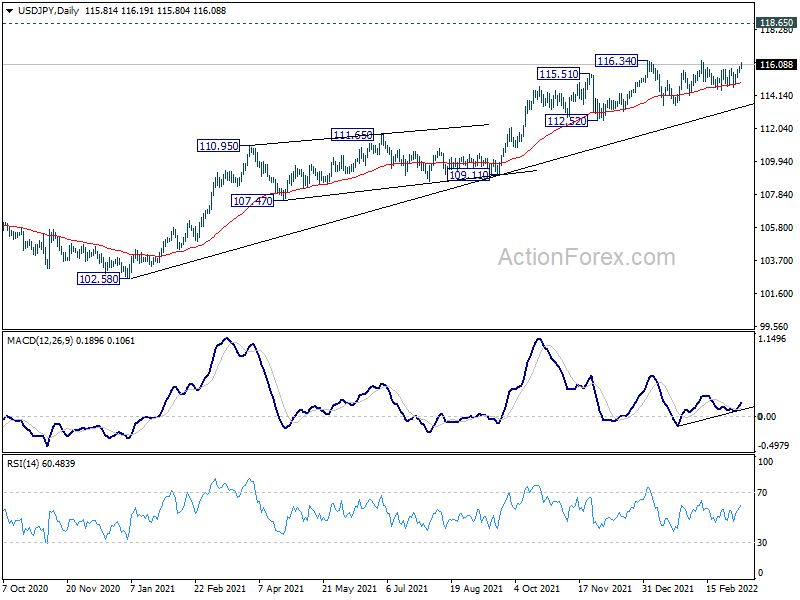
Intraday bias in USD/JPY stays neutral at this point. On the upside, firm break of 116.34 will resume larger up trend from 102.58 to 118.65 long term resistance next. On the downside, though, break of 114.40 will continue the corrective pattern from 116.34 with another fall to 113.46 support.
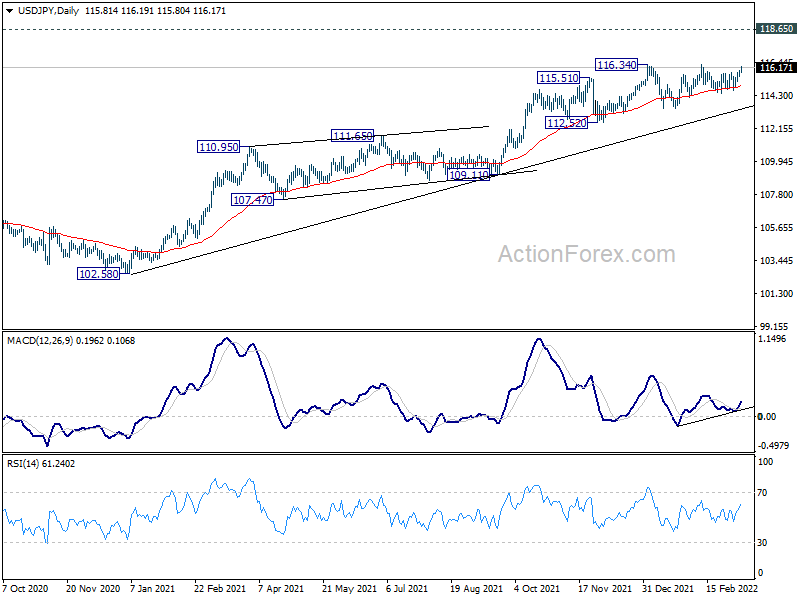
In the bigger picture, no change in the view that rise from 102.58 is the third leg of the up trend from 101.18 (2020 low). Such rally should target a test on 118.65 (2016 high). Sustained break there will pave the way to 120.85 (2015 high) and raise the chance of long term up trend resumption. This will remain the favored case as long as 55 week EMA (now at 111.64) holds.
USD/CHF Mid-Day Outlook
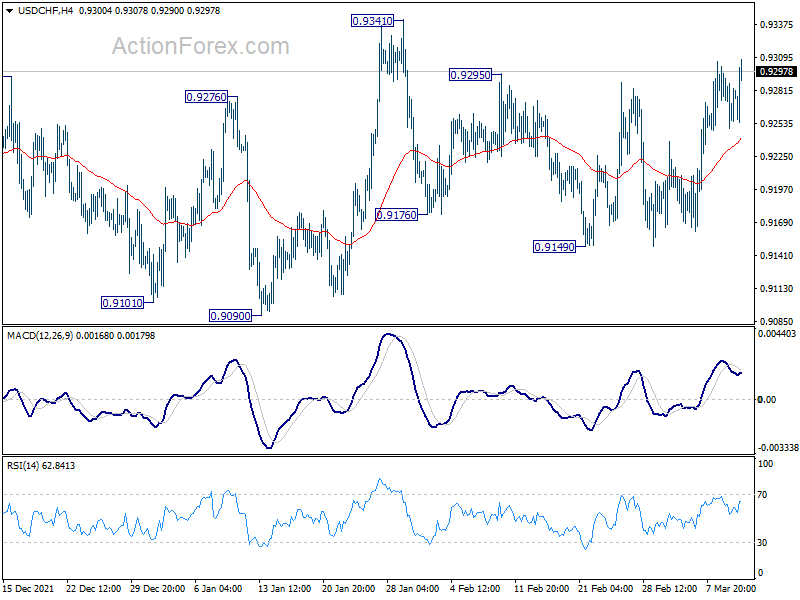
Daily Pivots: (S1) 0.9243; (P) 0.9273; (R1) 0.9296; More....
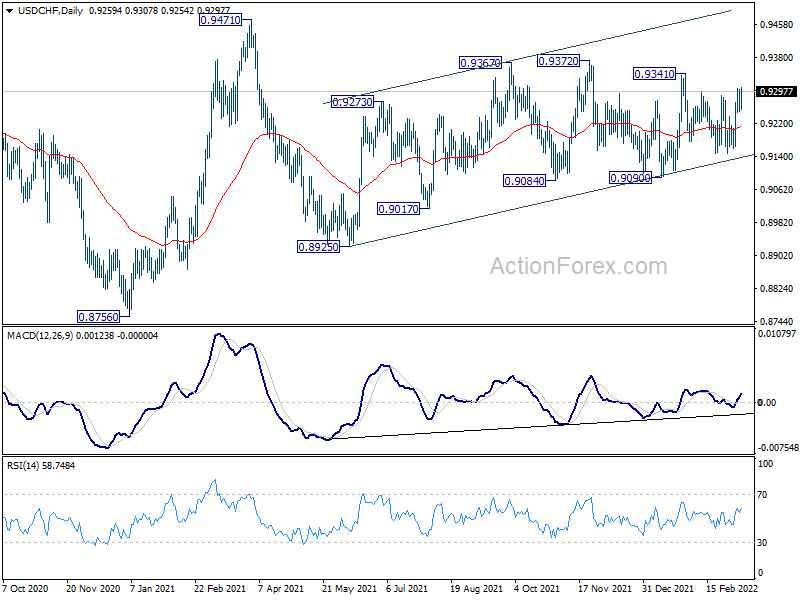
Sideway trading continues in USD/CHF and intraday bias remains neutral. Choppy rise from 0.8925 would still be in favor to extend higher as long as 0.9090 support holds. Break of 0.9341 will target 0.9372 resistance and then 0.9471. On the downside, however, break of 0.9090 will bring deeper fall back to 0.8925 support.
In the bigger picture, medium term outlook will be neutral at best as long as 0.9471 resistance holds. Larger down trend could still extend through 0.8756 (2021 low). However, firm break of 0.9471 will argue that the trend has already reversed and rebound the rally from 0.8756 with another impulsive move.
GBP/USD Mid-Day Outlook
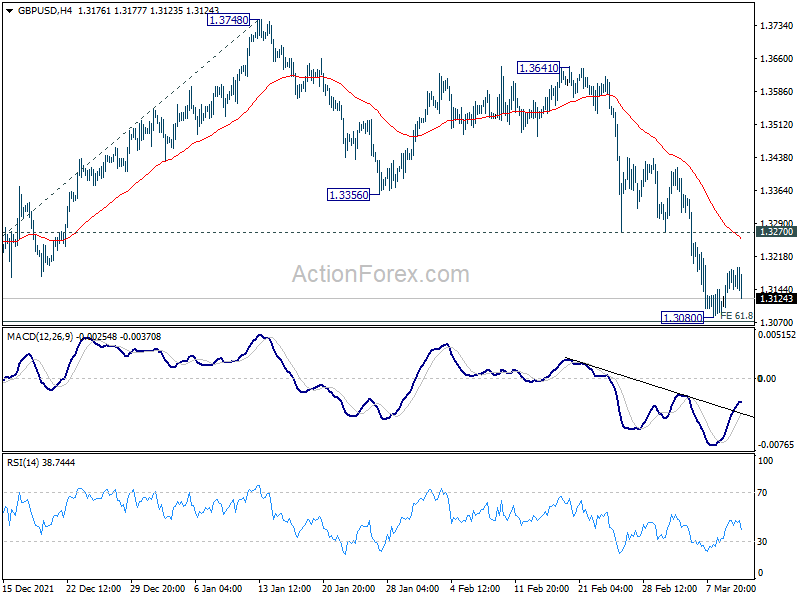
Daily Pivots: (S1) 1.3118; (P) 1.3154; (R1) 1.3219; More...
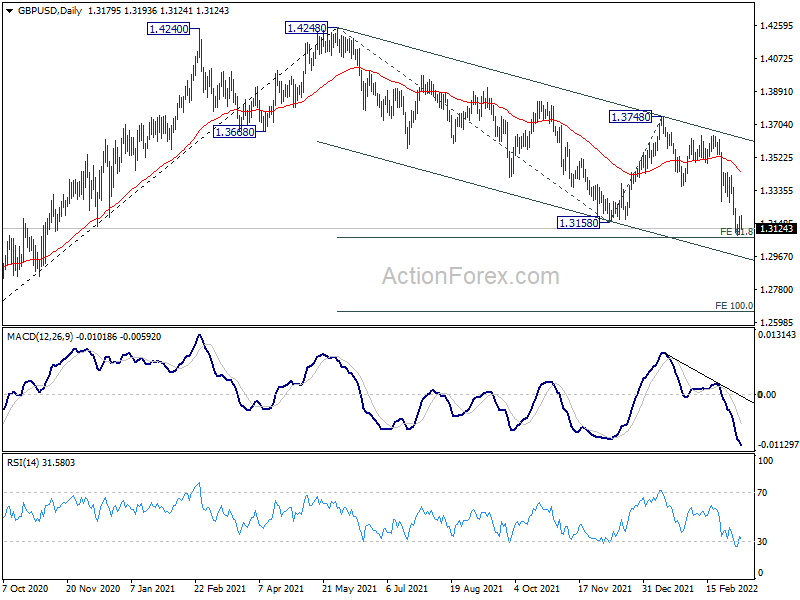
Intraday bias in GBP/USD remains neutral as consolidation form 1.3080 is still extending. Upside of recovery should be limited by 1.3270 support turned resistance. On the downside, sustained break of 61.8% projection of 1.4248 to 1.3158 from 1.3748 at 1.3074 will extend the down trend from 1.4248 to 100% projection at 1.2658. However, strong break of 1.3270 should indicate short term bottoming and bring stronger rebound.
In the bigger picture, current development suggests that the up trend from 1.1409 (2020 low) has completed at 1.4248. Decline from 1.4248 could still be a corrective move, or it could be the start of a long term down trend. In either case, deeper decline would now be seen back to 61.8% retracement of 2.1161 to 1.1409 at 1.2493. In case, break of 1.3748 resistance is needed to indicate medium term bottoming, or outlook will stay bearish.
Euro Rebound Stalls after ECB, Dollar Higher after CPI
Euro's rebound stalls after ECB policy announcement, mainly because risk markets turned softer again. Another round of negotiations between Russia and Ukraine failed and Russia will clearly continue its attack. Dollar is trading slightly higher after CPI came in expected, extending its run on making multi-decade high. Though, as for the day, Aussie is leading commodity currencies higher, Swiss Franc and Yen are weak.
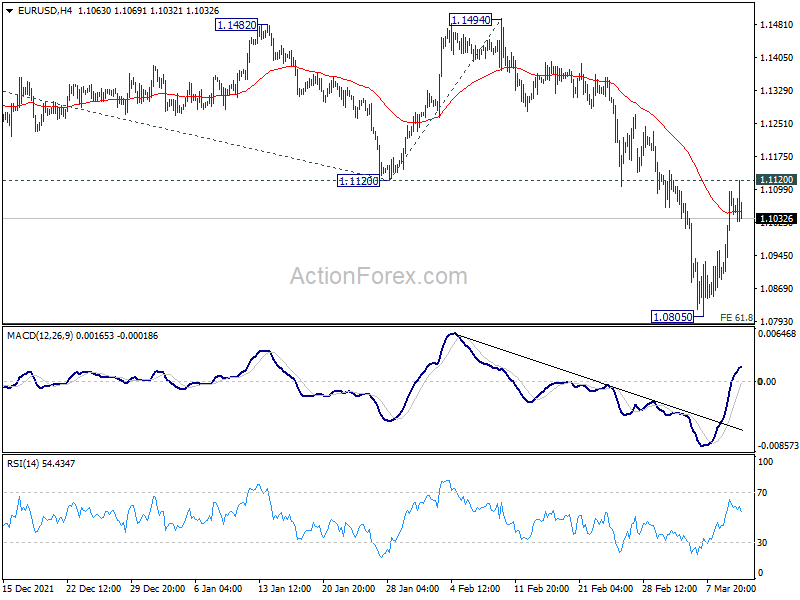
Technically, we'll keep focusing on USD/JPY as it should be ready to break through 116.34 to resume the larger up trend to 118.65 resistance. Also, focus will be on whether EUR/USD would be firmly rejected by 1.1120 resistance, to retain its near term bearishness.
In Europe, at the time of writing, FTSE is down -1.37%. DAX is down -2.92%. CAC is down -2.68%. Germany 10-year yield is up 0.057 at 0.275. Earlier in Asia, Nikkei rose 3.94%. Hong Kong HSI rose 1.27%. China Shanghai SSE rose 1.22%. Singapore Strait Times rose 1.42%. Japan 10-year JGB yield closed flat at 0.192.
ECB sets faster APP purchase wind-down schedule
ECB left interest rate unchanged as widely expected. Main refinancing, marginal lending facility and deposit rate are held at 0.00%, 0.25%, and -0.50% respectively. ECB added that "Any adjustments to the key ECB interest rates will take place some time after the end of the Governing Council's net purchases under the APP and will be gradual."
The pandemic emergency purchase program (PEPP) will stop net purchases as planned at the end of March. The purchase schedule for the regular asset purchase program (APP) is revised, with monthly net purchase at EUR 40B in April, EUR 30B in May and EUR 20B in June.
ECB added that the calibration for APP net purchases in Q3 will be "data-dependent and reflect its evolving assessment of the outlook". If medium term inflation outlook "will not weaken after the end of the net purchases, ECB will conclude net APP purchases in Q3. Also, ECB leaves it open to revise the schedule, size and duration of the purchases.
ECB upgrade inflation forecasts significantly, downgrades GDP forecasts
ECB President Christine Lagarde said in the post meeting press conference, inflation has "continued to surprise on the upside because of unexpectedly high energy costs.", and prices rises became "more broadly based". GDP growth was revised down for the near term, owing to the war in Ukraine.
Inflation projections were revised up "significantly" to 5.1% in 2022 (up from 2.6%), 2.1% in 2023 (up form 1.8%), and 1.9% in 2024 (up from 1.8%).
Excluding food and energy, inflation is projected to average 2.6% in 2022 (up from 1.9%), 1.8% in 2023 (up from 1.7%), and 1.9% in 2024 (up from 1.8%).
The economy is projected to grow 3.7% in 2022 (down from 4.2%), 2.8% in 2023 (down from 2.9%), and 1.6% in 2024 (unchanged).
Lagarde also said, "the Russia-Ukraine war will have a material impact on economic activity and inflation through higher energy and commodity prices, the disruption of international commerce and weaker confidence. The extent of these effects will depend on how the conflict evolves, on the impact of current sanctions and on possible further measures."
US CPI rose to 7.9% yoy in Feb, highest since 1982
US CPI rose 0.8% mom in February, matched expectations. Over the 12-month period, CPI accelerated from 7.5% yoy to 7.9% yoy, matched expectations. The 12-month increase is the largest since January 1982.
CPI core rose 0.5% mom. For the 12-month period, CPI core accelerated from 6.0% yoy to 6.4% yoy, matched expectations. The 12-month increase was the highest since August 1982.
Energy index rose 25.6% yoy. Food index rose 7.9% yoy, highest since July 1981.
US initial jobless claims rose to 227k, above expectations
US initial jobless claims rose 11k to 227k in the week ending March 5, above expectation of 205k. Four-week moving average of initial claims rose 500 to 231k.
Continuing claims rose 25k to 1494k in the week ending February 26. Four-week moving average of continuing claims dropped -31k to 157k, lowest since March 28, 1970.
Japan PPI rose record 9.3% yoy in Feb, led by energy and commodities
Japan corporate goods price index rose 9.3% yoy in February, above expectation of 8.7% yoy. At 110.7, the index hit the highest level marked since 1985. That's also the highest rise on record, as led by skyrocketing energy prices. Coal and petroleum prices jumped 34.2% yoy. Electricity, city gas and water prices also surged 27.5% yoy.
Commodity prices also surged with iron and steel up 24.5% yoy. Nonferrous metal rose 24.9% yoy. Lumber and wood products rose 58.0% yoy.
Import prices rose 34.0% yoy while export prices rose 12.7% yoy.
EUR/USD Mid-Day Outlook
Daily Pivots: (S1) 1.0944; (P) 1.1019; (R1) 1.1149; More...
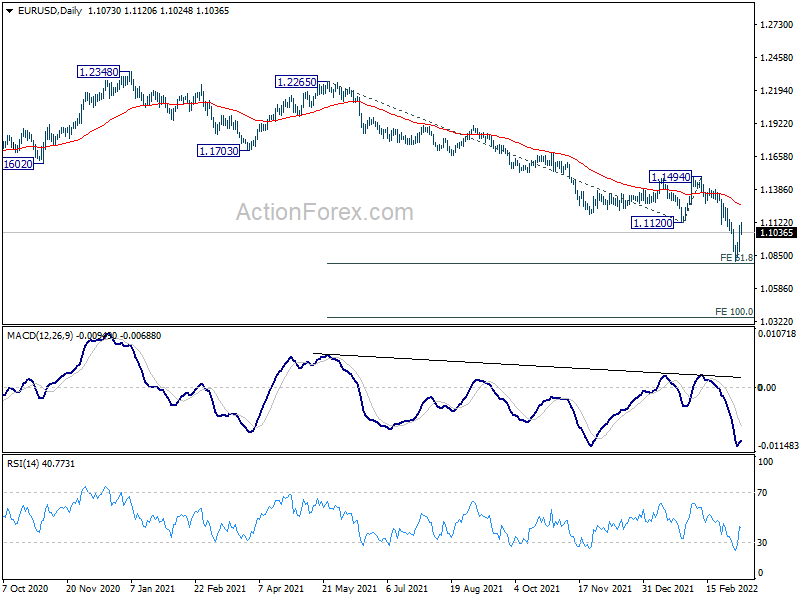
Intraday bias in EUR/USD remains neutral at this point. As long as 1.1120 support turned resistance holds, larger down trend from 1.1494 is still expected to continue. On the downside, firm break of 61.8% projection of 1.2265 to 1.1120 from 1.1494 at 1.0786 will pave they way to 100% projection at 1.0349 next. However, strong break of 1.1120 will confirm short term bottoming, at least, and bring stronger rebound back towards 1.1494 structural resistance instead.
In the bigger picture, the decline from 1.2348 (2021 high) is expected to continue as long as 1.1494 resistance holds. Firm break of 1.0635 (2020 low) will raise the chance of long term down trend resumption and target a retest on 1.0339 (2017 low) next. Nevertheless, break of 1.1494 will maintain medium term neutral outlook, and extend range trading first.
Economic Indicators Update
| GMT | Ccy | Events | Actual | Forecast | Previous | Revised |
|---|---|---|---|---|---|---|
| 23:50 | JPY | PPI Y/Y Feb | 9.30% | 8.70% | 8.60% | 8.90% |
| 00:00 | AUD | Consumer Inflation Expectations Mar | 4.90% | 4.60% | ||
| 00:01 | GBP | RICS Housing Price Balance Feb | 79% | 73% | 74% | |
| 12:45 | EUR | ECB Interest Rate Decision | 0.00% | 0.00% | 0.00% | |
| 13:30 | EUR | ECB Press Conference | ||||
| 13:30 | USD | Initial Jobless Claims (Mar 4) | 227K | 205K | 215K | 216K |
| 13:30 | USD | CPI M/M Feb | 0.80% | 0.80% | 0.60% | |
| 13:30 | USD | CPI Y/Y Feb | 7.90% | 7.90% | 7.50% | |
| 13:30 | USD | CPI Core M/M Feb | 0.50% | 0.50% | 0.60% | |
| 13:30 | USD | CPI Core Y/Y Feb | 6.40% | 6.40% | 6.00% | |
| 15:30 | USD | Natural Gas Storage | -116B | -139B |
EUR/USD Mid-Day Outlook
Daily Pivots: (S1) 1.0944; (P) 1.1019; (R1) 1.1149; More...
Intraday bias in EUR/USD remains neutral at this point. As long as 1.1120 support turned resistance holds, larger down trend from 1.1494 is still expected to continue. On the downside, firm break of 61.8% projection of 1.2265 to 1.1120 from 1.1494 at 1.0786 will pave they way to 100% projection at 1.0349 next. However, strong break of 1.1120 will confirm short term bottoming, at least, and bring stronger rebound back towards 1.1494 structural resistance instead.
In the bigger picture, the decline from 1.2348 (2021 high) is expected to continue as long as 1.1494 resistance holds. Firm break of 1.0635 (2020 low) will raise the chance of long term down trend resumption and target a retest on 1.0339 (2017 low) next. Nevertheless, break of 1.1494 will maintain medium term neutral outlook, and extend range trading first.