

Sample Category Title
ECB upgrade inflation forecasts significantly, downgrades GDP forecasts
ECB President Christine Lagarde said in the post meeting press conference, inflation has "continued to surprise on the upside because of unexpectedly high energy costs.", and prices rises became "more broadly based". GDP growth was revised down for the near term, owing to the war in Ukraine.
Inflation projections were revised up "significantly" to 5.1% in 2022 (up from 2.6%), 2.1% in 2023 (up form 1.8%), and 1.9% in 2024 (up from 1.8%).
Excluding food and energy, inflation is projected to average 2.6% in 2022 (up from 1.9%), 1.8% in 2023 (up from 1.7%), and 1.9% in 2024 (up from 1.8%).
The economy is projected to grow 3.7% in 2022 (down from 4.2%), 2.8% in 2023 (down from 2.9%), and 1.6% in 2024 (unchanged).
Lagarde also said, "the Russia-Ukraine war will have a material impact on economic activity and inflation through higher energy and commodity prices, the disruption of international commerce and weaker confidence. The extent of these effects will depend on how the conflict evolves, on the impact of current sanctions and on possible further measures."
(ECB) Introductory Statement to the Press Conference
Christine Lagarde, President of the ECB,
Luis de Guindos, Vice-President of the ECB
Frankfurt am Main, 10 March 2022
Good afternoon, the Vice-President and I welcome you to our press conference.
The Russian invasion of Ukraine is a watershed for Europe. The Governing Council expresses its full support to the people of Ukraine. We will ensure smooth liquidity conditions and implement the sanctions decided by the European Union and European governments. We will take whatever action is needed to fulfil the ECB's mandate to pursue price stability and to safeguard financial stability.
The Russia-Ukraine war will have a material impact on economic activity and inflation through higher energy and commodity prices, the disruption of international commerce and weaker confidence. The extent of these effects will depend on how the conflict evolves, on the impact of current sanctions and on possible further measures. In recognition of the highly uncertain environment, the Governing Council considered a range of scenarios in today's meeting.
The impact of the Russia-Ukraine war has to be assessed in the context of solid underlying conditions for the euro area economy, helped by ample policy support. The recovery of the economy is boosted by the fading impact of the Omicron coronavirus variant. Supply bottlenecks have been showing some signs of easing and the labour market has been improving further. In the baseline of the new staff projections, which incorporate a first assessment of the implications of the war, GDP growth has been revised downwards for the near term, owing to the war in Ukraine. The projections foresee the economy growing at 3.7 per cent in 2022, 2.8 per cent in 2023 and 1.6 per cent in 2024.
Inflation has continued to surprise on the upside because of unexpectedly high energy costs. Price rises have also become more broadly based. The baseline for inflation in the new staff projections has been revised upwards significantly, with annual inflation at 5.1 per cent in 2022, 2.1 per cent in 2023 and 1.9 per cent in 2024. Inflation excluding food and energy is projected to average 2.6 per cent in 2022, 1.8 per cent in 2023 and 1.9 per cent in 2024, also higher than in the December projections. Longer-term inflation expectations across a range of measures have re-anchored at our inflation target. The Governing Council sees it as increasingly likely that inflation will stabilise at its two per cent target over the medium term.
In alternative scenarios for the economic and financial impact of the war, which will be published together with the staff projections on our website, economic activity could be dampened significantly by a steeper rise in energy and commodity prices and a more severe drag on trade and sentiment. Inflation could be considerably higher in the near term. However, in all scenarios, inflation is still expected to decrease progressively and settle at levels around our two per cent inflation target in 2024.
Based on our updated assessment and taking into account the uncertain environment, the Governing Council today revised the purchase schedule for its asset purchase programme (APP) for the coming months. Monthly net purchases under the APP will amount to €40 billion in April, €30 billion in May and €20 billion in June. The calibration of net purchases for the third quarter will be data-dependent and reflect our evolving assessment of the outlook. If the incoming data support the expectation that the medium-term inflation outlook will not weaken even after the end of our net asset purchases, the Governing Council will conclude net purchases under the APP in the third quarter. If the medium-term inflation outlook changes and if financing conditions become inconsistent with further progress towards our two per cent target, we stand ready to revise our schedule for net asset purchases in terms of size and/or duration.
Any adjustments to the key ECB interest rates will take place some time after the end of our net purchases under the APP and will be gradual. The path for the key ECB interest rates will continue to be determined by the Governing Council's forward guidance and by its strategic commitment to stabilise inflation at two per cent over the medium term. Accordingly, the Governing Council expects the key ECB interest rates to remain at their present levels until it sees inflation reaching two per cent well ahead of the end of its projection horizon and durably for the rest of the projection horizon, and it judges that realised progress in underlying inflation is sufficiently advanced to be consistent with inflation stabilising at two per cent over the medium term.
We also confirmed our other policy measures, as detailed in the press release published at 13:45 today.
I will now outline in more detail how we see the economy and inflation developing, and will then explain our assessment of financial and monetary conditions.
Economic activity
The economy grew by 5.3 per cent in 2021, with GDP returning to its pre-pandemic level at the end of the year. However, growth slowed to 0.3 per cent in the final quarter of 2021 and is expected to remain weak during the first quarter of 2022.
The prospects for the economy will depend on the course of the Russia-Ukraine war and on the impact of economic and financial sanctions and other measures. At the same time, other headwinds to growth are now waning. In the baseline of the staff projections, the euro area economy should still grow robustly in 2022 but the pace will be slower than was expected before the outbreak of the war. Measures to contain the spread of the Omicron coronavirus variant have had a milder impact than during previous waves and are now being lifted. The supply disruptions caused by the pandemic also show some signs of easing. The impact of the massive energy price shock on people and businesses may be partly cushioned by drawing on savings accumulated during the pandemic and by compensatory fiscal measures.
Over the medium term, according to the baseline of the staff projections, growth will be driven by robust domestic demand, supported by a stronger labour market. With more people in jobs, households should earn higher incomes and spend more. The global recovery and the ongoing fiscal and monetary policy support are also contributing to this growth outlook. Fiscal and monetary support remains critical, especially in this difficult geopolitical situation.
Inflation
Inflation increased to 5.8 per cent in February, from 5.1 per cent in January.We expect it to rise further in the near term. Energy prices, which surged by 31.7 per cent in February, continue to be the main reason for this high rate of inflation and are also pushing up prices across many other sectors. Food prices have also increased, owing to seasonal factors, elevated transportation costs and the higher price of fertilisers. Energy costs have risen further in recent weeks and there will be further pressure on some food and commodity prices owing to the war in Ukraine.
Price rises have become more widespread. Most measures of underlying inflation have risen over recent months to levels above two per cent. However, it is uncertain how persistent the rise in these indicators will be, given the role of temporary pandemic-related factors and the indirect effects of higher energy prices. Market-based indicators suggest that energy prices will stay high for longer than previously expected but will moderate over the course of the projection horizon. Price pressures stemming from global supply bottlenecks should also subside.
Labour market conditions have continued to improve, with unemployment falling to 6.8 per cent in January. Even though labour shortages are affecting more and more sectors, wage growth remains muted overall. Over time, the return of the economy to full capacity should support somewhat faster growth in wages. Various measures of longer-term inflation expectations derived from financial markets and from surveys stand at around two per cent. These factors will also contribute further to underlying inflation and will help headline inflation to settle durably at our two per cent target.
Risk assessment
The risks to the economic outlook have increased substantially with the Russian invasion of Ukraine and are tilted to the downside. While risks relating to the pandemic have declined, the war in Ukraine may have a stronger effect on economic sentiment and could worsen supply-side constraints again. Persistently high energy costs, together with a loss of confidence, could drag down demand more than expected and constrain consumption and investment.
The same factors are risks to the outlook for inflation, which are on the upside in the near term. The war in Ukraine is a substantial upside risk, especially to energy prices. If price pressures feed through into higher than anticipated wage rises or if there are adverse persistent supply-side implications, inflation could also turn out to be higher over the medium term. However, if demand were to weaken over the medium term, this could also lower pressures on prices.
Financial and monetary conditions
The Russian invasion of Ukraine has caused substantial volatility in financial markets. Following the outbreak of the war, risk-free market interest rates have partially reversed the increase observed since our February meeting and equity prices have fallen.
The financial sanctions against Russia, including the exclusion of some Russian banks from SWIFT, have so far not caused severe strains in money markets or liquidity shortages in the euro area banking system. Bank balance sheets remain healthy overall, owing to robust capital positions and fewer non-performing loans. Banks are now as profitable as they were before the pandemic.
Bank lending rates for firms have increased somewhat, while lending rates for household mortgages remain steady at historically low levels. Lending flows to firms have declined after increasing strongly in the last quarter of 2021. Lending to households is holding up, especially for house purchases.
Conclusion
Summing up, the Russian invasion of Ukraine will negatively affect the euro area economy and has significantly increased uncertainty. If the baseline of the staff projections materialises, the economy should continue to rebound thanks to the declining impact of the pandemic and the prospect of solid domestic demand and strong labour markets. Fiscal measures, including at the European Union level, would also help to shield the economy. Based on our updated assessment of the inflation outlook and taking into account the uncertain environment, we revised our schedule for net asset purchases over the coming months and confirmed all our other policy measures.We are very attentive to the prevailing uncertainties. The calibration of our policies will remain data-dependent and reflect our evolving assessment of the outlook. We stand ready to adjust all of our instruments to ensure that inflation stabilises at our two per cent target over the medium term.
We are now ready to take your questions.
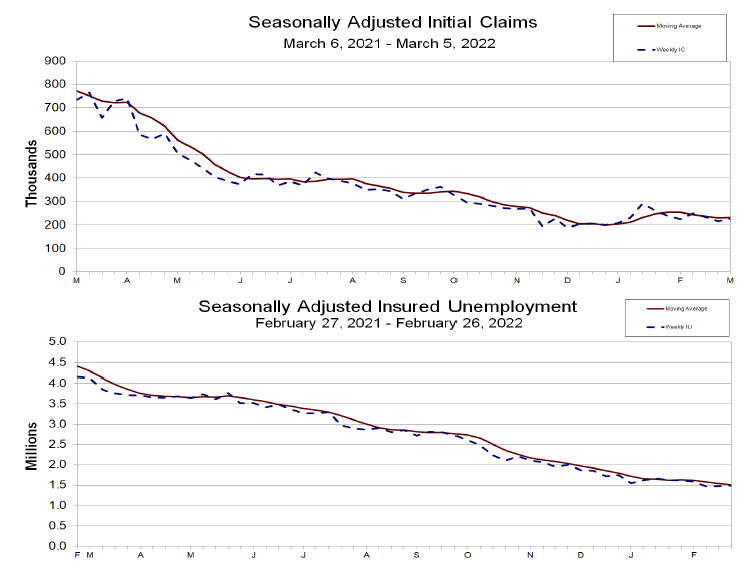
US initial jobless claims rose to 227k, above expectations
US initial jobless claims rose 11k to 227k in the week ending March 5, above expectation of 205k. Four-week moving average of initial claims rose 500 to 231k.
Continuing claims rose 25k to 1494k in the week ending February 26. Four-week moving average of continuing claims dropped -31k to 157k, lowest since March 28, 1970.
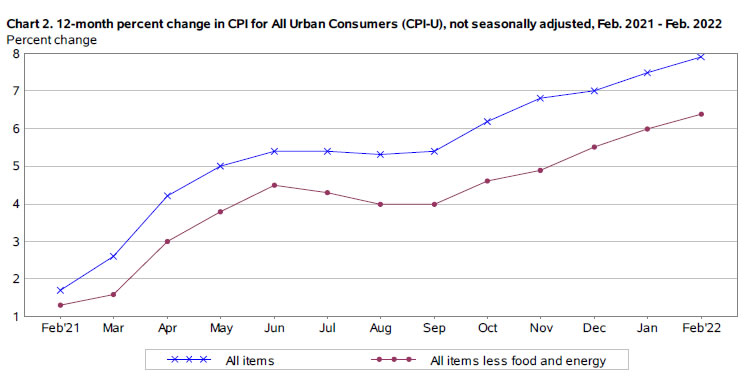
US CPI rose to 7.9% yoy in Feb, highest since 1982
US CPI rose 0.8% mom in February, matched expectations. Over the 12-month period, CPI accelerated from 7.5% yoy to 7.9% yoy, matched expectations. The 12-month increase is the largest since January 1982.
CPI core rose 0.5% mom. For the 12-month period, CPI core accelerated from 6.0% yoy to 6.4% yoy, matched expectations. The 12-month increase was the highest since August 1982.
Energy index rose 25.6% yoy. Food index rose 7.9% yoy, highest since July 1981.
Peace Talks Break Down Between Russia and Ukraine
- Latest peace talks fail, no progress on ceasefire
- Kuleba: Russia seeks surrender, Ukraine won't surrender
- Lavrov: Ukraine seems to want to have meetings for the sake of meetings
- Sanctions on Russia pile up: UK freezes assets of Russian oligarchs
- Last US CPI print coming up before the Fed hikes next week
- ECB has a big dilemma
After the big rally for equities and the euro and even bigger plunge for some key commodity prices on Wednesday, there has been a complete lack of follow-through in those moves at the time of writing this Thursday morning. The latest talks between Russia and Ukraine failed to provide breakthrough in ending the war. Markets have reacted in the way you would expect. Later today, we will have the ECB’s decision on monetary policy and press conference, as well as the last US CPI print before the Fed hikes rates next week. While these events may provide some volatility, the focus for the wider markets remains firmly fixated on Russia’s invasion of Ukraine and whether there will be any progress in peace talks in the coming days.
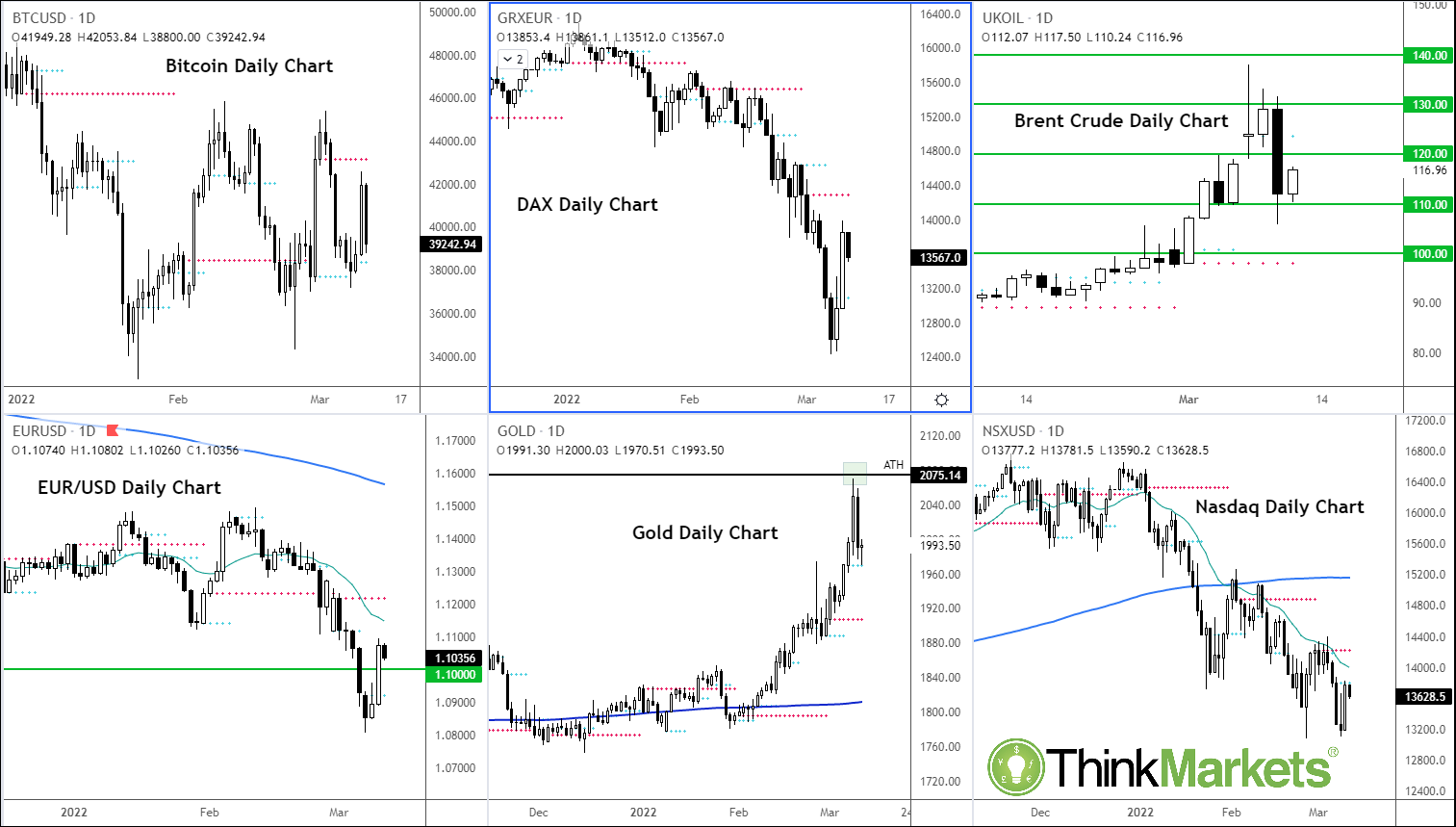
Commodities have rebounded after peace talks failed. Aluminium for example was up 5% and crude oil more than 4% higher, although wheat was down a touch and precious metals flat. European equity indices and US futures fell, with the risk off tone also hurting cryptocurrencies. Bitcoin dropped back below $40K after its big gains the day before. While the moves have so far not been as crazy as those observed earlier in the week, it goes to show that investors are not out of the woods just yet and more extreme volatility could be on the way.
There was a bit of hope that Russia’s Lavrov and Ukraine’s Kuleba would achieve something after starting peace talks in Turkey. But both sides are unwilling to make any major compromises to end the conflict. So, unsurprisingly, there was not progress at conclusion of the talks, which is why risk appetite has been held back so far.
Kuleba has said that they are ready to meet again but added that they cannot stop the war if the country that started it, meaning Russia, has no desire to do so. He added that Russia is seeking a surrender, but Ukraine won't surrender.
A couple of days ago, Russia had said the aim of its operations do not include overthrowing Ukrainian government and that it would be better if their goals are achieved through talks than military conflict. Talks are indeed always better than going to war, especially if there are no intentions of overthrowing the government. This might be a sign that Russia is blinking. But actions speak louder than words and Russia will have to do more than this. There is also the issue of trust, as this is the same people who told us that the troops on the Ukrainian border returned to base, only to then invade Ukraine shortly after.
Meanwhile, the West are continuing to add sanctions on Russia. Today, the UK government has announced a full asset freeze and travel ban on several of Russia’s oligarchs, whose business empires, wealth and connections are closely associated with the Kremlin. They include:
- Roman Abramovich owner of Chelsea FC and has stakes in steel giant Evraz and Norilsk Nickel
- Oleg Deripaska has stakes in En+ Group
- Igor Sechin is the Chief Executive of Rosneft
- Andrey Kostin is Chairman of VTB bank
- Alexei Miller is CEO of energy company Gazprom
- Nikolai Tokarev is president of the Russia state-owned pipeline company Transneft
- Dmitri Lebedev is Chairman of the Board of Directors of Bank Rossiya
The UK has already announced it will phase out the import of Russian oil and oil products by the end of the year. Don’t forget that the US also decided to launch an all-out economic war against Russia, banning imports of oil and gas from Russia. There will be consequences: high gas prices, even more inflation and retaliation from Russia.
Away from geopolitics, nothing else matters much, although we have the ECB policy decision coming up and the last US CPI inflation print before the Fed hikes rates next week.
US CPI is expected to come in 0.8% month-over-month following a 0.6% rise in January while core CPI is expected to have climbed 0.5% in February. On a year-over-year basis, head CPI is seen rising to 7.9% form 7.5%, while core CPI is expected to climb to 6.4% from 6.0% previously.
It will be interesting to hear how Christine Lagarde and her ECB colleagues will react to the big upsurge in key commodity prices given their conflicting impact on consumer inflation (positive) and the economy (negative).
Euro Rally Pauses as ECB Stays Pat
ECB maintains interest rates, reduces APP
The ECB held its key interest rate at 0.00% at today’s meeting, as was expected. The central bank reduced purchases under the Asset Purchase Program (APP), which had been set in February at EUR 40 billion throughout the second quarter. Instead, the ECB will purchase EUR 40 billion in April, 30 billion in May and 20 billion in June. The APP purchases are scheduled to end in the third quarter, rather than in Q4. After that, the ECB will be in a position to raise interest rates.
The financial markets continue to be rocked by extreme volatility, and this has been the case with the euro, which soared 1.67% on Wednesday. The euro is risk-sensitive, especially towards the Ukraine crisis, which is in proximity to the eurozone. Risk appetite improved on Wednesday, as oil prices retreated and some Ukrainian civilians managed to utilize human corridors and get away from the fighting. The dollar was down broadly, although traders would be wise to keep in mind that we are only a (negative) headline away from risk sentiment evaporating and sending the safe-haven dollar to higher ground.
On the Ukraine front, a meeting between the foreign ministers of Russia and Ukraine earlier today did not result in any breakthroughs, although the sides agreed to continue to meet. The fighting continues, and with the Russian invasion force appearing to have stalled, there are fears that Russian President Putin could barrel down in frustration and hit more civilian targets. This would exacerbate the massive humanitarian crisis, which has displaced millions of Ukrainians.
Later in the day, the US releases inflation reports for February. The markets are braced for a further acceleration in headline CPI, which is expected to hit 7.9% YoY, up from 7.5% beforehand. A print of 8.0% or higher will essentially cement a Fed rate hike next week and could result in the Fed members sending a hawkish message to the markets, as inflation continues to be one of the most important economic issues.
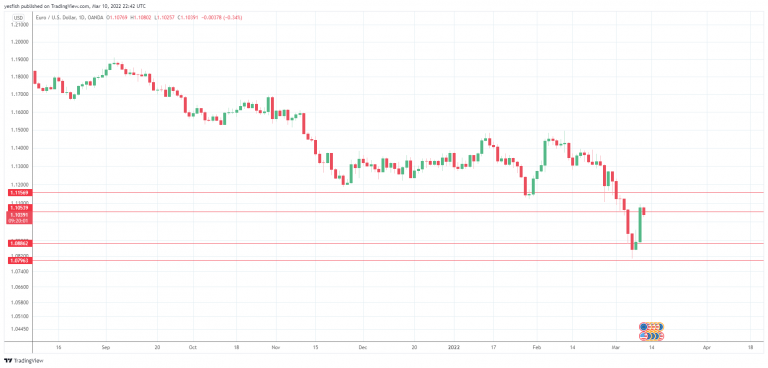
EUR/USD Technical
- EUR/USD continues to put pressure on resistance at 1.1053. Above, there is resistance at 1.1156
- There is support at 1.0886 and 1.0796
ECB sets faster APP purchase wind-down schedule
ECB left interest rate unchanged as widely expected. Main refinancing, marginal lending facility and deposit rate are held at 0.00%, 0.25%, and -0.50% respectively. ECB added that "Any adjustments to the key ECB interest rates will take place some time after the end of the Governing Council's net purchases under the APP and will be gradual."
The pandemic emergency purchase program (PEPP) will stop net purchases as planned at the end of March. The purchase schedule for the regular asset purchase program (APP) is revised, with monthly net purchase at EUR 40B in April, EUR 30B in May and EUR 20B in June.
ECB added that the calibration for APP net purchases in Q3 will be " data-dependent and reflect its evolving assessment of the outlook". If medium term inflation outlook "will not weaken after the end of the net purchases, ECB will conclude net APP purchases in Q3. Also, ECB leaves it open to revise the schedule, size and duration of the purchases.
(ECB) Monetary policy decisions
The Russian invasion of Ukraine is a watershed for Europe. The Governing Council expresses its full support to the people of Ukraine. It will ensure smooth liquidity conditions and implement the sanctions decided by the European Union and European governments. The Governing Council will take whatever action is needed to fulfil the ECB's mandate to pursue price stability and to safeguard financial stability.
Asset purchase programme (APP)
Based on its updated assessment and taking into account the uncertain environment, the Governing Council today revised the purchase schedule for its APP for the coming months. Monthly net purchases under the APP will amount to €40 billion in April, €30 billion in May and €20 billion in June. The calibration of net purchases for the third quarter will be data-dependent and reflect its evolving assessment of the outlook. If the incoming data support the expectation that the medium-term inflation outlook will not weaken even after the end of our net asset purchases, the Governing Council will conclude net purchases under the APP in the third quarter. If the medium term inflation outlook changes and if financing conditions become inconsistent with further progress towards our two per cent target, we stand ready to revise our schedule for net asset purchases in terms of size and/or duration.
The Governing Council also intends to continue reinvesting, in full, the principal payments from maturing securities purchased under the APP for an extended period of time past the date when it starts raising the key ECB interest rates and, in any case, for as long as necessary to maintain favourable liquidity conditions and an ample degree of monetary accommodation.
Key ECB interest rates
The interest rate on the main refinancing operations and the interest rates on the marginal lending facility and the deposit facility will remain unchanged at 0.00%, 0.25% and -0.50% respectively.
Any adjustments to the key ECB interest rates will take place some time after the end of the Governing Council's net purchases under the APP and will be gradual. The path for the key ECB interest rates will continue to be determined by the Governing Council's forward guidance and by its strategic commitment to stabilise inflation at two per cent over the medium term. Accordingly, the Governing Council expects the key ECB interest rates to remain at their present levels until it sees inflation reaching two per cent well ahead of the end of its projection horizon and durably for the rest of the projection horizon, and it judges that realised progress in underlying inflation is sufficiently advanced to be consistent with inflation stabilising at two per cent over the medium term.
Pandemic emergency purchase programme (PEPP)
In the first quarter of 2022, the Governing Council is conducting net asset purchases under the PEPP at a lower pace than in the previous quarter. It will discontinue net asset purchases under the PEPP at the end of March 2022.
The Governing Council intends to reinvest the principal payments from maturing securities purchased under the PEPP until at least the end of 2024. In any case, the future roll-off of the PEPP portfolio will be managed to avoid interference with the appropriate monetary policy stance.
The pandemic has shown that, under stressed conditions, flexibility in the design and conduct of asset purchases has helped to counter the impaired transmission of monetary policy and made the Governing Council's efforts to achieve its goal more effective. Within the Governing Council's mandate, under stressed conditions, flexibility will remain an element of monetary policy whenever threats to monetary policy transmission jeopardise the attainment of price stability. In particular, in the event of renewed market fragmentation related to the pandemic, PEPP reinvestments can be adjusted flexibly across time, asset classes and jurisdictions at any time. This could include purchasing bonds issued by the Hellenic Republic over and above rollovers of redemptions in order to avoid an interruption of purchases in that jurisdiction, which could impair the transmission of monetary policy to the Greek economy while it is still recovering from the fallout from the pandemic. Net purchases under the PEPP could also be resumed, if necessary, to counter negative shocks related to the pandemic.
Refinancing operations
The Governing Council will continue to monitor bank funding conditions and ensure that the maturing of operations under the third series of targeted longer-term refinancing operations (TLTRO III) does not hamper the smooth transmission of its monetary policy. The Governing Council will also regularly assess how targeted lending operations are contributing to its monetary policy stance. As announced, it expects the special conditions applicable under TLTRO III to end in June this year. The Governing Council will also assess the appropriate calibration of its two-tier system for reserve remuneration so that the negative interest rate policy does not limit banks' intermediation capacity in an environment of ample excess liquidity.
Liquidity lines with non-euro area central banks
In view of the highly uncertain environment caused by the Russian invasion of Ukraine and the risk of regional spillovers that could adversely affect euro area financial markets, the Governing Council decided to extend the Eurosystem repo facility for central banks (EUREP) until 15 January 2023. EUREP will therefore continue to complement the regular euro liquidity-providing arrangements for non-euro area central banks. Together, these form a comprehensive set of backstop facilities to address possible euro liquidity needs in the event of market dysfunctions outside the euro area that could adversely affect the smooth transmission of the ECB's monetary policy. Requests from non-euro area central banks for individual euro liquidity lines will be assessed by the Governing Council on a case-by-case basis.
***
The Governing Council stands ready to adjust all of its instruments, as appropriate, to ensure that inflation stabilises at its 2% target over the medium term.
The President of the ECB will comment on the considerations underlying these decisions at a press conference starting at 14:30 CET today.
GBP/USD Outlook: Recovery Loses Traction, Keeping in Play Risk of Bearish
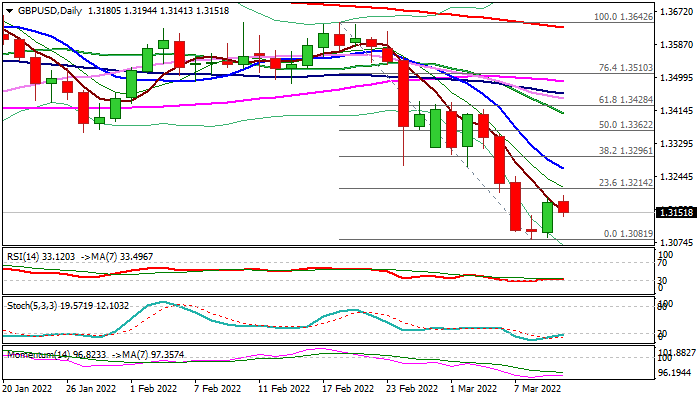
Cable eases on Thursday following repeated rejection on approach to 1.3200 barrier, signaling that fresh bulls might be running out of steam.
Initial signal of reversal on formation of Doji reversal pattern failed to get a confirmation on extension above 1.3214 (Fibo 23.6% of 1.3642/1.3081 bear-leg), warning that recovery was short-lived and larger bears are about to re-take full control.
Daily studies support this scenario as 14-d momentum remains deeply in the negative territory and full bearish setup of daily MA’s stays intact, however, bears need to register weekly close below key supports at 1.3164/20 (Fibo 38.2% of 1.1409/1.4249 / cracked 200WMA) to confirm bearish stance generate initial signal of bearish continuation.
Violation of new multi-month low at 1.3081 (the lowest since Nov 2020) would open way towards psychological 1.30 support and 1.2829 (50% retracement of 1.1409/1.4249) in extension.
Initial resistances lay at 1.3194/1.3214, followed by falling 10DMA (1.3265), but only sustained break above former strong support at 1.3300 zone (broken Fibo 76.4% of 1.3161/1.3748 / Fibo 38.2% of 1.3642/1.3081 bear-leg) would sideline larger bears.
Res: 1.3194; 1.3214; 1.3265; 1.3300.
Sup: 1.3124; 1.3081; 1.3000; 1.2950.
The US Won’t allow crypto to be used as shadow business
Bitcoin soared 8.8% on Wednesday, ending the day around $41.9K. Apparently, the benchmark cryptocurrency experienced clear problems with growth above $42K. On Thursday morning we see an equally strong reversal move back to $39K. As a result, Bitcoin lost 5.6% in 24hours Ethereum – 4.8%, other leading altcoins from the top ten are declining from 1% (Terra) to 7.2% (Avalanche).
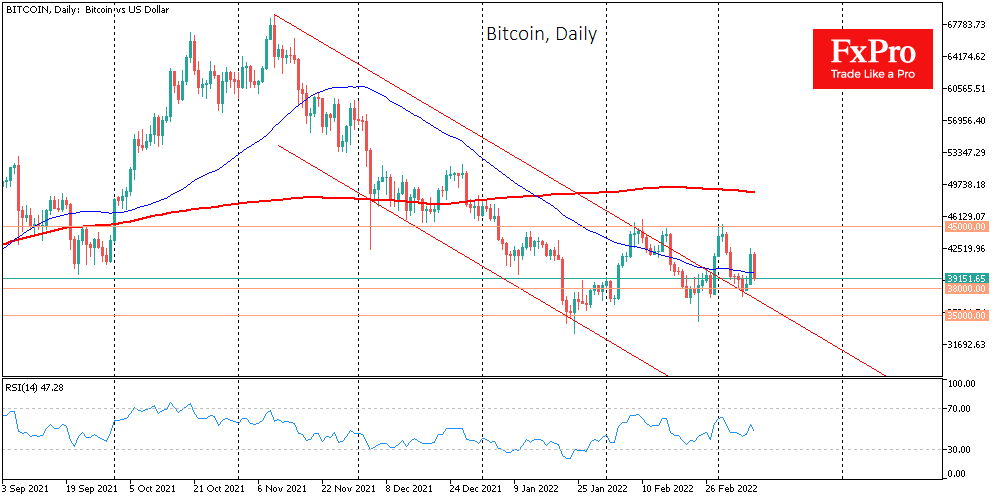
According to CoinMarketCap, the total capitalization of the crypto market decreased by 4.5% over the day, to $1.75 trillion. The Bitcoin Dominance Index dropped from 43.0% to 42.7%.
The Cryptocurrency Fear and Greed Index added 6 points to 28, climbing into “fear” territory.
Bitcoin’s growth momentum was also supported by the positive dynamics of stock indices, however, on Thursday morning, the positive pull on them remains in contrast to the sell-off of cryptocurrencies.
Bitcoin jumped when a statement by Janet Yellen appeared on the website of the US Department of the Treasury, which does not contain strict measures to control the field of cryptocurrencies. The statement was posted, probably prematurely, and then quickly removed from the site.
Later on Wednesday, US President Joe Biden signed the first executive order to regulate cryptocurrencies in the country. The document contained only the most general provisions, such as consumer protection, financial stability, technology development and the illegal use of cryptocurrencies. More specific measures in the field of control over the digital asset market will be developed by individual federal departments.
In our opinion, the States are making it clear that they will not allow cryptocurrencies to become a shadow business and be used to circumvent sanctions, taxes, money laundering and similar things. Such control is more difficult to implement than with centrally issued fiat money.