Sample Category Title
USD/TRY Outlook: Break of Key Supports Generates Negative Signals for Turkish Lira
The cross rose over 0.5% on Monday and hit 8-day high, on a biggest one-day rally in one month.
Sterling, as more risk-sensitive currency than the euro, reacted negatively on strong risk aversion that pushed global equities sharply lower.
Today’s rally completed reversal pattern on a daily chart, signaling an end of multi-day congestion, while surge above daily cloud (spanned between 0.8525 and 0.8559) suggest that bulls regained control, with close above daily cloud top to confirm and generate strong bullish signal.
Improving daily studies (north-heading 14-d momentum is about to break into positive territory and MA turned to bullish setup) support the action.
Fresh bullish acceleration has so far retraced over 61.8% of 0.8613/0.8500 bear-leg) and pressuring next Fibo barrier at 0.8587 (76.4%) violation of which would open way towards key resistance at 0.8613 Sep 7 high).
Broken cloud top reverted to significant support which should keep the downside protected.
Res: 0.8595; 0.8609; 0.8633; 0.8642.
Sup: 0.8569; 0.8559; 0.8543; 0.8525.
Temporary Comfort
European stock markets have been given an unexpected boost on Tuesday following reports that the bloc is close to an agreement on fresh joint bond sales to fund major projects.
It was reported that the joint bond sale will fund energy and defence spending across the EU following the Russian invasion of Ukraine. Europe has long been criticised for its over-reliance on Russian oil and gas, as well as its failure to hit its 2% NATO defence spending target, and the invasion has created the urgency to make the long-overdue changes.
While the short-term solutions will probably be focused on diversifying its supply, there will likely be a significant acceleration in its push towards green energy in the longer term. The size and make-up of the package could be announced in the coming days which will highlight just how seriously the EU is about transitioning away from Russia in light of recent events.
Unfortunately, these reports will only likely bring temporary reprieve in equity markets, a day after they were tipped into bear market territory. There still remains considerable uncertainty around the Russian invasion of Ukraine and commodity markets are continuing to see some extraordinary moves as a result.
The ripple effects from the invasion are severe and widespread and the worst may still be to come as traders desperately try to assess the fallout from potential supply disruptions of a wide range of commodities. The LME was forced to suspend nickel trading earlier after the price more than doubled to above $100,000 per metric ton in the mother of all short squeezes. Further market turbulence in the commodity space could easily follow.
Oil higher as the US prepares Russian import ban
There's a lot going on in the oil market at the minute which is contributing to the huge amount of volatility and uncertainty we're seeing. It's such a headline-driven market at the moment and today is certainly no different. US President Joe Biden is reportedly preparing to announce a unilateral ban on imports of Russian oil, LNG, and coal as part of the latest actions to hold the country accountable for its invasion of Ukraine.
The "unilateral" aspect of that is the most important as far as markets are concerned which is why oil prices are only 5-6% higher today, rather than 15-20%. Still, it's a bold move from the US, even if Russian imports make up a relatively small number. It's another step towards the West turning its back on Russia and leaving it isolated in the world. Europe's move will be slower but the debt raising is a big first step towards something similar.
At the same time, the IEA has warned the 60 million barrel coordinated reserve release last week was just an initial response and represented just 4% of IEA member stores. The group is expected to go further in order to bring down the price and we can only hope that future efforts will be more successful.
Of course, against the backdrop of war in Ukraine and severe sanctions against Russia, that's easier said than done. There was a not-so-subtle dig at Saudi Arabia and UAE in there as well, both of whom have refused to use spare capacity to ease supply issues and instead stuck with their fellow OPEC+ partners.
Rarely been a stronger bull case for gold as it approaches all-time highs
We may be seeing a temporary rebound in risk appetite today but that's not weighing on demand for gold, as commodity prices continue to spur fears of soaring inflation and recessions. The yellow metal has stormed above $2,000 to trade up around 2% on the day and it's not looking like slowing down.
Record highs are not that far away and it's hard to imagine a scenario in which demand doesn't remain strong. We're seeing such significant amounts of volatility and uncertainty at the moment that there's rarely been a stronger bull case for a traditional safe haven like gold.
Bitcoin facing major risk headwinds again
Bitcoin is recovering alongside risk appetite, up around 3% on the day. The realignment with broader risk appetite has been an interesting development having gone through a period of gains on the back of increased adoption following the invasion and Russian sanctions.
There's still scope for further support if we see more evidence of increased adoption but the realignment with risk could now be a headwind for the price. It's hard to imagine a significant rebound against the backdrop of the terrible scenes in Ukraine and increasing sanctions.
Dollar and US Futures Look Steady; Gold Shines
Ukraine – Russia tensions; rouble continues the drop
Russia-Ukraine peace talks have made no headway, and despite Germany's resistance to a ban on Russian energy imports, oil futures have fallen from a 14-year high reached on Monday. Analysts expect the supply shock to linger and harm growth in the coming months.
A convoy of buses are on their way to Mariupol to evacuate civilians from the southern port, which has been cut off from food, water, electricity, and heat for more than a week and has been subjected to incessant bombardment as a result of the conflict.
According to the United Nations, the number of refugees who have fled Ukraine has surpassed 2 million, making it one of the fastest exoduses in contemporary history.
Against the dollar, the rouble has lost around 40% of its value since the beginning of the year, with losses dramatically accelerated following Russia's invasion of Ukraine on February 24. The invasion prompted broad sanctions from governments throughout the world.
ECB meets later in the week; euro pares some losses
The euro plunged near a 22-month low of $1.0805 on Tuesday as the crisis in Ukraine cast a shadow over Europe's economic prospects, while commodity currencies took a pause from their weeks-long surge.
The European Central Bank (ECB) meets on Thursday with the threat of stagflation hanging over its heads, prompting economists to predict that policymakers will delay rate hikes until late in the year.
Dollar and stocks retreat
The dollar index is down from the 22-month peak, while the US stock futures are planning for a marginal positive open after a strong bearish momentum in the preceding sessions. The market has once again begun to price in additional Fed tightening. Recent statements are bolstering the belief that the Fed is on track to begin the tightening cycle with a 25-basis point increase.
The yen slipped marginally to $115.70, as rising oil import costs contributed to Japan's largest current account deficit since 2014 in January, according to the Bank of Japan.
Pound advances somewhat; gold holds above $2,000
The pound gained ground after the drop below 1.3100 on Monday versus the dollar while euro/pound is heading north, finding support at the 0.8200 round number after it reached its lowest level since June 2016, in part as a result of diverging policy expectations.
A lull in commodity currencies was observed, with the Australian and New Zealand dollars reversing early gains from their four-month highs reached on Monday. Gold prices remain above $2,000 per ounce, continuing the sharp upside rally.
Sunset Market Commentary
Markets
At the start this morning, it looked that trading would continue on yesterday’s risk-off script. Volatility remained elevated and so were energy/commodity prices. Uncertainty was fueled further by comments from Russian officials that the country could cut off gas delivery to Europe in response to European sanctions. However, fortunes changed early in European dealings. Bloomberg reported that the EU might soon present a new large-scale funding scheme (bond issuance) to facilitate the energy transition and to finance defense spending. The plan might be discussed at the EU Summit in Versailles later this week. Concrete details including on the size of the program are not available yet. Even so, European equities switched losses of more than 1.0% to touch intraday gains of 2.0% soon after the report. Gains partially evaporated later. The Eurostoxx50 gains about 0.50%. Italian and Spanish equities outperform. US indices show an indecisive pattern at the open. The impact on interest rate markets was more pronounced/sustained. Yesterday, EMU yields already trended higher due to a sharp rise in inflation expectations, despite an outright risk-off context. If (EU) fiscal policy would play a bigger role in mitigating the growth impact of current crisis monetary policy (the ECB), ceteris paribus, has more room to try to arrest runaway inflation. The German yield curve sharply bear steepens with yields rising between 8.5 bps (2-y) and 15.5 bps (30-y). The rise was both due to still higher inflation expectations and a more modest rise in the real yield. The prospect/hope on more funding at EU level also favoured non-core EMU bonds. 10-y spreads versus Germany narrow 19 bps for Greece, 13 bps for Italy and 9/8 bps for the likes of Portugal and Spain. US yields show a similar, but more modest move rising between 3 bps (2-y) and 8.5 bps (10-y). This rise is also still mainly driven by inflation expectations. Commodities are trading ‘mixed’ but still holding near recent peak levels. Brent hold hovers near $130 p/b.
The headlines on potential large scale EMU funding also help to put a floor for the euro. However, gains are far from impressive. EUR/USD currently trades near 1.0915. DXY hovers near the 99.00 big figure, slightly off yesterday’s ST peak. The rise in US and EMU yields this time also weighs on the yen with USD/JPY rebounding to 115.65 and EUR/JPY regaining the 126 big figure. After yesterday’s ‘U-turn’, sterling underperformance against the euro continued today with EUR/GBP trading at 0.8320. The headlines on EU funding also were a welcome bonus for CE currencies with EUR/CZK (25.66), EUR/PLN (4.88) and EUR/HUF (389) all easing of recent peak levels. However, the jury is still out whether this ‘new theme’ will be enough to cause a sustained U-turn. In the meantime, the National Bank of Hungary (MNB) widened the top of the rate corridor (from 5.4% to 6.4%) creating room to further raise the deposit rate on Thursday.
News Headlines
A bipartisan group of US senators introduced a bill to prevent Russia from liquidating gold by applying secondary sanctions to any American entities that knowingly transact with or transport gold from Russia’s central bank or sell gold (physically or electronically) in Russia. The group wants to close the loophole where the CBR’s $150bn (today’s prices) in gold reserves is used to withstand current sanctions. "By sanctioning these reserves, we can further isolate Russia from the world’s economy and increase the difficulty of Putin’s increasingly-costly military campaign", the senators said. The Russian central said shortly after last week’s EU/US draconic sanctions it would start buying gold again. As per end January, Russia had more than 2000 tons of gold IMF data showed.
UK think tank Resolution Foundation said UK households face the biggest decline in living standards since the 1970s oil shock as the Ukraine crisis deepens the cost of living crisis. Due to the jump in gas and oil prices, inflation could exceed 8% this spring, the research group said. Wage growth neared 4% according to the latest labour market report, resulting in real incomes dropping more than 4%. The Foundation proposed UK Chancellor Sunak to front-load benefit increases which are linked to inflation this year and deliver smaller gains in 2023 to smoothen the impact.
USD/JPY Mid-Day Outlook
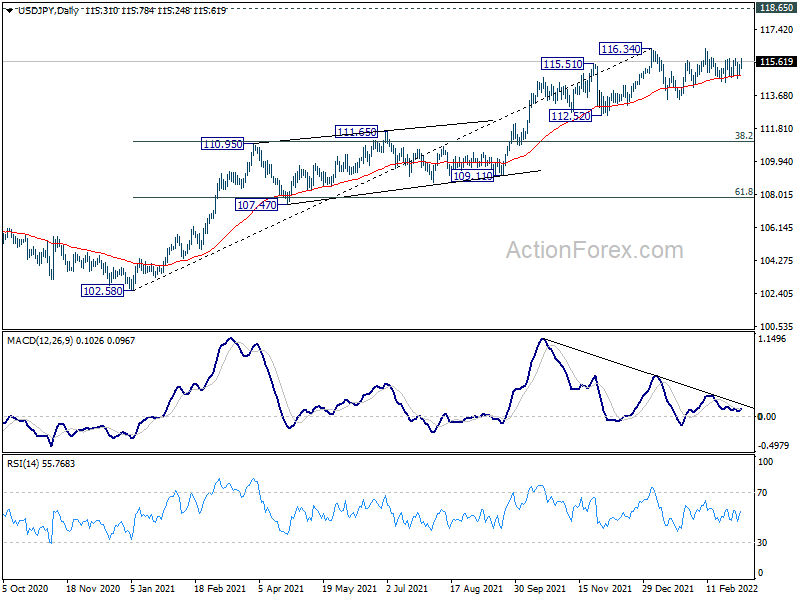
Daily Pivots: (S1) 114.94; (P) 115.21; (R1) 115.58; More...
Intraday bias in USD/JPY remains neutral as range trading continues. On the upside, firm break of 116.34 will resume larger up trend from 102.58 to 118.65 long term resistance next. On the downside, though, break of 114.40 will continue the corrective pattern from 116.34 with another fall to 113.46 support.
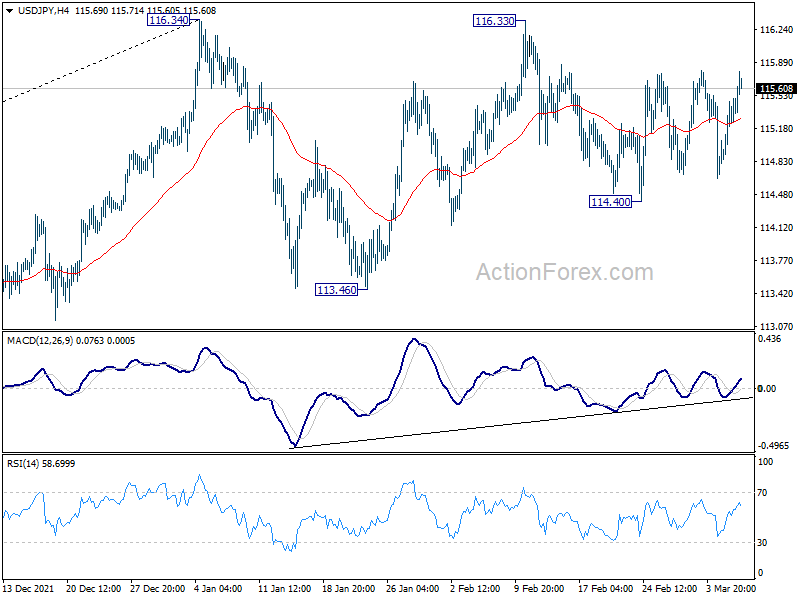
In the bigger picture, no change in the view that rise from 102.58 is the third leg of the up trend from 101.18 (2020 low). Such rally should target a test on 118.65 (2016 high). Sustained break there will pave the way to 120.85 (2015 high) and raise the chance of long term up trend resumption. This will remain the favored case as long as 55 week EMA (now at 111.64) holds.
USD/CHF Mid-Day Outlook
Daily Pivots: (S1) 0.9193; (P) 0.9232; (R1) 0.9295; More....
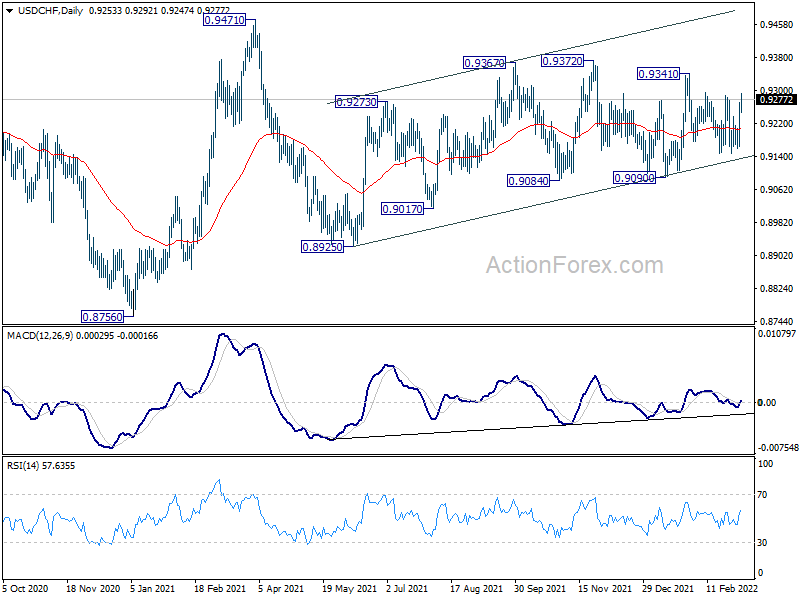
USD/CHF is still bounded in sideway trading and intraday bias remains neutral. Choppy rise from 0.8925 would still be in favor to extend higher as long as 0.9090 support holds. Break of 0.9341 will target 0.9372 resistance and then 0.9471. On the downside, however, break of 0.9090 will bring deeper fall back to 0.8925 support.
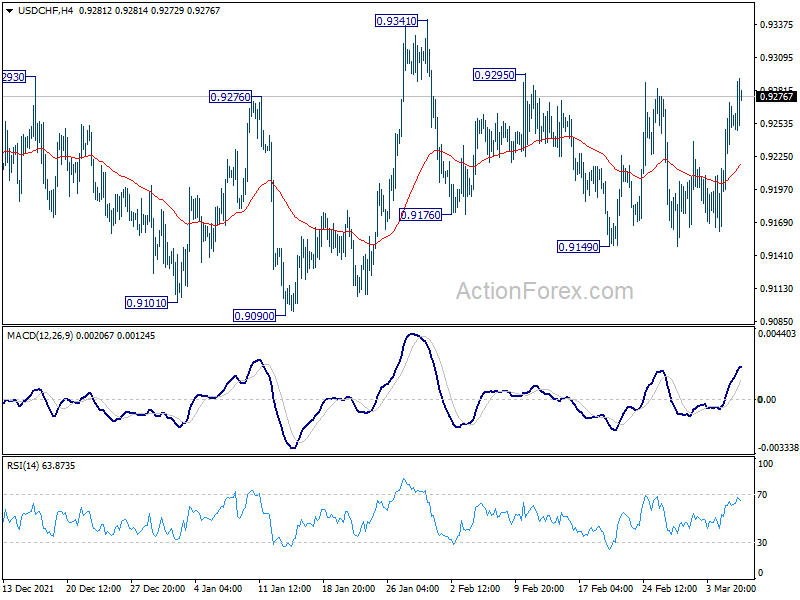
In the bigger picture, medium term outlook will be neutral at best as long as 0.9471 resistance holds. Larger down trend could still extend through 0.8756 (2021 low). However, firm break of 0.9471 will argue that the trend has already reversed and rebound the rally from 0.8756 with another impulsive move.
GBP/USD Mid-Day Outlook
Daily Pivots: (S1) 1.3054; (P) 1.3152; (R1) 1.3201; More...
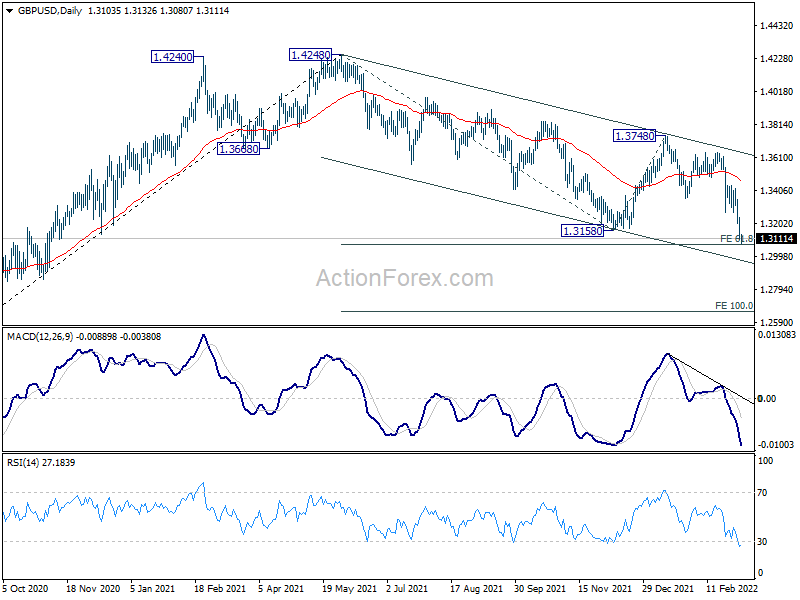
GBP/USD's decline is still in progress and intraday bias stays on the downside. Current down trend from 1.4248 is still in progress. Firm break of 61.8% projection of 1.4248 to 1.3158 from 1.3748 at 1.3074 will target 100% projection at 1.2658. On the upside, break of 1.3270 support turned resistance is needed to signal short term bottoming. Otherwise, outlook will remain bearish in case of recovery.
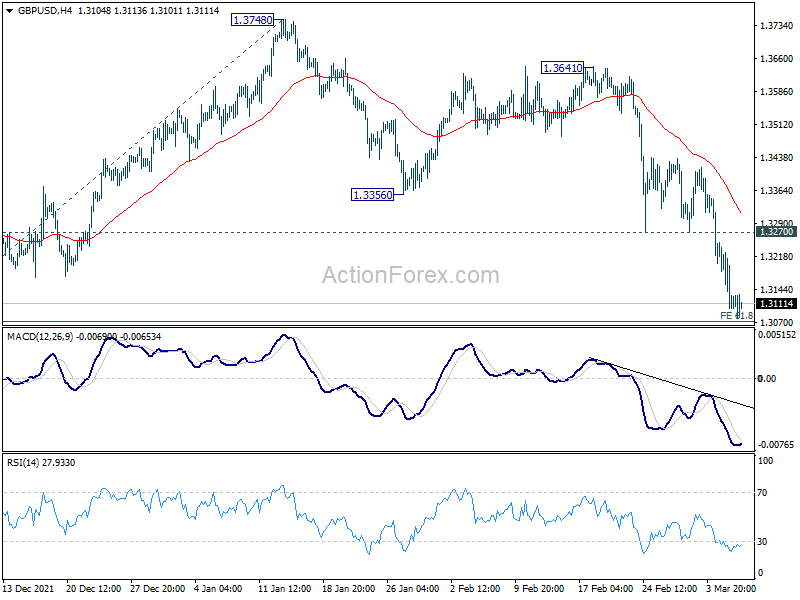
In the bigger picture, current development suggests that the up trend from 1.1409 (2020 low) has completed at 1.4248. Decline from 1.4248 could still be a corrective move, or it could be the start of a long term down trend. In either case, deeper decline would now be seen back to 61.8% retracement of 2.1161 to 1.1409 at 1.2493. In case, break of 1.3748 resistance is needed to indicate medium term bottoming, or outlook will stay bearish.
EUR/USD Mid-Day Outlook
Daily Pivots: (S1) 1.0795; (P) 1.0864; (R1) 1.0921; More...
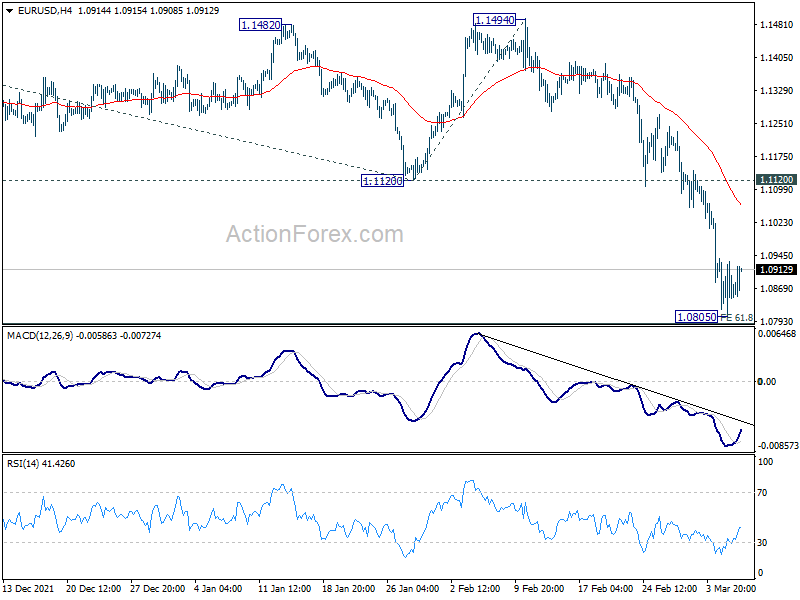
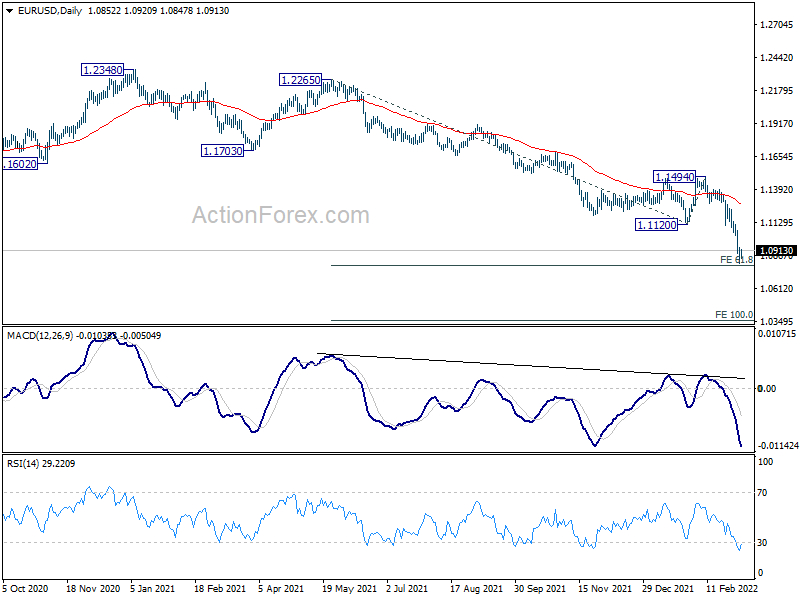
EUR/USD is staying in consolidation form 1.0805 temporary and intraday bias remains neutral. Stronger recovery cannot be ruled out. But upside should be limited by 1.1120 support turned resistance to bring down trend resumption. On the downside, firm break of 61.8% projection of 1.2265 to 1.1120 from 1.1494 at 1.0786 will pave they way to 100% projection at 1.0349 next.
In the bigger picture, the decline from 1.2348 (2021 high) is expected to continue as long as 1.1494 resistance holds. Firm break of 1.0635 (2020 low) will raise the chance of long term down trend resumption and target a retest on 1.0339 (2017 low) next. Nevertheless, break of 1.1494 will maintain medium term neutral outlook, and extend range trading first.
Gold Extends Rally, Oil Rises, Euro Consolidates
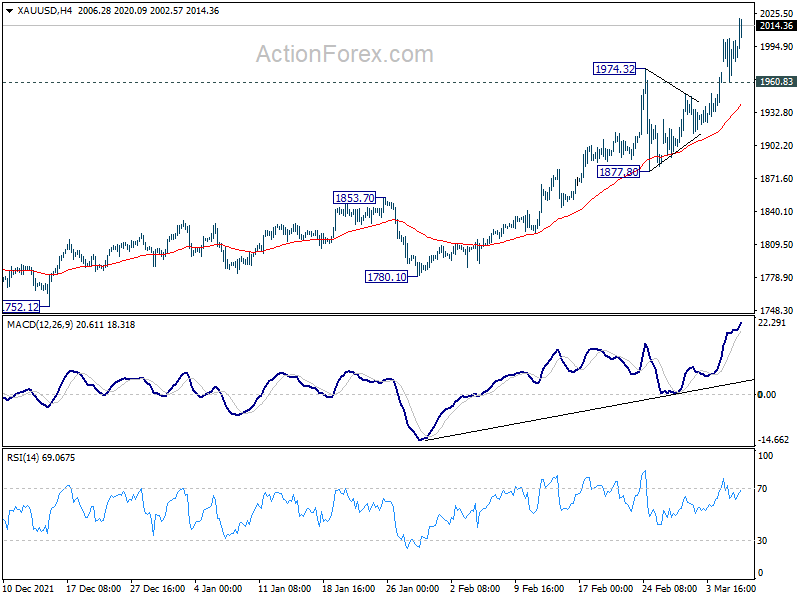
Overall market sentiment is steady today. Major European indexes are trading slightly in black, together with US futures. WTI oil rebounds on news that US President Joe Biden is set to announce ban of Russian oil imports as soon as today. Gold is extending recent rise after brief consolidation, with aim to have a test on record high. In the markets, Euro is continuing to recover, digesting recent losses. Dollar is also firm, except versus Euro and Kiwi. On the other hand, Aussie is in deep pull back while Yen also turns softer.
Technically, Gold is back above 2000 handle it's on track to retest 2074.84 high made in 2020. Decisive break there will resume long term up trend. In any case, further rise is expected as long as 1960.83 support holds. At the same time, we'll keep an eye on when WTI crude oil would break through 131.82 temporary top, to extend recent powerful rally towards 147 record high too.
In Europe, at the time of writing, FTSE is up 0.04%. DAX is up 0.50%. CAC is up 0.43%. Germany 10-year yield is up 0.1307 at 0.115. Earlier in Asia, Nikkei dropped -1.71%. Hong Kong HSI dropped -1.39%. China Shanghai SSE dropped -2.35%. Singapore Strait Times dropped -1.22%. Japan 10-year JGB yield rose 0.0082 to 0.155.
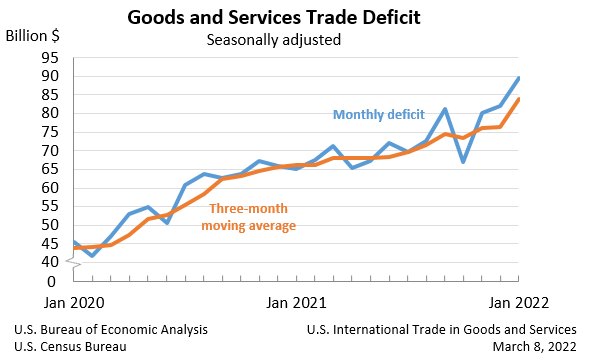
US goods and services trade services widened to USD 89.7B
US exports of goods and services dropped USD 3.9B to USD 224.4B in January. Imports rose USD 3.8B to USD 314.1B. Trade deficit widened to USD 89.7B, versus expectation of USD 85.7B.
The January increase in the goods and services deficit reflected an increase in the goods deficit of USD 7.1B to USD 108.9B and a decrease in the services surplus of USD 0.6B to USD 19.2B.
Year-over-year, the goods and services deficit increased USD 24.6 B, or 37.7%, from January 2021. Exports increased USD 29.9 B or 15.4%. Imports increased USD 54.4B or 21.0 %.
Eurozone Q4 GDP growth finalized at 0.3% qoq, EU at 0.5% qoq
Eurozone Q4 GDP growth was finalized at 0.3% qoq while employment grew 0.5% qoq. For 2021 as a whole, GDP grew 5.3%. GDP was 0.2% above pre-pandemic level in Q4 2019.
EU Q4 GDP growth was finalized at 0.4% qoq while employment grew 0.5% qoq. For 2021 as a whole, GDP grew 5.3%. GDP was 0.6% above pre-pandemic level in Q4 2019.
GDP growth by Member State: Slovenia (+5.4%) recorded the highest increase of GDP compared to the previous quarter, followed by Malta (+2.3%), Spain and Hungary (both +2.0%). Decreases were observed in Ireland (-5.4%), Austria (-1.5%), Germany (-0.3%), Croatia, Latvia and Romania (all -0.1%).
Also released, Germany industrial production rose 2.7% mom in January, above expectation of 0.5% mom. Italy retail sales dropped -0.5% mom in January, versus expectation of 1.1% mom.
BoJ Kuroda: Inappropriate to scale back stimulus while wage growth remains low
BoJ Governor Haruhiko Kuroda told the parliament today that inflation expectations and wages growth in Japan are still low. Even if inflation exceeds the 2% target, "it's inappropriate to deal with by scaling back stimulus or tightening monetary policy," he said.
"If crude oil and commodity prices drive up inflation while wage growth remains slow, that would hit households' real income and corporate profits, and hurt the economy," he said. "Such conditions won't lead to sustainable achievement of 2% inflation."
Regarding global sanctions on Russia, Kuroda said, "the rouble and Russian government bond prices are falling sharply. We can't rule out the possibility debt payment from Russia could be disrupted. The chance of Russia defaulting on its debt cannot be ruled out".
Japan bank lending grew 0.4% yoy in Feb, slowest since 2012
Japan bank lending grew 0.4% yoy in February, below expectation of 0.6% yoy. That's the slowest rate since May 2012. Lending by major banks dropped -1.3% yoy, biggest decline since August 2021. Regional banks' lending rose 1.7% yoy, smallest increase in more than a decade.
"We must keep an eye out on how developments in Ukraine could affect corporate funding through rising crude oil prices," a BOJ official told a briefing.
Also released, labor cash earnings rose 0.9% yoy in January, above expectation of 0.2% yoy. Current account surplus narrowed to JPY 0.19T in January, below expectation of JPY 0.33T.
Australia NAB business confidence rose to 13, getting back on track
Australia NAB business confidence rose from 4 to 13 in February. Business conditions rose from 2 to 9. Looking at some details, trading conditions rose from 8 to 10. Profitability condition rose from 2 to 5. Employment condition rose from -1 to 8.
"Overall, the February survey shows that the economy is quickly getting back on track as the Omicron wave recedes," said said NAB Group Chief Economist Alan Oster. "The outlook is fairly strong with supply disruptions and cost pressures now the major challenge facing businesses."
EUR/USD Mid-Day Outlook
Daily Pivots: (S1) 1.0795; (P) 1.0864; (R1) 1.0921; More...
EUR/USD is staying in consolidation form 1.0805 temporary and intraday bias remains neutral. Stronger recovery cannot be ruled out. But upside should be limited by 1.1120 support turned resistance to bring down trend resumption. On the downside, firm break of 61.8% projection of 1.2265 to 1.1120 from 1.1494 at 1.0786 will pave they way to 100% projection at 1.0349 next.
In the bigger picture, the decline from 1.2348 (2021 high) is expected to continue as long as 1.1494 resistance holds. Firm break of 1.0635 (2020 low) will raise the chance of long term down trend resumption and target a retest on 1.0339 (2017 low) next. Nevertheless, break of 1.1494 will maintain medium term neutral outlook, and extend range trading first.
Economic Indicators Update
| GMT | Ccy | Events | Actual | Forecast | Previous | Revised |
|---|---|---|---|---|---|---|
| 23:30 | JPY | Labor Cash Earnings Y/Y Jan | 0.90% | 0.20% | -0.20% | -0.40% |
| 23:50 | JPY | Bank Lending Y/Y Feb | 0.40% | 0.60% | 0.60% | 0.50% |
| 23:50 | JPY | Current Account (JPY) Jan | 0.19T | 0.33T | 0.79T | 0.81T |
| 00:01 | GBP | BRC Like-For-Like Retail Sales Y/Y Feb | 2.70% | 4.70% | 8.10% | |
| 00:30 | AUD | NAB Business Confidence Feb | 13 | 3 | 4 | |
| 00:30 | AUD | NAB Business Conditions Feb | 9 | 3 | ||
| 05:00 | JPY | Leading Economic Index Jan P | 103.7 | 104.5 | 104.8 | |
| 06:00 | JPY | Eco Watchers Survey: Current Feb | 37.7 | 38.1 | 37.9 | |
| 07:00 | EUR | Germany Industrial Production M/M Jan | 2.70% | 0.50% | -0.30% | 1.10% |
| 09:00 | EUR | Italy Retail Sales M/M Jan | -0.50% | 1.10% | 0.90% | 0.80% |
| 10:00 | EUR | Eurozone GDP Q/Q Q4 F | 0.30% | 0.30% | 0.30% | |
| 10:00 | EUR | Eurozone Employment Change Q/Q Q4 F | 0.50% | 0.50% | 0.50% | |
| 11:00 | USD | NFIB Business Optimism Index (CAD) Feb | 95.7 | 97.5 | 97.1 | |
| 13:30 | CAD | International Merchandise Trade Jan | 2.62B | -87.5B | -0.1B | -1.58B |
| 13:30 | USD | Trade Balance (USD) Jan | -89.7B | -87.5B | -80.7B | -82B |
| 15:00 | USD | Wholesale Inventories Jan | 0.80% | 0.80% |
US goods and services trade services widened to USD 89.7B
US exports of goods and services dropped USD 3.9B to USD 224.4B in January. Imports rose USD 3.8B to USD 314.1B. Trade deficit widened to USD 89.7B, versus expectation of USD 85.7B.
The January increase in the goods and services deficit reflected an increase in the goods deficit of USD 7.1B to USD 108.9B and a decrease in the services surplus of USD 0.6B to USD 19.2B.
Year-over-year, the goods and services deficit increased USD 24.6 B, or 37.7%, from January 2021. Exports increased USD 29.9 B or 15.4%. Imports increased USD 54.4B or 21.0 %.