Sample Category Title
Daily Technical Analysis
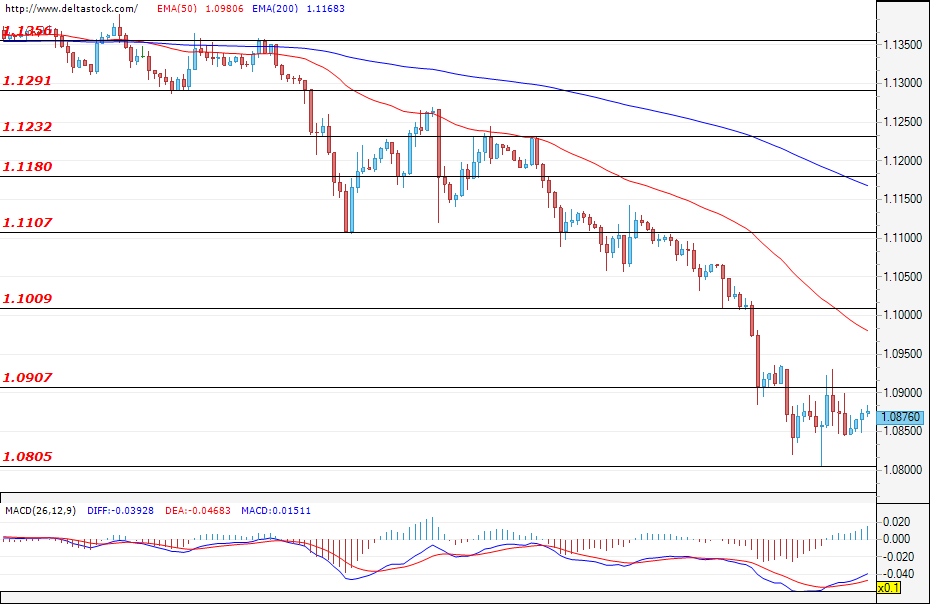
EUR/USD
The single European currency continues to lose ground against the dollar. The support at 1.0800 has so far managed to hold off the bearish pressure, but the overall market mood remains negative. In case of positive news about the war between Russia and Ukraine, the trend could change and the bulls might return to the market. If that’s the case, then their first resistance is expected to be the level of 1.0907. The important news for this week, which is also expected to have an impact on the market, is the interest rate of the European Central Bank and Christine Lagarde’s press conference.
USD/JPY
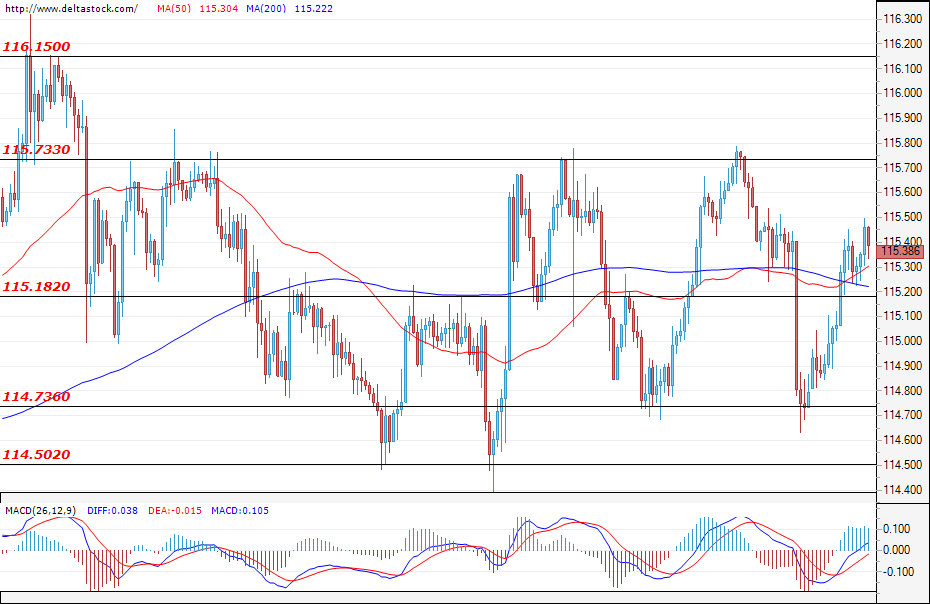
The yen lost quite a bit of ground against the dollar, but unlike other major currencies, it has managed to move in a stable price range for the time being. A possible breach of the resistance at 115.70 would give the bulls a more serious advantage and enable them to test the next one at 116.15. That being said, the first resistance is more likely to hold off the pressure and so the currency pair is expected to return to the lower border of the support range at 114.50.
GBP/USD
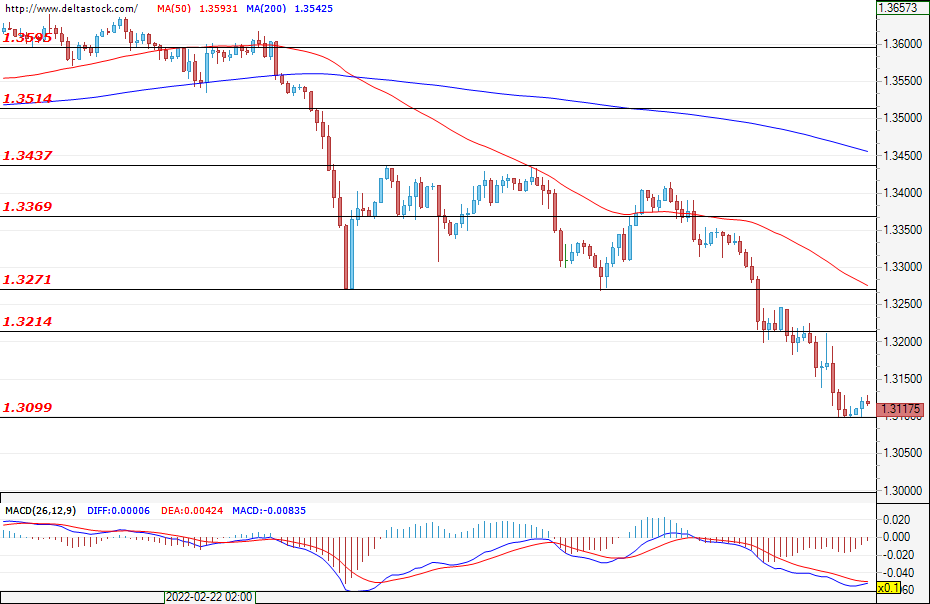
The support at 1.3150 was overcome and the price of the currency pair manages to stay below it for now. In case the bulls manage to return to the market, their first goal would be to overcome the resistance at 1.3150. Having the negative sentiment in mind, the movement is more likely to continue downward, overcoming the established minor support at 1.3099 and moving towards a test of the next important support at 1.3072, as seen from the higher time frames. Their first goal should be to overcome the resistance at 1.3150. Have in mind the negative sentiment, the movement is more likely to continue downward, overcoming the established minor support at 1.3099 and moving to test the next important support available at longer time frames at 1.3072
EUGERMANY40
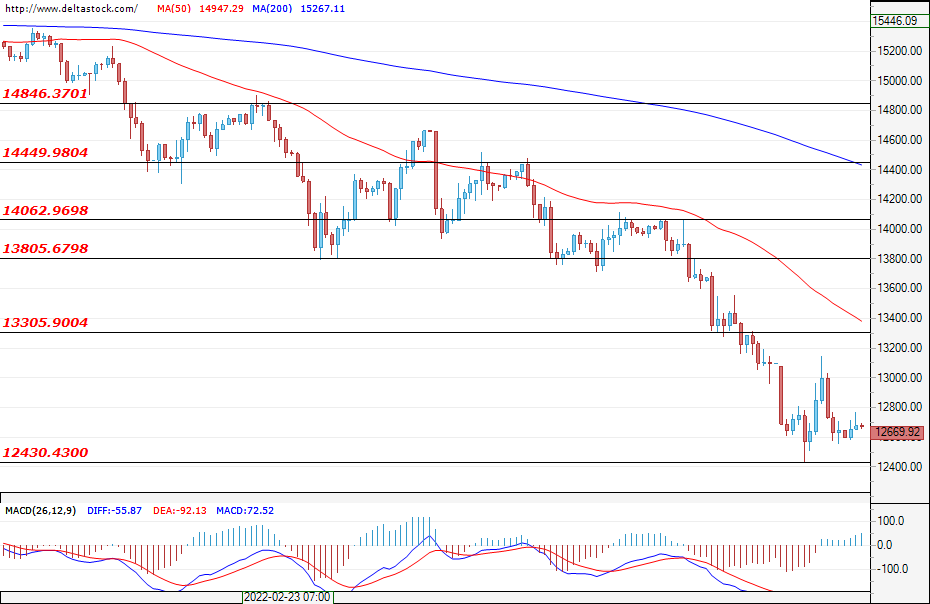
During the last session, the German index managed to recover towards the resistance at 13145. This turned out to be a correction, and after the opening of the U.S. exchanges, the sell-offs resumed, bringing the index down towards the level of support at 12557. A more pronounced bullish return is unlikely for now, even with the breach of the more important resistance at 13305. If the situation in Ukraine does not improve, then the bears will likely continue to prevail and will direct the index towards the support at 12430.
US30
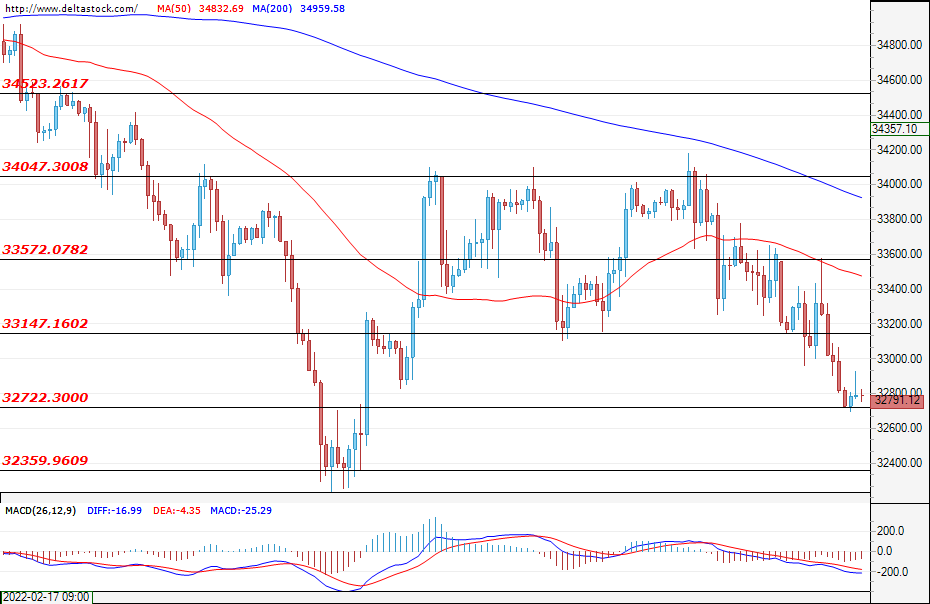
Although the U.S. blue-chip index performed better than its European equivalents, its losses on Monday reached the support at 32700. There is little chance of a breach and a consolidation above 34040, however. Should this scenario play out, however, then it could be interpreted as a signal for a possible price increase, which is expected to end at the next resistance at 34523. At the time of writing the analysis, the price is located at the level of 32800, the trends remain negative, and in case of a breach of the support at 32700, the bears might be able to re-test the next support zone at 32350.
US Risky Assets Underperformed Compared to European Peers
Markets
Same story, different day. Only this time, US risky assets underperformed compared to European peers. Wall Street opened lower and slid further throughout the session. Stocks finished 2.37% (DJI) to 3.62% (Nasdaq) lower. The S&P500 (-2.95%) closed around the 4198.70 support level (23.6% retracement of the complete recovery cycle). Equities in Europe had a dramatic start with the EuroStoxx50 quickly trading almost 5% in the red. Losses eventually were capped at 1.23%. Together with other indices including the German Dax, it still officially closed in bear market territory (>20% losses from cycle high).
Many commodities soared once again, sparked by reports of a possible Russian oil embargo by the US (and maybe its allies). Additional concerns arose late in the US session with Russia threatening to cut gas flows to Europe. The most notable price evolutions were (Dutch) gas futures which at some point rose 80% before paring gains to a still-impressive 18% in just one day. Oil extended gains as well. Brent finished at $123.21/b – the highest since 2012. Nickel skyrocketed an astonishing record 66% on a supply risk-driven short squeeze.
The moves jolted inflation expectations in the US and Europe. 10y inflation swaps in the former flirted with a record high to finish at 3.08% (+15bps). Europe closed at a 14-year high of 2.72% (+15bps). With real yields still in decline, nominal yield changes amounted to +3 bps (30y) to +7.2 bps (2y) in the US. The German curve saw a similar bear flattening, edging 1.9 bps (30y) to 5.7 bps (5y) higher. 10y yield support in the US and Germany at respectively 1.704% and -0.074% was tested but survived.
The dollar on FX markets held sway. Trade-weighted, the greenback surpassed the 99 barrier. EUR/USD came another step closer to the pandemic low in the 1.06-1.08 area (close at 1.0854). The CHF safe haven currency underperformed the likes of USD and JPY amid signals the SNB stands ready to intervene. For the first time in four days, the euro was able to rise against sterling though. EUR/GBP reversed course after losses brought the pair in proximity of the 0.82 big figure to finish at 0.8283.The first thing that stands out from this morning’s Asian-Pacific session, is nickel’s meteoric rise part two. After searing 66% yesterday to 48000 USD/MT, prices in just a few hours of trading today are at an unprecedented 100k. Stocks trade 1-2% in the red. European markets are set for a dark red open (-3%). US yields give back early gains and the Bund future inches higher.
EUR/USD is pretty balanced. Commodity-driven currencies including AUD and NZD take a breather. The ongoing broad-based commodity melt-up stoking growth fears remains the key driver for markets for the time being. It will even dominate the ECB meeting next Thursday. As seen yesterday, rising inflation expectations could protect core bond yields’ downside. We remain cautious on EUR/USD’s short-term upward potential, both fundamentally as technically. The next reference is situated at 1.078.
News Headlines
NAB Australia Business confidence (13 from 4) and business conditions (9 from 2) improved substantially in February as the impact from the recent Omicron wave eased. The gains were widespread across several subindices of the survey, including employment (8 from -1) which is an important factor in the assessment of the RBA with respect to the start of policy normalisation. Purchase costs remained elevated, rising at a quarterly cost of 2.7% Q/Q. Rises in labour costs rose at the same speed of 1.7% Q/Q. Australian bond yields today rose substantially, but this was more due to broader inflation fears resulting from higher commodity prices. The 3-y yield and the 10-y yield both rose 9 bps to 1.66% and 2.23% respectively. Even so, the Aussie dollar this morning fell prey to profit taking after a good run of late, declining back below the AUD/USD 0.73 handle (0.7288).In a speech to the Australian Financial Review Business Summit, Australian Prime Minister Scott Morrison said the pandemic illustrated that the country should become more self-reliant with respect to key manufacturing. In order to be less vulnerable to supply chain vulnerabilities, the Australian PM earmarked seven areas where Australia should build out manufacturing capacity, including pharmaceutical and protective equipment and semi-conductors.
Russia Threatens to Cut Gas Supplies to Europe
Market movers today
Focus remains on the war in Ukraine and whether US and Europe will impose an oil and gas embargo on Russia. The EU Commission will lay out its strategy on how to reduce its dependence on Russian energy.
In Poland the central bank will announce rates. We and other market analysts are looking for a rate increase of 50bp, but the sharp drop in the Polish Zloty and the spike in gas prices add to already strong inflation dynamics and hence put the central bank under immense pressure to carry out a bigger rate hike.
On the data front we get German industrial production and US NFIB small business optimism index.
Norway releases the monthly GDP data.
The 60 second overview
EU to reduce its dependence on Russian gas: According to Bloomberg the EU will today present its new plan to reduce the bloc's dependence on Russian gas imports by up to 80% this year. The plan will include tapping of new gas supplies, increasing energy efficiency, higher LNG imports and new pipelines from suppliers outside Russia. Especially, the plan will recommend to boost LNG imports significantly. The plan should also include a framework for liquidity support for companies effected by the crisis and a suggestion that member states could tax extraordinary windfall profits of energy companies.
Extreme volatility in gas: Despite the market being aware of the EU plans to cut dependence on Russian gas the Dutch natural gas future jumped up to 64% yesterday in a day of extreme volatility. However, like oil the market calmed somewhat during the day up 'only' 4% though prices are still up 100% in March.
Russia may cut of gas supplies: However, the market have to brace itself for another volatile day as Russia late Monday said that it considers to cut natural gas supplies to Europe through the Nordstream 1 pipeline. The threat comes the day before the EU presents its plan on how to be less dependent on Russian energy. See Bloomberg story here.
Volatile energy markets: Oil prices open yesterday at an elevated level with Brent front-month contract trading as high as USD 140 a barrel. The move higher came after US Secretary of State Antony Blinken over the weekend said that the US and its allies are actively discussing an embargo on Russian oil. However, oil prices eased somewhat during the day as Germany said that they are against a ban on Russian oil due to its possible negative impact on the German economy calling Russian oil 'essential'. Hence, Brent oil ended the US closing at USD 125 a barrel. Oil prices have been stable overnight.
Inflation expectations: German 10Y break-evens were yesterday pushed higher by 17bp to a new record-high at 2.57%. The 2Y break-even rose a stunning 52bp to a record-high 4.77%. The significant jump in market inflation expectations drove nominal yields higher though most of the move came through real rates trading deeper into negative.
Other commodities also seeing wild price swings. Other commodities such as nickel and wheat prices also saw extreme volatility and significantly higher prices yesterday as the market is basically pricing a full boycott of all Russian exports and as exports from Ukraine remain insecure due to the war.
New sanctions: EU's Von der Leyen said yesterday that the EU continues to work on further sanctions on Russia, and Italy's Draghi says EU countries need to move quickly. For more see this Reuters story. Apparently European governments are ready for a new round of sanctions targeting ports, ships, more individuals as well as technologies used in military equipment. An announcement may come as early as today.
Equities: Equity markets were in a rollercoaster session on Monday, followed by an equally volatile session in the commodity space. European markets saw huge intraday-moves, with Stoxx 600 starting the session -4% lower only to recover to -1.1% at closing. Meanwhile, US markets slid deeper into red as the session dragged on, with S&P500 ending at -3%, Nasdaq -3.6%, Dow -2.4%, and Russell 2000 -2.5%. Another huge outperformance of defensives, with growth cyclicals selling off -4% while energy and utilities gained 1.5%. VIX rose to its highest level this year at 36.5. US futures point lower this morning as well, but much more mildly so in the ballpark of -0.5%.
FI: It was again a very volatile day in the European government bond markets where "geography" and "size" matters more than fundamentals as shown by the dramatic widening of spreads for countries "close" to Ukraine/Russia such as Poland and Hungary as well Austria and Finland. However, we are also seeing smaller EU countries such as Slovakia, Ireland and Portugal underperforming not only Germany but also France. More pressure will be added to Russian bonds as JP Morgan will exclude all Russian bonds from their bond indices.
FX: USD and JPY gained and NOK and SEK lost on a day which was characterised by large moves on commodity and equity markets. EUR/USD dropped firmly below 1.09 and EUR/SEK rose firmly above 10.80.
Credit: Rising energy prices and the war in Ukraine led to further spread widening yesterday. iTraxx Xover widened 21bp and Main close to 5bp. HY bonds widened 23bp and IG 10bp.
Nordic macro
Norway: We expect the Norwegian mainland GDP to grow by 0.2% m/m in January, boosted by the partial reopening of parts of the service sector but held back by high power prices undermining retail sales. However, as we already know that capacity utilization is higher than normal and that wage and price expectations have risen sharply, there is currently less focus on the strength of economic growth.
EUR/USD Daily Outlook
Daily Pivots: (S1) 1.0795; (P) 1.0864; (R1) 1.0921; More...
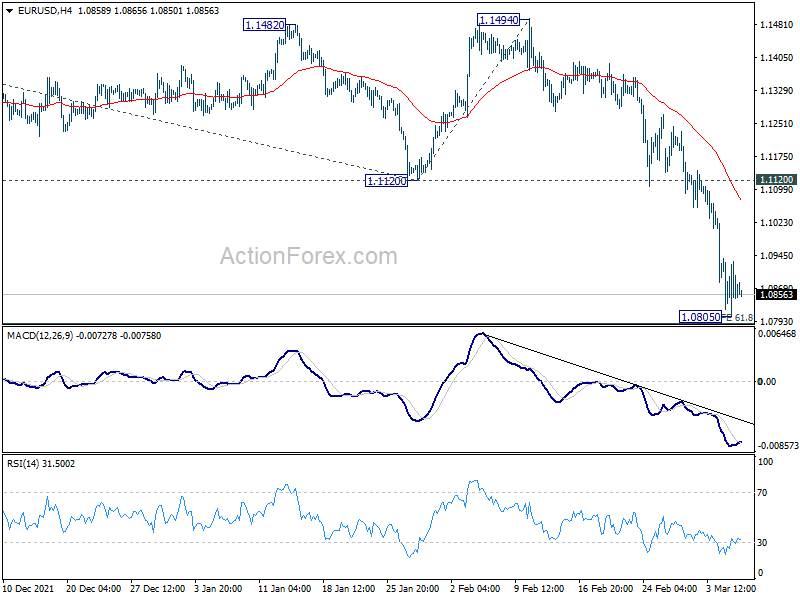
Intraday bias in EUR/USD is turned neutral with a temporary low formed at 1.0805. Some consolidations could be seen, but upside should be limited by 1.1120 support turned resistance to bring down trend resumption. On the downside, firm break of 61.8% projection of 1.2265 to 1.1120 from 1.1494 at 1.0786 will pave they way to 100% projection at 1.0349 next.
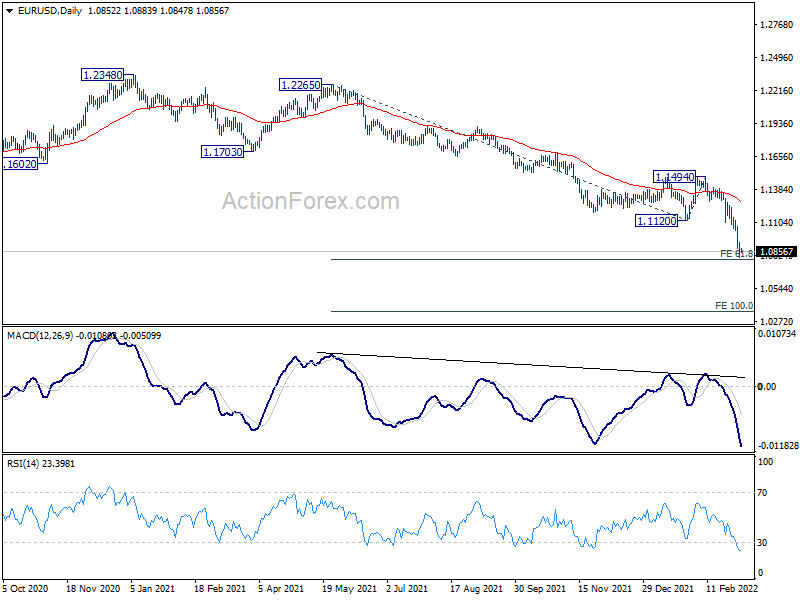
In the bigger picture, the decline from 1.2348 (2021 high) is expected to continue as long as 1.1494 resistance holds. Firm break of 1.0635 (2020 low) will raise the chance of long term down trend resumption and target a retest on 1.0339 (2017 low) next. Nevertheless, break of 1.1494 will maintain medium term neutral outlook, and extend range trading first.
GBP/USD Daily Outlook
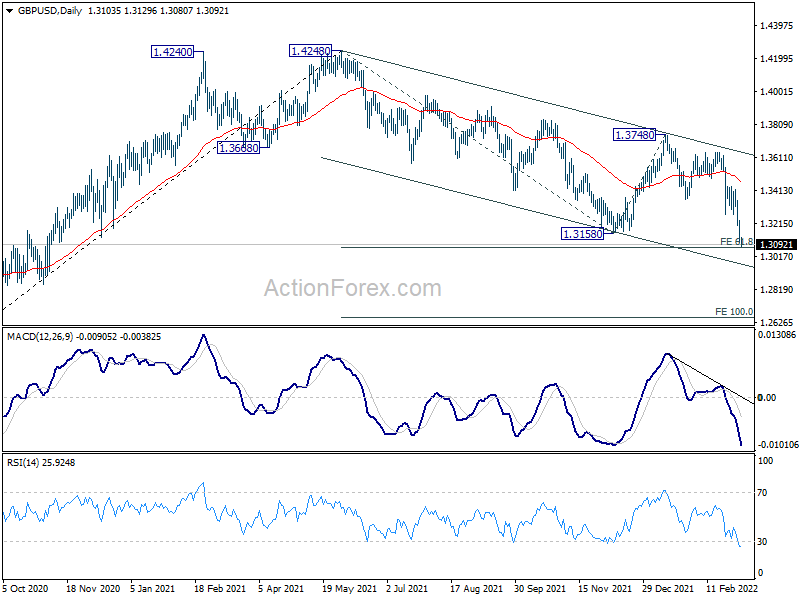
Daily Pivots: (S1) 1.3054; (P) 1.3152; (R1) 1.3201; More...
Intraday bias in GBP/USD remains on the downside at this point. Current down trend from 1.4248 is still in progress. Firm break of 61.8% projection of 1.4248 to 1.3158 from 1.3748 at 1.3074 will target 100% projection at 1.2658. On the upside, break of 1.3270 support turned resistance is needed to signal short term bottoming. Otherwise, outlook will remain bearish in case of recovery.
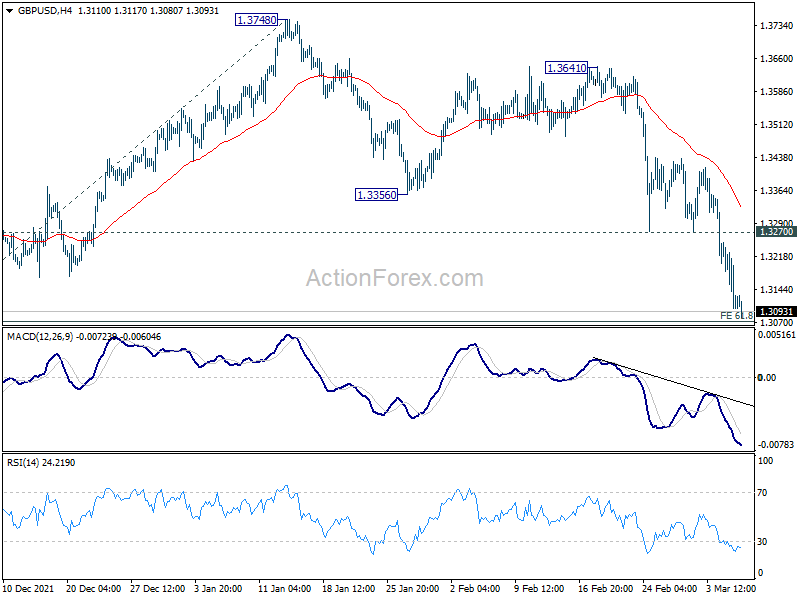
In the bigger picture, current development suggests that the up trend from 1.1409 (2020 low) has completed at 1.4248. Decline from 1.4248 could still be a corrective move, or it could be the start of a long term down trend. In either case, deeper decline would now be seen back to 61.8% retracement of 2.1161 to 1.1409 at 1.2493. In case, break of 1.3748 resistance is needed to indicate medium term bottoming, or outlook will stay bearish.
USD/CHF Daily Outlook
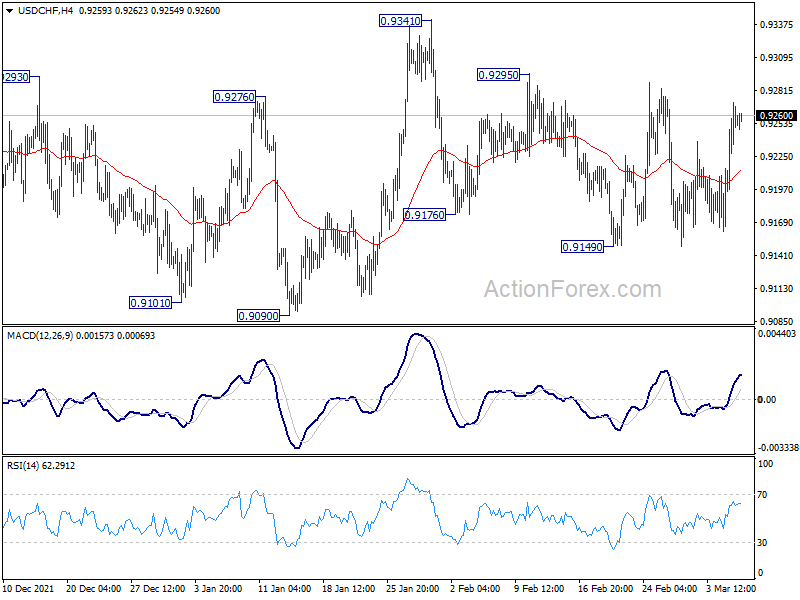
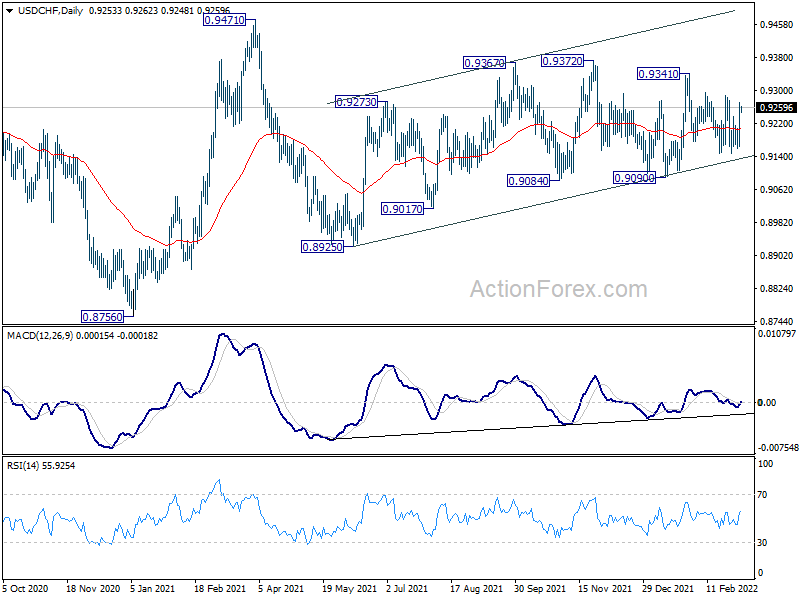
Daily Pivots: (S1) 0.9193; (P) 0.9232; (R1) 0.9295; More....
Intraday bias in USD/CHF remains neutral as range trading continues. Choppy rise from 0.8925 would still be in favor to extend higher as long as 0.9090 support holds. Break of 0.9341 will target 0.9372 resistance and then 0.9471. On the downside, however, break of 0.9090 will bring deeper fall back to 0.8925 support.
In the bigger picture, medium term outlook will be neutral at best as long as 0.9471 resistance holds. Larger down trend could still extend through 0.8756 (2021 low). However, firm break of 0.9471 will argue that the trend has already reversed and rebound the rally from 0.8756 with another impulsive move.
USD/JPY Daily Outlook
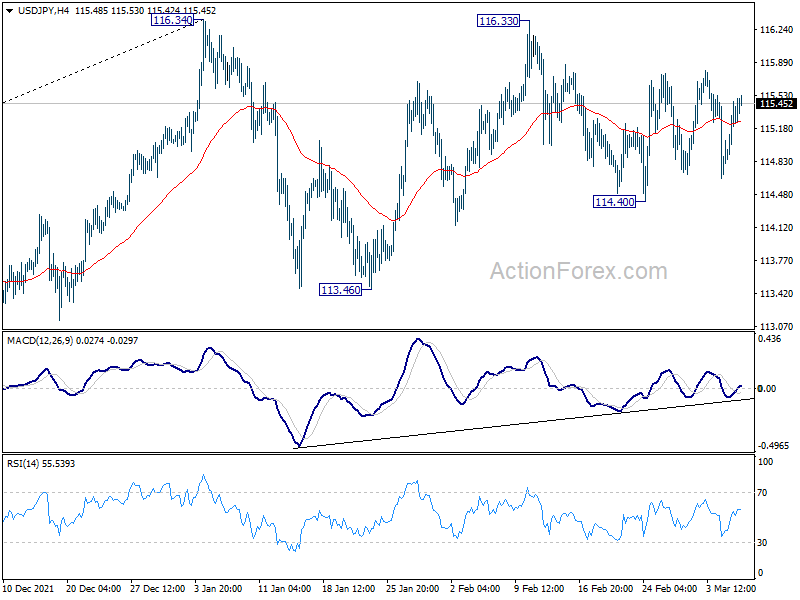
Daily Pivots: (S1) 114.94; (P) 115.21; (R1) 115.58; More...
USD/JPY is still bounded in range trading and intraday bias remains neutral first. On the upside, firm break of 116.34 will resume larger up trend from 102.58 to 118.65 long term resistance next. On the downside, though, break of 114.40 will continue the corrective pattern from 116.34 with another fall to 113.46 support.
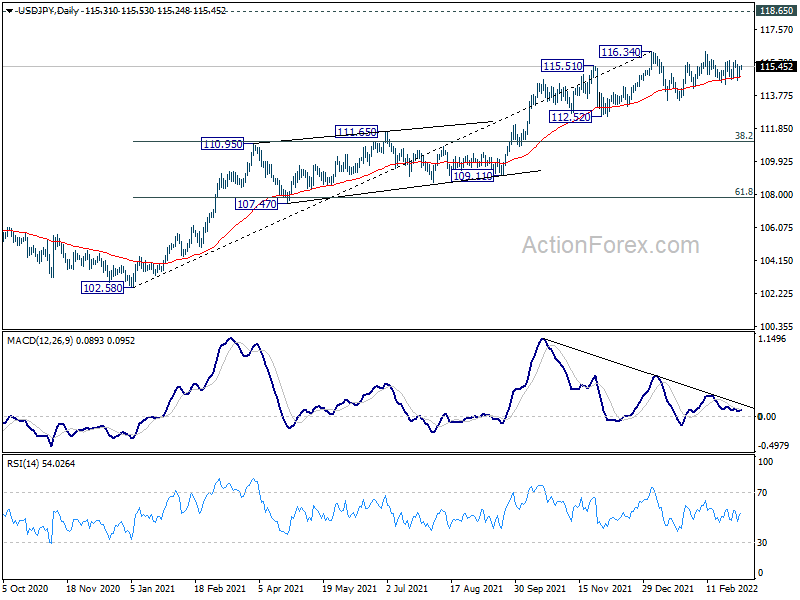
In the bigger picture, no change in the view that rise from 102.58 is the third leg of the up trend from 101.18 (2020 low). Such rally should target a test on 118.65 (2016 high). Sustained break there will pave the way to 120.85 (2015 high) and raise the chance of long term up trend resumption. This will remain the favored case as long as 55 week EMA (now at 111.64) holds.
AUD/USD Daily Report
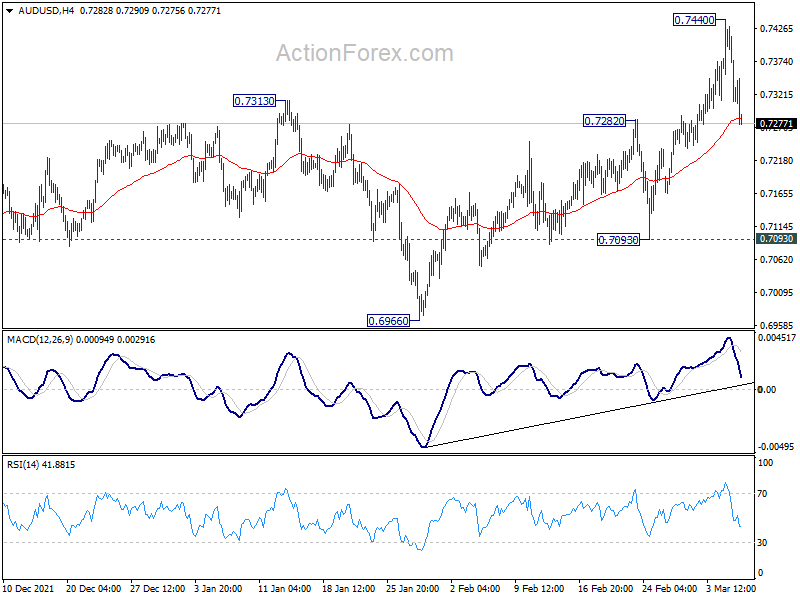
Daily Pivots: (S1) 0.7270; (P) 0.7356; (R1) 0.7399; More...
A temporary top is formed at 0.7440 with current retreat. Intraday bias in AUD/USD is turned neutral first. Some correction could be seen and deeper pull back cannot be ruled out. But further rally will remain in favor as long as 0.7093 support holds. As noted before, larger decline from 0.8006 might have completed at 0.6966 already. Above 0.7440 will resume the rise from 0.6966 for 0.7555 resistance next.
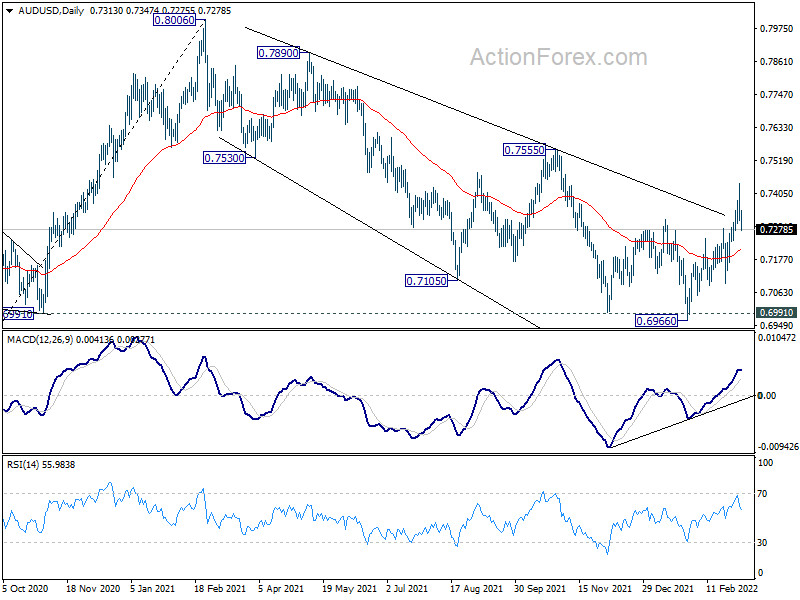
In the bigger picture, focus remains on 0.6991 key structural support. Sustained break there will argue that the whole up trend from 0.5506 might be finished at 0.8006, after rejection by 0.8135 long term resistance. Deeper decline would then be seen back to 61.8% retracement of 0.5506 to 0.8006 at 0.6461. Meanwhile, strong rebound from 0.6991 will retain medium term bullishness. That is, whole up trend from 0.5506 is still in progress for another rise through 0.8006 at a later stage.
USD/CAD Daily Outlook
Daily Pivots: (S1) 1.2729; (P) 1.2775; (R1) 1.2864; More...
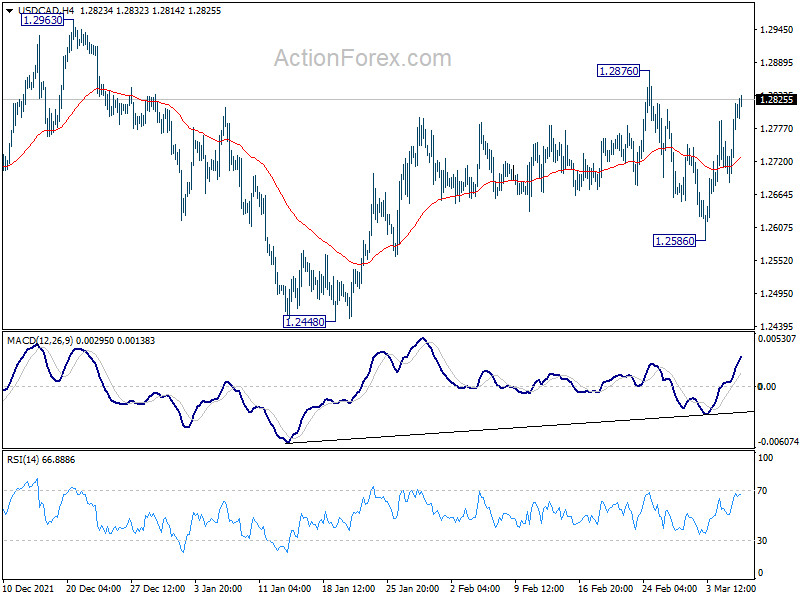
Intraday bias in USD/CAD remains neutral as range trading continues. On the upside, break of 1.2876 will resume the rally from 1.2448 to 1.2963 resistance. On the downside, break of 1.2586 will target 1.2448 support instead.
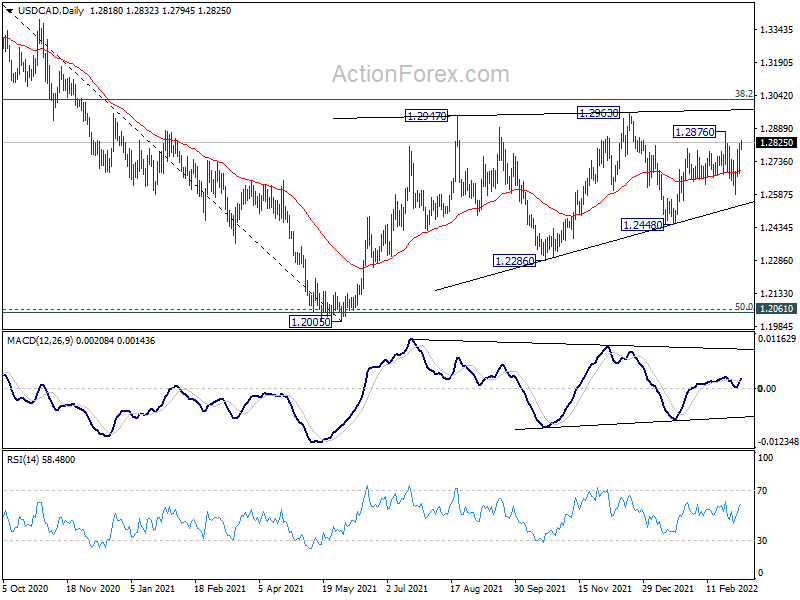
In the bigger picture, focus stays on 38.2% retracement of 1.4667 (2020 high) to 1.2005 (2021 low) at 1.3022. Sustained break there should confirm that the down trend from 1.4667 has completed after defending 1.2061 long term cluster support. Further rise would then be seen towards 61.8% retracement at 1.3650. However, rejection by 1.3022 will maintain medium term bearishness. Break of 1.2005 will resume the down trend from 1.4667 and that carries larger bearish implications too.
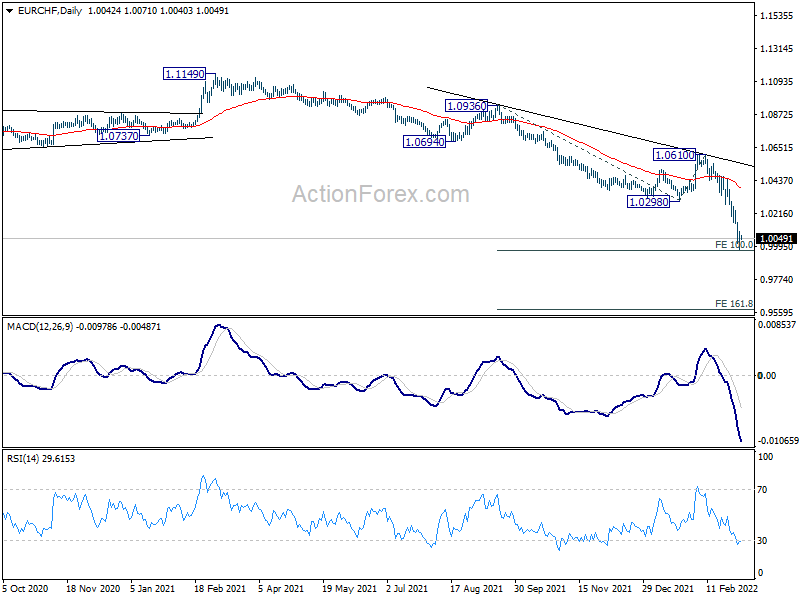
EUR/CHF Daily Outlook
Daily Pivots: (S1) 0.9979; (P) 1.0038; (R1) 1.0104; More....
A temporary low is formed at 0.9907 in EUR/CHF with current recovery. Intraday bias is turned neutral first. Some consolidation could be seen, but upside should be limited well below 1.0298 support turned resistance to bring down trend resumption. On the downside, firm break of 0.9970 will target 161.8% projection of 1.0936 to 1.0298 from 1.0610 at 0.9578.
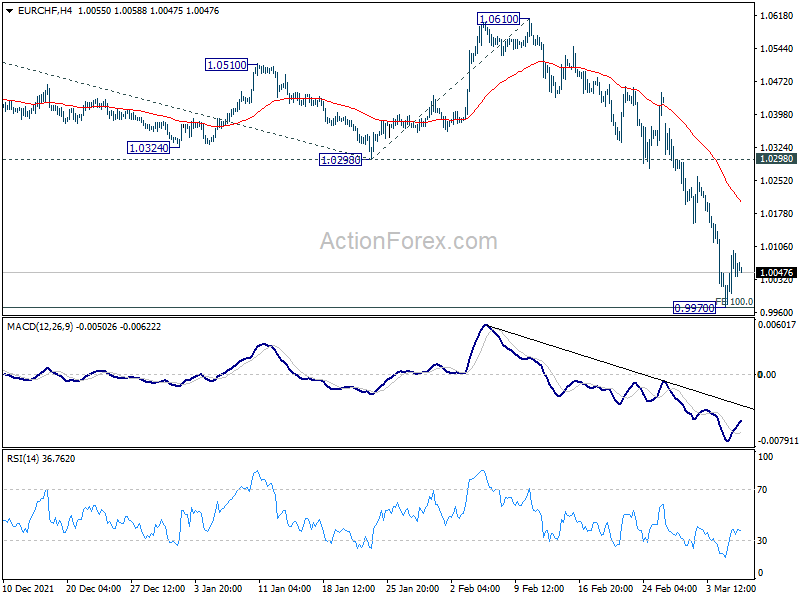
In the bigger picture, long term down trend from 1.2004 (2018 high) is still in progress. Next target is 100% projection of 1.2004 to 1.0505 to 1.1149 at 0.9650. Firm break there will target 100% projection at 0.9650. In any case, break of 1.0505 support turned resistance is needed to be the first sign of medium term bottoming. Otherwise, outlook will remain bearish.