

Sample Category Title
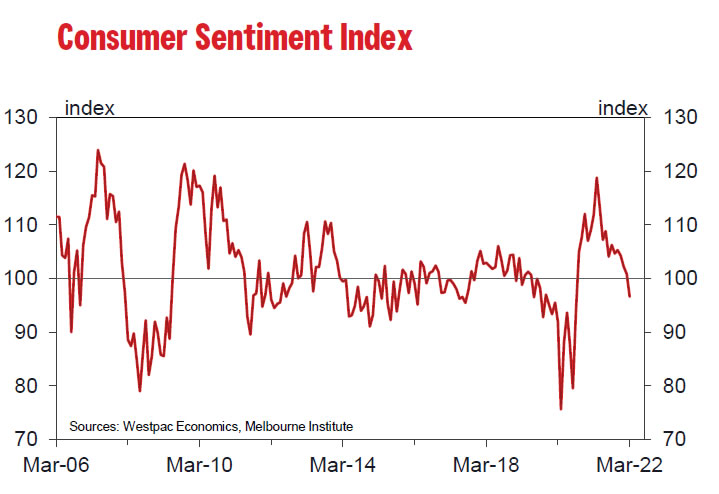
Australia Westpac consumer sentiment dropped to 96.6 in Mar, worst since Sep 2020
Australia Westpac consumer sentiment index dropped -4.2% to 96.6 in March, down from 100.8. That's the worst reading since September 2020, which was also the last time thee index was below the 100-level.
Westpac said: "The latest monthly fall comes as no surprise. The war in Ukraine; the floods in south- east Queensland and Northern NSW; ongoing concerns about inflation and higher interest rates were all likely to impact confidence, although the size of the decline is still notable."
Westpac maintained the view that the first RBA rate hike in the tightening cycle will start on August 2, following two more inflations reports of Q1 and Q2.
RBA Lowe: A rate hike this year is plausible
RBA Governor Philip Lowe reiterated in a speech that Australia has the "scope to wait and assess incoming information" before working on interest rates.
He highlighted two issues that policymakers are "paying close attention to". The first is the "persistence of supply-side price shocks" and the extent of impact from Russia's invasion of Ukraine. Secondly, that's "how labor costs in Australia evolve".
He noted that "given the outlook, though, it is plausible that the cash rate will be increased later this year." There is both a risk to "waiting too long" and "moving too early". But Low finished with the point that "it is only possible to achieve a sustained period of low unemployment if inflation remains low and stable". And, "recent developments in Europe have added to the complexities here."
Fitch downgrades Russia rating to C, sovereign default is imminent
Fitch Ratings has downgraded Russia's Long-Term Foreign Currency Issuer Default Rating (IDR) to 'C' from 'B'. The 'C' rating reflects Fitch's view that a sovereign default is imminent.
The rating agency said developments since March 2, the last downgrade to "B", "further undermined Russia's willingness to service government debt."
It added, "the further ratcheting up of sanctions, and proposals that could limit trade in energy, increase the probability of a policy response by Russia that includes at least selective non-payment of its sovereign debt obligations.
How Could the Dollar React to Another Inflation Spike?
US CPI inflation readings for February will be out on Thursday at 12:30 GMT, likely generating more anxiety for Fed policymakers amid the Ukrainian geopolitical nightmare as price pressures are expected to have intensified further. The US dollar is trading in secure territory and another upbeat inflation report could strengthen calls for a faster monetary tightening once again, making the reserve currency shine brighter.
Powell previews March rate decision
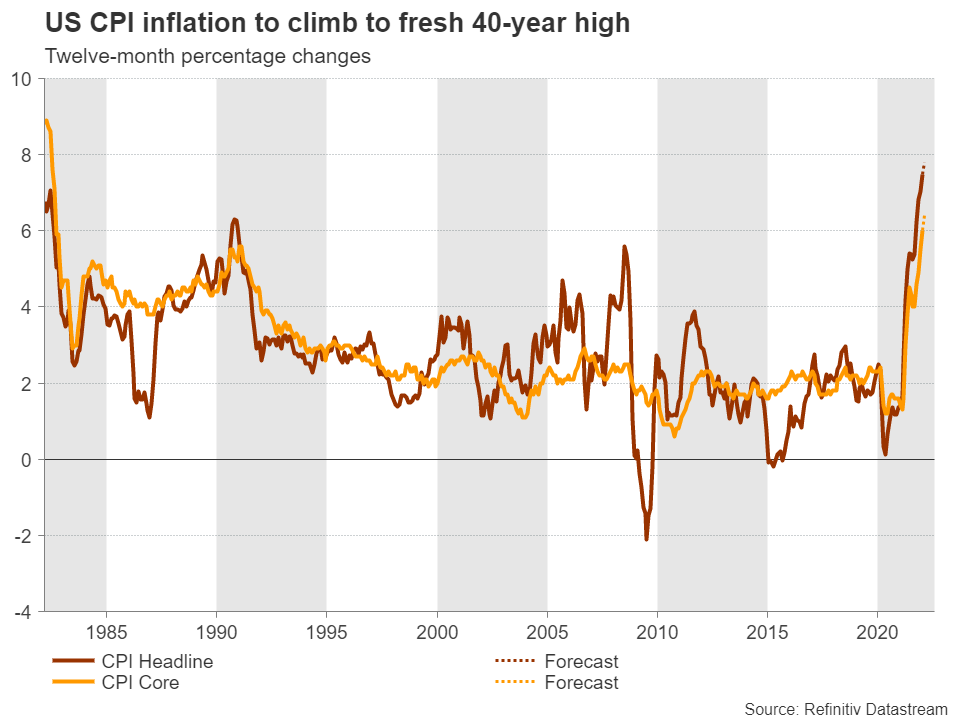
US consumer prices experienced their highest annual growth in 40 years in January, led by energy, electricity, and transportation costs. Other essential sectors such as food also posted considerable price increases, while the core CPI measure, which excludes volatile food and energy prices, surged to 6.0% y/y, flagging that what looked to be a pandemic-led price distortion is now developing to a broader inflation problem, which requires an immediate monetary action.
Indeed, speaking before a House panel, Fed chief Jerome Powell admitted he would propose a quarter-percentage point rate increase when the central bank’s voting committee meets next week, clearly revealing to investors how the policy gathering will play out. While that had initially curbed speculation for a more aggressive start to the tightening cycle, Powell kept that prospect open for the foreseeable future, indicating that the central bank would not hesitate to intervene drastically with non-traditional rate hikes even if such an action would sacrifice some economic growth.
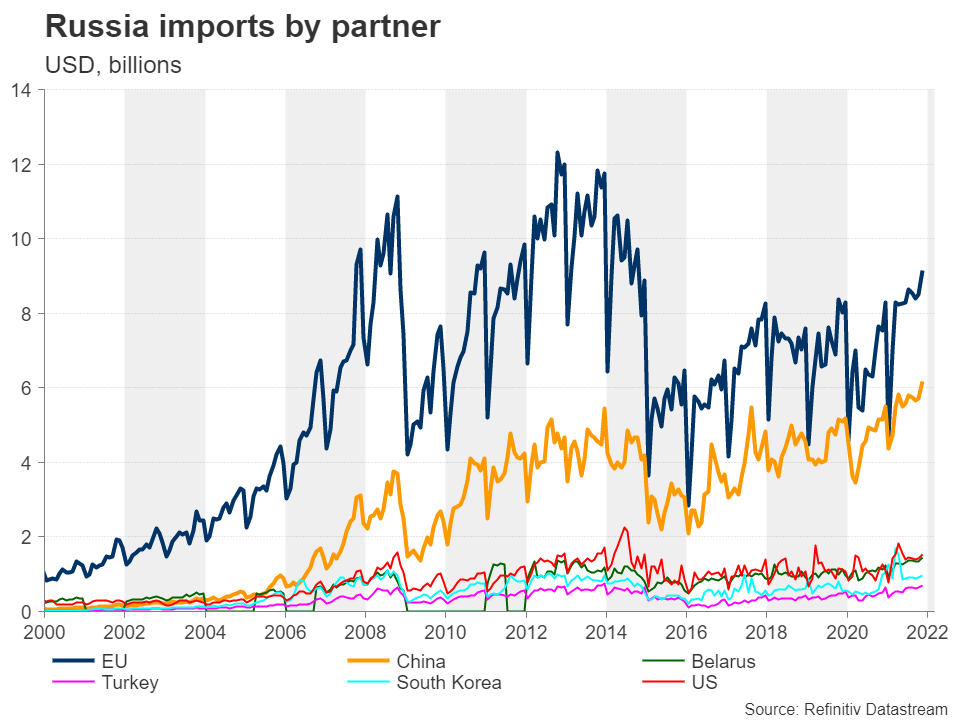
How exposed is the US to Russia?
It would not be a big surprise if Fed policymakers enter long debates over any tightening actions which could derail the economic expansion at a time when the tit-for-tat sanction war between Ukraine’s Western allies and Russia is moving from bad to worst, testing the interconnectedness of the global economy. That said, the US is less exposed to the Ukrainian crisis than its European rivals, given its small reliance on Russian exports and imports including the energy sector as well. Hence, the Fed could remain concentrated on cooling down inflation for now, and as long as the US economy keeps printing healthy data and the Ukrainian geopolitical crisis does not generate severe global economic shock waves.
US inflation to print fresh 40-year high
Hence, after February’s upbeat employment report, which revealed a stronger-than-expected hiring spree and an unemployment rate closer to pre-pandemic levels, the new CPI inflation report could raise again the stakes for a more aggressive Fed response. The headline measure is expected to edge up to a new 40-year high of 7.8% y/y and the gauge which excludes volatile food and energy prices is forecast to jump to 6.4% y/y, further deviating above the Fed’s 2.0% symmetrical price target.
How could the dollar react to another inflation spike?
As regards the dollar’s reaction, an upside surprise in the CPI data could bolster buying appetite for the world’s reserve currency, which is also extracting benefits from its safe-haven feature. Yet gains could appear moderate as investors are already aware that the sanction fight could make inflation stickier than analysts thought at the start of the year, and the Fed’s next policy decision is also well telegraphed. Moreover, futures markets are currently reflecting certainty for three additional 25 bps rate hikes by July, which makes February’s inflation data look less important but still a key indicator to influence rate expectations.
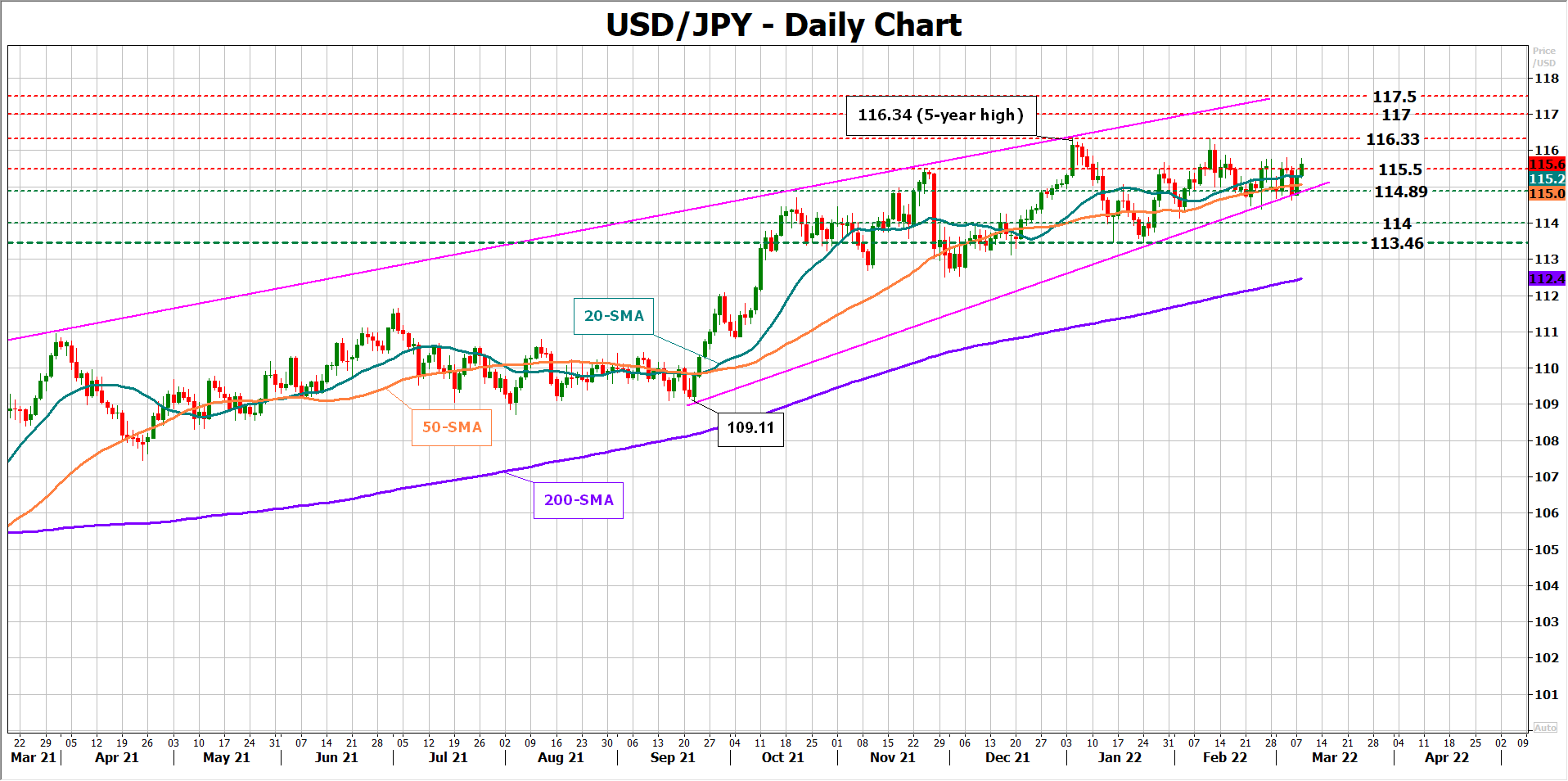
Looking at dollar/yen, the 115.50 level keeps balancing bullish moves for the second consecutive week. Should the CPI report push the pair above that boundary, traders may not rush to raise exposure to the market, unless the price climbs sustainably above the nearby ceiling of 116.33 and towards the 117.00 – 117.50 region.
In the case the CPI readings miss expectations, all attention will turn to the ascending trendline at 114.89, which has been supporting the market since September. Failure to bounce here could press the price towards the 114.00 level and January’s low of 113.46.
AUDUSD Upside Risks Linger Despite Heavy Retreat
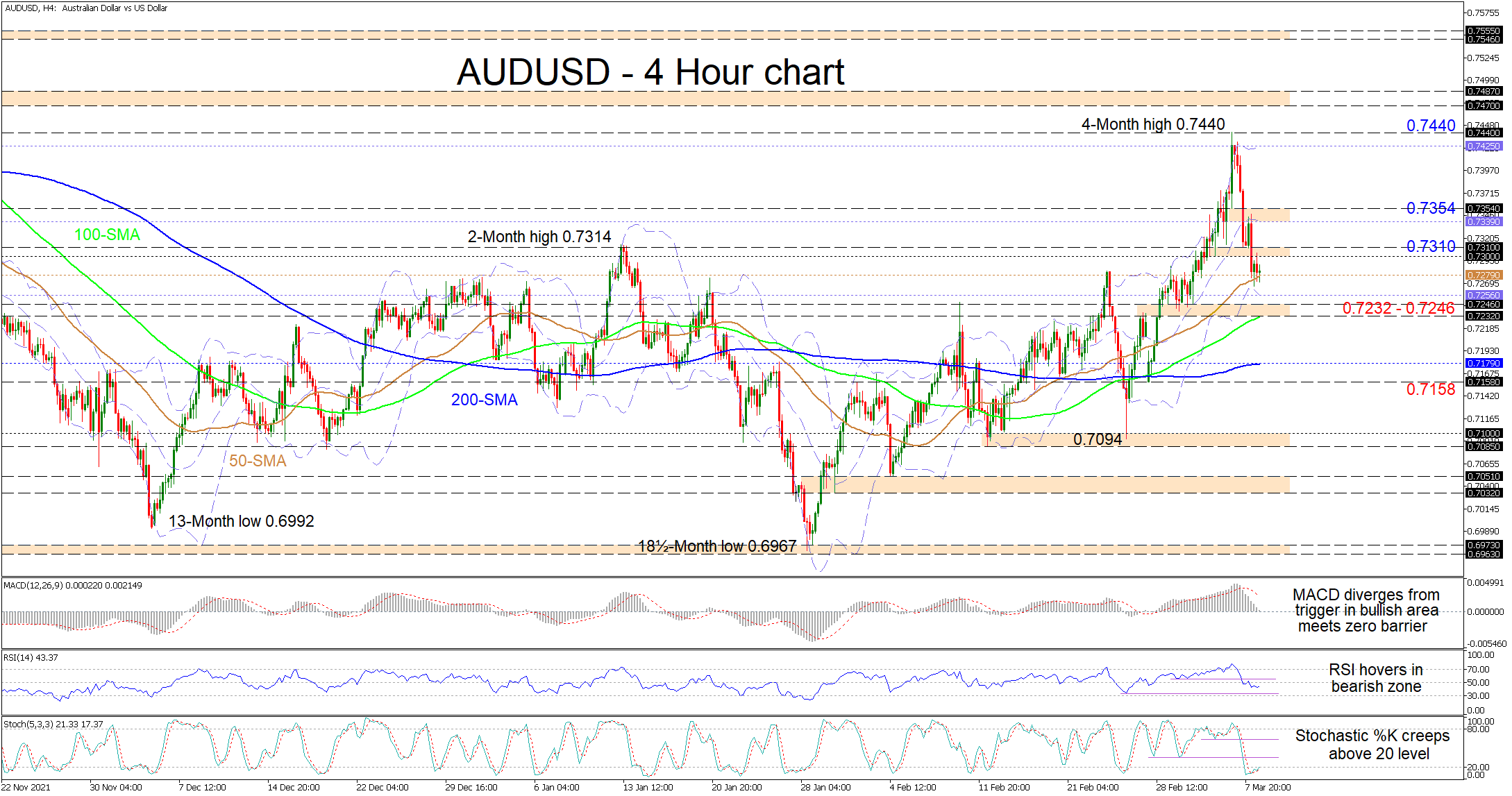
AUDUSD has snagged around the ascending 50-period simple moving average (SMA) around 0.7279 after its latest deep retracement from a four-month high of 0.7440. The SMAs are essentially defending the rally that began from the February 24 trough of 0.7094.
The short-term oscillators are endorsing the bearish drop and have yet to convincingly signal a shift in momentum to the upside. The MACD looks set to pierce into negative territory after accelerating far beneath its red trigger line, while the RSI is hinting of a pause in bearish momentum. The stochastic %K line is marginally above its %D line and is flirting with the 20 oversold level, indicating that buyers are finding some footing at the 50-period SMA.
In the positive scenario, traction off the 50-period SMA would need to initially overcome the 0.7300-0.7310 nearby upside constraint before tackling the region of resistance from the mid-Bollinger band at 0.7339 until the 0.7354 inside swing low. Conquering the latter obstacle too, the bulls could then propel to test the upper Bollinger band at 0.7425 and the adjacent four-month high of 0.7440.
Alternatively, the 50-period SMA at 0.7279 is the immediate support hindering additional developments to the downside. That said, for sellers to sustain the downward trajectory in the pair, they would need to drive the price below the lower Bollinger band at 0.7256 and the neighbouring 0.7232-0.7246 support border. Successfully breaching this key barrier, which is reinforced by the 100-period SMA, the bears could then target the 200-period SMA at 0.7179 before eyeing the 0.7158 trough.
Summarizing, AUDUSD has retraced around 50.0% of its recent rally but the bullish bearing remains active above the 0.7232-0.7246 boundary. That said, a price descent below the 0.7158 trough could spark growing worries about negative tendencies in the pair.
EURCAD Wave Analysis
- EURCAD reversed from support area
- Likely to rise to resistance level 1.41
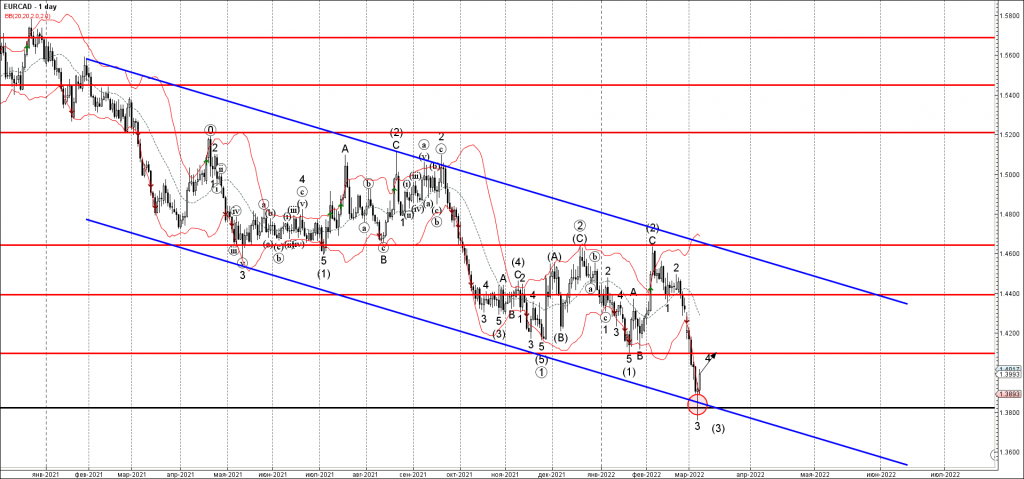
EURCAD recently reversed up sharply from the support area located between the key support level 1.3800, weekly down channel from 2021 and the lower daily Bollinger Band.
The upward reversal from this support area created the daily Japanese candlesticks reversal pattern Hammer.
EURCAD can be expected to rise further toward the next resistance level 1.41 (target price for the completion of the active wave 4).
Gold Wave Analysis
- Gold broke round resistance level 2000.00
- Likely to rise to resistance level 2075.00
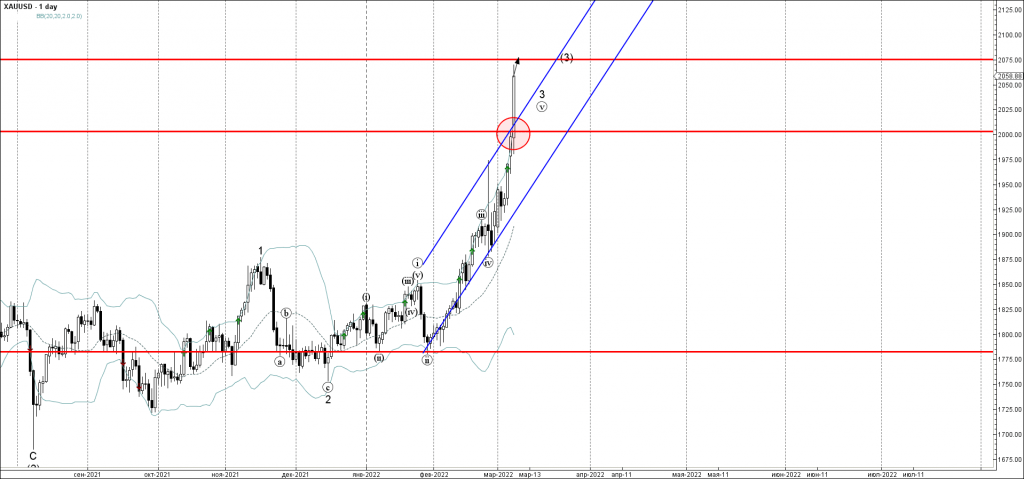
Gold recently broke through the major resistance area located between the round resistance level 2000.00 and the resistance trendline of the sharp daily up channel from October.
The breakout of this resistance area accelerated the active impulse waves 3 and (3).
Gold can be expected to rise further toward the next resistance level 2075.00 (target price for the completion of the active wave (3)).
ECB meeting: No right choices for the euro
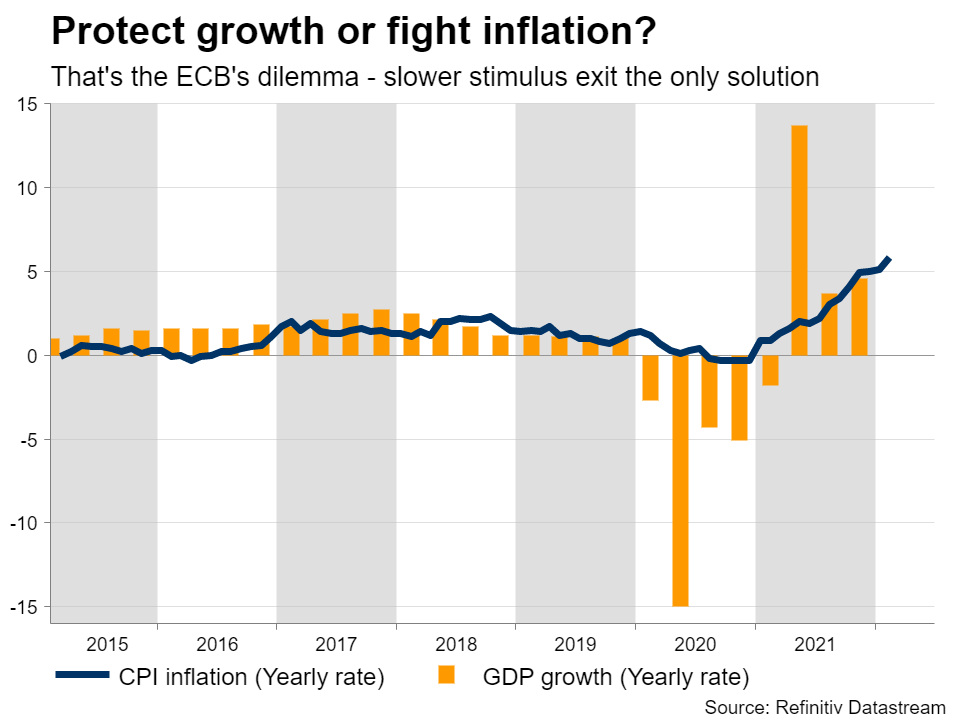
The European Central Bank faces a tough dilemma when it concludes its meeting at 11:45 GMT on Thursday. With the crippling sanctions imposed on Russia, European growth will slow down but inflation will heat up as energy prices soar. Will the ECB accept a period of higher inflation and delay its exit from stimulus measures, or forge ahead with higher rates and risk a recession? For the euro, neither choice is attractive.
ECB in a pickle
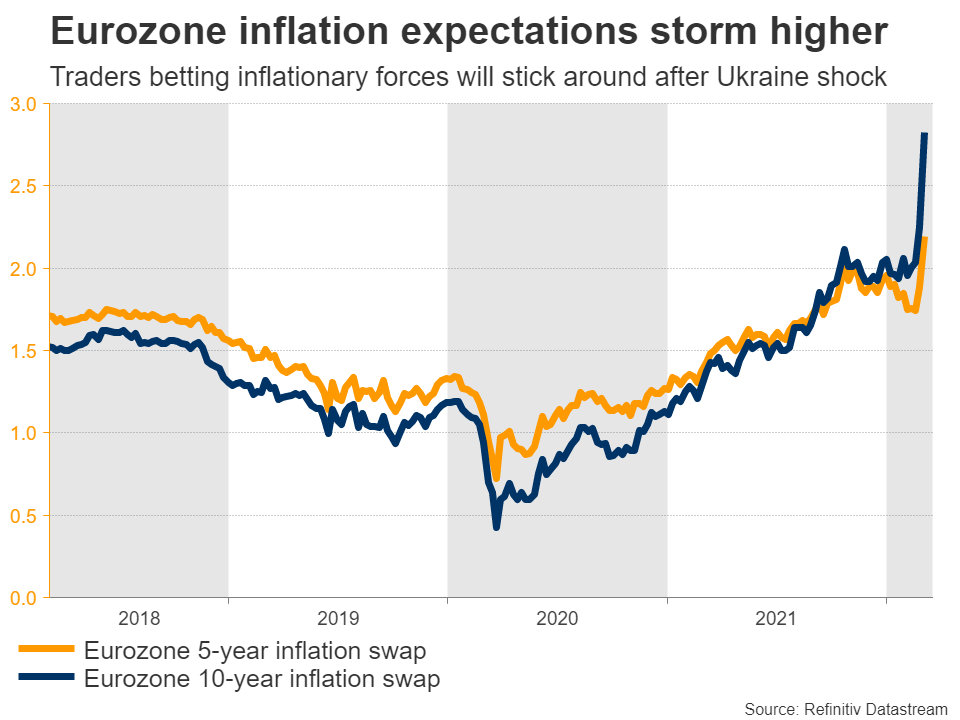
The crisis in Ukraine has produced another crisis for European monetary policy. Energy and food prices have stormed higher, which will probably propel inflation higher as well. Derivatives traders are already betting that inflationary forces will stick around for longer.
On the other hand, economic growth will take a serious hit. European consumers will get squeezed as a bigger percentage of their income gets spent on necessities. There’s also the banking sector to consider. Several large European banks have high exposure to Russian assets, which have suffered a dramatic devaluation.
Dealing with a situation of slower growth but rising inflation is an impossible task for a central bank. The ECB’s choices are simply terrible. Do you raise interest rates to cool inflation and risk choking economic growth, or do you pause tightening and allow inflation to rage uncontrollably?
Euro braces for impact
For the euro, neither choice is particularly attractive. Delaying the exit from stimulus measures would argue for lower real yields in Europe, while pressing ahead with higher interest rates could be interpreted as a policy mistake since it would raise the risk of a recession.
Traders are saying the ECB will choose option number one. Bets for rate increases have been dialed back since the war erupted, with only one rate hike currently priced in for this year, down from two recently.
For this meeting, the burning question is what happens to asset purchases. Until recently, investors expected the ECB to announce that its QE program would end completely by the summer, opening the door for raising interest rates in the fall. But now, this process could be delayed since moving forward with tightening could backfire.
The updated economic forecasts will also attract attention, as they are expected to reflect the fallout from the conflict in Ukraine.
Euro hostage to politics
The catch is that the ECB wants a stronger euro. A stronger currency would help to cool inflation faster, without the need to tighten policy so much. Hence, ECB policymakers have an incentive to strike a more hawkish tone at the upcoming meetings.
But they might not be able to get their wish. Admittedly, there isn’t much the ECB can do to really change the euro’s fortunes here. Even an announcement that asset purchases will end in the summer - which is probably the most euro-friendly outcome - might not be enough to turn the tide for long.
Everything revolves around geopolitics for now. What the ECB says is secondary. As such, market participants might need to see a ceasefire in Ukraine before the euro can enjoy a proper relief rally.
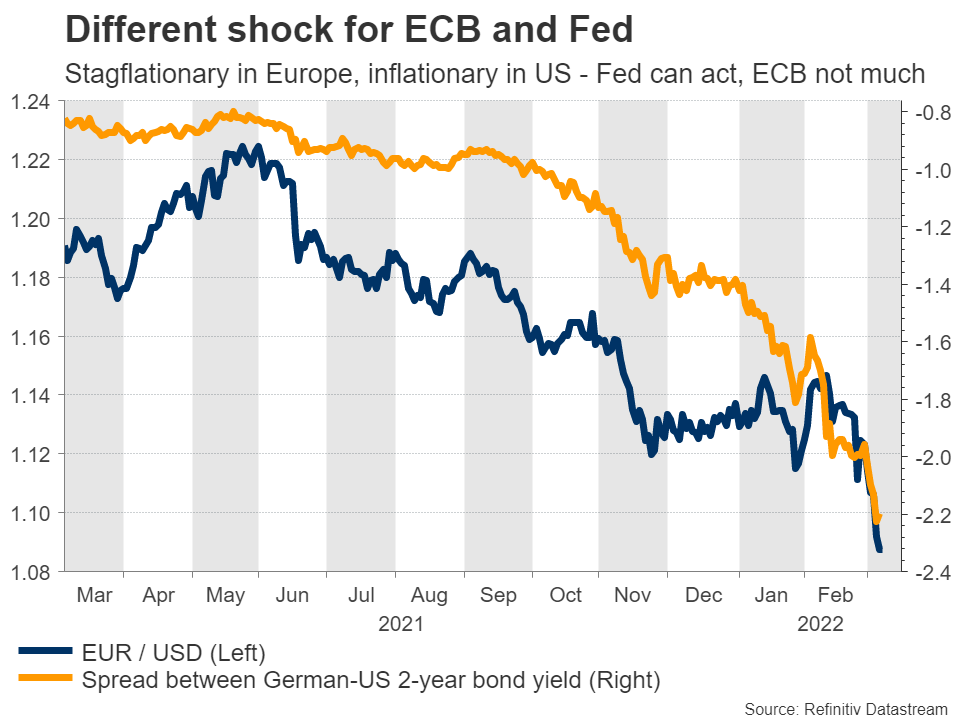
In the big picture, this crisis will likely leave scars on euro/dollar, because it has very different implications for the two economies. For the Eurozone, this is a stagflationary shock. It implies both slower growth and higher inflation, which leaves the ECB unable to tighten policy properly.
For the US, this is only an inflationary shock. America is energy independent and its banks have almost no exposure to Russian money, so this won’t be a serious setback for the economy. It will just push inflation higher. That’s something the Fed can respond to, and it will.
As a result, euro/dollar has resumed its downtrend and if the bears stay in control, their next target might be the 1.0800 zone.
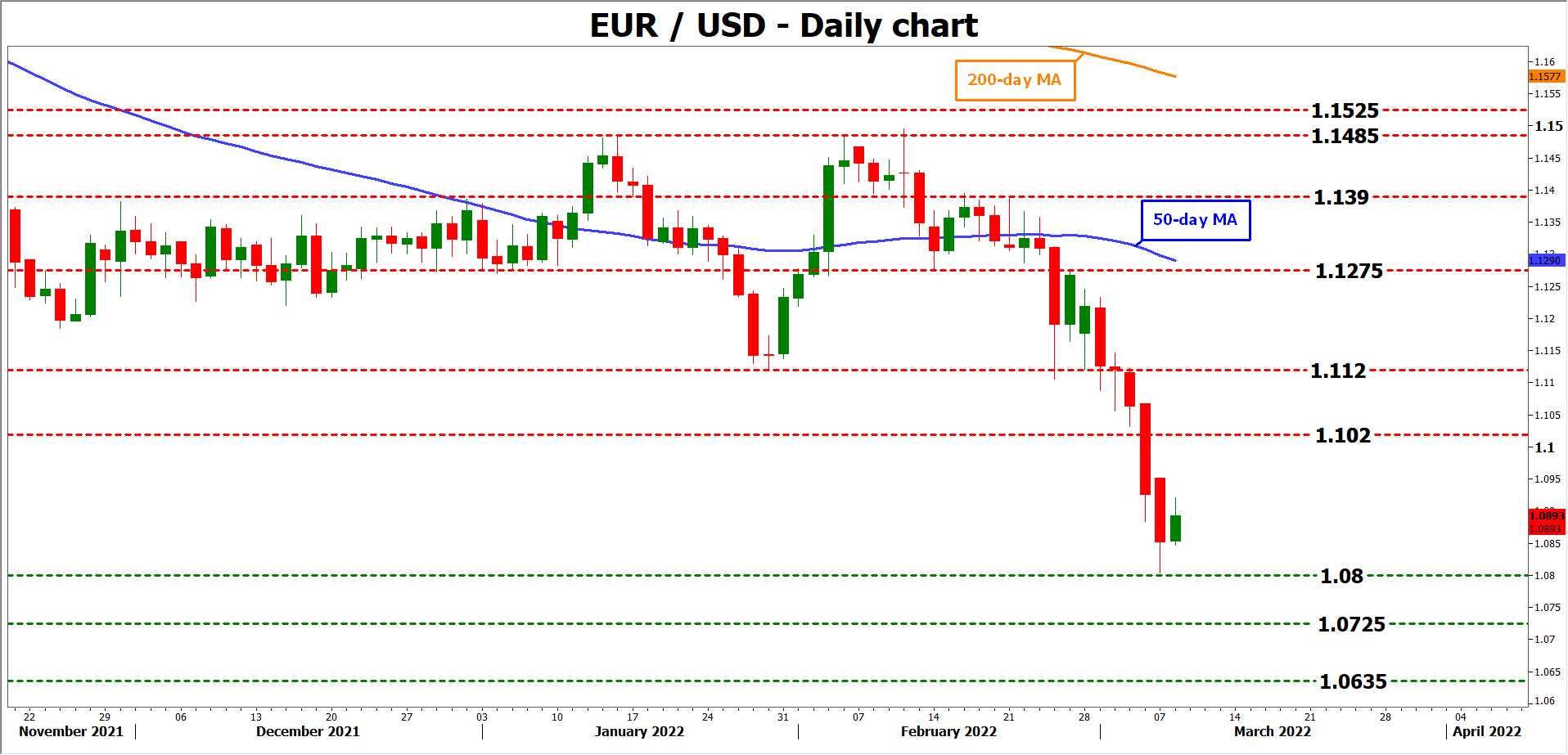
On the upside, if there is a ceasefire in Ukraine soon or the ECB ends its asset purchases, the pair could edge higher towards the 1.1020 region.
The Russian-Ukrainian Crisis May Push Oil Prices UpFurther
Brent oil is trading near $125 – in the 2011 and 2012 highs area. The market continues to receive bullish comments from politicians and officials. However, traders seemed set to pause to digest current price levels after a frightening rally to $129 at one point on Monday, reacting to reports that the US and allies are weighing a ban on Russian oil and gas imports.
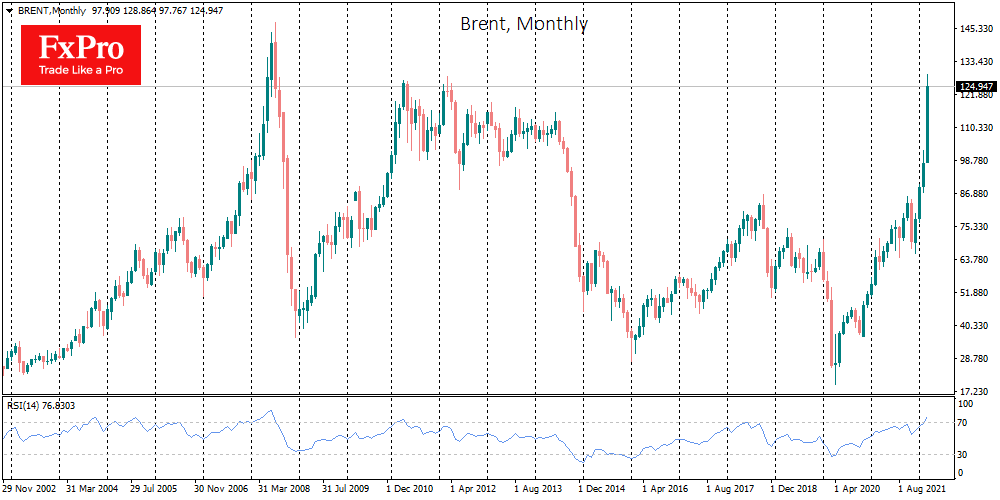
In Russia, Novak (a former energy minister and co-founder of OPEC+ deals) points out that the oil embargo will push prices into the $300 a barrel area. Probably, this forecast is based on a comparison of the current situation with the OPEC embargo in late 1972, when the price soared 3-4 times within a few weeks.
The International Energy Agency’s executive director said the Oil can still move higher from current levels.
Officially, Russia is not refusing to export Oil and Gas, but local companies have recently failed to sell Oil because of a buyers’ boycott or fears of being hit by US and EU sanctions.
Shell’s just-announced refusal to buy all Russian Oil is doing little to bring down the commodity price.
With this news backdrop, Oil is getting support on the downside in the $115 area, where last week’s highs were located. It will take a lot more political will to reverse the trend in Oil.
Also, the chances of Oil from Iran to make up for the drop-offs are somewhat thawed, as the president has said that Tehran will not give up its red lines.
Iran would logically be expected to use the situation to bargain for better terms on a deal with the West. The same applies to Venezuela, where US representatives have headed to secure a rise in global production.
Will the countries previously most disadvantaged by US sanctions use the momentum to ramp up production? That question is not yet answered. Likely, we should expect price rises to accelerate in the coming days before the situation reverses into a constructive direction and prices head for a correction.