Sample Category Title
Markets Shrug Off First Round of Russia Sanctions
- Asian stocks higher, US and European futures in the green
- Western sanctions against Russia far from harshest scenario
- Geopolitical fears most evident in commodity’s surge
- Global markets remain sensitive to threat of a deeper invasion
Markets are peeking out from behind the risk-off curtain, as sanctions announced by the US, UK, and Europe against Russia didn’t live up to the market’s worst fears. Most Asian markets are rising alongside European and US equity futures, as equity bulls attempt to pull the S&P 500 out of a technical correction once more. Meanwhile, safe havens have moderated with spot gold easing back below $1900, Treasury yields are pushing higher, and the dollar is ceding ground to most of its G10 peers.
Instead of sending the strongest message possible , the first tranche of sanctions by Western allies are seen as mere thumbtacks that only induce limited discomfort on Russia, at least for now. Some of the sanctions on Russian banks are largely symbolic and have limited impact on its financial dealings with the rest of the world. Although the Western allies have highlighted further scope for economic retaliation, Tuesday’s announcements suggest more leeway for Russia in the interim, noting that the EU’s measures still require confirmation from member states, while US lawmakers continue wrangling over a bipartisan package of Russian sanctions.
Still, the potential ramifications from the Ukraine crisis have been felt more keenly within the commodities complex. Natural gas futures in Europe surged by 10% after Germany halted the approval of the Nord Stream 2 pipeline. On Tuesday, Brent futures took a massive stride towards $100, aluminum traded close to its all-time high, and wheat futures in Chicago saw their biggest single-day advance since 2018. Further economic sanctions that make commodities scarcer could ramp up global inflationary pressures, which in turn could further drain risk appetite.
The Ukraine crisis has added to the wall of worries that market participants are contending with, including signs of persistently elevated inflation and the risk of a Fed policy error. Global financial markets are expected to remain sensitive to every development and nuance in this standoff between Russia and the West, with investors and traders bracing for the unending barrage of headlines headed their way.
USDJPY Challenges 115.00 Mark in Ascending Channel
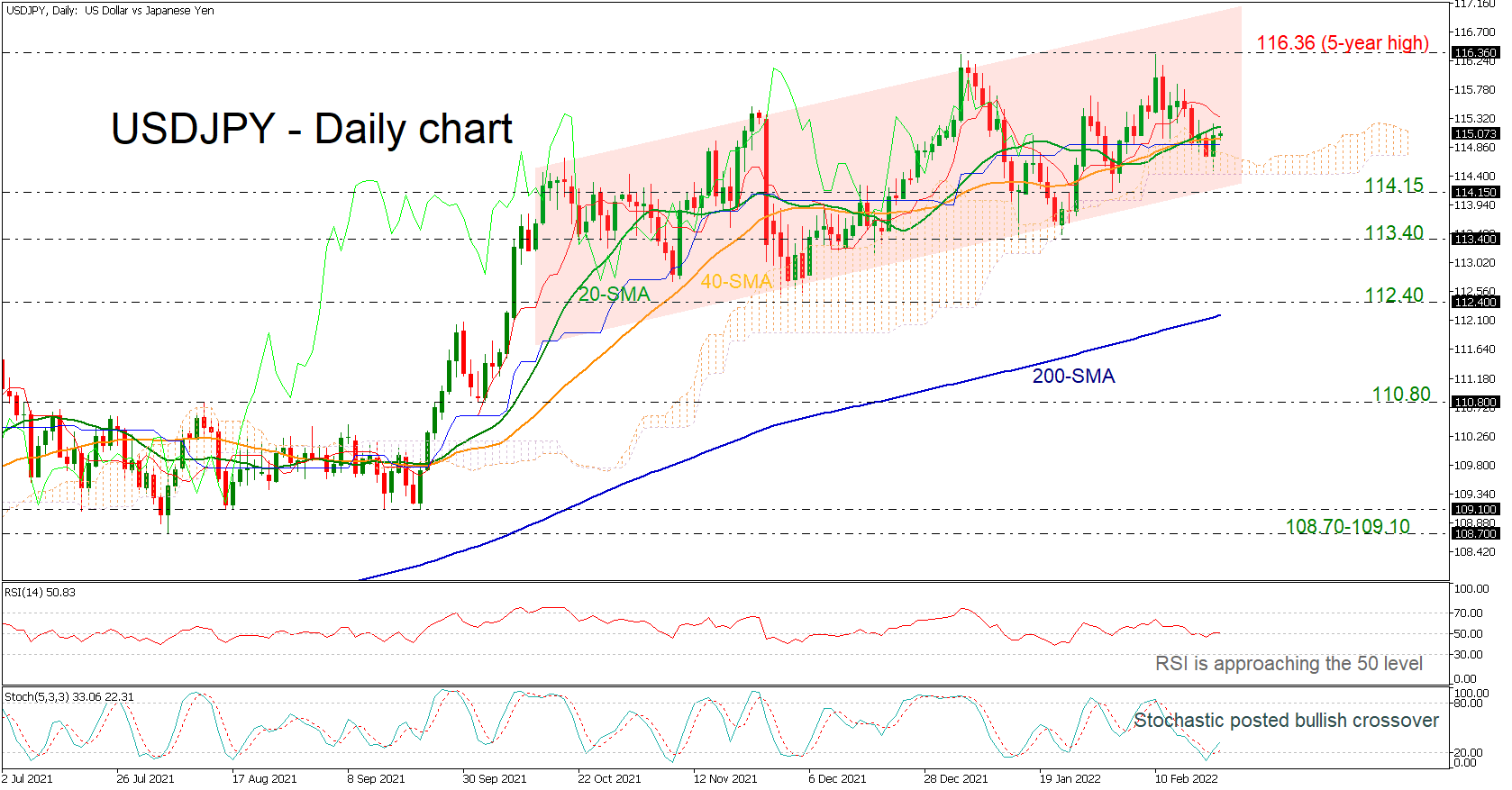
USDJPY came close to breaking the 20-day simple moving average (SMA) and the 115.00 round number on Tuesday, remaining above the Ichimoku cloud and within the upward sloping channel in the medium-term.
According to the RSI, the market could maintain positive momentum in the short-term as the indicator is positively sloped above its neutral threshold of 50, while the %K line of the Stochastics suggests that the market is heading north after the bullish cross with the %D line.
On the upside, the price could attempt to overcome the red Tenkan-sen line at 115.40, which if successfully broken, could open the door for the five-year high of 116.36. Should traders continue to buy the pair above that peak, bringing the long-term uptrend back into play, resistance could then run towards the 118.60 mark, registered in January 2017.
A reversal to the downside; however, could find immediate support at the lower surface of the Ichimoku cloud at 114.40, while slightly lower the 114.15 key-level could also come into view. If the latter fails to halt bearish movements, the next target could be the 113.40 support, which is holding below the ascending channel.
Turning to the medium-term trading, the outlook is positive over the past four months and only a decisive close below the 200-day SMA at 112.20 may change this outlook.
Daily Technical Analysis
EUR/USD
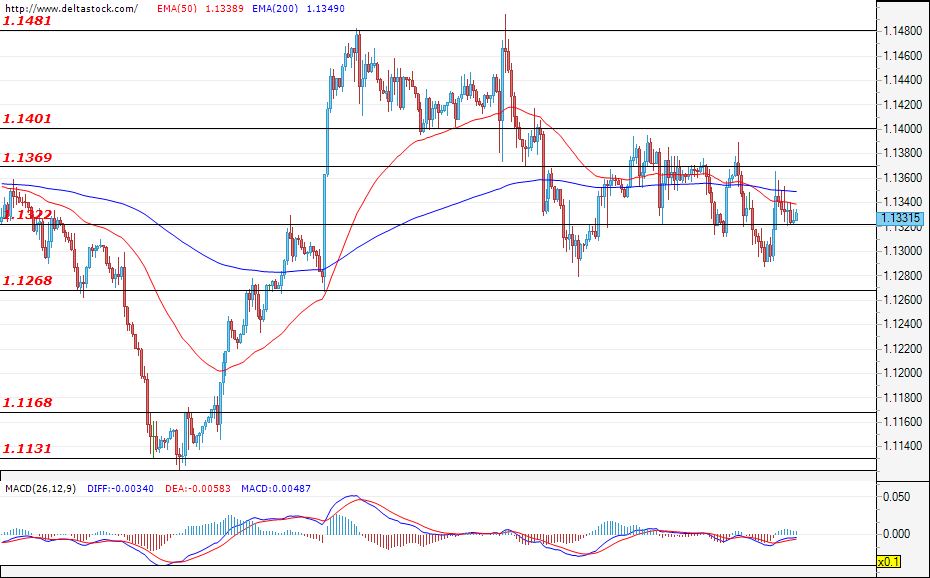
The depreciation of the single European currency was limited to just above the support zone at 1.1322 and the expectations for today’s trading session are for the pair to consolidate in the range of 1.1322 – 1.1369. However, if the bears prevail in this situation and manage to violate the mentioned support, then it is possible to witness another wave of depreciation of the euro against the greenback, but this time – towards the next more significant support area at 1.1270. The first important resistance level for the bulls is located at 1.1370, where a breach may lead the pair towards a test of the psychological level at 1.1400. Today, increased activity can be expected around the release of the CPI data for the EU (10:00 GMT), as well as following any news concerning the situation in Ukraine.
USD/JPY
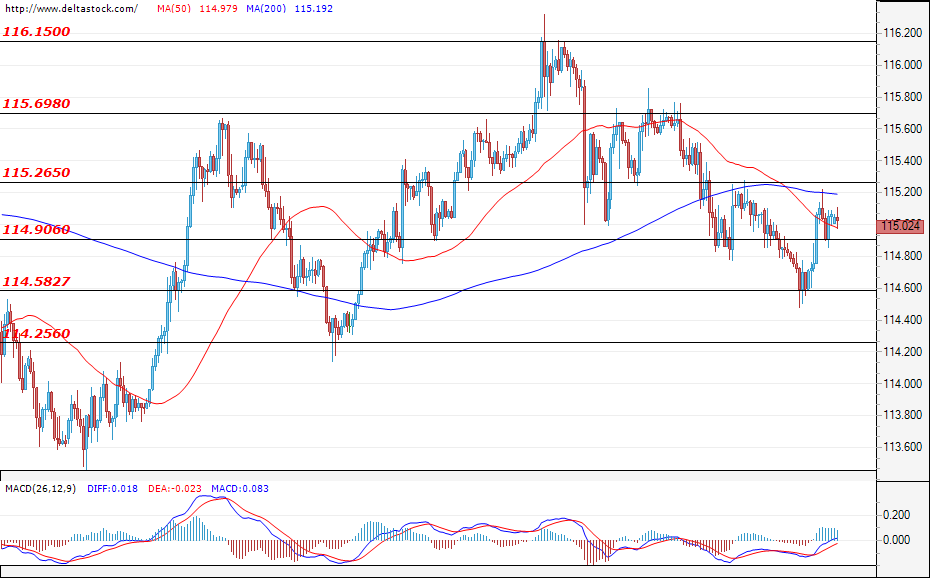
After the unsuccessful test of the resistance level at 115.70, the pair is now consolidating in the range of 114.90 – 115.26. A confirmed breach of the resistance at 115.26 would pave the way for the pair towards the next resistance at 115.70. On the other hand, if the bears regain control and manage to overcome the support zone at 114.90, then this would most probably result in an attack on the next support lying at 114.58.
GBP/USD
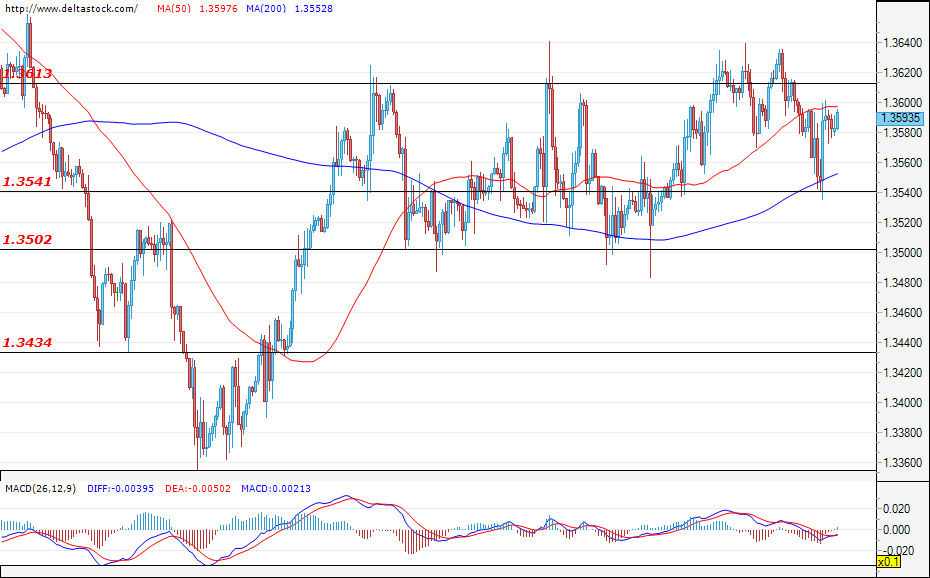
After the unsuccessful attempt of the bears to violate the support at 1.3540, the sterling recovered some of its losses against the U.S. dollar, and at the time of writing this analysis, the pair is headed towards a test of the resistance at 1.3613. A successful breach of this level would most probably lead to a further appreciation of the sterling towards the psychological level at 1.3700. However, the mentioned resistance was an obstacle for the bulls many times during the last weeks and the expectations therefore are for this level to only be tested and for the pair to bounce back and make an impulsive downward movement towards the support zone at 1.3540.
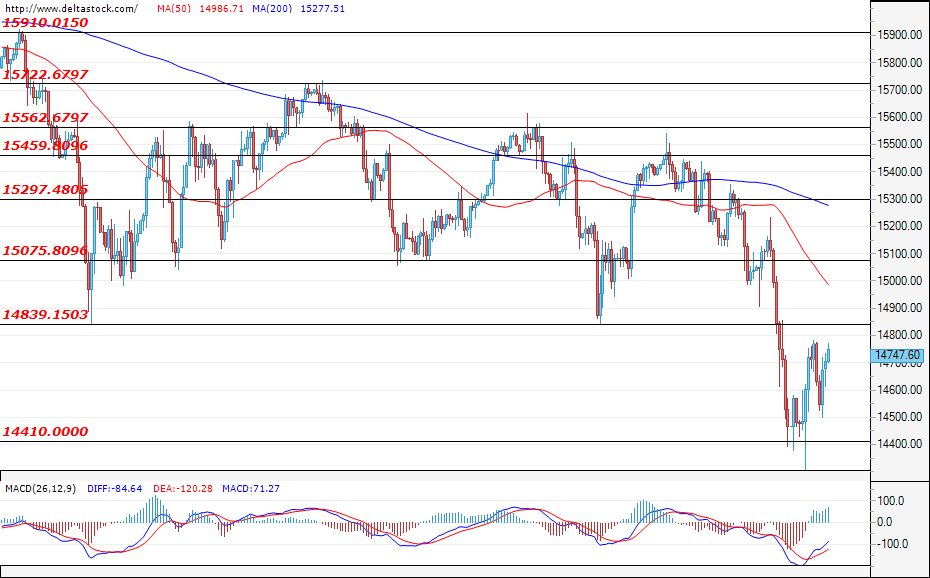
EUGERMANY40
After the massive sell-off that began in the beginning of the week, the bears started to take their profits around the level of support at 14410 and the index partially recovered its losses. The recovery may be considered as a short-lived correction and the bears would probably try to regain control and head the price towards another test of the critical support level at 14410. A breach of this level could be considered as a signal for a continuation of the downtrend and the next target for the bears would be the support at 13550. In the opposite direction, the first significant resistance lies at 14839. The expectations for today’s trading session are for the trading activity to remain in the range of 14410 – 14839. The situation in Ukraine will remain the main driving force behind the price action during today's session as well.
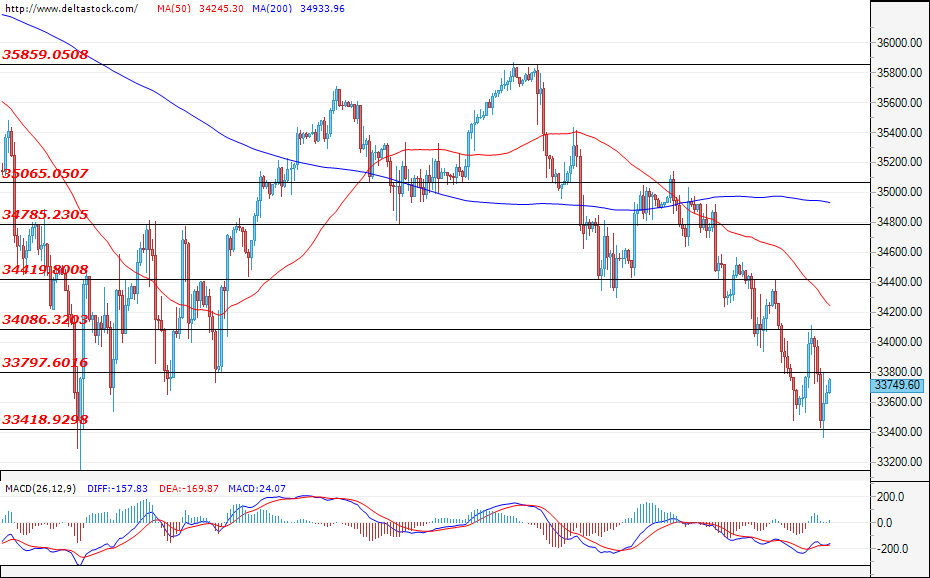
US30
The downtrend for the U.S. blue-chip stock index continues, with the bulls currently managing to limit the sell-off to just above the support at 33418. We may see a short-term upward correction towards the resistance at 34086, after which the downtrend could continue. A breach of the support zone at 33418 would significantly boost the sell-offs towards the psychological level at 33000.
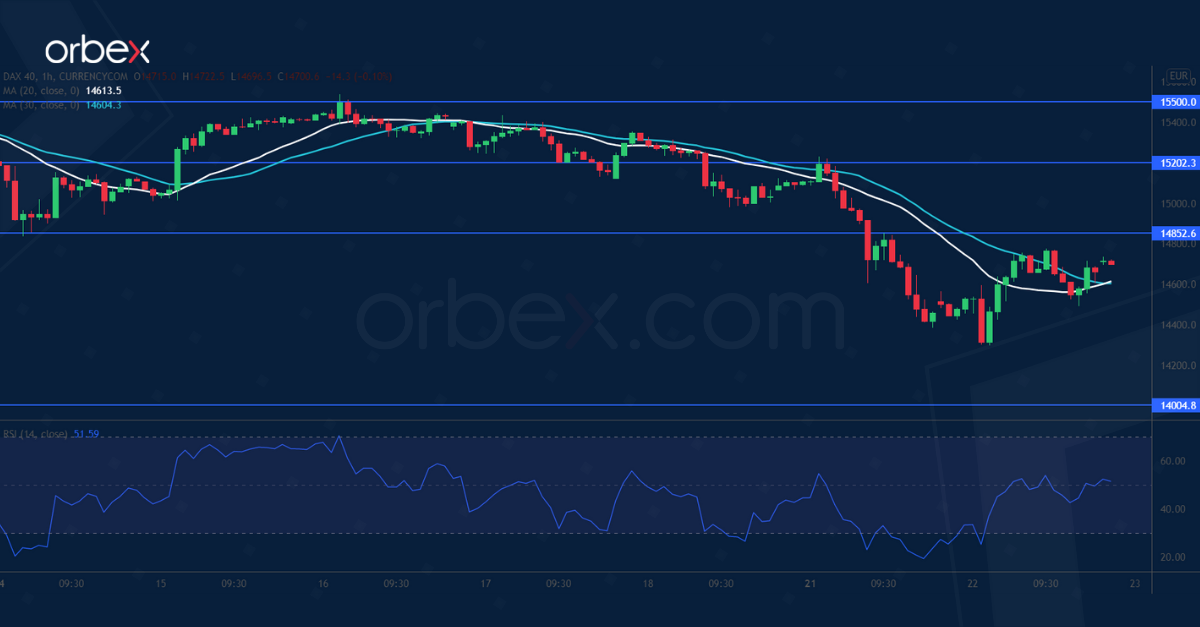
GER 40 Breaks Floor
Trepid sentiment continues to weigh on the Dax. The plunge below the 9-month long consolidation area (14850) may foreshadow a bear market.
As traders grew wary, trapped bulls would look to get out of their positions while the bears saw any rebound as an opportunity to sell into strength. An oversold RSI brought in some bids and 14850 is the immediate resistance.
However, the index would remain under unless it lifts offers around 15200. Otherwise, the psychological level of 14000 would be the next stop.
EUR/GBP Attempts Reversal
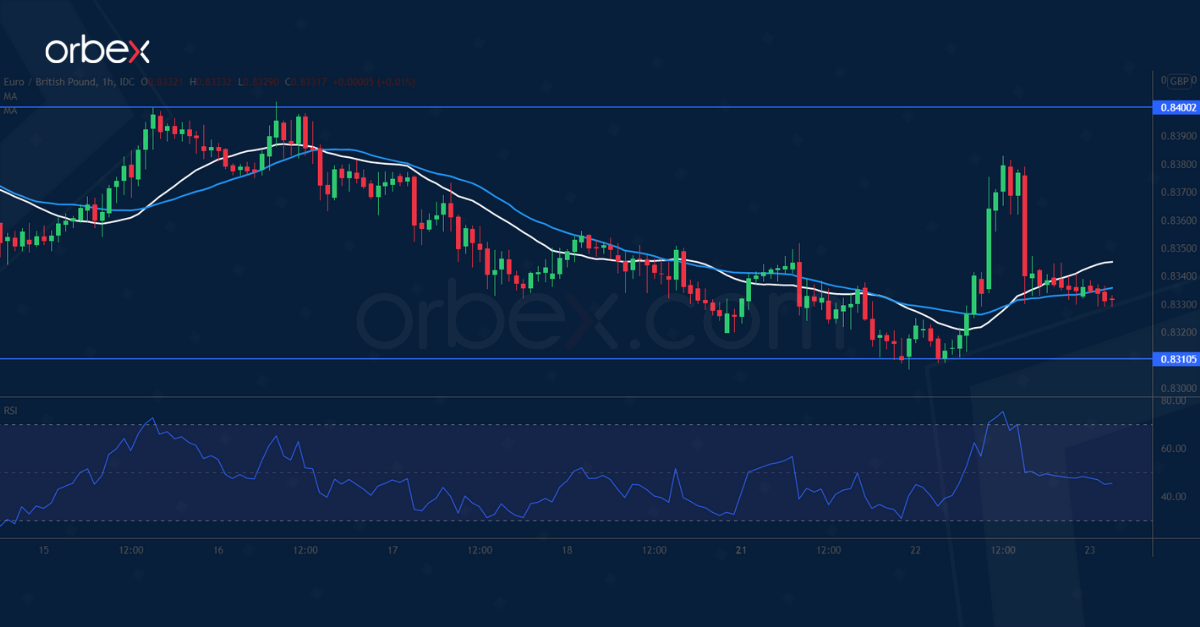
The sterling whipsawed after BOE officials’ comment about a “modest” rate hike over the coming months. The euro saw strong bids at the base of the February breakout rally (0.8310).
A break above 0.8370 wiped out some selling interest, a prerequisite for a meaningful recovery. 0.8400 is the next resistance and its breach would further boost buyers’ confidence and propel the single currency to the recent high at 0.8475.
On the downside, a bearish breakout would invalidate the rebound pattern and cause a sell-off below 0.8280.
EUR/USD Bounces off Support
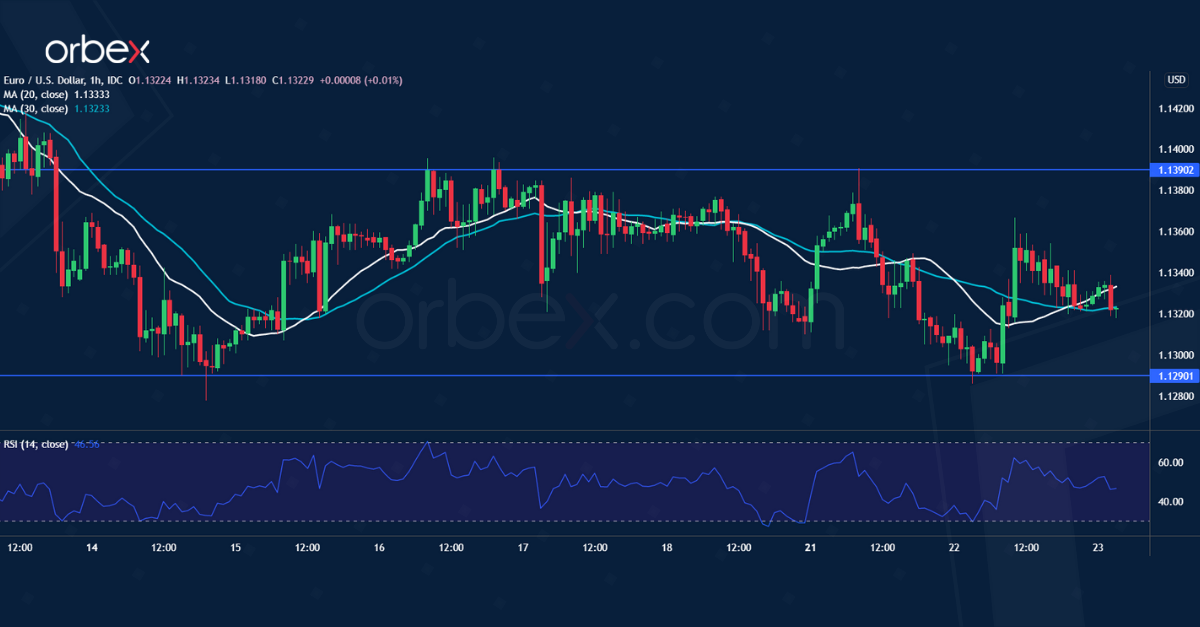
The euro surged over signs that Moscow may remain open to diplomacy.
The pair found support at the base of the previous rally (1.1290), indicating the bulls’ commitment to keeping the rebound intact. The RSI’s oversold situation attracted a slew of bargain hunters betting on a lengthy rebound.
A break above 1.1390 would prompt sellers to cover and pave the way for a sustained recovery. The recent peak and daily resistance at 1.1490 is a major hurdle. Its breach could extend the rally to 1.1600.
Some Kind of a Buy-the-Rumour, Sell-the-Fact on Russia’s Semi-Invasion
Markets
Yesterday’s lackluster Bund performance during Asian dealings even as geopolitical tensions intensified dramatically was the writing on the wall. German yields gapped lower at the European open but almost immediately started recovering afterwards. Support in the German 10y (+3.7 bps) yield around 0.15% easily survived. The curve eventually bear flattened with changes ranging from +5.5 bps (2y) to 2.2 bps (30y). US yields traded a similar pattern on their first trading day of the week. Yields advanced 8.4 bps (2y) to 1 bp (10y).
The implications of higher energy prices on expected central bank policy thus outweighed safe haven flows. Perhaps some geopolitical fatigue kicked in as well. European stocks for example erased all opening losses (>2%) to finish flat. Wall Street ended with losses of about 1.4% (DJI) but had to catch up a risk-off session on Monday.
Economic data included a better-than-expected (but not really after Monday’s strong PMIs) February German Ifo indicator. US Conference Board consumer confidence declined from 111.1 to 110.5 (110 expected). Americans are particularly less optimistic about the future with income and employment prospects deteriorating. They expect the inflation rate one year head at 7%, up from 6.8%.
The US dollar traded mixed; gaining against sterling but losing out vs. the euro. EUR/USD bounced off the 1.13 big figure to close at 1.133. USD/JPY eked out a gain to north of 115. EUR/GBP surged to an intraday high near 0.838 (from 0.831) before retracing part of that move to 0.834. BoE’s Ramsden made his case for further policy normalization though suggested markets are positioned too aggressively.Asian-Pacific markets this morning hold up well. They seem in some kind of a buy-the-rumour, sell-the-fact on Russia’s semi-invasion which was then followed by sanctions. Japanese markets are closed. Bund and Treasury futures edge lower.
FX markets trade muted. The kiwi dollar outperforms after the central bank substantially lifted its terminal rate expectations (see below). It was basically the single most important event on today’s economic calendar.
There’s a slew of central bank speeches scheduled which serves as a wildcard. ECB’s Holzmann kicked off saying the central bank should consider two hikes this year. He favours a start in the summer, even before net purchases have ended. A neutral rate of 1.5% is realistic by 2024, Holzmann added. We also keep an eye at the Bank of England’s testimony before parliament. Aside from that, risk sentiment remains key in driving trading for the time being.
Current sentiment is constructive and keeps the downside in core bond yields protected. EUR/USD struggles to convincingly leave the 1.13 support area behind. A return north of 1.1386/1.14 is needed for some ST reprieve. The same goes for EUR/GBP which remains dangerously close to current YtD lows.
News Headlines
The Reserve Bank of New Zealand (RBNZ) conducted a third consecutive 25 bps rate hike this morning, lifting the policy rate to 1%. Minutes showed it was a balanced call as the MPC considered an aggressive 50 bps rate hike as well. Nevertheless, the statement is clear: more tightening is needed with employment above its maximum sustainable level and headline CPI will above the RBNZ’s target range. The central bank expects the policy rate to reach 2.2% by the end of the year, slightly above its 2.1% forecast in November. The NZ money market is even more aggressive, suggesting a policy rate of around 2.75%. However, the biggest change from the RBNZ comes from 2023 policy rate forecasts which now show a peak policy rate of 3.3% end 2023 (vs 2.6% in November). The RBNZ lifted its inflation forecasts for fiscal year 2022 and 2023 to 6.6% (from 5.7%) and 3.2% (from 2.9%). Growth is expected stronger in fiscal 2022 (5.3% from 4.5%), but weaker in 2023 (2.9% from 4.2%). Uncertainty created by the persistent impacts of Covid-19, rising inflation and tighter (global) monetary conditions all play a role. In addition to its rate hike call, the RBNZ agreed to commence a gradual run-off of its balance sheet, both through bond maturities and managed sales. The RBNZ expects its bond portfolio to fade to zero (from currently >NZD $50bn) by the end of 2027. The kiwi dollar strengthens this morning to its best level in over a month (NZD/USD 0.6765). The NZD swap rate curve bear flattens with yields adding 2 bps (20-yr) to 11 bps (2-yr).
Sentiment Improves, But Risks Prevail
Market focus remains on Ukraine and Russia, as the US warns that Russia moving its army to the separatist regions in Donbas could mean a larger-scale invasion in the coming days. Russia is suffering from a first round of sanctions. The Nord Stream Pipeline project, which has been one of Putin’s priorities, has been put to coma, and Britain announced some sanctions targeting the banks. Lavrov and Blinken will no longer meet on Thursday.
More sanctions are expected in the coming days, but the measures that have been announced so far are not as heavy as feared.
Market mood is not cheerful but the softer-than-feared sanctions somewhat help lifting the mood. The risk appetite is limited, of course, except in some key assets including oil and commodities.
European natural gas futures jumped 8% yesterday, the barrel of Brent crude flirted with the $100 mark, as the US crude spiked above $96 before easing back to the $93 level this morning. Although we had news that oil prices are high enough to boost the US production throughout the year, Iraq and Nigeria are apparently not willing to pump faster, even the prices hit three-digit numbers. Price pullbacks are seen as interesting buy opportunities as the trend remains comfortably positive.
Elsewhere, gold steadied and slipped below the $1900 mark, while iShares Diversified Commodity ETF advanced to a fresh high.
S&P 500, Nasdaq selloff is only partly due to Ukrainian tensions
The European stock indices recovered earlier losses and closed yesterday near flat; even the Russian index rebounded after losing 10% the day before.
The US indices however traded down to catch up their Monday absence, and all three major indices closed the session between 1 and 1.50% lower. The US and European futures hint at recovery today, but the winds could change direction rapidly.
The S&P500 stepped into the correction territory after losing 1% at yesterday’s session, as Nasdaq fell to the lowest level since the beginning of the year. Although an improved sentiment regarding the Ukrainian tensions could lead to short term recovery, the US equity selloff is not only due to the Russian tensions. The most of the decline is explained by a quick hawkish shift in the Fed expectations and the prospects of tighter monetary policy remain in play.
Looking at the technicals, we are about to see a death cross formation in Nasdaq, which should add a further downside pressure to the tech-heavy index in the foreseeable future. The next important support stands a touch below the 13000 mark, where the major 38.2% Fibonacci retracement on the post-pandemic rally will either give support to keep the index in the bullish market, or will let it fall to the medium term bearish consolidation zone.
Speaking of raising the rates, the RBNZ hiked its official cash rate by 25 basis points to 1%. It was the third straight rate hike that brought the borrowing costs to the pre-pandemic levels in New Zealand. The bank also said it would start reducing its bond holdings and gave a more aggressive projection regarding the rate hike path that it will follow to tame the rising inflation and soaring home prices. The kiwi gained on the hawkish news, and advanced to a month-high against the greenback. The greenback on the other hand didn’t move much, the EURUSD traded a touch above the 1.13 level, while the USDJPY advanced past the 115 as safe haven flows left the yen yesterday, but the risk of them coming back prevail.
Bitcoin is back above the $38K mark, but gains could be fragile as a further rise in geopolitical tensions could pull the price all the way down to the $30K level. This is what’s being said in the market. So caution with cryptocurrencies!
Sanctions – Actions Speak Louder than Words as RUB Rallies
Market movers today
Market continues to focus on the developments in Ukraine. Russian parliament's upper house authorized President Putin to deploy armed forces abroad yesterday, and as Putin noted that the region which Russia considers independent is not limited to the areas controlled by the separatists, near-term uncertainty remains high.
Aside from the geopolitics, it is a quiet day in terms of economic data, final Euro Area inflation figures for January are due for release. From central banks, ECB's de Guindos and Fed's Daly will be on the wires.
The 60 second overview
Russian sanctions: All bark? As the situation escalated in Ukraine over the week (see more in Research Russia - Hope dies last - Nervous markets are far from pricing in a full-blown war, 22 February), the market has naturally turned its short-term attention to the specifics of sanctions. Yesterday, Biden announced a focus on 1) a select few Russian banks and 2) Russian foreign-debt financing. Meanwhile, Germany is naturally saying that certification of the NS2 will be on pause for the time being and EU will be sanctioning Russian politicians. To markets, this is a step back from the previously started intentions of starting at the top of the escalation ladder and USD/RUB has dropped from nearly 81.00 at highs to 78.65, and Russian equities are up some 10% from yesterday's lows. This naturally also reflects that at present levels in the currency positioning is quite neutral and the credit premium is substantial - although it can of couse always be repriced further.
Flight to safety move: Yesterday was a very volatile trading session starting with an initial risk-off on the geopolitical tensions with bunds touching 5bp lower in a flight to safety move. However markets quickly reversed with Bunds touching 13bp higher during the afternoon compared to the morning lows. On the day, Bunds ended 3bp higher. Front end Germany saw the biggest underperformance on sources stories that the Deutsche Finanzagentur had started to provide additional bonds to the market, which left Schatz 6bp higher on the day. The source story accelerated the trend of higher rates around lunch time. Official communication is still pending though. The fact that sources stories have floated the markets, suggest that the repo squeeze we have observed in the past weeks have made it to the attention of policy makers, however it is yet to be seen how quickly they will eventually react to it.
RBNZ hikes 25bp. Reserve Bank of New Zealand hiked interest rates by 25bp overnight, but signaled that more aggressive tightening may be needed. In terms of balance sheet, RBNZ will begin 'active QT' and it plans to sell bonds from its portfolio in addition to not reinvesting maturing investments. Economic risks have faded since the previous meeting in November, and while RBNZ decided against a 50bp this time, they clearly signaled that it could come at a later stage, and also lifted the endpoint of the rate path. NZD/USD rose overnight and while the geopolitical tensions' impact on commodities remains the key driver for NZD in the near-term, markets have not discounted much more than 25bp per meeting going forward, leaving further upside potential for NZD.
Equities: Equities mostly lower on Tuesday with geopolitics setting the scene. US gradually transformed to a risk-off session, with all sectors lower and cyclicals underperforming. Real estate and health care fared the best (also helped by yields moving lower) and consumer discretionary at the bottom. Interestingly, energy companies were among the worst performers as well. Presumably, as investors are not overly worried about the future of Russian energy exports. Still, VIX ticked higher and is now just south of 30. S&P -1%, Dow -1.4%, Nasdaq -1.2% and Russell 2000 -1.5%.
FI: Yesterday was a very volatile trading session starting with an initial risk--off on the geopolitical tensions with bunds touching 5bp lower in a flight to safety move.
FX: The correlation to non-RUB assets has shot up, EUR/USD including, as news flow has indeed escalated. Sanctions appear to not be starting at the top of the escalation ladder, as otherwise communicated as an option.
Credit: While CDS indices stabilized yesterday, cash bonds continued to sell off. iTraxx Xover tightened 2.3bp and Main 0.8bp. HY bonds, on the other hand, widened 6bp and IG 5bp.
Natural Gas Prices Jump after Germany Sanctions
The price of natural gas tilted higher in the overnight session after Germany announced plans to sanction the Nordstream 2 gas pipeline. The decision happened after Russian troops entered two regions of Ukraine on Monday night. In a statement, the German chancellor said that the action was necessary to prevent Russia from moving ahead with its invasion. In a statement, the deputy of the Russian security council said that these measures will push gas prices higher for ordinary German residents. The US, UK, EU, and Japan also unveiled sanctions that stopped short of being the toughest on the table.
The Dow Jones declined by more than 200 points in reaction to the Russian invasion of Ukraine. The index also fell in reaction to Home Depot, one of its major constituents. The firm said that its total sales rose by 11% in the fiscal fourth quarter to $35.72 billion. Its earnings per share jumped to $3.21 while its net income was $3.35 billion. The stock however dropped by more than 7% as investors reflected on the company’s weak guidance. Analysts expect that the sector will slow down as the fiscal stimulus impacts fade and people go back to work.
The EURUSD pair rose in the evening session as investors reacted to the latest American consumer confidence data. According to the Conference Board, the country’s confidence declined from 113 in January to 110.3 in February. This drop was better than analysts were expecting. The pair will today react to upcoming EU inflation numbers. Economists expect the data to show that the headline CPI increased from 5.0% in December to 5.1% in January as energy prices rose.
EURUSD
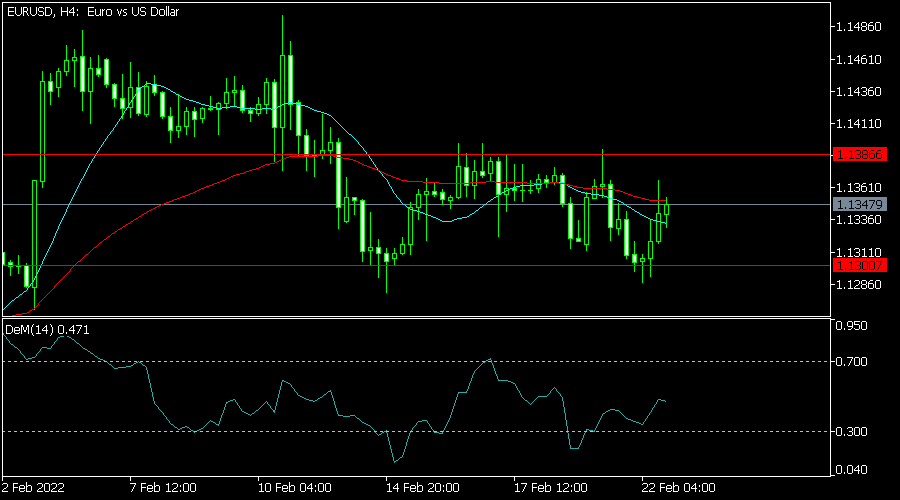
The EURUSD pair rose slightly as the crisis in Ukraine unfolded. It is trading at 1.1352, which is significantly higher than this week’s low of 1.1286. On the four-hour chart, the pair is trading between the 25-day and 50-day moving averages. It is also along the 61.8% Fibonacci retracement level while the DeMarker indicator has moved above the oversold point. Therefore, the pair will likely keep rising as bulls target the next key resistance at 1.1386.
XNGUSD
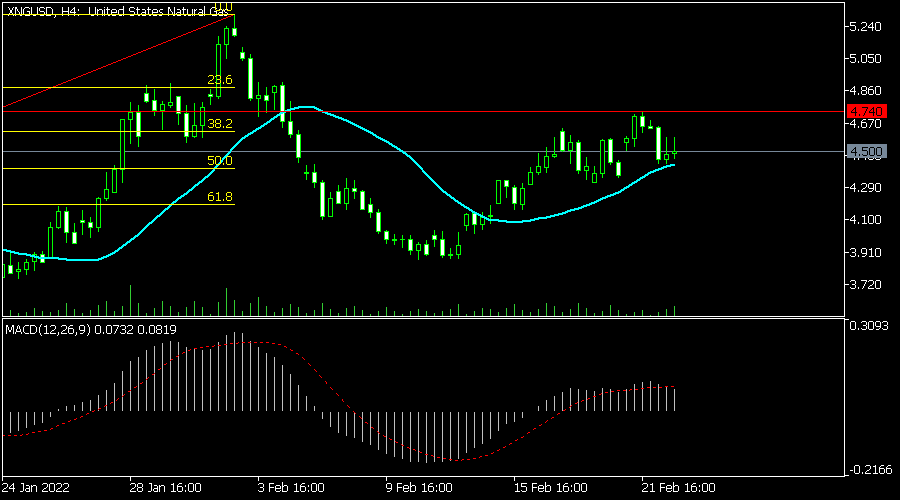
The XNGUSD pair has been in a bullish trend in the past few days. It has managed to move from the month-to-date low of 3.85 to the current 4.50. It has moved above the 25-day and 50-day moving averages while the price is between the 50% and 38.2% Fibonacci retracement level. Therefore, the pair will likely keep rising as bulls target the next key resistance at 4.74.
USDCHF
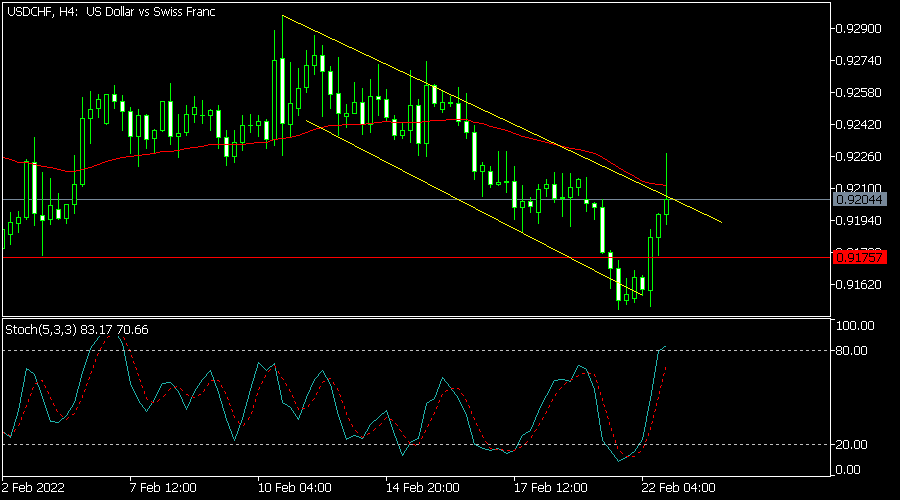
The USDCHF pair rose to a high of 0.9227 in the overnight session. This was the highest it has been since 16 February. The pair managed to move above the upper side of the descending channel while the Stochastic oscillator moved close to the overbought level. It is also slightly below the 25-day moving average. Therefore, the pair will likely keep rising today after it crossed a key resistance level.