

Sample Category Title
Stock Markets Rebound But Uncertainty Remains
You get the feeling that investors are not quite sure what to do today. The markets managed to bounce back sharply from their lows on Tuesday and that momentum carried forward at the start of today’s session, before easing off their best levels again. There isn’t much in the way of economic data to provide any fresh impetus, meaning investors will probably keep focusing on those headlines coming out of Russia and Ukraine. But now that investors have had time to digest everything that has happened, including the not-too-stringent-sanctions, their focus might return to inflation once again. The latest upsurge in energy prices will further exacerbate inflationary pressures and potentially hurt consumer spending.
Investors are wary of the energy crunch in Europe and how this might impact consumer inflation and spending in the months ahead. There is a risk that gas prices might rise further in light of Germany’s decision to cancel the approval of the Nord Stream 2 pipeline. So, inflationary pressures might exacerbate in the near term and force the ECB to apply the brakes by tightening its policy faster. Meanwhile, the Federal Reserve is also set to tighten its monetary policy aggressively, starting with at least a 25 basis point hike in March.
Therefore, investors might be less willing to bid up stock prices too much, until something fundamentally changes.
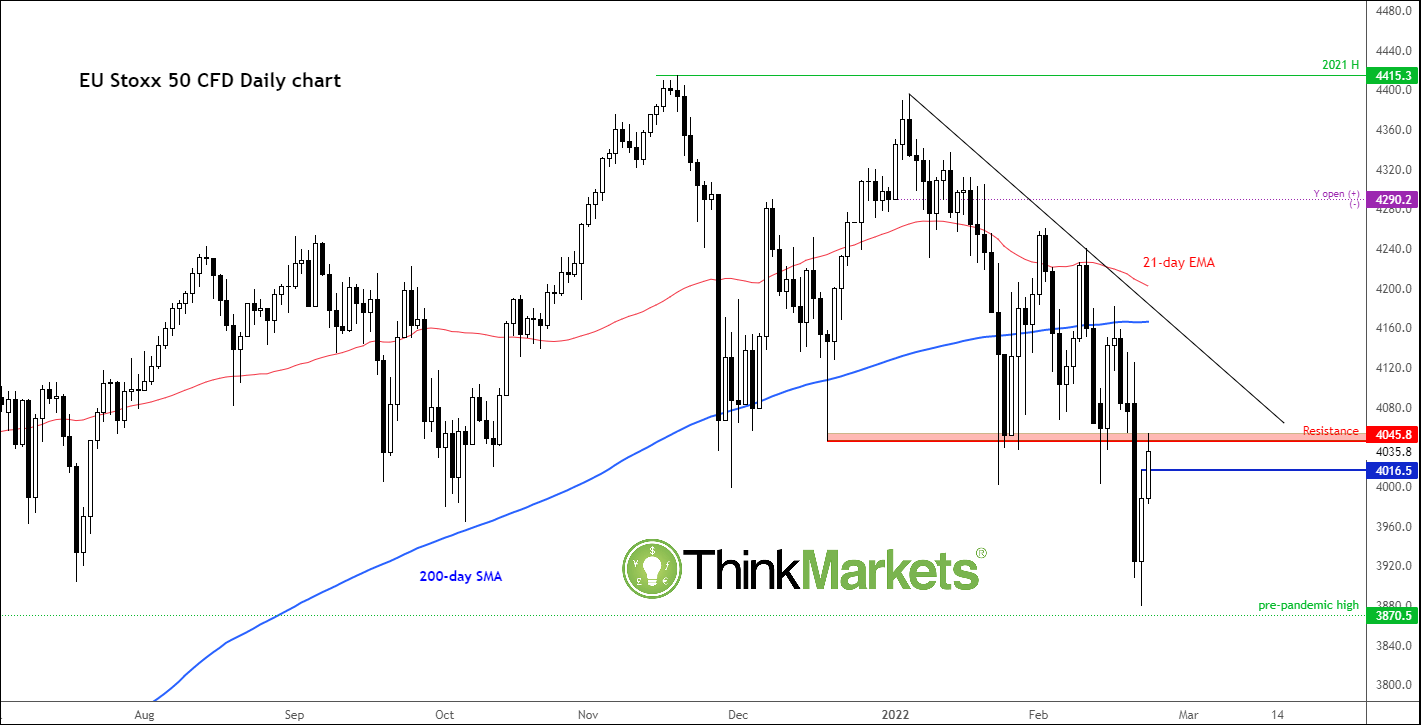
Meanwhile from a technical point of view, some of the global indices are testing key levels, including the German DAX, around 14830 to 15000. In this report, I wanted to highlight a very similar level on the Europe Stoxx 50 index:
Source: ThinkMarkets and TradingView.com
As per the chart, the area around 4045 had been a key support in the past. But now that we have broken below it, the sellers could step in here and trigger a fresh round of selling. If they don’t then that could be an early sign of bullish strength. Let’s see what happens here.
NZDUSD: Kiwi Bird Learns to Fly
The New Zealand dollar has been adding around 1% since the start of the day following the third key rate hike of 0.25 percentage points to 1.0% and comments from the RBNZ on the need for further policy tightening. Wednesday also saw the announcement of the start of a balance sheet reduction, including via active selling.
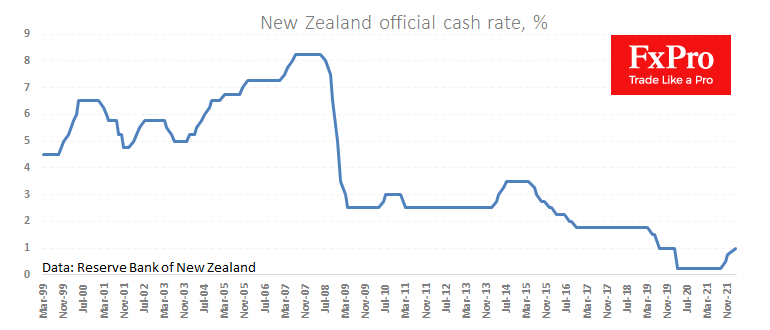
The central bank points to employment above the maximum sustained level and the overall economic performance above its potential, all with elevated inflation. The RBNZ also says further tightening is needed, pointing to upside risks to inflation.
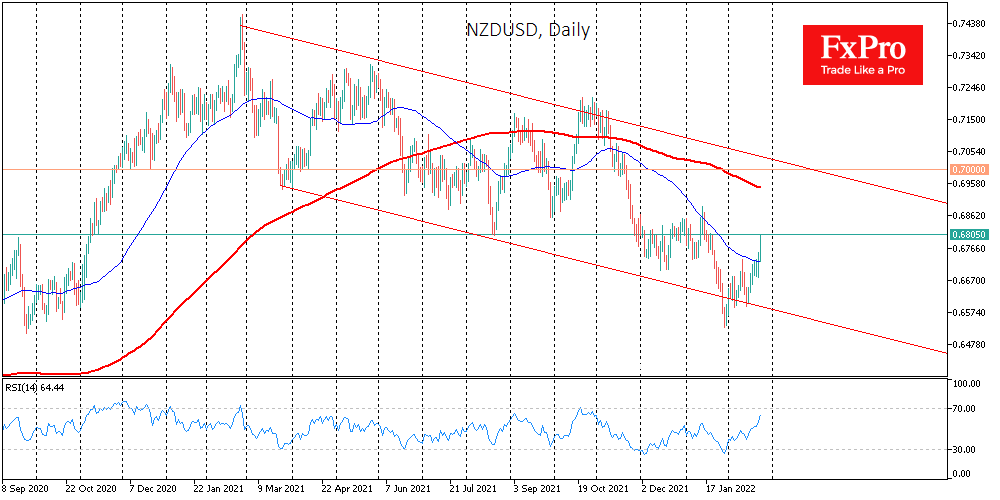
NZDUSD is testing 0.6800, as it did just over a month ago. The Kiwi came under pressure in the previous month due to a general risk bias in global markets. However, the paths of the NZDUSD and international markets diverged in February.
The steady demand of the New Zealand currency, which gained nearly 4% from the lows of late January, contrasts with the S&P500, which lost its rising momentum about a fortnight ago and is again near the lows of the year.
The main reason for that divergence is monetary policy – current and expected. The Reserve Bank of New Zealand has maintained the momentum of tightening for the third time in the last six months and promises further rises later in the year.
New Zealand has also found itself far removed from the worst geopolitical tensions in Europe of recent decades, continuing to benefit from record-breaking commodity prices.
In this environment, it would not be surprising to see the NZDUSD rise as far as 0.7000 by the end of next month, in a break from last year’s downward trend. Although, it would be too naive to expect an easy up ride for the Kiwi, as the US Fed is also signalling a very hawkish stance.
WTI Oil Outlook: Oil Prices Remain at the Back Food on Fading Supply Concerns but Biased Higher above $90
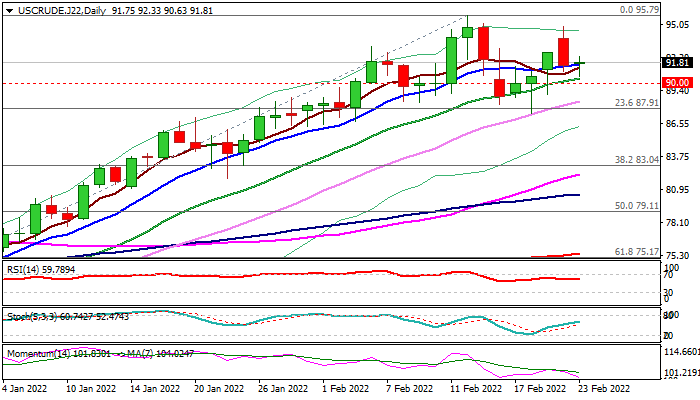
WTI oil consolidates on Wednesday following a 2.4% drop on Tuesday, after concerns about the disruption of oil supplies on the first wave of US and European sanctions on Russia eased.
Also, the signals of potential return of Iranian oil to the market limited gains, however, fears of further escalation of crisis over Ukraine, continue to underpin the oil prices.
Near-term action remains above rising 10DMA for the third straight day and keep pivotal $90 support out of reach that keeps bias with bulls.
On the other side, fading bullish momentum on daily chart, suggests that the downside is still vulnerable, with easing of geopolitical tensions, or at least fading concerns about global supply, to keep oil prices under pressure.
Fresh near-term bears may gain momentum on loss of $90 support and risk test of next key level at $87.44 (Feb 18 higher low), break of which would generate initial reversal signal on completion of failure swing pattern on daily chart.
Otherwise, the price action is expected to stay within extended consolidation.
Res: 92.33; 93.14; 94.90; 95.79.
Sup: 90.43; 90.00; 89.04; 88.47.
Sunset Market Commentary
Markets
Bank of England officials, including Haskel, Broadbent, Tenreyro and governor Bailey, appeared before parliament today to brief MP’s on monetary policy. The overall tone was balanced and the key takeaway is that “moderate” rate rises are likely in coming months to bring inflation back to target. They pushed back against current hawkish market expectations (>5 rate hikes discounted for the remainder of the year) with Bailey telling markets “not to get carried away”. BoE hawk Ramsden delivered a similar message yesterday. Tenreyro earlier in the testimony warned for the economic risks from quick action on inflation. But she did mention that most inflation shocks are still persistent while Bailey’s biggest concern are second-round effects, referring to companies that are now striking higher wage deals. UK money markets barely reacted and stick to the projected rate path of 1.75% by the end of the year. They still expect policy rates to hit the 1% milestone in May. At that point, the BoE would start actively selling government bonds. This was outlined in the normalization blueprint in August last year. If anything, Bailey nuanced this a bit, saying the central bank “will consider” selling assets. The UK yield curve barely changed and sterling trades a tad weaker post-testimony. EUR/GBP ekes out a small gain from 0.833 to 0.834. GBP/USD continues to hover around the 1.36 pivot.
Trading on other markets was mainly sentiment-driven. Dust settled somewhat after Russia’s Putin recognizing two self-proclaimed separatist republics in eastern Ukraine on Tuesday prompted a series of sanctions by the west. European stocks gain more than 1.2% in a buy-the-rumour, sell-the-fact market reaction. Wall Street opens with gains ranging 0.5-1%. The S&P inches 0.7% higher after it entered correction territory yesterday. Core bonds remain under selling pressure. The US curve flattens with yields 3.3 bps (30y) to 4.9 bps (2y) higher. German yields rise 5.6 bps at the front end and trade 1.8 bps higher in the 10y tenor. European swap yields take it up a notch with the 10y yield (0.857%) closing in on the previous recovery highs (0.874%) again after the 10 bps setback last week. The kiwi dollar on FX markets is the star performer. The currency profits from the RBNZ this morning hiking rates, lifting the rate path and preparing for quantitative tightening. EUR/NZD (1.667) loses support at 1.68 while NZD/USD tests important resistance at 0.68. Other commodity currencies (CAD, NOK and AUD) have a good run as well today. The euro is trading heavy but the dollar is a little worse off. EUR/USD rises marginally from 1.132 to 1.134. The trade-weighted greenback (DXY) eases to 95.93.
News Headlines
Czech National Bank governor Rusnok said in an interview on public radio that developments in Ukraine mean that price growth may ease at a slower pace than outlined in the latest projections. He didn’t rule out the possibility of a further policy rate rise – also following a higher January CPI release (9.9% Y/Y) – to combat this inflation risk, but added that any such move would certainly not a steep one. During this tightening cycle, the CNB already used 75 bps (twice), 100 bps and 125 bps rate hikes to lift the policy rate to 4.5% currently. The Czech money market expects the policy rate to peak at 5% this year. Apart from the upside inflationary risk, the crisis in Ukraine also represents a downside economic risk to the Czech Republic. The Czech koruna trades a little bit stronger in today’s positive risk environment at EUR/CZK 24.50. The CZK swap curve bear flattens with yields rising by 7 bps (30-yr) to 10.7 bps (2-yr).
The German GfK Institute’s measure for consumer sentiment unexpectedly fell in March from -6.7 to -8.1, the softest reading since May last year. Details showed a setback in both income expectations and the willingness to buy, while general business cycle expectations increased slightly. The rise in Covid-infection rates at the time of the survey and high inflation were the main worries. The outlook for the comings months is quite positive given the lifting of Covid-restrictions and hope of a more moderate price inflation.
EUR/USD Mid-Day Outlook
Daily Pivots: (S1) 1.1287; (P) 1.1327; (R1) 1.1366; More...
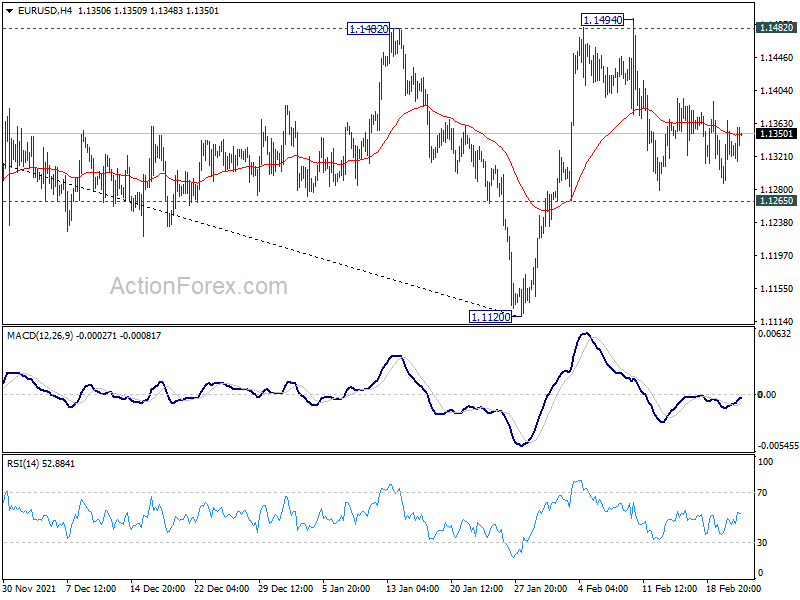
Outlook in EUR/USD is unchanged and intraday bias remains neutral first. On the upside, firm break of 1.1482 will target 38.2% retracement of 1.2348 to 1.1120 at 1.1589 next. Sustained break there will argue that whole fall from 1.2348 has completed too and target 61.8% retracement at 1.1879. On the downside, however, break of 1.1265 support will dampen this bullish view and bring retest of 1.1120 low instead.
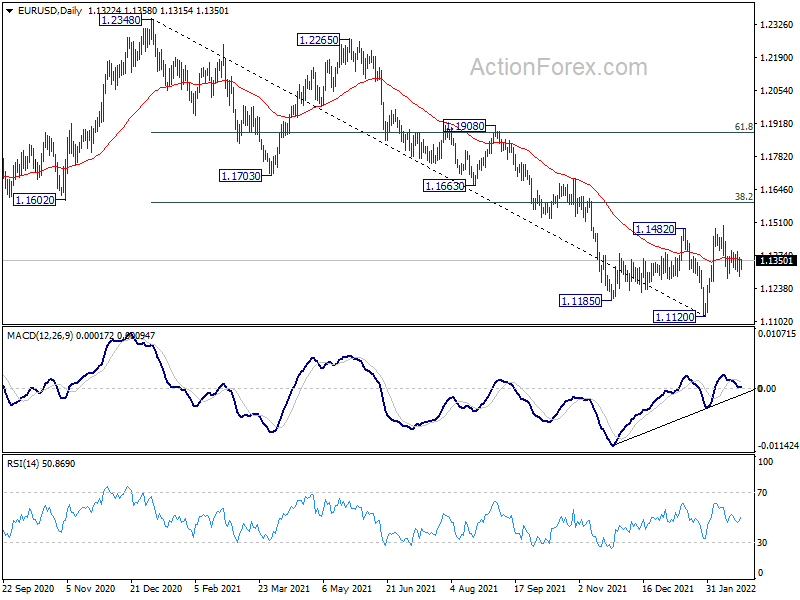
In the bigger picture, the decline from 1.2348 (2021 high) is seen as a leg inside the range pattern from 1.2555 (2018 high). Sustained trading above 55 week EMA (now at 1.1593) will argue that it has completed and stronger rise would be seen back towards top of the range between 1.2348 and 1.2555. However, firm break of 1.0635 (2020 low) will raise the chance of long term down trend resumption and target a retest on 1.0339 (2017 low) next.
GBP/USD Mid-Day Outlook
Daily Pivots: (S1) 1.3548; (P) 1.3577; (R1) 1.3614; More...
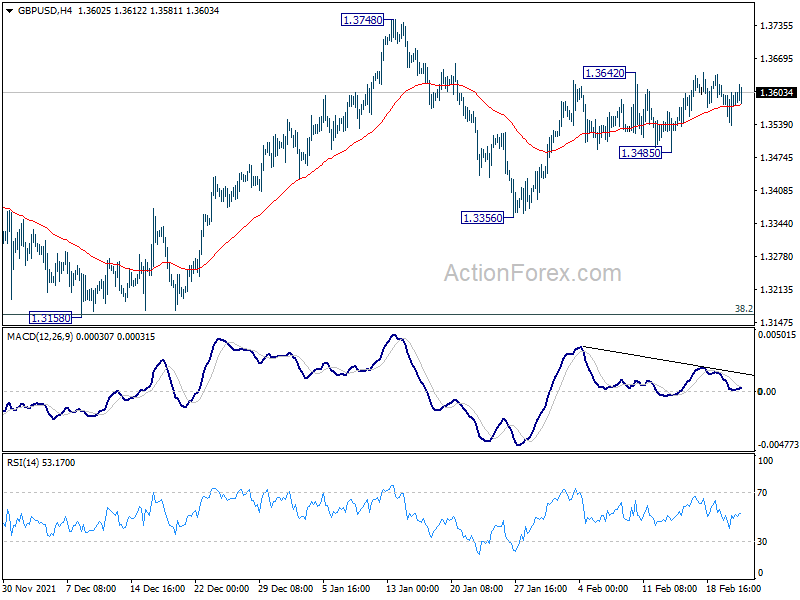
Intraday bias in GBP/USD remains neutral as range trading continues. On the upside, break of 1.3642 will resume the rebound from 1.3356 to 1.3748 resistance. Firm break there will revive the bullish case that correction from 1.4248 has completed with three waves down to 1.3158. Further rally should then be seen to retest 1.4248 high. On the downside, though, break of 1.3485 will turn bias to the downside for 1.3356 support instead.
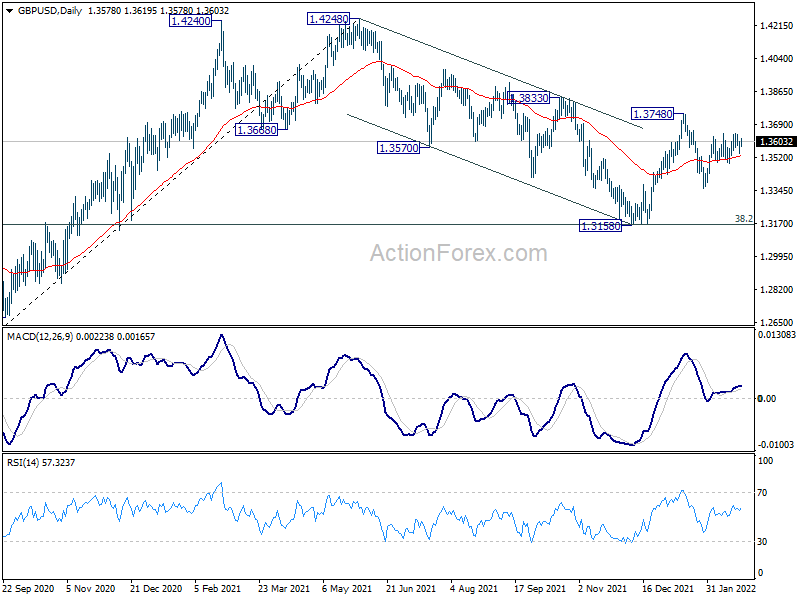
In the bigger picture, as long as 38.2% retracement of 1.1409 to 1.4248 at 1.3164 holds, up trend from 1.1409 (2020 low) is still in progress. On resumption, next target will be 38.2% retracement of 2.1161 to 1.1409 at 1.5134. Nevertheless sustained break of 1.3164 will argue that whole rise from 1.1409 has completed and bring deeper fall to 61.8% retracement at 1.2493.
USD/CHF Mid-Day Outlook
Daily Pivots: (S1) 0.9170; (P) 0.9199; (R1) 0.9246; More....
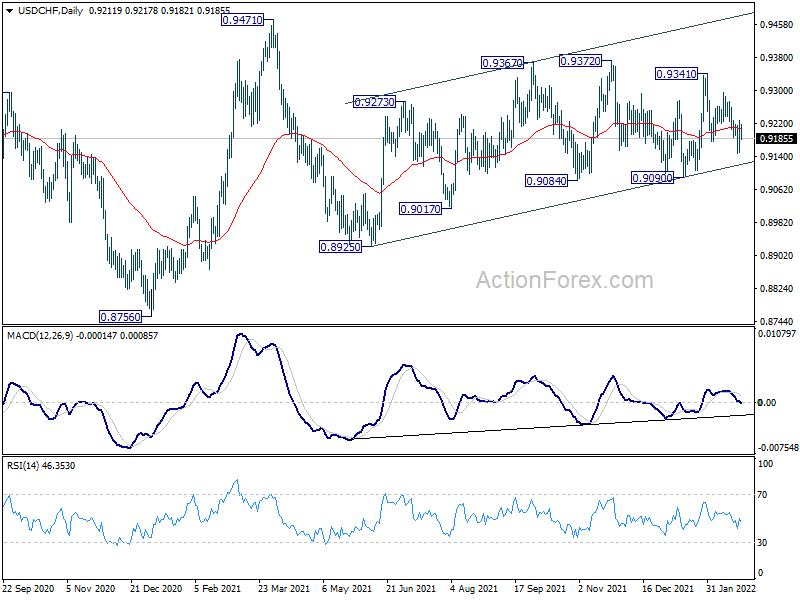
Intraday bias in USD/CHF remains neutral for the moment and sideway trading could continue. Choppy rise from 0.8925 would still be in favor to extend higher as long as 0.9090 support holds. Break of 0.9341 will target 0.9372 resistance and then 0.9471. On the downside, however, break of 0.9090 will bring deeper fall back to 0.8925 support.
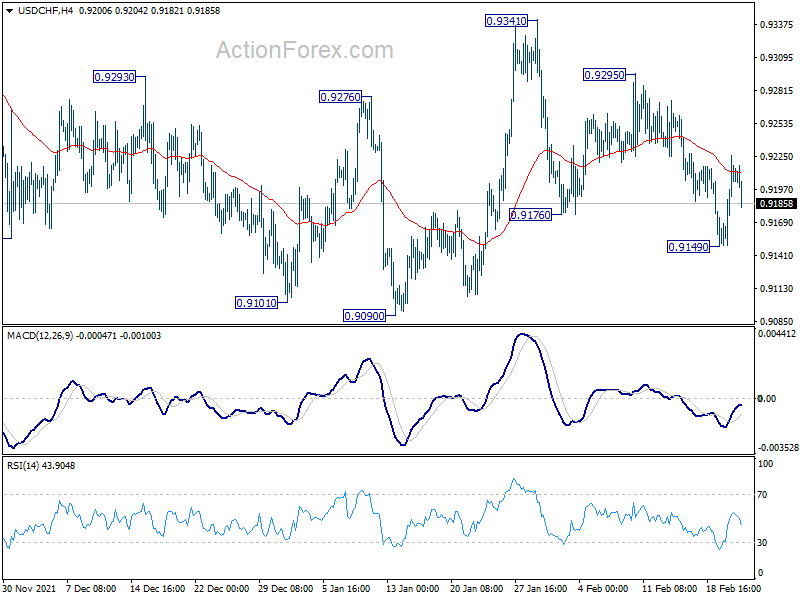
In the bigger picture, medium term outlook will be neutral at best as long as 0.9471 resistance holds. Larger down trend could still extend through 0.8756 (2021 low). However, firm break of 0.9471 will argue that the trend has already reversed and rebound the rally from 0.8756 with another impulsive move.
USD/JPY Mid-Day Outlook
Daily Pivots: (S1) 114.63; (P) 114.94; (R1) 115.37; More...
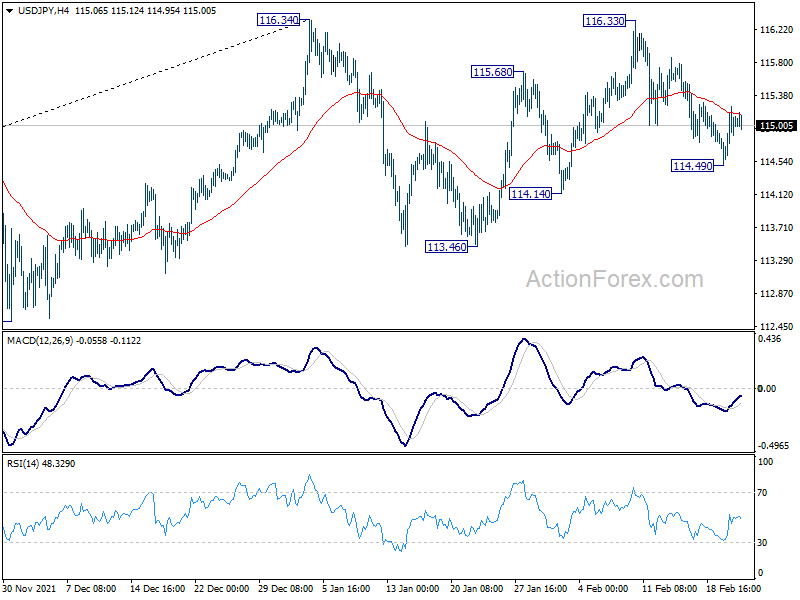
Intraday bias in USD/JPY remains neutral for the moment. On the downside, break of 114.49 will resume the decline from 116.33, as the third leg of the corrective pattern from 116.34. Further break of 114.14 and will target 113.46 support and below. On the upside, firm break of 116.34 will resume larger up trend.
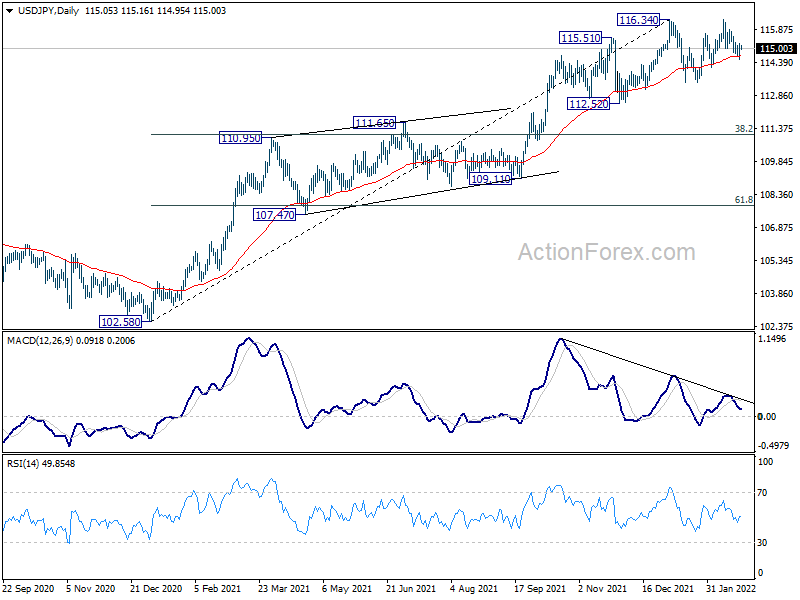
In the bigger picture, no change in the view that rise from 102.58 is the third leg of the up trend from 101.18 (2020 low). Such rally should target a test on 118.65 (2016 high). Sustained break there will pave the way to 120.85 (2015 high) and raise the chance of long term up trend resumption. This will remain the favored case as long as 55 week EMA (now at 111.61) holds.
AUD/USD Mid-Day Report
Daily Pivots: (S1) 0.7182; (P) 0.7208; (R1) 0.7243; More...
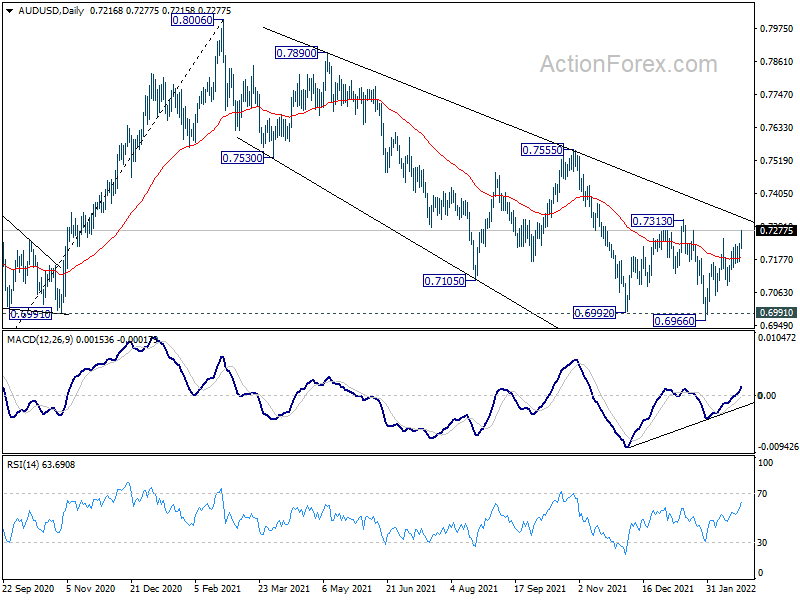
AUD/USD's rise from 0.6966 resumes by breaking through 0.7247, and intraday bias is back on the upside for 0.7313 resistance. Decisive break there argue that correction from 0.8006 has completed at 0.6966, after hitting 0.6991 key support. Outlook will be turned bullish for 0.7555 resistance next. On the downside, break of 0.7163 minor support will mix up the outlook again and turn intraday bias neutral.
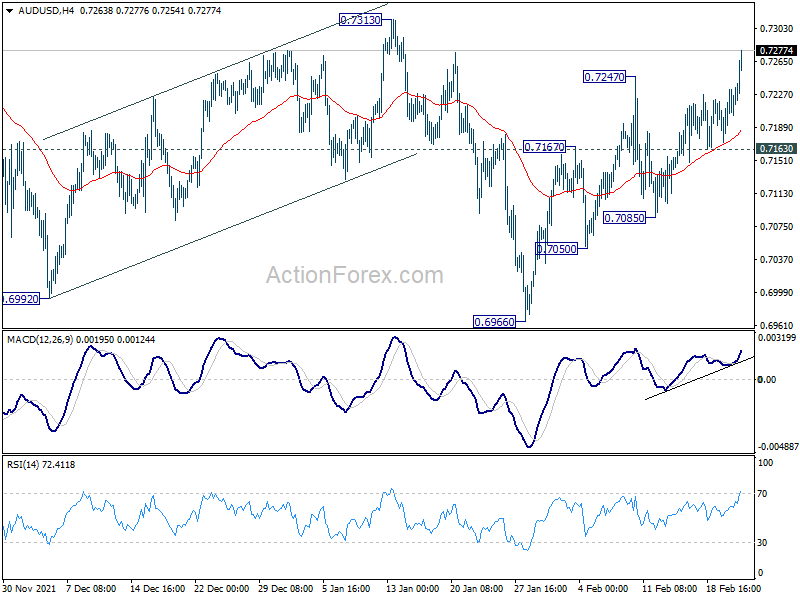
In the bigger picture, focus remains on 0.6991 key structural support. Sustained break there will argue that the whole up trend from 0.5506 might be finished at 0.8006, after rejection by 0.8135 long term resistance. Deeper decline would then be seen back to 61.8% retracement of 0.5506 to 0.8006 at 0.6461. Meanwhile, strong rebound from 0.6991 will retain medium term bullishness. That is, whole up trend from 0.5506 is still in progress.
Aussie Surges as Risk Sentiment Improves, Euro and Sterling Shrugs Hawkish Comments
The markets are generally trading in risk-on mode today. New Zealand Dollar is leading commodity currencies higher, with additional boost from hawkish RBNZ rate hike. Australian Dollar is following closely, then Canadian Dollar. on the other hand, Yen and Dollar are under some selling pressure. Euro and Sterling are mixed despite hawkish comments from ECB and BoE officials.
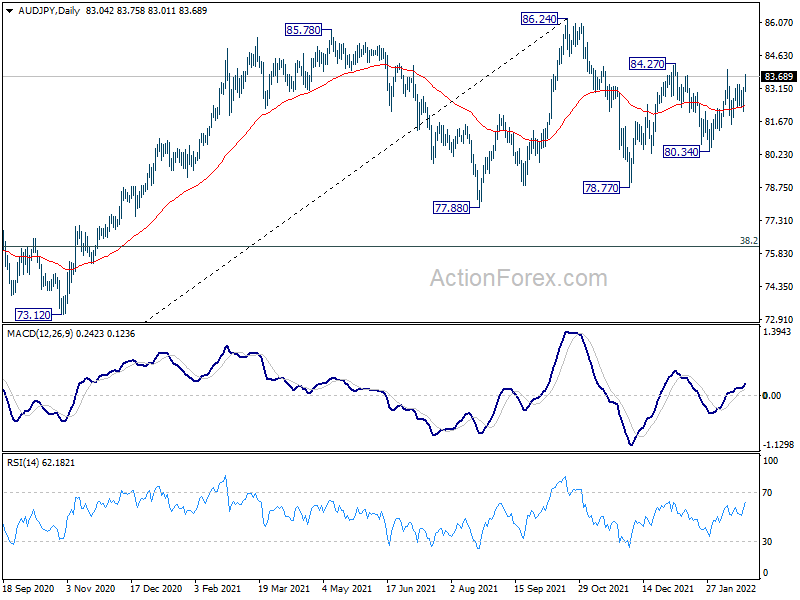
Technically, AUD/USD's break of 0.7247 resistance reaffirmed near term bullishness and resume rise form 0.6966. Further break of 0.7313 will add to the case of bullish trend reversal. At the same time, EUR/AUD 's diving to 1.5559 support and bring will pave the way back to 1.5250 low. Break of 84.27 resistance in AUD/JPY will also resume the whole rise from 78.77 to retest 86.24. Attention will be paid to these levels to confirm underlying strength of Aussie.
In Europe, at the time of writing, FTSE is up 0.68%. DAX is up 1.07%. CAC is up 1.37%. Germany 10-year yield is down -0.001 at 0.244. Earlier in Asia, Hong Kong HSI rose 0.60%. China Shanghai SSE rose 0.93%. Singapore Strait Times dropped -0.06%. Japan was on holiday.
BoE Bailey sees very clear risk of high inflation coming through second-round effects
In the UK parliament's Treasury Committee hearing, BoE Governor Andrew Bailey said, there was "very clearly an upside risk" inflation that "comes through from the second-round effects".
"The second-round effects are a real concern. If we get the second-round effects... of course we would need to react to that with higher interest rates... ," he warned. "And the consequence of that... is that it would of course slow activity in the economy and it would increase unemployment"
On off-loading the balance sheet, Bailey said, "what we said last August was that if and when Bank Rate reaches 1%, and the words are important here, we will begin to consider active sales. It's not the same sort of quasi automatic process that we had with the ceasing reinvestment. So the 1% is a necessary but not sufficient thing. We would want to conduct QT at times when its impact on monetary policy was least."
ECB de Guindos: We will readjust asset purchases if needed
ECB Vice President Luis de Guindos said asset purchases need to be completed before interest rates can rise. However, "we will look at the data, the projections and then we will readjust asset purchases if needed and will see when an interest rate hike can take place."
Governing Council member Bostjan Vasle said the Eurofi Magazine, "The time seems right for our monetary policy to move out of crisis mode and start the process of gradual normalisation."
"With the return of economic activity to the pre-crisis level, looming labour shortages and in part structural pressures on energy prices, our monetary policy needs to start rebuilding its space to be ready to respond to the next business cycle," Vasle added.
ECB Holzmann favors first hike in summer, second by year end
ECB Governing Council member Robert Holzmann told Swiss newspaper NZZ, "When it comes to the interest rate outlook, the ECB has always signalled that an interest rate hike should not take place until shortly after the bond purchases have ended."
"But it would also be possible to take a first interest rate step in the summer before the end of the purchases and a second at the end of the year. I would favour that."
Also, Holzmann said and exit from negative interest rate would be an "important signal" to the society and markets. He would likely to see two rate hikes by the end of this year or early 2023. But, "some of my colleagues would perhaps be even more progressive here, while others would be more cautious," he added.
"I think that a key interest rate of very roughly 1.5% in 2024 could be realistic, although that may well shift forward or backward somewhat," he said, adding that 1.5% would be a benchmark for neutral monetary policy.
Eurozone CPI finalized at 5.1% yoy in Jan, EU at 5.6% yoy
Eurozone CPI was finalized at 5.1% yoy in January, up from December's 5.0% yoy. The highest contribution to the annual euro area inflation rate came from energy (+2.80%), followed by services (+0.98%), food, alcohol & tobacco (+0.77%) and non-energy industrial goods (+0.56%).
EU CPI was finalized at 5.6% yoy, up from December's 5.3% yoy. The lowest annual rates were registered in France (3.3%), Portugal (3.4%) and Sweden (3.9%). The highest annual rates were recorded in Lithuania (12.3%), Estonia (11.0%) and Czechia (8.8%). Compared with December, annual inflation fell in eight Member States and rose in nineteen.
German Gfk consumer sentiment dropped to -8.1, expectations of easing inflation shattered
Germany Gfk consumer sentiment for March dropped from -6.7 to -8.1, below expectation of -6.2. In February, economic expectations rose from 22.8 to 24.1. Income expectations dropped from 16.9 to 3.9, lowest since January 2021. Propensity to buy dropped from 5.2 to 1.4.
"Above all, expectations of a significant easing in price trends at the beginning of the year have been shattered for the time being, as inflation rates continue to hover at a high level," explains Rolf Bürkl, GfK consumer expert.
"Nevertheless, the outlook for the coming months is quite positive: Only recently it was decided to lift profound pandemic restrictions. This gives cause for hope that consumer spending will also return as a result. If this were to be supported by moderate price inflation, consumer sentiment could finally recover in the long term as well."
RBNZ hikes rate to 1%, starts managed bond sales, raised OCR peak forecast
RBNZ raised OCR by 25bps to 1.00% as widely expected. Additionally, it will start to start reduction of the bond holdings under the Large Scale Asset Purchase program through "both bond maturities and managed sales.
The central bank also said "further removal of monetary policy stimulus is expected over time given the medium-term outlook for growth and employment, and the upside risks to inflation."
In the minutes, it's noted, "when deciding whether to move the OCR up by 25 or 50 basis points, many members saw this as a finely balanced decision."
However, firstly, the active sales of bond holdings may "put some upward pressure on longer-term interest rates". Also, the OCR is expected to "peak at a higher level than assumed" at the November MPC. The OCR peak was raised to around 3.4% in 2024, compared to 2.6% in November review.
Hence, the Committee came to a consensus of a 25bps hike, but "affirmed that it was willing to move the OCR in larger increments if required over coming quarters."
AUD/USD Mid-Day Report
Daily Pivots: (S1) 0.7182; (P) 0.7208; (R1) 0.7243; More...
AUD/USD's rise from 0.6966 resumes by breaking through 0.7247, and intraday bias is back on the upside for 0.7313 resistance. Decisive break there argue that correction from 0.8006 has completed at 0.6966, after hitting 0.6991 key support. Outlook will be turned bullish for 0.7555 resistance next. On the downside, break of 0.7163 minor support will mix up the outlook again and turn intraday bias neutral.
In the bigger picture, focus remains on 0.6991 key structural support. Sustained break there will argue that the whole up trend from 0.5506 might be finished at 0.8006, after rejection by 0.8135 long term resistance. Deeper decline would then be seen back to 61.8% retracement of 0.5506 to 0.8006 at 0.6461. Meanwhile, strong rebound from 0.6991 will retain medium term bullishness. That is, whole up trend from 0.5506 is still in progress.
Economic Indicators Update
| GMT | Ccy | Events | Actual | Forecast | Previous | Revised |
|---|---|---|---|---|---|---|
| 00:30 | AUD | Wage Price Index Q/Q Q4 | 0.70% | 0.70% | 0.60% | |
| 00:30 | AUD | Construction Work Done Q4 | -0.40% | 2.10% | -0.30% | -1.20% |
| 01:00 | NZD | RBNZ Interest Rate Decision | 1.00% | 1.00% | 0.75% | |
| 02:00 | NZD | RBNZ Press Conference | ||||
| 07:00 | EUR | Germany Gfk Consumer Confidence Mar | -8.1 | -6.2 | -6.7 | |
| 09:00 | CHF | ZEW Expectations Feb | 9 | 9.5 | ||
| 10:00 | EUR | Eurozone CPI Y/Y Jan F | 5.10% | 5.10% | 5.10% | |
| 10:00 | EUR | Eurozone CPI Core Y/Y Jan F | 2.30% | 2.30% | 2.30% |