

Sample Category Title
US oil inventories dropped -4.8m barrels, WTI rebounds and back above 90
US commercial crude oil inventories dropped -4.8m barrels in the week ending February 4. At 410.4m barrels, oil inventories are about -11% below the give year average for this time of year.
Gasoline inventories dropped -1.6m barrels. Distillate dropped -0.9m barrels. Propane/propylene dropped -1.9m barrels. Total commercial petroleum inventories dropped -8.1m barrels.
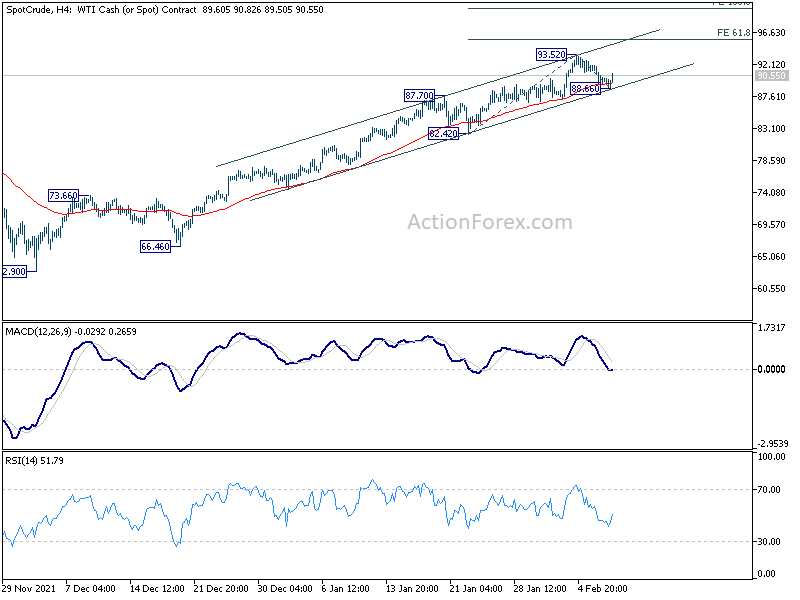
WTI crude oil recovers today after drawing support from 4 hour 55 EMA and near term channel support. It's now back above 90 handle. Near term outlook stays bullish for now. Current rise from 62.90 is still in progress and break of 93.52 will target 61.8% projection of 82.42 to 93.52 from 88.66 at 95.51 next.
ECB Schnabel: Extended period of high energy price inflation may lead to higher inflation expectations
In a Twitter Q&A, ECB Executive Board member Isabel Schnabel said, "in the 1970s rising oil prices triggered a harmful price-wage spiral, as inflation expectations drifted away." But, "today longer-term inflation expectations are well-anchored. We will ensure that high inflation does not become entrenched."
"Inflation will remain high for longer than anticipated. There is a risk that inflation continues to rise in the near term but it is likely to gradually decline towards the end of this year. There remains high uncertainty around the inflation outlook."
"Raising rates would not lower energy prices. But if high current inflation threatens to lead to a de-anchoring of inflation expectations, we may still need to respond, as our mandate is to preserve price stability."
"Monetary policy has to keep a watchful eye on all factors, including energy, that affect the medium-term inflation outlook. An extended period of high energy price inflation may lead to expectations of higher inflation in the future."
Why UK’s Q4 GDP Growth Data May Not Help the Pound
The UK will publish its final quarterly GDP growth readings for 2021 on Friday at 09:30 GMT. The outcome may not impress investors as forecasts imply the economy almost flatlined at the end of the year, growing more or less at the same pace as in the previous quarter. Perhaps, the data could be considered outdated as well since the Bank of England has already taken its first steps to tackle the hot inflation pressures. Therefore, the British pound may not find enough support from domestic data to resume its ascent this week, but the figures could still act as a safety net against any selling interest.
UK GDP growth to stabilize in Q4, but does it matter?
According to analysts, the UK economy expanded by 1.1% q/q in the last three months to December, exactly at the same rate as in the September quarter. The annual change may not light up fireworks either, as it is currently expected to moderate slightly to 6.5% y/y from 6.8% previously, approaching the normal pre-pandemic levels.
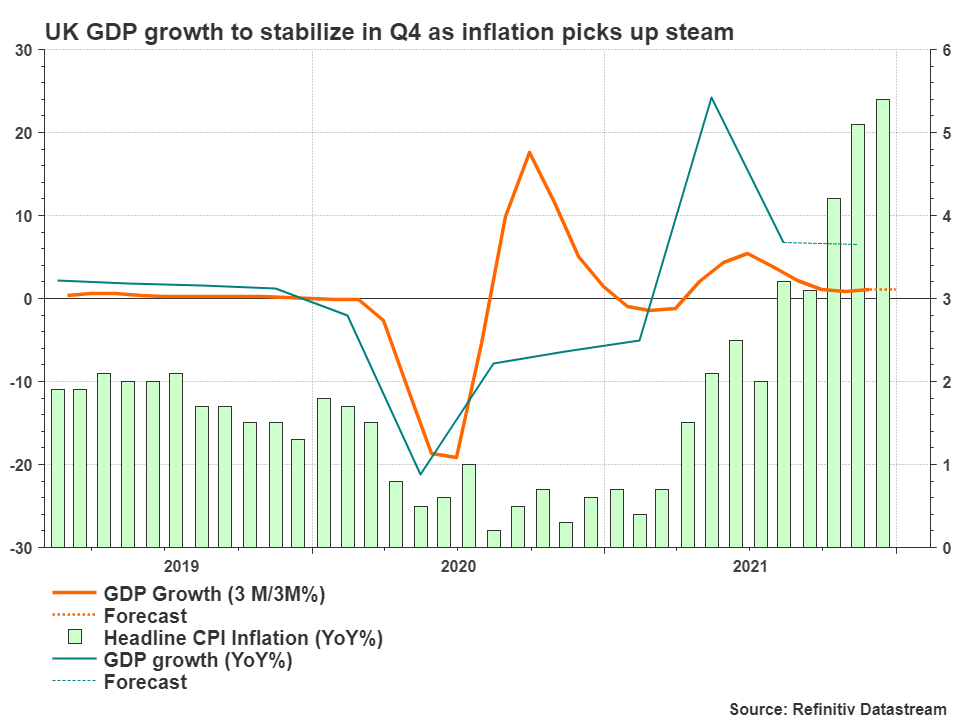
Undoubtedly, the above forecasts are still healthy and could bode well for the pound if materialized, especially as global supply chain disruptions and labor shortages are not expected to evaporate anytime soon. Yet, the data may not bring anything new to the table to adjust market sentiment.
The latest business Markit/CIPS PMI survey for January, although remaining within the expansion area, has already signalled a slower-than-expected positive start to the year, with the composite index barely improving from December. Details indicated that companies except those in the financial sector have raised their prices in an attempt to offset rising raw material costs, staff wages and energy bills, while some manufacturing companies faced their worst month in a year in terms of new orders. All in all, the survey’s respondents don’t expect any meaningful recovery before February.
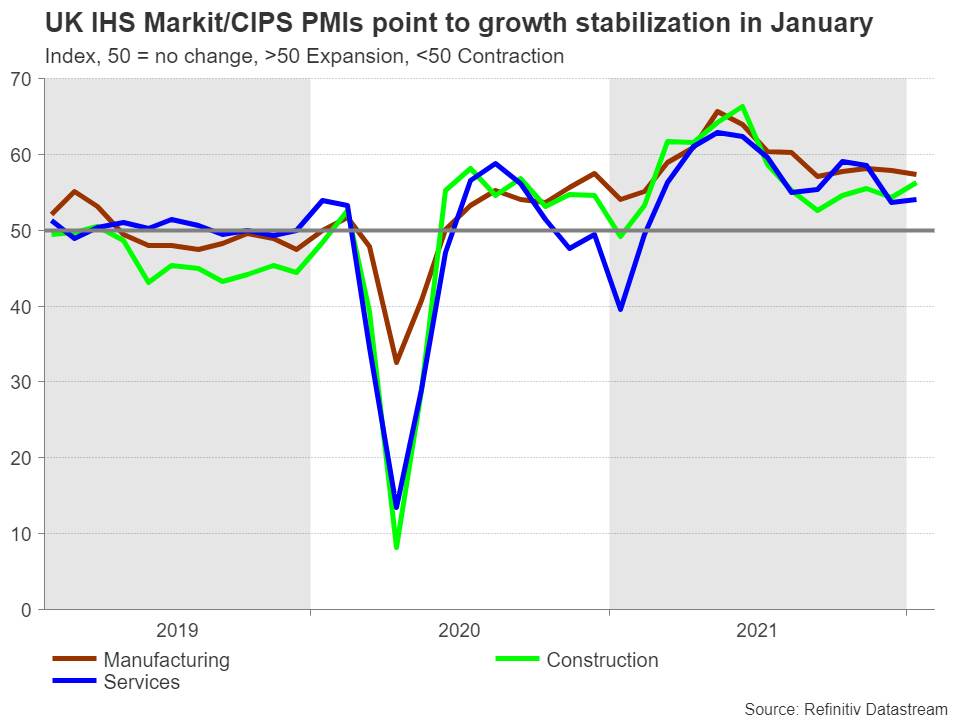
Besides, with the Bank of England having already hiked its interest rates twice over the past two meetings to 0.50% and given the high probability for a third rate increase in mid-March, last year’s GDP stats could do little to change the status quo unless they surprise significantly to the downside; that is currently seen the least likely case since the government applied only mild restrictions during the end-of-year omicron breakout.
Traders bearish on pound; US CPI inflation in focus
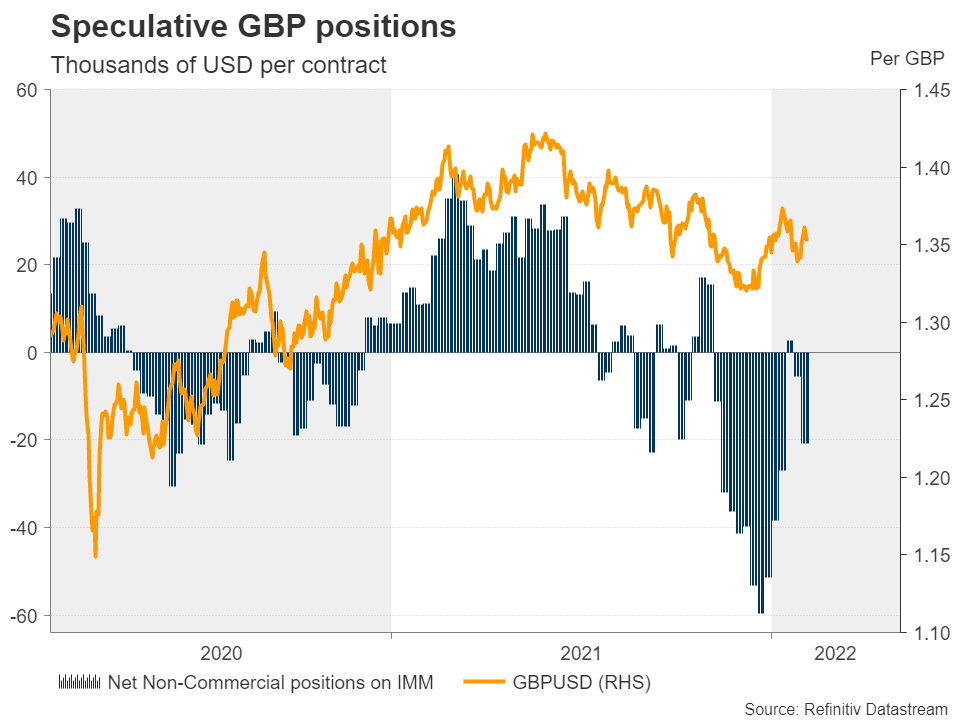
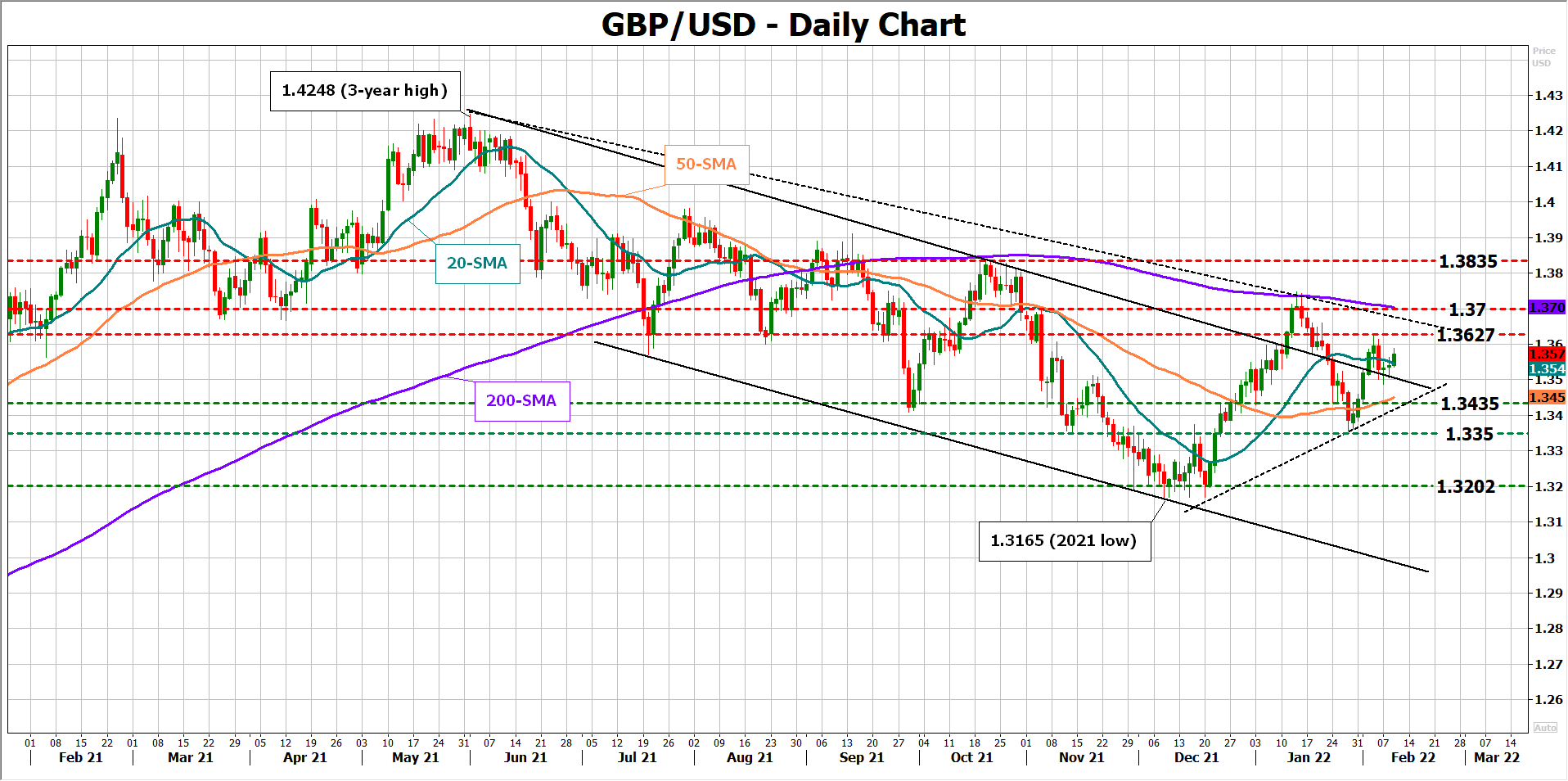
Speculative net short positions for the pound have worsened a bit in February, almost tripling last week’s size but are still standing above January’s extremes, reflecting a bearish mood among traders despite the BoE’s hawkish stance. In the absence of any important news out of the UK, the British pound could remain exposed to the dollar's strength as the BoE and the Fed rate hike expectations increase in tandem. Particularly, Thursday’s US CPI Inflation readings for January could press pound/dollar below the nearby 1.3500 base and towards the 1.3435 support region if they call for a faster 50 bps Fed rate hike. A steeper downfall could bring the 1.3300 – 1.3355 zone next into view.
Otherwise, if US inflation falls short of analysts’ estimates, signalling that Fed rate projections are exaggerated, the pound could recoup the pullback off 1.3627. Yet only a close above 1.3700 and the 200-day simple moving average (SMA) could revive buying confidence in the market.
Sunset Market Commentary
Markets
Trees don’t grow to sky. Even interest rate markets today took a breather as the combined effect of an ECB policy U-turn and strong US payrolls is apparently ‘discounted’. For now, it’s still nothing more than a pause, not a real correction, with tomorrow’s US inflation data a potential catalyst for further directional price action for bond markets. Central bankers’ comments don’t question the need for policy normalization, but don’t feel the need to push markets even further either. BoE’s chief economist Pill doesn’t rule out 50 bps steps but for now advocates a step-by-step approach as the outlook for wages and energy prices is highly uncertain. ECB’s Nagel confirmed that the ECB needs to recalibrate monetary policy in March if the inflation picture and above all the inflation outlook hasn’t significantly brightened by then. This shouldn’t be new for markets. At the same time, Nagel also warned for the risks/side effects of asset purchase programs. The jury on this topic is still out, but any (substantial) steps on the ECB reducing its balance sheet probably aren’t discounted by markets yet. Fed Bostic is still balanced between 3 and 4 rate hikes this year. He hopes for a gradual decline in M/M inflation readings in the near future to bring the PCE deflator to 3.0% by the end of the year. Still, he doesn’t exclude a 50 bps hike if the data would signal it to be appropriate. Bostic also advocates a substantial reduction of the balance sheet starting as soon as possible as he sees a lot of excess liquidity that can be reduced without representing a significant tightening. As indicated, today comments didn’t change the broader picture on policy normalization but didn’t prevent a limited countermove. US yields are developing between little changed (2-y) and easing 2.5 bps (10-y). This evening the US Treasury will sell $ 37 bln of 10-y Notes. On European interest rate markets the steepening trend continues, this time with the short end taking the lead. The German 2/5-y yields are easing 4.5 bps. The 30-y declines a more modest 0.75 bps. The relative calm on core bond markets for now brings only little relief for peripheral European bond markets with the 10-y Italian spread versus German easing no more than 2 bps. The pause in the bond market sell-off also revives some comfort among equity investors. European indices on average are rising about 1.75% (EuroStoxx). US indices continue yesterday’s comeback opening with gains of about 1.0%. (Brent) oil ($91.1 p/b) stays off its recent peak, but for now with no follow-through price action.
Despite substantial moves on bond and equity markets, changes in the major FX cross rates mostly are limited. DXY index eases to 95.50. EUR/USD is holding north of 1.14 but at 1.1430 gains are negligeable. The risk-on for now still doesn’t help sterling (cf Pill comments?). EUR/GBP is going nowhere holding in the 0.8430 area.
News Headlines
UK Prime Minister Johnson has announced he’ll end this month the requirement for people in England to self-isolate if they test positive for the coronavirus. It’s part of the government’s “Living with Covid” strategy – to be announced February 21 – and it is subject to the continuation of currently declining Covid statistics. The self-isolation obligation was due to end on March 24. By shelving the rules earlier, Johnson hopes to amend tarnished support from Conservative lawmakers who have been calling for easing restrictions amid concerns over individual freedoms and the impact on businesses, schools and health service.
Mexican inflation eased less than hoped in January, from 7.36% y/y to 7.07% vs 7.01% expected. Core inflation, excluding a.o. fuel, even accelerated from 5.94% to 6.21%, the highest reading since 2001 and way above the 3% (+/- 1ppt) inflation target of the central bank (Banxico). Its new governor Victoria Rodriguez Ceja faces a difficult balancing act when the MPC meets for the first time this year tomorrow: tighten policy and tame inflation but risk hurting already stalling growth (-0.1% q/q in Q4 2021). Banxico started its hiking cycle in June 2021 and raised policy rates from 4% then to 5.50% today. Consensus expect another 50 bps increase tomorrow. The Mexican peso strengthens marginally today, from USD/MXN 20.61 to 20.55.
Aussie Rises as Risk Appetite Rises
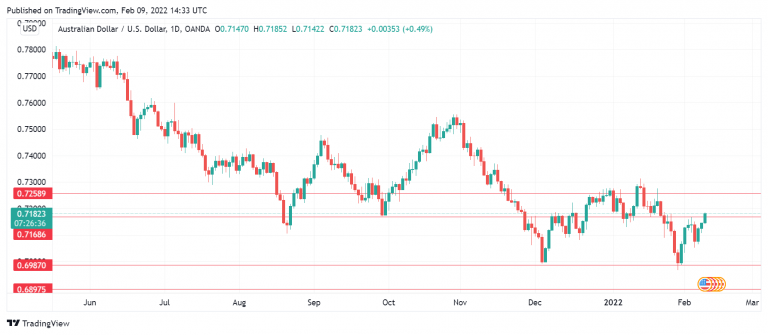
The Australian dollar has extended its rally for a third straight day. In the North American session, AUD/USD is trading at 0.7179, up 0.49% on the day. It’s looking all roses for the Aussie this week, which is up 1.49%.
The Australian government announced that it will reopen the international borders on February 21st. The country hasn’t allowed any tourists in the country in two years, which has badly hurt the tourism sector. Visitors who are vaccinated will now be allowed entry, which should pump billions into Australia’s economy.
We are seeing a significant discrepancy in confidence levels between businesses and consumers. On Tuesday, NAB Business Confidence in February jumped 15 points to +3, after a miserable -12 reading in December. Consumers, on the other hand, did not share in the optimism. Westpac Consumer Sentiment for February declined 1.3%, marking a third straight drop. Covid health restrictions have eased and the labour market is strong, but this hasn’t boosted the mood amongst consumers. The likely culprits for the gloomy outlook are the continuing rise in the cost of living and financial pressures due to Covid and the possibility of higher interest rates this year.
In the US, surging inflation has become a major headache for Joe Biden as well as the Federal Reserve. Biden could face an angry backlash at the mid-term elections if gasoline and food prices continue to rise, and the Fed is hoping that a series of rate hikes will curb inflation back towards the 2% level, which seems like ancient history.
Those headaches could feel worse on Thursday, if inflation accelerates as expected. CPI hit 7.0% in December, and the consensus is for a gain of 7.3% for January. If inflation is within expectations or higher, the likelihood of a 50-basis point hike in March will increase. According to CME’s FedWatch, the markets have priced in a 75% chance of a 25-bps rise and a 25% chance of a 50-bps hike at the March meeting.
AUD/USD Technical
- AUD/USD continues to rally and is testing resistance at 0.7168. Above, there is resistance at 0.7258
- There is support at 0.6987 and 0.6896
EUR/USD Mid-Day Outlook
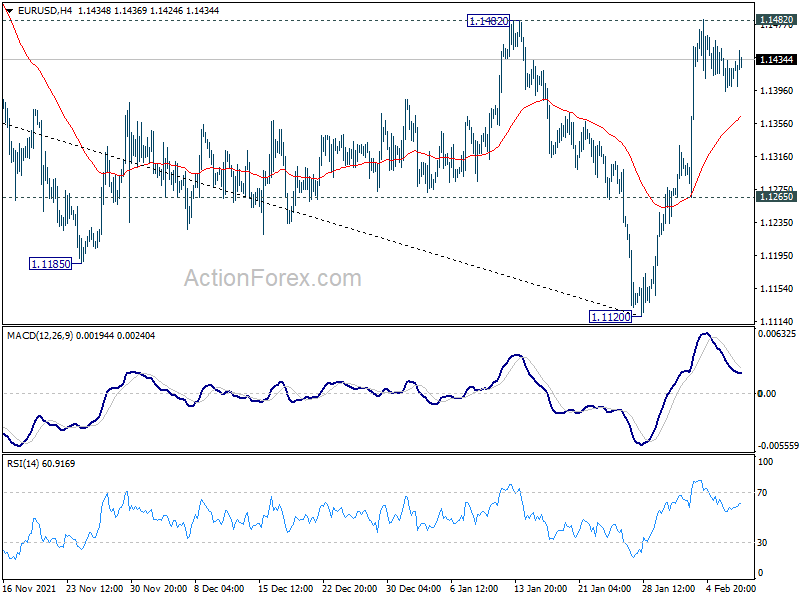
Daily Pivots: (S1) 1.1392; (P) 1.1421; (R1) 1.1445; More...
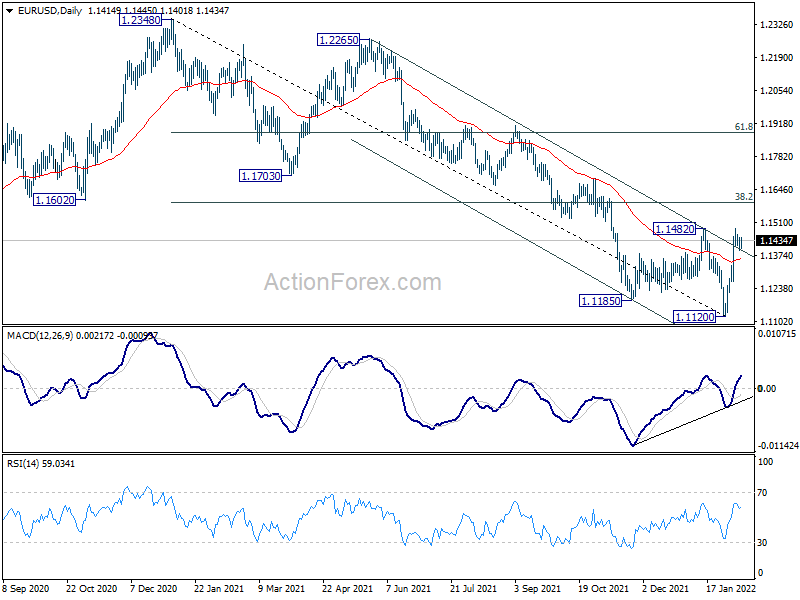
Intraday bias in EUR/USD stays neutral and outlook is unchanged. A medium term bottom could be in place at 1.1120, on bullish convergence condition in daily MACD. Break of 1.1482 resistance will target 38.2% retracement of 1.2348 to 1.1120 at 1.1589 next. Sustained break there will argue that whole fall from 1.2348 has completed too and target 61.8% retracement at 1.1879. On the down, however, break of 1.1265 support will dampen this bullish view and bring retest of 1.1120 low instead.
In the bigger picture, the decline from 1.2348 (2021 high) is seen as a leg inside the range pattern from 1.2555 (2018 high). Sustained trading above 55 week EMA (now at 1.1613) will argue that it has completed and stronger rise would be seen back towards top of the range between 1.2348 and 1.2555. However, firm break of 1.0635 (2020 low) will raise the chance of long term down trend resumption and target a retest on 1.0339 (2017 low) next.
USD/CHF Mid-Day Outlook
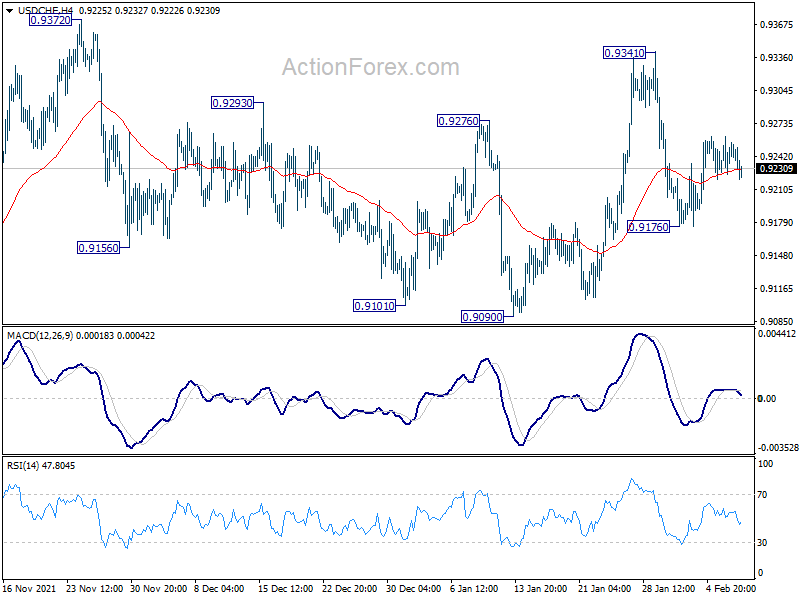
Daily Pivots: (S1) 0.9231; (P) 0.9247; (R1) 0.9268; More....
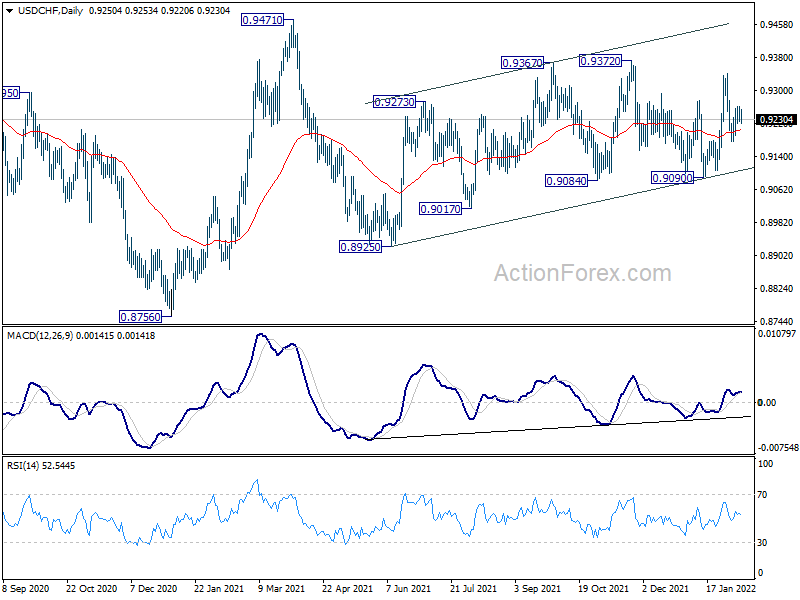
Intraday bias in USD/CHF remains neutral at this point. Further rise will remain mildly in favor as long as 0.9090 support holds. break of 0.9372 will resume the choppy rally from 0.8925 to 0.9471 high. However, break of 0.9090 will turn bias back to the downside for 0.8925 support instead.
In the bigger picture, medium term outlook will be neutral at best as long as 0.9471 resistance holds. Larger down trend could still extend through 0.8756 (2021 low). However, firm break of 0.9471 will argue that the trend has already reversed and rebound the rally from 0.8756 with another impulsive move.
USD/JPY Mid-Day Outlook
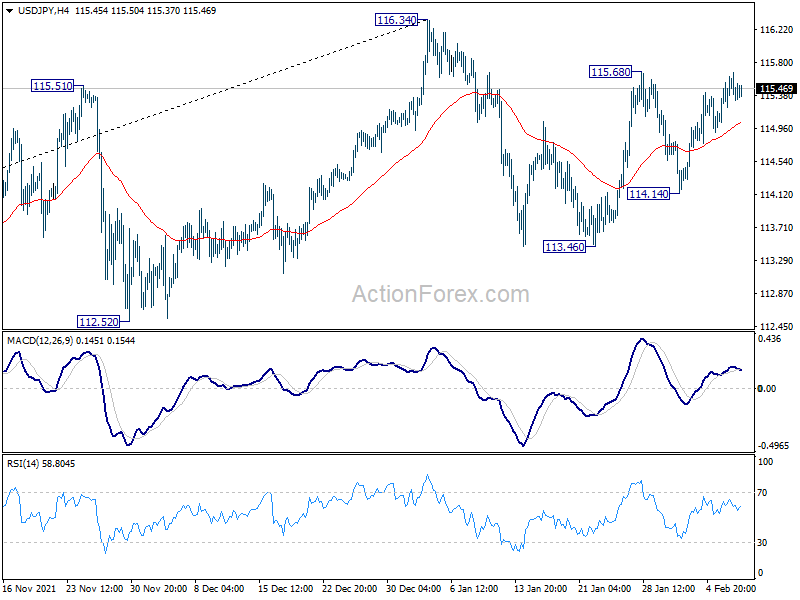
Daily Pivots: (S1) 115.20; (P) 115.41; (R1) 115.77; More...
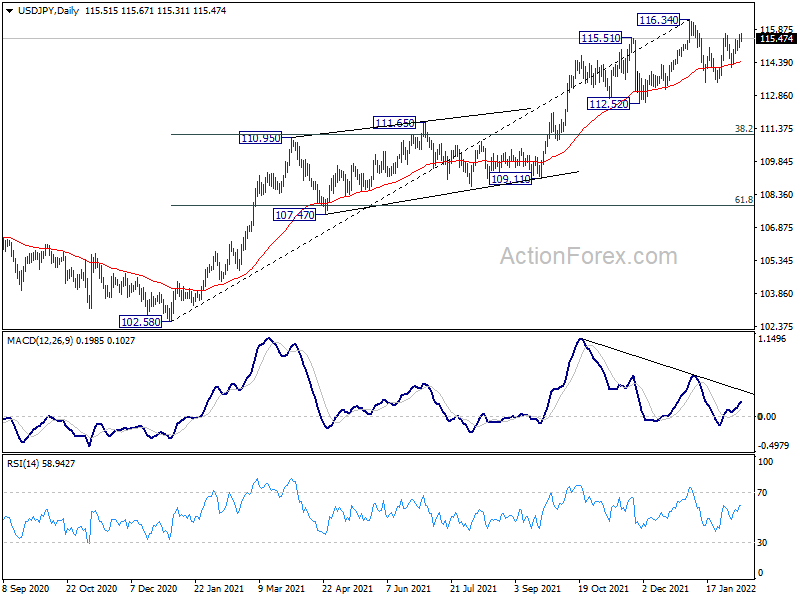
Intraday bias in USD/JPY remains neutral as range trading continues. Overall, consolidation pattern from 116.34 is still extending. On the upside, break of 115.68 will resume the rebound from 113.46 to retest 116.34 high first. On the downside, break of 114.14 should extend the consolidation with another falling leg through 113.46 support.
In the bigger picture, no change in the view that rise from 102.58 is the third leg of the up trend from 101.18 (2020 low). Such rally should target a test on 118.65 (2016 high). Sustained break there will pave the way to 120.85 (2015 high) and raise the chance of long term up trend resumption. This will remain the favored case as long as 55 week EMA (now at 111.21) holds.
US CPI Data Still Key as Today 10-Year Yield Aids Wall Street
Market jitters keep volatility faint and dollar remains glued on back foot
The US 10-year yield deflated to 1.927% today keeping the reserve currency bid, with the dollar index near the lower end of its recent range at 95.40, which provided US stock futures with freshly welcomed buoyancy for a test of the latest peaks following their deep corrections from all-time highs.
Nonetheless, market sentiment is still looking light awaiting additional volatility from the upcoming US inflation event.
The US economy remains robust with healthy consumption feeding economic growth. Full employment is expected to be on the horizon and average hourly earnings have improved, nourishing wage growth. The latter makes things tricky for the Fed as it doesn’t want extra factors in their economic blueprint to boost inflation when they are trying to put a cap on it.
Thus, investors’ focus remains centred around Thursday’s US CPI data, which will reveal whether historic levels of inflation persisted in January. The CPI rate is forecasted to rise to 7.3% from 2020’s ending rate of 7.0% y/y. The headline monthly figure excluding food and energy is expected to tick lower to 0.5% from December 2021 of 0.6%.
How could markets digest the data
One narrative is that inflation globally has been boosted by the energy crisis. Oil has extended its rally that began at the start of December 2021 throughout January with WTI oil futures recording a $93.15 per barrel peak, which may tip the scale towards a US CPI result that is rather elevated or stronger.
The question is how much will a high inflation figure underpin the dollar? Clearly, should inflation prove to remain hot, the domino effect of this is a vigilant Fed with a home run March hike.
However, is this already somewhat priced in? Looking back, the hawkish stance reiterated in the last FOMC meeting gave the dollar some legs after the Fed confirmed its move to post-pandemic policy, without lift-off in rates.
Moreover, less government spending as the road to normalization unfolds in 2022 has a lot of analysts expecting the pace of the US economy will begin to hamper especially if the Omicron variant disappears into the mist.
Furthermore, across the globe, it is apparent that some central banks are ahead of others on the interest rate theme as their recoveries move at different paces. What is key lately, is that central banks like the Reserve Bank of Australia (RBA) and the ECB last week, which were adamant that interest rates would likely rise in 2023 have now sent more hawkish tones to markets that unexpected higher levels of inflation may entail earlier action, and this may in a way offset some of the greenbacks expected boost in tomorrow’s US CPI release.
One thing is for sure, the Fed is likely to do as much as possible to avoid inflation lingering into the year.
Forex arena looks firm against soft dollar
Today euros weakness faded as it held above the $1.1400 handle crawling higher to $1.1440 as markets ignored President Lagarde’s attempts to offset heightened ECB tightening expectations. A frail dollar may have played a part, also aiding the pound and the antipodean currencies. The pound touched $1.3585, while the aussie creeped up to $0.7180 and the kiwi $0.6690.
Gold is around $1,825/oz and WTI oil futures are holding a recent drop above the $89.00 per barrel mark, as investors questioned tensions in the East and the resumption of Iran nuclear talks.
FOMC Member Bowman is due to talk at 15:30 GMT, while US crude oil inventories will also be released at that time.
Bank of Canada’s Governor Macklem is then scheduled for 17:00 GMT, at which some minor movements in markets could surface as simultaneously, FOMC Member Mester is speaking about the economic outlook and monetary policy at an online event hosted by the European Economic and Financial Centre.
The US 10-year Treasury auction is scheduled to follow at 18:00 GMT.
Oil’s Next Surge to Increase Inflation Angst
- Oil traders await weekly EIA data
- Drawdown in Cushing inventories may return prices to recent highs
- Persistently elevated inflation may force central banks into more aggressive stance
- Concerns over hawkish central bankers could roil markets further
Oil prices are cooling further from recent multi-year highs following the EIA’s raised forecasts for US production this year and next, which they forecast should peak at a record 12.6 million barrels per day in 2023. Positive developments surrounding Iran nuclear talks are also helping to put the brakes on oil’s recent rally. Yet, Brent is keeping its head above $90/bbl for the time being, while US crude is trading just below that psychologically important mark.
Oil benchmarks still find themselves in a supportive environment, one that features robust global demand, falling inventories, and lingering supply constraints, while geopolitical risk premiums are being added to the commodity’s bullish drivers. Tuesday’s API figures, which pointed to a surprise drawdown of over two million barrels last week, helped limit the recent drop in prices.
Markets are expecting an overall build in today’s release of US crude inventories of 1.5 million barrels, though the whisper number suggests an increase of just 238,000. However, oil prices will likely be more sensitive to the figures for crude stockpiles in Cushing, which have fallen for four consecutive weeks. Overall, the official EIA data must uphold the notion of a tightening market which may then restore oil to the multi-year highs of late.
Higher-than-expected US CPI may spark more volatility
The rally in oil prices has provided major fodder for inflationary pressures, which in turn has forced central banks to adopt a more aggressive monetary policy stance. The Bank of England has already pulled the trigger on back-to-back rate hikes, while the European Central Bank and the Federal Reserve have recently made hawkish pivots, with a view to reining in liquidity and raising interest rates.
Thursday’s release of the January US CPI is set to grab the market spotlight this week. Headline inflation is expected to come in at 7.3% year-on-year, while the core print which strips out food and energy costs, is forecasted to come in at 5.9%. Both of these figures, if confirmed, would mark their highest readings since 1982, showcasing the beast that central bankers must tame.
Investors and traders have been trying to get used to the prospects of a steeper ramp-up in policy tightening this year, hence the wild swings in various asset classes along the way. Markets remain exposed to the shifting sands in the outlook for US monetary policy until they can get a firmer grasp on the Fed’s path forward for the reduction in its balance sheet and interest rates hikes. Although positive surprises in the remaining US corporate earnings may offer some measure of relief over the immediate term, equity markets could still be roiled by the next major selloff in US Treasuries, with tech and growth stocks particularly at risk.