Sample Category Title
GBP/USD Mid-Day Outlook
Daily Pivots: (S1) 1.3516; (P) 1.3540; (R1) 1.3572; More...
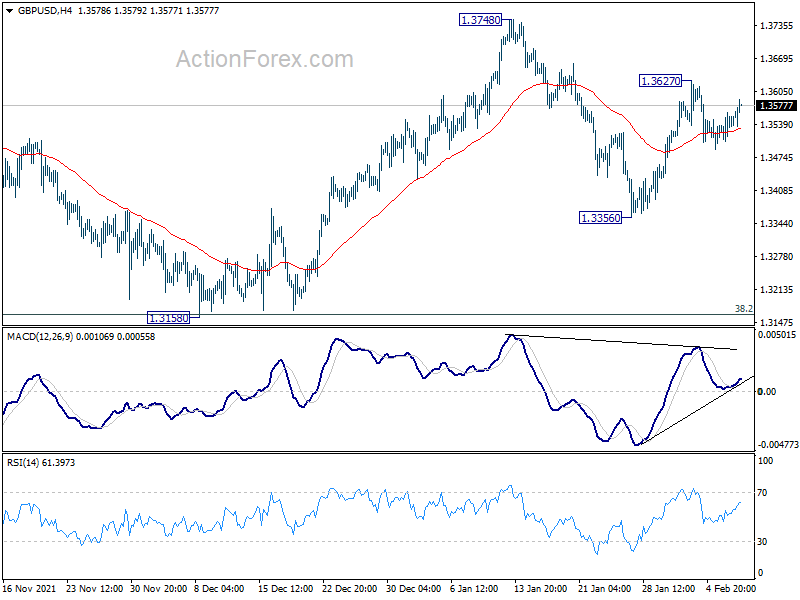
Intraday bias in GBP/USD remains neutral and outlook is unchanged. On the upside, break of 1.3627 will resume the rebound to 1.3748 resistance. Firm break there will revive the bullish case that correction from 1.4248 has completed with three waves down to 1.3158. Further rally should then be seen to retest 1.4248 high. On the downside, however, break of 1.3356 will bring retest of 1.3158 low.
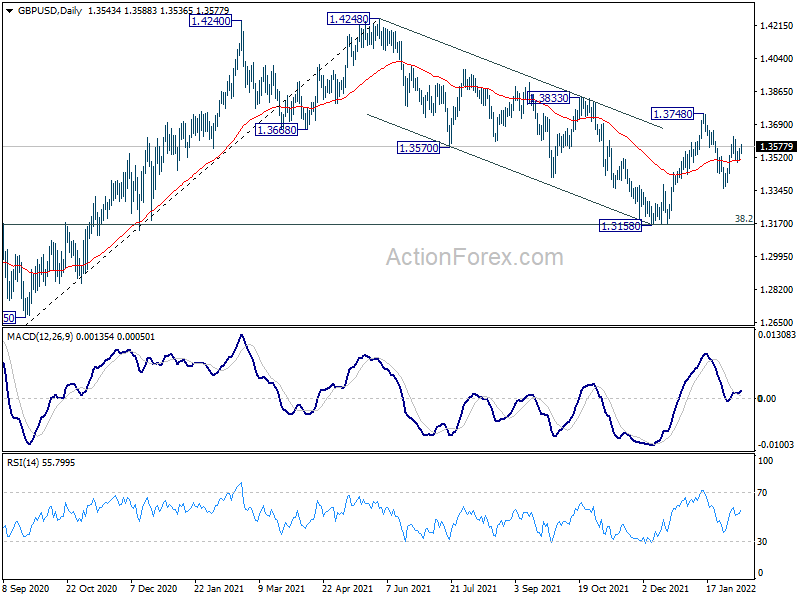
In the bigger picture, as long as 38.2% retracement of 1.1409 to 1.4248 at 1.3164 holds, up trend from 1.1409 (2020 low) is still in progress. On resumption, next target will be 38.2% retracement of 2.1161 to 1.1409 at 1.5134. Nevertheless sustained break of 1.3164 will argue that whole rise from 1.1409 has completed and bring deeper fall to 61.8% retracement at 1.2493.
Dollar Broadly Lower on Positive Risk Sentiment
Dollar trades broadly lower again today, as pressured by generally positive risk-sentiment. Yen is following as the next weakest. Canadian Dollar is also soft as WTI crude oil is struggling below 90 handle. On the other hand, Australian Dollar and New Zealand Dollar are trading broadly higher. Sterling and Swiss Franc are mixed for now. The US economic calendar is empty today. Investors will likely hold their bet until tomorrow's US CPI release.
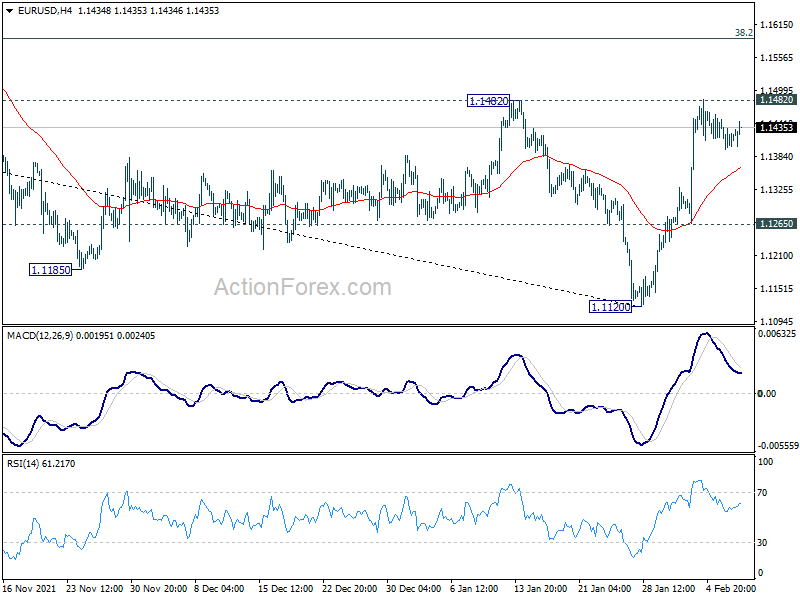
Technically, focus is now back on 1.1482 key resistance in EUR/USD. As noted before, sustained break there will at least confirm medium term bottoming at 1.1120, and raise the chance of bullish trend reversal. Further rally should then be seen to 38.2% retracement of 1.2348 to 1.1120 at 1.1589 next. If this happens, attention will also be on whether EUR/GBP would break through 0.8467 temporary top, and whether EUR/CHF would break through 1.0602 temporary top, to confirm underlying strength of Euro.
In Europe, at the time of writing, FTSE is up 0.71%. DAX is up 1.59%. CAC is up 1.51%. Germany 10-yaer yield is down -0.044 at 0.223. Earlier in Asia, Nikkei rose 1.08%. Hong Kong HSI rose 2.06%. China Shanghai SSE rose 0.79%. Singapore Strait Times rose 0.54%. Japan 10-year JGB yield rose 0.0003 to 0.208.
Fed Bostic: Let data shows if 25bps or 50bps hike is appropriate
Atlanta Federal Reserve President Raphael Bostic said today on CNBC, "in terms of hikes for the interest rates, right now I have three forecast for this year. I'm leaning a little towards four, but we're going to have to see how the economy responds as we take our first steps through the first part of this year."
"For me, I'm thinking very much of a 25-basis-point perspective," he said. "But I want everyone to understand that every option is on the table, and I don't want people to have the view that we're locked into a particular trajectory in terms of how our rates have to move over time. We're really going to let the data show us to what extent a 50 basis point or 25 basis point move is appropriate."
BoE Pill: A case can be made for measured rather than activist approach to policy decisions
BoE Chief Economist Huw Pill said in a speech even though the voted for a 25bps hike last week, "given the inflationary pressures we currently face, I can certainly understand why colleagues on the MPC voted for a 50bp hike".
But, "a case can be made for a measured rather than activist approach to policy decisions, with a focus on more persistent developments in the data that have lasting implications for the outlook for price stability," he said.
"That is what I would label a 'steady handed' approach to monetary policy. Even if it does not provide guidance in all circumstances, I hope it can help explain why I voted for a 25bp hike – rather than something larger – last week."
Bundesbank Nagel: ECB interest rates could rise this year
In a Die Zeit interview, new Bundesbank President Joachim Nagel said, "if the (inflation) picture does not change by March, I will advocate normalizing monetary policy." "The first step is to end net bond purchases during 2022," he said. "Then interest rates could rise this year."
Nagel also expects inflation in Germany to rise "significantly" above 4% in 2022. He warned that the economic costs of acting too late on inflation are significantly higher than acting early.
BoJ Nakamura: Conditions not fallen into place for modifying monetary policy
BoJ board member Toyoaki Nakamura said, "I don't think conditions have fallen into place for Japan to modify monetary policy." He warned, "if we raise interest rates now or before wages pick up, we would be taking away from companies money that would otherwise have been used to raise pay."
He added, "we'll patiently maintain our ultra-easy monetary policy until wages begin to rise sustainably."
"For companies, what's most important is for currency rates to move stably. If the dollar/yen moves within the current range (of around 103-115), that will make it easier for companies to make business decisions," he added.
Australia Westpac consumer sentiment dropped to 100.8, elevated pressures on finances
Australia Westpac-Melbourne Institute consumer sentiment dropped -1.3% to 100.8 in February, down from 102.2. The "economy, next 12 months" sub-index increased by 2.4% and the "economy, next 5 years" sub-index was up by 1.5%.
However, the "finances vs a year ago" sub-index slumped by -9.2% (more than reversing the surprise 7.5% lift in January) while the "finances, next 12 months" sub-index fell by -1.5% to be down by -4.3% since December.
Westpac said, "the most likely explanations for these elevated pressures on finances relate to: Omicron-related disruptions to activity and earnings at the start of the year; the rising cost of living; and the prospect of rising interest rates."
Also, Westpac does not expect the first rate hike by the RBA until August and it will be very interesting to observe how resilient this surprising recovery in confidence will be in the lead up to the first move."
GBP/USD Mid-Day Outlook
Daily Pivots: (S1) 1.3516; (P) 1.3540; (R1) 1.3572; More...
Intraday bias in GBP/USD remains neutral and outlook is unchanged. On the upside, break of 1.3627 will resume the rebound to 1.3748 resistance. Firm break there will revive the bullish case that correction from 1.4248 has completed with three waves down to 1.3158. Further rally should then be seen to retest 1.4248 high. On the downside, however, break of 1.3356 will bring retest of 1.3158 low.
In the bigger picture, as long as 38.2% retracement of 1.1409 to 1.4248 at 1.3164 holds, up trend from 1.1409 (2020 low) is still in progress. On resumption, next target will be 38.2% retracement of 2.1161 to 1.1409 at 1.5134. Nevertheless sustained break of 1.3164 will argue that whole rise from 1.1409 has completed and bring deeper fall to 61.8% retracement at 1.2493.
Economic Indicators Update
| GMT | Ccy | Events | Actual | Forecast | Previous | Revised |
|---|---|---|---|---|---|---|
| 23:30 | AUD | Westpac Consumer Confidence Feb | -1.30% | -2% | ||
| 23:50 | JPY | Money Supply M2+CD Y/Y Jan | 3.60% | 3.50% | 3.70% | |
| 07:00 | EUR | Germany Trade Balance (EUR) Dec | 6.8B | 11.3B | 10.9B | |
| 09:00 | EUR | Italy Industrial Output M/M Dec | -1.00% | 1.70% | 1.90% | |
| 15:00 | USD | Wholesale Inventories Dec F | 2.00% | 2.10% | ||
| 15:30 | USD | Crude Oil Inventories | 1.5M | -1.0M |
BoE Pill: A case can be made for measured rather than activist approach to policy decisions
BoE Chief Economist Huw Pill said in a speech even though the voted for a 25bps hike last week, "given the inflationary pressures we currently face, I can certainly understand why colleagues on the MPC voted for a 50bp hike".
But, "a case can be made for a measured rather than activist approach to policy decisions, with a focus on more persistent developments in the data that have lasting implications for the outlook for price stability," he said.
"That is what I would label a 'steady handed' approach to monetary policy. Even if it does not provide guidance in all circumstances, I hope it can help explain why I voted for a 25bp hike – rather than something larger – last week."
Fed Bostic: Let data shows if 25bps or 50bps hike is appropriate
Atlanta Federal Reserve President Raphael Bostic said today on CNBC, "in terms of hikes for the interest rates, right now I have three forecast for this year. I'm leaning a little towards four, but we're going to have to see how the economy responds as we take our first steps through the first part of this year."
"For me, I'm thinking very much of a 25-basis-point perspective," he said. "But I want everyone to understand that every option is on the table, and I don't want people to have the view that we're locked into a particular trajectory in terms of how our rates have to move over time. We're really going to let the data show us to what extent a 50 basis point or 25 basis point move is appropriate."
Commodities in Focus: Crude Oil, Aluminium and Gold
- Crude oil finally retreats
- Aluminium at 3-year highs
- Gold testing resistance
Crude oil finally retreats
Crude oil prices have remained under pressure after falling about 2% on Tuesday. The losses come after a strong start to the year. Until this week, prices had risen for 7 consecutive weeks. Will the buyers keep buying those dips, or have prices exceeded their fundamental values and due a correction?
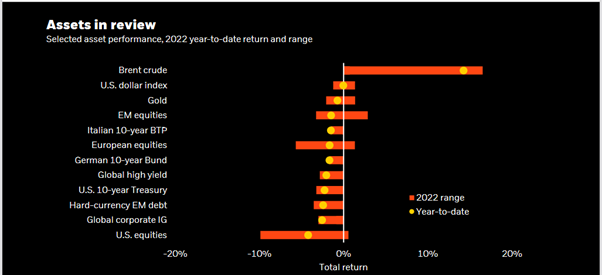
Oil prices have been by far the most notable mover so far this year, as per this handy graphic by BlackRock:
Source: BlackRoack
Investors have been buying crude oil as concerns over the economic impact of omicron variant did not materialise. On top of this, the OPEC+ stuck with its plan to increase supplies by only 400k barrels per day every month, despite calls for it to do more from oil consumer nations. But the group repeatedly failed to even hit that target, which created a supply/demand imbalance. Oil prices then found further support from geopolitical risks concerns Russia and Ukraine. Meanwhile, temporary travel restrictions were lifted across most of Europe, causing investors to expect strong demand for oil in the summer as travel and tourism is likely to ramp up. Indeed, TUI has noted strong booking momentum across all markets, with new bookings for summer 2022 now above pre-crisis levels. Travellers are happy and willing to pay higher prices, after two years of disruption because of the pandemic.
But how much of that is priced in remains to be seen. But I certainly expect the supply and demand imbalance to be temporary and expect it to move back into balance in the months ahead. Against this backdrop, I doubt oil prices will spike noticeably higher from current levels.
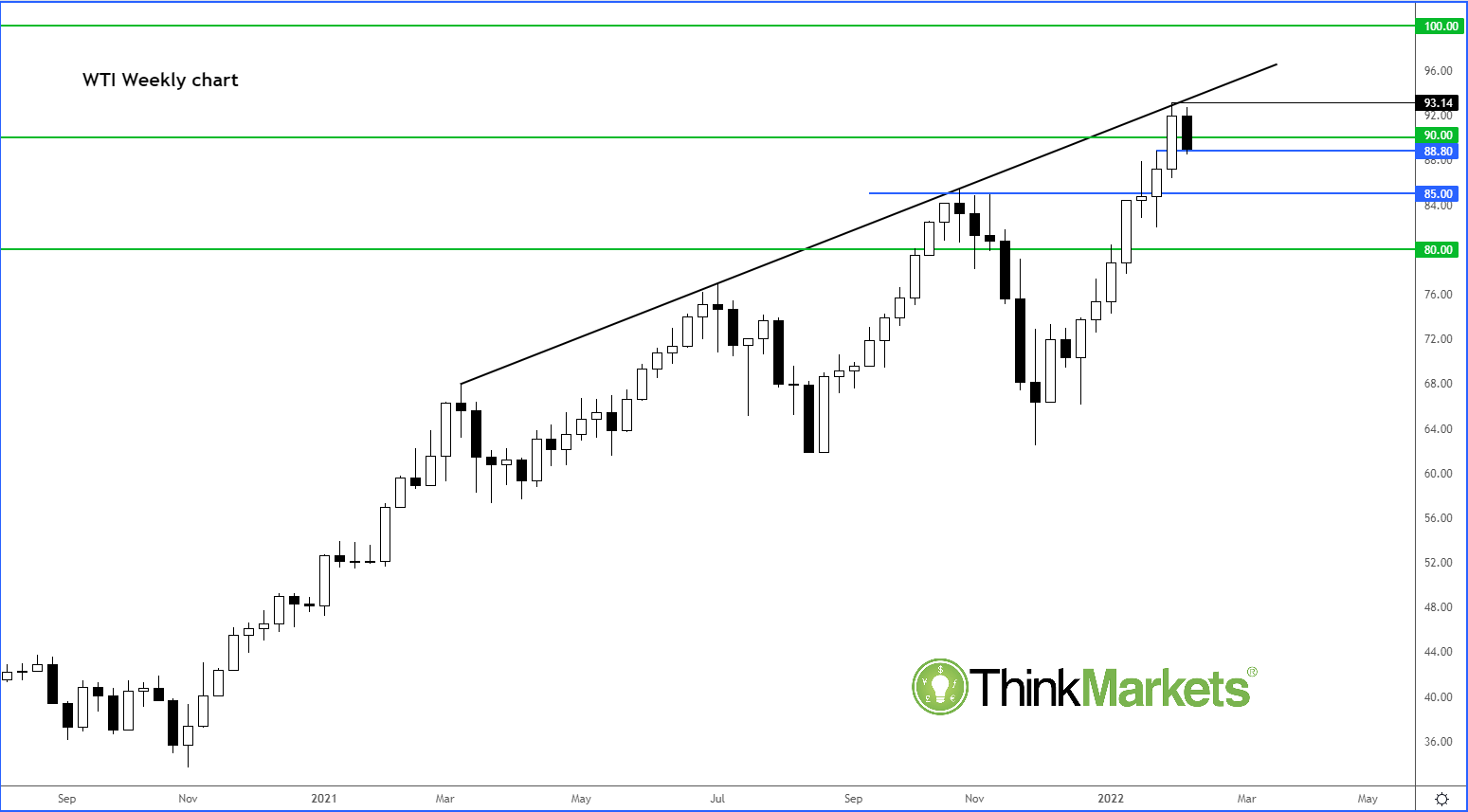
WTI has also sold off because of technical reasons as prices retreated from THIS trend line on the weekly time frame:
Source: ThinkMarkets and TradingView.com
It is worth watching WTI closely here as a failure to hold above the $90 psychological level could trigger a bit of profit-taking and opportunistic shorting opportunities.
Aluminium at 3-year highs
Aluminium continues to find support on the dips due to tight supply and falling inventories. The main problem is the cost of electricity which has sky-rocketed, making it very expensive for smelters to operate. This is why we have seen inventories falling sharply. What’s more, China is keen to reduce pollution to improve air quality, especially during the Beijing Olympics. One of the ways to achieve that is to reduce fossil fuel consumption. Smelters, which use huge amounts of electricity generated by coal-fired power plants, have been directly hit by this. There are also reports of covid outbreaks in aluminium-producing city of Baise, in China.
Gold testing resistance
The yellow precious metal broke to a fresh weekly high today, as yields dipped back a little. But overall, yields have been going higher alongside the metal. In the US, the 10-year yield has closed in on the 2.000% level. It looks like investors happy to pile into gold, a non-interest-bearing asset, as they seek to protect their wealth against the impact of soaring inflation. Rising prices are eroding the value of fiat currencies around the world, making gold an appealing investment for many. But gold must now clear the key $1830-$1850 resistance range, if it were to make a more serious comeback.
Confidence Building
Stock markets are making decent gains in Europe on Wednesday and US futures are also being led higher as confidence continues to build following a torrid start to the year.
It's hard to pinpoint exactly what has changed; whether it's earnings that are lifting the mood or the soothing tones of central bankers desperately trying to manage expectations. Perhaps it's simply a case of investors coming to terms with the tightening environment and feeling more comfortable with it.
Whatever the reason, investors certainly appear encouraged by the fact that the falling knife period looks to be in the rear-view mirror and we're now seeing signs of stabilization. In recent week's we've also seen periods of aggressive selling being bought into which has helped create the impression that the worst is behind us.
Of course, that could change quickly if the inflation outlook worsens, as has repeatedly been the case in recent months. And we won't have to wait long for the next hurdle on that front, with the US CPI data being keenly anticipated tomorrow.
Before then, we'll hear from Loretta Mester and Michelle Bowman from the Federal Reserve, and Huw Pill from the Bank of England. Both central banks have become far more hawkish in recent months but I expect we'll see some caution in the wording as none will want to needlessly spook financial markets.
Oil eases as talks continue
Oil prices are continuing to soften on Wednesday, as traders continue to weigh up the prospect of a nuclear deal between the US and Iran that could see more than a million barrels of oil flood the market at a time when it's very much needed. One eye will also be on the EIA inventory data after API reported a more than two million barrel drawdown on Tuesday.
WTI has slipped back below $90 but Brent is continuing to hold around there, after finding strong support over the last day or so. If US-Iran talks continue to progress, this level should come under some pressure, while a collapse of negotiations could be the catalyst that drives the price towards triple-figure territory.
Gold continues to push key resistance
Gold is relatively flat on the day but has remained well supported after registering a sixth winning day in seven. The yellow metal is once again seeing some resistance around $1,830, a break of which could open up a move towards $1,850.
Yields have softened a little over the last couple of days, especially in Europe, where policymakers are pushing back against market expectations for interest rates this year. We're still seeing 40 basis points of hikes being priced in by the end of the year which would be quite the shift. But that may be providing gold some further support in the near term.
Bitcoin recovery looking promising
The bitcoin price is easing a little again today after running into resistance around $45,500 on Tuesday. The risk relationship has become a little disconnected over the last week or so, with bitcoin appearing to front-run some of the recovery in stock markets. Risk appetite has improved this week which has coincided with some profit-taking in bitcoin. It continues to look promising though and a break of $45,500 would be another important and bullish hurdle.
February Riksbank Risks Surprise for EUR/SEK
Whether at Thursday’s meeting or further down the line, the Riksbank will inevitably have to become more hawkish as the impact of COVID begins to fade.
But there are a lot of moving parts to consider when the central bank meets tomorrow. Look out for two specific aspects of the decision.
Rate path brought forward
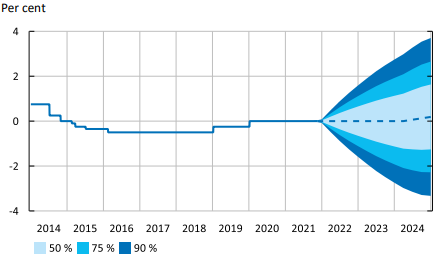
Firstly, will the central bank revise its guidance in terms of when it will conduct its first interest rate hike? Previously, the Riksbank had indicated the first interest rate would occur at the end of 2024. But that already puts the central bank behind the curve of the BoE, Fed and possibly even the European Central Bank. So, there is every possibility that forward guidance on the first rate is brought forward to mid-2024 or even the end of 2023.
Reinvestment may matter more
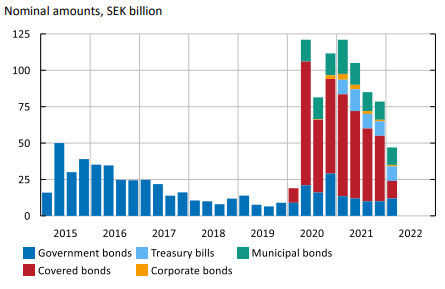
Secondly, November’s minutes showed that the Riksbank has been warming to reducing the size of its balance sheet this year. So, there is every chance it announces a faster than expected reduction in asset reinvestment, either in government and/or corporate bonds. This would send a stronger signal to the market as it would solidify the possibility of an even earlier interest rate hikes.
The impact on EUR/SEK
EUR/SEK has followed an interesting path over the last two years. Aside from the exceptional move higher in March 2020, due to the Swedish krona’s high susceptibility to global risk and the low established as the Riksbank upgraded its economic growth forecasts at its last meeting in November 2021, EUR/SEK, for the most part, has been rangebound between 10.70815 and 10.1101.
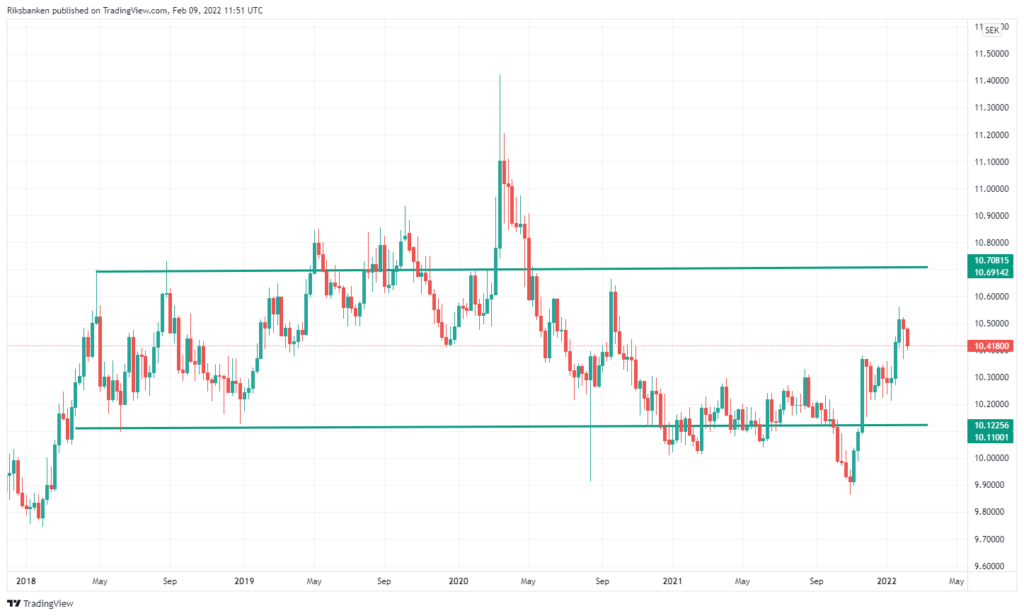
The rangebound nature of EUR/SEK should not be a surprise given the economic linkages between Sweden and the euro area. But any downside reaction in EUR/SEK from the upcoming meeting will likely be temporary and limited. Global economic conditions and monetary policy have drifted from the last time the Riksbank last met. Therefore, any downside in EUR/SEK is likely to be suppressed at the 10.1101 level. However, a more hawkish central bank does increase the chance it remains closer to the bottom of its pervious range.
GBPUSD on the Rise on Hawkish BoE and Stocks Uptick
GBPUSD is gaining 0.35% on Wednesday, surpassing 1.3585, not far from the month’s highs of 1.3620. The British pound is closely correlated with equity market dynamics, and the latest upward momentum in major global indices supports GBP buyers.
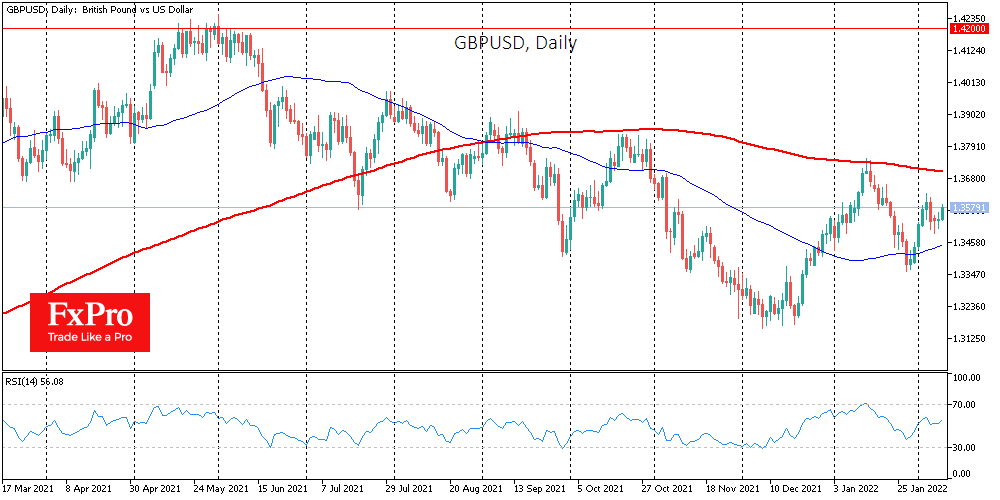
Also noteworthy is that the Bank of England switched to the next gear in its monetary policy tightening as last week’s rate hike was 25 b. p. rather than 50 b. p. by only a slight margin.
The euro is also losing ground against the pound after a sharp spike at the ECB meeting. In our view, the EURGBP surge was caused by a technical bounce on touching the 6-year low area. Meanwhile, the Bank of England’s stance suggests a much more decisive rate hike, which should provide a carry trade inflow into the pound and further push up the British currency.
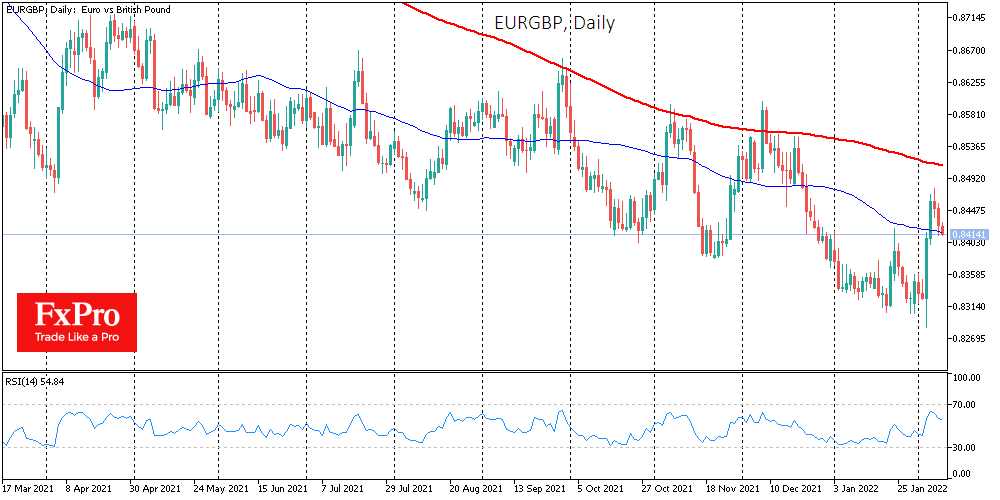
With the continued upward trajectory of equity indices, a renewal of the 6-year highs of the pound to the euro and a test of the 1.3750 area should come in just a matter of weeks.
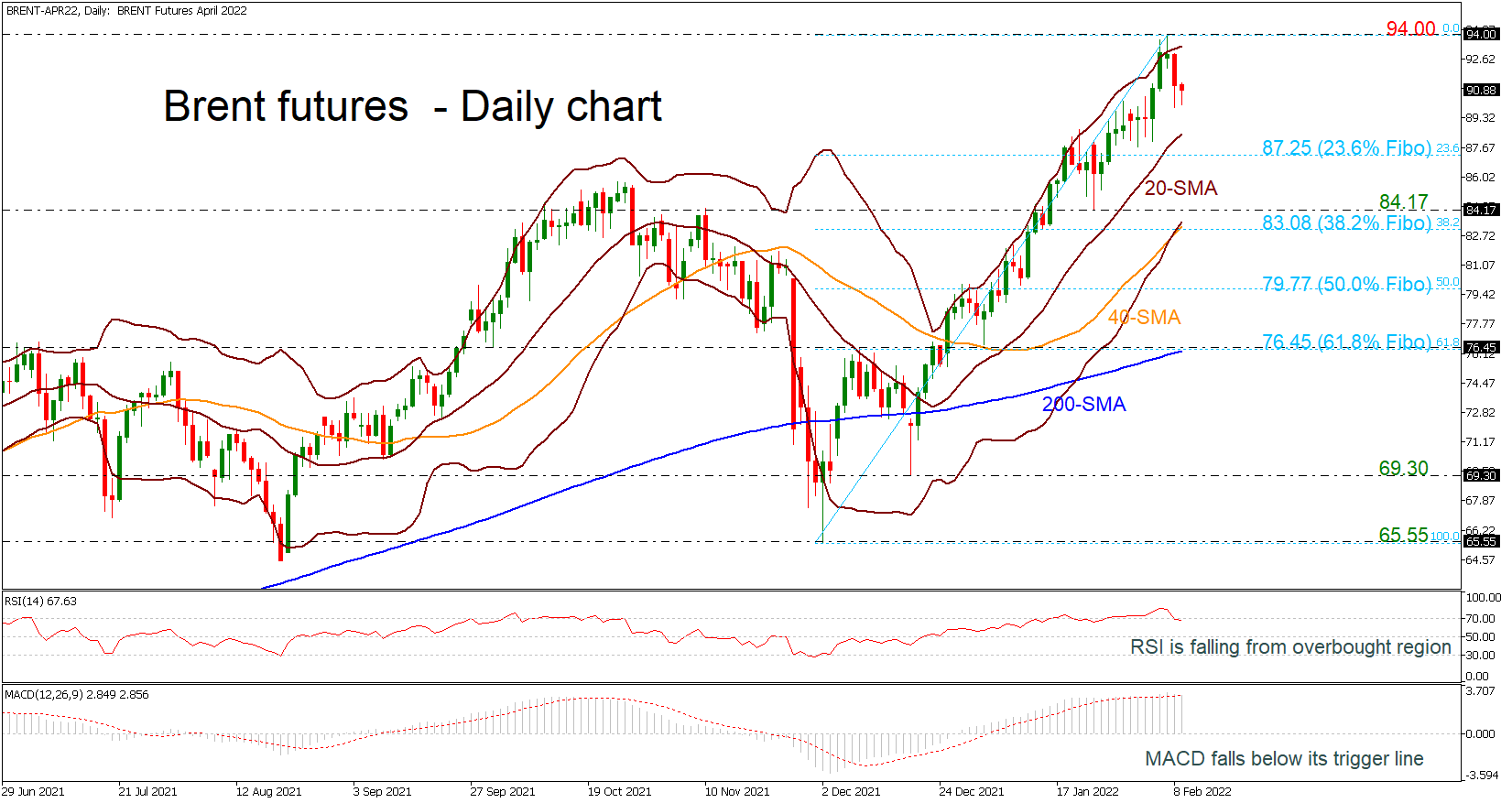
Brent Futures Remains Below Upper Bollinger Band and 94.00
Brent crude oil futures are easing after they reached the upper Bolling band and a new high at 94.00 on Monday. The RSI indicator is falling from the overbought region, while the MACD is dropping below its trigger line in the positive area, both suggesting a negative correction in the short-term timeframe.
If the price retreats further, the mid-level of the Bollinger band, which is also the 20-day simple moving average (SMA) at 88.37 could come immediately in focus. A drop lower could meet the 23.6% Fibonacci retracement level of the up leg from 65.55 to 94.00 at 87.25. Moving lower, the 84.17 support but more importantly the 38.2% Fibonacci, which overlaps with the 40-day SMA and the lower Bollinger band around 83.08 may act as a turning point. Steeper decreases could open the way for a bearish correction until the 50.0% Fibonacci of 79.77 and the 200-day SMA at 76.45, which lies the 61.8% Fibonacci as well.
In the positive scenario, a successful climb above the upper Bollinger band may have a rest at the 94.00 peak before rallying to fresh highs such as the next psychological levels of 95.00 and 96.00.
All in all, Brent futures have been in an upside tendency since December 2021 and only a daily close below the 200-day SMA may change this outlook to negative.
GBPCAD powers back as positive forces linger
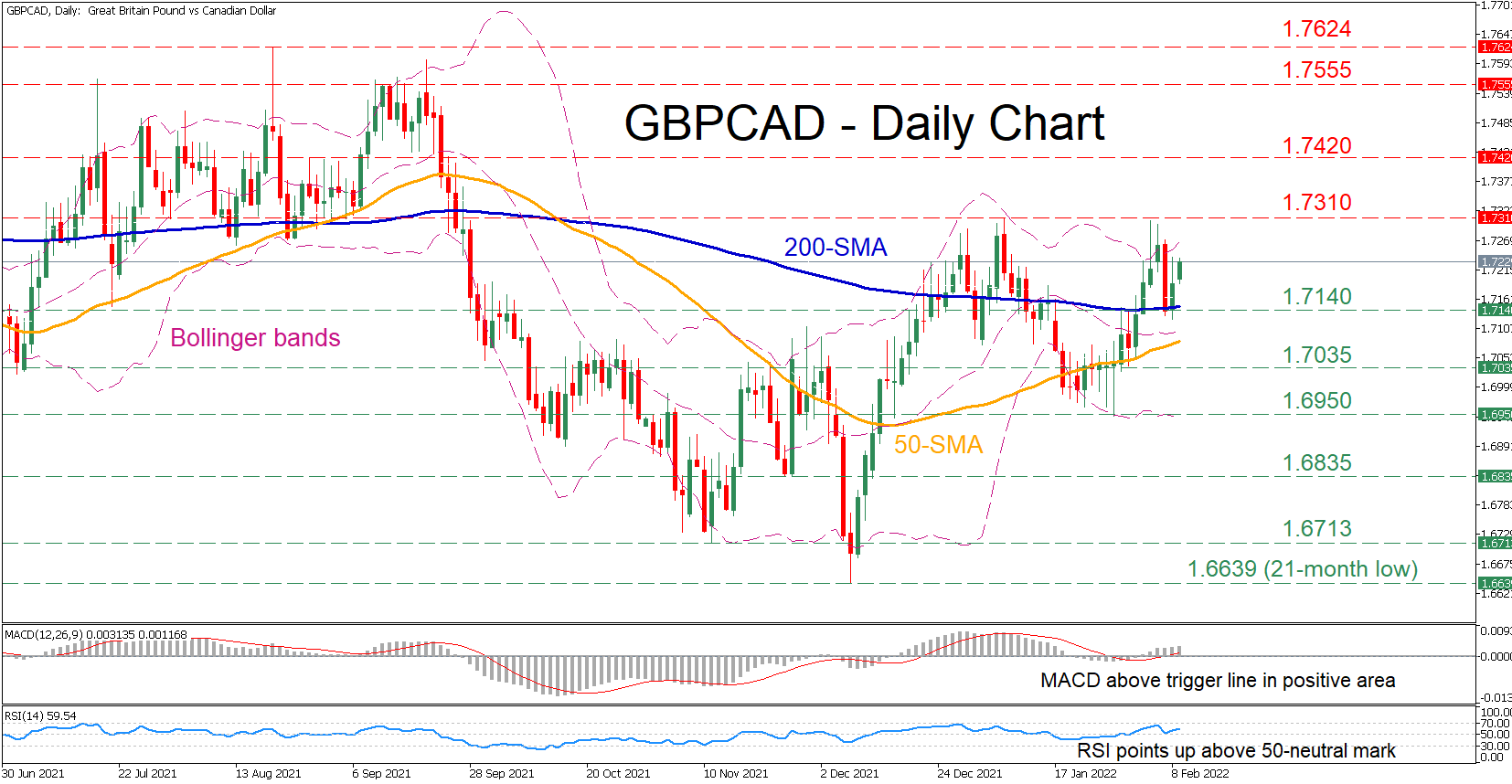
GBPCAD came back swinging after its January retreat as the bearish forces appeared to run out of steam. Moreover, the pair crossed above both its 50- and 200-day simple moving averages (SMAs), while the latter also rejected a temporary minor pullback, endorsing the bulls’ hopes for a more sustained uptrend.
The momentum indicators suggest that the near-term risks are tilted to the upside. The MACD is found above both zero and its red trigger line, while the RSI is ticking upwards in the positive territory.
Should the bulls maintain control, the price might ascend towards 1.7310, which has rejected several price advances in the last few months. Further upside pressure could send the price to test the 1.7420 barrier. Crossing above this region, the spotlight could turn to 1.7555, a level which the price has failed to close above since April 2021.
Otherwise, if selling pressure intensifies, the pair may encounter initial support at the 1.7140 obstacle, which overlaps with the 200-day SMA. Failing to halt there, the price might dip towards 1.7035 before it challenges the 1.6950 hurdle. A decisive move below the latter could pave the way towards the 1.6835 region.
To summarize, although the resumption of GBPCAD’s short-term upside trajectory remains the most likely scenario, the long-term outlook remains bearish. Therefore, a profound break above the 1.7555 ceiling is needed to alter the long-term picture back to positive.