Sample Category Title
EUR/USD Daily Outlook
Daily Pivots: (S1) 1.1402; (P) 1.1425; (R1) 1.1447; More...
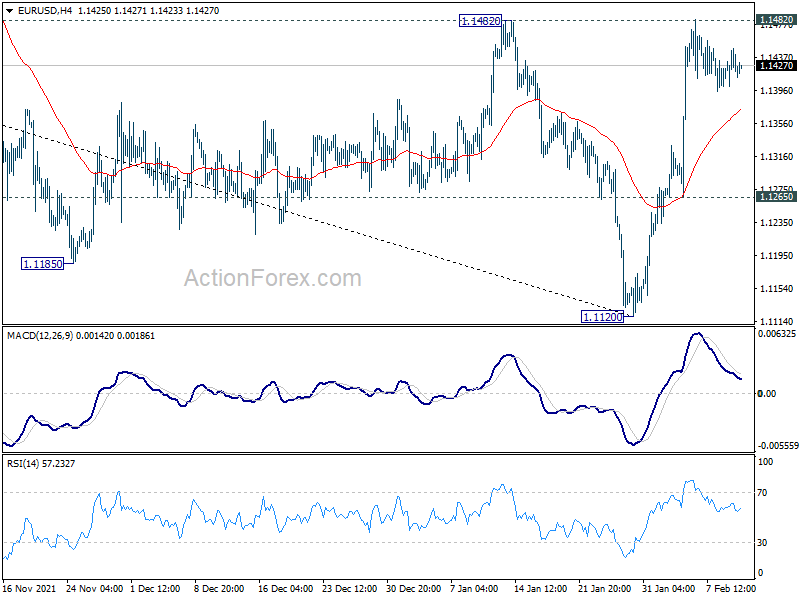
EUR/USD is still staying in consolidation in tight range and intraday bias remains neutral. As noted before, a medium term bottom could be in place at 1.1120, on bullish convergence condition in daily MACD. Break of 1.1482 resistance will target 38.2% retracement of 1.2348 to 1.1120 at 1.1589 next. Sustained break there will argue that whole fall from 1.2348 has completed too and target 61.8% retracement at 1.1879. On the down, however, break of 1.1265 support will dampen this bullish view and bring retest of 1.1120 low instead.
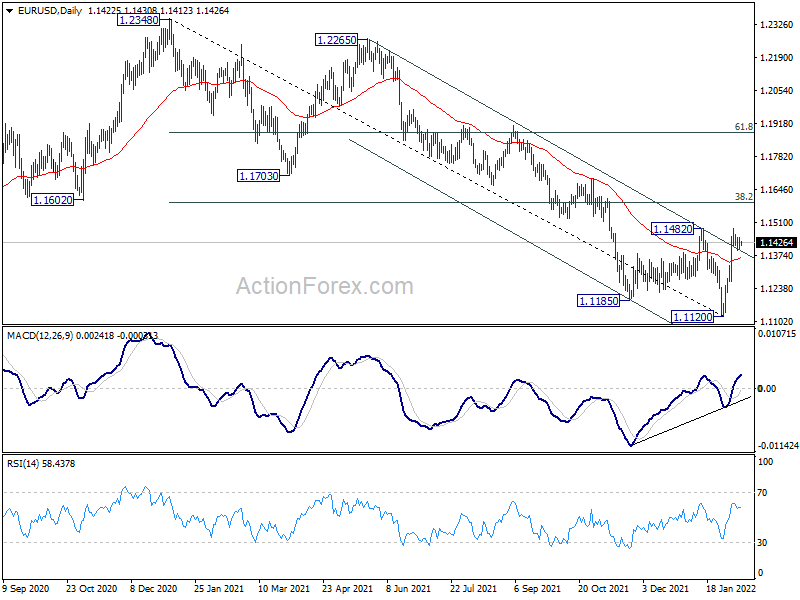
In the bigger picture, the decline from 1.2348 (2021 high) is seen as a leg inside the range pattern from 1.2555 (2018 high). Sustained trading above 55 week EMA (now at 1.1613) will argue that it has completed and stronger rise would be seen back towards top of the range between 1.2348 and 1.2555. However, firm break of 1.0635 (2020 low) will raise the chance of long term down trend resumption and target a retest on 1.0339 (2017 low) next.
Dollar Soft with Yen as US CPI Awaited
While US stocks staged a strong rally overnight, Asian markets turned mixed. Investors are holding their bets ahead of US CPI data. Australian Dollar remains the strongest one for the week, followed by Kiwi. Loonie also regained some ground with help from the stabilization in oil prices. On the other hand, Yen is currently the worst performing one, followed by Euro and then Dollar.
Technically, major focus remains on 1.1482 resistance in EUR/USD. Firm break there will add to the case of bullish trend reversal. At the same time, if that happens, attention will be paid on whether it's more of a return to strength in Euro, or weakness in Dollar. Sterling could be used as a gauge. Break of 1.3627 resistance in GBP/USD will be a sign of Dollar weakness. Break of 0.8476 resistance in EUR/GBP will be a sign of Euro strength. But of course, both could happen at the same time.
In Asia, Nikkei closed up 0.30%. Hong Kong HSI is down -0.33%. China Shanghai SSE is down -0.36%. Singapore Strait Times is down -0.02%. Japan 10-year JGB yield is up 0.0185 at 0.227. Overnight, DOW rose 0.86%. S&P 500 rose 1.45%. NASDAQ rose 2.08%. 10-year yield dropped -0.025 to 1.929.
Fed Mester: No compelling case to start with 50bps hike
Cleveland Fed President Loretta Mester "each meeting is going to be in play" regarding interest rate decisions. She added, "we're going to assess conditions, we're going to assess how the economy's evolving, we're going to be looking at the risks, and we're going to be removing accommodation."
On the idea of a 50bps rate hike in March, Mester said "I don't like taking anything off the table." However, "I don't think there's any compelling case to start with a 50 basis point".
"Again, we've got to be a little bit careful. Even though you can well telegraph what's coming, when you take that first action, there's going to be a reaction," she added.
On the topic of balance sheet runoff, Mester said, "I would support selling some of our mortgage-backed securities at some point during the reduction period to speed the conversion of our portfolio's composition to primarily Treasuries."
BoC Macklem: We signalled with unusual clarity a rising path for interest rates
In a speech, BoC Governor Tiff Macklem said current inflation, close to 5%, is "too high". But that is "not the result of generalized excess demand in the Canadian economy". Inflation "largely reflects global supply problems, most of which stem from the pandemic". As the pandemic recedes, "conditions around the world should normalize, taking pressure off global goods prices.". BoC expects inflation to "come down relatively quickly" in H2 2022 to 3% by the end of the year.
Macklem added, "to get inflation the rest of the way back to its 2% target, we need a significant shift in monetary policy". The economy will need "higher interest rates to moderate growth in spending and bring demand in line with supply", and "keep inflation expectations well anchored". And, "we signalled with unusual clarity that Canadians should expect a rising path for interest rates."
Japan CGPI rose 8.6% yoy in Jan, index at highest since 1985
Japan corporate goods price index rose 8.6% yoy in January, slowed slightly from December's 8.7% yoy, but beat expectation of 8.2% yoy. At 109.5, the index was at the highest level since September 1985.
Export prices jumped 12.5% yoy on Yen basis, 6.6% yoy on contract currency basis. Import prices surged a massive 37.5% yoy on Yen basis, and 28.0% yoy on contract currency basis.
However, consumer prices remained sluggish, with national CPI core at 0.5% yoy in December, which some economists expected to slow to 0.3% yoy in January.
BoJ officials, including Governor Haruhiko Kuroda, have indicated that it would be hard to see consumer inflation to sustainably reach 2% target without wages rise.
Elsewhere
Australia consumer inflation expectations rose further to 4.6% in February, up from 4.4%. UK RICS house price balance rose from 69 to 74, above expectation of 72.
Looking ahead, US CPI will be the major focus of the day. Jobless claims will be released as usual on a Tuesday.
EUR/USD Daily Outlook
Daily Pivots: (S1) 1.1402; (P) 1.1425; (R1) 1.1447; More...
EUR/USD is still staying in consolidation in tight range and intraday bias remains neutral. As noted before, a medium term bottom could be in place at 1.1120, on bullish convergence condition in daily MACD. Break of 1.1482 resistance will target 38.2% retracement of 1.2348 to 1.1120 at 1.1589 next. Sustained break there will argue that whole fall from 1.2348 has completed too and target 61.8% retracement at 1.1879. On the down, however, break of 1.1265 support will dampen this bullish view and bring retest of 1.1120 low instead.
In the bigger picture, the decline from 1.2348 (2021 high) is seen as a leg inside the range pattern from 1.2555 (2018 high). Sustained trading above 55 week EMA (now at 1.1613) will argue that it has completed and stronger rise would be seen back towards top of the range between 1.2348 and 1.2555. However, firm break of 1.0635 (2020 low) will raise the chance of long term down trend resumption and target a retest on 1.0339 (2017 low) next.
Economic Indicators Update
| GMT | Ccy | Events | Actual | Forecast | Previous | Revised |
|---|---|---|---|---|---|---|
| 23:50 | JPY | PPI Y/Y Jan | 8.60% | 8.20% | 8.50% | 8.70% |
| 00:00 | AUD | Consumer Inflation Expectations Feb | 4.60% | 4.40% | ||
| 00:01 | GBP | RICS Housing Price Balance Jan | 74% | 72% | 69% | |
| 13:30 | USD | Initial Jobless Claims (Feb 4) | 230K | 238K | ||
| 13:30 | USD | CPI M/M Jan | 0.40% | 0.50% | ||
| 13:30 | USD | CPI Y/Y Jan | 7.30% | 7.00% | ||
| 13:30 | USD | CPI Core M/M Jan | 0.50% | 0.60% | ||
| 13:30 | USD | CPI Core Y/Y Jan | 5.90% | 5.50% |
USD/CHF Struggles Ahead of US CPI Report
Key Highlights
- USD/CHF corrected gains from the 0.9340 resistance zone.
- There is a key bullish trend line forming with support near 0.9215 on the 4-hours chart.
- EUR/USD is holding gains above 1.1400, and GBP/USD attempts to clear the 1.3600 resistance.
- The US CPI could increase 7.3% in Jan 2022 (YoY).
USD/CHF Technical Analysis
The US Dollar failed to clear the 0.9350 resistance against the Swiss Franc. USD/CHF corrected lower below 0.9300, but dips were limited below the 0.9200 level.
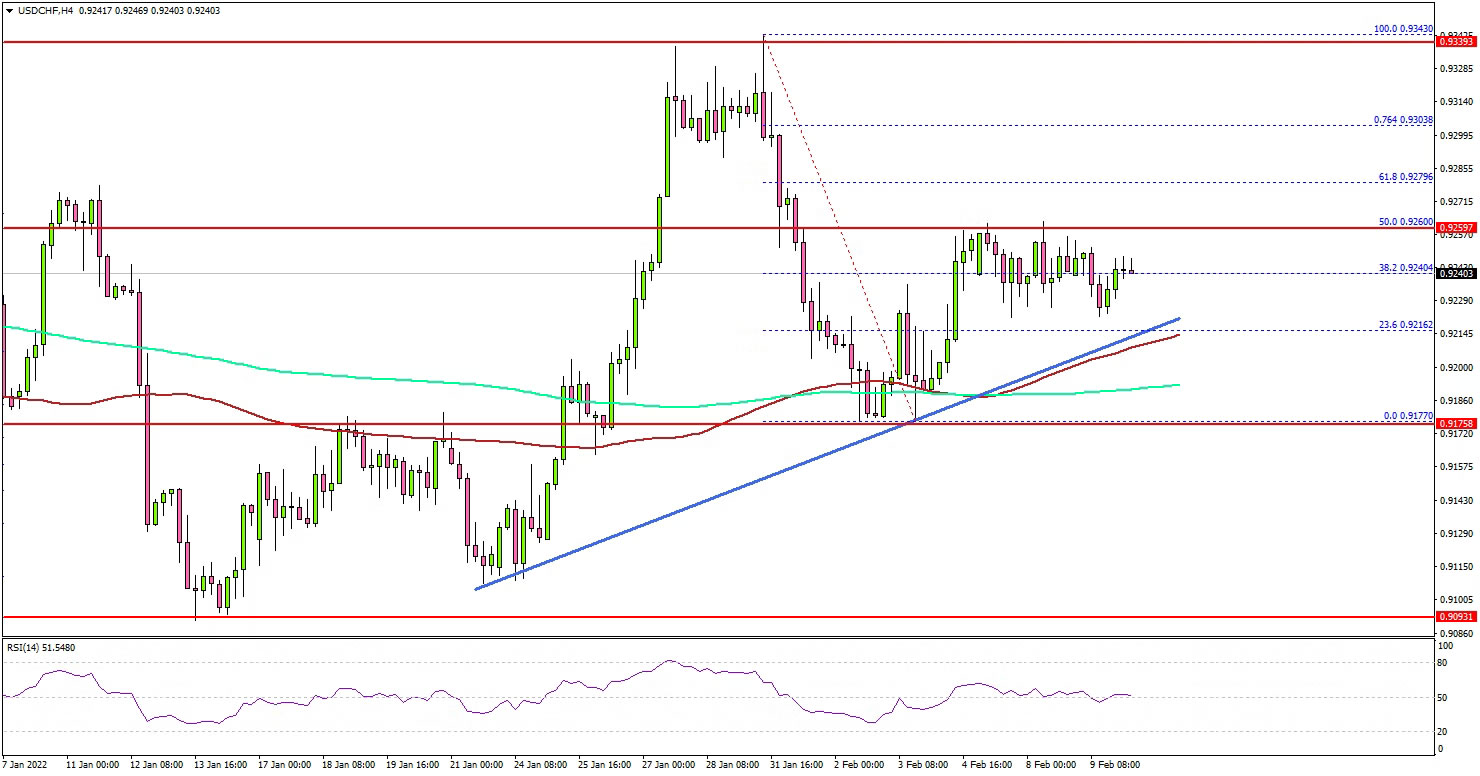
Looking at the 4-hours chart, the pair traded as low as 0.9177 and started a fresh increase. There was a move above the 0.9220 resistance level, the 100 simple moving average (red, 4-hours), and the 200 simple moving average (green, 4-hours).
However, the bears were active near the 50% Fib retracement level of the recent decline from the 0.9343 swing high to 0.9177 low.
To continue higher, the pair must surpass the 0.9260 resistance. The next major resistance is near the 0.9300 level. It coincides with the 76.4% Fib retracement level of the recent decline from the 0.9343 swing high to 0.9177 low.
A clear move above the 0.9260 resistance might start a major increase in the coming sessions. If not, there is a risk of a break below the 0.9200 support.
The next major support is near the 0.9180 level. Any more downsides might send the pair towards the 0.9100 level in the near term.
Looking at EUR/USD, the pair stayed above 1.1380 and might attempt a fresh rally. Similarly, GBP/USD could gain bullish momentum if it settles above the 1.3600 level.
Economic Releases
US Initial Jobless Claims - Forecast 230K, versus 238K previous.
US Consumer Price Index for Jan 2022 (MoM) – Forecast +0.5%, versus +0.5% previous.
US Consumer Price Index for Jan 2022 (YoY) – Forecast +7.3%, versus +7.0% previous.
US Consumer Price Index Ex Food & Energy for Jan 2022 (YoY) – Forecast +5.9%, versus +5.9% previous.
AUDUSD Wave Analysis
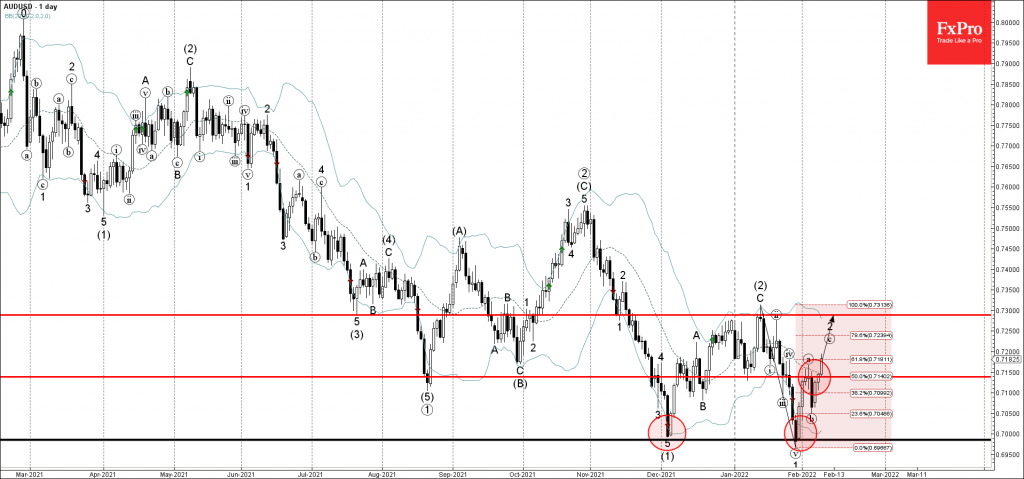
- AUDUSD broke resistance level 0.715
- Likely to rise to resistance level 0.7300
AUDUSD currency pair recently broke the key resistance level 0.715 (former strong support from the start of Januarys).
The breakout of the resistance level 0.715 coincided with the breakout of the 50% Fibonacci correction of the previous sharp impulse wave 1.
AUDUSD currency pair can be expected to rise further toward the next resistance level 0.7300 (target for the completion of the active wave 2).
Japan CGPI rose 8.6% yoy in Jan, index at highest since 1985
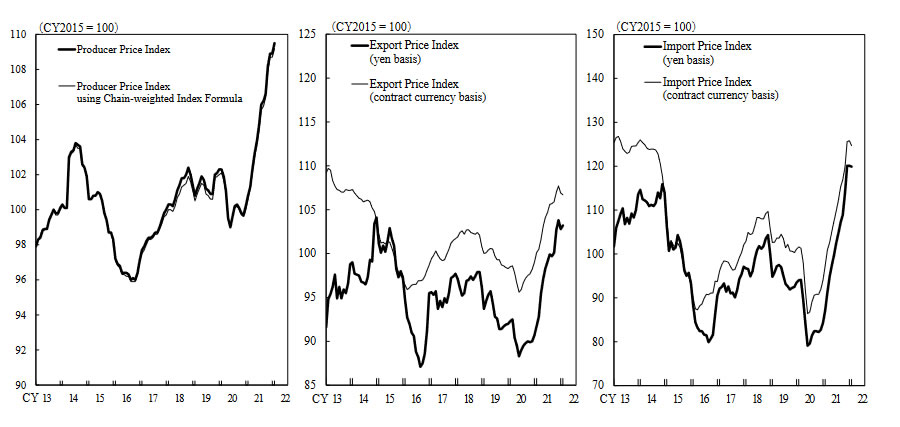
Japan corporate goods price index rose 8.6% yoy in January, slowed slightly from December's 8.7% yoy, but beat expectation of 8.2% yoy. At 109.5, the index was at the highest level since September 1985.
Export prices jumped 12.5% yoy on Yen basis, 6.6% yoy on contract currency basis. Import prices surged a massive 37.5% yoy on Yen basis, and 28.0% yoy on contract currency basis.
However, consumer prices remained sluggish, with national CPI core at 0.5% yoy in December, which some economists expected to slow to 0.3% yoy in January.
BoJ officials, including Governor Haruhiko Kuroda, have indicated that it would be hard to see consumer inflation to sustainably reach 2% target without wages rise.
Fed Mester: No compelling case to start with 50bps hike
Cleveland Fed President Loretta Mester "each meeting is going to be in play" regarding interest rate decisions. She added, "we're going to assess conditions, we're going to assess how the economy's evolving, we're going to be looking at the risks, and we're going to be removing accommodation."
On the idea of a 50bps rate hike in March, Mester said "I don't like taking anything off the table." However, "I don't think there's any compelling case to start with a 50 basis point".
"Again, we've got to be a little bit careful. Even though you can well telegraph what's coming, when you take that first action, there's going to be a reaction," she added.
On the topic of balance sheet runoff, Mester said, "I would support selling some of our mortgage-backed securities at some point during the reduction period to speed the conversion of our portfolio's composition to primarily Treasuries."
BoC Macklem: We signalled with unusual clarity a rising path for interest rates
In a speech, BoC Governor Tiff Macklem said current inflation, close to 5%, is "too high". But that is "not the result of generalized excess demand in the Canadian economy". Inflation "largely reflects global supply problems, most of which stem from the pandemic". As the pandemic recedes, "conditions around the world should normalize, taking pressure off global goods prices.". BoC expects inflation to "come down relatively quickly" in H2 2022 to 3% by the end of the year.
Macklem added, "to get inflation the rest of the way back to its 2% target, we need a significant shift in monetary policy". The economy will need "higher interest rates to moderate growth in spending and bring demand in line with supply", and "keep inflation expectations well anchored". And, "we signalled with unusual clarity that Canadians should expect a rising path for interest rates."
US January CPI Might Not Benefit the DXY
Increasingly higher inflation prints from the US may harm rather than prop up the US dollar index (DXY).
A big beat on January CPI is needed
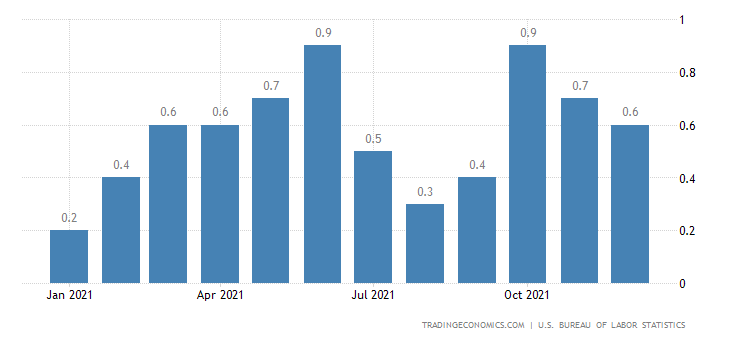
Increasingly higher inflation prints from the US my harm rather than prop up the US dollar index (DXY). The median consensus is already calling for a 7.3% y/y print with a narrow forecast range of 7.0%-7.6% y/y, versus a 7% print for December, according to a recent poll by Bloomberg. Granted, this is high by any measure, but on a month-to-month basis, headline inflation has been decelerating since November 2021.
Is the inflation narrative dead?
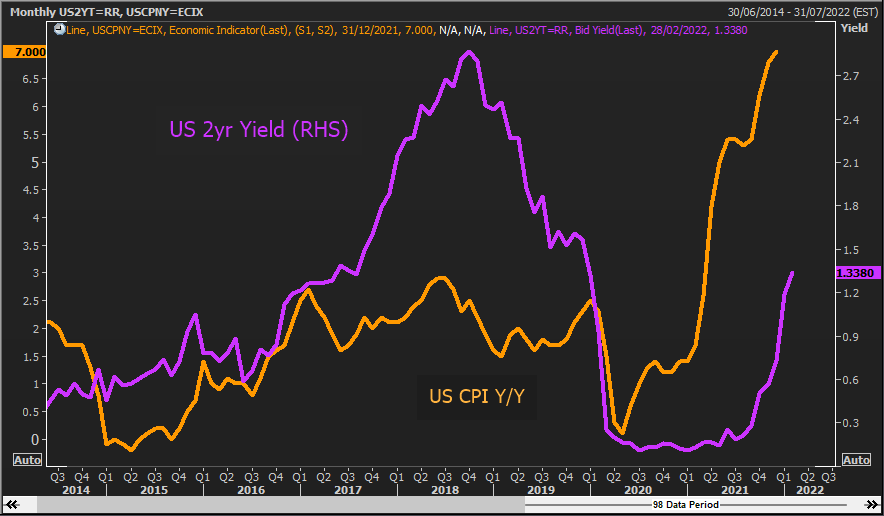
Even a consensus print could put downward pressure on the DXY. Rising inflation has been the dominate theme that has lifted Fed rate hikes expectations, and in turn helped lift the DXY. Interest rate markets imply four to five hikes in 2022, followed by potentially two or three more in 2023. A consensus CPI number or a miss has the potential to cause some of those interest rate expectations to unwind.
Attention could turn to growth
Death of the inflation story could quickly shift the market narrative away from inflation and firmly on growth. The International Monetary Fund’s World Economic Outlook points to US economic activity slowing from 5.7% last year to 4.0% in 2022. Furthermore, more timely indicators like the ISM January manufacturing and non-manufacturing indices show a slower pace of activity in January.
Labour market conditions, on the other hand, have held up as indicated by January’s strong labour market report. That said, the US labour cost index fell to 1%y/y in Q4 last year vs 1.3% y/y in Q3, casting doubts about a wage-price spiral. In addition, labour market participation, especially in certain sectors, remains depressed compared to pre-pandemic levels.
Technicals don’t look bullish
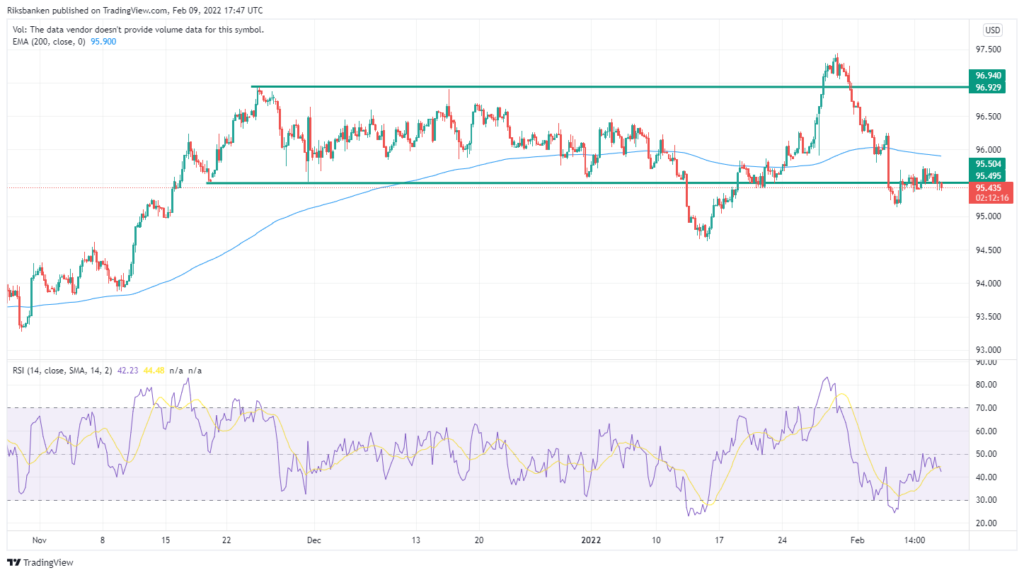
Likewise, the technical picture for the DXY doesn’t exactly exude confidence about the US dollar. After the big surge in the DXY in November 2021, the index failed a sustained break above the 96.940 95.495 range that has more or less held up since the end of December. More recently, the index has tested and been hugging the bottom of that range. RSI and the 200-day exponential moving average, also tell a less than bullish story.
US Dollar Index: Dollar Eyes US Inflation Data
The dollar index edges lower on Wednesday after rebound on better than expected US NFP showed signs of stall.
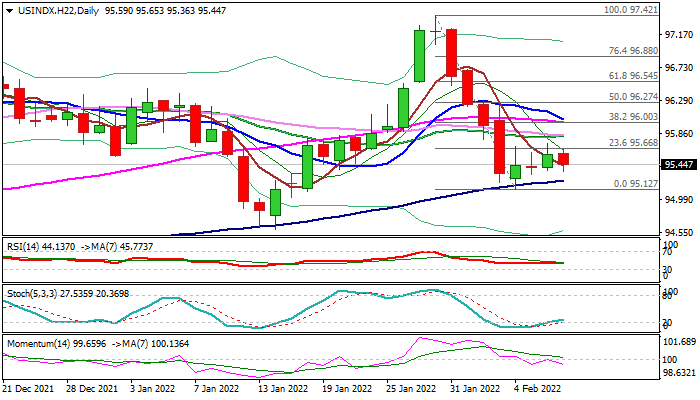
Repeated failure to clear initial Fibo resistance at 95.66 (23.6% of 97.42/95.12 bear-leg) weakened near-term structure, as daily MA’s (10/20/55) remain in negative setup and 14-d momentum stays in the negative territory.
The action, however, remains underpinned by 100DMA (95.24) and the base of thick daily cloud (95.08), but renewed attack at these supports cannot be ruled out.
Violation of these levels would signal an end of limited corrective phase of larger downtrend from 97.42 (2022 high).
Bullish scenario requires firm break of 95.66 Fibo barrier to generate initial bullish signal, which would look for confirmation on extension through 96.00/10 pivots (daily Kijun-sen / cloud top).
The action is likely to stay in a quiet mode ahead of key release of this week – US inflation, which is expected to generate stronger direction signals.
The price pressure is expected to rise further in January as forecasts see annualized inflation rising to 7.3% from 7.0% previous month that would increase pressure on the US central bank which has already penciled a rate hike in March and signaled three-to four further hikes this year.
The greenback may accelerate on inflation data beat as this would signal that Fed’s view of transitory process is no more valid and prompt a stronger action from the central bank.
Res: 95.73; 96.00; 96.10; 96.27
Sup: 95.24; 95.08; 94.87; 94.59