Sample Category Title
Another Elevated US Inflation Reading in the Cards Next Week
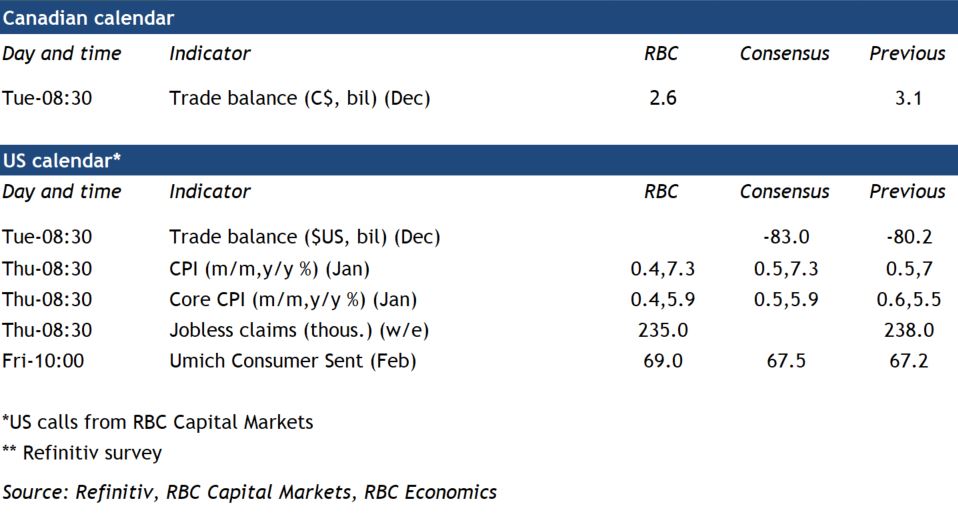
Canada should show a pullback in the merchandise trade balance to a smaller surplus, with both exports and imports ticking lower following a November surge. A drop in oil prices on early concerns about the economic impact of Omicron will lower the value of energy exports, although that will reverse in January as prices bounce back. We expect imports of machinery and equipment to rise after surveys showed many businesses bumping up against current production capacity and planning to invest more in operations.
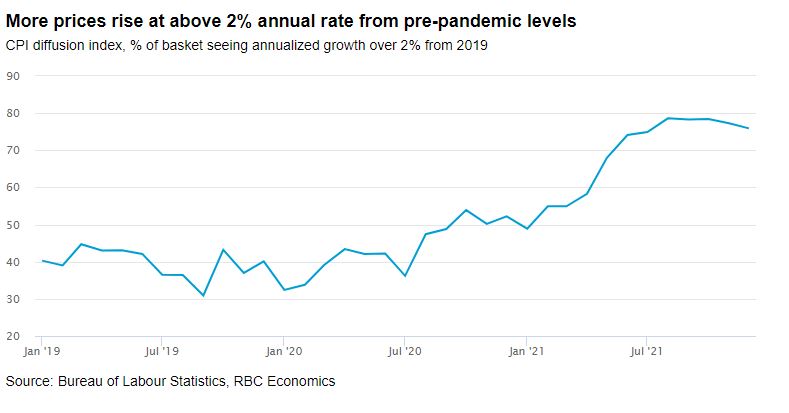
The rapid rebound in the economy—both within Canada and abroad—into late last year has prompted global monetary policymakers to worry that higher inflation rates could last longer than expected. Against that backdrop, the US CPI report will be carefully watched. We look for headline inflation to hold around 7.3% in January, a touch higher than the previous month’s reading—and still running at its highest rate since the early 1980s. Year-over-year price growth is being pushed higher by surging vehicle prices (tied to global supply chain disruptions) and rising shelter costs. A bounce-back in oil prices in January left prices at the pump more than 40% higher than a year ago. But the breadth of price growth has also widened substantially with more than three-quarters of the CPI basket rising at a rate faster than 2% as of December.
Policymakers at the U.S. Fed are unlikely to be surprised by yet another elevated inflation reading. But higher inflation rates alongside increasingly tight labour markets leave little reason to keep interest rates at emergency low levels. The same is true in Canada, even though near-term Omicron disruptions are expected to be more significant. Both the Fed and Bank of Canada are expected to kick off a rate hiking cycles as early as next month.
Week ahead data watch:
- We look for Canada’s Merchandise Trade surplus to narrow from $3.1 billion to $2.6 billion in December as a drop in oil prices weighs on energy exports and as imports of equipment rise on strong business investment intentions. The services trade balance is expected to edge higher with Omicron disrupting Canadian travel plans abroad.
- United States Headline CPI growth is expected mover higher to 7.3% year-over-year in January with ex-food & energy price growth accelerating to 5.9%.
Week Ahead – Plenty More Action to Come
How aggressively will central banks raise rates?
It’s been an incredible couple of weeks in the markets, one in which we’ve seen another hawkish move from multiple central banks, big swings in stocks on the back of earnings, and tensions around Ukraine intensify. The result has been very volatile markets and while the coming week looks a little lighter on event risk, there’s little reason to expect that the markets will suddenly settle down.
Just because central banks including the Fed, ECB, and BoE have already laid the groundwork for a more aggressive tightening this year, many questions remain unanswered and huge uncertainty around the inflation outlook remains. Traders will be paying very close attention to incoming data and comments from policymakers to better understand whether markets are positioned too aggressively, or still not enough.
Russia has obviously been in the headlines for many weeks now as troops have built up on the Ukrainian border and the West has made accusations of a possible impending invasion. While this will remain at the forefront of investors’ minds next week, the central bank will also be meeting later in the week and is expected to raise interest rates again as inflation continues to rise even after a year of tightening.
US
Traders were stunned after the January nonfarm payroll report showed hiring accelerated. Employers added 467,000 jobs last month, almost doubling the highest economist estimate. The December reading was also massively revised higher, which means the Omicron wave did not deliver a temporary disruption to the labor market recovery. Average hourly earnings continued to surge and that will feed into the inflation theme and drive expectations that the Fed will become even more hawkish.
The upcoming inflation data is all that matters and could lead to markets fully pricing in a half-point rate hike for the Fed at the March policy meeting. The January inflation report is expected to be red hot as the omicron wave intensified supply constraints and consumer demand remained strong. Wall Street expects the January inflation rate to rise between 7.0% and 7.6% from a year earlier.
Fed speak will include speeches from Michelle Bowman and Loretta Mester on Wednesday. Fed’s Bowman has not had any comments on monetary policy since October, so investors will pay close attention to see if she still resides with the hawks. Fed’s Mester has already supported a March liftoff and also a shrinking of the balance sheet as fast as possible without roiling markets.
EU
After this week’s handbrake turn from the ECB, focus next week will be on commentary coming from policymakers in regards to how soon we can expect an end of net asset purchases and, more importantly, what that means for interest rates this year. Markets are pricing in around 40-50 basis points of hikes this year after Christine Lagarde’s appearance following the meeting and there’s plenty of room for more if other central banks are anything to go by. German inflation on Friday will also be closely monitored.
UK
We have to wait until the end of the week for the bulk of the data from the UK, with GDP for Q4 headlining the releases. But this will come second next week to appearances from BoE policymakers, with Huw Pill speaking on Wednesday and Governor Andrew Bailey on Thursday. The Bank is clearly split on the pace of tightening if the vote this week (5-4) is anything to go by. Although their views appear more aligned than the MPCs is with the markets, which are pricing in four more hikes this year, despite Bailey’s comments in the press conference after the decision.
Boris Johnson is hanging on by a thread as key aides continue to abandon him and more backbenchers push for a vote of no confidence. The police investigation could be the final nail in the coffin for the Prime Minister.
Russia
Inflation is expected to have risen to 8.8% in January, up from 8.4% in December, and more than double its 4% target. This has happened even as the CBR has raised rates aggressively over the last year from 4.25% last February to 8.5% in December. And they’re expected to keep going on Friday, raising the key rate by another 100 basis points to 9.5%. Unemployment will also be released on Wednesday.
Tensions with the West remain high and the risk of invasion and sanctions are heightened. Escalations have taken their toll on the ruble, with higher oil prices perhaps easing the pain recently. With the West warning of Russian plans to stage a fake attack on Russian territory or Russian-speaking people in Eastern Ukraine in order to justify an invasion, it seems the situation could boil over at any minute.
South Africa
A couple of notable data points next week including mining and manufacturing production on Thursday.
Turkey
Inflation hit 48.7% in January, as reported by the Turkish Statistical Institute this week, which has been accused of falsifying the data to appease President Erdogan, with some claiming real inflation is much higher. Erdogan sacked the head of the institute days before the release, which has only further fueled claims that the data is unreliable. This begs the question if 48.7% is the falsified number, how high is the actual rate?
New Treasury and Finance Minister Nureddin Nebati claimed this week that he doesn’t think inflation will hit 50% this year and will peak in April, adding he hopes he’s not wrong. When below 50% is the best possible, and potentially unreliable, scenario, you know there’s a problem. He also reiterated that there is no turning back from this policy.
China
Chinese banks are expected to record an upswing in credit lending, after the People’s Bank of China cut its one-year loan prime rate twice in January, to 3.7%. The lending spurt should help reinvigorate the economy, which has slowed down to China’s zero-Covid policy.
Despite the Covid pandemic and the real estate crisis, the future looks bright for the economy. Eurostat reported last week that China’s GDP surpassed the entire EU for the first time in 2021.
India
The Reserve Bank of India holds a rate meeting on Wednesday. The RBI is expected to maintain the key lending rate at 4.0%, while potentially raising the reverse repo rate.
Australia
Australia releases NAB Business Confidence for January on Monday. In December, the index slid 24 points to -12, as the Omicron wave took a toll on business sentiment.
On Tuesday, Westpac Consumer Confidence for February will be released. The index has posted back-to-back declines, indicating pessimism among consumers.
The Melbourne Institute Consumer Inflation Expectations for February will be published on Thursday. The index slowed to 4.4% in January, down from 4.8% prior. Still, this is well above the RBA target band of 2%-3%. The release will be closely watched as inflation expectations can manifest into real inflation.
New Zealand
New Zealand 2-yr Inflation Expectations for Q1 will be released on Tuesday. Inflation continues to rise in New Zealand, and the index rose to 2.96% q/q in 2021 Q4, up from 2.3% previously. A higher reading in Q1 would support expectations of a rate hike when the RBNZ meets on February 23rd.
The manufacturing sector continues to expand but has been hampered by disruptions to supply and production chains. BusinessNZ Manufacturing PMI will be released on Thursday.
Japan
Japan is seeing an upswing in inflationary pressures, although to a lesser extent than in the US and UK. The rise in food and gas prices has dampened consumer spending, a key driver of the economy. In November, Household Spending came in at -1.3%. The consensus for the December release, which will be released on Monday, stands at a flat 0.0%.
Thailand
The Bank of Thailand holds a policy meeting on Wednesday. The central bank highlighted Omicron as a major risk when it held rates at the December meeting and is expected to maintain rates at 0.50%.
Economic Calendar
Saturday, Feb. 5
- EU-US Energy Council: EU foreign policy chief Borrell speak with Secretary of State Blinken
Sunday, Feb. 6
- Queen Elizabeth II celebrates platinum jubilee
Monday, Feb. 7
- Lunar New Year break ends, Mainland Chinese markets reopen
- Germany’s Scholz meets Biden in Washington
- Informal meeting of EU agriculture ministers in Strasbourg
Economic Data/Events
- China Caixin services PMI, forex reserves
- Germany Industrial production
- South Africa gross and net reserves
- Switzerland Foreign currency
- Sweden Budget balance
- Turkey Budget balance
- Russian Official reserves
- Switzerland unemployment, sight deposits
Tuesday, Feb. 8
- Norway Energy ministry update on petroleum activity
- Bank of France Governor Villeroy speaks at French National Assembly’s Finance Committee
Economic Data/Events
- US Trade
- Poland rate decision: Expected to raise Base Rate by 50bps to 2.75%
- Sweden Industrial production
- France Trade
- Japan household spending
- Italy retail sales
Wednesday, Feb. 9
- Fed President Mester speaks at European Economics and Financial Centre event
- BoE Chief Economist Pill speaks at the Society of Professional Economists’ annual conference on “U.K. Monetary Policy Outlook.”
- EU foreign and health ministers meet in Lyon, France with an aim of developing the bloc’s health policy
- Sweden scraps its Covid restrictions, citing a higher vaccination rate and a manageable situation in hospitals
Economic Data/Events
- US wholesale inventories
- India Central Bank (RBI) Interest Rate Decision: Expected to raise Reverse Repo Rate by 40 bps to 3.75%
- Thailand Central Bank (BOT) Interest Rate Decision: Expected to keep interest rate unchanged at 0.50%
- BOC Gov Macklem speaks to Canadian Chamber of Commerce
- Fed’s Mester speaks at European Economics and Financial Centre event
- BoE Chief Economist Pill speaks at the Society of Professional Economists’ annual conference on “U.K. Monetary Policy Outlook.”
- EU foreign and health ministers meet in France to discuss the bloc’s health policy.
- Sweden reopens and scraps its Covid restrictions
- Mexico CPI
- Russia CPI
- Australia consumer confidence
- South Africa business confidence
- Germany Trade
- Italy industrial production
- Japan M2 money stock
- Mexico international reserves
- Russia unemployment, retail sales, real wages
- EIA Crude Oil Inventory Report
Thursday, Feb. 10
Economic Data/Events
- US CPI, initial jobless claims
- Mexico Rate decisions: Expected to raise overnight rate 50bps to 6.00%
- Sweden Rate decisions: Expected to keep interest rates unchanged at 0.00%
- Hungary one-week deposit rate
- European Commission publishes updated economic forecasts.
- BOE Gov Bailey speaks at The CityUK annual dinner
- National Bank of Poland releases minutes of the rate decision
- South Africa’s Ramaphosa delivers state of the nation address
- Japan PPI
- South Africa manufacturing production
- South Africa manufacturing, mining, gold, and platinum production
- Turkey Unemployment
- Russia gold and forex reserves
- UK RICS house price balance
Friday, Feb. 11
Economic Data/Events
- US University of Michigan consumer sentiment
- Germany CPI
- Hungary CPI
- Switzerland CPI
- Russia Rate Decisions: Expected to raise key rate 100bps to 9.50%
- UK GDP, industrial production, trade
- India industrial production
- Mexico industrial production
- Turkey industrial production
- Russia trade
- New Zealand PMI
- Turkey current account, industrial productions, expected inflation
Sovereign Rating Updates
- Turkey(Fitch)
- Hungary (S&P)
- Switzerland (S&P)
- Denmark (Moody’s)
- Germany(Moody’s)
- Belgium (DBRS)
Week Ahead – US Inflation in the Spotlight Again, UK GDP Eyed Too
The skidding US dollar will be looking to the January inflation readings out of the United States to reverse its decline as financial markets enter a somewhat quieter week. UK GDP growth numbers will be the other highlight as the pound’s rally lost steam after the Bank of England sent some mixed signals on the economy. The kiwi might find some love should the RBNZ’s own survey show inflation expectations are creeping higher in New Zealand. However, with earnings releases also slowing down, markets might nevertheless struggle to find fresh direction in the coming days.
Waiting for inflation to peak
It will likely be another grim picture on the inflation front next week as the US consumer price index is expected to edge up to yet another multi-decade high on Thursday. The 12-month rate in CPI is forecast to have risen by 7.2% in January, climbing 0.2 percentage points from the prior month. There might be some relief from the month-on-month rate, which is expected to have risen at the slowest pace in four months, by 0.4%. However, the core rate will likely raise eyebrows as it’s set to jump from 5.5% to 5.9% year-on-year.
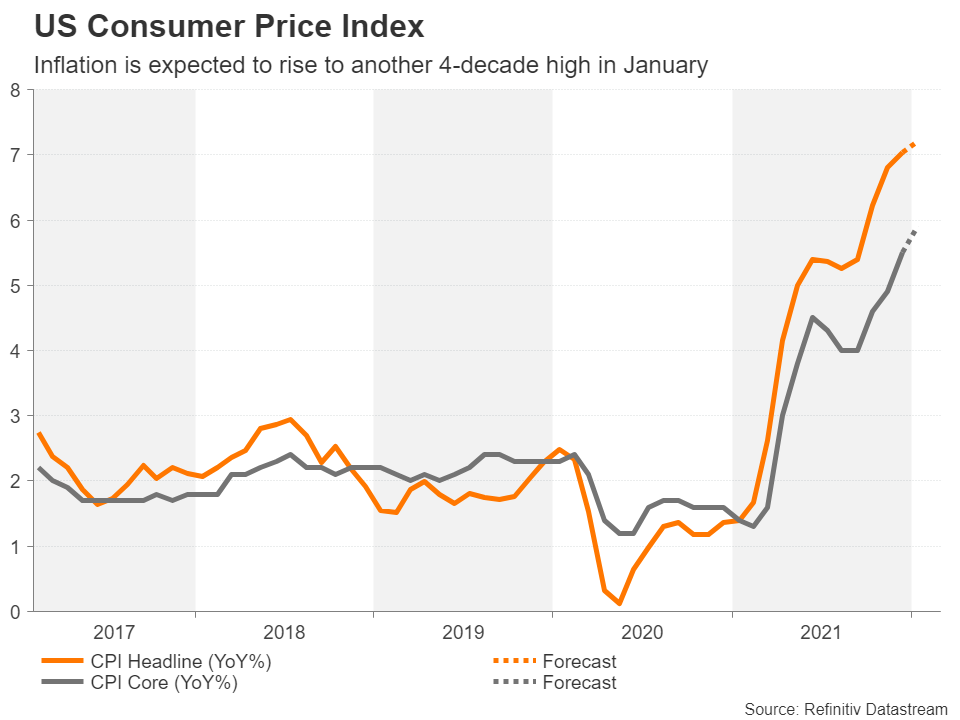
The next few months will be crucial in determining whether inflation has started to peak so investors will be scouring over the details of the report to find any signs that price pressures in the CPI components most affected by the pandemic and the related supply disruptions are starting to ease.
Weaker-than-expected readings in either the headline or core rates would raise hopes that inflation is plateauing. This would be good news for shares on Wall Street but not so much for the dollar as Treasury yields could tumble if investors begin to price out some of the more excessive rate hikes bets for the Fed.
The dollar index slid sharply from the 18-month high it hit only a week ago after Fed policymakers calmed fears that a 50-basis-points rate hike was on the menu in March. However, should the inflation numbers surprise on the upside again, that would add wind to the dollar’s sails.
In other data out of the US, the University of Michigan’s preliminary consumer sentiment gauge will be watched on Friday.
Energised euro might shine even in quiet week
The euro shot higher after the European Central Bank signalled it may have to pull back the pandemic-era stimulus at a much faster pace than currently indicated, opening the door to a rate increase in 2022, amid the worsening threat of higher inflation.
Eurozone government bond yields surged in the aftermath of the meeting as the prospect of a rate hike later this year draws closer. The euro will likely have to rely on this rally enduring in the coming days if it is to stretch its gains as there’s not a lot on the European calendar of interest apart from some German stats.
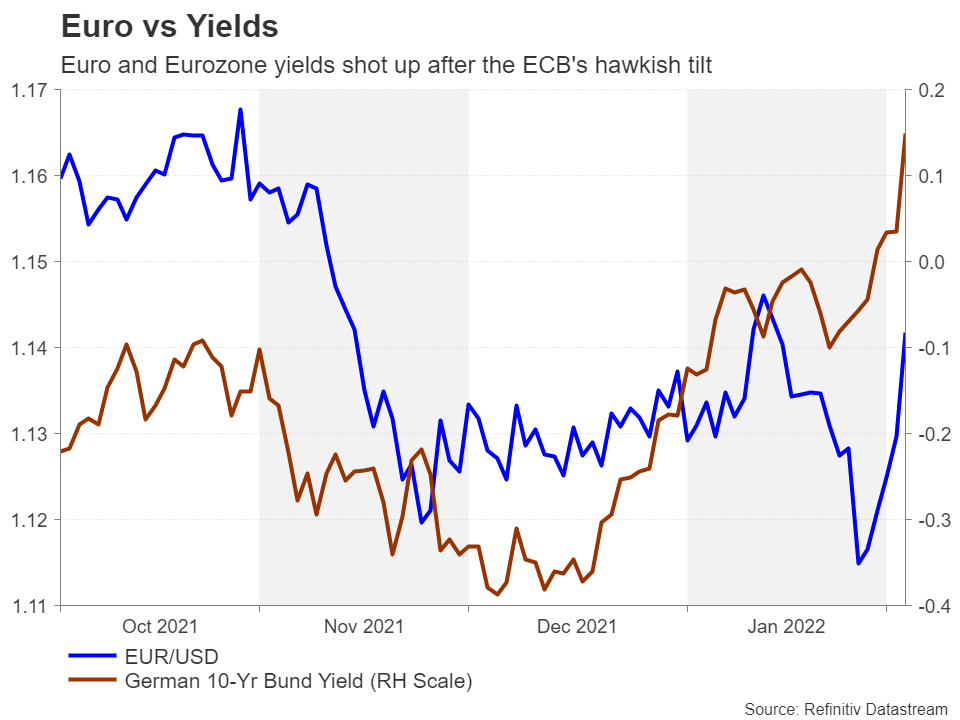
German industrial output for December is out on Monday and will be followed by trade figures on Wednesday and the final January CPI print on Friday. Germany’s recovery has stumbled lately and is now lagging those of some other Eurozone countries, so any positive surprises could assist the euro’s latest upwards march.
Outside of the euro area, Sweden’s Riksbank meets on Thursday and might follow in the ECB’s footsteps in sounding more hawkish.
Pound turns to GDP data after BoE confuses markets
The Bank of England maintained its advantage over other major central banks in being the least behind the curve on inflation by hiking rates for the second meeting in a row in February. However, despite the overall hawkish backdrop of the meeting, Governor Andrew Bailey pointed out some downside risks to their upwardly revised inflation forecasts, casting uncertainty over the rate outlook even as he flagged more rate hikes in upcoming meetings.
So although sterling remains well supported after the BoE meeting, it may need a fresh upside driver to sustain its rebound against the greenback. It’s doubtful if next week’s quarterly GDP publication can act as that driver.
Data on Friday will likely reveal that the UK economy recouped all its lost output from the pandemic in the three months to December. GDP is projected to have expanded by 1.1% quarter-on-quarter, the same pace as in Q3.
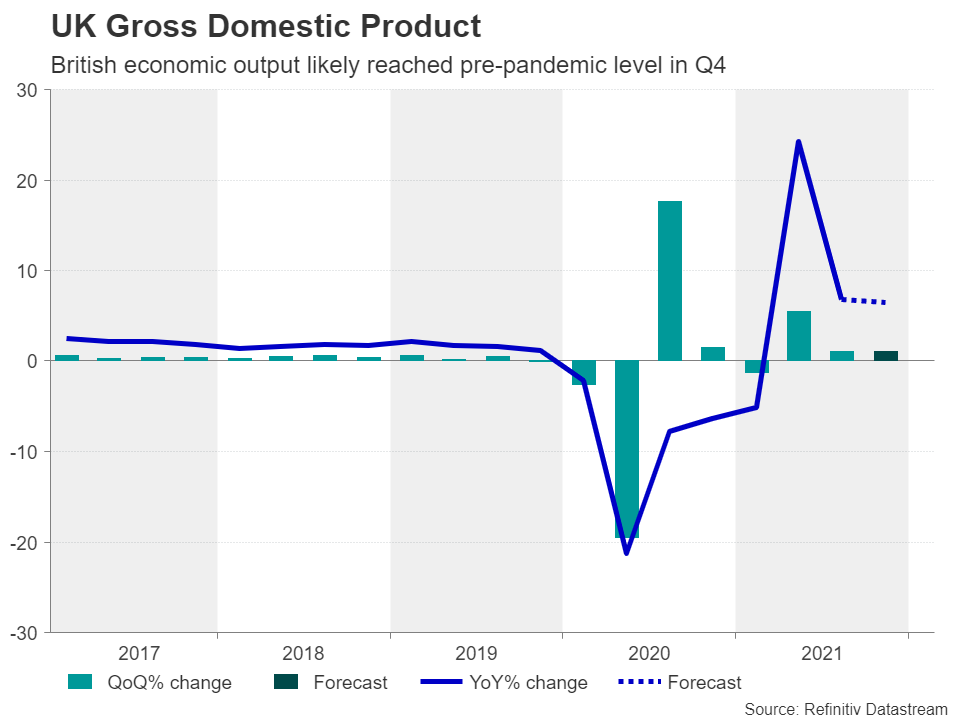
Separate numbers for December will be available too, including for industrial production and the trade balance. These could attract more attention if they show a bigger-than-anticipated impact from the Omicron wave on the economy. With the Bank of England decision out of the way, the degree to which growth faltered in December and January and how quickly it picks up going forward will probably be of more significance for traders.
Hence, reaction to the data might be limited even if there’s an impressive beat in the headline GDP figure.
Kiwi looks to RBNZ survey as bounceback gathers steam
The Reserve Bank of New Zealand doesn’t meet until February 23, but markets might get a clue as to what to expect from its quarterly survey on inflation expectations on Friday. The RBNZ’s measures of price expectations has been a good guide on the central bank’s next move in the past and could be again if expectations for one- and two-year inflation jump sharply like they did in the previous two surveys.
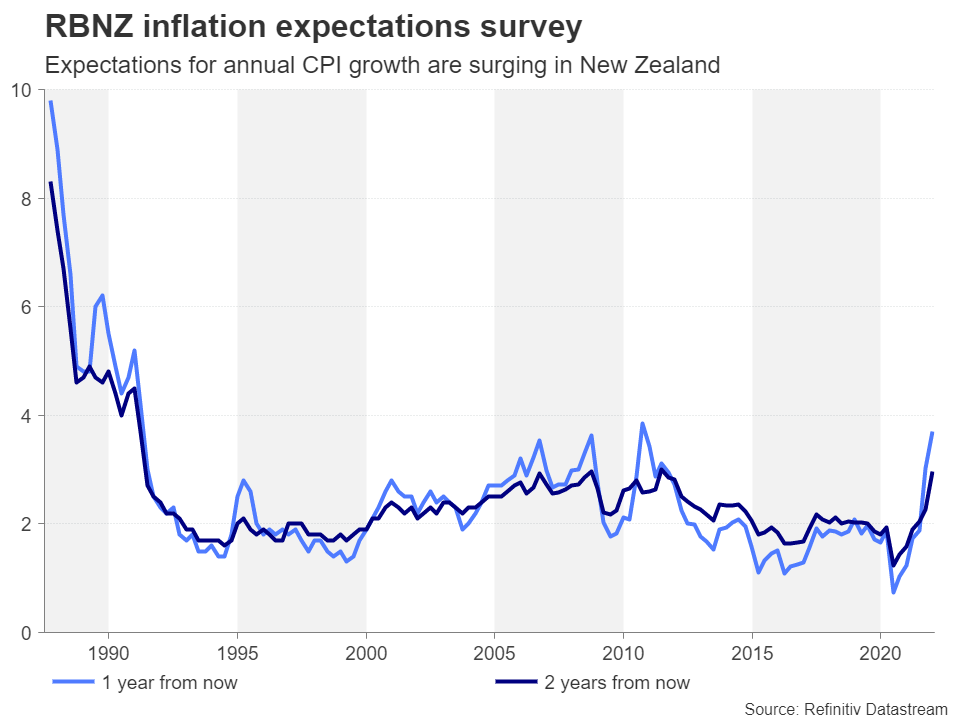
A rate hike is almost certain at the February meeting, but policymakers might have trouble with the very steep rate hike path futures markets have priced in. If inflation expectations climb further, that would create less room for disappointment and support the New Zealand dollar’s grind higher.
In neighbouring Australia, the aussie dollar will likely be taking its cues from the broader market risk tone as the only major release is the final retail sales estimate for December as well as for the whole December quarter.
A further improvement in risk sentiment next week could inflict more damage on the Japanese yen, which is paring some of its January gains. However, household spending numbers for Japan on Tuesday and corporate goods prices on Thursday are unlikely to provide much of a boost.
Weekly Focus – ECB Repricing is the Name of the Game, Expect a Hike in December
German yields rose and EUR gained three figures against the USD this week to 1.14, as markets priced in an increasingly hawkish ECB. After the ECB Governing Council meeting on Thursday, we changed our call and now expect the ECB to hike rates in December 2022, and again in March 2023 (See ECB Review: New call - ECB to hike in Dec22 and Mar23, 3 February). Based on Lagarde's comments on the press conference, the ECB GC is more and more concerned about inflation, while seeing growth risks broadly balanced. In several occasions, Lagarde had the opportunity to close the door for a rate hike in 2022 but she intentionally left it open. Same time, Lagarde confirmed 'sequencing' indicating that the ECB would only hike rates after ending its net asset purchases (APP). Hence, we still see the current market pricing as too aggressive, as the ECB would have to accelerate the pace of taper in order to be able to hike in September, let alone in the summer.
Tighter financial conditions will be a key market driver in 2022. After last week's FOMC meeting, we changed our Fed call and now expect five hikes (a total of 125bp) this year and QT in June. The risks are tilted towards more aggressive tightening, and we think that compared to 2015, the Fed is 'behind the curve' this time around (See Fed Update: - Different economy, different hiking cycle - a comparison with December 2015, 3 February).
Tighter financial conditions will make life harder for indebted sovereigns, businesses and individuals, and may exacerbate regional divergence in growth and recovery. While developed economies have broadly recovered back to pre-pandemic levels, insufficient vaccine rollout, slow recovery in international tourism and limited fiscal space remain a drag on EM growth. Tighter financial conditions through wider credit spreads and stronger USD will make the external financing environment for EM substantially more challenging at a time when overall debt levels are at historical highs and borrowing needs remain elevated. In Europe, the focus remains on Turkey, where another staggering inflation print was recorded this week (48.7% in January). In the context of looming Fed rate hikes, with an extremely low and negative real interest rate and weak buffers, the Turkish economy remains one of the most vulnerable ones in the EM universe.
Repricing of expected ECB action was the name of the game this week. The curve flattened with a 25bp rise in 2y and a 15bp rise in 10y Bund yields. The futures markets are pricing in the first ECB hike as soon as in July, which we see premature. ECB repricing was the key driver for a higher EUR/USD this week but we think next week's US inflation print (Thursday) could again turn the attention back to the US. We continue to see EUR as overvalued vs. fundamentals, and maintain our forecast for EUR/USD at 1.08 in 12M.
Next week's data calendar is pretty light. If the US inflation print surprises on the upside, we think a 50bp hike by the Fed in March is possible. We will also keep a close eye on any comments from FOMC and ECB policymakers, although there are not many speeches in the calendar. China is back from the New Year's celebrations and a key thing to watch will be whether there's a pickup in new COVID-19 cases after increased travelling. Also, any headlines on the Russia-Ukraine standoff will be watched closely.
Sunset Market Commentary
Markets
This morning, US and European interest rate markets continued yesterday’s ‘unusual’ disconnect. European markets still reacted to yesterday’s ‘implicit’ U-turn of Chair Lagarde. She backtracked on the ‘temporary inflation’ narrative and didn’t repeat the mantra of no ECB rate hikes in 2022. The era of negative EMU interest rates is coming to an end. Money markets are embracing the idea that the ECB might raise its policy rate out of negative territory by the end of this year. US interest rates initially declined (albeit marginally) on rumours that omicron could cause a blip in the labour market recovery. However, it didn’t. On the contrary. According to the monthly BLS payrolls data, the US economy in January added 467 000 jobs, much more than the 125 000 expected . Any presumed softness at the end of last year was also overthrown by an impressive 709k upward revision. Wage growth (average hourly earnings) accelerated at an impressive 0.7% M/M (5.7% Y/Y). Even the rise in the unemployment rate (calculated from a different source/household survey) to 4.1% from 4.0% should be considered as good news as it was the result a higher participation rate. Admittedly, the interpretation of this data series was difficult due to statistical adjustments. Whatever, the overall picture only confirmed Chair Powell’s upbeat assessment on the labour market at the Fed press conference last week. US yields switched an initial cautious decline for yet another impressive jump higher, the short end still taking the lead. The curve bear flattens with the 2-y/5-y sector rising 10/9 bps and the 30-y +5.5 bps. The 2-y is again setting a new cycle peak (1.30%). The 10-y is testing the 1.90% top! German yields, were 4.5/2.5 bps higher before the payrolls and extended their post-ECB follow-through rise. Yields are rising 6 bps for the 2-y, 7 bps for the 5-y and 5 bps for the 10-y. Curve flattening at the very long end keeps the 30-y little changed. The prospect of higher core EMU yields and the ECB expected to halt net asset purchases (APP) sooner than expected also hurts peripheral EMU bonds. 10-y year yields spreads versus Germany of Greece, Italy and Spain widen a further 12 bps, 5 bps and 3 bps respectively. European equities are losing up to 1-1.5% after yesterday’s WS losses. US indices show remarkable resilience (modest gains of 0.25%/0.50%) given the wild swings on interest rate markets.
The euro extended yesterday’s post-ECB gains this morning, with EUR/USD attacking the 1.1483 top. The payrolls prevented a break at this stage. At 1.1440, however, the euro is holding yesterday’s gain, which should be a promising sign for euro bulls. At the same time, the dollar extends gains against most other majors with DXY rebounding to the 96.60 area. The Swiss franc is ceding further ground (1.0560). Sterling is losing further ground against the euro (EUR/GBP 0.8450) and the dollar (cable 1.3530). In CE the forint and the Czech koruna are holding strong. The zloty underperforms.
News Headlines
Canadian payrolls showed that 200.1k jobs went bust in January. Markets expected a smaller setback (-110k). Details showed both full time (-82.7k) and part time (-117.4) jobs decreasing. The number of people who were employed but worked less than half their usual hours rose by 620k (+66.1%) in January, the largest increase since March 2020. The unemployment rate ticked up from 6% to 6.5% (first increase since April) with the labour force participation rate falling from 65.4% to 65%. Hourly wages rose by 2.4% Y/Y, down from 2.7% Y/Y in December. The Omicron-outbreak is to blame for the weak payrolls report as many jurisdictions implemented stricter public health measures. Accommodation and food services was the hardest-hit industry. USD/CAD gained a big figure from 1.2675 to 1.2775 and approaches the 2022 high (1.2814). The move is both inspired by USD-strength (post US payrolls) and CAD-weakness. The temporary labour market setback won’t interfere with the Bank of Canada’s intentions to start its tightening cycle in March.
Positive Surprise from NFP Supports Dollar, Trouble for Equities
A positive surprise on US employment. The official BLS report showed a jobs increase of 467K, markedly better than the expected 110-165K. Moreover, the previous data was seriously revised upwards and now reports employment growth of 510K in December compared to the initially reported 199K.
Average hourly earnings rose by 0.7% m/m and 5.7% y/y, showing further acceleration and increasing signs that the inflation genie is out of the bottle.
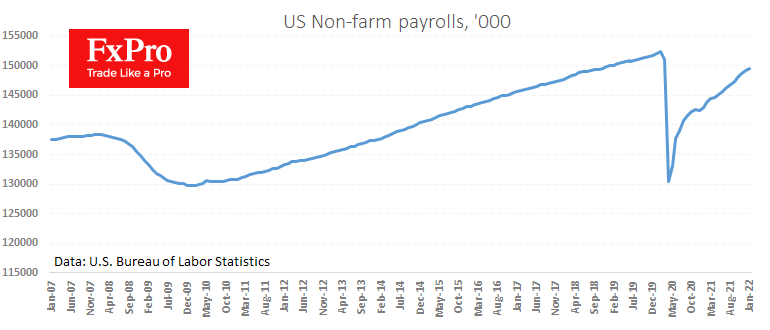
As a result, markets are intensifying their expectations for policy tightening, laying a 34% chance of an immediate 50-point rate hike in March versus 18% before the release.
The strong labour market and the mood for decisive rate hikes also support the dollar, which adds 0.4% after the release. This is likely that the USD growth impulse is far from the end, and dollar growth will continue in the coming days or even weeks.
US: Payrolls Make Strong Gains January, Despite Omicron
The U.S. economy gained an impressive 467k jobs in January, well above market expectations. January's report also included the annual benchmark revisions to the payrolls numbers, and was a result the monthly gains in employment in November and December were revised up materially (+709k). Overall, payrolls remained 1.9% below their pre-pandemic level.
The unemployment rate rose a tick to 4.0% in January. The household survey data reflected updated population estimates. Removing the effects of the population controls, employment fell 272k. The number of people on temporary layoff rose 147k, the largest increase since December 2020, likely reflecting Omicron-related furloughs. The labor force participation rate is now at 62.2%, below the 63.4% pre-pandemic
Looking at shifts by industry, employment rose in leisure and hospitality (+151k), professional and business services (+86k), retail (+61k) and transportation and warehousing (+54k). All of these sectors, except leisure and hospitality, now have employment levels above their pre-pandemic highs.
Average hourly earnings were up 5.7% from a year ago in January, which was likely biased upwards by lower average hours.
The impact of Omicron can be seen in reduced hours worked. The index of aggregate weekly hours was down 0.3% month/month, the first monthly decline since last February.
Key Implications
Payrolls defied expectations in January, posting a solid month of increase. The impact of Omicron on the jobs market was more evident in the household survey, where the unemployment rate edged higher. The survey reference period is shorter for the household survey than for payrolls, so the bar for being counted as unemployed for a short work absence is lower.
That said, we expect the impact of Omicron wave to be nasty, brutish and short. Hospitalizations across many regions are already coming down, and by March, Americans will likely be resuming many of the close contact activities they put on hold. We expect the disruption to output to be greater than employment, but it will also bounce back strongly in the second quarter. Several Fed officials have already indicated they would look through any Omicron related disruptions. There is nothing in today's report to dissuade the FOMC from taking rates higher in March.
Canada’s Economy Sheds Jobs in January
The Canadian labour market lost 200k positions in January, worse than the consensus call for a loss of 120k positions. Full-time (-83k) and part-time (-117k) employment fell on the month.
Even with the labour force participation rate dropping 0.4 percentage points, to 65%, job losses pushed the unemployment rate 0.5 percentage points higher to 6.5% in January.
By industry, services-producing employment fell 223k, with food services leading the way, down 113k. Meanwhile, employment increased in the goods-producing sector (+23k), with the construction industry (+23k) once again driving the gains.
By province, employment was down mostly in Ontario (-146k) and Quebec (-63k), the two provinces most directly impacted by public health restrictions.
Lastly, total hours worked fell 2.2% month-on-month, ending the streak of advances that started in July 2021.
Key Implications
This was sure to be a negative report. The Omicron wave and associated lockdowns forced many businesses to adjust on the fly. They did this by cutting jobs and hours significantly. Notably, all of the increase in unemployment was due to more people on temporary lay-off or scheduled to start a job in the near future, suggesting the setback will be short lived.
With reopening already underway, we expect a big bounce back when the February data are released next month. Canadian businesses and workers have been incredibly resilient through all the stops and starts over the last two years. This wave should be no exception.
The Bank of Canada should be confident that employment will rebound swiftly and will still execute on its first rate hike in March. Market pricing hasn't budged off this and Canadian bond yields are up this morning.
EUR/USD Mid-Day Outlook
Daily Pivots: (S1) 1.1322; (P) 1.1386; (R1) 1.1505; More...
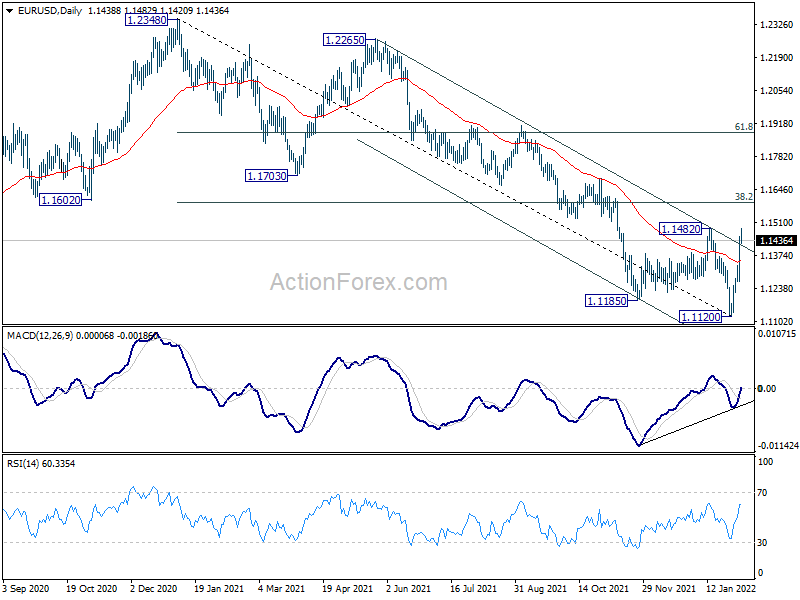
No change in EUR/USD's outlook and intraday bias stays on the upside. Considering bullish convergence condition in daily MACD, a medium term bottom could be in place already. Break of 1.1482 will affirm this case and target 38.2% retracement of 1.2348 to 1.1120 at 1.1589 next. On the downside however, break of 1.1329 minor support will mix up the outlook and turn intraday bias neutral first.
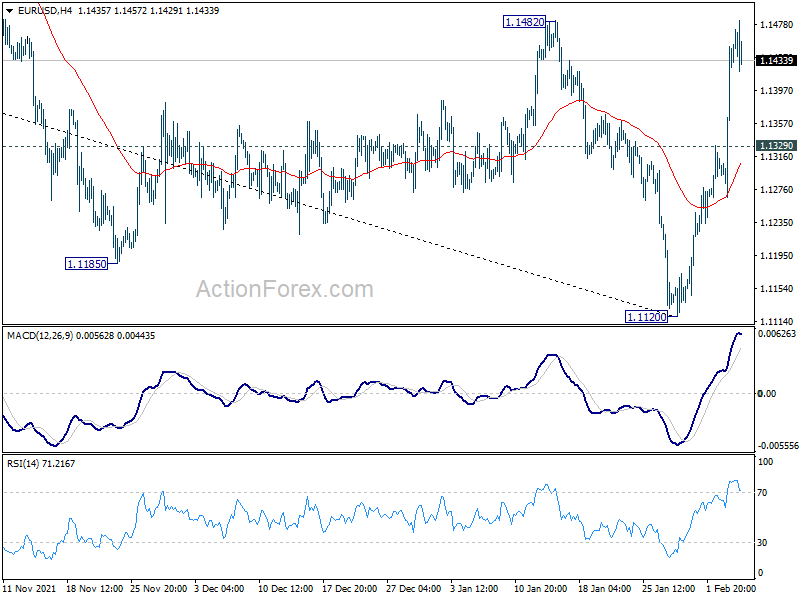
In the bigger picture, the strength of the the decline from 1.2348 (2021 high) suggests that it's not a corrective move. But still, it could be the fourth leg of a sideway pattern from 1.0339 (2017 low), or resuming long term down trend. In any case, outlook will now stay bearish as long as 1.1482 resistance holds. Next target would be 1.0635 low. However, firm break of 1.1482 will raise the chance that whole fall from 1.2348 has completed, and turn focus back to 1.1703 resistance for confirmation.
USD/CHF Mid-Day Outlook
Daily Pivots: (S1) 0.9175; (P) 0.9206; (R1) 0.9234; More....
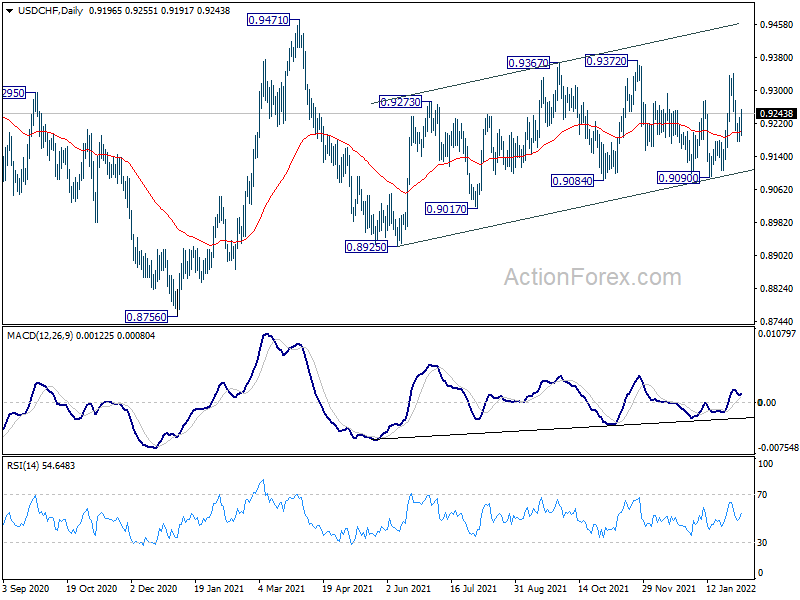
Intraday bias is back on the upside in USD/CHF with break of 0.9250. Further rise would be seen back to 0.9341 resistance first. Break will target 0.9372. On the downside, below 0.9176 will resume the fall form 0.9341 to 0.9090 support. Firm break there will argue that choppy rise from 0.8925 has completed, and turn near term outlook bearish.
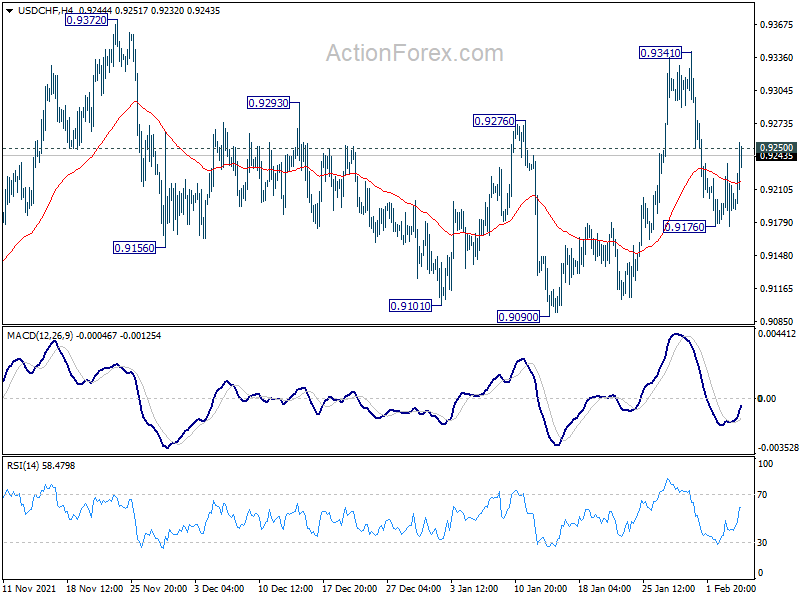
In the bigger picture, medium term outlook will be neutral at best as long as 0.9471 resistance holds. Larger down trend could still extend through 0.8756 (2021 low). However, firm break of 0.9471 will argue that the trend has already reversed and rebound the rally from 0.8756 with another impulsive move.