Sample Category Title
Canada Reports Jobs Data, What’s the FX Outlook?
The latest batch of Canadian employment data will hit the markets at 13:30 GMT Friday. It seems that the Omicron wave hit the labor market in January, with forecasts pointing to a loss in jobs. That said, this is probably a temporary setback. The loonie has been driven mostly by risk sentiment in stock markets lately, but over time, it could realign itself with Canada’s strong fundamentals and soaring oil prices.
Solid economy
The Bank of Canada hesitated to raise interest rates last week, disappointing market expectations. Policymakers highlighted the risks posed by the Omicron variant, which will likely hold back economic activity for a few months because of the restrictions across the country.
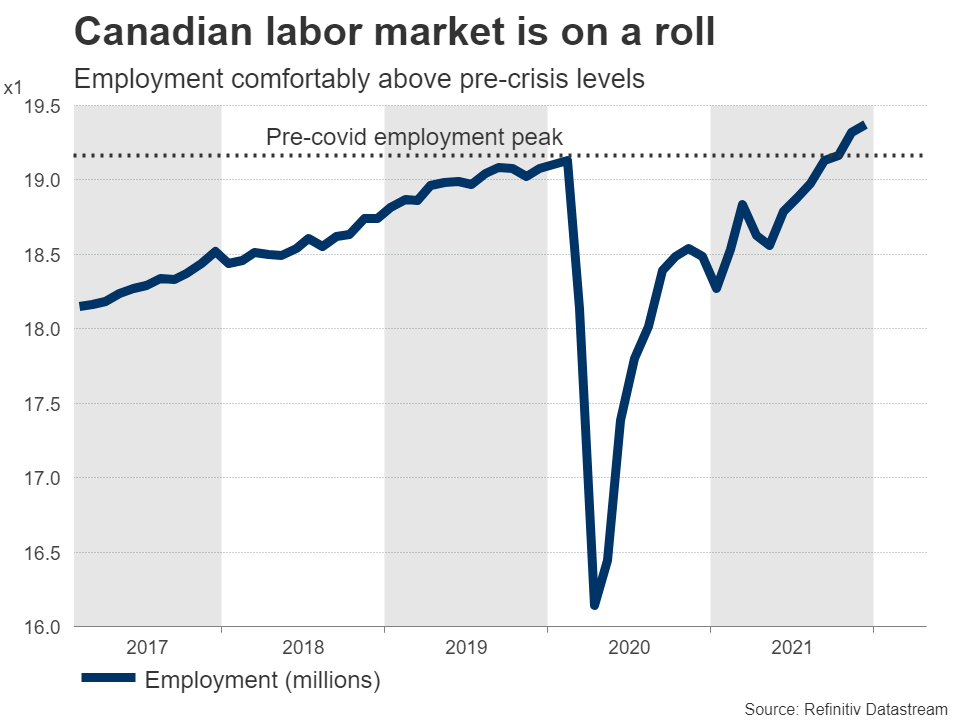
But the commentary around the economy was very cheerful. They noted that inflation is scorching hot, businesses are optimistic, the housing market is booming, oil prices are elevated, and economic growth has been surprisingly strong. Most importantly, the labor market has tightened significantly, pushing wages higher.
In other words, even though the central bank didn’t raise interest rates, it essentially signaled that it will do so several times this year. Money markets are currently pricing in a rate hike at almost every meeting for the rest of the year - a testament to the strength of the economy.
Soft report
Turning to the upcoming data, forecasts suggest that the economy lost 117k jobs in January amid business closures driven by covid restrictions and adverse weather conditions. That would push the unemployment rate higher by three ticks to reach 6.2%.
While this would clearly be bad news, it wouldn’t be a disaster either. Some damage to the jobs market was inevitable with the restrictions in many provinces, but those are already being relaxed. Hence, it may prove to be only a temporary setback for the economy, similar to previous covid waves.
Bear in mind that America’s jobs report will be released at the same time as Canada’s, so the reaction in dollar/loonie will depend on both datasets.
Taking a technical look at the pair, initial support to declines may be found near the 1.2620 zone.
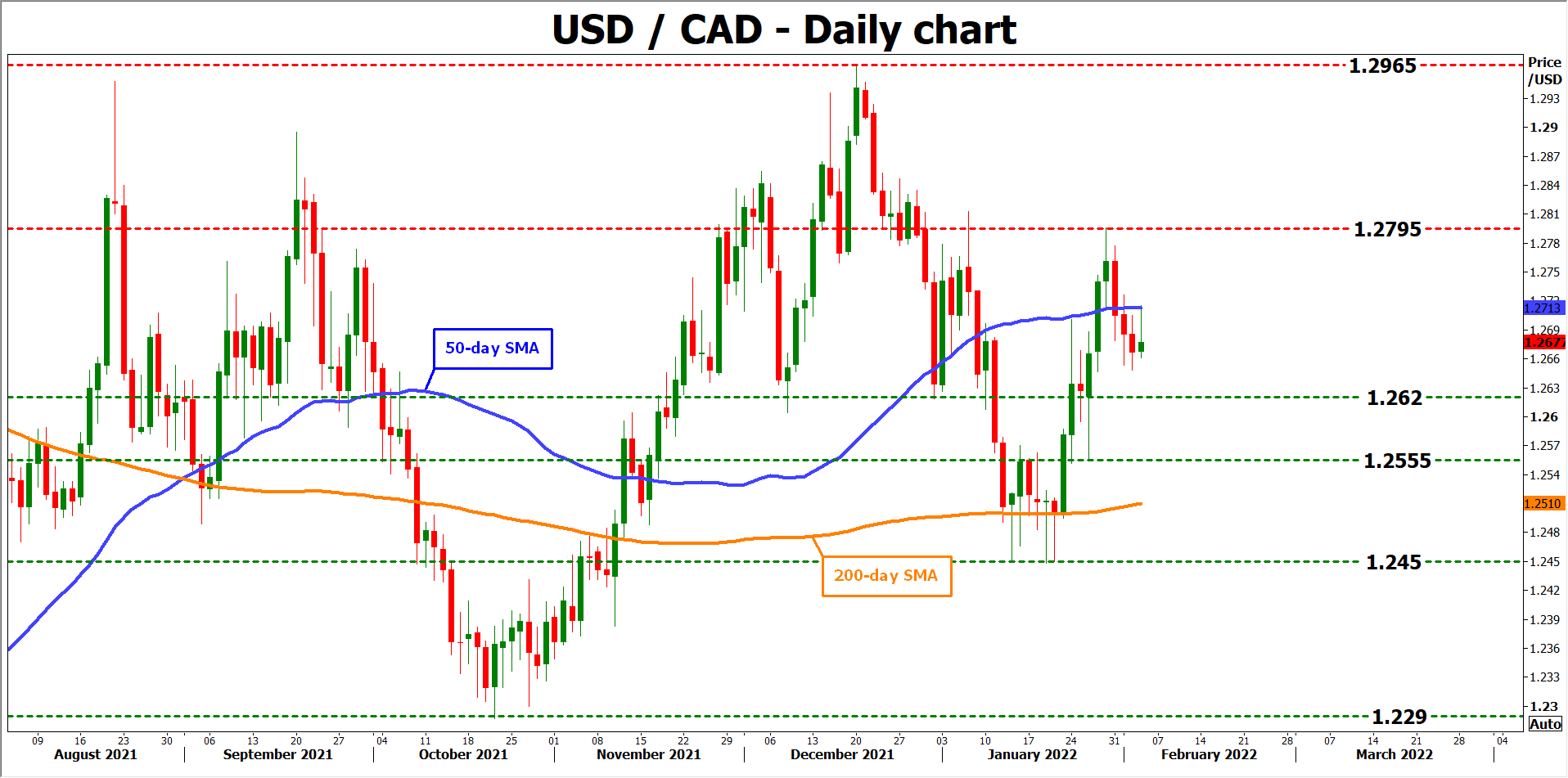
On the upside, the first barrier for the bulls may be the latest high at 1.2795.
Loonie decouples from oil
In the FX market, the Canadian dollar has been trading mostly as a function of risk sentiment in recent weeks, rising and falling with stock markets. This is natural considering that Canada is a major exporting economy and is therefore vulnerable to shifts in the global environment.
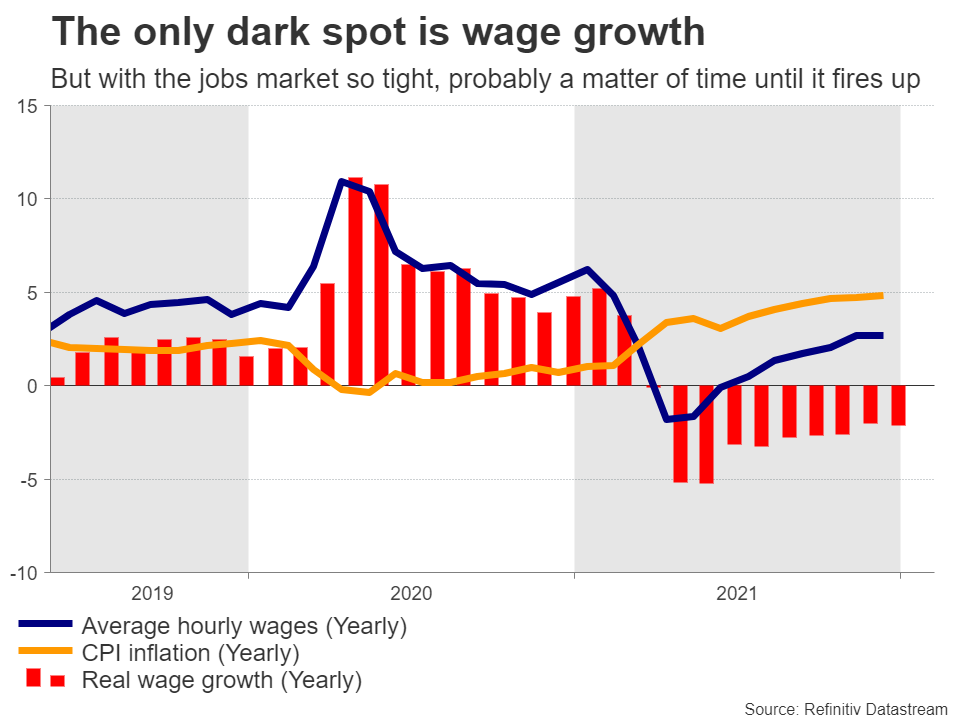
That said, the economy’s fundamentals are robust. The only ‘dark spot’ is wage growth, which remains relatively slow, but given how strong the labor market is, it is probably only a matter of time until it fires up. Additionally, oil prices are very elevated, which is good news for Canada’s massive oil industry and overall economic growth.
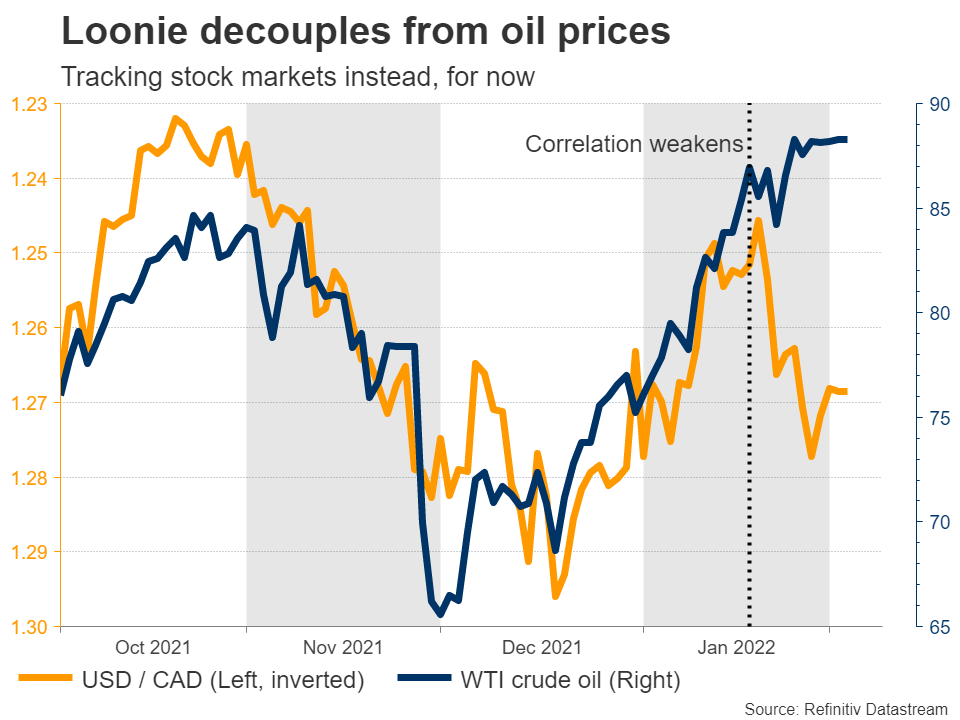
Adding everything up, the outlook for the loonie remains constructive. While the currency could remain in the hands of risk appetite for now as fears over central bank tightening hit equity markets, over time, it could realign itself with the strong underlying economy and energy prices.
Geopolitical tensions are another variable to consider, but luckily for the bulls, an escalation in Ukraine might not hurt the loonie as much as other risky assets thanks to the potential bullish impact on oil prices. Instead, the real risk for the loonie would be a deal between America and Iran that boosts global oil supply.
Stocks Slide Amid Weak Earnings and More Tightening
European stock markets are coming under pressure on Thursday, with the moves being exacerbated by the realisation that rate hikes may come earlier and faster than thought.
Equity markets were already under a little pressure today, as earnings from Meta and Spotify brought investors back down to earth with a bang. Results from Microsoft, Apple and Alphabet had been far more encouraging and it seemed that the worst could be over for big tech. Today's sell-off suggests we're not out of the woods yet.
The spotlight was always going to be on the BoE and ECB today to see whether more aggressive tightening was going to be warranted to get to grips with inflation. The BoE had already started raising rates and indicated more will come this year while the ECB has repeatedly pushed back.
With the ECB appearing to have become the latest to buckle and abandon its commitment to its previously held transitory beliefs, yields are spiking and that's weighing heavily on stock markets in the region. The question now is how far expectations will go as they may have a lot of catching up to do.
Mixed messages from the BoE
The Bank of England appeared to tick all the boxes but not in a particularly helpful manner on Thursday. The central bank raised interest rates by 0.25%, in line with expectations, while four of the nine MPC members - a very large minority - preferred a 0.5% hike and Governor Bailey later indicated that market expectations were too aggressive. So an outcome that kind of appeals to everyone but satisfies no one.
On top of that, the Bank announced that it will start reducing the size of the balance sheet through non-reinvestment of maturing assets and active sales of corporate bonds. Gilts will only be considered for active selling once the bank rate hits 1%, which markets still believe will happen much earlier than the BoE is trying to suggest.
Clearly, there are wide-ranging opinions on the MPC which is contributing to what appears to be a gulf between the BoE and markets rate expectations this year. Recent history has been on the side of the latter which is pricing in another rate hike at each of the next two meetings. There was plenty of volatility in the pound since the initial announcement, as you can imagine, with the currency starting to settle a little higher.
ECB buckles under inflationary pressure
The ECB avoided doing anything radical today but not-so-subtle tweaks in the statement and Lagarde's responses in the press conference made clear that the central bank no longer thinks a rate hike is unlikely this year. It was always unlikely that we were going to see a dramatic shift in the absence of new economic projections but it's clear after today that we will see something along those lines next month.
Once again, it seems that the market is ahead of the curve and the central bank is chasing behind. And based on current market rates, the ECB will have some serious catching up to do. This may change, if as many expect inflation peaks over the next few months and we see evidence of pressures easing, which will allow central banks to proceed as they wish. But recent history hasn't favoured listening to what policymakers are saying so perhaps we should strap ourselves in for a turbulent year and a lot more tightening.
The euro is performing very well on the day, on the back of Lagarde's press conference, and the clear message that rate increases this year are no longer off the table. With three or four 10 basis point hikes now heavily priced in by the end of the year, the currency could remain in favour as we adjust to something we haven't experienced in a decade; interest rate hikes in the eurozone.
Oil softens but major correction unlikely
Oil prices are softening a little again today, as they continue to struggle around the $90 level. This comes even as OPEC+ refused to be pressured into raising output faster in March - or perhaps be forced to do something they're unable to do right now. The group stood by previous commitments on Wednesday which leaves us to wonder just how much they will actually manage to deliver this time.
The steady approach didn't generate any fresh optimism for crude, despite rumours beforehand that we could see a larger increase in March, amid political pressure. Instead, we seem to be seeing a little profit-taking. I don't think this makes $100 oil any less likely, or that we'll see any significant correction, but we may see it lose some momentum in the near term and even pull back a little.
Gold suffers as more tightening is priced in
Gold appears to have fallen back into consolidation and is even a little lower today after paring some of last weeks losses in the early part of the week. Central banks upping their game is not favourable for the yellow metal and we are now seeing that across the board, from the Fed maybe raising interest rates five times, to the BoE perhaps doing similar and even the ECB joining to a much lesser degree. All are coming around to the market view that inflation is here for a while and it needs addressing.
The yellow metal has slipped back below $1,800 on more hawkish expectations for the BoE and ECB, despite the moves weakening the dollar. It's almost 1% lower on the day and appears to be struggling after breaking that psychological support level. The next test below is $1,780, with a break of this potentially seeing attention shift further back to $1,760, around the late 2021 lows.
Bitcoin slips again in risk-off markets
Bitcoin is also not faring well in the monetary tightening environment although it's the impact it's having on broader risk appetite that's probably the most damaging aspect of that. It's around 1% lower on the day, having pulled further back from $40,000 on Wednesday, where it was briefly threatening to break back above earlier this week. We could see it consolidate in this region in the near term, with a significant break of $30,000 potentially triggering another aggressive move lower.
Aussie Steady as Rally Fizzles
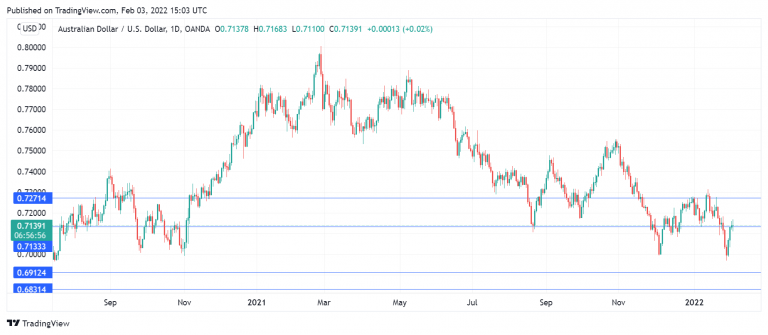
The Australian dollar headed lower earlier in the day before recovering. In the North American session, AUD/USD is trading at 0.7137, down 0.01% on the day.
The RBA policy meeting went as expected, with the bank winding up its bond asset programme while preaching caution. Governor Lowe stressed that the end of QE did not mean that a rate rise was imminent and remained non-commital, saying that a hike could be a year away or even longer. Lowe reiterated that there are significant uncertainties as to recent inflationary pressures and that it was too early to determine if inflation was sustainably within the central bank’s 2%-3% target band and said that there was no need to respond aggressively to inflation.
Lowe is clearly in no rush to raise rates and may not have abandoned the view that inflation is transient and will ease in the near term. The markets, in contrast, are more hawkish and feel that high inflation will prompt the RBA to raise rates in the second half of 2022.
Wage growth remains an obstacle to a rate hike, according to the RBA. Governor Lowe has stated that he will not raise rates prior to wage growth rising to 3.0%. We’ll get a look at the 2022 forecast for wage growth on Friday when the RBA releases its monetary policy statement. The current projection stands at 2.5%, but if the bank revises this forecast upwards, it would reinforce expectations of a rate hike later in 2022.
The RBA has been in the spotlight this week, overshadowing some positive economic releases. Building Approvals for December jumped 8.2% m/m, surprising the markets which had projected a 1.0% decline. The NAB business confidence index sparkled in Q4, climbing to 18, up from -2 beforehand. The end of Covid lockdowns invigorated the economy and gave a massive boost to business confidence.
AUD/USD Technical
- AUD/USD continues to test resistance at 0.7133. Above, we find resistance at 0.7271
- There is support at 0.6913 and 0.6831
Sunset Market Commentary
Markets
The Bank of England did what it was supposed to do: raise rates. The MPC agreed on a 5-4 basis for a 25bps hike to 0.5%. The four members voting against were actually in favour of a 50bps bump! Bringing the base rate to 0.5% means the BoE seizes to reinvest proceeds from maturing government bonds. The central bank will also start actively selling from its £20bn big corporate bond portfolio. High inflation is the obvious driver. Price increases are now expected to peak at 7%+ in April. That’s 2 ppts higher compared to the November forecast. Inflation is expected to ease over time on the assumption of stabilizing energy prices, easing supply chain pressures and a decline in tradeable goods prices. Wage growth will strengthen further over the coming year before easing from 2023. This follows a loosening in the labour market as UK GDP growth is expected to slow to subdued rates beyond the near term on the adverse impact of high inflation on UK income and spending. The unemployment rate may rise to 5% by 2024 and excess supply may build to 1%. Growth was revised down to 3.75% (-1.25 ppt) in 2022, 1.25% (-0.25 ppt) in 2023 and 1% in 2024. Short-term though, more tightening is needed. Based on current market projections of the policy rate hitting a 1.5%/1.75% peak by mid-2023, the BoE sees inflation still above 2% in 2023. It won’t be until 2024 before inflation eases back towards/below the 2% target (1.6%). UK yields spiked on the decision on the fact that a 50 bps hike was such a close call. Changes range from 13 bps (2y) over 11.3 bps (10y) to 8.4 bps (30y). Markets now believe the policy rate may hit 1% already in May, triggering the next normalization phase of quantitative tightening sooner. This may explain why long tenors are also rising this sharply. Sterling gets bid with EUR/GBP hitting an intraday low just shy of the crucial 0.8277 support. The pair quickly pared some of those knee-jerk losses to change hands still north of 0.83 ahead of the ECB and even gained afterwards to 0.838 on genuine euro strength.
The European Central Bank as expected hasn’t changed anything to policy (intentions). PEPP will be put to bed end March. APP will be raised to ensure a smooth transition before returning to the original buying pace in Q4 2022. Based on current guidance, this excludes the possibility of a 2022 rate hike. But. President Lagarde hinted this may change in March, saying that they will be looking in close detail to the inflation drivers, the upward risks surrounding it and its impact given the “unanimous concern” on current developments. She(rlock) noted the situation has changed and that it needs to be reassessed based on the data. Policy goals are “much closer to target”, she added. Lagarde also refused to repeat that an interest rate hike is “very unlikely in 2022” when explicitly asked to neither did she want to tell markets they were ahead of themselves. Those same markets got all the confirmation they wanted from the central bank and steam on. A first 10 bps rate hike is discounted for July already with a total of almost 30 bps more hikes priced in this year. Short-term European swap rates soar 10 bps (2y) to 12.5 bps (5y). The complete curve briefly hit positive territory for the first time since 2015. Since the ECB sticks to the official forward guidance, net bond buying needs to end quickly (in the summer?!) for rate hikes to happen. This launches the longer tenors as well up to 9.3 bps for the 10y. Peripheral spreads rise. Italy (+7 bps) underperforms. The euro is unchained: EUR/USD jumps more than a full big figure intraday to test the 1.14 big figure. European stock markets turn red on the clearest sign of European monetary policy finally being normalized.
News Headlines
The Czech National bank raised the policy rate by 75bps to 4.50%. The move was expected by most analysts, but there was an outside risk of 100bps, as some expected frontloading tightening which would allow the CNB to stop the cycle sooner. Inflation strongly outpaced the 2% (+/- 1%) target, printing at 6.6% in December. Central bank members indicated risks for inflation to move near 10% in the first months of 2022. Governor Rusnok holds a press conference later today and the CNB will update and comment quarterly economic forecasts tomorrow. The koruna touched the strongest level against the euro in more than 10 years near EUR/CZK 24.10 before the decision, but currently again trades in the 24.20 area.
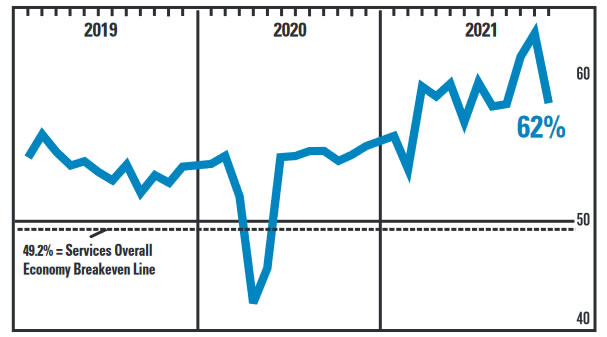
US ISM services dropped to 59.9 in Jan, corresponds to 3.5% annualized GDP growth
US ISM Services dropped -2.4 pts to 59.9 in January, above expectation of 58.7. Looking at some details, business activity/production dropped -8.4 to 59.9. New orders dropped -0.4 to 61.7. Employment dropped -2.4 to 52.3. Supplier deliveries rose 1.8 to 65.7. Prices dropped -1.6 to 82.3.
ISM said: "The past relationship between the Services PMI® and the overall economy indicates that the Services PMI® for January (59.9 percent) corresponds to a 3.5-percent increase in real gross domestic product (GDP) on an annualized basis."
Euro in Lively Bullish Party after ECB; BoE Fails to Boost Pound after Rate Hike
Bank of England hikes rates
Abandoning its communication fiasco of late last year, the Bank of England delivered its first back-to-back rate increase in almost two decades, lifting interest rates by 25 basis points to 0.50% as widely expected.
Consistent with its guidance, the committee also judged that it should cease reinvesting the maturing government bond purchases of its portfolio in a gradual and predictable manner, reiterating that it would initiate the process of selling (quantitative tightening) once the benchmark rate rises to 1.0%.
What previously looked like a temporary disorder of the pandemic, inflation has become a sticky phenomenon from mid-2021 onwards, with the central bank elevating its price growth forecasts to 7.25% by April and seeing it at 5.21% in a one-year time from 3.40% previously. Four of the nine voting members wanted the central bank to act even more aggressively, hiking borrowing costs at a faster pace of 50 bps to 0.75%, looking past the pandemic uncertainty and perhaps sacrificing some economic growth with an eye to quickly putting out the inflation fire.
Yet, the rate hike parade could see further continuation in the coming months if the economy moves in line with February’s projections, though whether it would be a fast or gradual process remains to be seen, the BoE chief Andrew Bailey said. That uncertainty and the dependence on future economic developments have likely canceled the pound’s immediate bullish reaction, pressing poud/dollar back to 1.3605 after a peak at a weekly high of 1.3627. Likewise, it immediately lost its shine versus the euro, pulling back to 0.8357 per euro after touching a new two-year high at 0.8338. In other pound pairs, however, pound/yen is still maintaining its upside momentum for now, peaking at 156.47.
ECB stands pat but Lagarde boosts euro
Meanwhile in the eurozone, the European Central Bank’s policy announcement did not shoot any fireworks but Lagarde's press conference provided the much needed boost to the euro.
Sticking to the initial plan, the board kept its deposit rate unchanged at a record low of-0.50% as analysts forecasted despite inflation ticking to a fresh multi-year high in January.
The only adjustment was the removal of the wording that monetary policy could change in either direction, but the euro was broadly unaffected in the aftermath until Lagarde’s inflation comments during her press conference revived sharp bullish pressures, sending euro/dollar rapidly up to 1.1378. Particularly, the ECB chief sounded hawkish after admitting that inflation could “remain elevated for longer than expected”, signaling that price growth could climb beyond January’s high of 5.1% in the near term. Investors, however, will probably wait for additional clarification during the March meeting when the central bank updates its economic projections.
Euro/yen staged an impressive rally as well, flying straight up to 130.89 from 129.47 before the press conference started. That is the largest daily increase in a long time.
The German 2-year government bond yield soared to -0.326%, the highest since 2016, while the longer-term 10-year equivalent unlocked a three-year high at 0.14%.
Futures markets are currently pricing three rate hikes of 10bps with a stronger probability.
Stock markets
Turning to stock markets, Meta, the owner of Facebook, cautioned investors with a loss of a million daily users worldwide and a stagnation in its most profitable Canadian and US markets during its post-market earnings call on Wednesday, squeezing the Meta stock lower by 22%. Besides a worse-than-expected decline in profits, CEO Mark Zuckergerg, who is pivoting the company’s future to a virtual world while heavily involved in antitrust battles, flagged a potential growth slowdown in revenues in the first quarter of 2022, citing a reduction in time spent on its services, inflation headwinds in advertising spending and Apple’s ad-tracking changes.
The company’ brilliant performance during the past two years has been a key driver of the global stock record rally. Hence, yesterday’s depressing results could easily put this month’s upturn in US indices on hold for now, while Amazon’s earnings after the closing bell today could be the next test for the high valued tech sector. Futures tracking the Nasdaq 100 were heavily down by more than 2.0% during the time of writing. The S&P 500 is set to open 1.0% lower, while the Dow Jones could trade with softer injuries when the US session starts.
Tech shares in the European STOXX 600 are not in a better place today, plunging by 1.24%. Utilities and energy shares have so far escaped the plunge, remaining stable in the day.
EUR/GBP Mid-Day Outlook
Daily Pivots: (S1) 0.8318; (P) 0.8335; (R1) 0.8345; More...
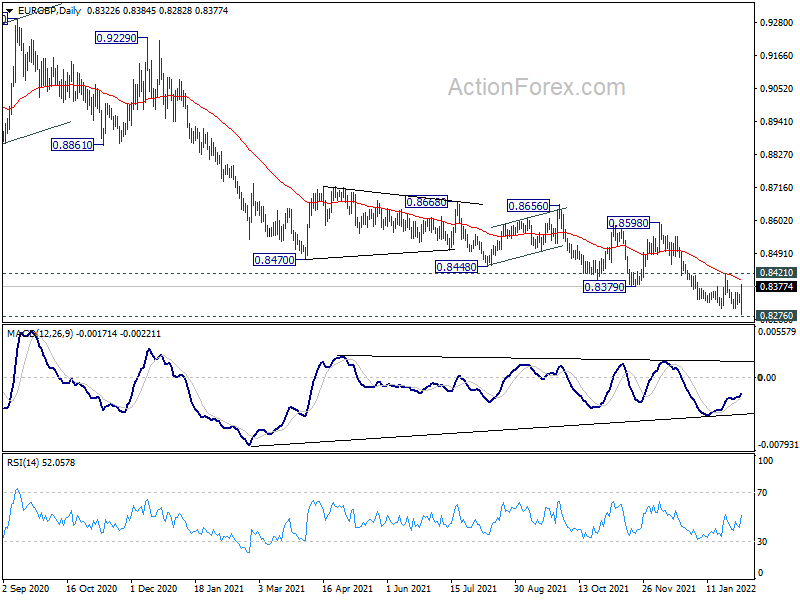
EUR/GBP spiked lower to 0.8282 but recovered strong just ahead of 0.8276 key long term support. Intraday bias remains neutral first. On the upside, firm break of 0.8421 resistance should now will be a sign of bullish reversal. Further rise would be seen back to 0.8598 structural resistance for confirmation. However, sustained break of 0.8276 will carry larger bearish implication and could prompt downside acceleration.
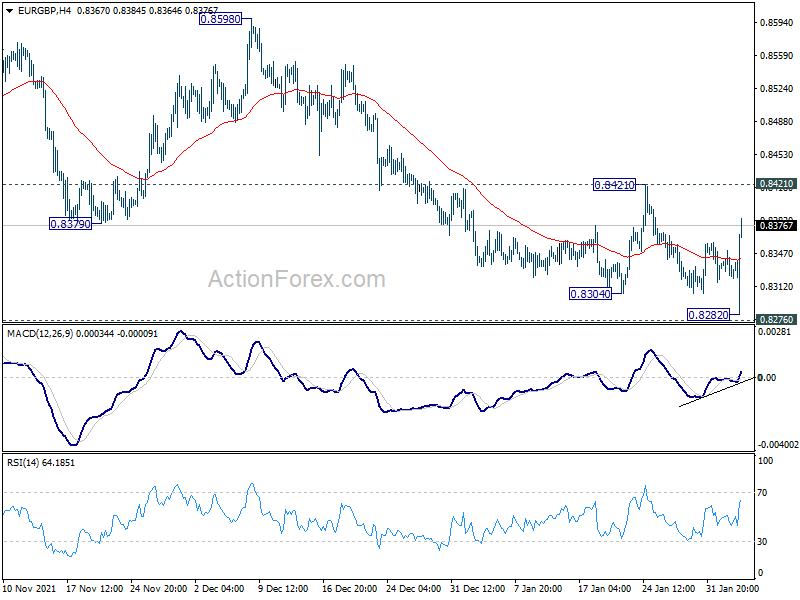
In the bigger picture, price actions from 0.9499 (2020 high) are still seen as developing into a corrective pattern. Deeper fall could be seen as long as 0.8598 resistance holds, towards long term support at 0.8276. We'd look for bottoming signal around there to bring reversal. Meanwhile, firm break of 0.8598 will now be an early sign of medium term bottoming and bring stronger rebound. However, sustained break of 0.8276 will argue that the long term trend has reversed.
EUR/JPY Mid-Day Outlook
Daily Pivots: (S1) 129.12; (P) 129.30; (R1) 129.54; More....
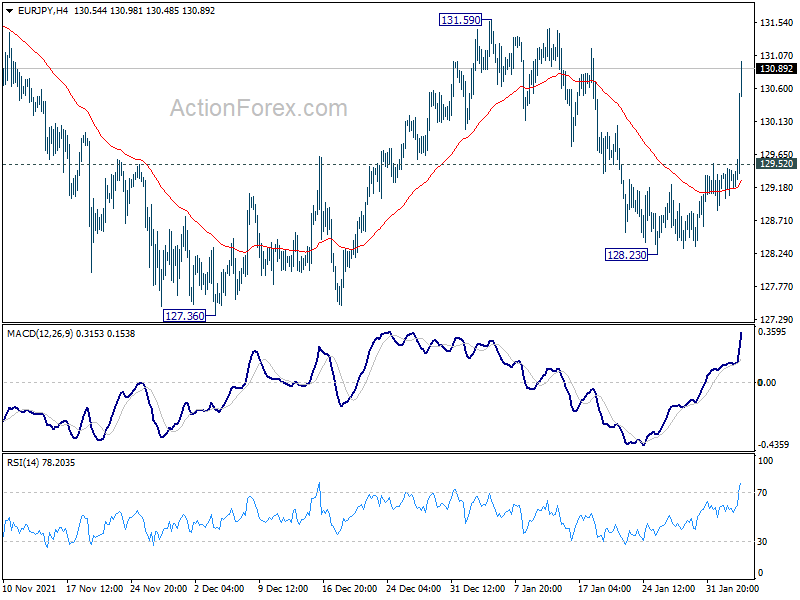
EUR/JPY's strong break of 129.76 resistance suggests that fall from 131.59 is merely a correction to rise from 127.36, and has completed at 128.23 already. Intraday bias is back on the upside for 131.59 resistance first. Firm break there will revive the case that consolidation pattern from 134.11 has finished at 127.36. Further rally should then be seen back to 133.44/134.11 resistance zone. On the downside, below 129.52 minor support will mix up the outlook and turn intraday bias neutral first.
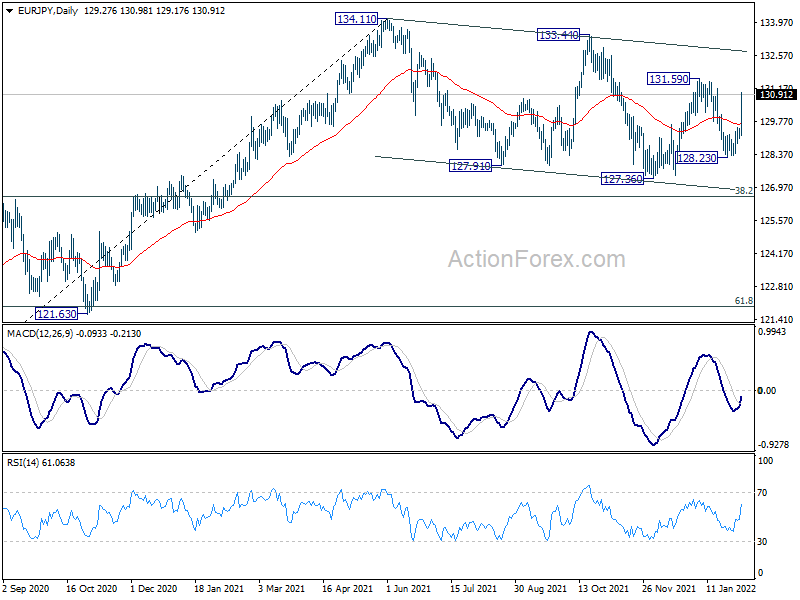
In the bigger picture, price actions from 134.11 are currently seen as a consolidation pattern only. As long as 38.2% retracement of 114.42 (2020 low) to 134.11 at 126.58 holds, up trend from 114.42 is still in favor to continue. Break of 134.11 will target long term resistance at 137.49 (2018 high). However, sustained break of 126.58 will raise the chance of bearish reversal. In this case, deeper decline would be seen to 61.8% retracement at 121.94, and possibly below.
GBP/JPY Mid-Day Outlook
Daily Pivots: (S1) 154.95; (P) 155.19; (R1) 155.57; More...
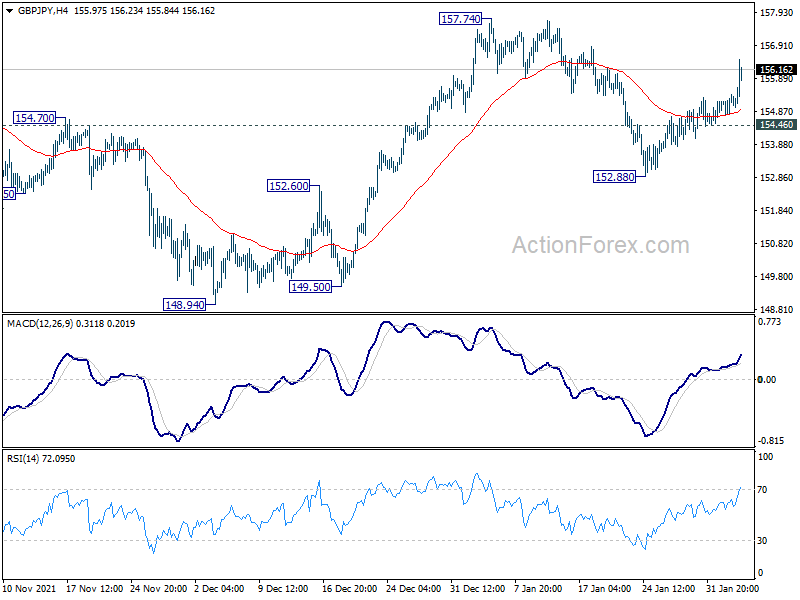
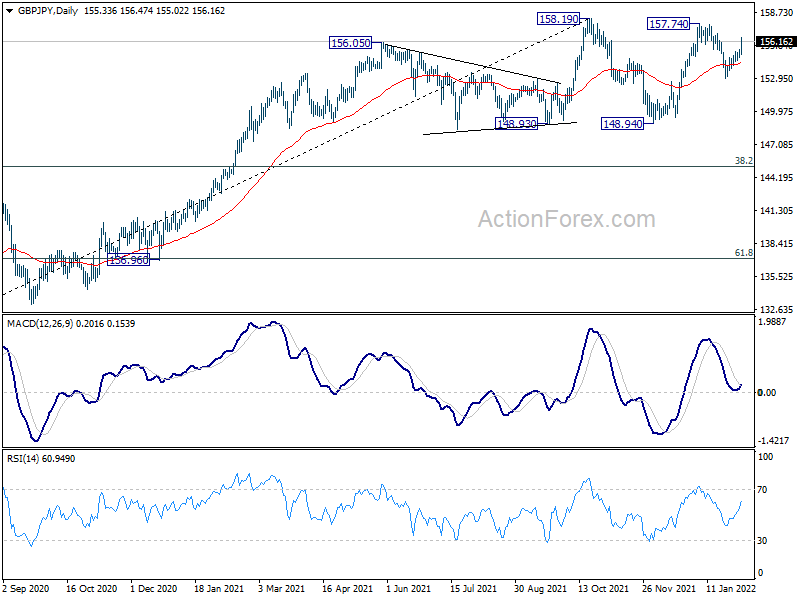
GBP/JPY's strong break of 155.38 minor resistance suggest that fall from 157.74 was merely a correction to rise from 148.49, and has completed at 152.88 already. Intraday bias is back on the upside for retesting 157.74/158.19 resistance zone. Firm break there will resume larger up trend. On the downside, break of 154.46 minor support will mix up the outlook again and turn intraday bias neutral.
In the bigger picture, price actions from 158.19 are currently seen as developing into a consolidation pattern to up trend from 123.94 (2020 low). Downside should be contained by 123.94 to 158.19 at 145.10 to bring rebound. Firm break of 158.19 will resume the up trend to long term fibonacci level at 167.93. However, sustained break of 145.10 will raise the chance of trend reversal and target 61.8% retracement at 137.02.
USD/JPY Mid-Day Outlook
Daily Pivots: (S1) 114.13; (P) 114.46; (R1) 114.77; More...
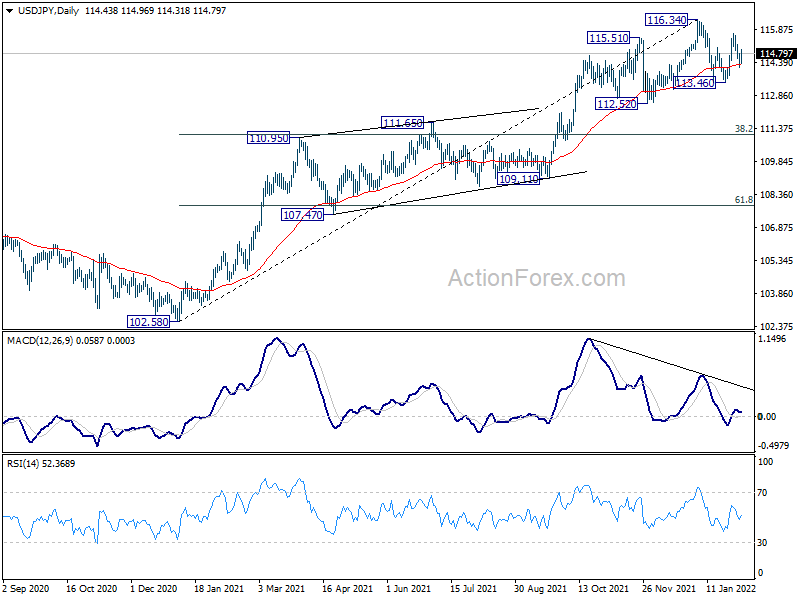
Intraday bias in USD/JPY is turned neutral first with current recovery from 114.14. Overall, corrective pattern from 116.34 is extending. Below 114.14 will target 113.46 and possibly further to 112.52 support. On the upside, above 115.68 will bring retest of 116.34 high.
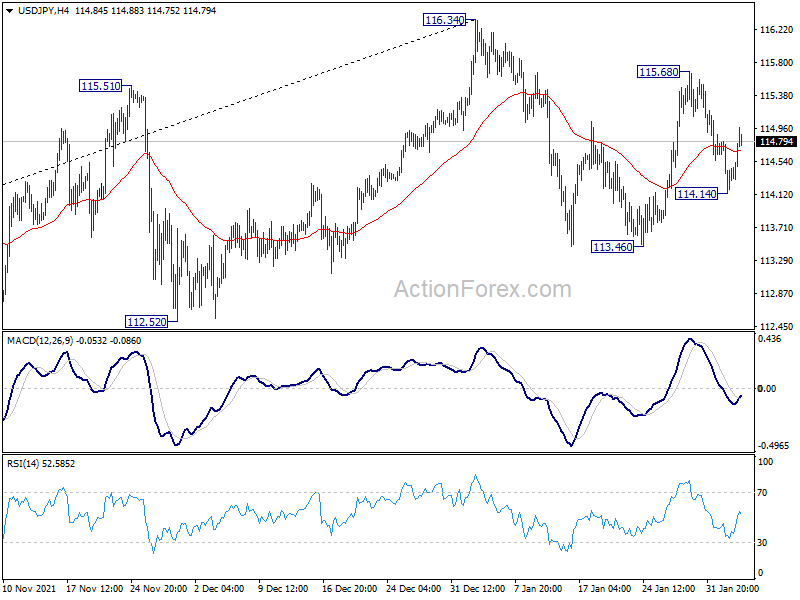
In the bigger picture, no change in the view that rise from 102.58 is the third leg of the up trend from 101.18 (2020 low). Such rally should target a test on 118.65 (2016 high). Sustained break there will pave the way to 120.85 (2015 high) and raise the chance of long term up trend resumption. This will remain the favored case as long as 55 week EMA (now at 111.07) holds.