

Sample Category Title
Cliff Notes: Inflation to Remain Front of Mind for Central Banks in 2022
Key insights from the week that was.
The first week of February has been acutely focused on monetary policy, with last week’s US FOMC meeting followed by the RBA, BoE and ECB.
Beginning with the RBA, their February meeting was largely as expected, with asset purchases brought to an end and an assessment of the reinvestment of maturing bond proceeds scheduled for the May Board meeting. As outlined by Chief Economist Bill Evans after the decision, the RBA has revised down its growth view for 2022 and 2023 (from 5.5% and 2.5% to 4.25% and 2.0% respectively) as a result of the impact of omicron at the beginning of 2022 and arguably for 2023 given the market cash rate profile, an input for their forecasts, has lifted materially since November. Their view on underlying inflation has also been revised up materially to 3.25% in 2022 and 2.75% in 2023 as a result of the recent strength in prices seen globally. However, the Governor’s statement made clear the RBA’s view that while “inflation has picked up, it is too early to conclude that it is sustainably within the target band.”
This view stems from “uncertainties about the outlook for supply side problems” and as “it is likely to be some time yet before aggregate wages growth is at a rate consistent with inflation being sustainably at target.” Governor Lowe delved deeper into these key themes in a subsequent speech to the National Press Club. Most notable for the policy outlook in the speech and Q&A is that Governor Lowe set out a more flexible approach to assessing wage pressures. Currently, their forecast for the Wage Price Index is 2.75% in 2022 and 3.00% in 2023, below the “3%+” guidance previously given as necessary for sustained ‘at target’ inflation. However, in this speech, he also made clear that the RBA recognised the WPI was slow moving and limited in the wage pressures it picks up – overlooking gains from bonuses and promotions. Chief Economist Bill Evans consequently discussed the significance of this broader assessment of wage pressures for the outlook for policy, affirming our call for a first move in August. Also called out in this piece is that the RBA does not see a need for a quick or aggressive policy pivot as is the case in the US. There, CPI inflation around 7.0%yr and wages growth above 4.0%yr justifies the four hikes (100bps of tightening) Westpac has forecast for 2022. This contrast to two hikes in Australia before year end, a cumulative 40bps.
Note, a full view of the RBA’s forecasts and their assessment of risks will be provided today in their February Statement on Monetary Policy. Westpac Economics’ own take on the domestic scene, global economy and financial markets will also be detailed in our latest edition of Market Outlook, which can be accessed through Westpac IQ.
Before moving offshore, a quick take on this week’s domestic data which has largely been focused on the consumer and housing. Housing finance approvals showed that delta related disruptions are now behind us, with total approvals up 4.4% in December and 11% since October’s delta lows to be 0.8% above the May 2021 peak. Owner-occupier demand remains the primary driver of loan growth and, combined with investors’ appetite, is continuing to push house prices higher, capital city home prices gaining 0.8% in January, 21%yr, according to CoreLogic. The dwelling approval data meanwhile remained noisy into year end, gaining 8.2% in December on the back of narrow strength in unit approvals. Looking through the month-to-month volatility, the existing pipeline of projects and delays related to COVID-19 is expected to see strength in construction through most of 2022, though growth will abate by year end. In addition to the bulletins on key data releases, this week also saw the release of Westpac Economics’ latest edition of the Red Book, our in-depth assessment of the Australian consumer.
Then to offshore. Firstly in New Zealand, the Q4 labour force survey re-enforced that the labour market remains very tight, with the unemployment rate falling to 3.2% in Q4, a new historic low back to 1986. At 0.8% in the quarter and 2.6%yr, wage gains are clearly robust, but not rapid, allowing the RBNZ to continue tightening at a measured pace. A full view of the New Zealand labour market and the implications was provided by our New Zealand economics team in their Q4 review.
Then to the main events of the global calendar, the Bank of England and ECB February meetings. Both proved more hawkish than the market had anticipated, the BoE most obviously so. The BoE Monetary Policy Committee was finely balanced 5-to-4 in favour of a 25bp hike to 0.50% instead of a 50bp move to 0.75%. The Committee also agreed to cease re-investment of the proceeds from maturing bonds, setting up the rundown of its balance sheet through 2022 and beyond. The franking of market pricing of a move up in the Bank Rate to around 1.50% by mid-2023 (1.00% in November) was also a vote of confidence in the economy’s strength and recognition that inflation and wage risks are increasing as the labour market continues to tighten. It is notable however that the press conference made clear the Committee has incorporate more persistent price pressures from energy than the market has priced and, despite this, inflation is seen back below target by the end of the forecast period at the beginning of 2025. On these forecasts, the Bank of England terminal rate will be below that of the FOMC after a similarly timed hiking cycle.
Finally to the ECB, while the outcome of their February meeting was as expected, the post-meeting communications caught the market by surprise. During the press conference, President Lagarde focused attention on recent upside surprises to inflation and that price pressures were likely to prove more persistent in 2022 than previously anticipated. Further, with respect to policy, President Lagarde noted that the “situation has changed” and hence there was need to carefully assess updated staff forecasts, due next ahead of the March meeting. Still, it remains the case that the ECB require inflation to be sustainably at target to justify a rate hike and, before a hike, asset purchases need to have ceased. To get a hike in 2022 will therefore require more concern over inflation and confidence in activity and financial conditions than was seen pre-pandemic. This seems unlikely.
USD/JPY Aims Fresh Increase, NFP Report Next
Key Highlights
- USD/JPY started a decent increase from the 113.50 zone.
- It broke a crucial bearish trend line with resistance near 114.20 on the 4-hours chart.
- EUR/USD surged above 1.1350, and GBP/USD spiked above 1.3600.
- The US nonfarm payrolls could increase 150K in Jan 2022.
USD/JPY Technical Analysis
The US Dollar saw a major decline from the 116.35 zone against the Japanese Yen. USD/JPY traded below the 115.00 support to move into a bearish zone before the bulls appeared.
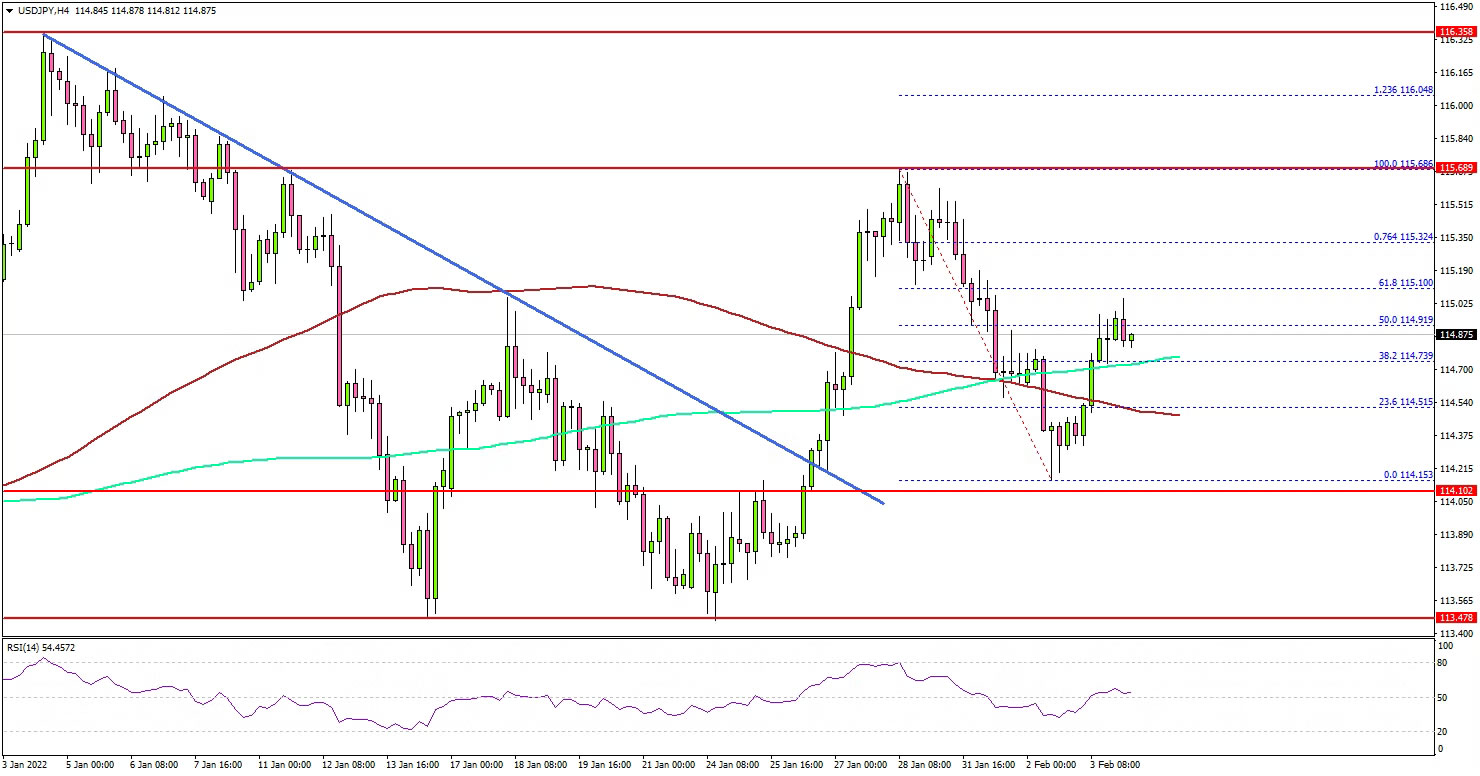
Looking at the 4-hours chart, the pair found support near the 113.50 zone. It seems like a double bottom pattern was formed near 113.50. The pair was able to climb above the 114.20 and 114.50 resistance levels.
There was also a break above a crucial bearish trend line with resistance near 114.20 on the same chart. The pair stabilized above the 114.50 level, the 100 simple moving average (red, 4-hours), and the 200 simple moving average (green, 4-hours).
An immediate resistance is near the 115.10 level. The first major resistance is near the 115.50 zone. A clear move above the 115.50 level might start a major increase in the coming sessions.
If there is no upside break above 115.50, the pair could start another decline. An immediate support is near the 114.50 level. The next major support is near the 114.10 level, below which the bears might aim a test of the 113.50 zone.
Fundamentally, the US ISM Services Index for Jan 2022 was released yesterday by the Institute for Supply Management (ISM). The market was looking for a decline from 62.0 to 59.5 in Jan 2022.
The actual result was near the forecast, as there was a drop in the US ISM Services Index to 59.9. The last reading was revised up from 62.0 to 62.3.
Looking at EUR/USD, the pair gained bullish momentum for a move above 1.1350. Similarly, GBP/USD was able to rally above the 1.3600 level.
Economic Releases
- US nonfarm payrolls for Jan 2022 – Forecast 150K, versus 199K previous.
- US Unemployment Rate for Jan 2022 - Forecast 3.9%, versus 3.9% previous.
- Canada’s Employment Change for Jan 2022– Forecast -117.5K, versus 54.7K previous.
- Canada’s Unemployment Rate for Jan 2022- Forecast 6.2%, versus 5.9% previous.
ECB Review: New Call – ECB to Hike in Dec22 and Mar23
- After the hawkish ECB meeting today, we change our ECB call and now expect the ECB to hike its deposit facility rate in December this year, and again in March 2023, by 25bp each, which will bring the deposit facility rate to 0%. For now, our call is for a 'two-and-done'. We expect Danmarks Nationalbank (DN) to follow the ECB and hike the deposit rate to -0.10%.
- There is still elevated uncertainty on this call, but given that Lagarde highlighted the uncertainty of the model framework in its staff projections, that inflation will remain elevated for longer than previously expected, and a tight labour market, we change our view to acknowledge the increased risk, which now becomes our baseline.
- Given the highly uncertain inflation outlook, the ECB left out the sentence from December, which said that inflation was projected to settle below 2% – which is a hawkish shift in our view.
- On several occasions during the press conference, Lagarde had to close the door for a rate hike in 2022, but she intentionally left the door open ensuring that she did not want to make pledges without conditionality.
- For the first time since 2014, the ECB added a risk assessment to the inflation outlook in its monetary policy decision, which are on the upside, in particular in the short-term.
- Today's meeting will also be remembered to show the largest difference to date between the ECB's released decision and the press conference. The ECB's decision released at 13:45 CET carried almost no changes, where the 'at present or lower' and sequencing was confirmed.
- Indications of TLTRO to be discussed in March or later.
Growth risk broadly balanced – elevated uncertainty with tight labour market
The growth risk outlook, which was assessed to be broadly balanced, carried the expected small nuances to the December decision. Domestic demand expected to fare well, in particular after the restrictions end, where the impact from Omicron was assessed to be less, while highlighting geopolitical uncertainties.
On the inflation front, Lagarde said that the majority was still energy driven, but food prices were highlighted due to seasonal factors (elevated transportation cost and fertilisers). There was unanimity in the governing council that the high inflation print was of concern. She also highlighted a larger share of price increases and uncertainty for how long the pandemic-related high inflation implications would remain. The most recent inflation figures were unanimously seen with concern.
Previously, we argued that the wage dynamic was the missing piece in the puzzle for us to change call for a rate hike. Lagarde clearly downplayed the importance of this by highlighting its lagged nature of the measure, but also that the participation rate is now at pre-Covid levels and unemployment rate below the start of the pandemic, and expected to tighten further.
Sequencing still holds – rate hike in December
We now expect the ECB to hike in December this year by 25bp for the first time since 2011. While Lagarde emphasised the flexibility and optionality of the calibration of instruments and its data dependency, she reiterated several times that sequencing is still valid. This means that the ECB will end its net asset purchases before hiking policy rates. Given the wording today from Lagarde, we believe the ECB will use this option in December, as we do not expect the ECB to accelerate the taper purchase pace (current guidance until October), sufficient to open for a September hike. However, there is a risk that the ECB will follow the Fed's accelerated taper decisions, which would bring September in play.
As we have seen increased awareness about the negative side effects of the negative interest rate policy, we expect the ECB to go for 'two-and-done', bringing the deposit rate to zero in March 2023.
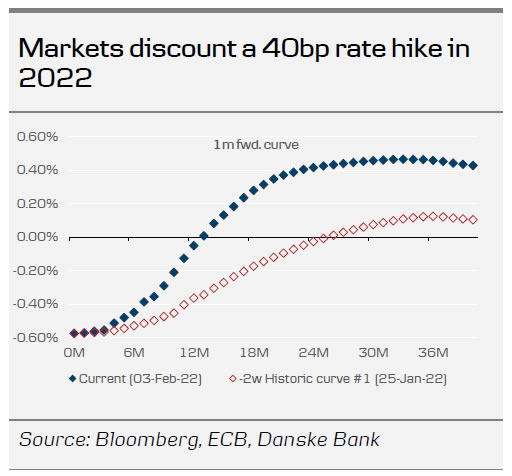
Despite our new ECB call, we still find the 2022 pricing aggressive. At the time of writing, markets are pricing in 42bp for December this year.
EUR rates fuelled EUR/USD move higher
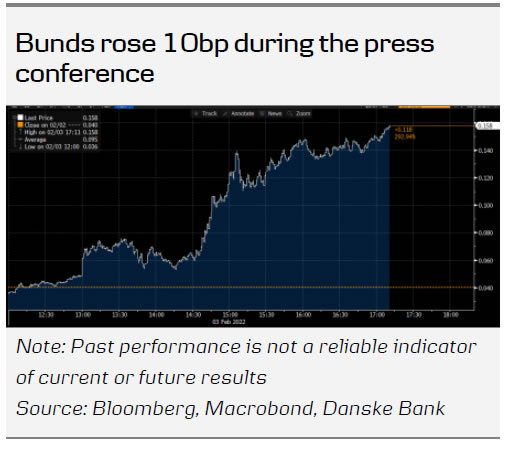
EUR/USD increased around a figure on the ECB meeting, to around 1.14. The dominant driver was a repricing of where European interest rates should be: higher. The reaction itself – that EUR/USD follows yields during the brief time span of the ECB press conference – is quite common. However, spot is generally decoupled from yields over the 1-3m horizon, and we expect this to continue to be the case.
At present, the market's focus is quite short-term. Indeed, as of last week, EUR/USD dropped substantially on the back of the hawkish Fed meeting and this week, we see the exact opposite on the back of the ECB meeting. Looking ahead, the upcoming US CPI print can easily turn market's attention around again. Equally so if the bounce in global equities comes to a halt (USD positive). It is also quite common that the ECB speakers may 'clarify' the message in the following days – in either direction and with equal implications for EUR/USD spot.
Looking a bit further ahead, we continue to see EUR as overvalued vs. fundamentals, for the investment environment to change in a manner that is a drag on the EUR and for European data to underwhelm. We do not expect, nor see, that relative policy rates are a big driver in EUR/USD spot. In 12 months, we continue to forecast EUR/USD spot at 1.08.
Danmarks Nationalbank to follow the ECB
We expect Danmarks Nationalbank (DN) to follow the ECB and hike 25bp in December and March, respectively. We expect DN to hike both the repo and the deposit rate. After the two hikes, the repo rate would be 0.05% and the deposit rate -0.10%. EUR/DKK trades at the low end of the trading range and last year DN was forced to sell DKK in FX intervention to floor EUR/DKK around the 7.4360 level. We see a possibility that DN could hike 10-15bp less or cut in between ECB hikes if downwards pressure on EUR/DKK spot and need to sell DKK in FX intervention returns in Q4 this year or Q1 next year.
EURUSD Wave Analysis
- EURUSD reversed from support zone
- Likely to rise to resistance level 1.1470
EURUSD currency pair recently reversed up sharply from the support zone lying between the major support level 1.12 (which has been reversing the pair from the middle of 2020) and the lower weekly Bollinger Band.
This support zone was further strengthened by the nearby 61.8% Fibonacci correction of the previous weekly upward impulse from the start of last year.
Given the prevailing euro optimism – EURUSD currency pair can be expected to rise further toward the next resistance level 1.1470 (top of wave 4 from January).
EURAUD Wave Analysis
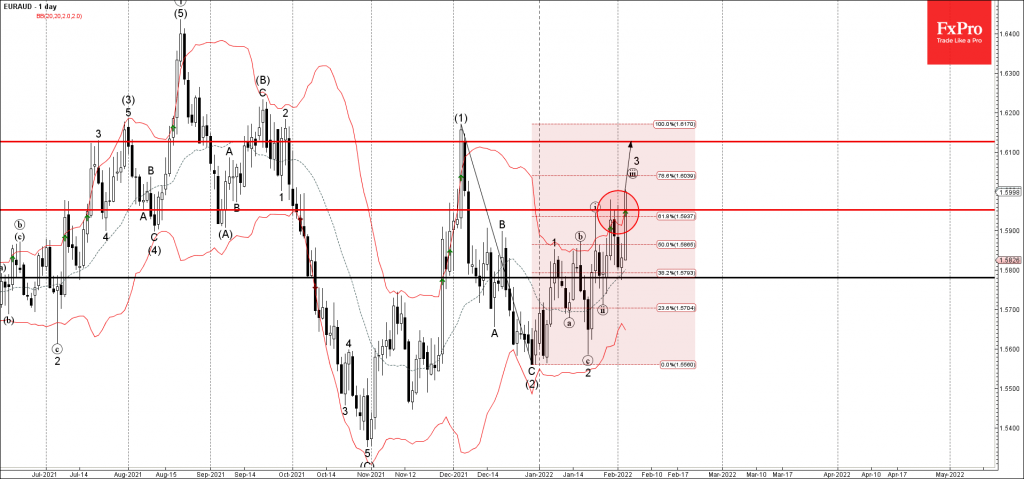
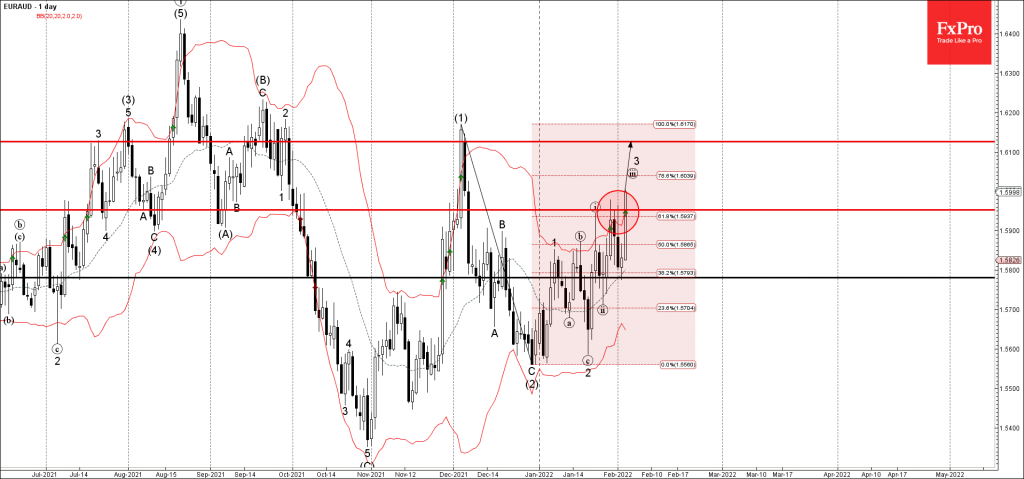
- EURAUD broke resistance zone
- Likely to rise to resistance level 1.6125
EURAUD currency pair recently broke the resistance zone lying between the key resistance level 1.5950 (which has been reversing the pair from January) and the 61.8% Fibonacci correction of the previous ABC correction (2) from December.
The breakout of this resistance zone accelerated the both of the active impulse waves (iii) and 3 of wave (3) from December.
EURAUD currency pair can be expected to rise further toward the next resistance level 1.6125 (target price for the completion of the active impulse wave 3).
Bank of England Hawks Take Flight
Summary
- The Bank of England (BoE) delivered a February monetary policy announcement that was towards the hawkish end of market expectations. The BoE raised its policy rate 25 bps to 0.50%, though several policymakers dissented in favor of a larger 50 bps increase. The central bank also said it will stop reinvesting maturing proceeds from its government and corporate bond holdings.
- The BoE raised its inflation forecasts, and now sees inflation peaking at 7.25% in April 2022. Despite an outlook for slower growth, in part as household incomes are squeezed by higher energy prices, the central bank said further modest tightening will be appropriate in the months ahead.
- Given the hawkish announcement, we have adjusted our outlook for Bank of England monetary policy. We expect another 25 bps policy rate increase to 0.75% in May, and also a 25 bps increase to 1.00% in August. However, as higher energy prices weigh on growth and inflation passes its peak, we do expect the pace of Bank of England tightening to slow. We do not envisage any move at the November meeting, while for 2023 we see 25 bps rate increases in February and August of next year, which would see the policy rate end 2023 at 1.50%.
Bank of England Hikes Rates and Signals Further Tightening to Come
The Bank of England (BoE) delivered a February monetary policy announcement that was at the hawkish end of spectrum in terms of market expectations. The BoE increased its policy rate by 25 bps to 0.50%, which was widely expected. However, policymakers were close to delivering an even larger 50 bps rate increase given a 5-4 vote, with the four dissenters voting in favor of a larger rate increase. In addition, having reached the 0.50% policy rate threshold and considering the economic circumstances, the BoE also said it would stop reinvesting maturing proceeds from government bonds and corporate bonds, and in addition signaled some sales of corporate bonds, allowing its balance sheet to reduce in size.
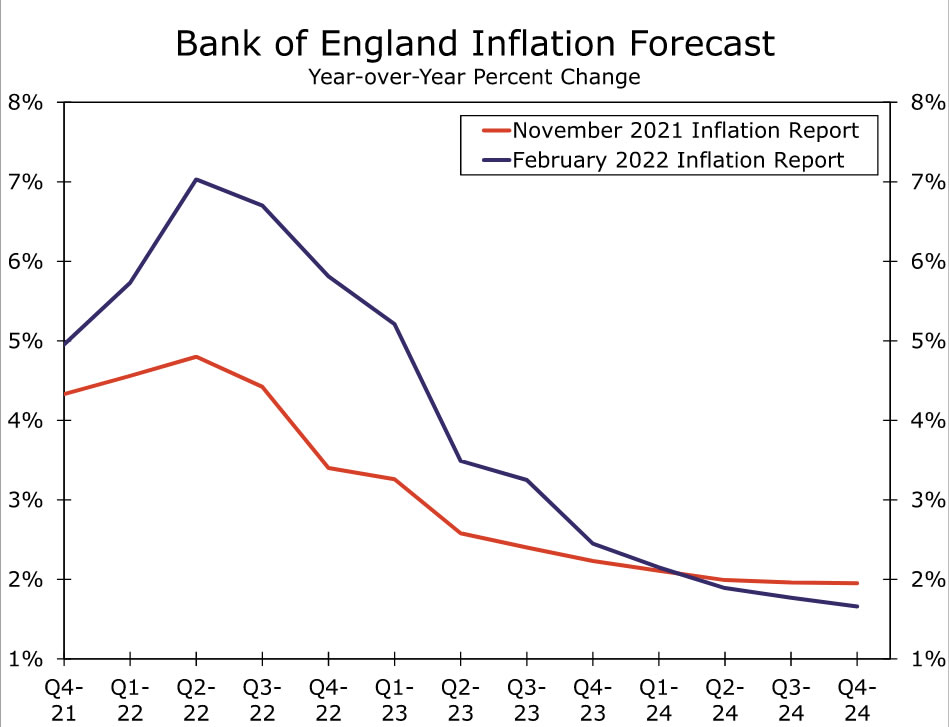
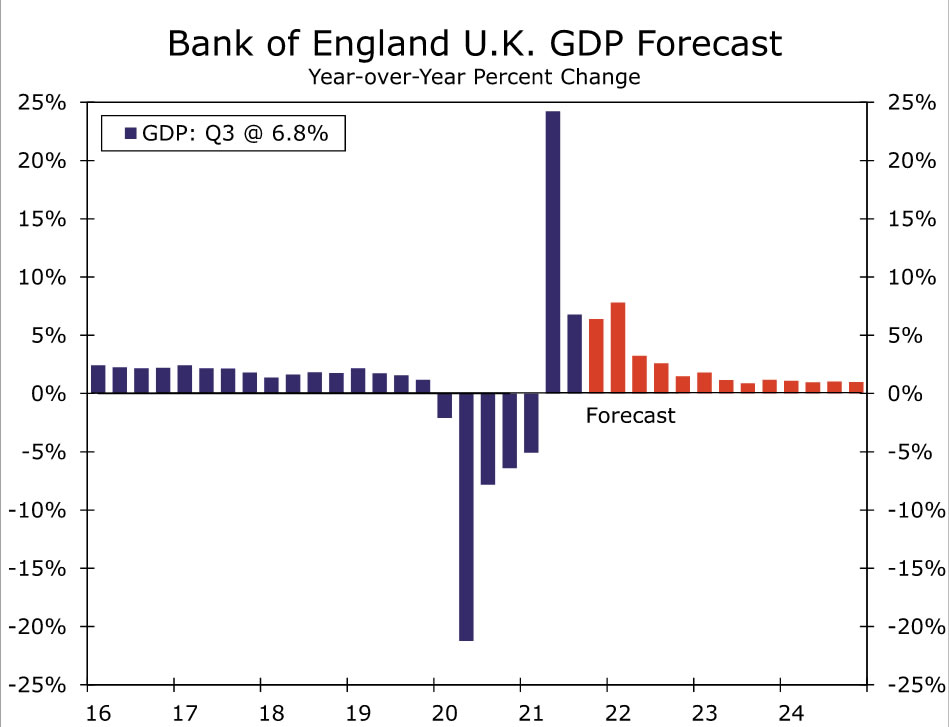
The central bank's statement and accompanying economic projections contained some other hawkish elements as well. The BoE lifted its CPI inflation forecasts, saying it expects inflation to peak at 7.25% in April 2022. The Bank of England sees inflation slowing to 2.15% in two years and to 1.6% in three years. The revisions to the GDP growth outlook were in the other direction, with the forecast for 2022 GDP growth lowered to 3.75%.
The BoE acknowledged that energy and other price increases would squeeze real household incomes and economic growth, but also said the "MPC’s remit is clear that the inflation target applies at all times, reflecting the primacy of price stability in the UK monetary policy framework" and added that the "MPC judges that, if the economy develops broadly in line with the February Report central projections, some further modest tightening in monetary policy is likely to be appropriate in the coming months." As a result, despite the prospect of slower growth, especially elevated inflation prompted the Bank of England to move at today's meeting, and some further near-term rate hikes appear likely.
Indeed, comments from Governor Bailey tended to suggest that central bank monetary tightening would be front-loaded to some extent. Speaking after the formal policy announcement, Bailey said the BoE had not raised rates because the economy is "roaring away," there is much uncertainty on the outlook, and that it is a mistake to assume interest rates are on an inevitable long march up.
Expect Earlier, And More, Bank of England Rate Hikes
We had been on the dovish end of the spectrum regarding our Bank of England outlook heading into today's meeting—hence today's announcement necessitates a change in our view. With the central bank signaling modest further tightening in the near-term, we expect another 25 bps policy rate increase to 0.75% in May, and also a 25 bps increase to 1.00% in August. However, as higher energy prices weigh on growth and inflation passes its peak, we do expect the pace of Bank of England tightening to slow. We do not envisage any move at the November meeting, while for 2023 we see 25 bps rate increases in February and August of next year, which would see the policy rate end 2023 at 1.50%. For the next 12 months in particular, our forecasted pace of rate hikes is more conservative than what is currently priced in by market participants, and as a result we still anticipate moderate weakness in the pound versus the U.S. dollar in the months and quarters ahead.
Dollar Falls Further on BoE and ECB’s Hawkish Steer
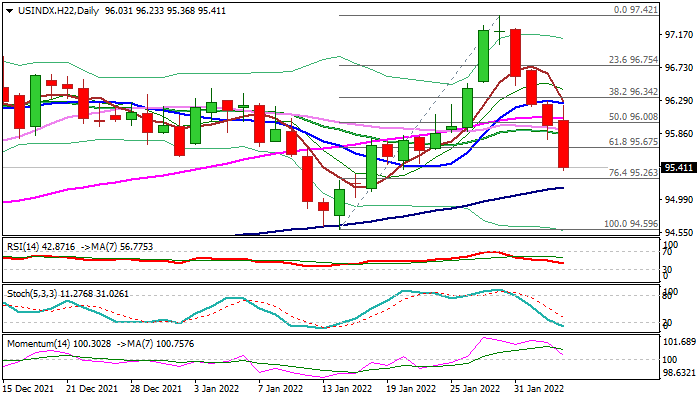
The dollar index accelerated lower and hit the lowest in over two weeks on Thursday, following BoE and ECB’s policy meetings.
Near-term bears extend into fourth straight day, boosted by BoE’s hawkish hike and changed ECB’s narrative in central bank’s tiny shift towards tightening bias and dropping comments that 2022 hikes are unlikely, while narrowing divergence between the Fed and BoE and ECB on expected rate hikes, adds pressure on the US currency.
Weaker structure of daily studies (sharp loss of positive momentum / MA’s 10/20/30 turned to bearish setup) favors further weakness, as bears surged through 95.67 pivot (Fibo 61.8% of 94.59/97.42 upleg) and eye targets at 95.26 (Fibo 76.4%), 95.14 (100DMA) and 95.08 (daily cloud base)
Today’s close below broken 95.67 Fibo support to confirm bearish signal.
Res: 95.67; 95.85; 96.00; 96.25
Sup: 95.26; 95.14; 95.08; 94.59
EURCAD Soars to Monthly Highs; Bullish But Overbought
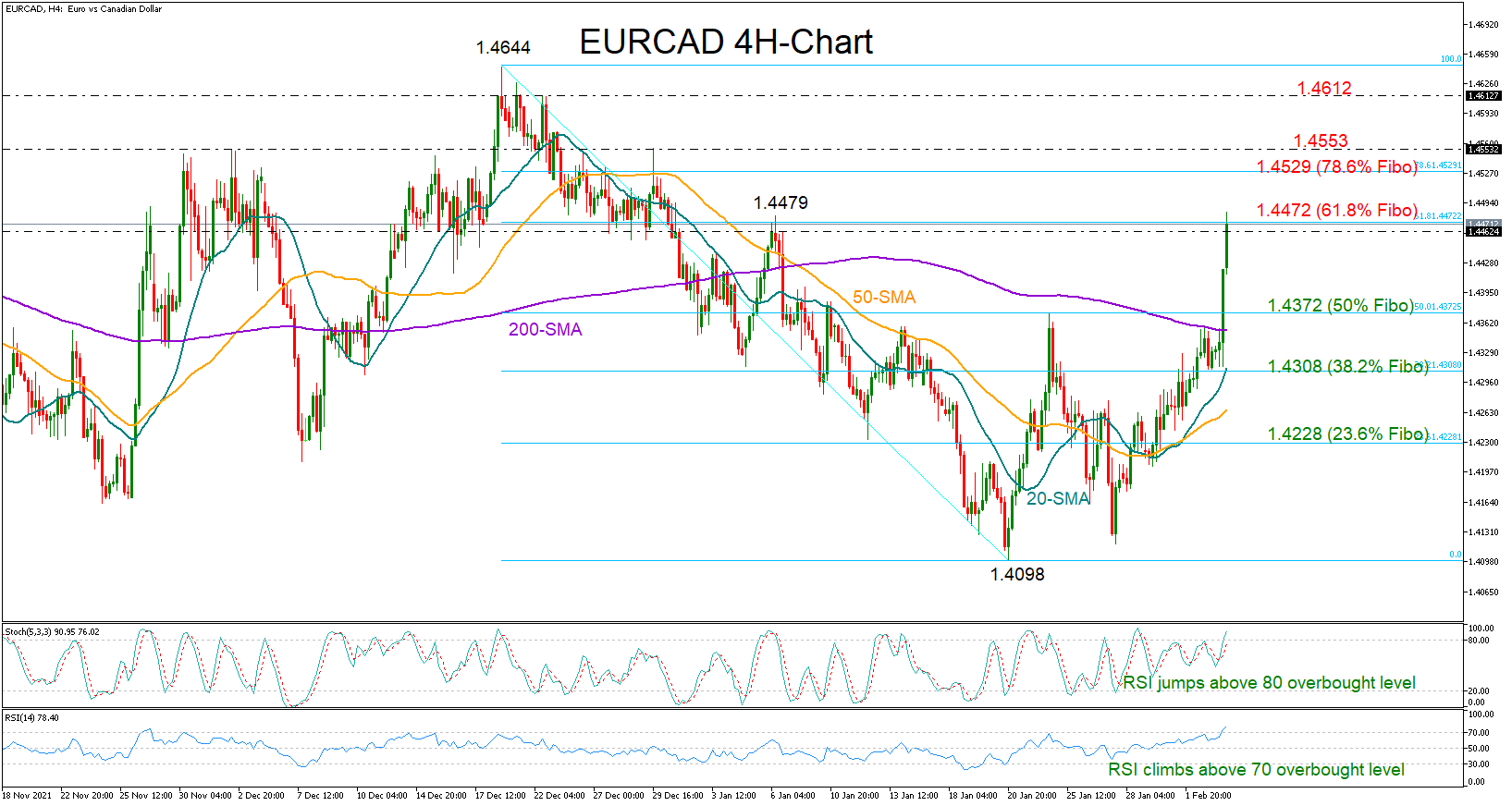
EURCAD surged furiously above the 200-period simple moving average (SMA) on the four-hour chart, which has been blocking upside movements over the past few sessions, to print a one-month high at 1.4484.
The market action, however, has not closed above January’s top of 1.4479 and the 61.8% Fibonacci retracement of the 1.4644 – 1.4098 down leg yet. Hence, a downside correction is still looking increasingly likely as the RSI and the Stochastics sail in the overbought area.
In the event the wall at 1.4479 collapses, the price could immediately jump into the 1.2529 – 1.4553 region formed by the 78.6% Fibonacci and the 2021 limits. Crawling higher, the rally could battle the crucial border of 1.4612 and the 1.4644 top before printing a new peak at 1.4726.
If the 1.4479 bar proves a tough obstacle, the pair may reverse south to seek support around the 50% Fibonacci of 1.4372. The 20-period SMA and the 38.2% Fibonacci of 1.4308 could next show up on the radar ahead of the 23.6% Fibonacci of 1.4228.
In summary, the latest sharp bullish run in EURCAD seems to have entered overbought waters, increasing the likelihood for a downside correction near January’s limits.
US: Services Sector Slowed as Omicron Hit in January, But Growth Continued
The ISM services index eased 2.4 percentage points (ppts) to 59.9 in January (from 62.3 reported in December). This was a slightly better reading than 59.5 expected by the median consensus estimate.
Demand sub-indexes continued to grow, but at a slower pace. The business activity sub-index declined by 8.4 ppts to 59.9 from 68.3, while new orders remained above 60, easing only 0.4 ppts to 61.7 from 62.1 reported in December.
The supply-side indicators saw mixed fortunes. Delivery times worsened, with the supplier deliveries sub-index increasing by 1.8 ppts to 65.7, still the index is 10 points below its recent high of 75.7 in November. Meanwhile, the backlog of orders sub-index eased by 4.9 ppts to 57.4 from 62.3 in December (likely due to slower demand).
Inventories were up by 2.7 points to 49.4, while inventory sentiment increased markedly to 47.5 (+9.2 ppts) – still in the contractionary territory, suggesting that inventories remain too low for the level of demand.
The new export orders sub-index plunged to contraction, collapsing by 15.6 ppts to 45.9. Imports remained in expansion dropping to 51.1 (- 4.4 ppts).
The employment sub-component slowed for the second month, but remained expansionary with a reading of 52.3, down from 54.7 in December.
The prices paid component moved lower to 82.3 from its highest level of 83.9 in December.
Fifteen industries expanded in January. The three industries reporting contraction are Agriculture, Forestry, Fishing & Hunting; Arts, Entertainment & Recreation; and Information.
Key Implications
The services sector started the new year on a weaker footing, largely due to Omicron. Based on the sentiment expressed in today's report, firms' remain cautiously optimistic about demand despite "challenging operating conditions".
Comments on employment paint a colorful picture: "Omicron is keeping between 20 and 25 percent of our workforce out daily". We'll have a better idea about how Omicron affected January employment numbers tomorrow. Stay tuned.
Despite these challenges, the trend path remains upward, suggesting that the sector will bounce back once the threat of Omicron fades. The sector hasn't fully profited from reopening and should continue to benefit from consumers' directing more of their spending to services.