Sample Category Title
Volatile Trading Continues as Fed Meets, Ukraine Tensions Boil
- Wall Street bounces back but futures, Asia sink again; mood brighter in Europe
- Dollar and yen hold firm as Fed angst and geopolitical risks keep havens in demand
- Earnings and US consumer confidence gauge may test investor nerves
More rocky rides for stocks
Shares on Wall Street staged a dramatic rebound on Monday, recovering from heavy losses that briefly took the S&P 500 into correction territory. The benchmark index was down by about 4% at one point before a last minute rally pulled stocks out of the sinkhole. The S&P 500 ended the session 0.3% higher. The Dow Jones closed up a similar amount, while the Nasdaq Composite, which had slumped almost 5%, posted a 0.6% gain. However, the tech-heavy Nasdaq remains in correction territory and futures are down again, suggesting the bounce back was merely a buy-the-dip opportunity rather than a meaningful rebound.
Still, with technical indicators signalling that the near two-week selloff was overdone, a comeback is possible, especially if the upcoming earnings releases and Fed meeting go the markets’ way. In the meantime, there are jitters all around.
Stocks in Asia plummeted today, with China’s CSI 300 index closing at a six-month low and the Nikkei 225 at a 5-month low. It’s a slightly more positive picture in Europe where shares are recouping some of yesterday’s huge losses.
Even if the mood continues to improve somewhat over the course of the day, sentiment remains fragile as investors have quite a lot to contend with.
Fed policy in the spotlight
The US Federal Reserve starts its two-day monetary policy meeting today and although no change is expected at tomorrow’s announcement, speculation is running high that Fed chief Powell will flag a sharp removal of accommodation at the next meetings. Markets are in no doubt now that policymakers need to act quickly to get a grip on inflation. But there’s worries that the Fed has fallen so behind the curve, it won’t be possible to bring inflation back under control without choking off growth.
Yesterday’s flash PMIs out of the US have already raised question marks about the strength of the economy as they pointed to stagnating growth in January.
The fears about the growth outlook might be one reason why Treasury yields have taken a backseat lately, though they are edging slightly up today.
Safe havens bolstered by Ukraine tensions
The US dollar on the other hand has been taking its lead from the broader market anxiety, not just about the Fed but also from geopolitical factors, as well as the elevated volatility in stock markets.
The dollar index is currently trading near two-week highs, as it continues to erase its early January slide. The safe-haven Japanese yen has been another major beneficiary of the recent market panic, appreciating significantly against the riskier currencies such as the pound, aussie and kiwi.
Gold hasn’t fared too badly either from the latest market upheaval, though the strong bids for the dollar in the last couple of sessions have taken some of the shine off bullion. The precious metal was last quoted 0.3% lower at $1,1837/oz.
Whether gold can make more substantive gains in the next few days probably depends on whether the standoff between the West and Russia over Ukraine escalates further. With Russian troops massing on Ukraine’s border, the situation could deteriorate at any moment.
Aussie gets CPI boost, other majors sag
The prospect of a war on Europe’s doorstep is taking a toll on the euro, which has slid back below $1.13. The never-ending partygate saga in the UK seems to be only marginally weighing on sterling.
The New Zealand dollar, meanwhile, is unable to catch a break, skidding to more than 14-month lows versus the greenback. The loonie was off yesterday’s lows as investors eyed a possible rate hike tomorrow by the Bank of Canada. But the Australian dollar got a boost from stronger-than-expected CPI data out of Australia earlier today, bolstering expectations of a hawkish shift by the RBA next week.
Coming up later today, the US consumer confidence index for January could help shape the market tone ahead of the earnings reports by General Electric and Verizon before the market open, and by Microsoft after Wall Street’s closing bell.
Aussie Yawns after Inflation Surges
The Australian dollar is flat on Tuesday, trading quietly at 0.7140 in the European session.
Q4 inflation higher than expected
Inflation remains on the move, as fourth-quarter CPI beat expectations. CPI climbed 1.3% q/q (1.0% exp.), up from 0.8% in Q2. On an annualized basis, CPI jumped 3.5% (3.2% exp.), up from 3.0% in Q2. The drivers behind the rise in inflation were higher fuel prices and the cost of new homes, as the construction sector continues to grapple with a shortage of building materials coupled with strong demand.
With annualized inflation running at a 3.5% clip, above the RBA’s target band of 2%-3%, the key question facing the markets is how will the RBA respond? Unemployment has fallen faster and inflation has climbed higher at a faster pace than the RBA anticipated, but this does not mean that a rate hike is around the corner. RBA Governor Philip Lowe has repeatedly stated that he won’t raise rates until unemployment has fallen to 4% and wage growth rises to 3%. Unemployment is close to that requirement, falling to 4.2% in December, but wage growth is well below target, at 2.2%.
Central bankers like to rely on the argument that high inflation without a rise in wage growth is not sustainable, which is why I would urge market participants not to assume that the RBA will shift policy even if inflation keeps climbing – the bank may well decide to hold off on a rate hike until wage growth is at or close to 3%, which is not expected to occur prior to 2023.
Of course, there is always the possibility that Governor Lowe will change course and become more aggressive due to market pressure and the rise in inflation, as was the case with the Federal Reserve which has become more hawkish over the past few months. The strong CPI reading is also significant in that it lends further support to expectations that the RBA will wrap up its bond-buying scheme at the February meeting.
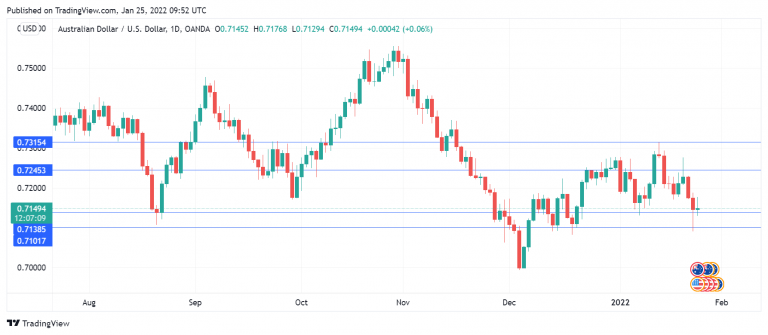
AUD/USD Technical
- AUD/USD is putting pressure on support at 0.7138. Close by, there is support at 0.7101, protecting the round number of 0.7100
- There is resistance at 0.7245 and 0.7315
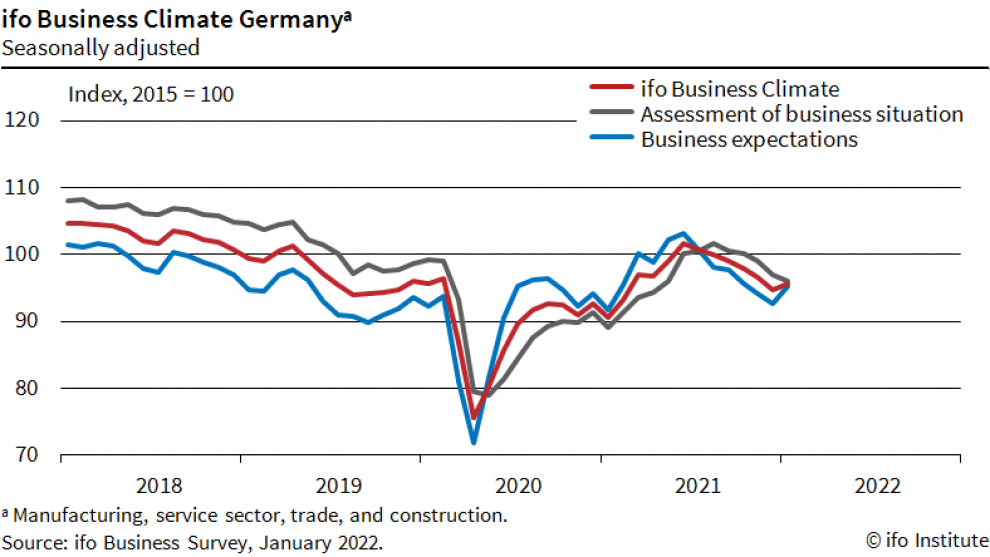
Germany Ifo business climate rose to 95.7, a glimmer of hope
Germany Ifo Business Climate rose from 94.8 to 95.7 in January, above expectation of 94.7. Current Assessment index dropped from 96.9 to 96.1, matched expectations. Expectations index improved from 92.7 to 95.2, above expectation of 93.0.
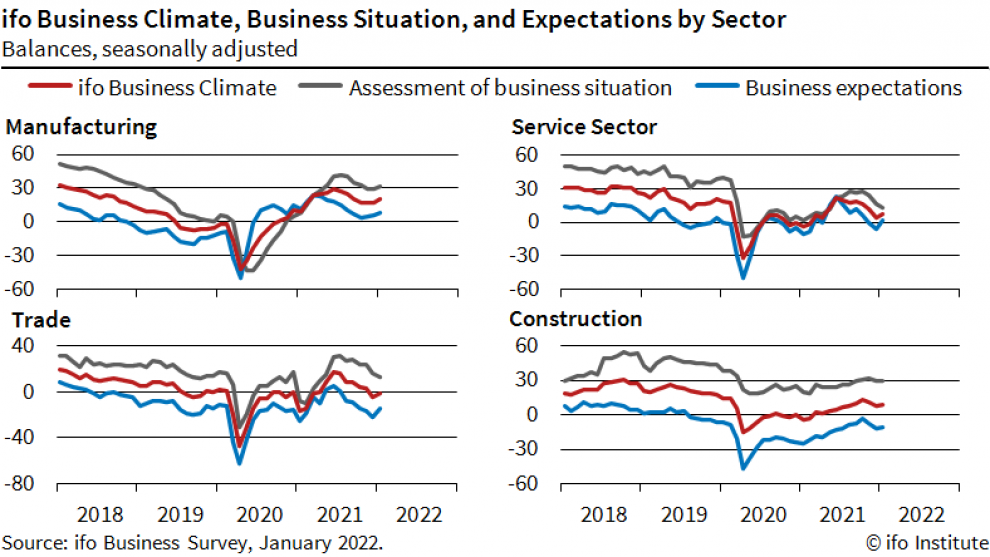
By sector, manufacturing rose from 17.4 to 19.9. Services rose from 4.6 to 7.7. Trade rose from -4.1 to -1.3. Construction rose from 7.6 to 8.7.
Ifo said: "While companies' assessments of the current situation were somewhat less positive, their expectations improved considerably. The German economy is starting the new year with a glimmer of hope."
Markets Cautious Ahead Of Russia-Ukraine Tensions and Fed Meeting
Asian stocks flashed red on Tuesday morning, alongside U.S futures after an explosively volatile session on Wall Street.
Global equity markets were flung on a chaotic rollercoaster ride as investors grappled with Fed hike fears and mounting geopolitical tensions over Ukraine. In the currency space, king dollar edged higher despite the slight retreat in Treasury yields while gold glittered amid the risk aversion.
European markets are catching up on the strong US close this morning, but the caution in Asia has cast a cloud over sentiment as investors would prefer to shrug off the intense volatility that rattled global markets on Monday.
Although Wall Street swung back toward positive territory yesterday as investors exploited the selloff to snatch discounted shares, US equity bulls are certainly not out of the woods. Should inflation concerns, Fed hike fears, and geopolitical tensions fuel risk aversion in the days ahead, this could spell trouble for risk assets across the globe.
Overnight, Australia’s inflation jumped to 3.5% in the fourth quarter of 2021 amid rising petrol and housing costs. The Australian dollar pushed higher during early trading as expectations rose over the RBA adopting a more hawkish tone at its next monetary policy meeting on February 1. Traders are currently pricing in a 58% chance of a rate hike by May 2022, with June fully discounted.
Spotlight swings on Fed meeting
Although monetary policy is widely expected to remain unchanged, the FOMC meeting could provide some key insight into how aggressive the Fed intends to tighten policy throughout 2022. Markets expect the central bank to signal on Wednesday that it plans to hike interest rates in March, with a total of four 25 basis point interest rates increases expected by the end of this year. While the Fed may stick to the script, any hesitancy on future rate increases or a more dovish tone could breathe life back into riskier assets. Alternatively, a hawkish Fed may deal another blow to stock markets, injecting equities bears with fresh confidence.
Commodity spotlight - Gold
Gold kicked off the week on a firm note as geopolitical tensions accelerated the flight to safety.
The slight retreat in Treasury yields also helped zero-yielding gold, as prices ventured towards the $1845 resistance level. There is no doubt that this will be a big week for gold with its near-term outlook likely to be influenced by the Fed meeting.
A hawkish Fed that signals multiple rate hikes could dampen the appetite for gold, resulting in prices sinking back towards $1831 and $1810. If the Fed surprises markets by deviating from the script and shows hesitancy in future rate hikes, this may push the precious metal higher towards $1870.
AUDUSD Aims for Recovery as Short-Term Decline Halts
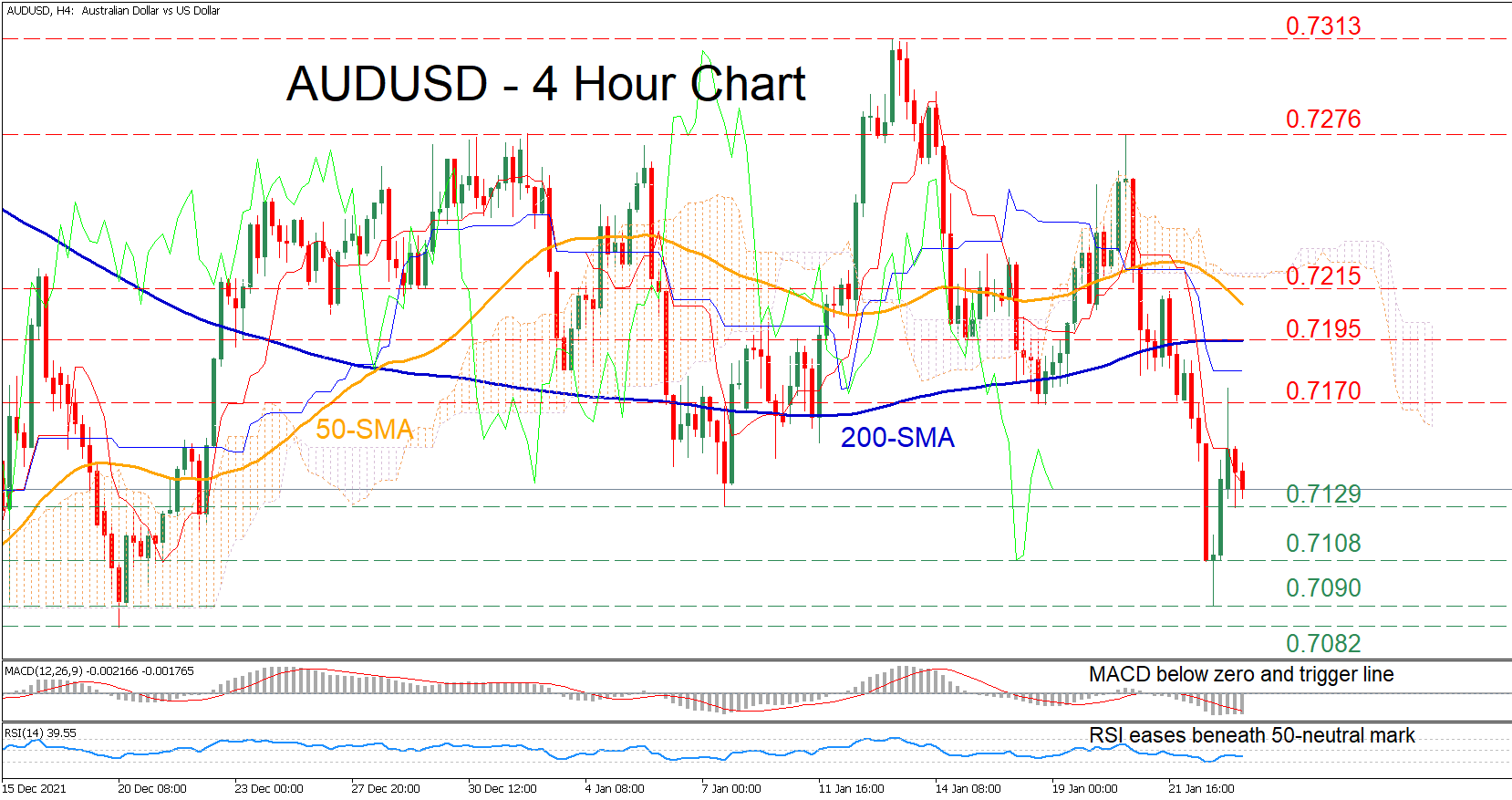
AUDUSD has experienced a sharp dip in the four-hour chart, crossing beneath both its 50- and 200-period simple moving averages (SMAs). However, the pair managed to partially bounce back after finding significant support at the 0.7090 level.
The ongoing rebound seems to be in danger as the short-term oscillators indicate that selling forces continue to have the upper hand. The MACD histogram remains below both zero and its red signal line, while the RSI is hovering in the negative zone. Moreover, the price is currently trading well beneath the Ichimoku cloud further endorsing the negative outlook.
Should the negative momentum intensify, the price might dip towards the recent low of 0.7129. Breaching this barrier, the bears could aim for the 0.7108 obstacle. Further downside pressure could send the price to test 0.7090.
On the flipside, if buyers manage to retake control, the price may meet initial resistance at the 0.7170 hurdle. Conquering this barricade, the spotlight would turn to the 0.7195 level, which overlaps with the 200-period SMA. Higher, the price might jump towards the 0.7215 region before it challenges 0.7276.
In brief, the outlook for AUDUSD remains negative despite the recent minor rebound. For that bearish tone to reverse, the price needs to profoundly cross above the 0.7276 region.
EURCHF Continues its Downtrend Move as Bearish Forces Linger
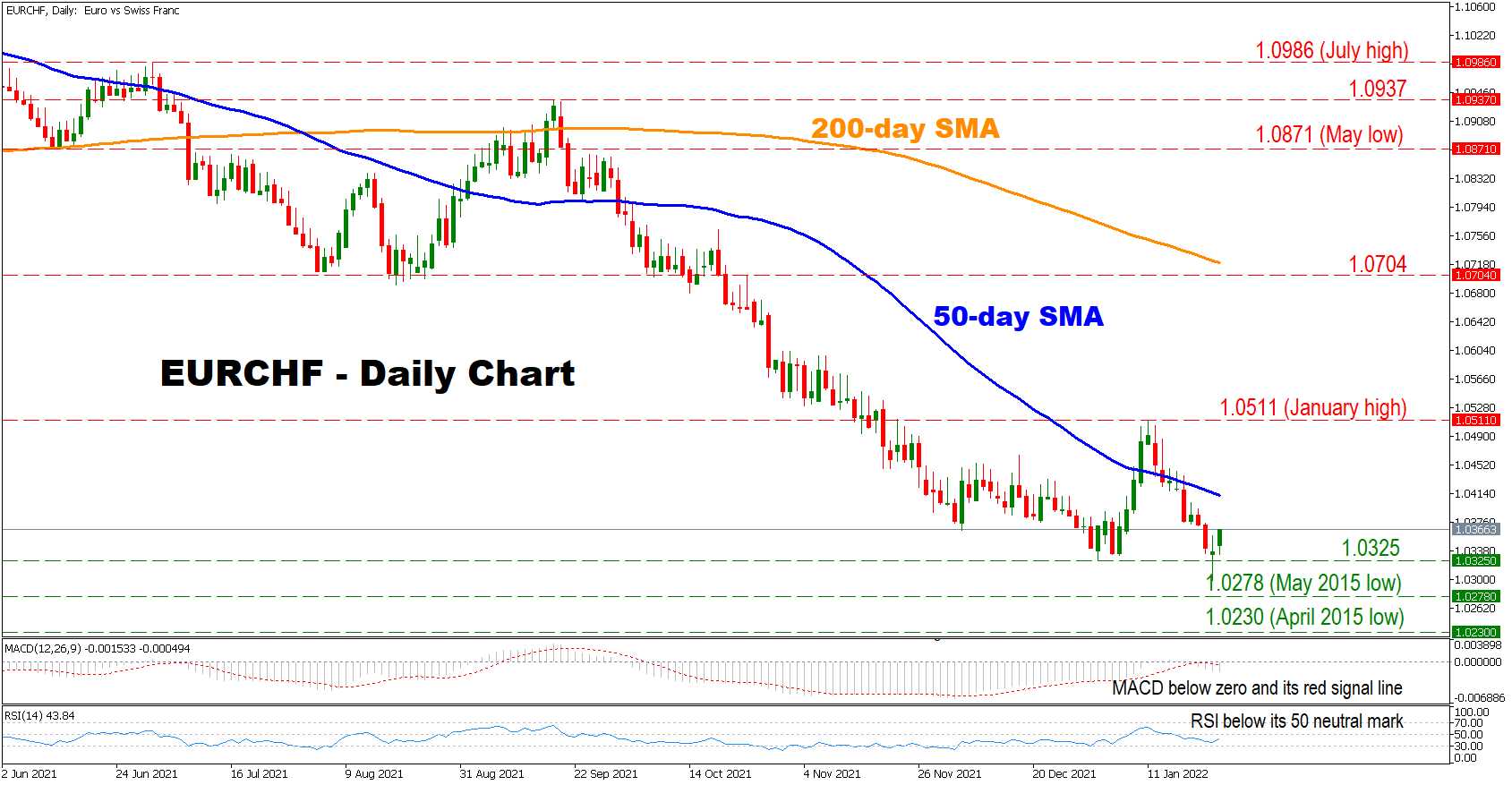
EURCHF continues its downward trend, marking yet more lower lows as negative forces linger. Moreover, the pair is currently trading well below its 50- and 200-day simple moving average (SMA), reflecting an overall bearish outlook.
Short-term momentum indicators are supporting a negative bias as the RSI is located below its 50 neutral mark. Also, the MACD is found below zero and its red signal line, which might indicate that the negative momentum is gaining further traction.
Should the bears maintain control, the first line of support might be found at the 1.0325 barrier. A decisive move below this level could intensify selling pressures, sending the price to test its crucial May 2015 low at 1.0278. A break below the latter could shift bears’ attention towards the April 2015 low at 1.0230.
On the flip side, initial resistance might be found at the 50-day SMA currently at 1.0412 before buyers shift their attention towards the January high at 1.0511. Crossing above this point could open the door towards the region which includes the 1.0704 obstacle and the 200-day SMA currently at 1.0723. A break above the latter could turn the fortunes around for the pair, sending the price to test its May low at 1.0871.
In brief, the overall outlook for the pair is bearish. For sentiment to change, buyers would need to break above the 200-day SMA.
Gold Technical Signals Flash Green; Trendline in Focus
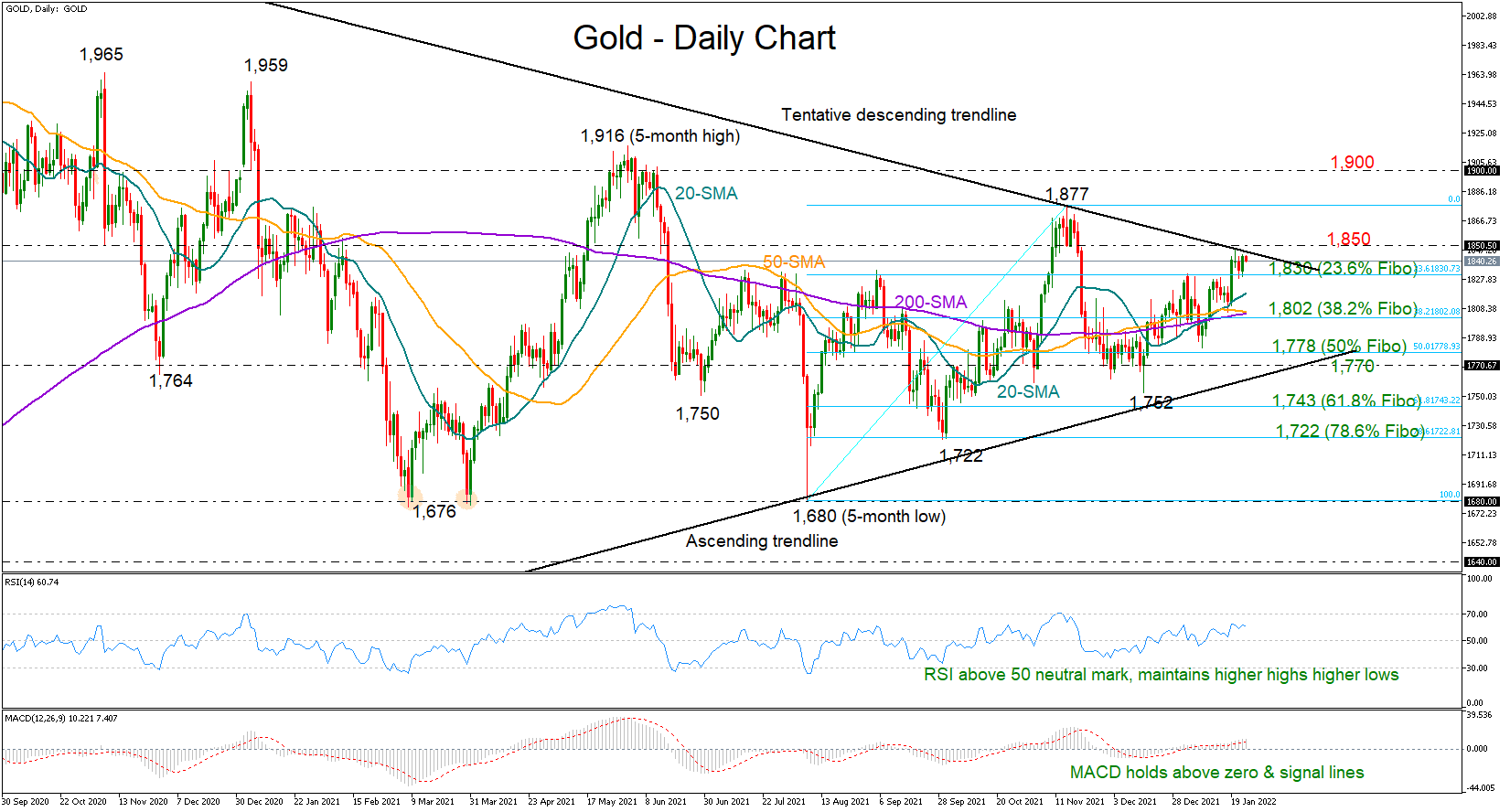
Gold shifted the spotlight to the descending trendline, which is connecting the all-time high of 2,079 from August 2020 with November’s 2021 peak of 1,877, following the break above the tough 1,830 ceiling.
The recent bullish double cross between the 20-day simple moving average (SMA) and the longer-term SMAs is promoting further progress in market trend, while the positive trajectory in the RSI and the MACD suggests an upside move in the price is more likely than a downside one.
Bullion, however, will need to successfully close above the resistance trendline and the 1,850 round-level to raise buying orders towards November’s top of 1,877. Running higher, the precious metal could face a critical test within the 1,900 – 1,916 region, a break of which would officially violate the long-term downtrend from the 2,079 record high, hopefully bringing the medium and long-term bulls into play as well.
Should the bearish scenario unfold, with the price pulling back below the 1,830 mark, the 20-day SMA could immediately attempt to block the way towards the 38.2% Fibonacci retracement of the 1,680 – 1,877 up leg at 1,800. Breaching the latter, the price will probably seek shelter around the 50% Fibonacci before it heads towards the long-term supportive trendline around 1,770. Failure to bounce here could see a more aggressive sell-off towards the 61.8% Fibonacci of 1,743.
In brief, Gold's technical signals continue to flash green despite its latest stabilization, with buyers eagerly waiting for a sustainable move above the resistance trendline and the 1,850 number to further raise exposure in the market.
S&P 500 Sinks into Correction ahead of Microsoft and Verizon Earnings
American stocks tumbled on Monday as worries over ongoing tensions between Russia and western countries escalated. In a statement, UK intelligence officials warned that Russia was targeting the Ukrainian capital in a “lightning war”. The statement came two days after the agency said that Russia was planning on installing a pro-Russian government in Ukraine. The UK and the US have ordered their diplomatic staff out of Ukraine while NATO has sent weapons to Ukraine. The Dow Jones index declined by over 900 points while the S&P 500 moved into the correction zone.
The US dollar tilted higher ahead of the upcoming consumer confidence data. The numbers are expected to show that consumer confidence declined from 115.8 in December to 111.8 in January. The decline will likely be because of the omicron variant and rising consumer inflation in the country. The data will come a day after Markit published relatively weak flash manufacturing and services PMI data. The two declined to 55.0 and 50.9 in January, respectively. The next key catalyst for the US dollar will be the latest Fed interest rate decision.
The earning season will continue today and have an impact on American equities. The top companies that will publish their earnings today are American Express, Xerox, Johnson & Johnson, Raytheon. Archer-Daniels-Midland, Lockheed Martin, Invesco, Verizon, and Microsoft. Most of these companies are expected to report strong quarterly results. At the same time, they are also expected to express concerns about wage inflation. Meanwhile, Ford announced that it was stopping new orders for the Maverick truck because it was straining to fill the backlog.
EURUSD
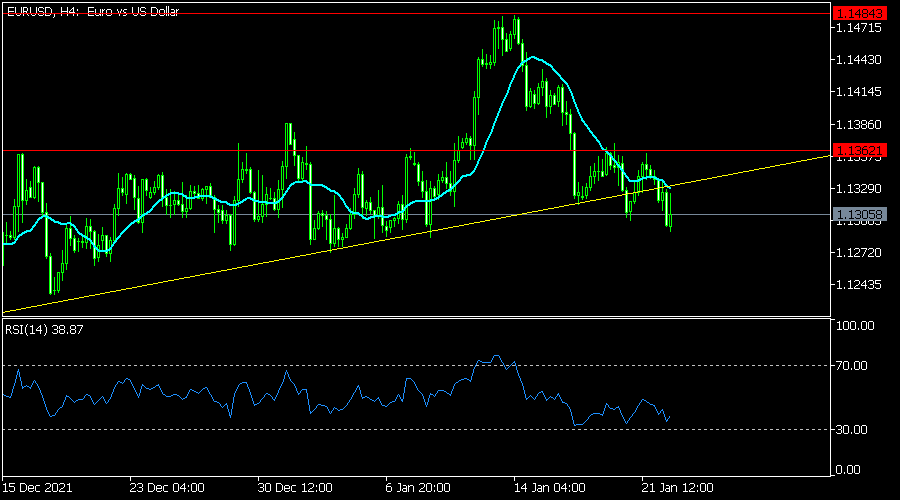
The EURUSD pair declined in the American and Asian sessions as investors rushed to the safety of the US dollar. The pair is trading at 1.1308, which is a few pips above yesterday’s low of 1.1290. On the four-hour chart, the pair has moved below the ascending trendline shown in yellow. It has also moved slightly below the 25-day moving average while the Relative Strength Index (RSI) has been falling. Therefore, the pair will likely keep falling ahead of the US consumer confidence data.
USDCHF
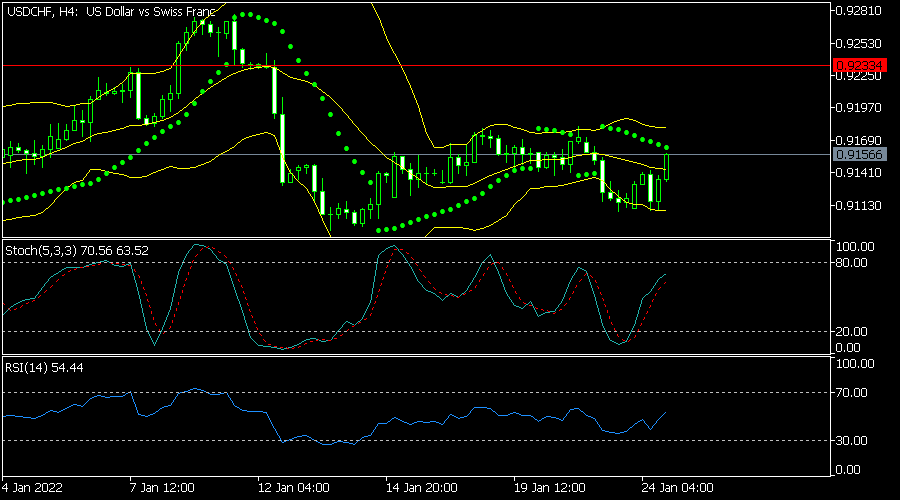
The USDCHF pair tilted higher after weak flash manufacturing and services PMI data. It is trading at 0.9150, which is slightly above last week’s low of 0.9105. On the four-hour chart, the pair is slightly above the middle line of the Bollinger Bands. It has also moved above the 25-day moving average and is slightly below the dots of the parabolic SAR. The pair will likely continue the bullish trend today.
XBRUSD
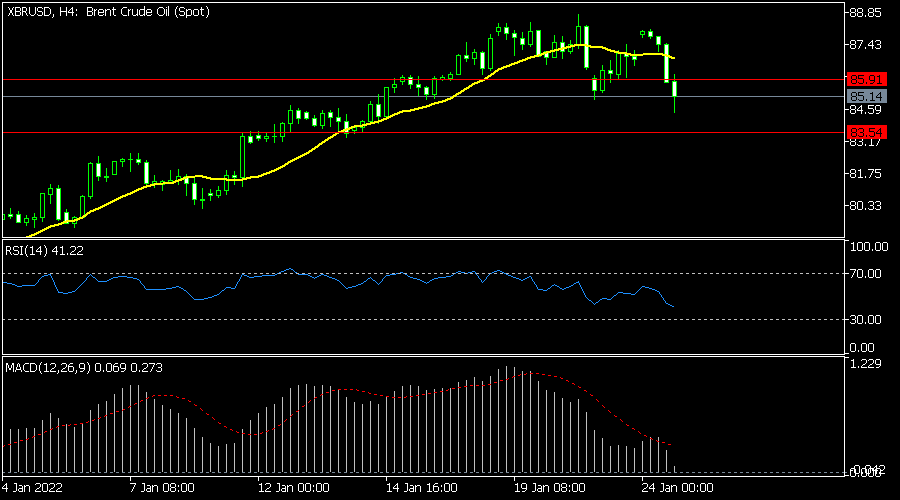
The XBRUSD pair declined to a low of 84.55 as focus shifted to the Federal Reserve. The pair is trading at 85.15, which is slightly lower than last week’s high of 88.73. On the four-hour chart, the pair moved slightly below the key support level at 85.90. It also moved below the 25-day moving average while the MACD and RSI have also retreated. The pair will continue its bearish trend today as bears target the key support at 83.50.
GER 40 Tests Critical Support
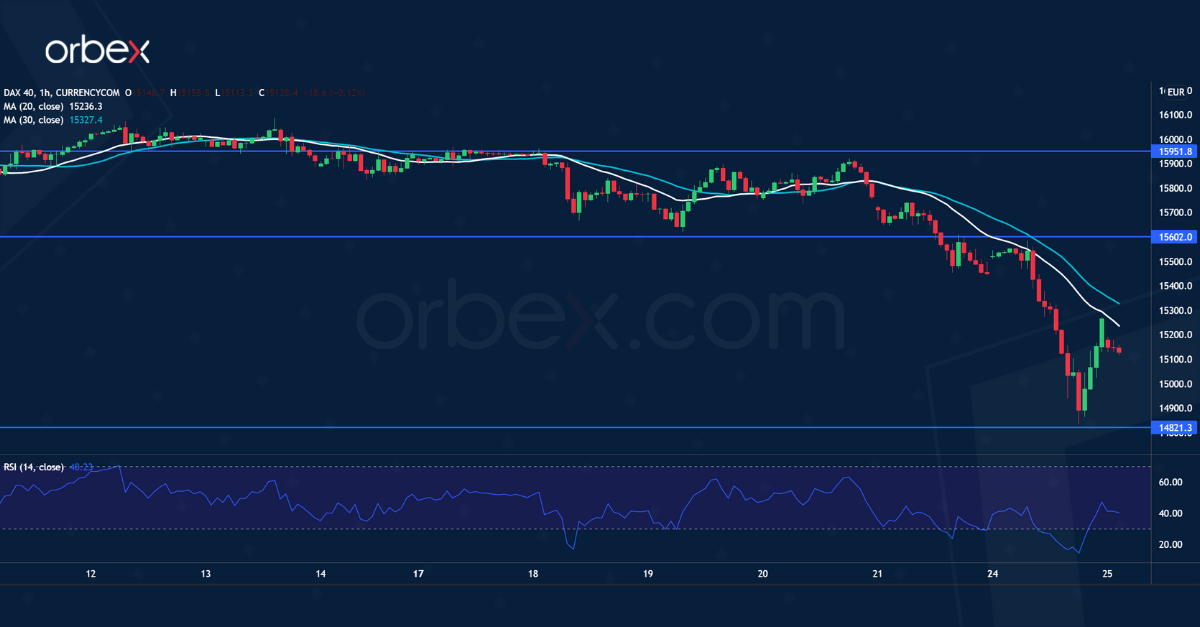
The Dax 40 plunges amid rising tensions in Ukraine. The index has given up all gains from the rebound in late December and cut through the major demand zone around 15070.
The RSI’s repeatedly oversold situation attracted a buying-the-dips crowd. Nevertheless, there is no sign of improvement in the market mood. And price action has not stabilized yet.
A grind of last October’s low at 14820 would test the bulls’ resolve in the medium-term. On the upside, 15600 is the first hurdle to lift.
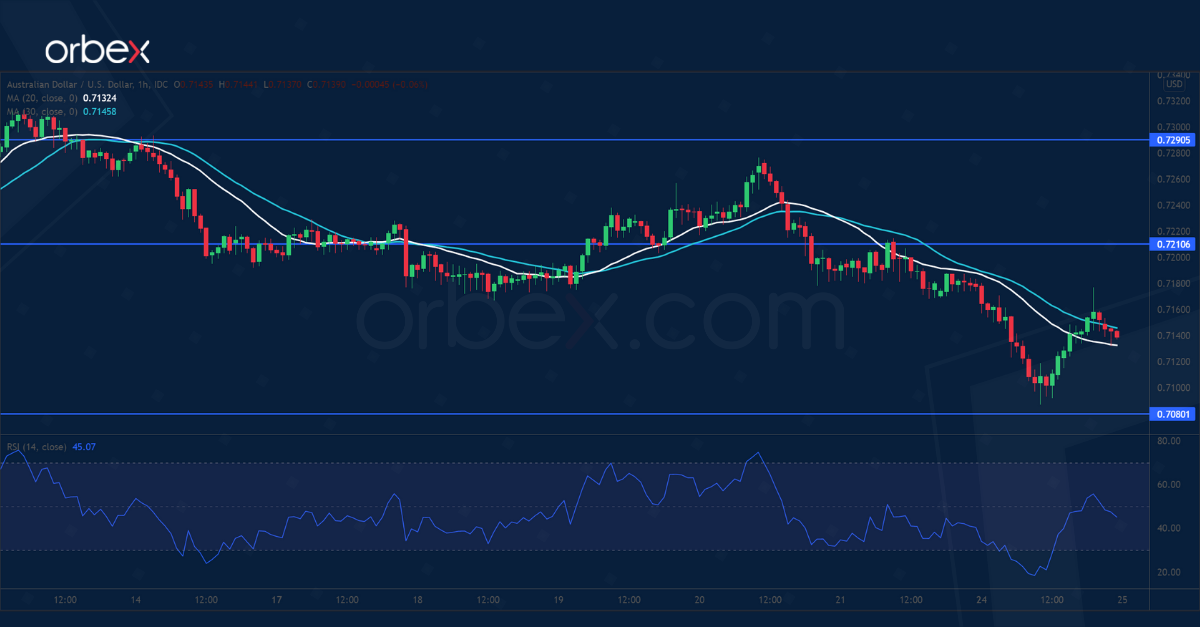
AUD/USD in Bearish Reversal
The Australian dollar recovered after the Q4 CPI beat expectations. However, the latest rally took a bearish turn after the price slipped below 0.7170.
The lack of commitment to hold onto recent gains suggests a weak risk appetite. A fall below the daily support at 0.7130 further weighs on the Aussie and prompts buyers to bail out.
The RSI’s oversold situation helped lift the pair temporarily. Nonetheless, the bears might be eager to sell into strength near 0.7210. 0.7080 would be the next stop as the trend turns south.