Sample Category Title
USD/CAD Daily Outlook
Daily Pivots: (S1) 1.3699; (P) 1.3719; (R1) 1.3752; More...
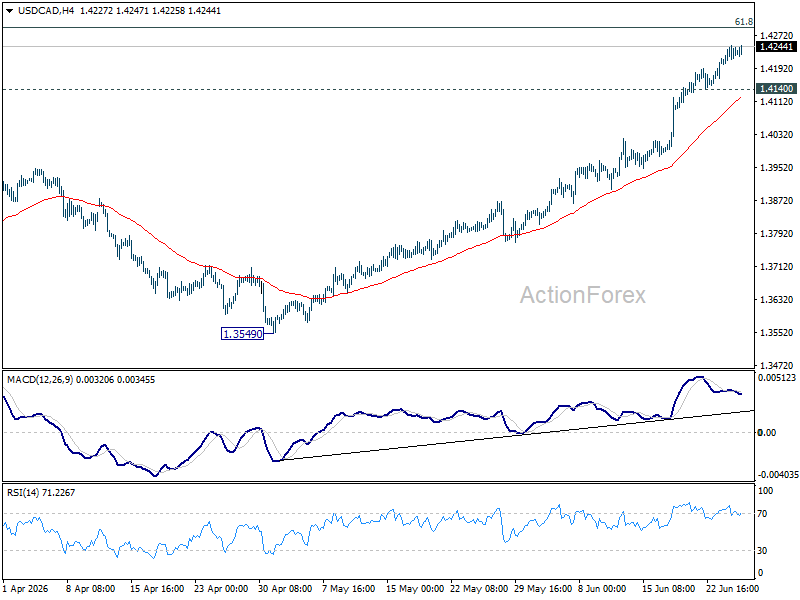
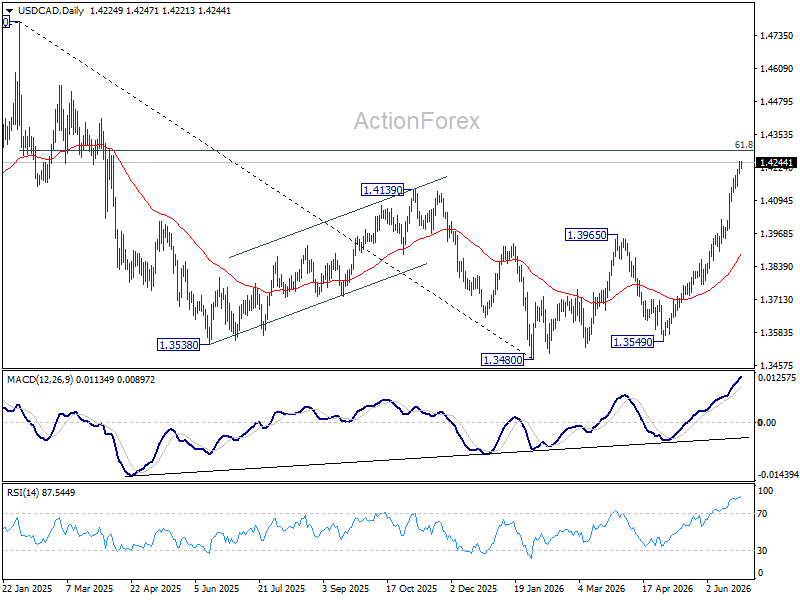
No change in USD/CAD's outlook and intraday bias remains neutral. On the upside, firm break of 1.3751 resistance will suggest that stronger rebound is underway, and target 1.3927 resistance first. Meanwhile, break of 1.3524 support will bring resumption of whole down trend from 1.4791.
In the bigger picture, price actions from 1.4791 are seen as a corrective pattern to the whole up trend from 1.2005 (2021 low). Deeper fall could be seen, as the pattern extends, to 61.8% retracement of 1.2005 to 1.4791 at 1.3069. However, break of 1.3927 resistance will argue that the correction has completed with three waves down to 1.3480 already.
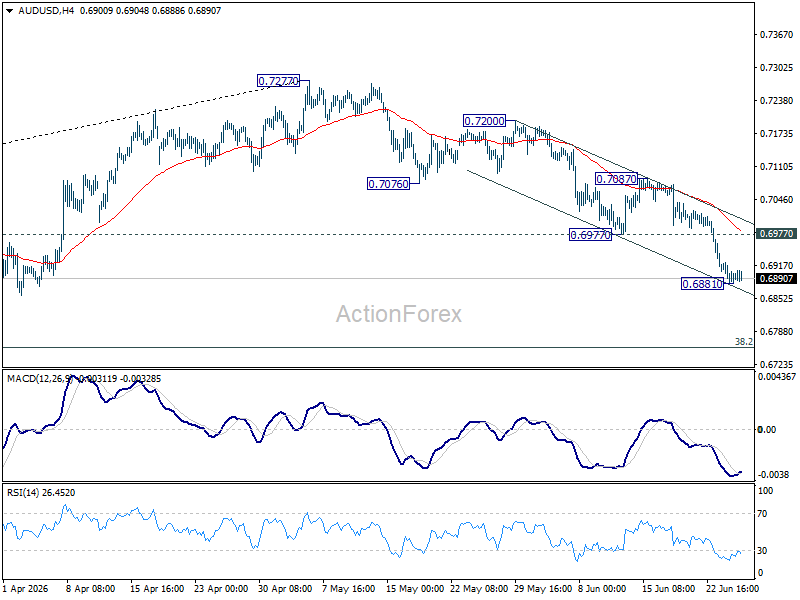
AUD/USD Daily Report
Daily Pivots: (S1) 0.6986; (P) 0.7055; (R1) 0.7093; More...
Sideway trading continues in AUD/USD and intraday bias remains neutral at this point. With 0.6943 support intact, further rally is still expected. On the upside, firm break of 100% projection of 0.5913 to 0.6706 from 0.6420 at 0.7213 could prompt upside acceleration to 161.8% projection at 0.7703. However, firm break of 0.6943 will indicate that a larger scale correction is already underway.
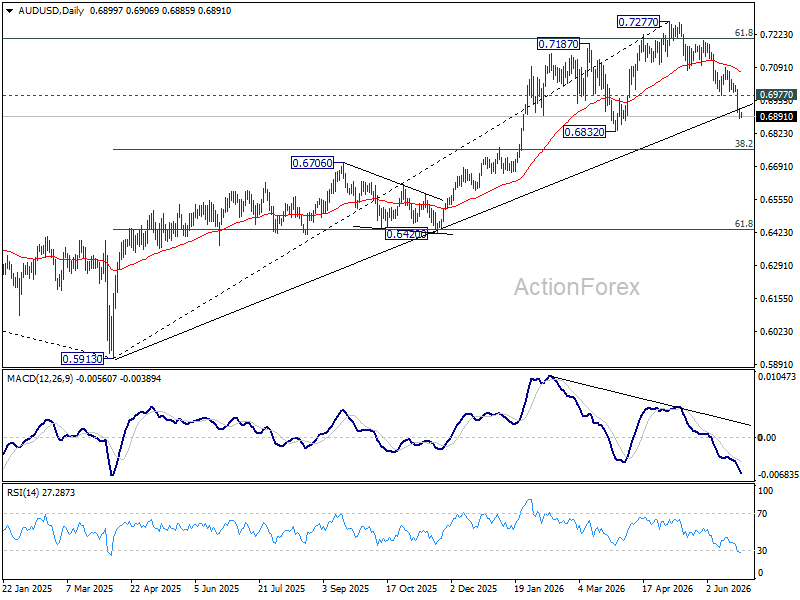
In the bigger picture, current development argues that rise from 0.5913 (2024 low) is reversing whole down trend from 0.8006 (2021 high). Decisive break of 61.8% retracement of 0.8006 to 0.5913 at 0.7206 will pave the way back to 0.8006. This will remain the favored case as long as 0.6706 resistance turned support holds, even in case of deep pullback.
EUR/USD Daily Outlook
Daily Pivots: (S1) 1.1488; (P) 1.1518; (R1) 1.1570; More….
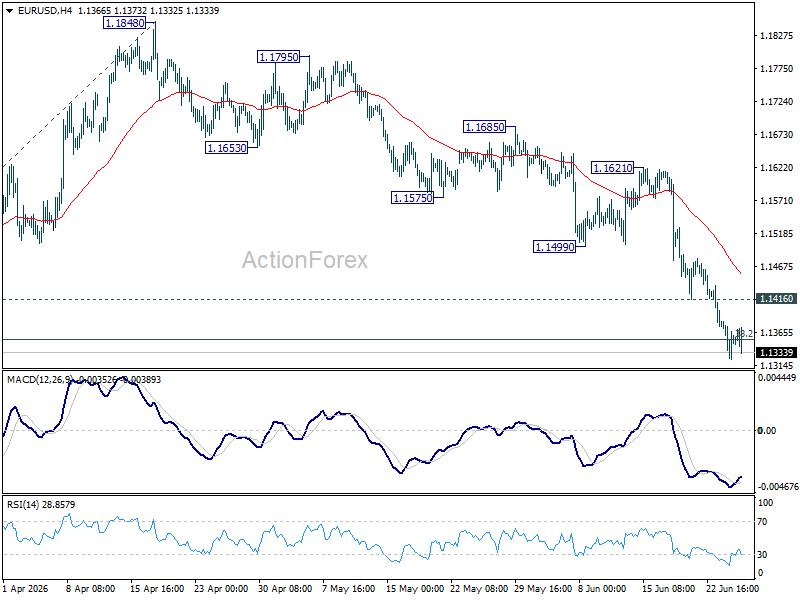
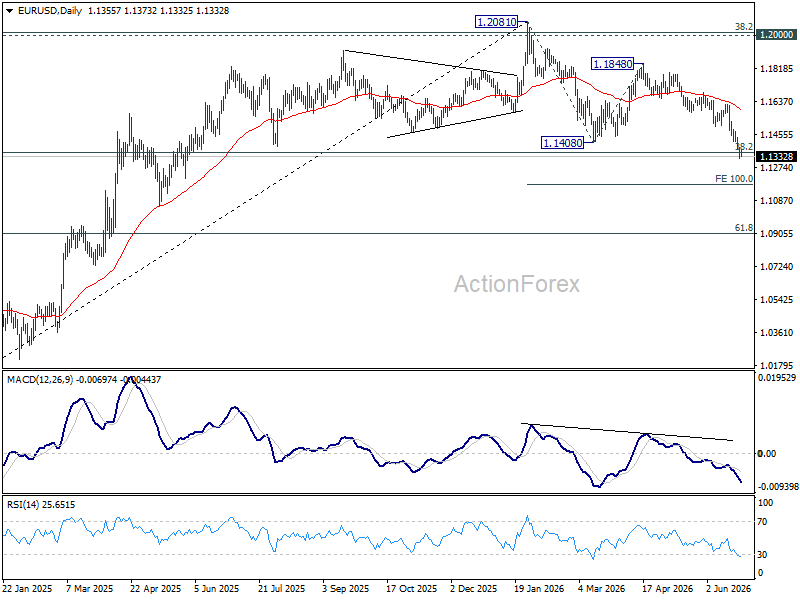
Intraday bias in EUR/USD stays neutral and more consolidations could be seen. Further decline is expected as long as 1.1666 resistance holds. Below 1.1408 will resume the fall from 1.2081 to 38.2% retracement of 1.0176 to 1.2081 at 1.1353. Firm break there will target 61.8% projection at 1.0904 next.
In the bigger picture, the break of 55 W EMA (now at 1.1495) confirms rejection by 1.2 key cluster resistance level. The whole up trend from 0.9534 (2022 low) might have completed as a three wave corrective rise too. In either case, deeper fall is now expected to long term channel support (now at 1.0528. Risk will stay on the downside as long as 1.2081 holds, in case of recovery.
GBP/USD Daily Outlook
Daily Pivots: (S1) 1.3215; (P) 1.3295; (R1) 1.3339; More...
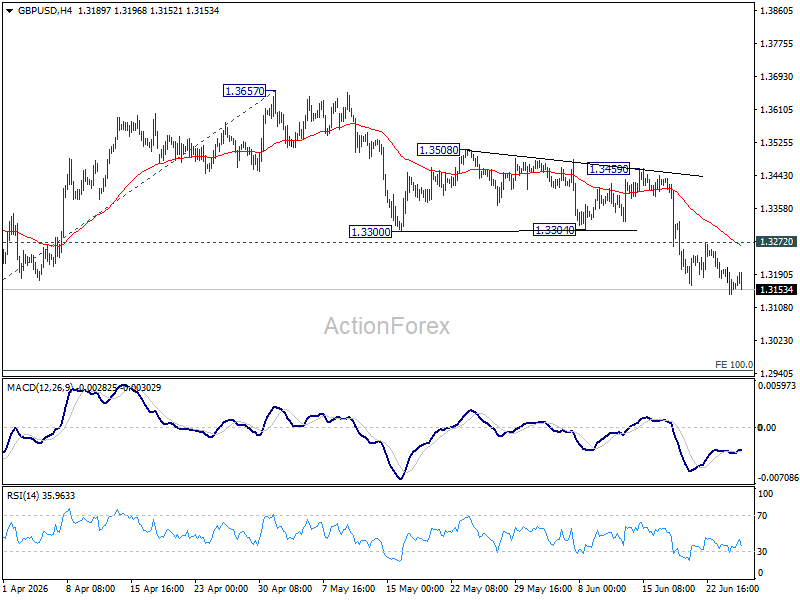
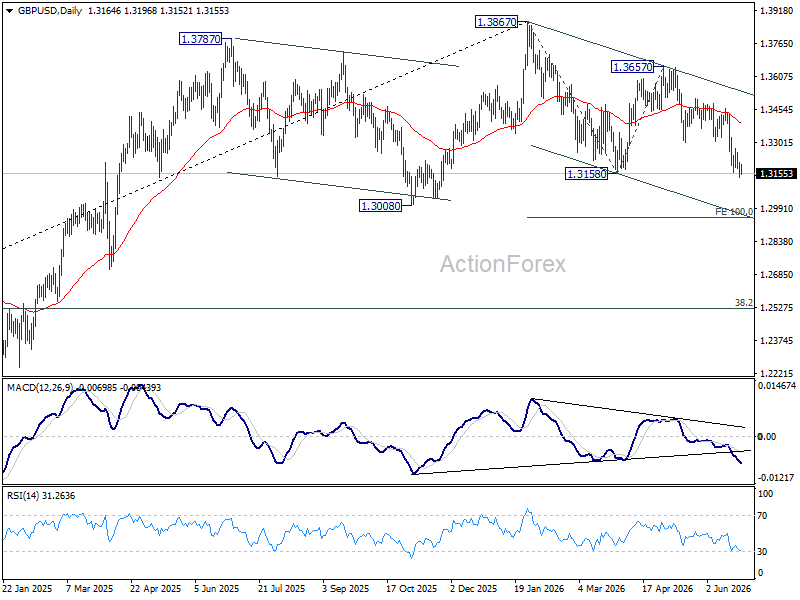
Intraday bias in GBP/USD stays neutral and more consolidations could be seen above 1.326. But risk will stay on the downside as long as 1.3482 resistance holds. Below 1.3216 will resume the fall from 1.3867 to 1.3008 structural support. Firm break there will carry larger bearish implication and target 1.2524 fibonacci level.
In the bigger picture, considering bearish divergence condition in both D and W MACD, a medium term top should be in place from 1.3867. Firm break of 1.3008 support will argue that fall from 1.3867 is at least correcting the rise from 1.0351 (2022 low) with risk of bearish reversal. That would open up further decline to 38.2% retracement of 1.0351 to 1.3867 at 1.2524. For now, medium term outlook will be neutral at best as long as 1.3867 resistance holds, or under further development.
USD/JPY Daily Outlook
Daily Pivots: (S1) 159.00; (P) 159.46; (R1) 160.36; More...
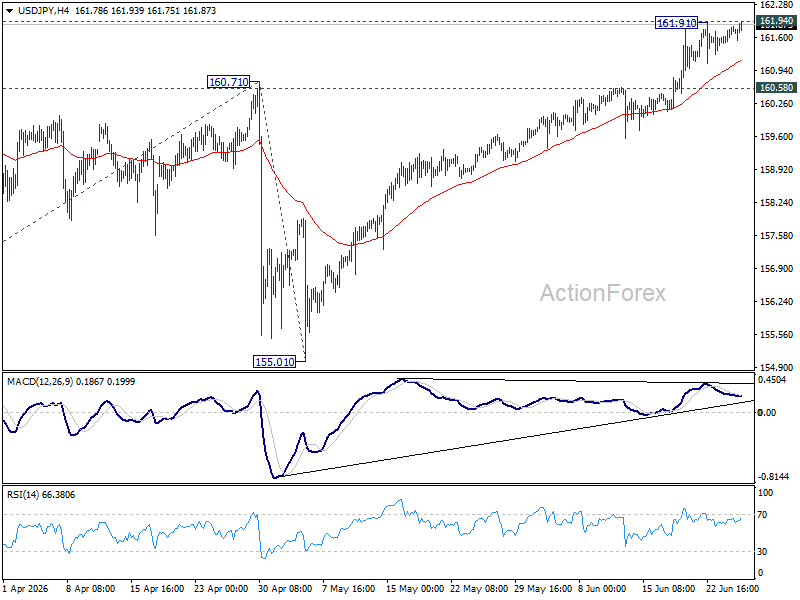
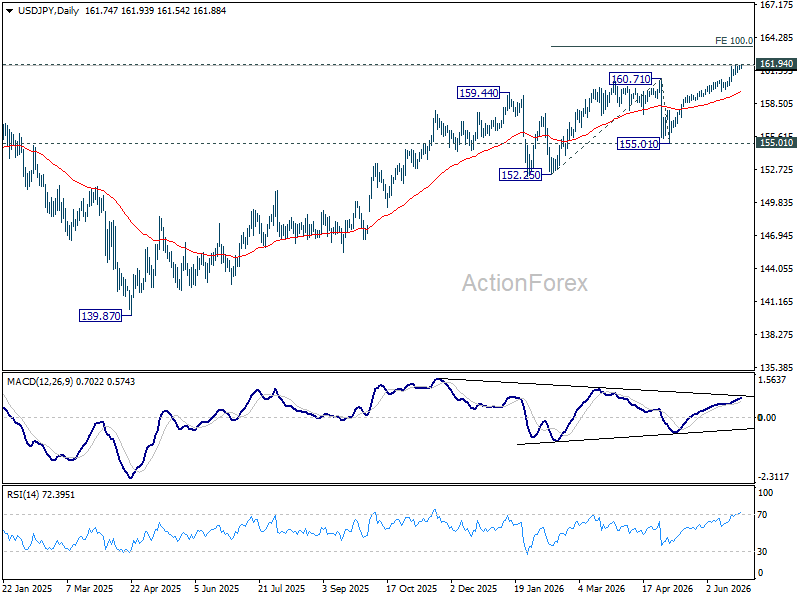
Intraday bias ins back on the upside with breach of 159.74 temporary top. Current rise from 152.25 should target a retest on 161.94 high. Firm break there will confirm larger up trend resumption and target 61.8% projection of 139.87 to 159.44 from 152.25 at 164.34. Nevertheless, considering bearish divergence condition in 4H MACD, break of 158.55 support should indicate short term topping. Intraday bias will then be back on the downside for deeper pullback
In the bigger picture, outlook is unchanged that corrective pattern from 161.94 (2024 high) should have completed with three waves at 139.87. Larger up trend from 102.58 (2021 low) could be ready to resume through 161.94. This will remain the favored case as long as 55 W EMA (now at 152.70) holds. Firm break of 161.94 will pave the way to 61.8% projection of 102.58 to 161.94 from 139.87 at 176.75.
UK wage growth cools as labor market softens despite stable unemployment
UK labor market data showed further signs of cooling in February, with wage growth easing and employment momentum weakening. Payrolled employees rose modestly by 20k on the month to 30.3 million, but were still down -49k compared to a year earlier, highlighting a gradual loss of underlying strength. Wage pressures moderated, with median monthly pay growth slowing from 4.4% yoy to 4.1% yoy. The claimant count rose by 24.7k in February, slightly below forecasts of 25.8k.
In the three months to January, average earnings excluding bonuses eased from 4.1% yoy to 3.8% yoy, undershooting expectations 4.0% yoy. Earnings including bonuses slowed from 4.2% yoy to 3.9% yoy, matched expectations. The trend points to a gradual easing in pay-driven inflation pressures.
Despite the softer wage backdrop, the labour market remains relatively resilient on the surface. The unemployment rate held steady at 5.2%, in line with expectations.
No One Knows
The relief in Oil markets on news that Iraq would resume exports via Turkey didn’t last long. News that another important Iranian official has been killed and Iranian energy facilities attacked turned the market upside down, as Iran threatened the Gulf countries with fierce retaliation, highlighting that their energy facilities have now become ‘a legitimate target’. Qatar already reported extensive damage to one of the world’s largest LNG export plant.
So, Oil and Gas prices rebounded, wiping out the early optimism across stock markets. The war is escalating rather than showing signs of easing. And risks in oil prices remain tilted to the upside. That ultimately means that risks to equities remain to the downside as:
- Rising energy prices increase costs and weigh on earnings.
- The Federal Reserve (Fed) and other major central banks will remain cautious – possibly hawkish – in the coming months to ensure that inflation doesn’t spiral out of control.
Released yesterday, the US PPI update wasn’t encouraging. Producer prices accelerated more than expected in February: core PPI rose to 3.9% y-o-y from 3.5% a month earlier, above the 3.7% expected by analysts. Meanwhile, US gasoline prices have risen nearly 40% since the beginning of March. Diesel has crossed $5 per gallon, also marking a nearly 40% increase since the start of the month.
Still, the Fed kept its calm at this week’s meeting, maintaining rates unchanged as widely expected, while the dot plot pointed to one rate cut this year, though the distribution shifted toward fewer cuts. Inflation expectations were revised higher, but Jerome Powell said that it’s ‘too soon’ to assess the impact of higher oil prices and that ‘no one knows’ what the impact will be. He noted that if this is a textbook energy shock, they have the option to look through it, but continued to insist that tariffs are a potential risk to inflation.
He said that it’s ‘important to keep policy either mildly restrictive or close to that, but not too restrictive given the downside risks in the labour market. We are balancing these two goals.’
The decision and the accompanying statement were perceived as relatively hawkish by markets: the 2-year yield rose and equities fell. I personally found Powell’s remarks rather balanced. He even said that if there is progress on inflation by mid-year, we could see a rate cut. But in fine: no one knows.
Overall, the market reaction was hawkish.
Beyond the US, the Bank of Canada (BoC) and the Bank of Japan (BoJ) also left their policy rate unchanged, while citing heightened risks due to the Middle East war. Canada is a net energy exporter, placing it on the ‘right side’ of the table. The same is not true for Japan and Europe.
Europe today is a net importer of energy and more importantly, the continent has been relying heavily on US and Middle Eastern supplies since turning its back on Russia following the war in Ukraine. Today, the situation is becoming critical. Energy prices are rising and, combined with a stronger US dollar, are pushing inflation expectations higher. This, in turn, is leading investors to adopt a more hawkish stance on central bank policy.
Today, the European Central Bank (ECB), the Bank of England (BoE) and the Swiss National Bank (SNB) will announce their policy decisions. Even though all three are expected to keep rates unchanged, the recent rise in energy prices and its impact on inflation expectations will likely lead to cautious — and possibly hawkish — statements. How hawkish? We will see.
It’s true that central banks tend to place less emphasis on food and energy prices because they are volatile. But time is not your friend in a war, and Europe has learned this the hard way. The energy crisis triggered by the war in Ukraine is a stark reminder that prolonged disruptions in energy supply can lead to sustained price pressures and must be addressed accordingly. European policymakers have recently stressed their desire to avoid repeating the same mistakes made during that crisis.
As a result, the ECB’s statement will likely be hawkish, possibly hinting at tighter policy later this year, depending on the duration of the Middle East conflict and its medium-term impact on oil prices.
Across the Channel, the BoE will likely shelve the rate cut it had been preparing to deliver. Even though growth remains anaemic and calls for support, the British economy is highly sensitive to energy prices. The 10-year gilt yield has risen by as much as 50bp since the February 27 low.
There is not much MPC members can say today — no one has a crystal ball, and no one knows how long the war will last. But the longer it lasts, and the higher energy prices climb, the further away the dream of a BoE cut drifts.
In both cases, rate hikes from the ECB and the BoE are unlikely to support the euro and sterling if energy becomes expensive. Tighter monetary policy driven by a supply shock tends to slow growth, which is ultimately negative for currencies. As such, both the euro and sterling are likely to remain under pressure from a stronger US dollar as long as the Middle East conflict persists and keeps oil prices elevated.
In Switzerland, the situation is slightly different. Switzerland is also a net energy importer, but the strength of the franc helps cushion the economy against rising oil prices to some extent. The SNB will likely prefer to wait and see.
How Will ECB Respond to Sharp Rise in Energy Prices?
In focus today
Today, we expect the ECB to leave the deposit rate unchanged at 2.00% in line with consensus and market pricing. We expect Lagarde to communicate a full commitment to price stability and readiness to act to upward price pressures but at the same time acknowledge heightened uncertainty and that it is too early to draw firm conclusions. Our baseline is unchanged ECB rates in 2026 and 2027 but with a clear upside risk. Read more in: ECB Preview - Hot war, cool heads?, 13 March.
In England, we expect the Bank of England to keep the Bank Rate unchanged at 3.75%. The war in the Middle East has pushed the pause button on further cuts for now. Ahead of the meeting, a fresh jobs report is released with higher unemployment becoming an increasing worry recently. Read more in: Bank of England Preview - Cutting cycle on pause, 13 March.
In Sweden, we and markets expect the Riksbank to keep the policy rate at 1.75%. We expect the main message will be a cautious "wait and see", without any significant adjustments to the near-term rate path. In terms of forecasts and guidance, however, the current environment is highly uncertain.
Also in Sweden, Origo inflation expectations will be published today and given recent events, it is reasonable to expect them to rise somewhat. However, it is worth noting that the responses were collected approximately 10 days ago.
We expect the Swiss National Bank (SNB) to keep rates unchanged at 0%. We are attentive to any comments on the recent strengthening of the Swiss Franc, which provides a tricky backdrop for the SNB which struggles with low inflation.
In Norway, Norges Bank's (NB) regional survey report is released. Growth has developed as expected, so we expect respondents to signal 0.3-0.4% q/q growth in both Q1 and Q2, consistent with NB's forecast. However, with elevated inflation and a tighter-than-expected labour market, capacity utilization will be the most important piece of information. A significant increase could make it necessary for NB to tighten monetary policy to anchor inflation expectations.
Overnight, China releases Loan Prime Rates, which we expect to be unchanged again as the leading 7-day reverse repo rate has not moved for some time.
Economic and market news
What happened overnight
In Japan, with an 8-1 vote split, the Bank of Japan (BoJ) kept rates unchanged this morning at 0.75%, as widely expected. Markets have taken the decision very calmly. While acknowledging risks from increased tension over the situation in the Middle East, the BoJ expects underlying inflation to increase gradually, and it will thus "continue to raise the policy interest rate and adjust the degree of monetary accommodation". We expect the next rate hike from the BoJ in April, but much hinges on spring wage negotiations and of course energy prices.
What happened yesterday
In the conflict in the Middle East, tensions escalated as Israeli strikes hit Iran's Pars gas field, a critical part of the world's largest natural gas deposit. Iranian media reported that the strikes hit gas tanks and sections of a refinery, marking the first attack on energy production facilities since the war began. In retaliation, Iran launched a ballistic missile and hit the world's largest liquefied natural gas facility in Qatar later in the evening, causing extensive damage. Earlier in the day, Iran had issued a warning, labelling regional oil and gas infrastructure in Saudi Arabia, the UAE, and Qatar as "direct and legitimate targets," significantly heightening risks to global energy supplies.
Oil and gas prices rose sharply as big gas facilities in Iran and Qatar were hit and facilities in UAE were attacked. Oil price rose above USD 110/bbl overnight and nears the top from Monday last week. If big energy installations continue to be drawn into the war, energy prices will likely rise much further as production over the medium term is hit.
The gold price fell sharply and firmly below USD 5,000/oz yesterday. The gold price has dropped since the war started which might be caused by higher bond yields and the stronger USD.
In the US at the FOMC meeting, the Fed kept rates on hold in the 3.5-3.75% target, as expected. Powell refrained from strong forward guidance but appeared more concerned about inflation than downside risks to growth. He highlighted uncertainty from higher energy prices and reiterated the Fed's readiness to adjust policy rates as needed.
Also in the US, February PPI surprised to the upside for the second month in a row coming in at +0.7% m/m SA (cons. +0.3%). However, compared to January, the pick-up in price pressures seems more broad-based this time around as both core services and core goods inflation seem to be picking up. For core goods specifically, this was the highest m/m SA reading (+0.8%) since April 2022, suggesting that tariff-related costs pressures could still be increasing.
In Canada, the Bank of Canada (BoC) kept its policy rate unchanged at 2.25%, as expected. BoC highlighted downside growth risks, while inflation risks have increased due to higher energy prices. The BoC noted that it is "too early to assess the impact of the conflict in the Middle East on growth in Canada," which complicates sending clear policy signals. The central bank did state that they will look through the immediate impact on inflation of the war but nevertheless stands ready to respond if needed.
In the eurozone, final February inflation figures confirmed flash estimates ahead of the ECB rate decision today, with headline at 1.9% y/y and core at 2.4% y/y.
Equities: Equities ended sharply lower yesterday after opening in positive territory in early European trading. Markets faded throughout the session as geopolitical escalation around Iran intensified, with equity performance showing an almost perfect negative correlation with the move higher in energy prices.
Unsurprisingly, the energy sector outperformed in this environment. More notably, however, defensive consumer sectors led the downside. This suggests an increasing investor focus on the implicit tax on consumption, initially via higher tariffs, and now increasingly through the rapid rise in energy prices. In that sense, the price action points to growing concern around the pressure on real disposable income.
Asian equities are trading in negative territory this morning. European futures are lower, while US futures are broadly unchanged.
FI and FX: Oil and gas prices rose sharply as gas facilities in Iran and Qatar were hit and facilities in the UAE were attacked. The oil price rose above USD 110 per barrel overnight and is nearing the top from Monday last week. As widely expected, the Fed and BoJ kept policy rates unchanged, while their communication highlighted the uncertainty from the war in the Middle East. Today, we look forward to a string of central bank meetings (Riksbank, SNB, BoE and ECB), all expected to stay on hold. While not our base case, a hawkish Lagarde/ECB could naturally temporarily calm down the decline in EUR/USD today. In general, we emphasize that rising global energy prices and tighter global financial conditions would both be supportive factors for the broad USD. We still like our tactical short EUR/USD idea with a target of 1.12. As for the Riksbank, our baseline is that a wait-and-see approach will not rock the boat for the SEK in an environment where macro factors are taking the backseat and geopolitical developments set the scene for FX.
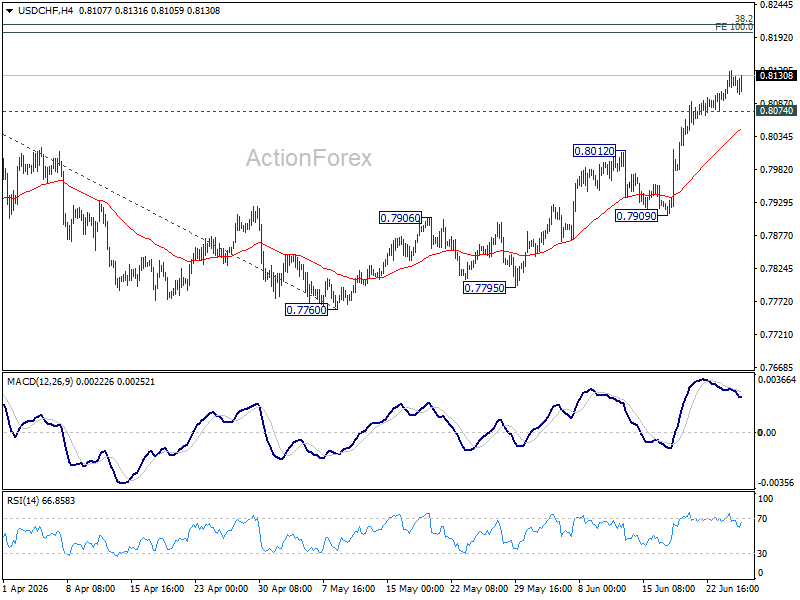
USD/CHF Daily Outlook
Daily Pivots: (S1) 0.7867; (P) 0.7903; (R1) 0.7967; More….
USD/CHF's rise from 0.7603 resumed by breaking through 0.7921 temporary top. Intraday bias is back on the upside. The current rally is seen as correcting whole down trend from 0.9200. Next target is 38.2% retracement of 0.9200 to 0.7603 at 0.8213. On the downside, below 0.7842 support will turn intraday bias neutral first.
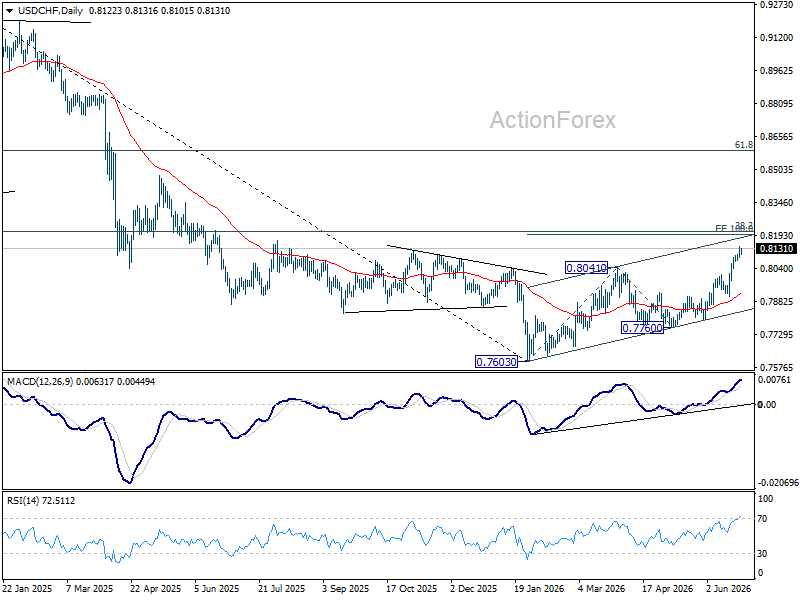
In the bigger picture, a medium term bottom should be in place at 0.7603 on bullish convergence condition in D MACD. Rebound from there is seen as correcting the fall from 0.9200 only. However, decisive break of 55 W EMA (now at 0.8091) will suggest that it's probably correcting the larger scale down trend from 1.0146 (2022 high). On the other hand, rejection by the 55 W EMA will setup down trend resumption to 100% projection of 1.0146 (2022 high) to 0.8332 from 0.9200 at 0.7382 at a later stage.
Risk Aversion Deepens as Fed Highlights Inflation Risks, Downplays Growth Impact
Risk aversion deepened across global markets as the combination of escalating energy conflict and a more inflation-focused Federal Reserve weighed on sentiment. While the initial selloff in US equities overnight was triggered by a sharp spike in oil prices, the late-session decline pointed to a second driver—markets reacting to the Fed’s message that inflation risks heightened due to geopolitical uncertainty.
The escalation in the Iran conflict has moved into a more dangerous phase, with both sides targeting critical energy infrastructure. Reports that Israel struck Iran’s South Pars gas field were followed by retaliatory attacks on facilities in Saudi Arabia, the UAE, and Qatar, including the Ras Laffan LNG hub. This shift toward targeting core supply nodes signals a structural increase in energy risk premium.
Importantly, the nature of these attacks suggests that the disruption is strategic rather than temporary. By targeting alternative supply hubs, Iran appears to be attempting to “equalize the pain,” ensuring that global supply remains constrained even if its own exports are curtailed. This dynamic implies that elevated oil prices may persist even in the absence of continuous escalation.
Against this backdrop, the Fed’s latest decision and projections added further pressure on markets. While rates were left unchanged, the upward revision in inflation forecasts—particularly the rise in 2026 PCE to 2.7%—signaled that policymakers see a more persistent inflation path than previously expected.
Chair Jerome Powell reinforced this message, noting that inflation progress would continue but “not as much as we had hoped.” More importantly, he made clear that rate cuts remain conditional, stating that “if we don’t see that progress, then you won’t see the rate cut.” This underscores that the Fed is not prepared to ease policy in the face of rising inflation risks.
At the same time, Powell appeared to temper concerns about growth. While acknowledging that higher energy prices would exert “downward pressure on spending and employment,” he emphasized that the US’s position as a net energy exporter could offset these effects through increased production and investment.
The result is a policy framework that places greater weight on inflation risks than on potential growth headwinds. With inflation already trending higher before the onset of the Iran conflict, the additional energy shock is seen as compounding an existing problem.
Fed fund futures pricing reinforces this interpretation. Markets now assign over 90% probability that rates will remain unchanged at 3.50–3.75% through the first half of the year, with only a marginal chance of a hike. This reflects growing acceptance that the Fed is in no rush to ease policy.
Market reaction reflects this recalibration. US equities extended losses into the close, and the selloff carried into Asian trading, indicating a broad reassessment of risk. However, the response in FX markets has been notably contained, with major pairs largely confined within recent ranges.
Meanwhile, currency performance suggests positioning rather than panic. Aussie led gains, followed by Kiwi and Euro, while Swiss Franc underperformed despite the risk-off tone. Dollar also failed to dominate, reflecting the absence of a clear flight-to-safety dynamic and reinforcing the view that markets are grappling more with inflation repricing than systemic stress.
With SNB, BoE, and ECB decisions ahead, attention now turns to whether other central banks will validate or push back against the emerging inflation narrative. For now, markets remain in a phase of controlled risk aversion, driven less by immediate crisis and more by the realization that inflation risks may persist longer than previously anticipated.
In Asia, Nikkei fell -3.50%. Hong Kong HSI is down -1.82%. China Shanghai SSE is down -1.15%. Singapore Strait Times is down -0.68%. Japan 10-year JGB yield is up 0.045 at 2.263. Overnight, DOW fell -1.63%. S&P 500 fell -1.36%. NASDAQ fell -1.46%. 10-year yield rose 0.057 to 4.259.
SNB, BoE, ECB set to hold as BoE votes and ECB guidance drive volatility
Rates are expected to stay unchanged, but BoE vote split and ECB policy signals could trigger FX moves as markets weigh inflation and growth risks. Read more.
BoJ holds rates, signals further hikes despite temporary inflation dip
BoJ kept rates at 0.75% and reaffirmed tightening bias, looking through a near-term inflation dip as wage growth and rising oil prices support outlook. Read more.
Mixed Australia employment data: Hiring strong, but job quality slips
Employment jumped 48.9k in February, but unemployment rose to 4.3% as full-time jobs fell and labour supply increased. Underlying softness tempers the strong headline. Read more.
NZ GDP disappoints at 0.2% as momentum fades into year-end
New Zealand GDP rose just 0.2% qoq in Q4, missing expectations and slowing sharply from Q3. Weak construction and flat per capita growth highlight a fragile recovery. Read more.
USD/CHF Daily Outlook
Daily Pivots: (S1) 0.7867; (P) 0.7903; (R1) 0.7967; More….
USD/CHF's rise from 0.7603 resumed by breaking through 0.7921 temporary top. Intraday bias is back on the upside. The current rally is seen as correcting whole down trend from 0.9200. Next target is 38.2% retracement of 0.9200 to 0.7603 at 0.8213. On the downside, below 0.7842 support will turn intraday bias neutral first.
In the bigger picture, a medium term bottom should be in place at 0.7603 on bullish convergence condition in D MACD. Rebound from there is seen as correcting the fall from 0.9200 only. However, decisive break of 55 W EMA (now at 0.8091) will suggest that it's probably correcting the larger scale down trend from 1.0146 (2022 high). On the other hand, rejection by the 55 W EMA will setup down trend resumption to 100% projection of 1.0146 (2022 high) to 0.8332 from 0.9200 at 0.7382 at a later stage.