

Sample Category Title
USD/JPY Mid-Day Outlook
Daily Pivots: (S1) 149.97; (P) 150.68; (R1) 151.16; More...
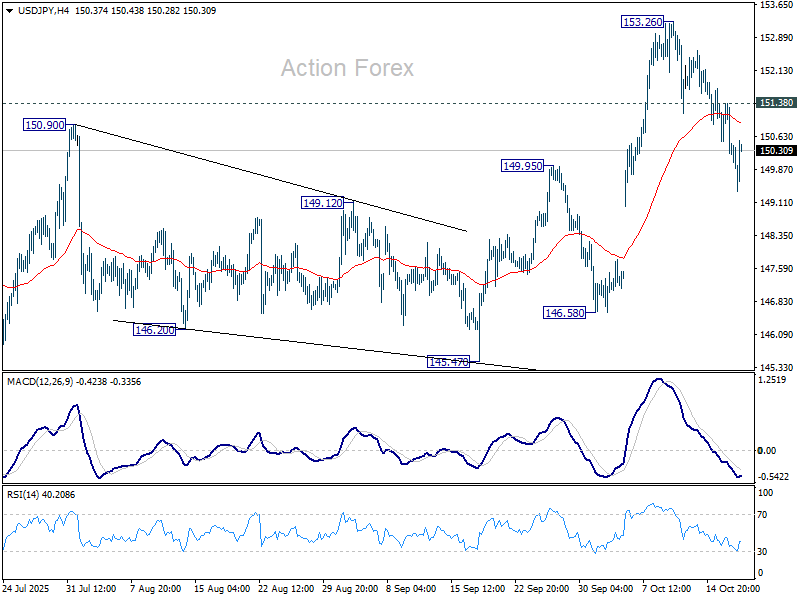
Intraday bias in USD/JPY stays mildly on the downside at this point. Fall from 153.26 short term top would target 55 D EMA (now at 148.58) instead. Sustained break there will raise the chance of bearish reversal and target 145.47 structural support next. On the upside, above 151.38 minor resistance will turn intraday bias neutral again first.
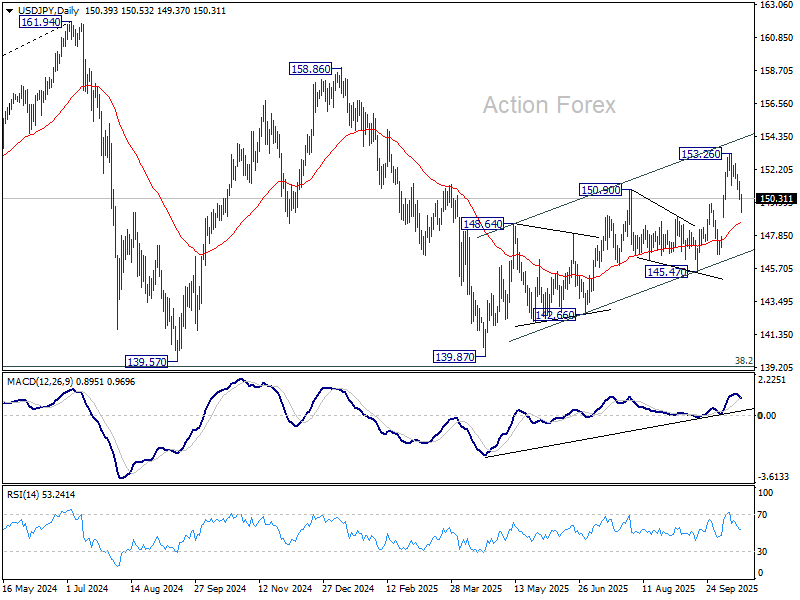
In the bigger picture, current development suggests that corrective pattern from 161.94 (2024 high) has completed with three waves at 139.87. Larger up trend from 102.58 (2021 low) could be ready to resume through 161.94 high. On the downside, break of 145.47 support will dampen this bullish view and extend the corrective pattern with another falling leg.
GBP/USD Mid-Day Outlook
Daily Pivots: (S1) 1.3399; (P) 1.3427; (R1) 1.3462; More...
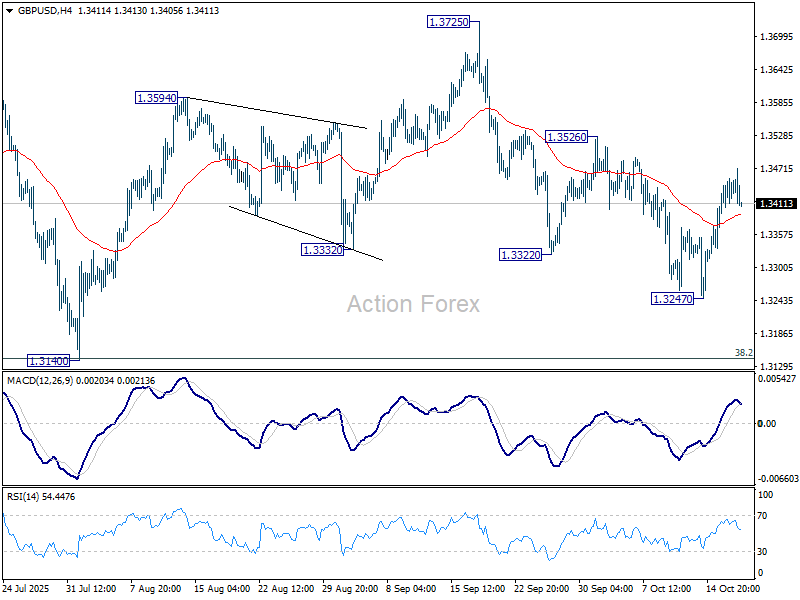
GBP/USD's recovery lost momentum well above of 1.3526 resistance and intraday bias remains neutral. Fall from 1.3725 could still extend lower through 13247. But even in that case, strong support is expected from 1.3140 cluster (38.2% retracement of 1.2099 to 1.3787 at 1.3142) to complete the corrective pattern from 1.3787. On the upside, break of 1.3526 will bring stronger rally back to 1.3725/87 resistance zone.
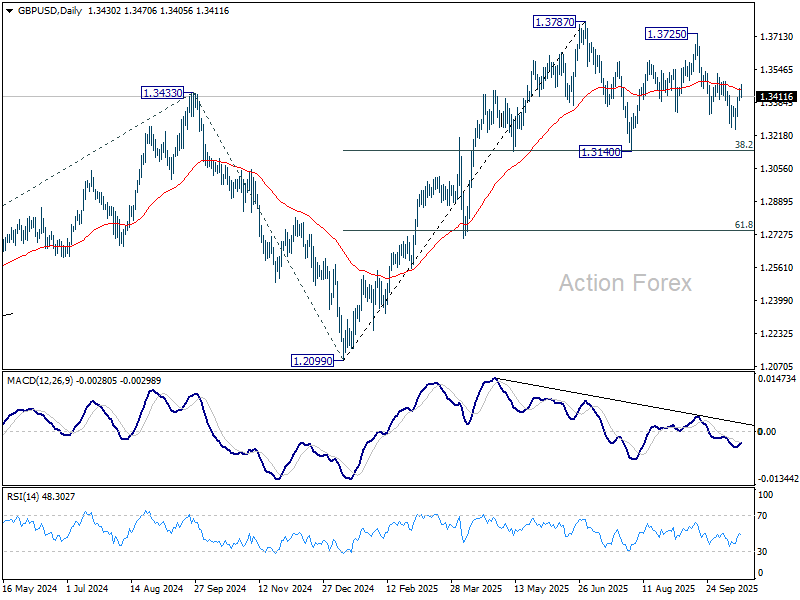
In the bigger picture, rise from 1.0351 (2022 low) is still seen as a corrective move. Further rally could be seen to 61.8% projection of 1.0351 to 1.3433 (2024 high) from 1.2099 (2025 low) at 1.4004. But strong resistance could emerge from 1.4248 (2021 high) to limit upside. Sustained break of 55 W EMA (now at 1.3173) will argue that a medium term top has already formed and bring deeper fall back to 1.2099.
EUR/USD Mid-Day Outlook
Daily Pivots: (S1) 1.1655; (P) 1.1675; (R1) 1.1706; More…
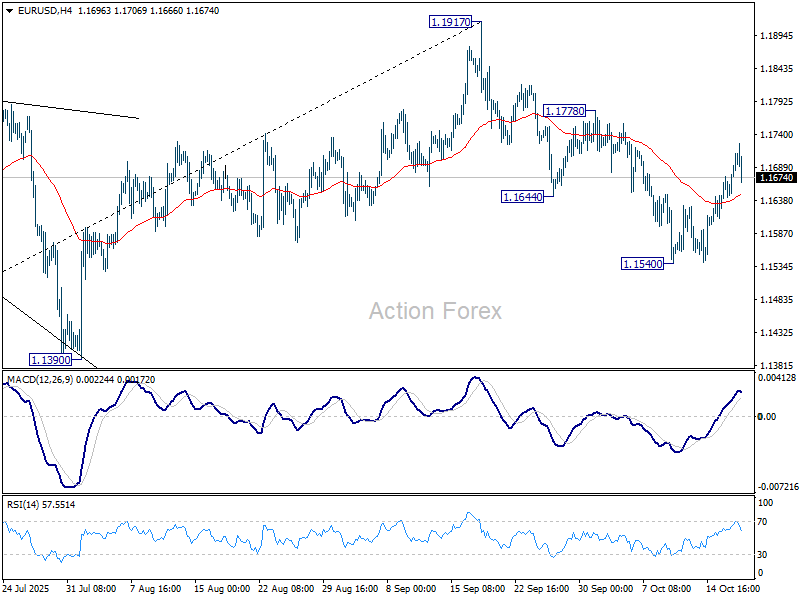
EUR//USD retreated well ahead of 1.1778 resistance and intraday bias stays neutral. Further decline is still expected with 1.1778 resistance intact. On the downside, break of 1.1540 will resume the fall from 1.1917 to 1.1390 , or further to 38.2% retracement of 1.0176 to 1.1917 at 1.1252. However, firm break of 1.1778 will suggest that pullback from 1.1917 has completed, and bring retest of this high.
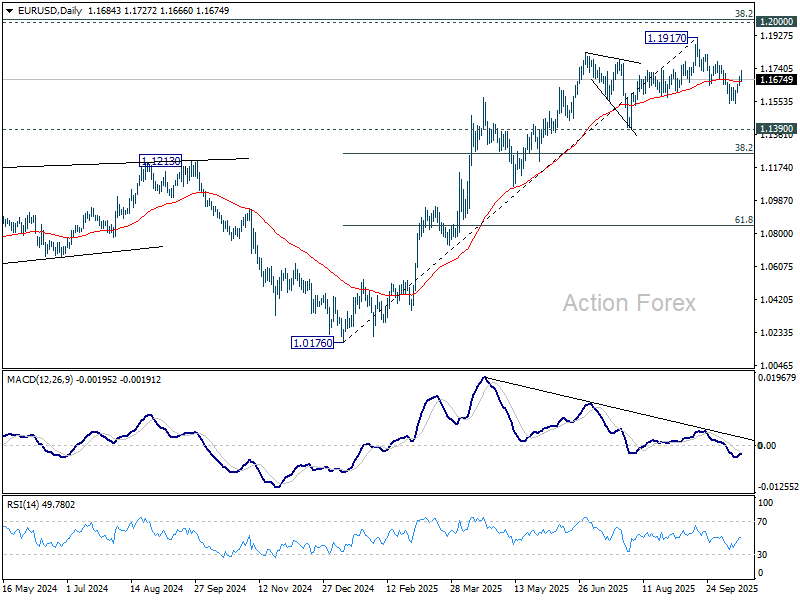
In the bigger picture, considering bearish divergence condition in D MACD, a medium term top is likely in place at 1.1917, just ahead of 1.2 key psychological level. As long as 55 W EMA (now at 1.1274) holds, the up trend from 0.9534 (2022 low) is still extended to continue. Decisive break of 1.2000 will carry larger bullish implications. However, sustained trading below 55 W EMA will argue that rise from 0.9534 has completed as a three wave corrective bounce, and keep outlook bearish.
Wall Street Finds Footing After Bank Rout, but Conviction Still Lacking
As markets enter into U.S. session, sentiment showed signs of stabilization, as investors cautiously stepped back into equities after a sharp selloff in regional banks yesterday. Concerns over credit quality and loan losses had triggered a steep decline in financial stocks, but bargain-hunting helped bank shares rebound, lifting broader index futures in premarket trading. The recovery suggests investors see the recent slump as overdone for the immediate term.
Still, sentiment remains cautious and directionless, with traders reluctant to take bold positions amid a backdrop of multiple macro headwinds — including the U.S. government shutdown, trade friction with China, and geopolitical uncertainty. The market’s current tone suggests consolidation rather than conviction, as participants wait for clearer signals on both policy and economic momentum before re-engaging.
In the currency markets, performance remains consistent with a cautious, risk-off tone. The Swiss Franc continues to lead the week as the strongest major currency, followed by Sterling and Yen, while Loonie lags behind. Dollar and Kiwi are also under pressure, with Aussie and Euro trading mid-range.
In Europe, at the time of writing, FTSE is down -0.96%. DAX is down -1.42%. CAC is up 0.02%. UK 10-year yield is up 0.044 at 4.546. Germany 10-year yield is up 0.013 at 2.588. Earlier in Asia, Nikkei fell -1.44%. Hong Kong HSI fell -2.48%. China Shanghai SSE fell -1.95%. Singapore Strait Times fell -0.63%. Japan 10-year JGB yield fell -0.026 to 1.631.
BoE's Pill: Risk of self-sustaining inflation calls for more cautious pace in cuts
BoE Chief Economist Huw Pill said today that the UK’s inflation remains far stickier than expected, reinforcing the case for a slower pace of monetary easing.
In a speech, Pill noted the “lack of progress” in reducing inflation as “disappointing”. He cautioned that the persistence of above-target inflation, combined with heightened sensitivity among firms and households to price developments, risks creating "self-sustaining inflation dynamics". The prominence of food prices, which directly affect household perceptions of inflation, could further embed inflation expectations if not carefully managed.
This, he argued, calls for a "more cautious pace in withdrawing monetary policy restriction so as to ensure continuation in disinflation towards the 2% target." While Pill reiterated that future rate cuts remain likely over the next year if the outlook evolves as expected, he stressed the importance "to guard against the risk of cutting rates either too far or too fast."
Eurozone CPI finalized at 2.2%, driven by services and food prices
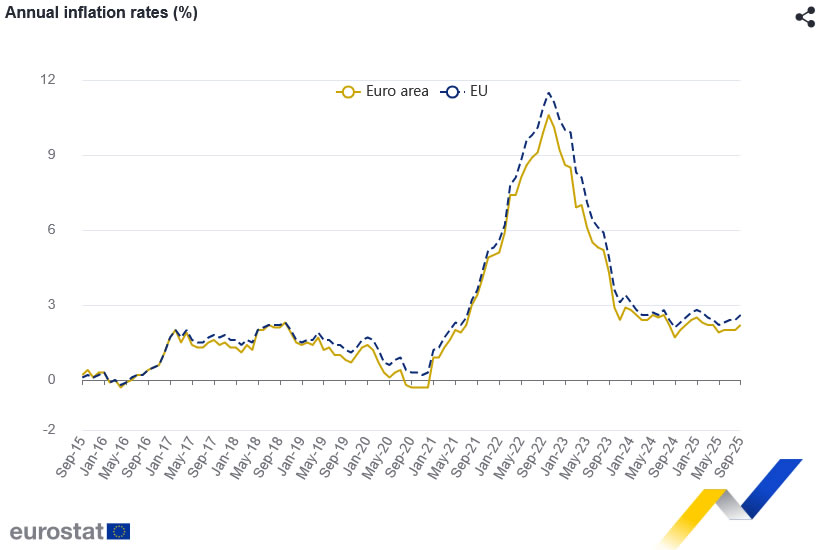
Eurozone inflation edged higher in September, with headline CPI finalized at 2.2% yoy, up from 2.0% in August. The core measure, which excludes energy, food, alcohol & tobacco, also firmed to 2.4% yoy from 2.3%.
The main driver of the increase came from services, which contributed +1.49 percentage points to the annual rate, followed by food, alcohol, and tobacco (+0.58 pp), and non-energy industrial goods (+0.20 pp). Energy continued to be a drag, subtracting -0.03 pp.
Across the broader European Union, annual inflation was finalized at 2.6% yoy, up from 2.4% in August, with wide divergence among member states. Cyprus (0.0%), France (1.1%), and Italy and Greece (1.8%) recorded the lowest rates, while Romania (8.6%), Estonia (5.3%), and Croatia and Slovakia (4.6%) posted the highest. Inflation fell in 8 countries, was stable in 4, and rose in 15.
Ueda signals watchful patience as BoJ weighs October policy options
BoJ Governor Kazuo Ueda reiterated overnight that the central bank will consider rate hikes "if our confidence in hitting the outlook increases”. He added that he intends to continue gathering informations before making any decisions at the October 29–30 policy meeting.
Ueda observed that G20 members regard the world economy as broadly stable but facing persistent risks, from trade disputes to geopolitical frictions. "Many institutions and observers still factor them into their outlooks, or at least treat them as downside risks when assessing the global and U.S. economies,” he said.
BoJ’s Uchida: Further hikes if outlook holds
BoJ Deputy Governor Shinichi Uchida said in a speech on today that the central bank remains prepared to raise interest rates further if its current projections for growth and inflation are realized. He emphasized that the BoJ will “judge without any pre-conception” while monitoring both domestic and global conditions.
Uchida highlighted rising uncertainty surrounding overseas economies, particularly due to shifting trade policies that could influence Japan’s external demand and price trends. “It’s necessary to closely monitor how these developments may affect financial and foreign exchange markets, as well as Japan’s economy and prices,” he said.
EUR/USD Mid-Day Outlook
Daily Pivots: (S1) 1.1655; (P) 1.1675; (R1) 1.1706; More…
EUR//USD retreated well ahead of 1.1778 resistance and intraday bias stays neutral. Further decline is still expected with 1.1778 resistance intact. On the downside, break of 1.1540 will resume the fall from 1.1917 to 1.1390 , or further to 38.2% retracement of 1.0176 to 1.1917 at 1.1252. However, firm break of 1.1778 will suggest that pullback from 1.1917 has completed, and bring retest of this high.
In the bigger picture, considering bearish divergence condition in D MACD, a medium term top is likely in place at 1.1917, just ahead of 1.2 key psychological level. As long as 55 W EMA (now at 1.1274) holds, the up trend from 0.9534 (2022 low) is still extended to continue. Decisive break of 1.2000 will carry larger bullish implications. However, sustained trading below 55 W EMA will argue that rise from 0.9534 has completed as a three wave corrective bounce, and keep outlook bearish.
BoE’s Pill: Risk of self-sustaining inflation calls for more cautious pace in cuts
BoE Chief Economist Huw Pill said today that the UK’s inflation remains far stickier than expected, reinforcing the case for a slower pace of monetary easing.
In a speech, Pill noted the “lack of progress” in reducing inflation as “disappointing”. He cautioned that the persistence of above-target inflation, combined with heightened sensitivity among firms and households to price developments, risks creating "self-sustaining inflation dynamics". The prominence of food prices, which directly affect household perceptions of inflation, could further embed inflation expectations if not carefully managed.
This, he argued, calls for a "more cautious pace in withdrawing monetary policy restriction so as to ensure continuation in disinflation towards the 2% target." While Pill reiterated that future rate cuts remain likely over the next year if the outlook evolves as expected, he stressed the importance "to guard against the risk of cutting rates either too far or too fast."
XAU/USD: Gold Continues to Hit New Record High in Each Session
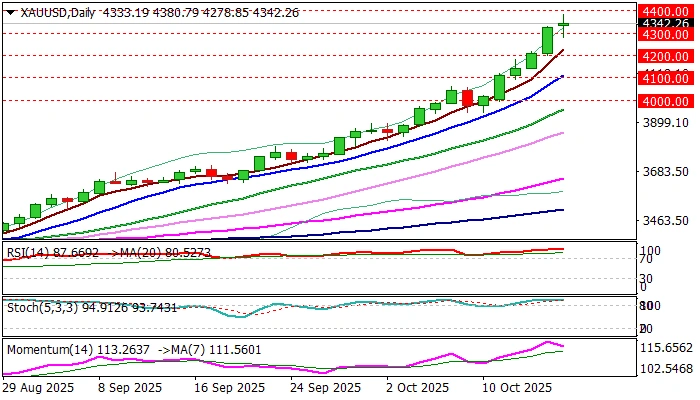
Gold continues to hit new record high on daily basis and rose to $4380 in early Friday trading, after the metal rallied 2.8% on Thursday and closed above $4300, recording new fastest move between two round-figure levels of just one day.
The yellow metal remains in strong uptrend which accelerates and steepens in growing euphoria over historical rally into safety.
Gold is also on track for weekly gain of over 8%, which marks the best week since September 2008, as the price was up almost $400 during the past five days and has advanced around 66% from the beginning of the year.
Growing trade tensions between the US and China, which threaten of uncontrollable escalation, tough rhetorics of Moscow, Washington and NATO over the war in Ukraine, fragile peace in the Middle East, clouded political and economic situation in a number of developed countries and strong demand for physical gold from central banks continue to fuel gold’s rally, with the newest signs of weakness in US regional banks, adding to the cocktail of key factors that continue to lift metal’s price.
Bulls remained resilient despite strongly overbought daily and weekly studies, but some price adjustment is likely to be seen soon, as 14-d momentum turned south and strongly overbought \RSI turned sideways, generating initial signal.
However, potential consolidation or correction is likely to be limited and probably mark positioning for fresh push higher, if current strongly supportive environment persists.
Broken $4300 level, although being cracked, marks initial support, with deeper pullback to ideally hold above $4200 (psychological / Thursday’s low) and not exceed rising daily Tenkan-sen ($4160) to keep bulls in play for probe through $4400 and possible attack at $4500, which now marks key barrier.
Res: 4380; 4400; 4422; 4500.
Sup: 4300; 4278; 4200; 4160.
USD/JPY: US-Japan Yield Spread Breakdown Signals Further Yen Strength Ahead in the Near Term
Key takeaways
- USD/JPY reversed from its recent high of 153.28, falling 2.2% as bullish U.S. dollar momentum faded.
- Political uncertainty in Japan weakened the “Takaichi Trade,” reducing bets on extended monetary easing.
- The 10-year U.S.-Japan sovereign yield spread broke below key 2.47% support, signalling further downside pressure.
- Technical indicators point to a short-term bearish setup, with support at 149.05–148.55 and resistance at 151.70.
Since our prior report, the USD/JPY has witnessed a minor “momentum crush” as bullish sentiment of the US dollar took a backseat, where the USD/JPY did a residual push up to print an intraday high of 153.28 on 10 October 2025, before it tumbled by 2.2% to hit an intraday low of 149.90 at the time of writing.
In addition, the “Takaichi Trade” of shorting the yen in anticipation of a revival of easy monetary policy in Japan has lost traction as Sanae Takaichi, the newly elected leader of the LDP ruling party, may not receive enough parliamentary votes to become Japan’s next prime minister after the LDP’s long-term coalition partner, Komeito withdrew its 26-year partnership with the LDP.
Let’s now look at several macro and technical factors that suggest further potential downside in the USD/JPY, at least in the near term.
10-year US Treasury/JGB yield spread has (finally) broken below a major support level of 2.47%
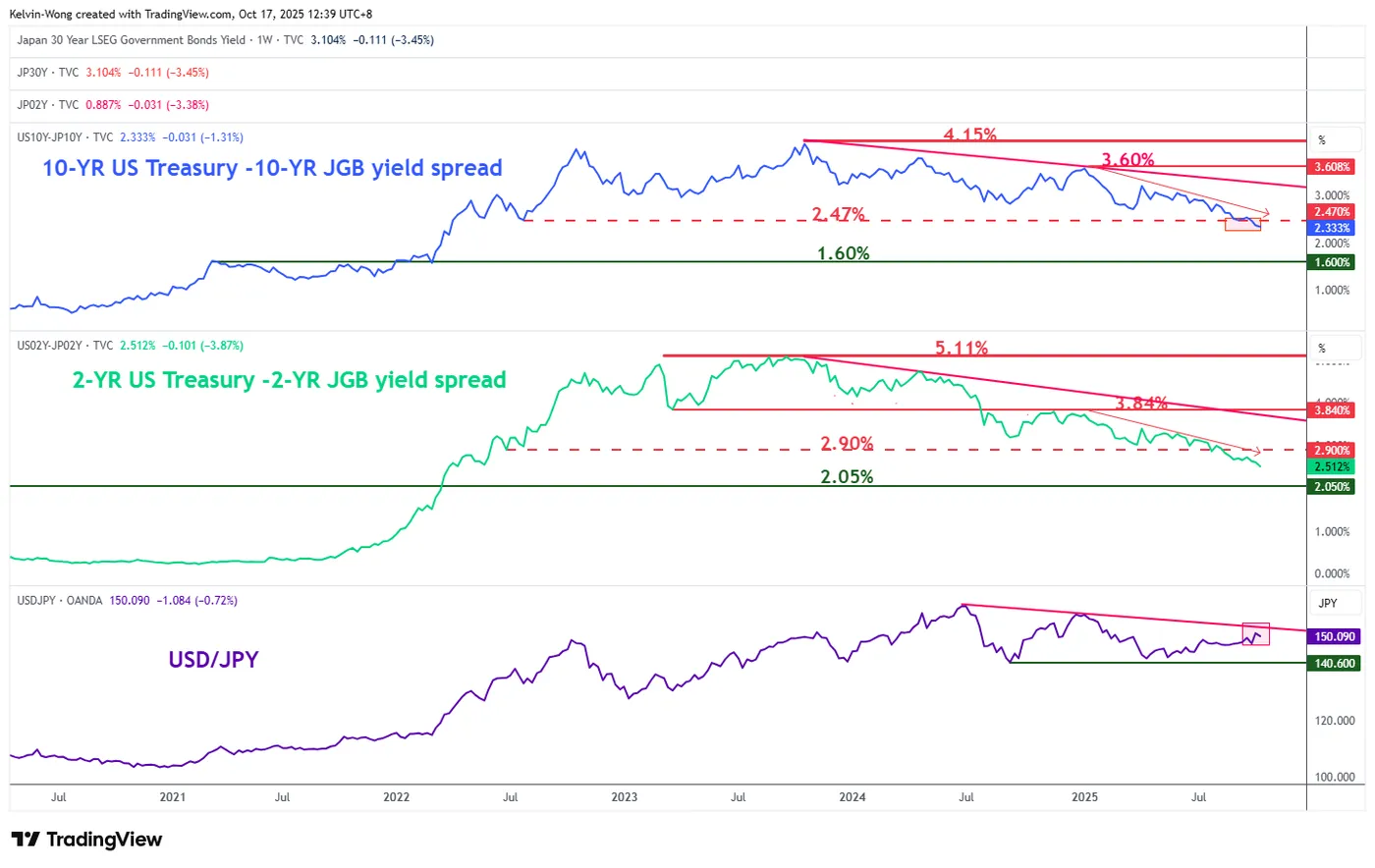
Fig. 1: Yield spreads of US Treasury/JGB with major trend of USD/JPY as of 17 Oct 2025 (Source: TradingView)
The 10-year yield differential between the US Treasury note and JGB has broken below the 2.47% major support with a daily close below it since 8 October 2025 (see Fig. 1)
A move away further down from 2.47% is likely to cement a further narrowing of the 10-year US-Japan sovereign bond yield differential, and a similar movement occurred during late December 2024 to mid-April 2025 that triggered a medium-term decline of 10% on the USD/JPY.
Implied volatility from JPY options has started to tick higher
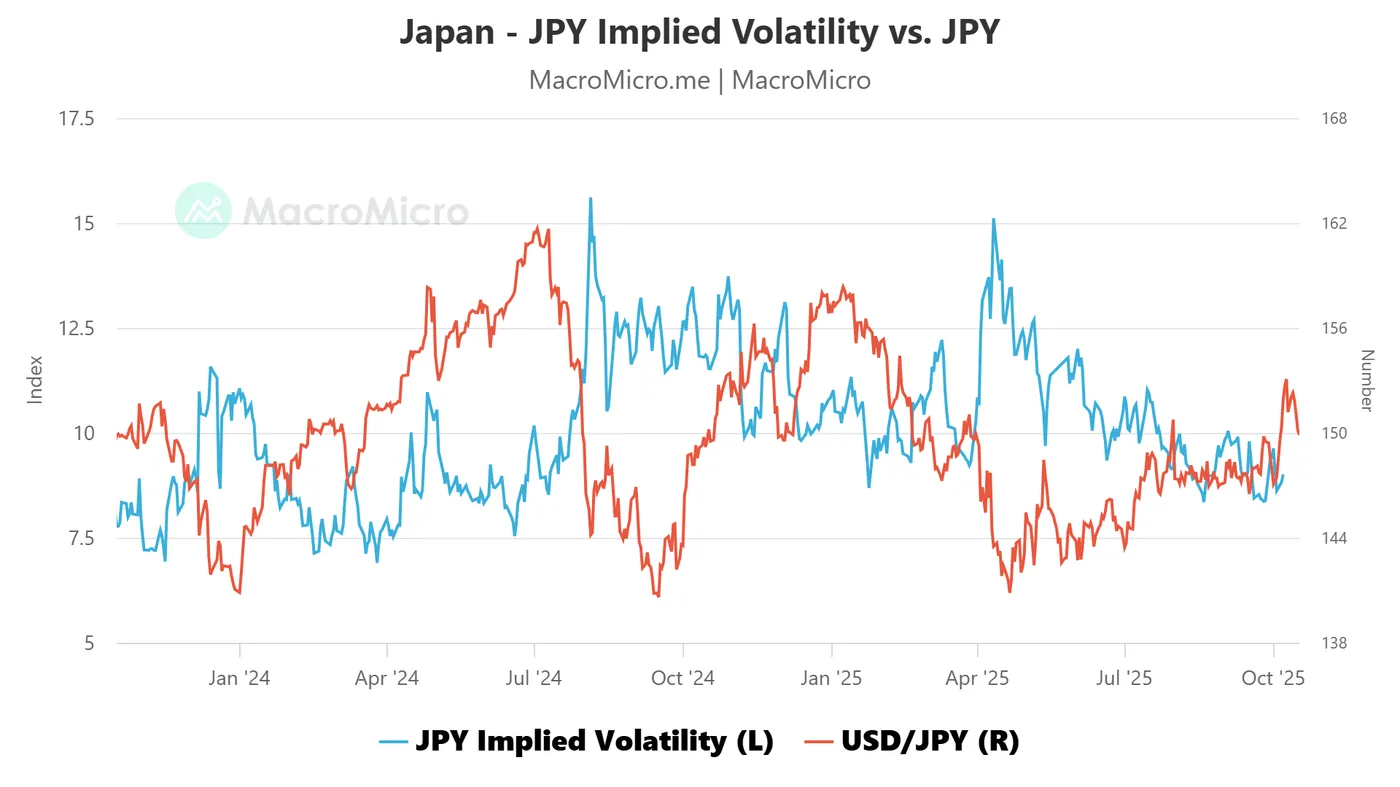
Fig. 2: JPY implied volatility as of 7 Oct 2025 (Source: MacroMicro)
The implied volatility of JPY measured via FX options has started to increase from a relatively low level of 8.39 printed on 26 September 2025 (almost a 9-month low) to 9.01 on 7 October 2025 (see Fig. 2)
Prior similar observations seen from 24 January 2025 to 7 February 2025, where the implied volatility of JPY jumped from 8.69 to 10.59, which thereafter led to a fall of 10% on the USD/JPY.
Failure bullish breakout on the USD/JPY
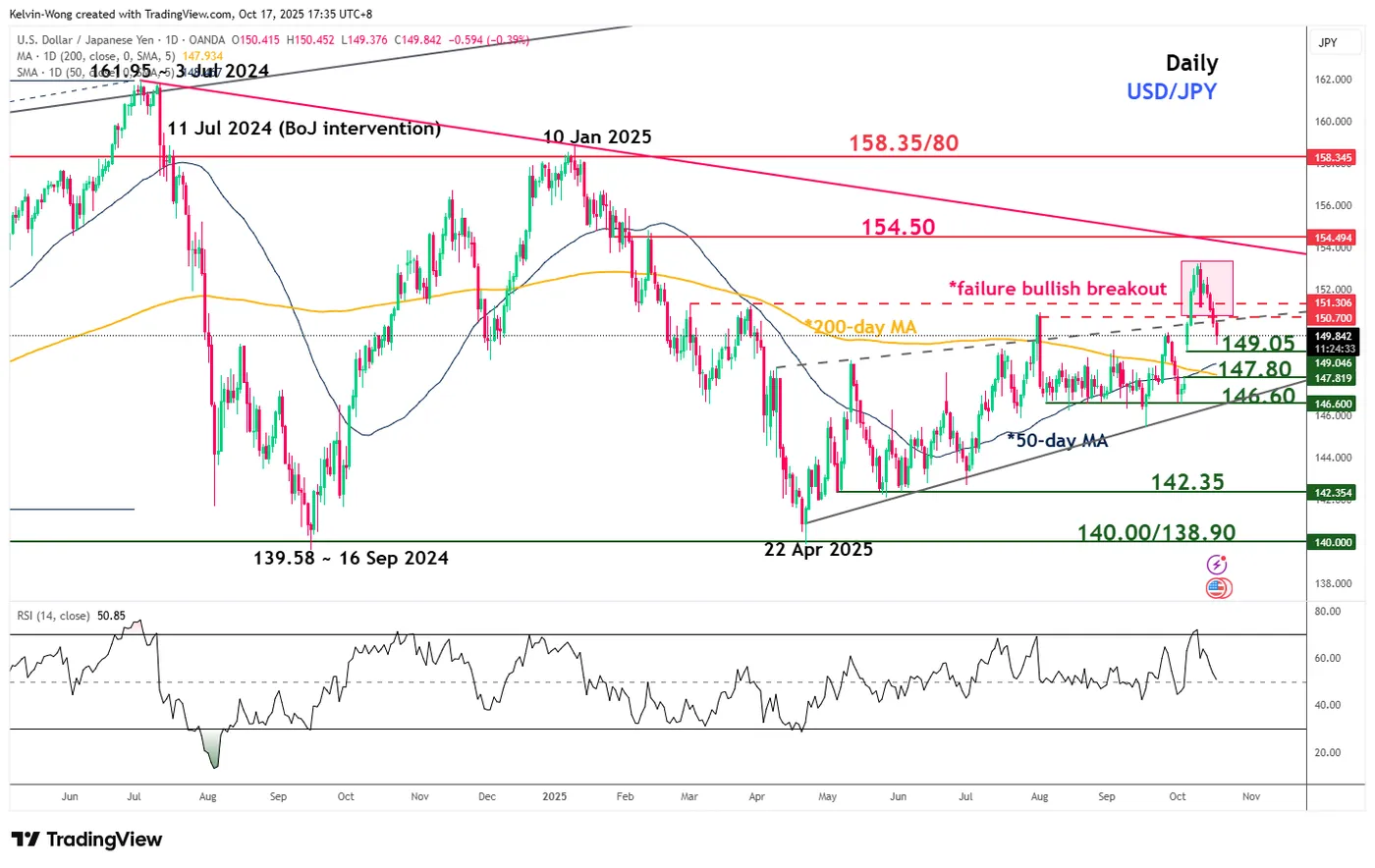
Fig. 3: USD/JPY medium-term trend as of 17 October 2025 (Source: TradingView)
The recent bullish breakout of the USD/JPY above its “Ascending Wedge” range resistance on 7 October 2025 is considered a “failure bullish breakout” as its latest price actions of the USD/JPY have reintegrated back below the aforementioned range resistance at 150.50.
These observations suggest that the USD/JPY is likely to revert to its medium-term sideways motion, with the key range support to watch at 146.60 (see Fig. 3).
We will now examine its latest short-term (1 to 3 days) trajectory and key technical levels to watch on USD/JPY
Preferred trend bias (1-3 days) – Vulnerable for a bearish break below 20-day MA
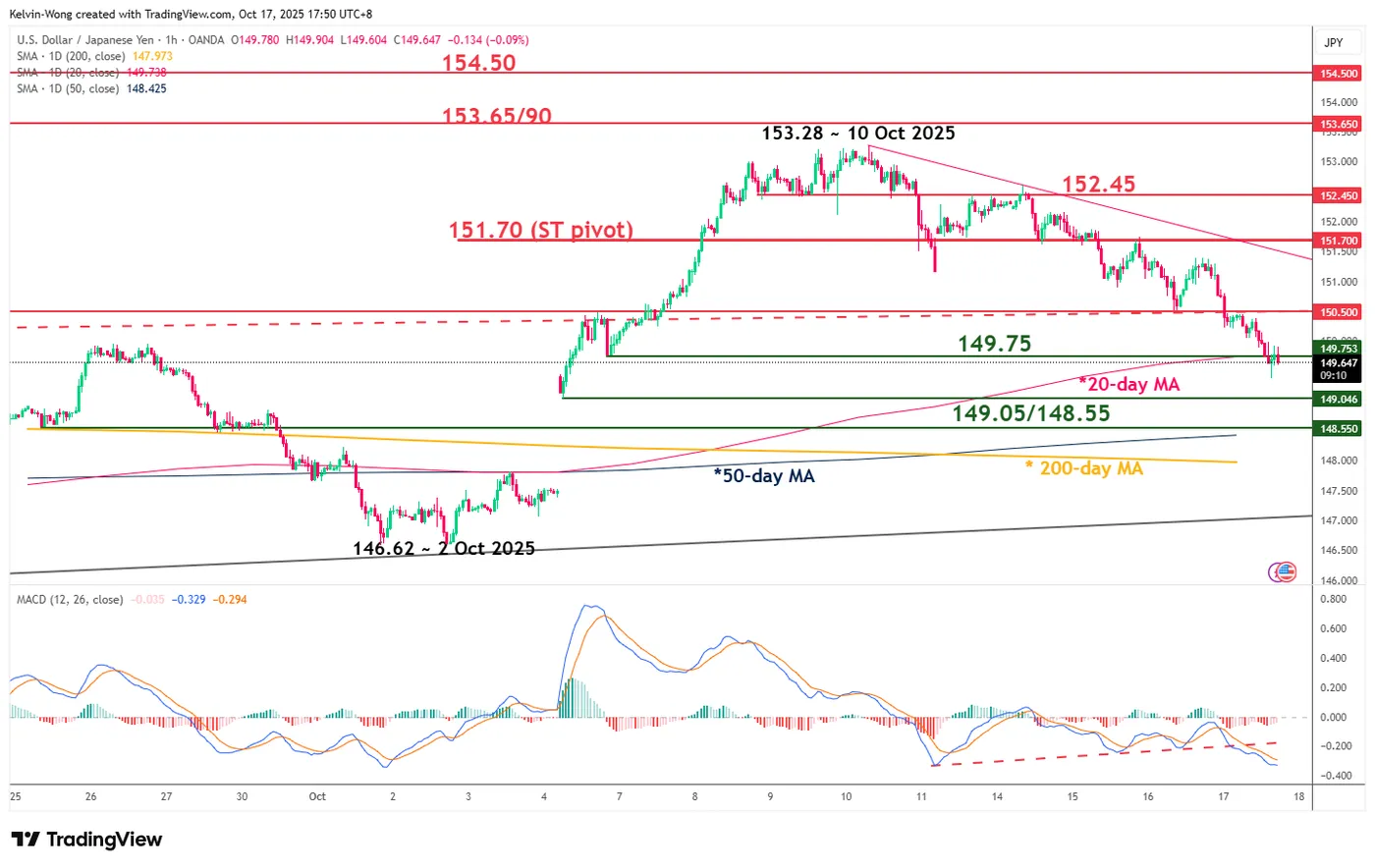
Fig. 4: USD/JPY minor trend as of 17 October 2025 (Source: TradingView)
Bearish bias in any bounces below 151.70 key short-term pivotal resistance, and a break below 149.75 exposes the next intermediate support zone at 149.05/148.55 in the first step (see Fig. 4).
Key elements
- The hourly MACD trend indicator of the USD/JPY has broken below a key ascending trendline support that has occurred below the centreline, which suggests a potential buildup of a bearish momentum condition.
- These observations indicate that the 20-day moving average, which is acting as a near-term support at 149.75, is likely to be broken down.
- The intermediate support zone of 149.05/148.55 is defined by the gap support formed on 6 October 2025 and the 50-day moving average.
Alternative trend bias (1 to 3 days)
A clearance above 151.70 key short-term resistance invalidates the bearish scenario for a squeeze up towards the next intermediate resistance at 152.45.
US: Lack of Labor Market Data Due to Government Shutdown – Investors Seek Alternative Indicators
- Investors rely on private data (ADP, ISM, Conference Board), but correlations with official figures are weak.
- Alternative indicators suggest slower hiring, not a collapse.
- The Fed is likely to stay cautious with future rate cuts.
The third week of the partial shutdown of the U.S. federal government is increasingly disrupting access to official economic data. The suspension of key reports makes it more difficult for the Federal Reserve to assess the economic situation as it prepares for the upcoming FOMC meeting scheduled for October 28–29. In this environment, investors and analysts are attempting to replace government statistics with private-sector indicators — though their reliability remains limited.
Limited Access to Data and the Fed’s Policy Challenges
Due to the ongoing stalemate in Congress, many federal agencies, including statistical offices, have been closed since October 1. This has resulted in the suspension of several crucial releases, including employment reports. The Bureau of Labor Statistics (BLS) plans to publish consumer inflation data on October 24, albeit with a one-week delay. For the Federal Reserve, this situation represents a significant obstacle to evaluating the state of the economy — especially the labor market, which currently shows signs of fragility.
Private Data Sources – Limited Informational Value
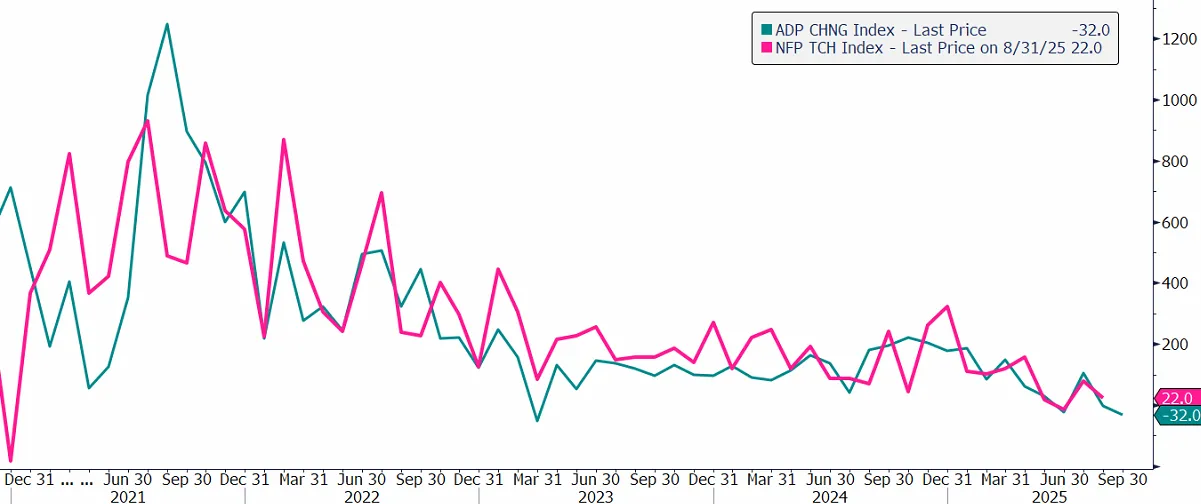
ADP: The ADP report, based on payroll data from 26 million private-sector employees, showed that U.S. private employers cut 32,000 jobs in September, marking the latest sign that the labor market is entering a significant slowdown. By sector, the largest losses were recorded in service-providing industries, including leisure and hospitality as well as business services, where employment fell by 28,000 positions. Moreover, the real-time correlation between ADP data and official BLS figures remains very weak at 0.12, indicating no statistically meaningful relationship. As a result, the ADP report provides limited insight into what the official employment report might have shown had the government not been shut down.
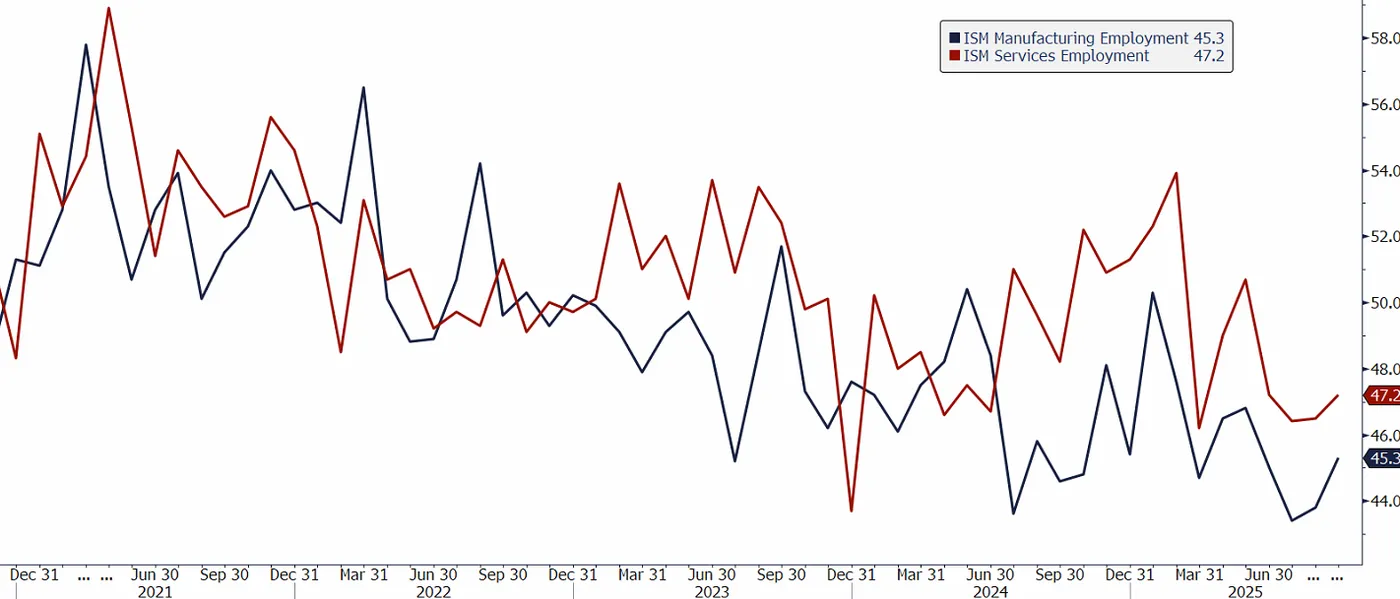
ISM Indices: The Institute for Supply Management’s manufacturing and services surveys suggest a slowdown in hiring, with both employment components remaining below the neutral 50-point threshold. In September, the employment subindex for the services sector stood at 47.2 points, while the manufacturing employment subindex came in at 45.3 points — both signaling contraction in hiring activity. While the manufacturing employment index shows a moderate correlation (0.6) with employment dynamics, its volatility and discrepancies with actual data limit its predictive reliability.
Sentiment Indicators and Predictive Models
Conference Board: The gap between the share of respondents who believe that “jobs are plentiful” and those who say they are “hard to get” (known as the labor market differential) is highly correlated with the unemployment rate. This metric has recently declined, signaling a deterioration in consumer sentiment and suggesting possible softening in the labor market over the coming months.
Chicago Fed: The Federal Reserve Bank of Chicago continues to publish its own unemployment rate estimates based on models incorporating both public and private data. According to the latest (not yet officially released) estimates, the unemployment rate stood at 4.34 percent in September — only slightly higher than August’s 4.32 percent. However, the historical accuracy of this model has been limited.
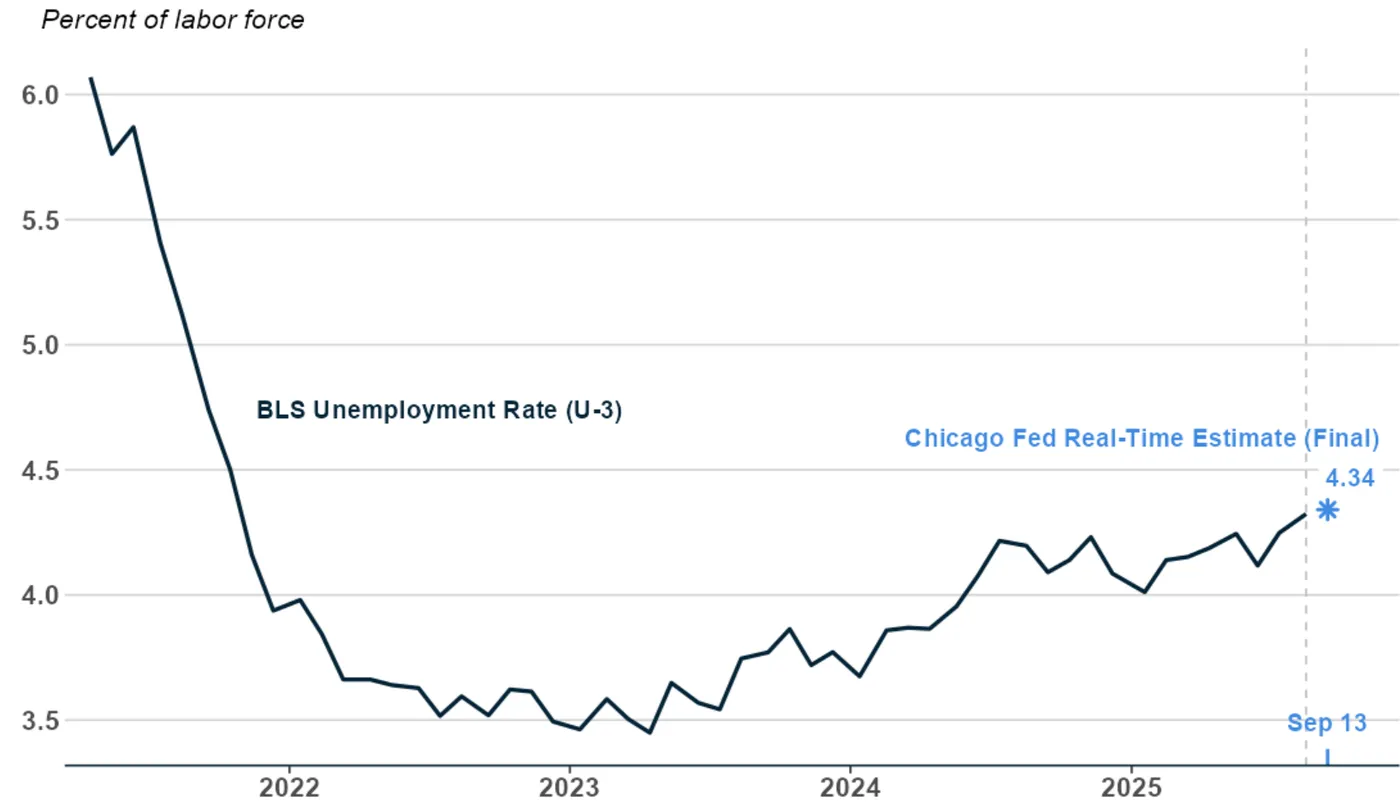
Chicago Fed Real-Time Unemployment Rate (September 2025), source: chicagofed.org
The Labor Market Is Slowing, Not Collapsing
While alternative indicators provide some insight into current economic conditions, they cannot fully replace official data, which remain methodologically consistent and historically comparable. The available private data suggest a moderation in hiring momentum rather than a sharp downturn. The U.S. labor market thus appears to be entering a phase of gradual cooling rather than contraction — a scenario that may encourage the Federal Reserve to proceed cautiously with further interest rate cuts in the months ahead.
Eurozone CPI finalized at 2.2%, driven by services and food prices
Eurozone inflation edged higher in September, with headline CPI finalized at 2.2% yoy, up from 2.0% in August. The core measure, which excludes energy, food, alcohol & tobacco, also firmed to 2.4% yoy from 2.3%.
The main driver of the increase came from services, which contributed +1.49 percentage points to the annual rate, followed by food, alcohol, and tobacco (+0.58 pp), and non-energy industrial goods (+0.20 pp). Energy continued to be a drag, subtracting -0.03 pp.
Across the broader European Union, annual inflation was finalized at 2.6% yoy, up from 2.4% in August, with wide divergence among member states. Cyprus (0.0%), France (1.1%), and Italy and Greece (1.8%) recorded the lowest rates, while Romania (8.6%), Estonia (5.3%), and Croatia and Slovakia (4.6%) posted the highest. Inflation fell in 8 countries, was stable in 4, and rose in 15.
BoJ’s Uchida: Further hikes if outlook holds
BoJ Deputy Governor Shinichi Uchida said in a speech on today that the central bank remains prepared to raise interest rates further if its current projections for growth and inflation are realized. He emphasized that the BoJ will “judge without any pre-conception” while monitoring both domestic and global conditions.
Uchida highlighted rising uncertainty surrounding overseas economies, particularly due to shifting trade policies that could influence Japan’s external demand and price trends. “It’s necessary to closely monitor how these developments may affect financial and foreign exchange markets, as well as Japan’s economy and prices,” he said.