Sample Category Title
Elliott Wave Analysis: Light Crude Oil (CL) Weakness Expected to Persist
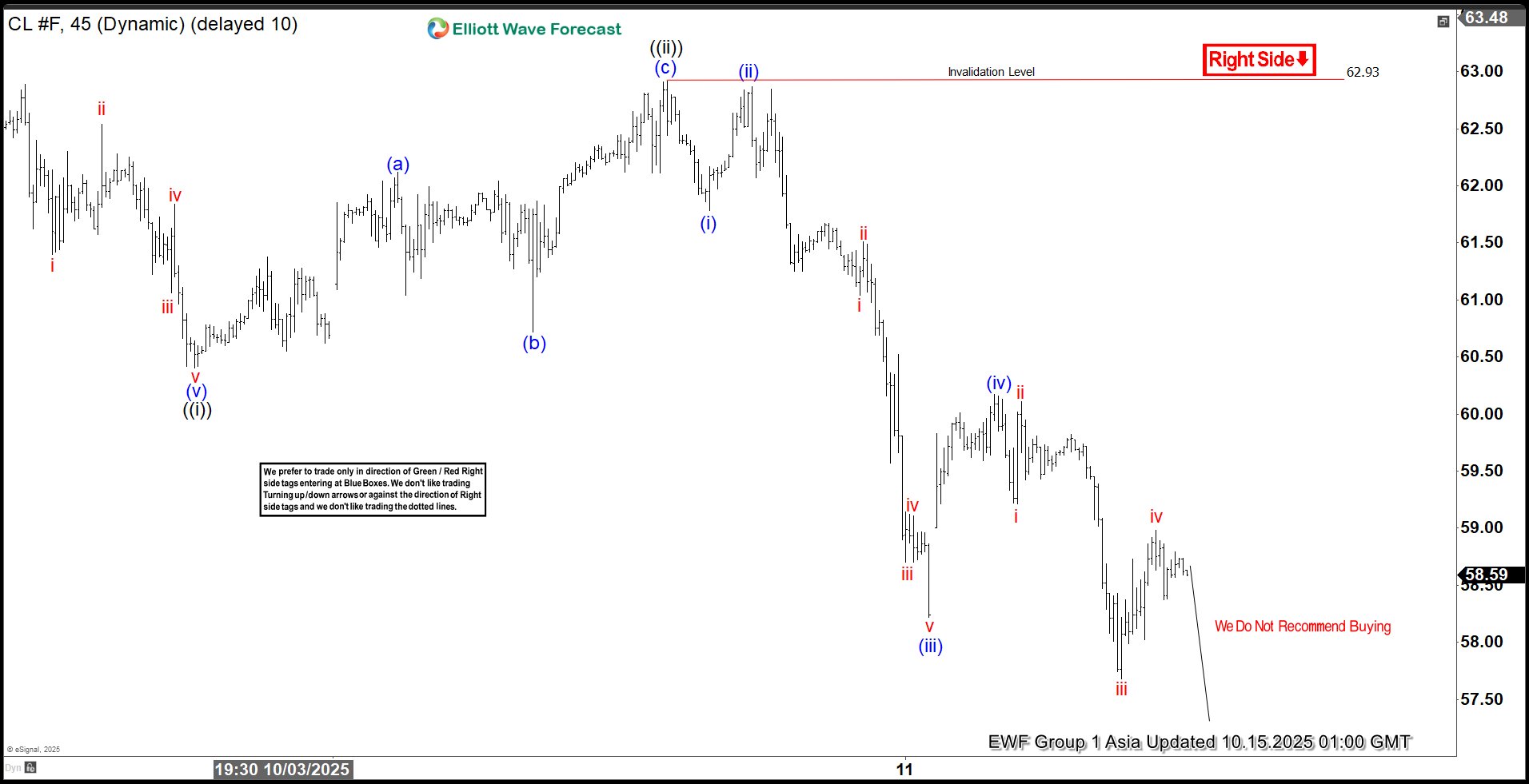
The short-term Elliott Wave analysis for oil indicates that a decline from the September 26, 2025, high is unfolding as a five-wave impulse. Starting from that peak, wave ((i)) concluded at $60.40, as depicted on the 45-minute chart. Subsequently, wave ((ii)) rallied in a zigzag Elliott Wave pattern. From the low of wave ((i)), wave (a) reached $62.12, followed by a pullback in wave (b) to $60.72. The upward move in wave (c) peaked at $62.93, completing wave ((ii)) at a higher degree.
Oil then continued its descent in wave ((iii)), structured as an impulsive sequence. From the wave ((ii)) high, wave (i) dropped to $61.78, and wave (ii) corrected to $62.87. Wave (iii) extended lower to $58.22, with a bounce in wave (iv) reaching $60.17. In the near term, as long as the pivot at $62.93 holds, any rally is expected to falter in a 3, 7, or 11-swing pattern, leading to further declines. The potential downside target lies between $53.2 and $56.9, based on the 100% to 161.8% Fibonacci extension of wave ((i)). This analysis suggests continued bearish momentum, with limited upside potential unless the key pivot is breached.
Oil (CL) – 45 Minute Elliott Wave Technical Chart:
CL – Elliott Wave Technical Video:
https://www.youtube.com/watch?v=q_vrvXMZqxI
GBP/USD Extends Downside Move – Is The Pair Heading For 1.30 Next?
Key Highlights
- GBP/USD declined further below 1.3350 and tested 1.3300.
- A major bearish trend line is forming with resistance at 1.3385 on the 4-hour chart.
- EUR/USD extended losses below 1.1600 and started a consolidation phase.
- Gold rallied to a fresh all-time high above $4,175 before it faced resistance.
GBP/USD Technical Analysis
The British Pound started a major decline below 1.3400 against the US Dollar. GBP/USD dropped below the 1.3350 and 1.3300 levels to enter a bearish zone.
Looking at the 4-hour chart, the pair settled below the 100 simple moving average (red, 4-hour) and the 200 simple moving average (green, 4-hour). The pair even tested the 1.3250 zone and recently started a consolidation phase.
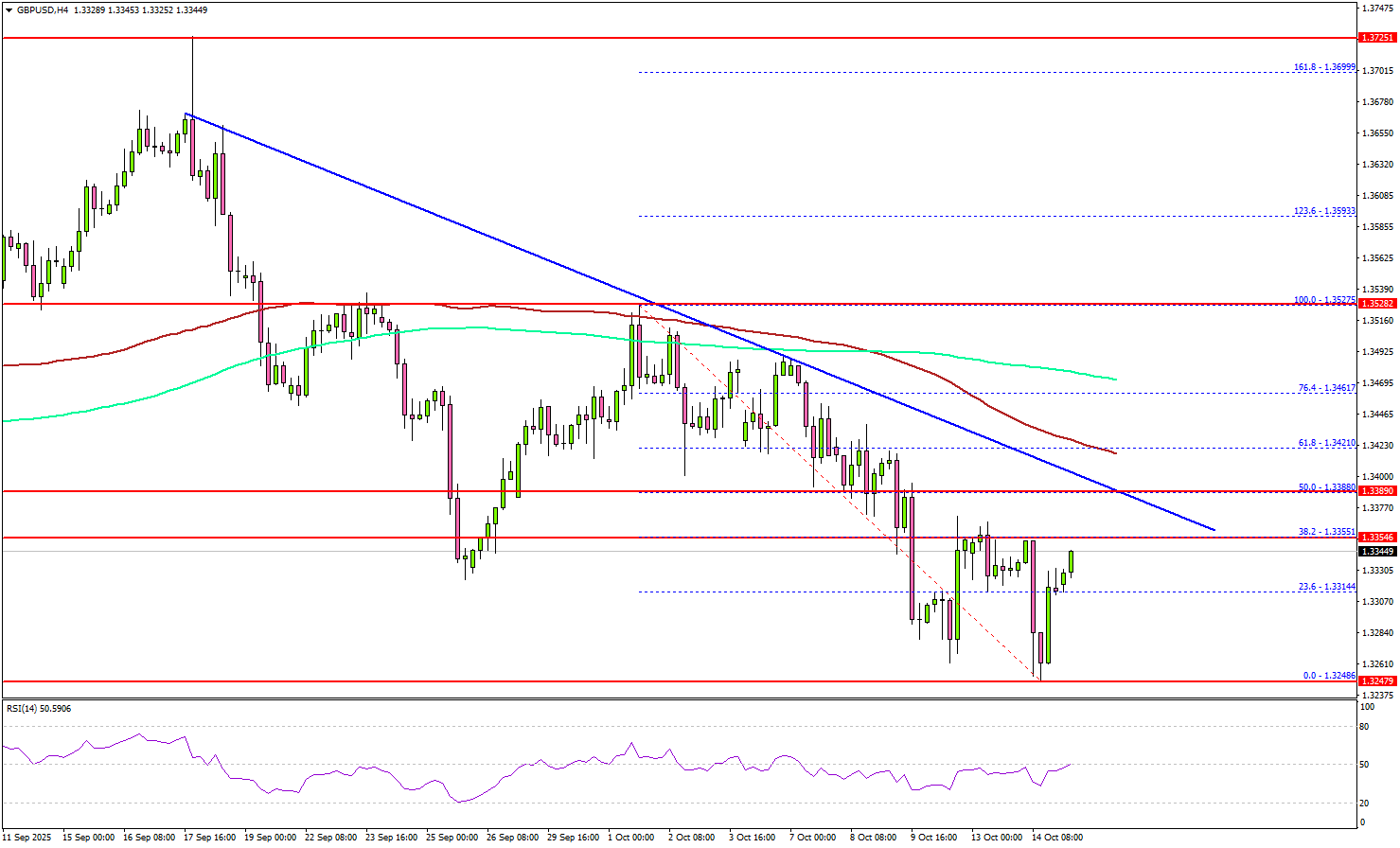
On the upside, the pair faces resistance near the 1.3350 level. It is close to the 23.6% Fib retracement level of the recent decline from the 1.3527 swing high to the 1.3248 low.
The main hurdle could be 1.3385. There is also a major bearish trend line forming with resistance at 1.3385 and the 50% Fib retracement level of the recent decline from the 1.3527 swing high to the 1.3248 low. A close above the trend line resistance might push the pair to the 100 simple moving average (red, 4-hour) or even the 200 simple moving average (green, 4-hour).
On the downside, the pair might find support at 1.3250. The main support might be 1.3200. A close above 1.3200 could send the pair toward 1.3120. Any more losses might open the doors for a test of 1.3000.
Looking at EUR/USD, the pair faced an increase in selling pressure, resulting in a drop below the 1.1600 support zone.
Upcoming Key Economic Events:
- ECB's De Guindos speech.
- BoE's Ramsden speech.
China’s CPI still negative at -0.3% in September as food prices drag
China’s consumer inflation remained in negative territory in September, highlighting continued weakness in domestic demand even as underlying price pressures showed tentative signs of improvement. Headline CPI rose from –0.4% yoy to –0.3% yoy, missing expectations of –0.2% yoy.
The National Bureau of Statistics said lower food and energy prices were the main contributors to the decline, with food prices down -4.4% yoy and consumer goods prices falling -0.8% yoy, partly offset by a 0.6% yoy increase in service prices.
However, the data also showed hints of stabilization beneath the surface. Core CPI, which excludes food and energy, rose 1.0% yoy from a year earlier, its highest level since February 2024, suggesting that domestic price momentum is slowly recovering in service sectors and other non-food categories.
Meanwhile, factory-gate prices continued to contract, with PPI rising from –2.9% yoy to –2.3% yoy, in line with expectations. This marks the 36th consecutive month of producer deflation, underscoring persistent cost pressures in manufacturing. NBS statistician Dong Lijuan said recent capacity management efforts in several industries have helped narrow the pace of decline, noting that market competition has improved as industrial supply and demand slowly rebalance.
RBA’s Hunter: Economy holding up, inflation still persistent in some areas
RBA Assistant Governor Sarah Hunter said in a speech on Tuesday that recent data suggest the Australian economy has been performing slightly stronger than expected, reinforcing the Bank’s decision to keep the cash rate unchanged at 3.60% at its September meeting. She noted that the RBA continues to see signs that “private demand is recovering,” “inflation may be persistent in some areas,” and that labor market conditions remain “stable.”
Hunter highlighted that GDP grew 1.8% over the year to the June quarter. “If anything, outcomes have been a little stronger than those expected in the August SMP,” she said, citing resilient private spending and steady employment as evidence that the economy remains on firmer footing than previously anticipated.
She also pointed to high-frequency indicators showing that underlying inflation in the September quarter is likely to be stronger than anticipated, suggesting that economic and labor market conditions remain “a bit tighter than we had assessed.” However, she acknowledged that employment growth has slowed "slightly" more than expected, while "elevated" global uncertainty continues to cloud the outlook.
Hunter concluded that the RBA will “continually reassess” its view on the economy and adjust policy as appropriate.
BoE’s Bailey notes labor market cooling, IMF warns inflation still highest in G7
BoE Governor Andrew Bailey said overnight that the latest U.K. labor market data released this week reinforced his view that inflation pressures are continuing to ease gradually. Speaking at an IIF event in Washington, Bailey noted “I’ve been saying this for some time, but I think we’re seeing some softening of labor markets”.
Bailey acknowledged that uncertainty over U.S. tariffs had prompted many firms to delay investment plans, creating another drag on business sentiment. Meanwhile, he said the central bank had not yet observed any direct impact on inflation.
His remarks came as IMF Chief Economist Pierre-Olivier Gourinchas cautioned that the BoE must be “very cautious” with future rate cuts, given that U.K. inflation remains stubbornly high compared with peers. The IMF’s latest forecasts project U.K. consumer prices rising 3.4% in 2025 and 2.5% in 2026, the highest in the G7.
Fed’s Powell keeps October cut alive as downside risks to jobs rise
Fed Chair Jerome Powell reinforced expectations for another rate cut later this month. Speaking overnight, he said that based on available information despite government shutdown, the outlook for growth, employment, and inflation “has not changed much.”
Powell pointed out that hiring momentum has weakened, with payroll gains "slowed sharply" over the past several months. He attributed this partly to structural factors such as lower immigration and participation, which have constrained workforce growth. Even though layoffs remain subdued, Powell warned that the “downside risks to employment appear to have risen,” citing survey evidence that households see fewer job openings and firms report less hiring difficulty.
On inflation, Powell noted that price pressures remain contained. The latest surveys and data indicate that goods price increases are "primarily reflect tariffs rather than broader inflationary pressures". While short-term inflation expectations have edged higher this year, long-term expectations remain well anchored around the Fed’s 2% target.
Taken together, Powell’s tone is balanced but leaning dovish. Fed fund futures continue to see over 90% change of another 25bps cut to 3.75-4.00% on October 29.
Powell/TACO Combo Lifts Wall Street from Early Losses
Today marked the first trading day of the week for many North American traders after Columbus Day for the US and the Canadian Thanksgiving — and the session opened with what felt like a long-weekend hangover.
Overnight markets had reacted sharply to China’s condemnations regarding the escalating US-China trade tensions, notably hurting Oil markets even further.
Despite Trump’s reassuring comments on Sunday, which helped risk assets rebound over the weekend and led to a bullish Monday session, sentiment reversed during the Asia session leading to a scary opening Bell.
Major indices gapped down, with the Nasdaq dropping 1.2% and cryptocurrencies also taking another hit after last week’s selloff.
Sentiment quickly shifted mid-morning after the rough open.
US Trade Representative Jamieson Greer downplayed some of the recent rhetoric between the two nations, triggering a rebound just 20 minutes after the open that carried momentum throughout the session.
By midday, all four major US indices had turned positive, erasing their early losses.
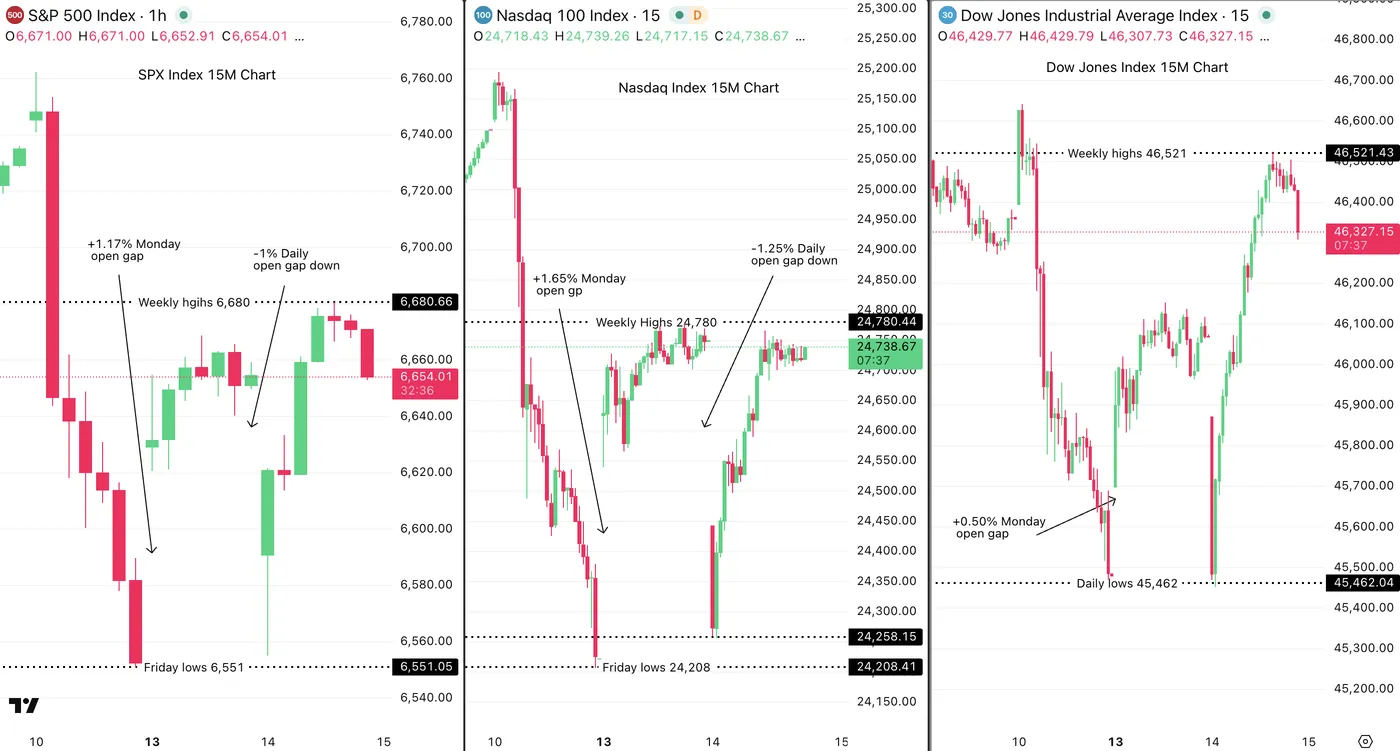
15M Chart Outlook for US Equities – October 14, 2025 – Source: TradingView
Despite the impressive rebound right after the open taking all indices to their weekly highs, there is are ongoing selloff waves in the Dow Jones and the S&P 500 to keep some eyes on. Nasdaq is not really reacting much for now and I am not spotting any headlines.
The real bullish catalysts came around mid-day from Fed Chair Jerome Powell, whose dovish remarks at the National Association for Business Economics meeting brought further bullish momentum.
Powell’s comments raised questions about whether the Fed had early insights into the NFP data, as he emphasized that further labor market softening could justify additional easing.
His tone cemented expectations for another rate cut by month-end, reinforcing the ongoing theme of things not being so bad after all despite the US-China trade scare.
Still, the price action is looking more rangebound with the recent swings rather than back to fully bullish – Let's take a closer look to the Dow Jones, Nasdaq and S&P 500.
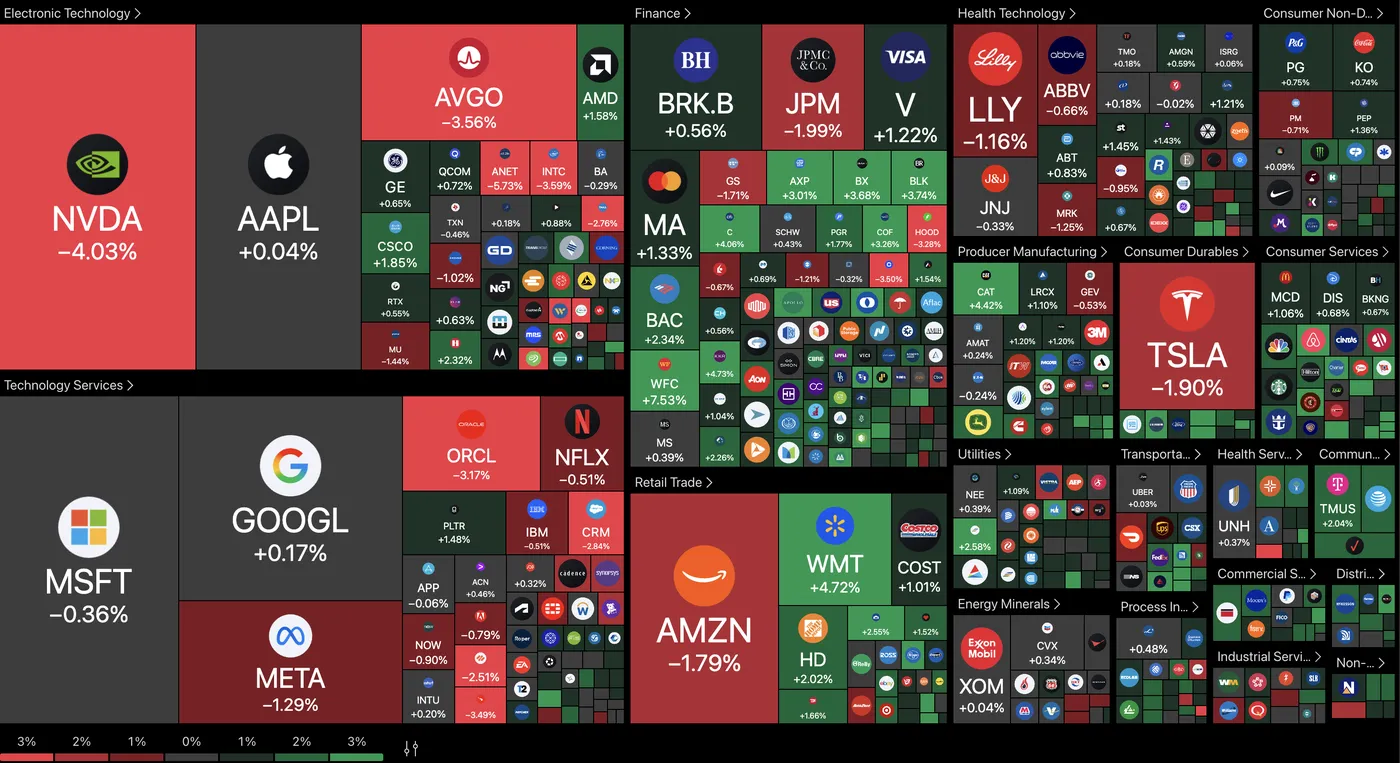
US Equity heatmap – October 14, 2025 – Source: TradingView
US Index analysis and levels: Dow Jones, Nasdaq and S&P 500
Dow Jones 4H Chart
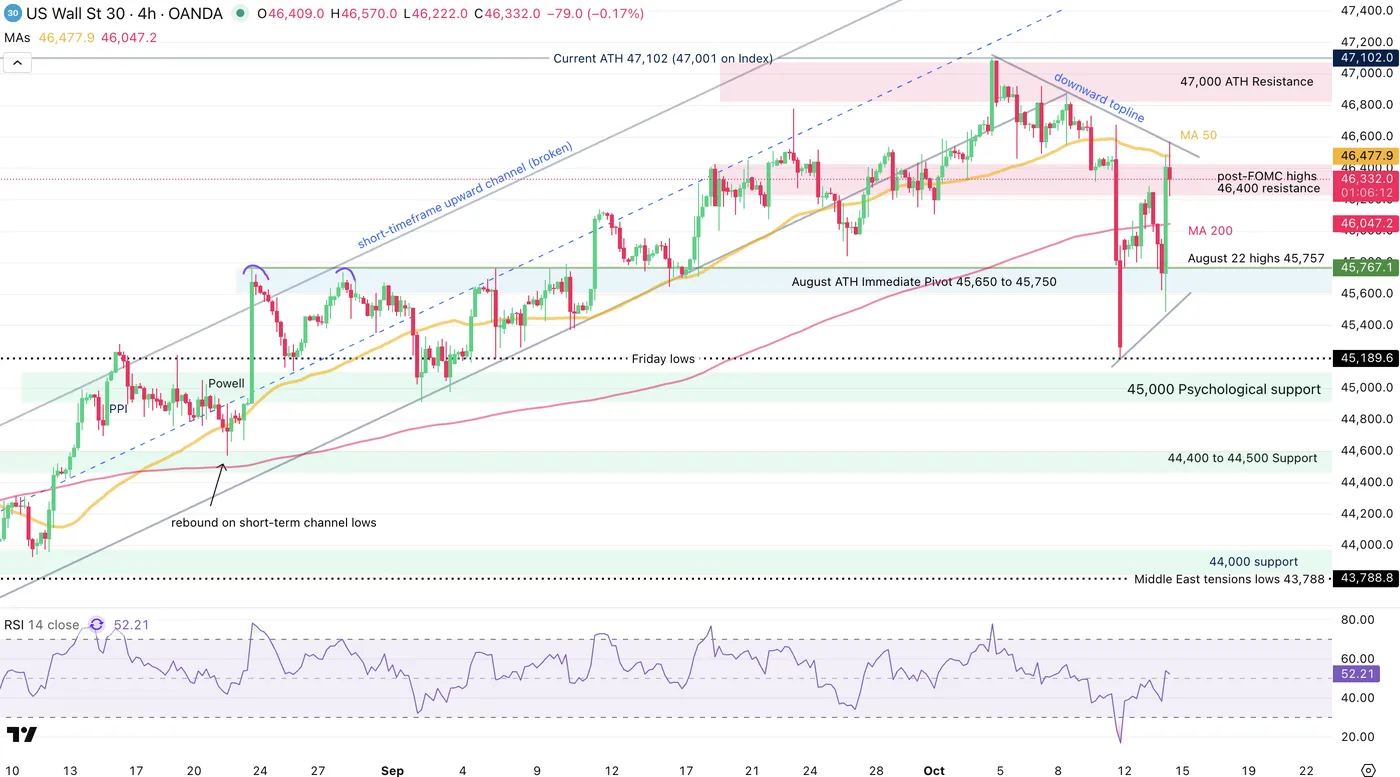
Dow Jones 4H Chart, October 14, 2025 – Source: TradingView
The Dow Jones led an impressive rebound today, lifted by decent earnings and a easier-path ahead when turning to Powell's latest comments.
A few things to look going forward:
- A downward topline has put a strong stop to the ongoing bullish action
- Bulls will have to break above the Monday highs to relaunch a fully bullish price action
- Sellers will also have to break below the daily lows to relaunch take control
- In the meantime, the technical outlook being mixed, a consolidation period would have high probability of taking place – At least until the market knows more on the US-China situation.
Dow Jones technical levels of interest
Resistance Levels
- Current All-time high 47,105
- Daily highs to break with topline 46,560
- ATH Resistance Zone 47,000 to 47,160 (+/- 150 pts)
- post-FOMC highs resistance zone around 46,400 (immediately testing)
Support Levels
- August ATH Immediate Pivot 45,650 to 45,750
- Daily session lows at 45,490
- Friday lows at 45,189
- 45,000 psychological level
- 44,400 to 44,500 Main Support
Nasdaq 4H Chart
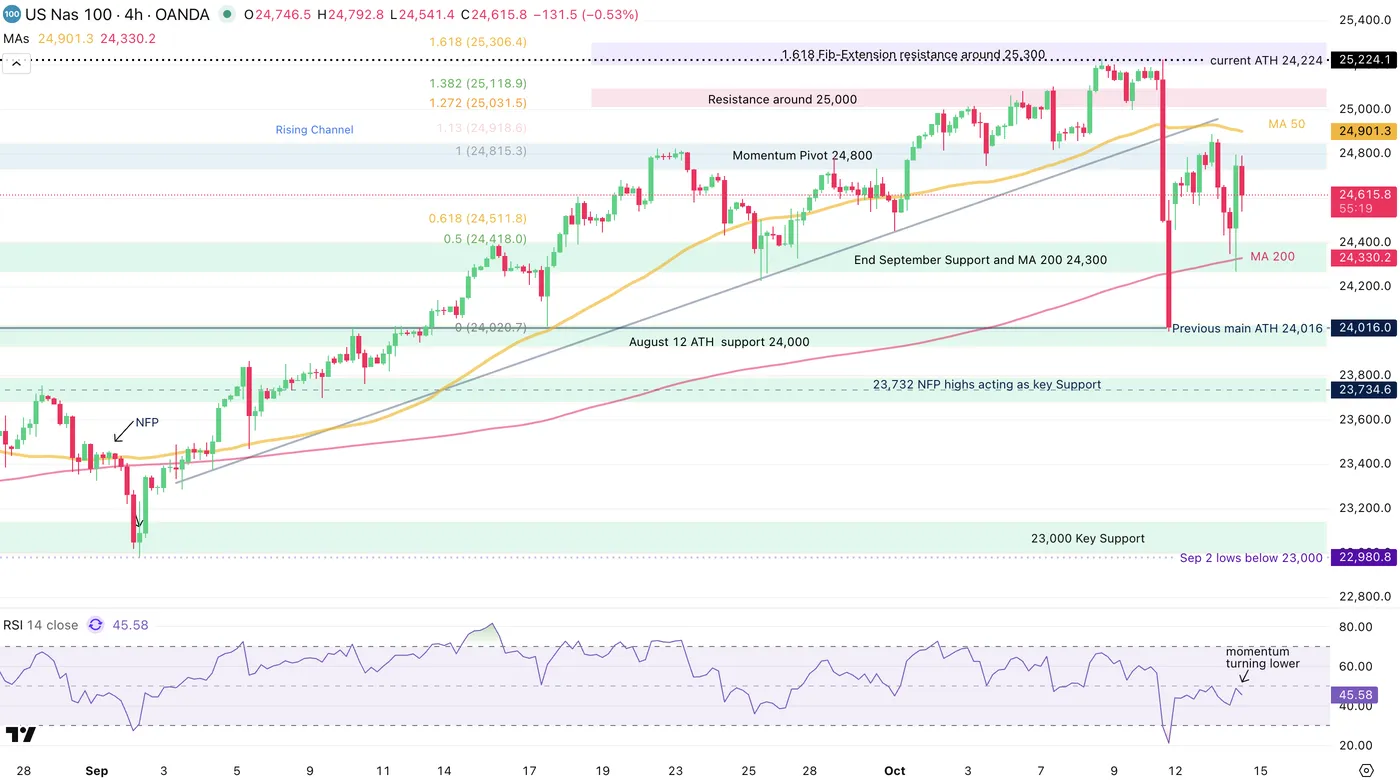
Nasdaq 4H Chart, October 14, 2025 – Source: TradingView
The Tech-Heavy index hasn't rebounded as strongly as its peers today on a relative change and is finding itself in a mixed technical environment.
It is the second time that sellers appear at the key Momentum pivot around 24,800 showing how undecisive the price action is.
Keep an eye on struggling names in tech like Nvidia: If they come back from here, Nasdaq should follow suit.
If the big names keep getting offered, ther path ahead might be a bit more grim.
Nasdaq technical levels of interest
Resistance Levels
- current ATH 25,224
- 1.618 Fib-Extension resistance between 25,200 and 25,300
- Momentum Pivot 24,750 to 24,800
- Monday highs and 4H MA 50 24,890
Support Levels
- End September Support and MA 200 24,300 (morning rebound)
- Friday lows 24,016
- August 12 ATH zone turning support (23,950 to 24,020)
- 23,000 Key Support
- Early 2025 ATH at 22,000 to 22,229 Support
S&P 500 4H Chart
S&P 500 4H Chart, October 14, 2025 – Source: TradingView
Similarly as the Nasdaq, sellers have appeared around the momentum pivot and the overall action might not be as bullish as it was the past few months – Keep an eye on sentiment.
A pattern that emerges is the ongoing break-retest action of the main May upward channel – short term technicals are looking more neutral than anything for now.
The price action will be interesting for the time to come, expect volatility.
S&P 500 Trading Levels:
Resistance Levels
- 6,774 (current All Time-Highs)
- Key current Resistance 6,745 to 6,760
- Key Pivot Zone 6,670 to 6,700
- potential resistance (1.618 fib - 6,790 to 6,800)
Support Levels
- 6,570 to 6,600 Key Support
- FOMC and daily lows 6,562
- 6,490 to 6,512 Previous ATH now Support (MA 200 Confluence)
- 6,400 Main Support
- 6,210 to 6,235 Main Support (August NFP Lows)
Safe Trades!
USD/CAD Price Outlook: Consolidation Above Key 1.4000 Handle. What Next for Loonie?
The loonie has recovered in the US session after starting the day on the back foot. The move was more driven by the US dollar than any developments on the side of the Canadian Dollar.
The loonie has come under pressure in recent days as oil prices have also retreated to fresh lows. When it comes to USD/CAD, the loonies weakness coincided with a rally for the US Dollar which has defied the US Government shutdown and US-China tensions to leave the US Dollar Index (DXY) hovering near recent highs.
Technical Analysis - USD/CAD
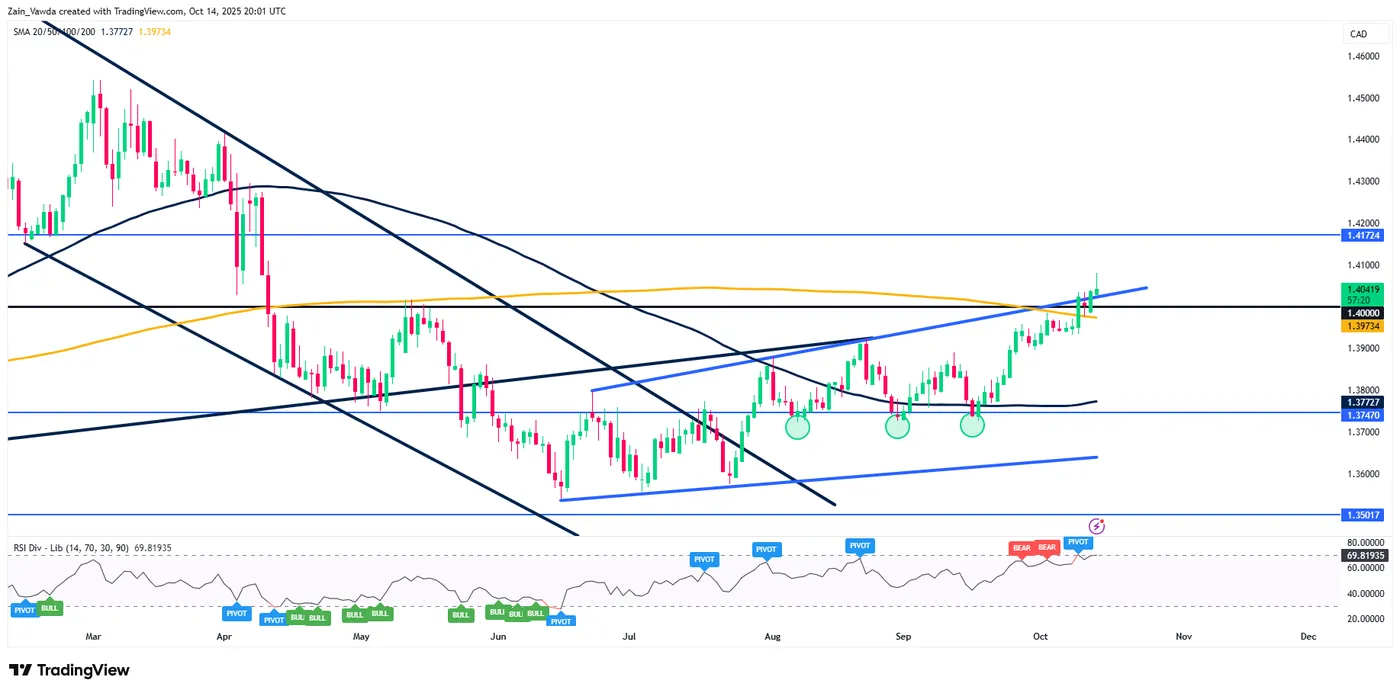
Back to the technicals though and USD/CAD has broken the channel which had help price over for just over two months. This sets up USD/CAD for a potential 280 pip move.
The medium-term outlook does look positive for USD/CAD as price has broken above the psychological 1.4000 handle and the 200-day MA. This is the first time USD/CAD trades above the 200-day MA since April 10, 2025. Funny enough this also coincided with USD/CAD breaking below the 1.4000 handle as is the case with the break above this time around.
This makes the 200-day MA key for me and thus if we are to see the bullish move continue, price needs to remain above the 200-day MA if we get any pullback in price.
USD/CAD Daily Chart, October 14, 2025
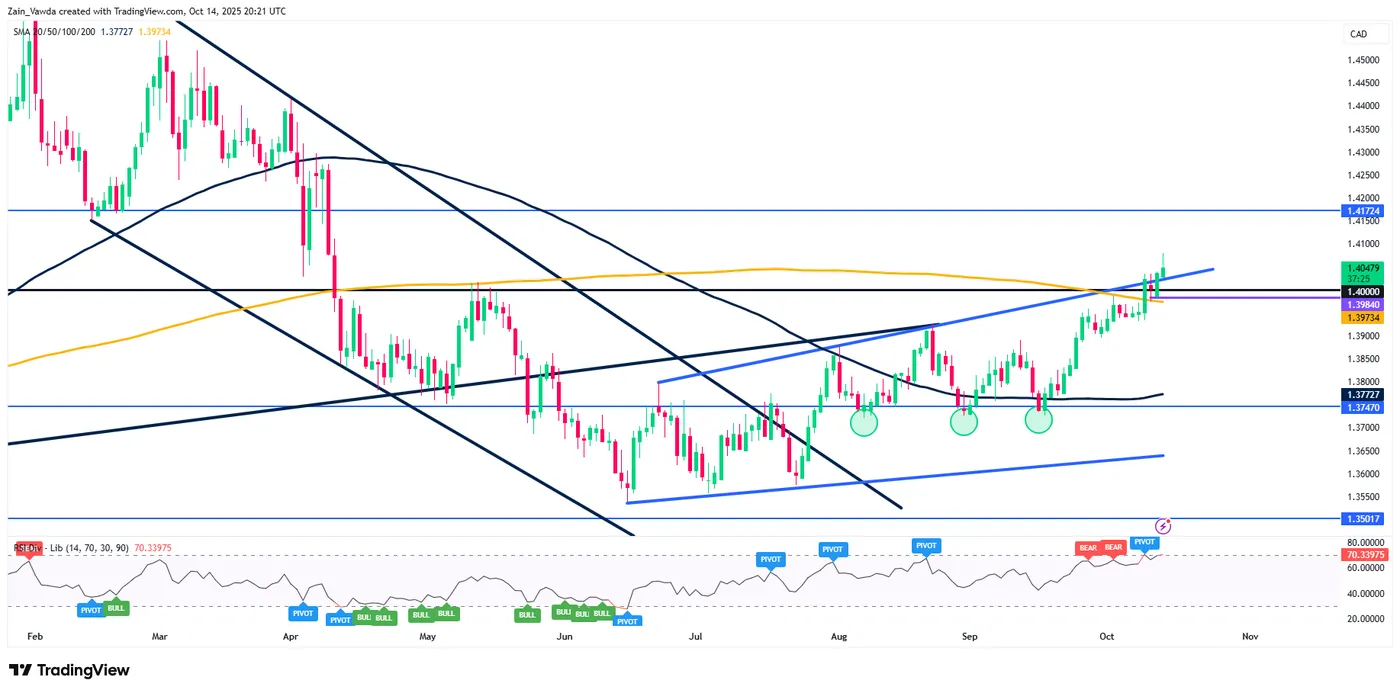
Source: TradingView.com (click to enlarge)
Dropping down to the four-hour chart and you can see that we have just had a bearish engulfing candle close.
Together with the daily hovering near overbought territory (it was in overbought territory when USD/CAD was at its daily high) could lead to a slightly deeper pullback.
If this does materialize, the swing low at 1.39840 is very close to the 200-day MA on the daily timeframe, which rests around
Thus a hold above this level may be the sign for those would be bulls looking to get involved.
USD/CAD Four-Hour Chart, October 14, 2025
Source: TradingView.com (click to enlarge)
Economic Data Ahead
The US Government shutdown remains in effect and thus data from a US perspective remains out of reach. There is also a lack of high impact data from Canada this week with a speech by Bank of Canada Governor Tiff Macklem the highlight.
This could leave the technicals as a major driver for price moves while trade war developments between the US and China will also play a role.
Next week is much more interesting. We get the releases of key inflation data from the US & Canada.
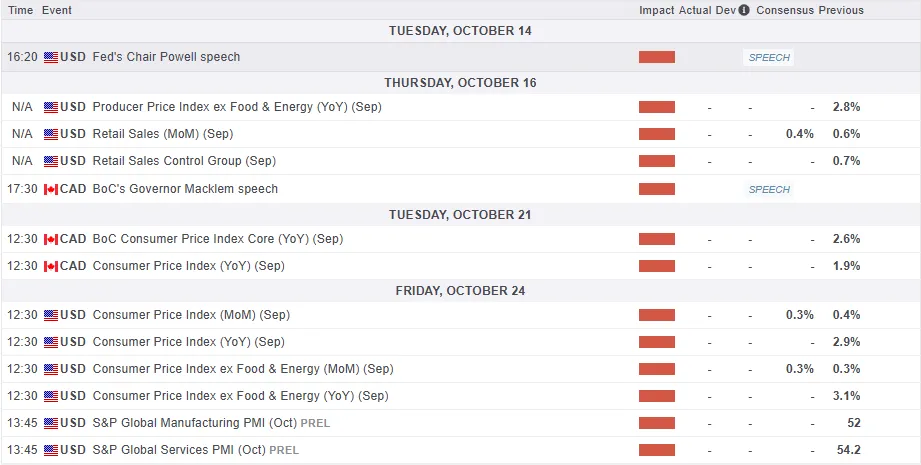
For all market-moving economic releases and events, see the MarketPulse Economic Calendar.
Client Sentiment Data - USD/CAD
Looking at OANDA client sentiment data and market participants are short on USDCAD with 75% of traders net-short. I prefer to take a contrarian view toward crowd sentiment and thus the fact that so many traders are short means USD/CAD prices could rise in the near-term.
WTI Oil Tumbles as US-China Trade Tensions Flare Up Again
A degrading sentiment took a pause yesterday as participants digested Trump’s remarks over a prolonged North American trading weekend , which initially signaled a possible de-escalation in trade tensions between the US and China.
However, optimism looks short-lived.
China reiterated its stance through multiple official channels — including its Commerce Ministry and state media — emphasizing its readiness to respond firmly to any tariff actions which comes after an initial Friday comment from Donald Trump in case you missed the story.
This is even leading to the EU and US looking to partner up again to fight the Chinese aggressive policy.
Adding pressure, US ships began paying duties at Chinese ports today, a measure long anticipated but now officially in effect.
This development has weighed heavily on global trade sentiment, extending the downtrend in Oil prices.
With easing Middle East tensions and steady Russian supply to fund its war in Ukraine, Oil fundamentals remain pointed to the downside except for the advent any black swan event.
WTI has now fallen below $60, and has been holding below the threshold since Trump's original post.
Let’s dive into Oil spot charts to see whether this decline is nearing exhaustion — or just beginning.
WTI Daily Chart
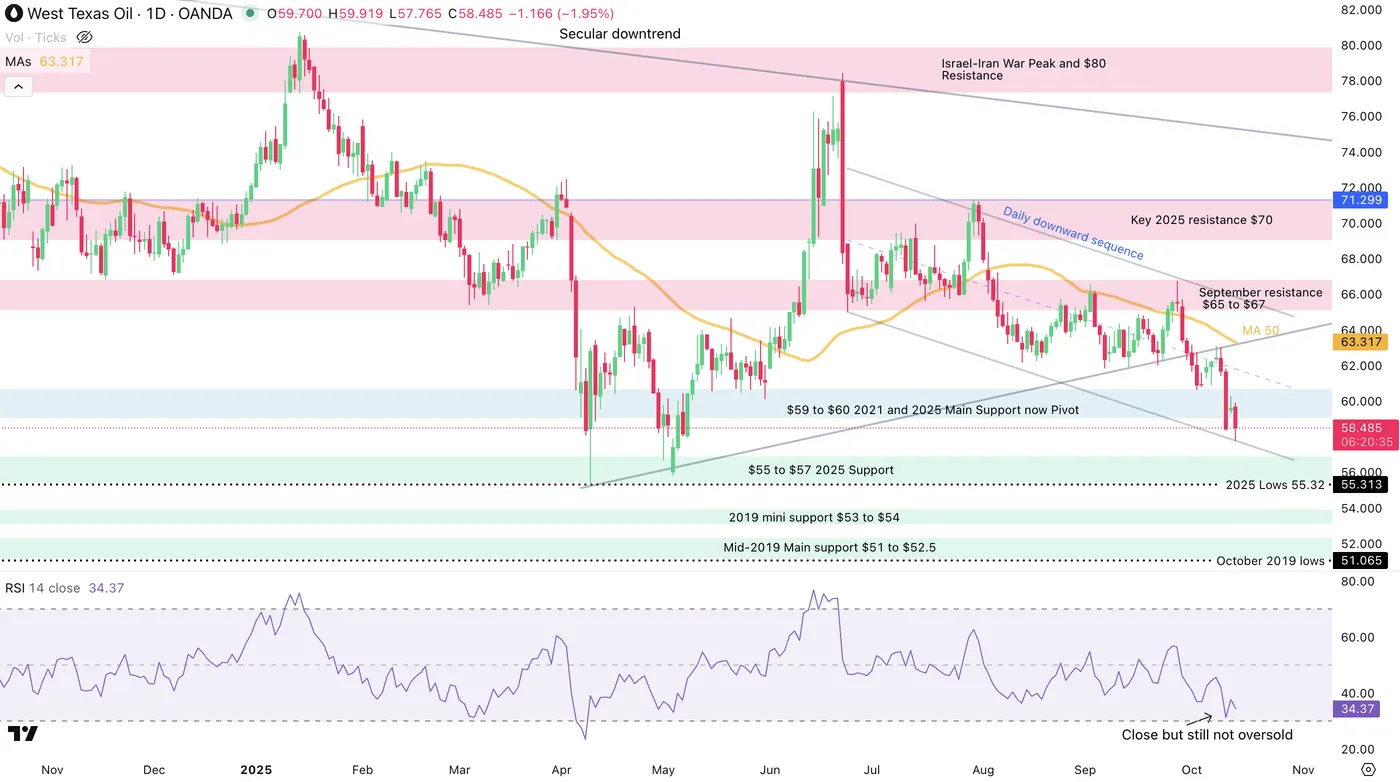
US Oil Daily Chart, October 14, 2025 – Source: TradingView
This year has seen many factors leading to downward revised global economic performance.
The most evident one is the Trump tariffs which added a widespread angst among economists, especially as they get imposed about a year after the conclusion of the fastest hike cycles, which aimed to dampen the fast growing economies from 2022 and 2023.
Even a few years after, economic deceleration still imposes its dominance on oil demand, particularly when looking at the slowing labor growth in OECD nations which generate a lot of demand.
For example, the UK just published weak data as seen in the overnight data report (more on this coming on MarketPulse today) and an also slowing US jobs market.
This combined with Chinese deflation doesn't help for bulls prospects.
There is some nuance however, with Chinese trade data coming in way better than expected and airlines projecting a solid outlook ahead.
The daily chart shows reactions at the lows of the daily downtrend after the overnight 1.50% drop.
The RSI is approaching the oversold territory but isn't quite there. Let's take a closer look.
WTI 4H Chart and levels
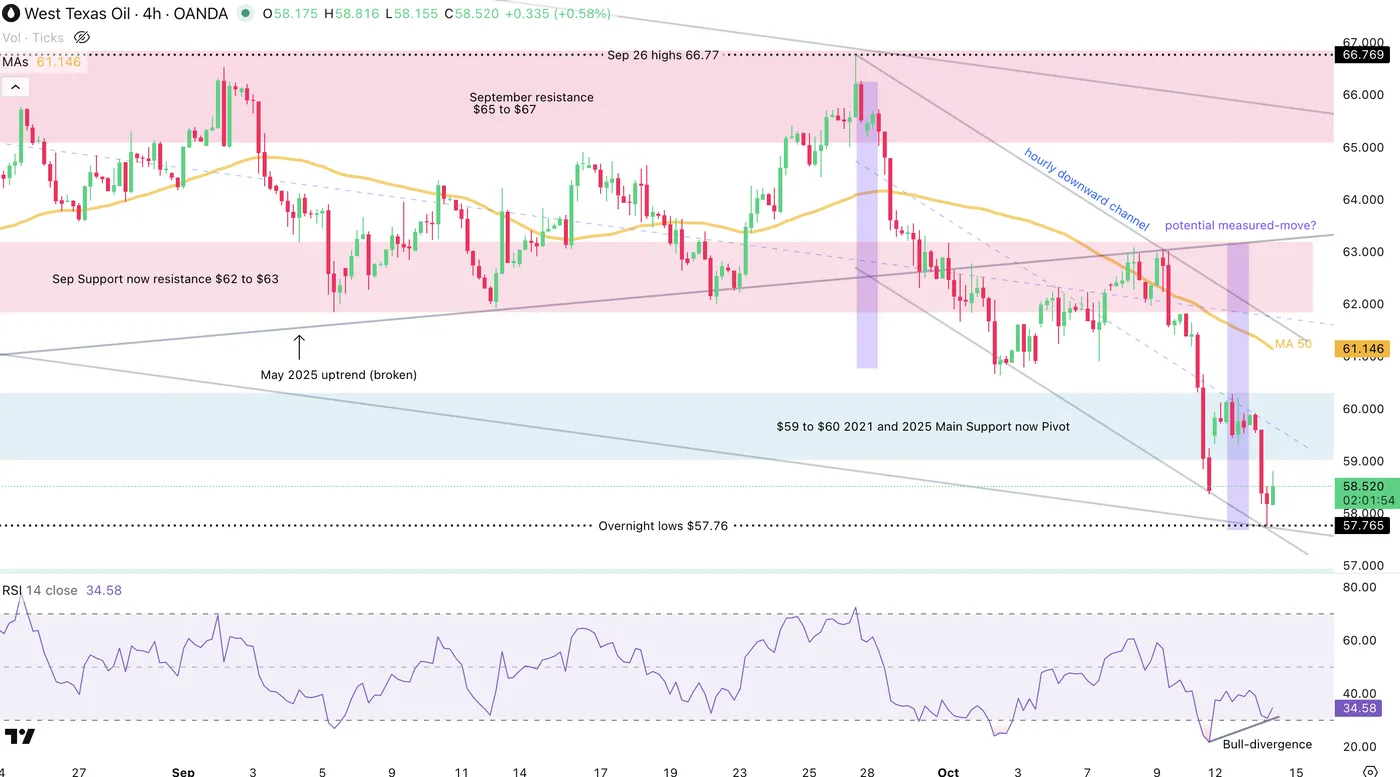
US Oil 4H Chart, October 14, 2025 – Source: TradingView
Since the end of September, Oil has firmly held its daily descending channel and even formed a steeper hourly trend.
This led to the overnight $57.75 lows, levels not seen since May 2025 and the Liberation Day troughs.
There has been some small mean-reversion however as prices reach a confluence bottom of the daily & hourly channels, combined with a bullish RSI divergence and an end to a measured-move.
Traders will have to look at the daily lows: any attempt to make new lows and any 4H close below would maintain the bearish trend and push towards the $55 2025 support zone.
Any rebound from here may point to the 4H 50-MA at $61.15 , at a confluence with the upper bound of Hourly Channel.
Levels to place on your WTI charts:
Resistance Levels
- $59 to $60 2021 and 2025 Main Support now Pivot
- MA 50 and upper bound of Hourly Channel $61.15 to $61.30
- September range Support now resistance $62 to $63
- September resistance $65 to $67
Support Levels
- Overnight lows $57.76
- $55 to $56.50 2025 Support
- 2019 mini support $53 to $54
- Mid-2019 Main support $51 to $52.5
Safe Trades!
EURCAD Wave Analysis
EURCAD: ⬆️ Buy
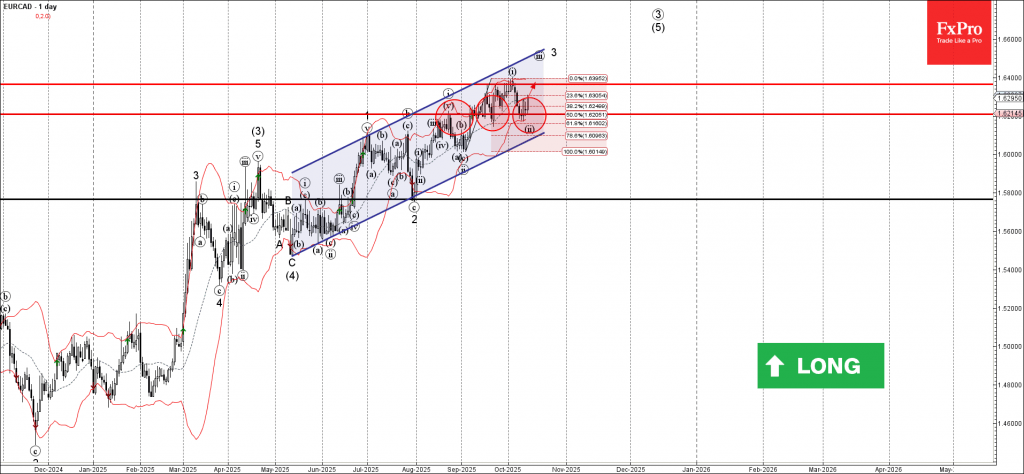
- EURCAD reversed the support level 1.6200
- Likely to rise to resistance level 1.6365
EURCAD currency pair recently reversed up from the support level 1.6200 (former monthly high from August, which has been reversing the price from the start of September, as can be seen below).
The support level 1.6200 was strengthened by the lower daily Bollinger Band and by the 50% Fibonacci correction of the upward impulse from September.
Given the clear daily uptrend, EURCAD currency pair can be expected to rise to the next resistance level 1.6365 (which reversed the previous impulse wave i).