

Sample Category Title
ECB: Right Back Where We Started From
Executive Summary
- The ECB held policy steady today but sent strong signals on easing measures likely to come in September. An ECB rate cut in September is all but certain now—the only question is how large—and we now expect the ECB to restart its QE program.
- We think the ECB will buy €45B of sovereign bonds per month for 12 months starting in October. That will almost certainly require the ECB to raise its issuer limits for sovereigns to 50% from 33%. We are not expecting the ECB to buy corporate bonds or equities.
- We are not making any changes to our GDP and CPI forecasts for the Eurozone as a direct result of these changes, and instead will wait for upcoming data—including Q2 GDP— before assessing whether changes to our economic forecasts are warranted. Today’s ECB announcement could restrain the euro in the short term, although with the Fed also easing policy, we still see room for some euro recovery over time.
Draghi Tees Up the 'Package'
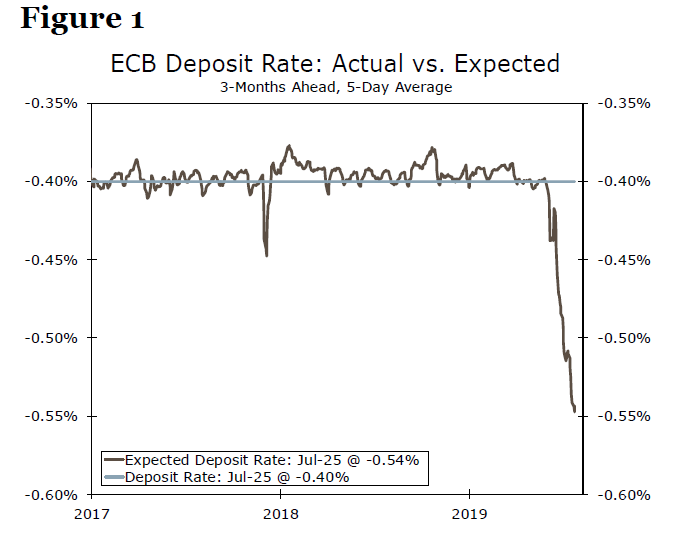
The European Central Bank (ECB) announced monetary policy today, and while it made no immediate changes to interest rates or other tools, it set the stage for a broad package of easing measures at its next meeting in September. First, the statement noted that key interest rates would remain at present levels or lower at least through the first half of 2020, with the addition of 'or lower' signaling a near-term rate cut is likely on the way. As a reminder, we expect the ECB to cut interest rates 10 bps at the September meeting. At this point, a rate cut in September is nearly a sure thing, as media reports after today’s announcement suggest ECB policymakers view a cut in September as certain. One area of uncertainty is whether the ECB may opt for a 20 bps rate cut instead of just 10 bps—markets are pricing in more than 10 bps of rate cuts by October (see Figure 1 on following page).
The ECB also opened the door to additional easing measures, as it said authorities are examining potential new net asset purchases as well as a tiering system for commercial bank reserves and changes to forward guidance. Reinforcing that view were comments from ECB President Draghi in the post-meeting press conference that 'we don’t like what we see on the inflation front.' He also noted that the economic outlook is getting 'worse and worse.' To be sure, it was not all gloom—Draghi also noted that the risk of recession was relatively low. However, even in the absence of recession, the persistent weakness in Eurozone growth and inflation, in the context of today’s ECB statement and comments, suggests the ECB is likely to deliver a broad package of easing measures in September.
What's In the Box?
With a rate cut from the ECB in September more or less a given at this point, the question is, what other measures might the Governing Council (GC) announce and implement, if any? We had previously not expected the central bank to restart its QE program, partly because of the potential political, legal and practical challenges associated with buying more assets. Perhaps more importantly, we felt that the inflation outlook, both in terms of actual inflation and inflation expectations, was not dire enough to justify renewed QE at this time. However, today's ECB policy announcement suggests that policymakers are more concerned about the inflation outlook, and moreover, we note a key change in the central bank's signaling around its inflation goal. Specifically, the ECB's statement noted that 'the GC is determined to act, in line with its commitment to symmetry in the inflation aim.' The central bank's inflation target of 'below, but close to, 2%' is by its nature not symmetric around 2%, but the mention of symmetry suggests the ECB may be more comfortable with, and indeed possibly even pushing for, inflation above 2%. This strong signaling on inflation in our view suggests that a new QE program will be announced in September.
The parameters of any possible QE program from the ECB are hard to determine with precision, but we note a few key points:
- Timing: Announced in September, but implement actual purchases starting in October
- Amount/Duration: €45 billion per month for 12 months, or €540 billion in total purchases, with the possibility of being extended
- Composition: Sovereign bonds—not expecting corporate bonds or equities to be included at this time
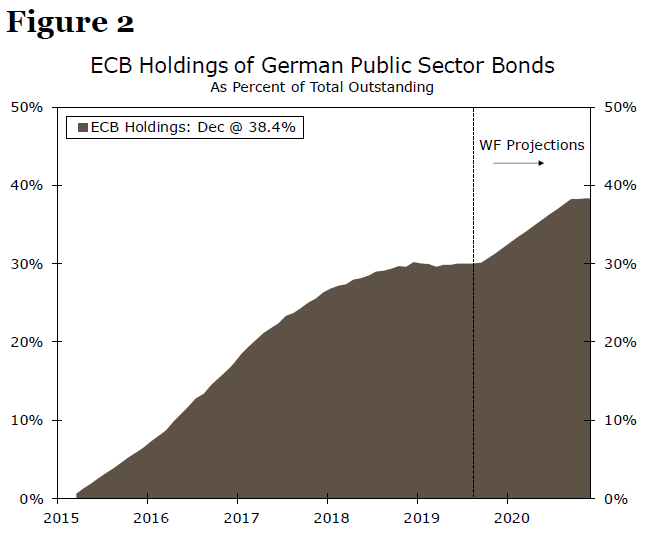
Among the most pressing issues the ECB will need to contend with in implementing new asset purchases is the self-imposed issuer limits, which currently prevent the central bank from purchasing more than 33% of any issuer's stock of eligible debt. By our calculations, the central bank already owns just over 30% of German sovereign debt securities, suggesting that renewed asset purchases would require a change to the issuer limits. The most likely change is, in our view, for the central bank to simply raise the issuer limits, perhaps to 50%. If the ECB implements new asset purchases in line with the amounts we expect, our calculations suggest the share of German government debt owned by the ECB would rise to around 40%, far enough below 50% that it gives the central bank some wiggle room if it wants to extend the duration of or increase the amount of its purchases (Figure 2).
What about other measures? The ECB has explored implementing a tiering system for commercial bank reserves, aimed at mitigating the side effects of negative interest rates on banks in the Eurozone. However, in light of comments from ECB policymakers on the matter thus far, there appears to be too much opposition among policymakers for the central bank to implement such a system at this time, and indeed we are not expecting such a system to be put into place. In terms of the amount and duration of any purchases, the central bank is likely to choose these parameters such that any purchases are sufficiently large to have a meaningful economic impact but not so large that it reduces policy flexibility. Purchasing €45 billion per month of sovereign bonds would increase the ECB's holdings around 25%, a fairly substantial increase, but would also allow for the central bank to ramp up (or reduce) purchases down the road if needed (recall that the ECB initially purchased €60 billion per month in bonds when it first launched QE in 2015, and increased to €80 billion per month in 2016). For now, we do not expect corporate bonds to be included in any new QE program, as financing conditions for Eurozone corporates appear to be more favorable than in early 2016 when the ECB first implemented corporate sector purchases. Meanwhile, we are not expecting equities to be included, considering the likely political and practical challenges and apparent resistance from ECB policymakers.
What about other measures? The ECB has explored implementing a tiering system for commercial bank reserves, aimed at mitigating the side effects of negative interest rates on banks in the Eurozone. However, in light of comments from ECB policymakers on the matter thus far, there appears to be too much opposition among policymakers for the central bank to implement such a system at this time, and indeed we are not expecting such a system to be put into place. Accordingly, in September, we are expecting the ECB to implement a 10 bps cut to its deposit and refinancing rates and announce a new QE program, but refrain from additional policy measures.
Conclusion
The ECB sent fairly strong signals today that a broad package of easing measures is likely to be delivered in September. A rate cut is highly likely, while we also now expect the central bank to announce a new program of asset purchases focused on sovereign bonds. In all, today's developments reflect the broader theme of global central banks—not just the Fed—shifting in a more dovish direction, a theme which factors into our view of a soft landing for the global economy. Meanwhile, turning to the euro, we think the single European currency will remain on the defensive for now, but we still think it can recover gradually against the greenback over the longer term.
EUR/JPY And GBP/JPY Signaling More Upsides
The Euro and British Pound traded higher this week against the Japanese Yen. Both EUR/JPY and GBP/JPY are correcting lower, but dips remain well supported.
Important Takeaways for EUR/JPY and GBP/JPY
- The Euro spiked higher recently after it tagging the 120.00 support area against the Japanese Yen.
- There was a break above a major bearish trend line with resistance near 120.80 on the hourly chart of EUR/JPY.
- GBP/JPY is trading with a positive bias and remains well bid above the 135.00 level.
- There is a key bullish trend line forming with support near 134.80 on the hourly chart.
EUR/JPY Technical Analysis
Earlier this week, the Euro declined steadily below the 121.00 support level against the Japanese Yen. The EUR/JPY pair even traded below the 120.50 support level and traded close to the 120.00 support level.
A swing low was formed near 120.04 on FXOpen and recently the pair jumped sharply higher. It broke the 120.50 resistance level and the 50 hourly simple moving average
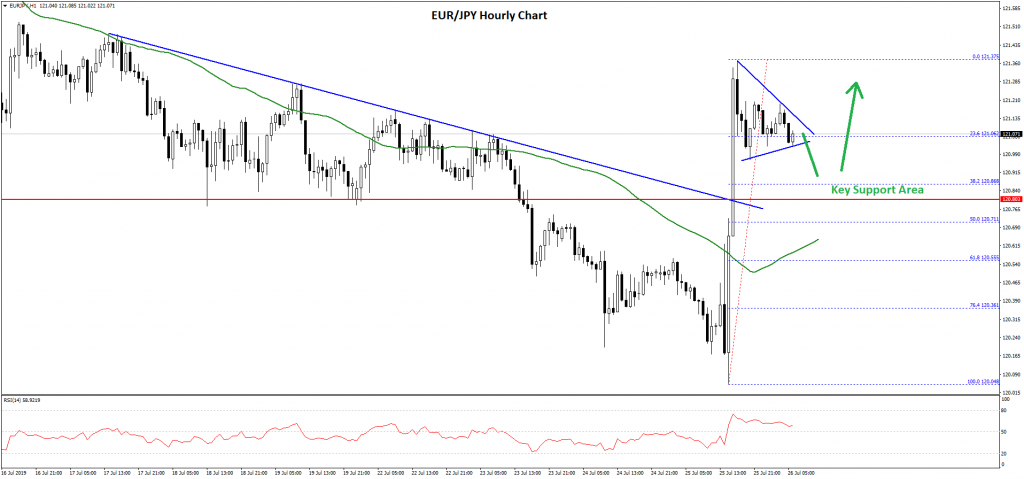
Moreover, there was a break above a major bearish trend line with resistance near 120.80 on the hourly chart of EUR/JPY. The pair even settled above the 121.00 level and recently traded as high as 121.37.
It is currently correcting lower below the 121.20 level plus the 23.6% Fib retracement level of the last wave from the 120.04 low to 121.37 high. It seems like there is a short term breakout pattern forming with support near the 121.00 level.
If there is a downside break, the pair might correct towards the key 120.80 support level. The main support is near the 120.70 level and the 50% Fib retracement level of the last wave from the 120.04 low to 121.37 high.
Therefore, dips in EUR/JPY towards the 120.80 and 120.70 levels are likely to find a lot of buying interest in the near term. On the upside, the pair might face hurdles near the 121.50 and 121.80 levels.
GBP/JPY Technical Analysis
The British Pound followed a steady bullish path above 134.20 this week against the Japanese Yen. The GBP/JPY pair broke the key 134.60 resistance levels to extend its upside and move into a positive zone.
The pair climbed above the 135.00 resistance and the 50 hourly simple moving average. Finally, there was a break above the 135.50 level and the pair traded close to the 135.70 level.
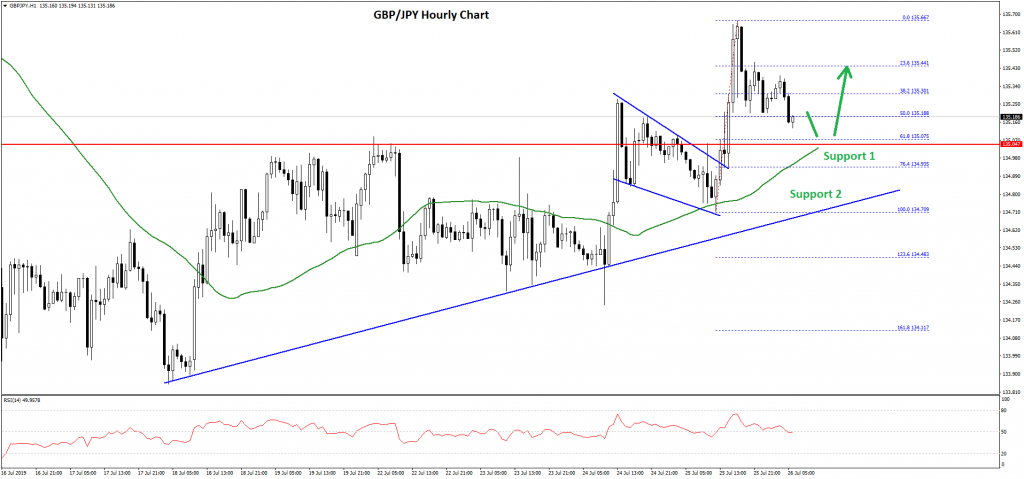
A swing high was formed at 135.66 and the pair is currently correcting lower below 135.50. It is currently testing the 50% Fib retracement level of the last wave from the 134.70 low to 135.66 high.
On the downside, there are a few important supports near the 135.10 and 135.00 levels. The 61.8% Fib retracement level of the last wave from the 134.70 low to 135.66 high is also positioned near the 50 hourly simple moving average to act as a strong support above 135.00.
Moreover, there is a key bullish trend line forming with support near 134.80 on the hourly chart. Therefore, dips towards the 135.00 and 134.80 levels are likely to find a strong buying interest in the near term.
On the upside, an initial resistance is near the 135.40 level, above which the pair could climb higher towards the 135.70 and 136.00 levels in the coming sessions.
Market Morning Briefing: Pound Has Immediate Resistance Near 1.2525
STOCKS
Profit-booking in equities following the European Central Bank (ECB) President’s comment that there is no threat of a recession at the moment. This hints that the central banks, especially the US Federal Reserve may not be as aggressive as the market has been expecting in cutting rates. As a result some profits have been taken-off the table and the indices are likely to trade lower ahead of the US Fed meeting next week on Wednesday (July 31).
Dow (27140.98, -128.99, -0.47%) is heading to test 27000. While 27000 hold, a sideways consolidation between 27000 and 27500 is possible for some time. But a break below 27000 can trigger a fall to 26600. While below 27500, we expect the Dow to break 27000 and fall to 26600.
DAX (12362.10, -160.79, -1.28%) has failed to breach 12600 and has come-off sharply much beyond our expected level of 12400. Immediate resistance is at 12380 and the next is at 12450. While these resistances hold, a fall to 12200-12100 is possible in the near term.
Nikkei (21642.52, -114.03, -0.52%) has failed to sustain above 21750 and has come-off today. However, support is at 21600 and 21550 which can limit the downside and push Nikkei higher again to 21750 levels.
Shanghai (2919 2936, -1.36, -0.05%) is holding above 2900 but is not gaining strength. This leaves the near-term outlook mixed. Shanghai can consolidate between 2880 and 2950 for some time.
Nifty (11252.15, -19.15, -0.17%) bounced above 11300 during the day yesterday, but failed to sustain higher. It has come-off to close below 11300 again. The outlook remains bearish to test 11100-11000 while it trades below 11300.
Similarly, Sensex (37830.98, -16.67, -0.04%) is bearish to test 37500 and even 37000 while it remains below 38000.
COMMODITIES
Commodities are looking ranged just now and could see some narrow movement before gaining some momentum next week.
Brent (63.39) is almost stable near levels seen yesterday while Nymex WTI (56.19) is trading slightly higher. Mentioned supports near 62 and 54 are holding well for now and possibly keep crude prices stable or ranged for some time.
Gold (1417.40) is trading low just now and could have scope of falling towards 1410-1400 in the near term.
Silver (16.45) is holding below 16.60 and while that holds, Silver could target to test lower levels of 16.00 soon. View would be bearish below 16.60.
Copper (2.7055) has come off after testing 2.74 on the upside. If he price manages to break below 2.70, it could test 2.68/66 on the downside.
FOREX
Currency markets saw volatility after the ECB policy statement release yesterday where the central bank kept interest rates unchanged but signals a possible rate cut in its next meeting in Sep’19. There is also concern of inflation remaining much below its 2% target.
Dollar Index (97.77) traded within 98-97.50 yesterday and while it currently trades below 98, it is important to see if it re-attempts a test of 98.0-98.5 in the near term before coming off from there. On the 3-day candles, there is scope for Dollar Index to test resistance near 98.50 on the upside before facing rejection from there.
Euro (1.1150) too tested 1.11 initially followed by a sharp bounce to 1.1190 yesterday. Currently trading at 1.1150, if the currency holds above support at 1.11, it could bounce back towards 1.12-1.13 again in the near term. Else a sharp rise towards 98.0-98.50 on the Dollar Index could be bearish for Euro towards 1.11 or lower in the near term. We would wait and watch for a couple of sessions to gain some clarity.
Dollar-Yen (108.59) has moved above 108.50 and could now target upper resistance at 109 which is likely to hold in the first testing. While below 109, there is still some scope of testing 107; else a break above 109 would take the pair towards 110. For now we prefer a rejection from 109.
Euro-Yen (121.06) has held well above 120 and while that holds, the pair may move higher targeting 122-123 in the near term. Near term looks bullish while above 120.
Aussie (0.6947) has fallen below immediate support just above 0.6950 and could target 0.69-0.68 in the medium term. Near term looks bearish on the 3-day candles.
Pound (1.2450) has immediate resistance near 1.2525 and while that holds, Pound could come off in the near term towards 1.2350 as we have been mentioning in the past few editions. Near term view is bearish.
USDCNY (6.8759) is likely to remain sideways in the 6.89-6.85/80 region with more preference for a test of the lower limit of the mentioned range.
USDINR (69.05) closed above 69 yesterday and could test 69.10/15 on the upside before coming off from there. Resistance near 69.25 is likely to hold in the medium term pushing Dollar-Rupee back towards 68.90/75.
INTEREST RATES
The European Central Bank (ECB) left the rates unchanged yesterday and have opened doors for more easing going forward. Whether the easing will be in the form of rate cuts or asset purchases is not known and decided as of now. The ECB President ruling out the possibilities of a recession at the moment has reduced the hopes in the market that the central banks may not go ahead with easing at a much faster pace than anticipated. This in turn has helped the bond yields to bounce yesterday. All eyes will be on the US Fed now which is scheduled to release its monetary policy next week on Wednesday (July 31)
The US Treasury yields have moved up across tenors with the near-end witnessing a sharp rise compared to the far end. This has reduced the chances of a dip that we had mentioned yesterday. The 2Yr (1.85%) and 5Yr (1.85%) were up 4 bps each while the 10Yr (2.07%) and 30Yr (2.60%) were up 2 bps and 1 bps respectively. The 2Yr and 5Yr are getting strong support near 1.80%. While above 1.80% they can rise to 1.90%-1.93% in the coming days. As mentioned yesterday, the 10Yr yield has to rise past 2.10% to gain momentum and target 2.20%.
The German yields have inched higher. The 2Yr (-0.77%) and 5Yr (-0.68%) were up 1 bps while the 30Yr (0.24%) was up sharply by 4 bps. The 5Yr (-0.37%) remained stable. The 30Yr is bouncing from a key support level of 0.20%. While it holds, the yield can move up to 0.30% or even higher in the coming weeks.
The 10Yr GoI (6.5135%) has risen past 6.50% today and has negated the chances of a dip to 6.35% mentioned yesterday. The chances are looking high for the 10Yr GoI to break 6.55% and rise to 6.60% and 6.65% in the coming days. Support is at 6.42%.
ECB Review – Hinting Easing Without Giving Details
The July ECB meeting aims at preparing the market for further easing in September. As expected, the members hinted that interest rate could fall to lower level. They also discussed about the possibility of restarting QE and the two-tiered interest rate system. The announcement was not without surprise. The explicit inflation target was removed and the bar for further easing was lowered. Yet, these surprises do not alter our view that a easing package would be announced in September.
Removing Explicit Inflation Target
ECB expects the policy rates to “remain at their present or lower levels at least through the first half of 2020”. Addition of “lower levels” came in as expected. However, reference to inflation target was tweaked to “and in any case for as long as necessary to ensure the continued sustained convergence of inflation to our aim over the medium term”. This was compared with June’s language that “… sustained convergence of inflation to levels that are below, but close to, 2% over the medium term”. The change might signal upcoming change in ECB’s interpretation in price stability. As suggested in the policy statement was that the members are “determined to act” if “the medium-term inflation outlook continues to fall short of our aim… in line with its commitment to symmetry in the inflation aim”. At the press conference, President Draghi affirmed that “commitment to symmetry around the inflation aim” and added that “which in a sense is 1.9%”.
Lowering Bar for Further Easing
As mentioned above, ECB noted that it stands ready to act if “the medium-term inflation outlook continues to fall short of its aim”. At the Sintra forum, Draghi suggested actions would be taken “in the absence of improvements”. We interpret this as easing would still come even if there is no downward revision on the updated economic projection in September.
Hinting Easing Package without Details
As mentioned in the statement, ECB “underlined the need for a highly accommodative stance of monetary policy for a prolonged period of time”. It also suggested that the relevant Committees would examine options, “including ways to reinforce its forward guidance on policy rates, mitigating measures, such as the design of a tiered system for reserve remuneration, and options for the size and composition of potential new net asset purchases”. These references indicate that the upcoming easing measure would be a package, rather than just rate cut. For the first time, ECB referred to “a tiered system” when it talked about “mitigating measures”. This evidences that the members are concerned about defending bank profitability as the deposit rate falls deeper to the negative territory. This has further increased the likelihood that the rate cut in September would come with a “two-tiered system”.
We reiterate our expectations that, in September, ECB would announce an easing package, including forward guidance enhancement, rate cut with tiering system and QE. ECB would cut the deposit rate by -20 bps from the current -0.4%, along with a tiering system. It could as the same time announce resumption of QE for 12 months initially, with corporate bonds and sovereign debt included the purchase program.
USD/JPY Eyeing More Upsides Above 109.00
Key Highlights
- The US Dollar climbed higher recently from the 108.00 support against the Japanese Yen.
- USD/JPY traded above a key bearish trend line at 108.15 on the 4-hours chart.
- The US Initial Jobless Claims for the week ending July 20, 2019 declined from 216K to 206K.
- The US Gross Domestic Product in Q2 2019 (Prelim) might grow 1.8%, less than the last +3.1%.
USDJPY Technical Analysis
The US Dollar started a decent upward move from the 107.20 swing low against the Japanese Yen. The USD/JPY pair gained traction above 108.00 and it seems like it could even surpass 109.00 in the near term.
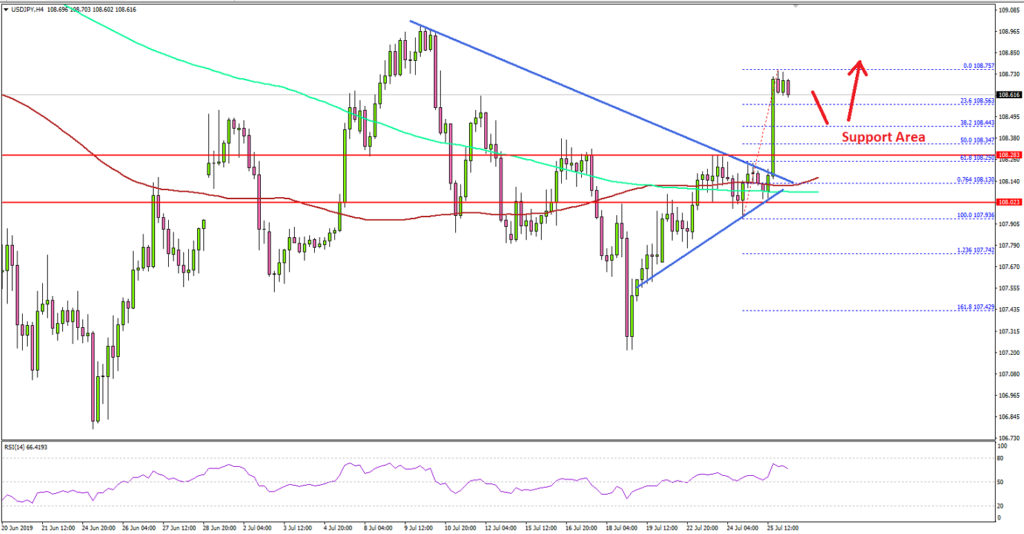
Looking at the 4-hours chart, the pair formed a solid support near the 108.00 level and recently started a decent increase. There was a close above the 108.20 level, the 100 simple moving average (red, 4-hours), and the 200 simple moving average (green, 4-hours).
Moreover, the pair traded above a key bearish trend line at 108.15 on the same chart. It opened the doors for more gains above the 108.50 resistance.
The pair traded close to the 108.80 level and it is currently consolidating gains. An initial support is near the 108.50 level. However, the main support is near 108.35 plus the 50% Fib retracement level of the upward move from the 107.93 low to 105.75 high.
Therefore, if there is a downside correction, the pair could find bids near the 108.50 or 108.35 levels. To start a substantial decrease, the pair must trade below the 108.00 support and the 100 simple moving average (red, 4-hours).
On the upside, an initial resistance is near the 108.80 level, above which the pair might attempt more upsides above the 109.00 level.
Fundamentally, the US Initial Jobless Claims figure for the week ending July 20, 2019 was released by the US Department of Labor. The market was looking for a minor increase in claims from 216K to 219K.
However, the actual result better than the forecast, as there was a decline in the US Initial Jobless Claims from 216K to 206K.
The report added:
The advance number for seasonally adjusted insured unemployment during the week ending July 13 was 1,676,000, a decrease of 13,000 from the previous week’s revised level. The previous week’s level was revised up 3,000 from 1,686,000 to 1,689,000.
Overall, the US Dollar bulls remain in control and pairs such as EUR/USD, GBP/USD and AUD/USD might continue to face selling pressure.
Economic Releases to Watch Today
- US Gross Domestic Product Q2 2019 (Preliminary) – Forecast 1.8% versus previous 3.1%.
- US Personal Consumption Expenditures Prices for Q3 2019 (QoQ) – Forecast +0.6%, versus +0.5% previous.
Daily Markets Broadcast
US indices retreat after ECB didn’t cut rates
The SPX500 index touched a record high yesterday but then retreated, echoing weakness across the other indices. The slight pessimism crept in after the ECB chose not to cut rates yesterday.
US30USD Daily Chart
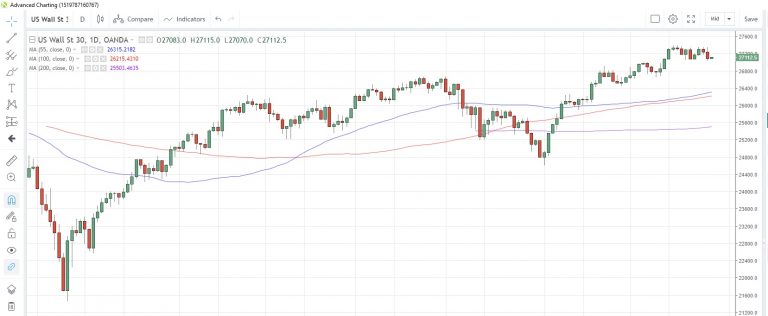
The US30 index fell for a second day yesterday, despite strong economic data and some OK earnings reports
The 100-day moving average at 26,215 and the 55-day average at 26,315 continue to track each other higher
US economic growth probably slowed to 1.8% y/y in the second quarter, according to the latest survey of economists. That’s a marked slowdown from Q1’s +3.1%.
DE30EUR Daily Chart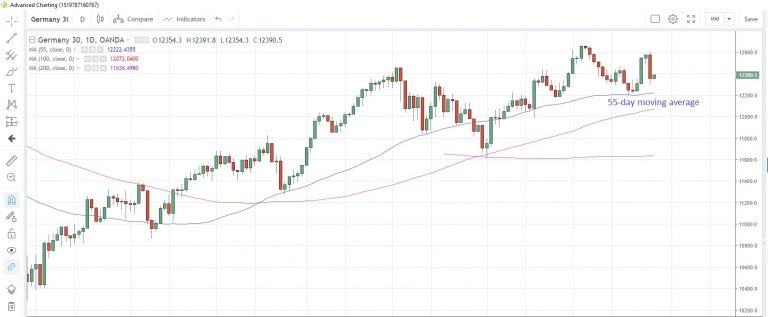
The Germany30 slumped the most since May 13 after the ECB opted not to cut rates. An economic outlook that is getting “worse and worse” and an increased likelihood of additional stimulus were not enough to stop the decline
The index is falling toward the 55-day moving average at 12,222, which has supported prices on a closing basis since June 3
In the post-meeting press conference, Bank chief Draghi said that cutting rates had not been discussed, but added that he sees EU rates at present or lower levels through to at least the first half of next year, or as long as necessary.
CN50USD Daily Chart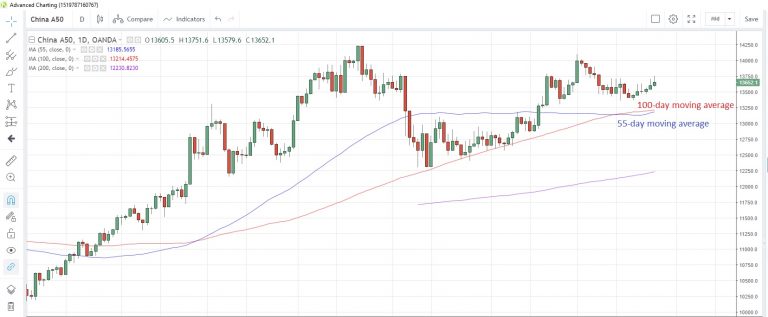
The China50 index advanced for a third consecutive day yesterday, helped along by the prospect of progress in US-China trade negotiations on Monday
Th 55-day moving average at 13,185 has turned higher this week and looks poised to cross back above the 100-day moving average at 13,214 early next week
Markets will start to focus on the July PMI readings next week, which are scheduled to be released on Wednesday. Contrary to the softer flash Markit manufacturing PMI readings from around the globe, China’s PMI is seen rising to 54.4 from 54.2 in June. One could argue that there is a risk of a lower number, which would be detrimental to risk appetite.
EURJPY Bounces Off Lower Prices
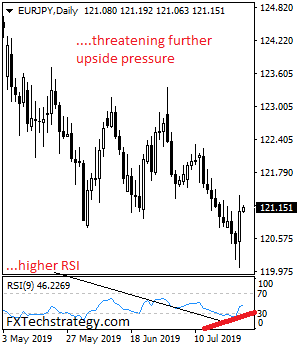
EURJPY bounces off lower prices to close higher on Thursday. This has opened the door for more strength in the days ahead. On the downside, support comes in at the 120.50 level where a break if seen will aim at the 120.00 level. A cut through here will turn focus to the 119.50 level and possibly lower towards the 119.00 level. On the upside, resistance resides at the 121.50 level. Further out, we envisage a possible move towards the 122.00 level. Further out, resistance resides at the 122.50 level with a turn above here aiming at the 123.00 level. On the whole, EURJPY retains its corrective upside pressure.
Eco Data 7/26/19
[php_everywhere instance="1"]
US500 Index Retests and Pushes Through Previous All-Time High
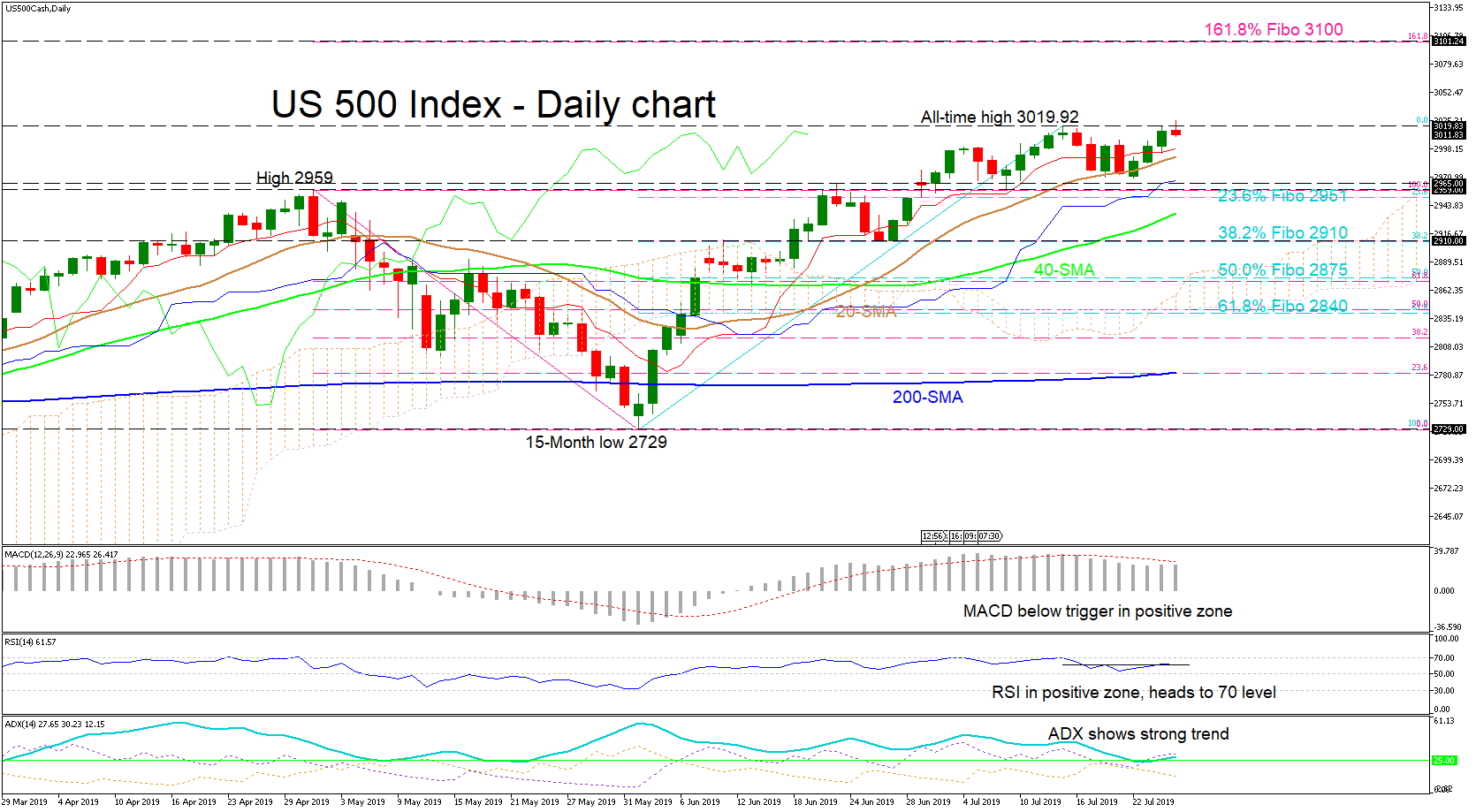
US 500 stock index after retreating last week, began a sure but steady move to revisit the all-time high of 3019, and currently is climbing above it. The price found support at the Tenkan-sen average, and the moving averages are headed higher holding the price above them.
The momentum indicators suggest a quick reload necessary for the jump ahead, as the MACD is nearing a cross above the trigger in the positive region, whilst the RSI is slightly pointing up approaching the 70 level. The ADX is also indicating a strong trend scenario.
Downwards, the area around the all-time high would need to hold, initially sending price down to face the 20-day simple moving average (SMA) currently at 2990, before the support region of 2959 – 2965 can be tested. Breaching the levels would bring the 23.6% Fibo of the up move from 2729 to 3019.92, of 2951 up for grabs. Following would be the 40-SMA presently at 2936 before consideration of the 38.2% Fibo of 2910 coupled with swing support.
For upside continuation, a strong close candle above the all-time-high would cement the short-term bullish bias and could unfold the 161.8% Fibo of the down move from 2959 to 2729, of the 3100 handle.
Summarizing, a bullish bias dominates all the time frames, but a very short-term neutral bias could unfold between the all-time-high of 3019 and 2959 if the resistance of 3019 holds.
ECB Review: The Grande Finale is Scheduled for 12 September
- It is a matter of how the ECB will act, no longer if. The ECB tasked committees to examine the potential QE restart, rate cut, tiering and forward guidance, although there were no details on rate cut size, QE size, limits etc.
- The economic assessment in the statement was virtually unchanged although Draghi said that the economic outlook is 'getting worse and worse' as well as 'inflation expectations declining'.
- Draghi went to great lengths today to emphasise symmetry in the inflation mandate where both realised and projected were mentioned.
- Markets will keep speculating about the composition of the stimuli, but were somewhat disappointed with the lack of details
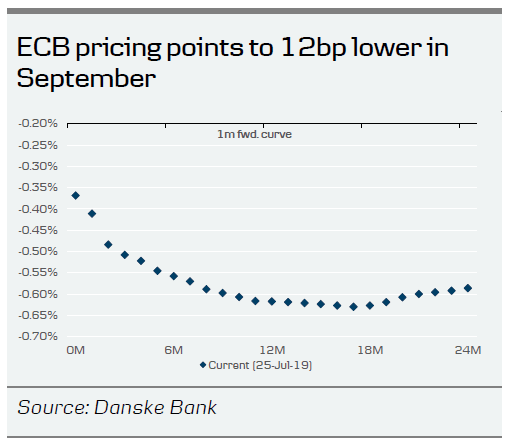
At the July meeting Mario Draghi sent a strong signal to the market, that further stimulus is on its way to help the ailing economy. As we expected, the ECB adjusted the forward guidance as a first step, opening up the possibility of policy rates remaining 'at present or lower levels' at least through H1 20. In our view this has set the scene for a deposit rate cut, which we expect to be announced at the September meeting (we expect a 20bp rate cut), paired with a restart of the QE programme and extended forward guidance (see ECB Research: New ECB call - rate cut and restart of QE, 18 June 2019). Markets are currently pricing 12bp of cut in September.
However, while Draghi more or less pledged that a highly accommodative monetary is going to be needed for a prolonged period of time, he remained deliberately vague on the what/when/how of the exact policy measures, which tasked committees have been charged with examining until September. Tasked committees have previously been used with bigger changes in monetary policy measures.
One novelty in the ECB's statement related to the emphasis on the symmetry of the inflation aim (both realised and projected where mentioned). Draghi indicated that inflation could overshoot the target at the Sintra speech six weeks ago.
The ECB's assessment of the inflation and economic outlook and risks was broadly unchanged. While resilience is still apparent in the service and construction sectors, Draghi also stressed the outlook was getting worse and worse, especially in manufacturing. This means the expected rebound in H2 19 is now less likely with incoming data. The risk of recession was seen as 'pretty low' (from 'very low' in June).
The language on the inflation outlook was slightly more subdued, as the pass-through from labour cost pressures to inflation is taking longer than expected. In that light, Draghi stressed that the GC is not happy with the achievements on the inflation front and will not accept permanent undershooting of its target.
All this reinforced the message of a more uncertain inflation and growth outlook, that will be the base of the easing package to be unveiled in September.
FX: our fundamental predisposition is to buy EUR/USD
The initial reaction in FX markets was to send EUR/USD to a new multiyear low just above 1.1100. During the press conference, however, EUR/USD rebounded as little confirmation news was delivered to the EUR bears hence triggering profit taking. At the time of writing EUR/USD is trading higher than before the ECB meeting albeit still little changed relative to the opening levels this morning of close to 1.1150.
From an FX perspective we think the crucial part of the signalled easing package lies in rate cuts (see FX Edge: The EUR and ECB – rate cuts are all that matter, 12 July 2019). A sizeable cut in the deposit rate (and 20bp is a bare minimum in our view) would force a greater share of excess liquidity on the market, help turn around inflation expectations and weaken the EUR. However, history has shown that market expectations have tended to exceed the ECB's eventual easing package announcement at the time of the ECB policy meetings. In addition, if a September rate cut is delivered together with a tiering system it would in our view diminish the negative EUR FX impact. Also FOMC rate cuts and a cyclical stabilisation in H2, all else being equal, would constitute EUR/USD supportive factors. As the speculative leverage funds segment remains heavily short EUR/USD according to the weekly CFTC IMM data (IMM Positioning Update, 21 July) a change of the H1 environment could add to the move higher in the cross this autumn. Consequently, our fundamental predisposition is to buy EUR/USD dips on a strategic bias on this ECB message.
Fixed income: more support to European fixed income
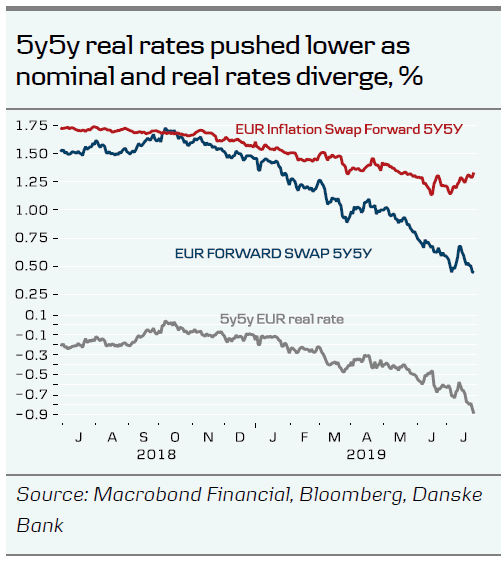
European fixed income markets initially rallied on the back of the easing 'package' from Draghi. The hunt for yield or the struggle to avoid negative yields will as a consequence intensify and real yields were pushed a new leg lower. That said, later in the day nominal yields moved higher as the market got no new details during the press conference and as inflation expectations moved higher. In respect of the latter, notice that 5y5y EUR inflation swap moved 4bp higher to 1.33% and that 5y5y EUR real rates fell 5bp to -0.89% over the day.
We have so far called for a test of -0.45% for 10Y bund yields and we stick to this view ahead of the September meeting with more downside potential. Rate cuts would according to the textbook lead to a curve steepening 2s10s, 5s10s, 10s30s etc. as long-term inflation expectations are pushed higher. However, given the upcoming QE programme and the struggle to avoid negative yields we argue it is too early to move against the flattening trend in European bond markets.
Given the Draghi package we keep our positive view on semi-core and periphery. Our favourite in the periphery has for a long time been Spain and Portugal, and Finland in semicore. The strong demand for duration and positive yields means that Italy can be expected to continue to tighten versus core markets.