

Sample Category Title
Japan FM Aso: We won public trust for sales tax hike
In Japan, Kyodo news reported today that Chief Cabinet Secretary Yoshihide Suga and Finance Minister Taro Aso will likely retain their posts in a cabinet reshuffle . Prime Minister Shinzo Abe said he has noted decided on the cabinet yet, after winning a solid majority in the upper house election on Sunday. The new cabinet will likely be announced in September.
Separately, Aso said after a cabinet meeting that the election gave the ruling coalition a stable political footing. Hence, he said, "I believe we won public trust for the sales tax hike".
This somewhat echoed Abe's comment yesterday that based on a stable political basis, the Abe cabinet will take more aggressive and bold economic measures than ever."
GBP/USD Facing Key Resistance Near 1.2550
Key Highlights
- The British Pound struggled to gain momentum above 1.2550 against the US Dollar.
- GBP/USD is struggling to trade above a key bearish trend line near 1.2515 on the 4-hours.
- The Chicago Fed National Activity Index (CFNAI) increased from -0.03 to -0.02 in June 2019.
- The US Housing Price Index in May 2019 could rise 0.3% (MoM), less than the last +0.4%.
GBPUSD Technical Analysis
The British Pound started an upside correction from the 1.2381 low against the US Dollar. The GBP/USD pair traded above the 1.2460 and 1.2500 resistance levels, but it struggled to gain traction above 1.2550.
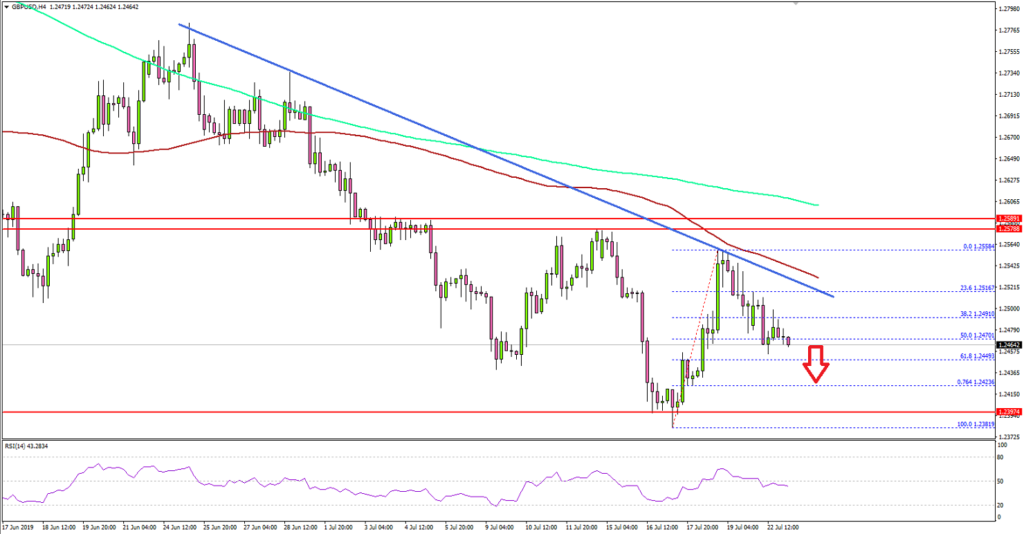
Looking at the 4-hours chart, the pair failed below a significant resistance area near 1.2575 plus the 100 simple moving average (red, 4-hours). A swing high was formed near 1.2558 before the price trimmed gains.
It traded below the 1.2500 support plus the 50% Fib retracement level of the upward move from the 1.2381 low to 1.2558 high. On the downside, the main supports are near 1.2445 and 1.2415, below which there is a risk of more losses.
If GBP/USD slides below 1.2400 once again this week, it could trade to a new monthly low below 1.2380. Conversely, the pair needs to climb above the 1.2550 and 1.2575 resistance levels plus settle above the 100 simple moving average (red, 4-hours) to start a strong rise.
If there is a successful close above the 1.2575 resistance, the pair might attempt to break the 1.2600 resistance plus the 200 simple moving average (green, 4-hours).
Fundamentally, the Chicago Fed National Activity Index (CFNAI) for June 2019 was released by Federal Reserve Bank of Chicago. The market was looking for an increase from -0.05 to 0.10.
However, the actual result was disappointing as the index increased to -0.02. The last reading was revised up from -0.05 to -0.03, but the overall increase was very less.
The report added:
One of the four broad categories of indicators that make up the index increased from May, and two of the four categories made negative contributions to the index in June. The index’s three-month moving average, CFNAI-MA3, ticked up to –0.26 in June from –0.27 in May.
Overall, GBP/USD is facing a few key resistances near 1.2550 and 1.2575, above which the pair could start a solid increase in the near term.
Economic Releases to Watch Today
- US Housing Price Index for May 2019 (MoM) – Forecast +0.3%, versus +0.4% previous.
- US Existing Home Sales for June 2019 (MoM) – Forecast +0.2%, versus +2.5% previous.
Daily Markets Broadcast
Wall Street rebounds on hopes for trade talk progress
US indices closed higher yesterday amid reports that US negotiators would head to Beijing next week for the first face-to-face meetings since the G-20 summit. Tensions are still high in the Gulf while the results of the UK Conservative Party leadership race should be announced today.
US30USD Daily Chart
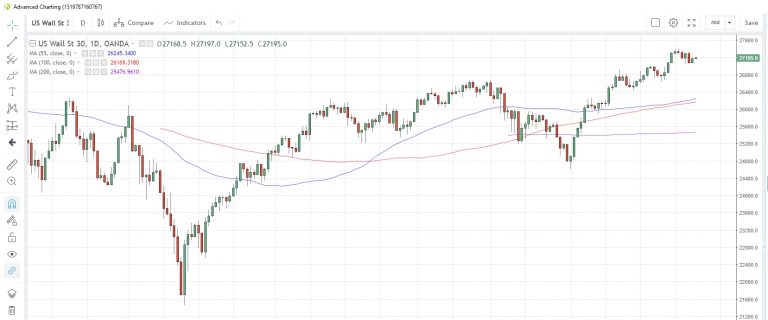
The US30 index rebounded yesterday, fueled by hopes for advances in the trade talks and calls from Fed board nominee Shelton for a 50bps cut at next week’s meeting
The 100-day moving average at 26,169 and the 55-day average at 26,245 continue to track each other higher
US existing home sales probably rose 0.2% m/m in June, the latest survey of economists suggests. House prices are seen up 0.3% m/m in May, a slower increase than April’s +0.3%.
DE30EUR Daily Chart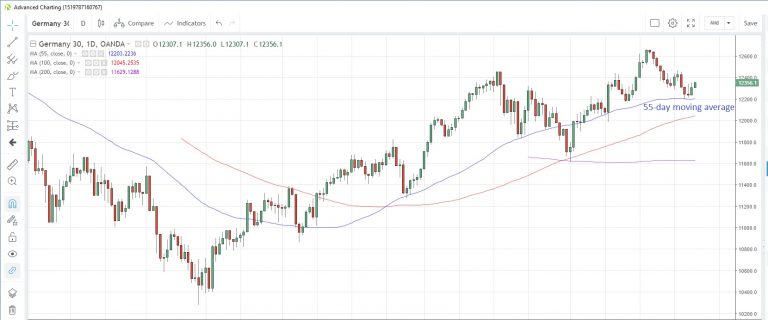
The Germany30 rose for the first time in four sessions yesterday, lifted by the better mood on Wall Street and after ratings agency Fitch affirmed Germany’s AAA rating with a stable outlook
The index has held above the 55-day moving average at 12,203, which has supported prices on a closing basis since June 3
Markets are preparing for the ECB meeting on Thursday, which is widely expected to have a dovish bias but without any change in benchmark rates.
UK100GBP Daily Chart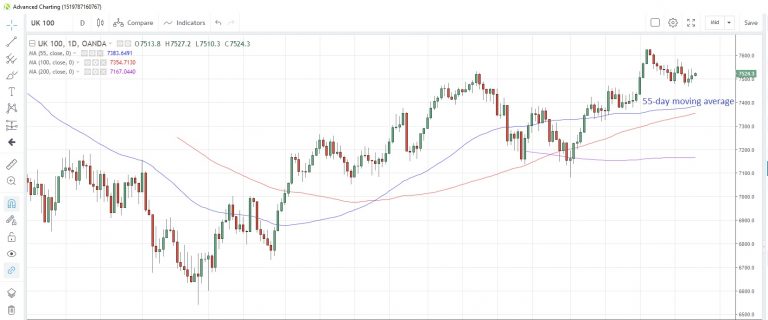
The UK100 index looks set for a third day of gains today after early trading as we await the outcome of the Tory Party leadership contest. Boris Johnson, a well-known hard-Brexiteer, is expected to be victorious, though his ability to push through a no-deal exit has been curtailed by recent voting in Parliament
The index has traded above the 55-day moving average, which is at 7,384 today, since June 18
Aside from the leadership rules, we have the CBI industrial trends orders index and a speech from BOE’s Haldane on tap.
Market Morning Briefing: Euro Has Fallen Sharply And Could Test Immediate Support Near 1.1180
STOCKS
Equities continue to trade lower. Dow can test its support at 27000 and DAX has room on the downside to test 12100-12000. Nikkei has bounced but has key resistances which can cap the upside. Shanghai has broken the range on the downside and can fall in the coming days. Sensex and Nifty are hovering above their crucial supports which have to hold in order to avoid further fall and trigger a bounce.
Dow (27171.90, +17.70, +0.07%) remains bearish in the near-term to test 27000. However, the slow pace of fall indicates that the downmove may not extend beyond 27000 and target 26600 immediately, but may happen after some consolidation above 27000.
DAX (12289.40, +29.33, +0.24%) remains bearish to test 12100 and 12000 on the downside. Resistance in the 12350-12400 region can cap the upside.
Nikkei (21630.74 +213.95 +1%) has risen past 21500 which we had expected to hold. However, there is resistance at current levels and at 21750 and the outlook will turn bullish only on a strong rise past 21750. While below 21750, the view is negative to test 20900 and 20750 in the coming days.
Contrary to our expectation, Shanghai (2893.26, +6.29, +0.22%) has declined below 2900. While below 2900, a fall to 2850-2835 is possible in the near term.
Sensex (38031.13, -305.88, -0.80%) can bounce to 38600-38800 while it sustains above the key support level of 37900. But, this bounce can get negated on a strong break below 37900 in which case a fall to 37000 or even lower is possible.
Nifty (11346.20, -73.05, -0.64%) has to sustain above 11300 in order to avoid further fall to 11000. While above 11300, a bounce to 11500 is possible in the coming sessions.
COMMODITIES
Commodities are all trading near immediate support or resistance levels that could old for a few sessions. Gold could bounce back from 1410 while Silver and Copper looks weak. Crude prices could move up a bit in the near term.
Gold (1419.10) has support near current levels on the 3-day charts and while that holds, Gold could move up again to re-test 1460/80 in the near term. Overall broad range of 1400-1480 is likely to hold for the week.
Silver (16.26) is holding below immediate resistance near 16.60 and while that holds, Silver could see some ranged movement in the near term. A dip towards 16.00-15.75 looks likely.
Copper (2.7250) has fallen from levels near 2.75 as expected and could dip lower towards 2.70-2.68 in the near term before again attempting to bounce from there. Very near term looks weak for Copper.
Brent (63.32) and Nymex WTI (56.23) have moved up a bit. Brent could test 65 on the upside before falling back towards 61 while Nymex WTI has resistance near 58 which is likely to hold just now. Although the crude prices may move up just now, they looks bearish in the longer run.
FOREX
Dollar Index (97.38) has moved up and could test resistance at 97.50. It would be important to watch if the index breaks above 97.50 to move up further in the near term. Preferred view would be a rejection from 97.50 again. In case the index moves up sharply, contrary to our expectation, we could consider a test of 98 in the medium term. For now, we watch price action near 98 closely.
Euro (1.1199) has fallen sharply and could test immediate support near 1.1180. On a break below 1.1180 we may look for a fall towards 1.1150-1.1125 over the next 1-2 sessions.
Dollar-Yen (108.02) has risen as expected and could rise towards 108.50-109.00 in the near term. Note that 107 is an important support and while that holds, Dollar-Yen is bullish for the coming months.
Euro-Yen (120.98) is trading just below 121 and if the pair manages to fall further, it could be vulnerable to a test of 120 or even lower I the near term. Watch price action near current levels. Failure to bounce back immediately could indicate a possible decline for the near term.
Aussie (0.7026) has immediate resistance near 0.7060/7070 and while that holds, Aussie could dip towards 0.70 or lower in the near term.
Pound (1.2463) is holding above important near term resistance near 1.26 and while that holds, the currency is bearish for the near term towards 1.2350.
USDCNY (6.8826) has risen as expected and could target 6.90 in the near term. View remains bullish above 6.86.
USDINR (68.9125) has some possibility to test 68.75/65 while 69 holds just now. Thereafter, the pair could move up towards 69.25 in the medium term. Trade within 69.00-68.75/65 looks likely in the near term.
INTEREST RATES
Bond market continues to trade subdued. The US Treasury yields remain lower and can dip further ahead of the Federal Reserve meeting next week (July 31). The German yields remains bearish in near-term as the market waits for the European Central Bank (ECB) meeting on Thursday (July 25). The Indian 10Yr GoI is holding higher and can see some corrective bounce in the coming days.
Treasury yields dipped at the near-end while the far-end remained stable. The 2Yr (1.82%) and 5Yr (1.81%) were down 1 bps while the 10Yr (2.06%) and 30Yr (2.58%) remained stable. Our view remains the same. We expect the Treasury yields to dip further in the coming days. The 30Yr can dip to 2.50% while below 2.60% and the 10Yr can test 2% on the downside in the near term.
The German yields have dipped further and keeps our near-term bearish view intact. The 2Yr (-0.79%) was down 2 bps and the 5Yr (-0.68%), 10Yr (-0.35%) and the 30Yr (0.24%) yields were down 3 bps each. As mentioned yesterday, the 2Yr can dip to -0.85% and the 10Yr can test -0.40% in the coming days.
The 10Yr GoI (6.4175%) sustains higher and is keeping our near-term bullish view for a rise to 6.50%-6.55% intact. A break above 6.45% will pave way for the above mentioned targets.
USD/CAD Canadian Dollar Lower after Wholesales Data Disappointment
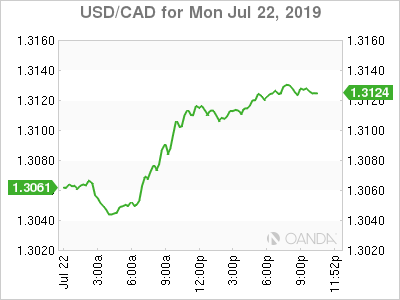
The Canadian dollar fell against the US dollar on Monday. The USD/CAD traded at 1.3122 at the end of the session Canadian wholesale sales surprised to the downside with a -1.8 percent drop, when the forecast called for a 0.8 percent gain. The loonie has risen 3.78 percent year to date against the dollar as the Fed's 180 degree turn has put pressure on the American currency while the Bank of Canada (BoC) waits patiently on the side lines.
Disappointing data like the today's wholesale numbers will affect the probabilities of a lower interest rates in Canada. The divergence between the US and Canadian central banks could end up being lower if trade disputes continue at a massive scale, forcing the BoC to lower rates to avoid a recession.
Oil surged, but offered little support to the loonie at the start of the week. With the Wholesale sales data out of the way for this week's economic calendar, the Canadian currency will be trading on external data with the US PMI, durable goods and advance GDP the most likely to move the needle. The ECB will set the tone this week on how dovish can you go, without actually cutting rates as the market awaits the July FOMC meeting for the first rate cut of the new easing monetary policy cycle.
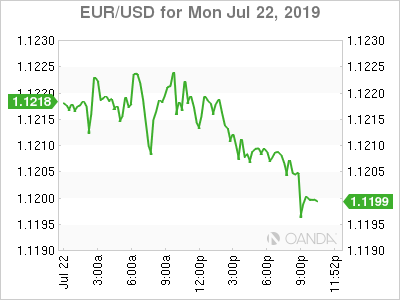
The US dollar is lower across the board on Monday. The greenback will be on the back foot until the second day of the July Federal Open Market Committee (FOMC) meeting. The central bank is expected to cut rates by 25 basis points, but a deeper cut would put more downward pressure for the currency. The EUR managed to gain on the USD, despite the European Central Bank (ECB) publishing its rate statement this week and the anticipation of more dovish rhetoric or almost a 50 percent chance of lowering the deposit rate deeper into negative territory.
ECB President Mario Draghi will finish his mandate this October, with former IMF leader Christine Lagarde his appointed successor. The leadership change brings up timing issues as the central bank will ease more to stave off recession and spark growth but could wait until the new head is in charge.
OIL
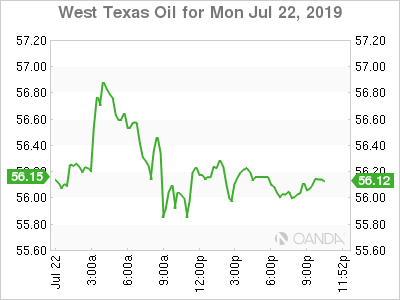
Oil prices rose on Monday as the Middle East tensions once again resurfaced. WTI and Brent gained on the back of Iran seizing a British oil tanker last week. Ample supply is keeping the rise to a moderate level even after taking the importance of the Strait of Hormuz into consideration.
Lower global demand estimates from OPEC, IEA and EIA have hit crude prices in the last couple of weeks. Weather and geopolitical disruptions have been temporary and only the OPEC+ deal has given traders clarity with the group's commitment to reducing the oil glut at their expense. 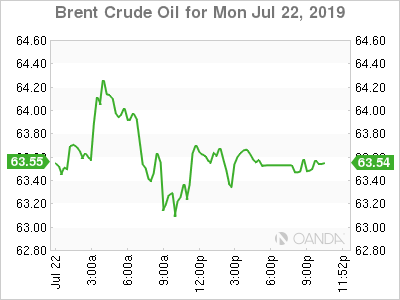
The US pulled out of the Iran nuclear deal and has put economic sanctions in place and has begun to ask other nations to pitch in to protect shipments. The seizure of the UK ship comes at an unfortunate time given the lack of leadership as Theresa May steps down.
GOLD
Gold trading was choppy at the start of the week. The yellow metal almost ended up where it started and did not trade outside a tight 5 dollar range. There was little data to guide investors with most of the market awaiting PMI data in Europe and the US due Wednesday and the ECB policy statement on Thursday.
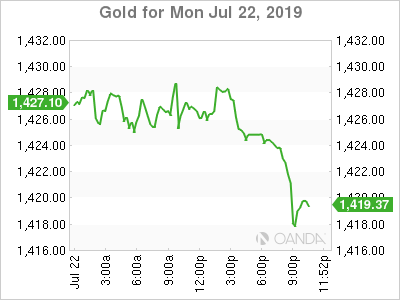
Geopolitical uncertainty has kept gold bid as the dollar is under pressure from the upcoming US interest rate cut that has been telegraphed by the Fed. The market has priced in a 25 basis points cut, but a 50 basis points slash is still possible even though Fed members have talked down the probability of a deep cut in July.
Middle East tensions as Iran and the US exchanged comments continue to rise as Iranian forces captured a British tanker. Gold had lost some momentum as a more diplomatic outcome was discussed by Iranian and American leadership, but now military action is back on the table giving a boost to the yellow metal as a safe haven.
STOCKS
US stocks continued their winning ways as the Fed is expected to cut interest rates on July 31. Tech and energy stocks led the way as US President Donald Trump continued to pile pressure on the Fed to lower interest rates. The Fed is highly anticipated to lower the benchmark rate by 25 basis points in July but could intervene one or two more times in 2019.
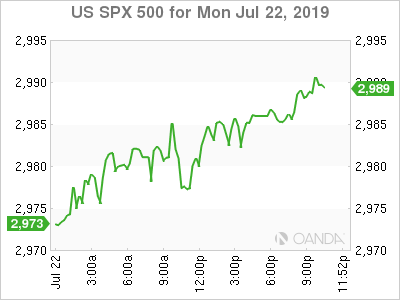
US PMI data will provide guidance as the leading indicator could validate a more measured approach by the Fed or put even more pressure on the central bank to act now with a deeper cut to steady the economy.
Earnings data has been better than expected and given the pessimistic guidance not much was expected. Recession fears are still circling about, with Morgan Stanley putting a 20 percent chance of a recession next year.
GBPJPY Bear Pressure Remains Towards 133.84
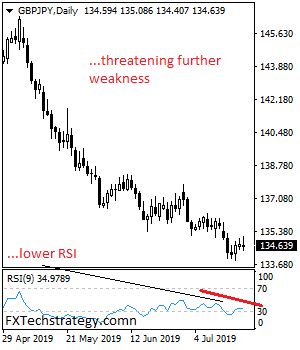
GBPJPY bear pressure remains towards 133.84 support zone as we expect more weakness. On the downside, support comes in at the 134.00 level where a violation will aim at the 133.50 level. A break below here will target the 133.00 level followed by the 132.50 level. Its daily RSI is bearish and pointing lower suggesting further weakness. Conversely, resistance is seen at the 135.00 level followed by the 135.50 level. A cut through that level will set the stage for a move further higher towards the 136.00 level. Further out, resistance resides at the 136.50 level. All in all, GBPJPY remains biased to the downside nearer term.
Eco Data 7/23/19
[php_everywhere instance="1"]
MARKET WRAP: Muted Stock Market Reaction, Gold Gained Strength
Crude maintained its gain while gold price soared ahead of the GDP data *No major moves in the equity market because of some major events.
Stocks
- The S&P 500 Index has traded slightly higher to kick start a new week. As of 15:22 London time, the index was up by 0.18%.
- The Stoxx Europe 600 Index jumped 0.01% as traders prepare themselves for heavy bank earning week
- The UK FTSE 100 index remained muted as the selection of the Prime Minister process continues. Boris Johnson is likely to take the position which may trigger an initial upward move for the index.
Currencies
- The Dollar Spot Index traded above the 97 mark as traders await the upcoming US GDP data. The index increased by 0.09% to 97.24
- The Euro moved lower ahead of the ECB monetary policy decision which is due on Thursday. It is widely expected that the bank may cut the interest rate further.
- The British pound may move lower tomorrow as the risk of no-deal Brexit becomes more real if Boris becomes the Prime Minister of the UK. The currency traded lower today by nearly 0.19%.
- The Japanese yen dropped 0.21% to 107.94 per dollar.
Bonds
- The Yield on 10-year Treasuries dropped by two basis point to 2.03%.
- Britain’s 10-year yield declined two basis point to 0.728%.
Commodities
- West Texas Intermediate crude soared due to the geopolitical tensions. It rose 0.67% to $56.00 a barrel.
- Gold price continued it upward move, still trading in a flag pattern on a daily time frame. It rose 0.1% to 1422.
A Flashlight for the FOMC Blackout Period
At its meeting next week, the FOMC is expected to do something it has not done in over a decade: cut the fed funds rate. Despite a spurt of better-than-expected economic data, policymakers at recent public appearances, particularly Fed Chairman Jerome Powell, have done little to dial-back expectations for a cut. We have now entered the blackout period, that time in the immediate lead-up to the FOMC meeting when officials refrain from commenting on monetary policy. The most likely outcome in our view is that the FOMC will cut the fed funds rate 25 bps, emphasizing risks to the outlook from global growth and trade policy as well as stubbornly low inflation. In this report, we shine some light on what is driving that call as well as other possible scenarios and the probability of those outcomes.
Remind Me Again Why We're Doing This?
Imagine for a moment you did not keep up with what the Federal Open Market Committee (FOMC) was saying and instead just looked at the data independently in an effort to anticipate the committee's next move. Keeping in mind that the Fed is tasked with promoting maximum employment while maintaining price stability, you might reasonably conclude that the current state of policy is the perfect elixir for achieving both mandates with fairly agreeable results in the economy and financial markets. Face it: we are amidst the longest equity bull market, inflation is under control and unemployment is near its lowest rate since we first landed a man on the moon. Consumer spending is on track to post a 4-handle for its growth rate in the second quarter. Does it feel like easier monetary policy is the most appropriate policy response at this moment?
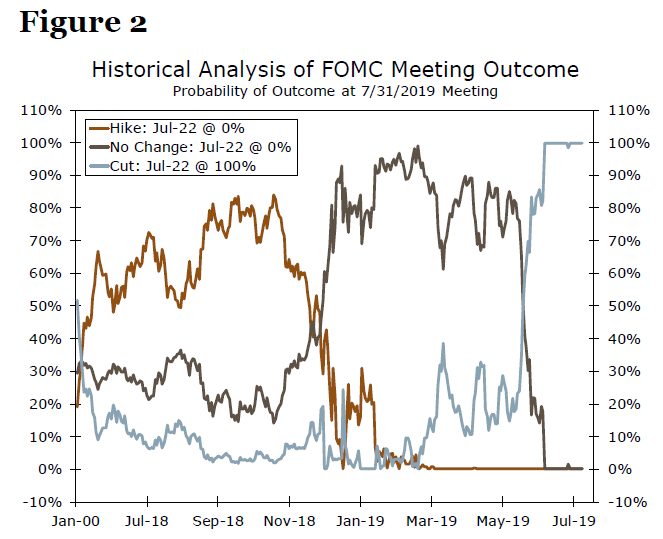
As recently as last autumn, guidance indicated the upward stairway for rates had at least a few more floors to go. Financial markets had some doubts about the pace of tightening, but expectations were still well-anchored in terms of direction. As recently as November, financial markets baked in an 80% probability that that the Fed would have hiked again by July (Figure 2). By January, all bets were off with markets banking instead on the FOMC remaining on hold. By May, thanks to jawboning by some Fed officials, it has become a lock that the FOMC will cut in July.
So What Changed?
During the dot-com boom and subsequent bust, there were questions about whether the Fed had some culpability in inflating the bubble in tech stocks by not tightening faster to rein in the "irrational exuberance" that was evident to the Fed at the time. What might posterity say about an FOMC that cuts interest rates with the unemployment rate at a near-record low and the stock market at a near-record high? At the risk of oversimplification: because the global economy is showing signs of serious strain amid the ongoing trade war, and inflation has been too low for too long.
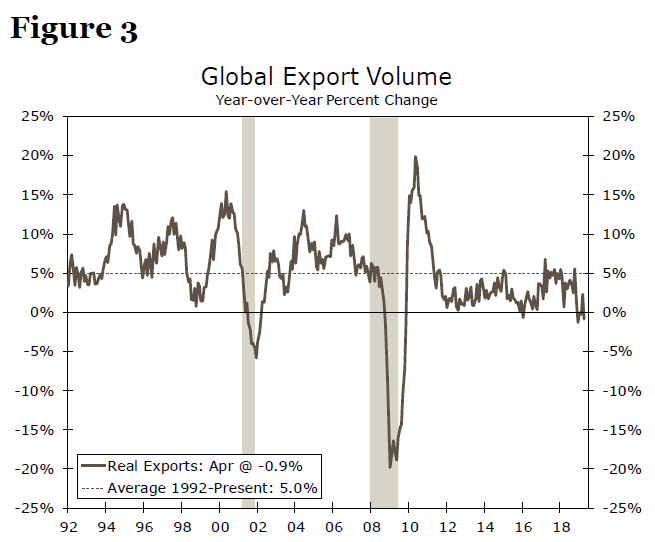
Let's take the global environment first. Figure 3 plots the year-over-year growth in global export volumes. Observe that over the past 30 years, it takes a U.S. recession to make global trade growth go negative. Yet, here we are in negative territory—an anomaly absent a U.S. recession for at least a generation. It may not be part of its mandate, but the Fed is paying attention to this cut-and-dry evidence that global trade is drying up. Trade tensions are at the heart of the pullback in global growth, and the FOMC fears the impact here at home, particularly as it relates to confidence and investment. In his testimony before Congress earlier this month, Chairman Powell made five separate references to deteriorating global growth in his opening remarks before taking questions.
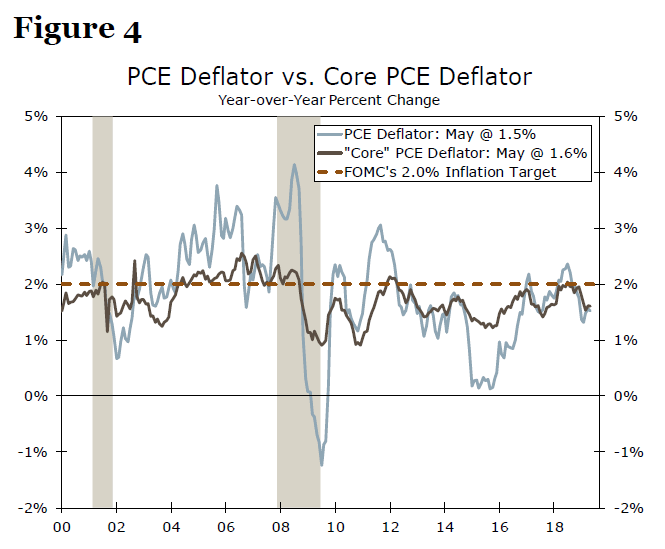
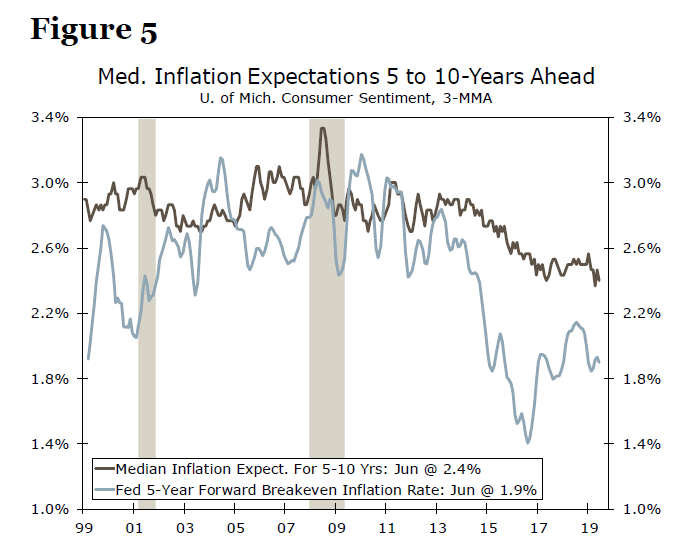
As for inflation, the task of eventually hitting the Fed's 2% target on a sustained basis is getting harder with every monthly shortfall. True, the pace has picked up more recently after a few one-off factors early in the year, increasing at a 2.0% annualized pace the past three months. But fear is rising that the sub-2% trend shown in Figure 4 is becoming entrenched, as inflation expectations hover near-record lows. Low inflation would not be the worst thing if nominal interest rates were higher, but it further hinders the FOMC's ability to cut real rates come the next recession with nominal rates also low—an issue the Fed is thinking about intently as it undergoes its current review of policy, strategies and tools.
Suffice it to say, the FOMC is therefore in the unenviable position of loosening policy despite a soaring equity market and a labor market that is arguably overheating. More so than at any time since the height of the financial crisis, the FOMC faces a daunting challenge of delivering on the expected accommodation without overshooting and engendering the next crisis or falling short in terms of forward-guidance and undoing the benefit of a rate cut. Against that confounding backdrop, we now offer our take on some of the various policy options available to the Fed and handicap the probability of each scenario, beginning with the most likely to occur.
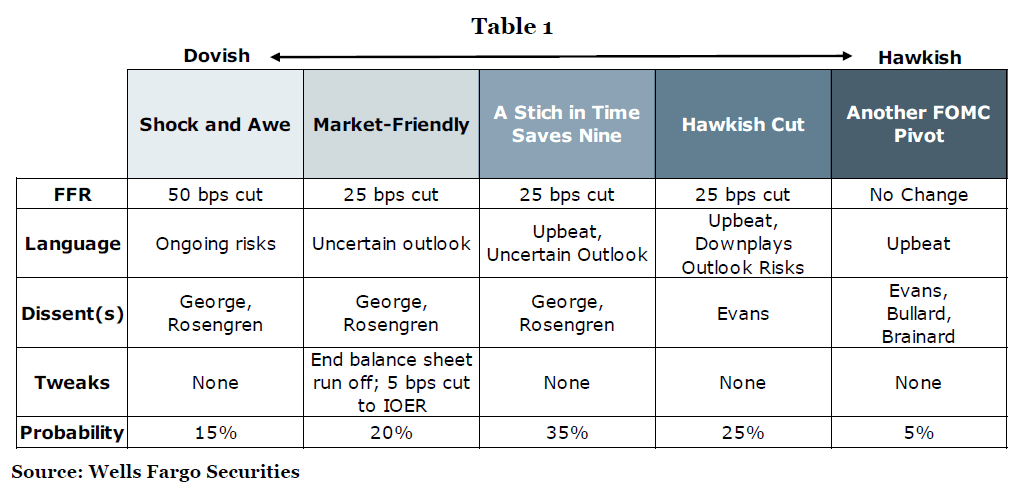
Scenario I: A Stich in Time Saves Nine
- Fed funds rate: 25 bps cut
- Language: More upbeat on recent activity, but notes uncertainty and risks to the outlook persist, while inflation remains muted
- Dissent(s): George (Kansas City), Rosengren (Boston)
- Other Tweaks: None—balance sheet normalization continues as planned, no changes to IOER
- Probability: 35%
The most likely outcome of the upcoming meeting in our view, and therefore our baseline call, is that the FOMC will cut rates by 25 bps. The statement will likely upgrade the recent performance of the economy to "solid" (as it was described as recently as May), as consumer spending has picked up more convincingly and job growth has rebounded. However, the statement and Chairman Powell in his press conference are expected to emphasize the continued risks and uncertainties the global trade environment presents to the outlook.
In light of those risks, the FOMC will likely deem it prudent to offer additional accommodation as part of a risk-management approach to policy. Given the limited space to cut the fed funds rate this cycle, the premise of this move would be to get out ahead of any meaningful slowdown in growth that could bring the expansion to an end. In addition, we expect to see the continued run of belowtarget inflation and the need to shore-up inflation expectations relayed as another reason for easier policy despite a generally strong economy (Figure 5). The door would remain open for additional cuts in the next few months.
The number and direction of dissents will be telling as to how much the Committee is coalescing around this "risk-management" approach. We would not be surprised to see a dissent from Kansas City Fed President Esther George and Boston Fed President Eric Rosengren in this scenario as each has been skeptical of additional accommodation at this time.
Scenario II: The Hawkish Cut
- Fed Funds Rate: 25 bps cut
- Language: More upbeat on recent activity, downplays risks to the outlook
- Dissent(s): President Evans (Chicago)
- Other Tweaks: None
- Probability: 25%
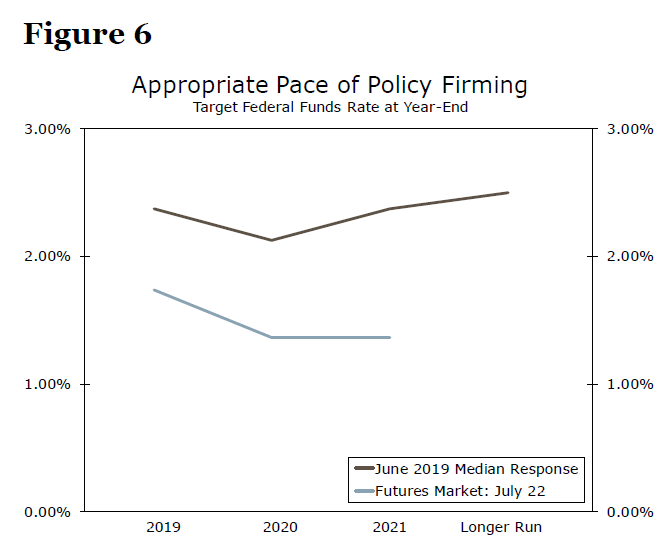
Words matter. In this scenario, the FOMC proceeds with the nearly universal expectation to cut the fed funds rate, but re-asserts control over expectations going forward. Since the committee's last rate move (a 25 bps hike in December), it has struggled to manage the expectations of financial markets. Case in point, the futures market suggests a greater than 60% probability that the Fed will cut at least three times in the second half of 2019. Chances of two or even one more cut this year would look much less likely, however, with a "hawkish cut".
What might this look like? In the statement, the assessment of recent activity generally and consumer spending specifically would be upgraded along the lines of our baseline case. "Uncertainties" in the outlook would be used to justify the meeting's cut, but the statement would evoke a willingness to see how some of these uncertainties and the economy unfold given the additional policy support enacted. More evidence of a hawkish turn, however, would come from the Chairman in his press conference. We would expect to hear a more positive tone on recent data and have Powell remind us that the FOMC is data dependent. In addition, we would expect to hear more about the downsides of offering too much accommodation when the economy is still solid, such as the potential for financial imbalances to build.
A dissent in this scenario may come from Chicago President Evans. He has discussed the need for 50 bps of cuts this year to get inflation back above 2% and may therefore want to signal additional easing this year. St. Louis Fed President James Bullard is another notable dove. He has said, however, that he does not see the Fed entering an "easing cycle", which makes us think he could be ok with a 25 bps cut now but then waiting to see how things go from here. The signaling to in essence be "patient" again may sufficiently placate Presidents George and Rosengren to where they vote along with the committee.
Scenario III: The Market-Friendly Move
- Fed Funds Rate: 25 bps cut
- Language: Similar to June—risk and uncertainties in the outlook, inflation muted
- Dissent(s): George (Kansas City), Rosengren (Boston)
- Other Tweaks: End balance sheet run off immediately and/or extra 5 bps cut to IOER
- Probability: 20%
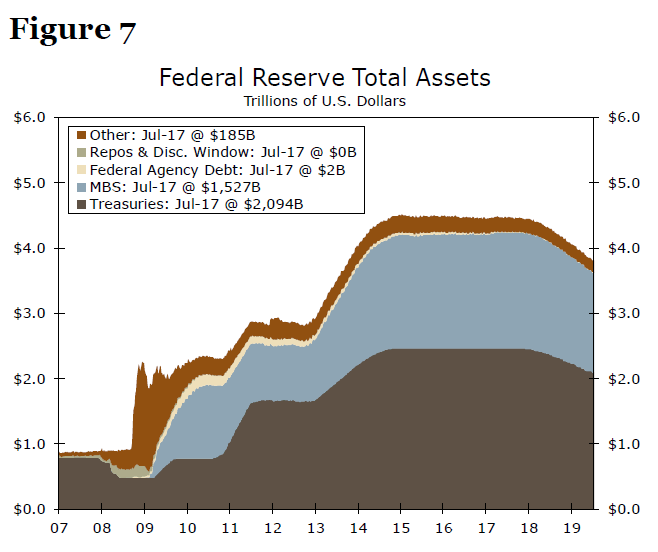
Why meet when you can exceed expectations? The most likely outcome according to markets is for the FOMC to cut rates 25 bps, but the FOMC could throw in a little something extra. Specifically, it could announce concluding its balance sheet normalization immediately, rather than wrapping it up at the end of September, as is currently planned. The early end would leave the balance sheet approximately $28 billion larger than it would otherwise be. In practice, that would be a marginal amount given the Fed's $3.8 trillion in assets at present (Figure 7), but would underscore the FOMC's willingness to more proactively provide accommodation. A hurdle to this approach would be that the FOMC has emphasized the fed funds rate as its primary policy tool. However, the committee has adjusted balance sheet plans before, most recently in March.
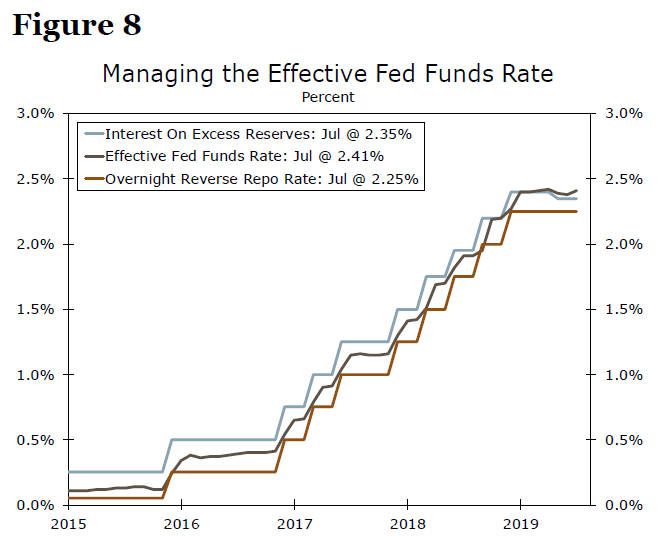
Another subtle tweak that the FOMC may gift to markets would be an extra 5 bps cut to interest on excess reserves (IOER). The rate of IOER is supposed to serve as the top of the floor used to guide the fed funds rate since the financial crisis. For the past three years, the effective fed funds rate has traded above the midpoint of the FOMC's target range. That led the FOMC to either raise IOER less than the target rate (June and December in 2018) or cut the IOER despite keeping the fed funds target unchanged (May 2019) to push it closer to the mid-point. Those moves have been considered technical adjustments. Currently the effective rate is closer to the mid-point than when prior technical adjustments were made (Figure 8), so an additional 5 bps cut on the IOER in July could therefore be a signal of some extra policy easing. The extra effort to ease policy would likely be considered superfluous to Kansas City Fed President Esther George and Boston Fed President Rosengren, leading each to dissent in this scenario.
Scenario IV: Shock and Awe
- Fed Funds Rate: 50 bps cut
- Language: Dovish—emphasizes ongoing risks to outlook, muted inflation
- Dissent(s): Rosengren (Boston), George (Kansas City)
- Other Tweaks: Unlikely given the larger-than-expected fed funds cut, which is still viewed as the primary policy tool
- Probability: 15%
Could a 50 bps cut be in the cards? Markets think this a real possibility. Currently futures have priced in about a 20% chance that the FOMC slashes the fed funds rate 50 bps. After all, global growth remains on the ropes and the downside risks of trade battles escalating with China and other countries loom large. At the same time, persistently low inflation suggests the need for more radical efforts to achieve the Fed's target.
Cutting 50 bps immediately would send a strong signal that the FOMC is serious about generating higher inflation on a sustained basis. It would also provide a shot in the arm to capital spending, which the FOMC has highlighted as an area of concern. More generally, a large cut now would send a clear message that the FOMC is taking a more proactive approach to policymaking and staying ahead of the curve.
Such an aggressive move, however, could backfire. A 50 bps cut could suggest that the economy is in a more precarious position than it currently is. Business and consumer confidence could suffer, while markets get spooked. True, there is some precedent of the FOMC cutting rates 50 bps in prior cycles. But a key difference was that in each of those periods, the economy was showing signs of slipping into recession or struggling to emerge from one. The current period is more akin to the mid-cycle slowdown of the 1990s. In that period, the Fed cut just 25 bps in its opening bid.
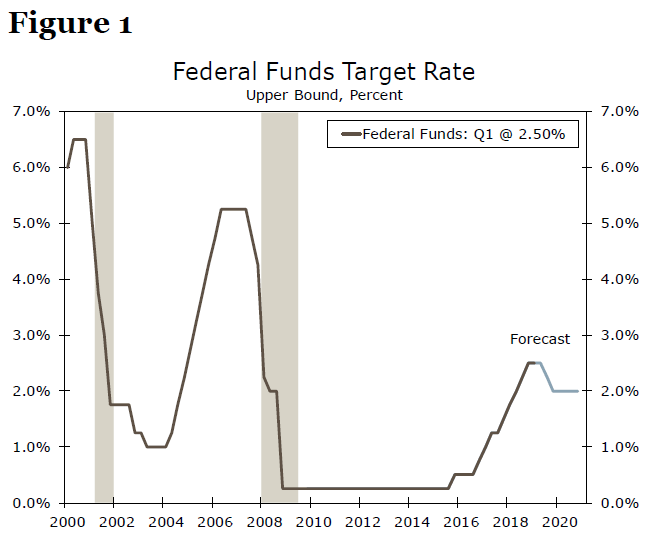
Another reason to bet against this scenario is that the actual level of the main policy rate at 2.50% today is much lower than where it stood in 2007 (5.25%) or at the start of 2001 (6.50%). Finally, a 50 bps cut with the tightest labor market in decades, inflation low but firming and economic growth above potential could be seen as kowtowing to political pressure. Say goodbye to the Fed's credibility as independent stewards of the economy.
Scenario V: Another FOMC Pivot
- Fed Funds Rate: No Change
- Language: More upbeat on the economy and inflation, but still will closely monitor incoming information and do what it takes to sustain expansion
- Dissent(s): Evans (Chicago), Bullard (St. Louis), Brainard (Board)
- Other Tweaks: None
- Probability: 5%
The hawkish tail risk scenario ought to be considered as well. It would be unexpected, but not unthinkable for the Fed to not deliver at all on the expected accommodation. Chairman Powell certainly did not give that signal in his speeches and testimony the past few weeks. The committee, however, could see enough improvement in conditions and the outlook to hold fire for now. Maybe the rebound in payrolls in June was not enough for Powell to change his tune on the policy outlook when asked by Congress in his semi-annual testimony, but the labor market outlook is not the only area where data is looking better. Consumer spending now looks to have clocked a 4% pace in the second quarter, with fundamentals still solid. Inflation has also picked up, with both core CPI and core PCE increasing at least at a 2.0% annualized pace the past three months. Trade tensions have also diffused to an extent, with talks between the United States and China having resumed. In many ways, the economy and trade situation looks to be in-line with the outlook in early May, when the FOMC still pledged to be patient.
When financial markets have priced in the alluring promise of easy money, the letdown when you do not deliver can be substantial. Markets have been pricing in a 100% chance of a 25 bps cut this month since the FOMC released its more dovish statement in June. Chairman Powell has had a number of opportunities to stress some improvement in recent data and easing of trade tensions. He has not. Ditching the seemingly well-telegraphed rate cut would hit financial markets hard immediately. Ongoing challenges for the FOMC would also ensue, since the Chairman's credibility would be eroded and the powerful tool of communication would be removed from his toolkit.
Needless to say, there would likely be a number of dissents in this scenario. Chicago Fed President Evans would almost assuredly be joined by Bullard, who is on the record saying he supports a cut in July. Lael Brainard may submit the first dissent by a governor in 14 years since she has recently said that basic principles of risk management would argue for softer monetary policy.
Sunset Market Commentary
Markets
Core bond markets traded very subdued today. The German Bund and US Treasuries both were slight upwardly oriented, though under low volumes. Investors await key data (EMU PMI’s, US GDP) and events (new British PM, ECB) to unfold later this week. Markets didn’t even flinch after president Trump unleashed a new Twitter storm against the Fed, saying they “missed it (big)” by having “tightened far too much and too fast”. On the trade front, Chinese media reported that Mnuchin and Lighthizer are likely to visit China next week. Equities profited but the impact on bonds was negligible. Treasuries eventually outperformed Bunds as early US buying kicked in. The US yield curve bull flattened with yields changing from -1 bps (2-yr) to -2.4 bps (10-yr). German yields were unchanged (2-yr) to 2 bps lower (10-yr). Peripheral spreads widen with Italy (+6 bps) again underperforming amid rising political tensions. Lega’s Salvini is rumoured to make or break the ruling coalition this week. Belgium successfully tapped the bond market, raising 1.2bn via 10-yr bonds at an all-time low and negative yield of -0.038% and a bid-to-cover of 1.42. Its 2033 auction (0.78bn) printed at 0.255% with 2.14 bid-to-cover. The spread vs. Germany’s 10-yr yield widened a marginal 1 bp.
The dollar maintained Friday’s gains as markets see a 25 bp rate cut as the most likely outcome after assessing the last indications from Fed sources before the start of the blackout period for Fed communication on monetary policy. For now, there are few additional follow-through gains for the USD currency. EUR/USD and USD/JPY didn’t break any important technical support/resistance levels yet. Sentiment on risk improved on headlines that US-China trade talks are developing in an improved atmosphere, but there was no clear directional impact on the dollar. At the same time sentiment on the EUR/USD cross rate remains rather dented. Investors apparently remain cautious on euro long exposure as they ‘fear’ the ECB might err to the dovish side with even an outside risk of a rate cut already at this week’s policy meeting. EUR/USD came within reach of the 1.12 level, but a real test/break still didn’t occur yet (currently 1.1215/20 area). USD/JPY is struggling to regain in 108 big figure.
Sterling selling resumed today after a modest rebound at the end of last week. UK Foreign Office Minister Duncan resigned in anticipation of the change in leadership on Wednesday. Several other ministers are also expected to quit if Boris Johnson, as expected, becomes PM as he said that ministers should be prepared to accept leaving the EU without a deal. EUR/GBP rebounded back toward the 0.90 barrier this morning. Political uncertainty continues to dominate sterling trading, but the economic picture might also become a further sterling negative. The NIESR think tank in a new update on the UK economy said that there is already a one-in-four chance that the UK entered a technical recession and NIESR predicts a severe downturn in case of a disorderly no deal Brexit. EUR/GBP currently hovers in the 0.8990 area. Cable eased to currently trade in the 1.2480 area.
News Headlines
There is a 1 in 4 chance that Brexit has already pushed the UK into a recession, Niesr said today. The UK think tank added that it sees a possibility of a “severe” downturn in the event of a disorderly no-deal Brexit. Its central forecast is still based on a smooth Brexit however, which would leave the economy with a 1% growth both in 2019 and 2020.
EU officials said the bloc plans to drag out trade talks with the US by making limited concessions on less important matters until the current administration turns its focus on the 2020 re-election bid. The closer Trump gets to the presidential voting, the less inclined he might be to trigger a full blow trade war with Europe.