Sample Category Title
ECB Preview – Expecting Change in Forward Guidance and Hints on QE Resumption and Tiering
We expect ECB to implement more easing measures to stimulate the economy, and the timing would likely be in September. The July meeting, scheduled later this week, would be used to prepare the market further the easing package. Over the past month, ECB has sent strong signals that a rate cut would likely come. Besides the June meeting minutes, President Mario Drahi signaled at Sintra’s forum on June 18 that, “in the absence of improvement, such that the sustained return of inflation to our aim is threatened, additional stimulus will be required”.
Earlier this month, ECB members also hinted more stimulus would come soon. Chief economist Philip Lane suggested that “substantial accommodation is still required to bring inflation back to aim. If more easing is needed, we have the tools… Pro-active measures (including negative rates) are the surest way to ensure inflation climbs to our aim". At an interview with BFM Business TV, Board member Benoît Cœuré also noted that “accommodative monetary policy is needed more than ever”. However, the members probably have not reached an agreement on what measures should be implement as kick- off.
Lackluster Recovery Prompts More Stimulus
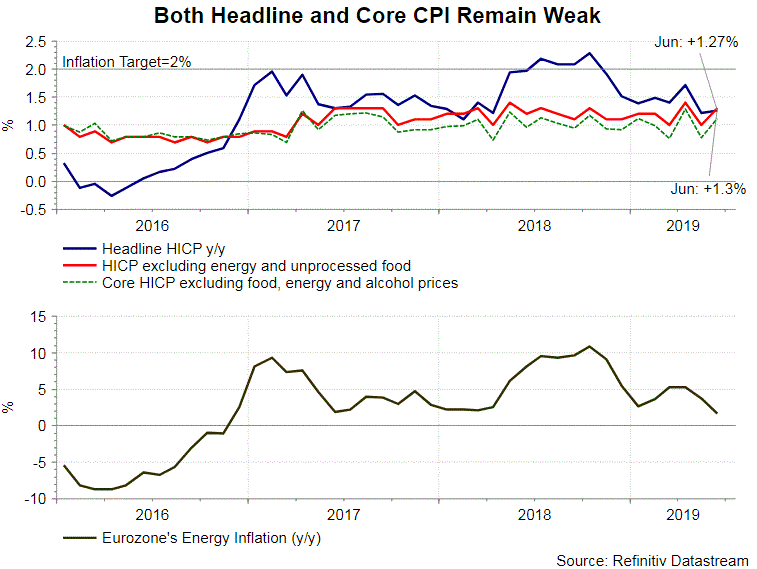
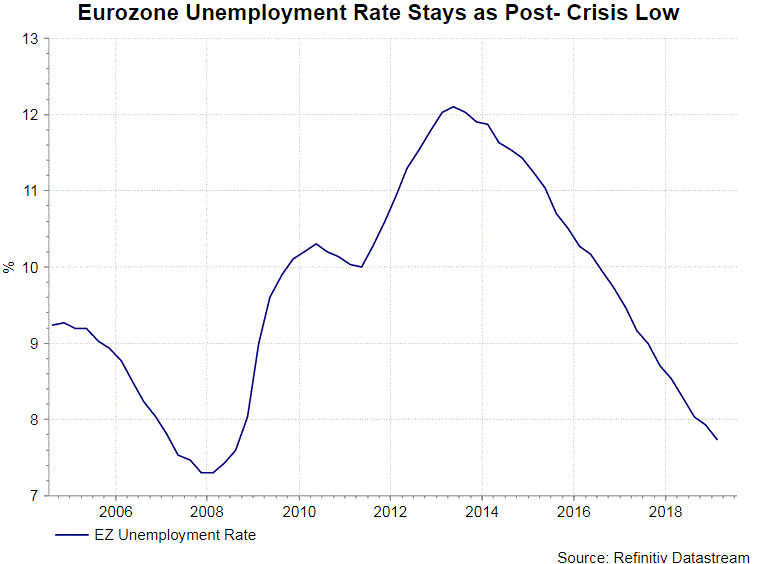
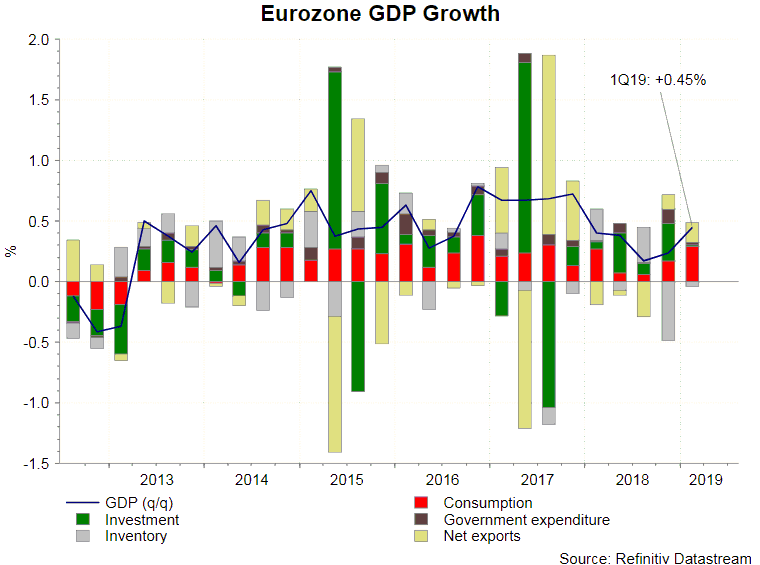
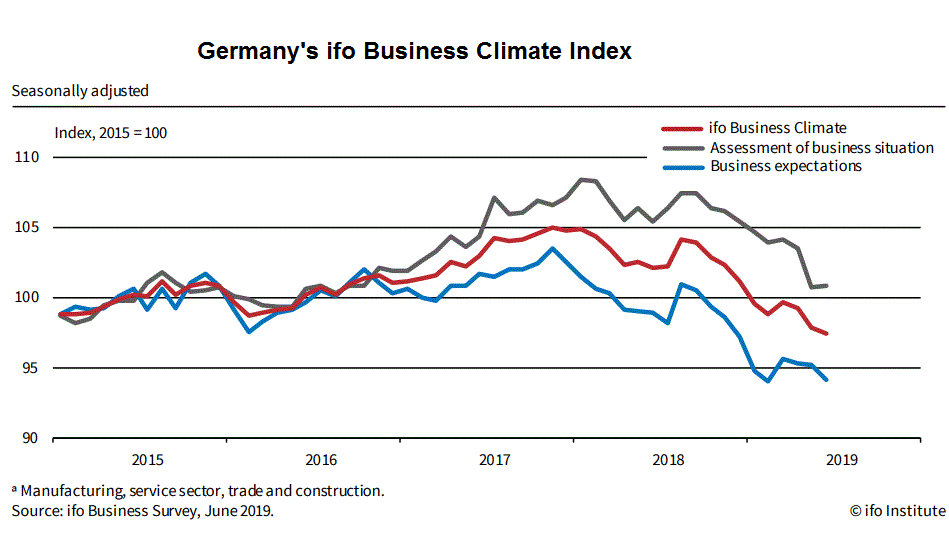
Eurozone’s economic developments have remained weak since the last meeting. Similar to other major economies, post- crisis lowe unemployment rate in the Eurozone has failed to boost inflation. headline CPI steadied at 1.3%, while core inflation improved to +1.1%, in June. Both readings stay markedly below ECB’s +2% target. GDP growth climbed to +0.45% q/q in 1Q19. Growth in both business investment and government spending shrank from the prior quarter. Final PMI index climbed +0.4 point to 52.2. As suggested in the accompanying report, “the survey is indicative of GDP merely rising by just over 0.2% in the second quarter, and a deterioration of business expectations for the year ahead to one of the lowest seen for over four years suggests the business mood remains somber”. It added that “downside risks to the outlook prevail amid trade war worries, rising geopolitical uncertainty and slowing global economic growth”. Separately, Germany’s ifo business climate index fell to 97.4 in June, down from 97.9 in May. This is its lowest level since November 2014. The accompanying statement noted that “companies have grown increasingly pessimistic about the coming months”.
 The Easing Package
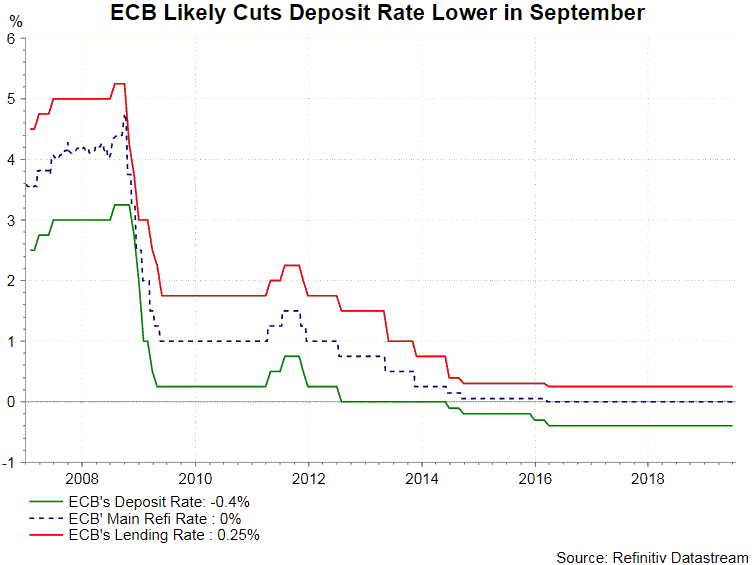
At this week’s meeting, we expect the forward guidance would be adjusted in order to prepare the market for further easing. In June, ECB extended the forward guidance, expecting the policy rates to remain at their present levels “at least through the first half of 2020”. We expect it to add that the policy rates would stay “at present or lower levels” at the upcoming meeting. At the meeting statement, as well as the press conference, ECB would likely indicate that the members discussed about the possibility of restarting QE and the tiered interest rate system
If ECB is to announce further easing, it would come in the form of an easing package, rather than just a rate cut. The package would include enhancement of the forward guidance, reduction of the deposit and resumption of QE. At the Sintra forum, Draghi noted that policymakers “remain able to enhance our forward guidance by adjusting its bias and its conditionality to account for variations in the adjustment path of inflation”. On the rate cut, it likely that the members would decide to lower the deposit rate by -20 bps from the current -0.4%. Any rate cut could come with tieriin as so as to defend bank profitability. Taking interest rates deeper to the negative territory alone would by no means be “stimulative”. As such, ECB would likely accompany it with resumption of QE, the asset buying program that ended in December 2018. We expect the central bank resume asset buying for 12 month initially and include corporate bonds and sovereign debt in the program.
There are several reasons we believe September would be more appropriate that July. Updated ECB staff projections will be released in September should give the members more information to determine what measures to take. Since ECB would likely announce a set of measures, it would be prudent for the members to be better informed before making decision. Meanwhile, announcing measures in September would allow ECB to gauge Fed’s action (likely a rate cut) on July 31.
EUR/CAD 4H Chart: Could Edge Higher
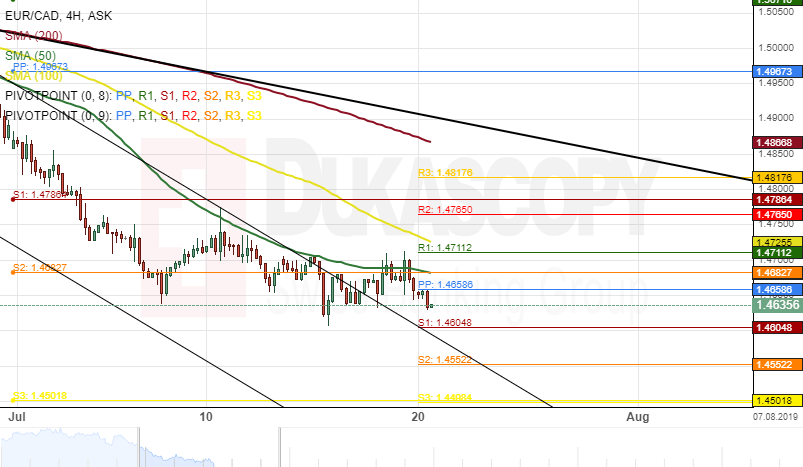
The common European currency traded sideways against the Canadian Dollar during last week's trading sessions. The 50-hour simple moving average provided resistance for the exchange rate.
By and large, it is likely that the EUR/CAD currency pair could aim for a resistance level formed by the 200-hour simple moving average at 1.4871 during the following trading sessions.
However, a resistance cluster formed by the weekly R2 and the monthly S1 near the 1.4765 area could provide support for the currency exchange rate during this week sessions.
EUR/AUD 4H Chart: Potential Upside Reversal
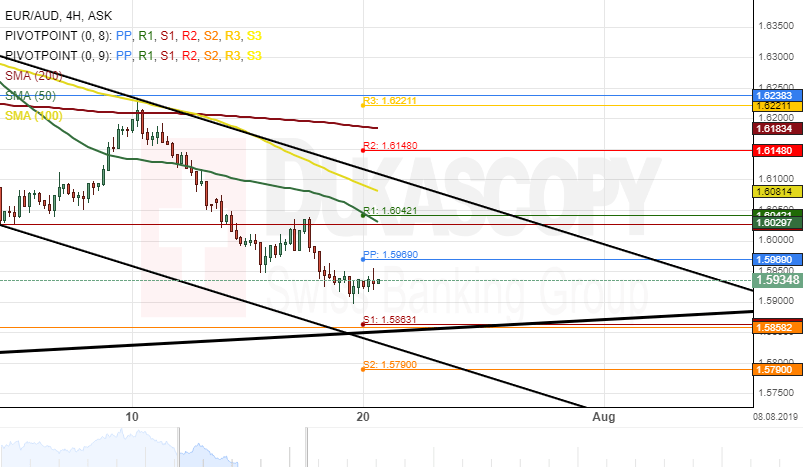
The Eurozone single currency has depreciated about 0.91% in value against the Australian Dollar since last week's trading sessions. The currency pair reached eleven weeks low on July 19.
Everything being equal, it is likely that the exchange rate could make an upside reversal from a support cluster formed by the combination of the weekly and the monthly PPs at 1.5863 during the following trading sessions.
Furthermore, technical indicators flash strong buy signals on the weekly time-frame chart. Therefore, bulls are likely to come into play this week.
More Action From The Strait Of Hormuz
Iranian military confronted and seized a British warship on Friday as Tehran said it was violating international maritime rules. UK officials were not clear on how they intent to reply to this action but they stated they are in talks with their international allies to make decisions. US officials have also stated they will be in talks with the British over the incident. This could be retaliation from Iran's side as British forces had seized a ship thought to carry Iranian Oil earlier in July. We would not be surprised if the situation intensifies further this week while if so, safe haven instruments along with Oil prices could react significantly to the matter. Last week the US had claimed to drop and Iranian drone which Iranian officials later denied. Europeans, the UK and the US may have to try other ways to approach the Iranian matter as until now what we are seeing is retaliation persisting. If the Strait of Hormuz becomes inaccessible to Oil tankers even for a small period then Oil prices could be getting some support. Oil tankers are already undertaking increased expenses to enter the area as companies providing ship insurance are charging extra for sailing in war risk area. Today the U.K. government’s emergency committee will be having a meeting to discuss how to deal with the matter. According to Bloomberg UK officials said they aim to deescalate the matter.
Chinese companies turn to the US for farm products
According to China's official Xinhua news agency, Chinese firms are reaching out to U.S. exporters to buy crops and agricultural products. This is an indication that the two sides are taking the initiative to strengthen their relationships and they are in goodwill. In the previous days, China has confirmed that Vice Premier Liu He and Commerce Minister Zhong Shan were in talks with Mnuchin and Trade Representative Robert Lighthizer on further steps to be taken so the two sides implement what exactly was agreed in Osaka during the G20 meeting. The progress is important as the two sides seem to be working according to plan and the reaction could be evident on the USD which could get some support.
Other economic highlights, today and early tomorrow
Today, we get Canada’s Wholesale Sales growth rates for May. Tomorrow in the early Asian session, from Australia, RBA Ass. Governor Kent speaks.
GBPUSD 4 Hour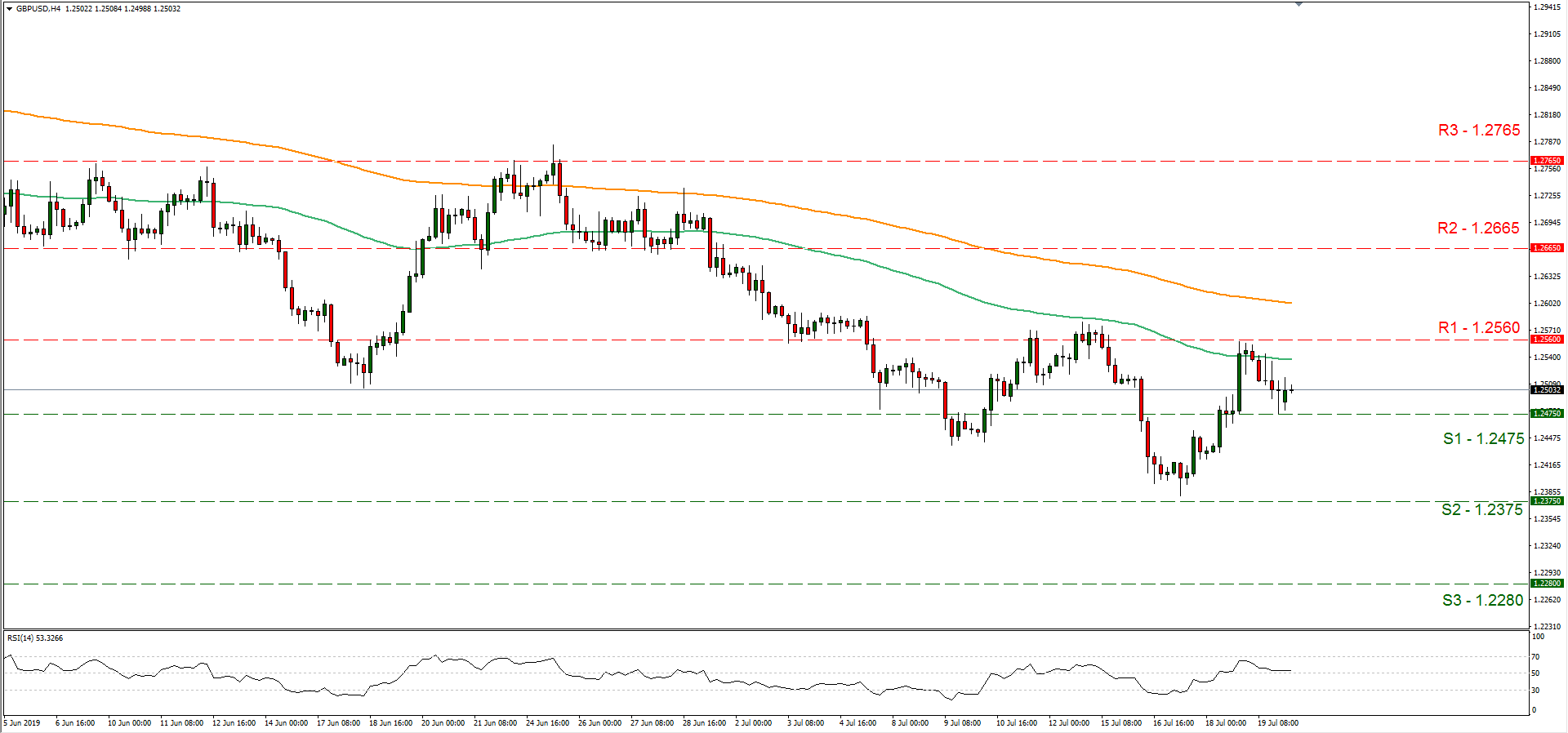
Support: 1.2475 (S1), 1.2375 (S2), 1.2280 (S3)
Resistance: 1.2560 (R1), 1.2665 (R2), 1.2765 (R3)
AUDUSD 4 Hour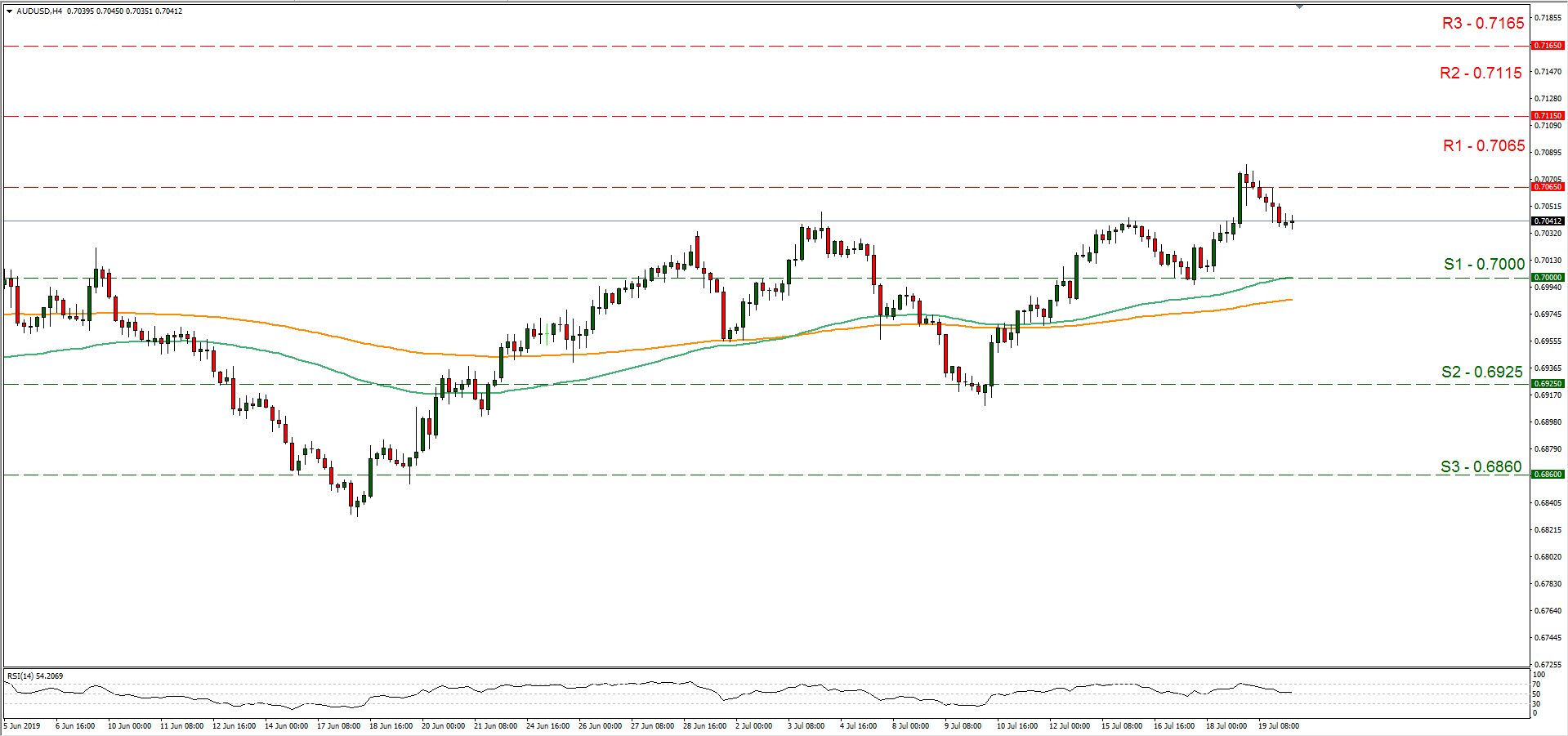
Support: 0.7000 (S1), 0.6925 (S2), 0.6860 (S3)
Resistance: 0.7065 (R1), 0.7115 (R2), 0.7165 (R3)
American Currency Is In The Green
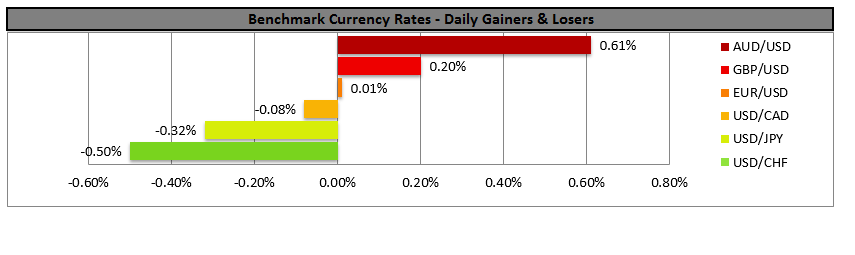
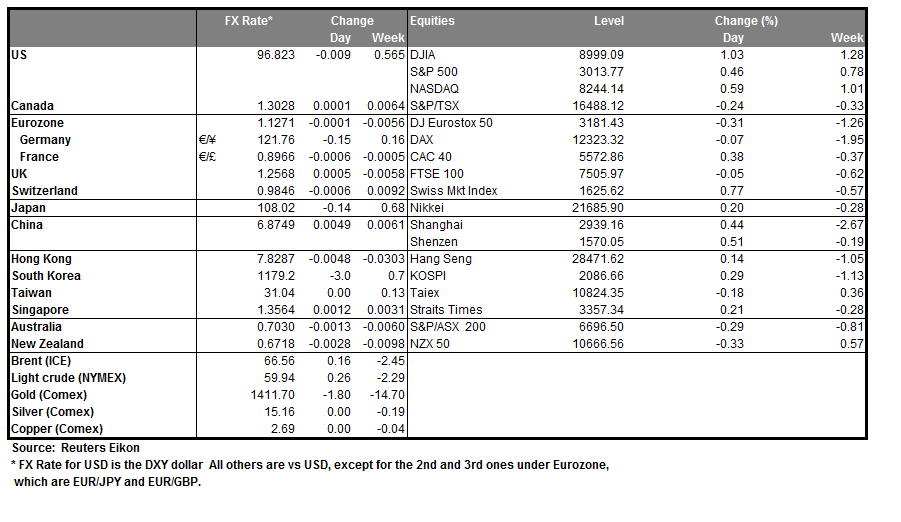
The US dollar is strengthening against most currencies. The US dollar index (#DX) closed in the positive zone (+0.38%) on Friday's trading session. The American currency was supported by weakening investors' expectations regarding a sharp reduction in the Fed's interest rate at the next meeting on July 30-31. The president of the Federal Reserve Bank (FRB) of St. Louis, James Ballard, said he was in favor of reducing the rate by only 0.25 percentage points instead of 0.5%, as participants in financial markets had previously assumed.
On Friday, ambiguous economic data were also published in the United States. Thus, the consumer expectations index from the University of Michigan in July was 90.1 and turned out to be better than the expected value of 89.8. However, at the same time, the consumer sentiment index from the University of Michigan counted to 98.4 and was worse than the predicted value of 98.6.
Today, the US-Mexico deal regarding migrants is expiring and it is not yet clear what the next step of US President Donald Trump will be. The United States and Mexico reached an agreement in June of this year, according to which it was decided that if the United States deemed that Mexico did not do enough for migrants from Mexico to the United States to return to their homeland before July 22, two countries would begin negotiations on changing the rules. We recommend keeping track of current information on this issue.
The "black gold" prices show a positive trend. At the moment, futures for the WTI crude oil are testing the mark of $56.90 per barrel.
Market Indicators
- On Friday, the US stock markets were bearish: #SPY (-0.56%), #DIA (-0.30%), #QQQ (-0.73%).
- The yield on 10-year US government bonds is at 2.04-2.05%.
The news feed 2019.07.22:
- Today the publication of important economic news is not expected.
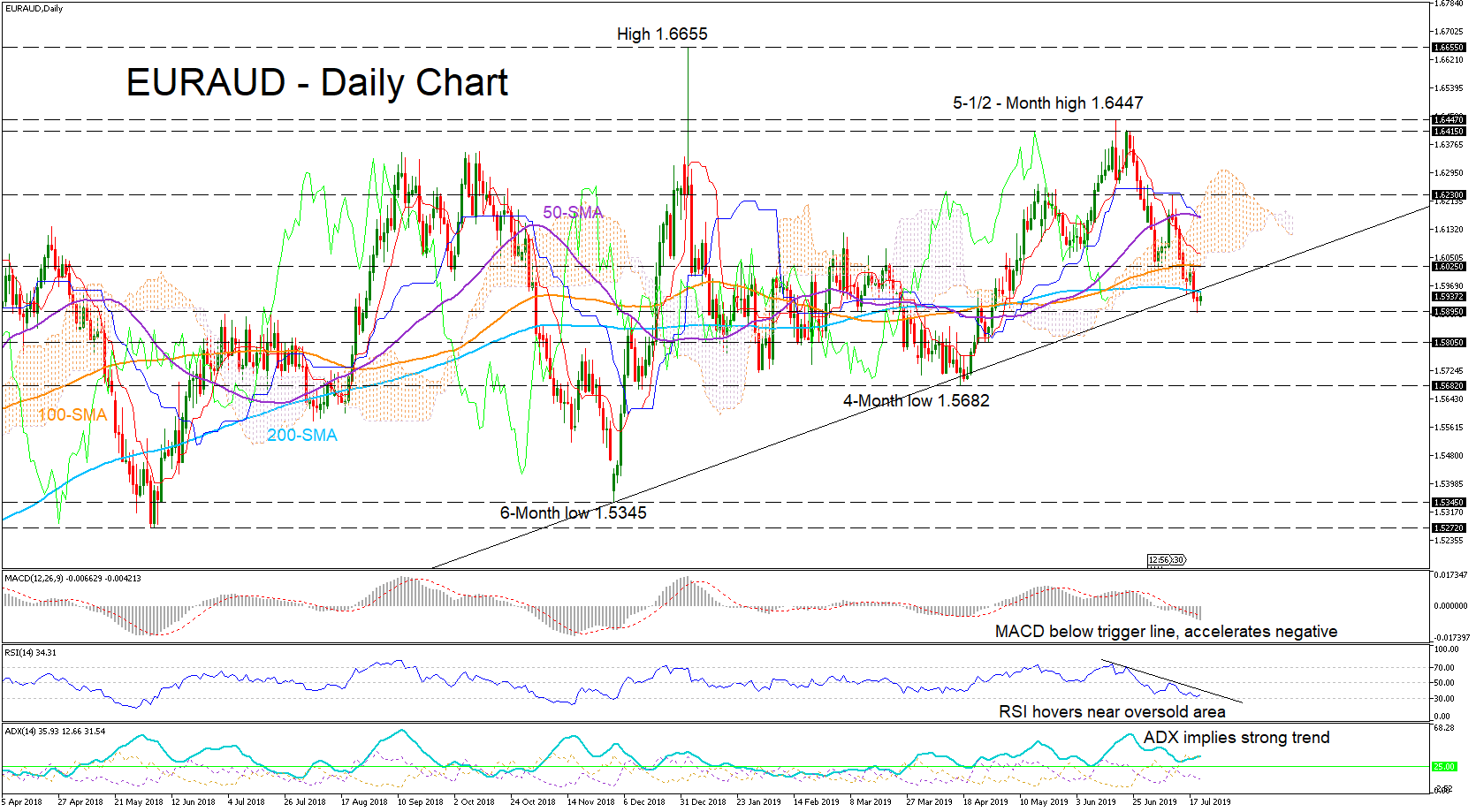
EURAUD Hands On With The 200-SMA, Joined By The Uptrend Line
EURAUD descended from a five-and-a-half-month high of 1.6447, over a one-month period, to break through a double obstacle of the 200-day simple moving average (SMA) and the uptrend line from Feb 2017. Price stalled just below the 1.5900 psychological level, where buyers have come on board to try and move back north.
The price has crossed downwards through the Ichimoku cloud and all simple moving averages. The 50- and 100-day (SMAs), although above the 200-SMA, have started to turn down, indicating possible negative sentiment could continue. The MACD and RSI are in negative areas concurring a downwards direction. The ADX indicates a strong trend.
To the upside, the 1.5900 – 1.5895 support would need push price to fracture the overwhelming 200-SMA, to then endure a resistance of 1.6025 coupled with the 50-SMA and Ichimoku cloud. A persisted push up through the cloud could bring further resistance of 1.6230 tested before the highs of 1.6415 and 1.6447.
Downside induced movement would require the 200-SMA and trendline to push the price past the initial support 1.5895 to encounter the next support of 1.5805, and if surpassed, the 4-month low of 1.5682 could unfold.
Overall the medium- and long-term trend remains bullish, but if the short-term trend were to show determination and push past the 1.5682 low, a bearish bias would take over.
No Summer Lull Just Yet
We may have entered into summer holiday territory but this week is going to be anything but a lull, with earnings, major data, a new UK Prime Minster and a central bank decision guaranteed to spice things up.
That said, Monday is unlikely to be a knockout, with only a few companies due to report and the data calendar looking equally bare. Instead, Monday may be a day for reflection on where we stand and preparation for what lies ahead. We've not been short of headlines recently which has kept investors on their toes.
Much of the attention recently has been on the Fed, with stock markets it seems heavily reliant on the central bank to cut interest rates multiple times this year. Bullard further attempted to pare back expectations for a 50 basis point cut next week, claiming he would like to cut by 25, adding that he sees no need for 50. Given that he's among the most dovish policy makers and possible the most dovish voter on the FOMC currently, it's surprising that a 50 basis point cut is still 20% priced in.
Is gold poised for a correction?
Attempts by the New York Fed to clarify John Williams' comments late last week, combined with those made by Bullard on Friday, have successfully pared back expectations for a 50 basis point cut next week - although they still remain high - which in turn has helped the dollar rebound and pulled gold off its highs. Gold broke above $1,450 last week for the first time in more than six years, following Williams' initial comments. The question now is how much more is to be priced in and whether in the near-term, gold has had its fun. Longer term, the environment remains bullish for gold but a lot has now been priced in. $1,400 now looks a very interesting level to the downside, with recent highs obviously then notable above.
GBP back in the red ahead of PM announcement
Sterling is once again in the red ahead of tomorrow's expected announcement that Boris Johnson will replace Theresa May as Prime Minister. Johnson has been the considerable front-runner since day one and there is little doubt in most people's minds that he will be declared the winner and new PM on Tuesday. Given his views on Brexit and no-deal in particular, this has not been great news for the pound but with much of it now priced in, sterling may see some reprieve in the coming weeks. Although, the closer we get to 31 October, if no-deal looks likely, any gains may quickly unravel.
Further escalation in the gulf pushes oil higher
Oil prices are around 2% higher at the start of the week following another escalation in the Persian Gulf as the Iranian Revolutionary Guard seized a British-flagged tanker, an act clearly linked to the UK's decision to seize a tanker carrying Iranian oil a couple of weeks ago. This is just the latest in a series of acts in recent weeks that have heightened tensions, primarily between the US and Iran, and raised the risk of a larger conflict. So far, that has managed to be avoided, probably because neither side wants to be the one that dramatically escalates the situation but traders are clearly a little on edge due to the importance of the passage for global oil supplies. Oil prices haven't risen too much yet but if the situation deteriorates further, we should possibly brace for higher prices.
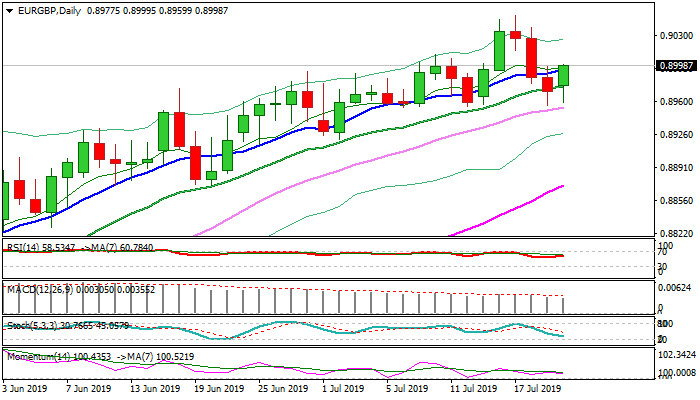
EUR/GBP Outlook: Fresh Advance Needs Clear Break Above 0.90 To Signal An End Of Corrective Phase
The cross regained traction on Monday and bounces, after three-day pullback was contained above rising 30DMA (0.8953), despite Friday’s close below psychological 0.90 support.
Fresh strength pressures 0.90 level but needs daily close above rising 20 and 10DMA’s and 0.90 barrier to generate fresh signal for recovery.
Fresh bulls lack for now stronger positive momentum which could obstruct recovery, especially on repeated close below 0.90 handle that would keep the downside vulnerable.
A number of key events, scheduled this week, are expected to generate fresh signals for the cross.
New British PM will be appointed on Tuesday, while pound remains under pressure from persisting fears of no-deal Brexit, which could rise if Boris Johnson becomes a prime minister.
The European central bank meets on Thursday, with 50% expectations for 0.10% rate cut, as the ECB wants to ease ahead of Fed (31 July) in attempts to prevent further Euro’s rise.
Res: 0.9009, 0.9025, 0.9038, 0.9050
Sup: 0.8976, 0.8953, 0.8920, 0.8872
GBPUSD Sold From 1.2510
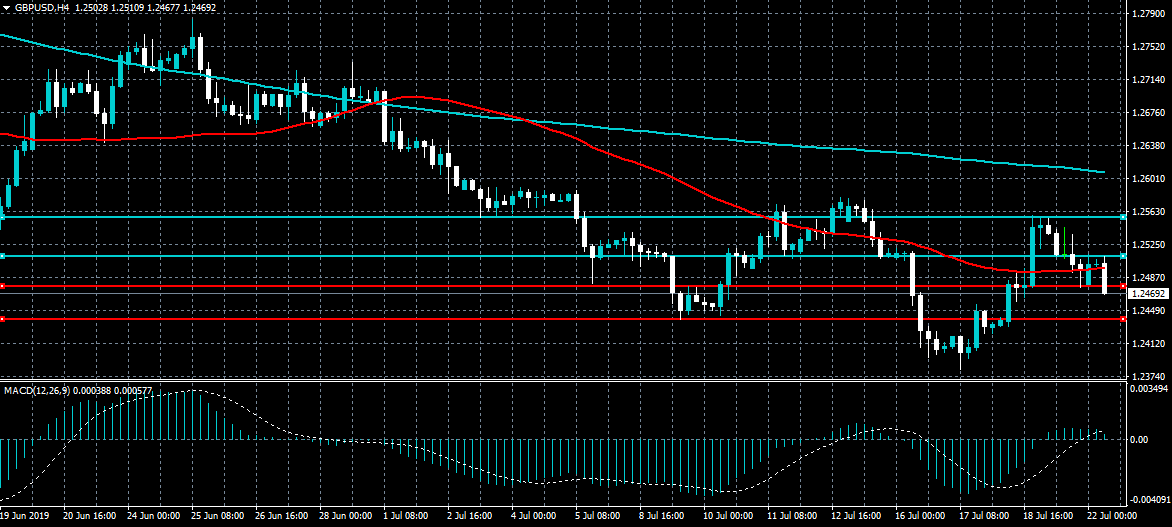
The British pound has slipped back under the 1.2500 support level against the US dollar after bulls failed to attract buying interest above the 1.2510 resistance level. GBPUSD bears are now stalking the 1.2480 support, with downside back towards the 1.2440 level now in focus. Overall, sustained weakness below the 1.2480 support level should be considered extremely negative for the GBPUSD pair.
The GBPUSD pair is only bullish while trading above the 1.2510 level, key resistance is located at the 1.2530 and 1.2560 levels.
If the GBPUSD pair trades below the 1.2510 level, key support is found at the 1.2480 and 1.2440 levels.
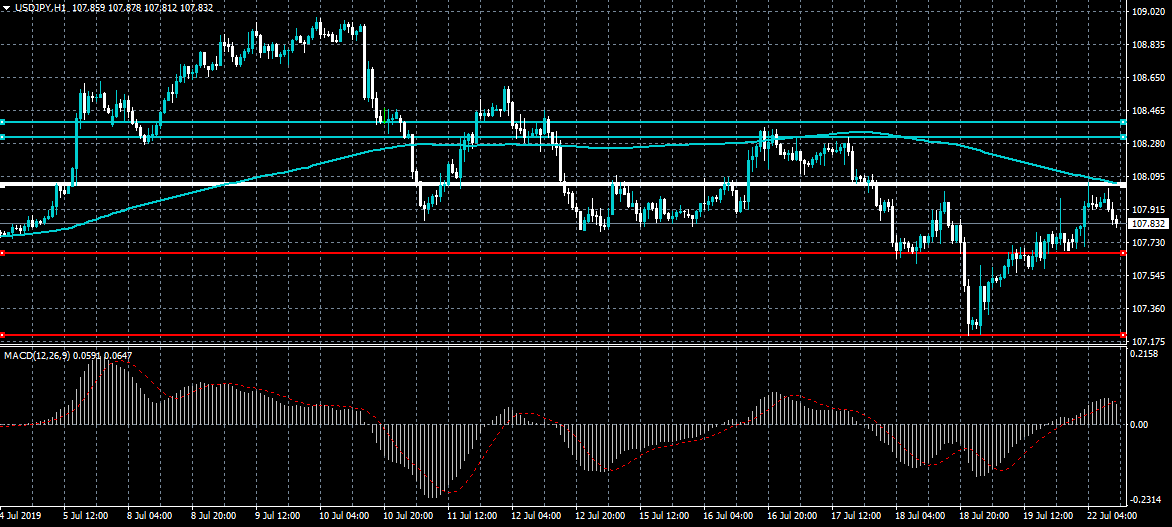
USDJPY Rejected From 108.00
The US dollar has once again been rejected from the 108.00 resistance level against the Japanese yen, despite positive Sino-US trade news this morning. USDJPY sellers need to force the USDJPY pair below the 107.60 level to trigger the next round of technical selling. Bulls need to hold price above the 108.00 level in order to encourage buying towards the 108.35 to 108.40 resistance zone.
The USDJPY pair is only bearish while trading below the 108.00 level, key support is found at the 107.60 and 107.20 levels.
The USDJPY pair is only bullish while trading above the 108.00 level, key technical resistance is found at the 108.30 and 108.45 levels.