Sample Category Title
Why Bear Case Is Strong For The Next Two Weeks
Global equity markets have started the week on the back foot, it is in this essence that I am not convinced for a number of reasons. Basically, the global stock market has a little to celebrate especially the US and European markets. Before I dig deep down in why, I am convinced there is only less than 5% chance for these equity markets to move higher.
But, let's have a look at the year-to-date performance. The S&P 500 index is up 18.74 percent, the Dow Jones 16.40%, the Nasdaq 22.78 percent. The Eurostoxx 50 index has soared 15.95% YTD, the FTSE100 11.6%, the CAC 40 index 17.37% and the DAX 16.11%. No doubt these are very phenomenal gains, however, this is where bulls are likely to face disappointment.
The question is where is the opportunity if the stock market is going to face a muted or bearish trading trend?
Well, the CBOE volatility index is an interesting place to start with, the index is down nearly 43.16% YTD and the equivalent of this for the European Stoxx, the VStoxx index, has plunged 42.60% YTD. On Friday alone, the CBOE volatility index jumped 6.80% and I believe there is more to come.
A Lot Is Already Priced In
- The key event for this particular week is the European Central Bank meeting, and the hopes are that the bank is going to be immensely dovish in its tone. It is believed that the bank isn’t going to leave the powder dry this time, a 10 basis points interest rate cut is likely to take place. This is already priced into the market and I believe thatointed because the tone of the ECB isn't going to be as dovish as the expectation.
the market may be disapp - Last week, over in the US, we have seen the US banks coming out with poor quarterly earnings. In other words, there was a little to celebrate. Now, given that the US banks have not been able to help the bullish sentiment, and this is when the US economy is in a much better state than the EU: so is their balance sheets, there is a little hope for the European banks to drive the markets higher because of their earnings. My model tells me that the European banks are going to suffer more from their earning results because of the feeble trading revenue.
- The second biggest bull case for the markets, again something which is fully priced in, is the Fed cutting their interest to stimulate the growth. Now, a 25 basis points interest rate cut is the best thing that the market is going to get. If one is expecting a 50 basis points rate cut, then one must be living in a Cuckoo-Land.
- Donald Trump, the US president, isn't the kind of specie who is going to back down anytime soon from the ongoing trade war between the US and China. A small deal is expected and this is where it stops- at least for now. Do not be surprised if he starts to put some tariffs on other countries and traders have not priced this element at all.
- In this tech heavy earning week, the results could be surprising and this may trigger a positive reaction, but it isn't likely to last long because of the fact that the guidance for the second half estimates is going to be subdued.
To conclude, I believe that most of the positive news is already priced in and market participants haven't given much thought to the other side of the coin. This is why I believe that the risk is skewed to the downside and this particular move maybe more violent than before.
Market Sentiment Hit By Fed Miscommunication
Equity markets kicked off the week in red on Monday with risk appetite appearingto be hurt bymiscommunication from Federal Reserve. The probability of a 50-basis point rate cut by the Federal Reserve roseon Thursday after Federal Reserve Bank of New York President John Williams said the US central bank should take swift action when faced with adverse economic conditions. His comments led investors to believe that a more aggressive rate cut is underway when the Fed meets on July 30-31. However, a statement from the NY Fed stated that Williams’ speech was an academic one based on research and not about potential action at the upcoming Federal Open Market Committee (FOMC) meeting. The clarification from the NY Fed trimmed the probability of 50 basis point rate cut to below 20% from about 65%. In such time of uncertainty, messages from the Fed needs to be more coordinated and aligned to prevent shocks in the markets. The sentiment was even further dented on Friday after Iran captured the British oil tanker, increasing tensions in the already volatile region.
Surprisingly though, oil price gains were limited. Market participants would have expected prices to climb $10 to $20 given the rising tensions in the Strait of Hormuz, which is the most critical shipping route for Oil. Brent traded 1.6% higher on Monday, while still $4 below the previous week high. The little reaction seen in prices suggest two things. One, markets do not believe that these tensions will further escalate and two, the ongoing trade disputeswill further hit demand while the US supply continues to reach new highs. While fundamentals do support lower oil prices, investors need to carefully watch the developments in Strait of Hormuz. After all, the Strait is responsible forone-fifth of the world’s oil supply, and any disruption will lead to a significant spike in prices.
This week investors will be watching for signs on how the next phase of ECB monetary easing will look like. European bond and equity markets have already been moving on assumptions of a rate cut and more Quantitative Easing (QE). If a rate cut doesn’t come on Thursday, expect ECB Chief Mario Draghi to provide guidance on when and how easing will take place. Any disappointment from the ECB will likely lead to a sell-off in Eurozone bonds and steep rally in the Euro, however, I don’t think this is the base case scenario.
Earnings season is in full swing, Tech along with Industrial companies will likely make most of the headlines. This week may determine whether US corporates will enter an earning recession or have avoidedit. Alphabet, Amazon, Facebook, and Twitter among other companies will all release their second-quarter results. Almost 30% of Corporate America have been citing the US-China trade tensions as a major headwind to their profitability and expect this number to increase with the second week of earnings announcement.
Fed Pushes Stocks, Iran ‘Provokes’ Oil
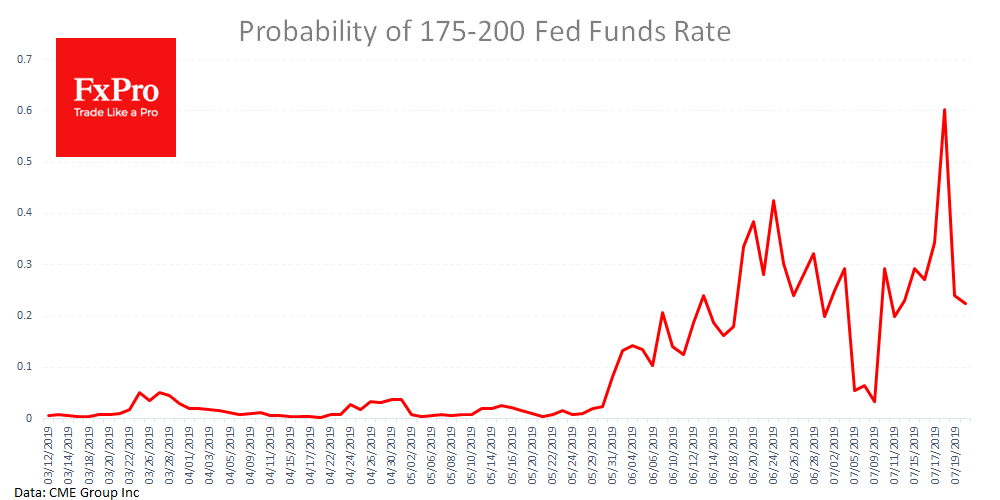
Markets have started the week under pressure. Expectations that the Federal Reserve will cut interest rates by 50 points in July collapsed from 60% to 23%. This occurred after the NY Fed clarified that the speech of John C. Williams was not about the FOMC move at the next meeting. Such a turn is rather positive for the US currency, since there is an opportunity to increase short-term interest rates. Also, the dollar gains additional attractiveness as a safe haven amid the return of tension in the Persian Gulf.
Stocks
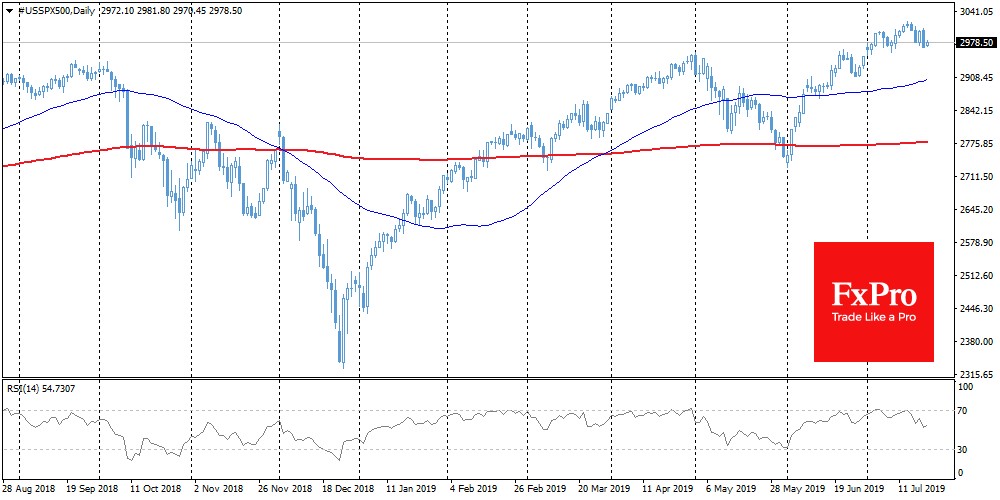
The markets’ mood for a less aggressive policy easing triggered a sell-off on stocks. At the end of the previous week, the S&P500 fell by 0.6%, while index futures dropped to two-week lows. Asian markets are mixed, with the Nikkei225 grew by 0.6% after the yen weakened.
EURUSD
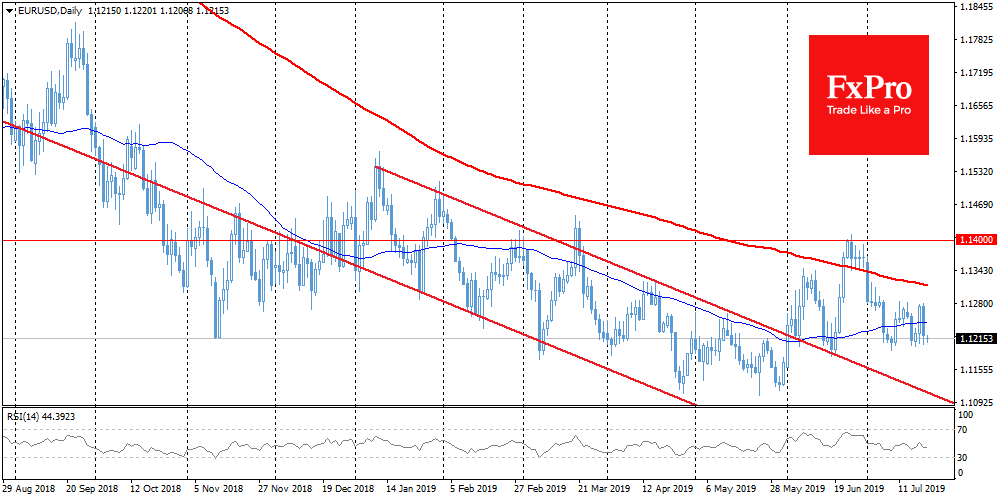
The single currency failed to develop on the offensive, returning to the 1.1200 area. This week, the ECB meeting will be held, from which analysts expect mainly transparent hints of policy easing in September. According to FxPro analysts, in the light of weaker growth and inflation the European Central Bank has many more reasons to act immediately. The risks of an unexpected rhetoric softening look real enough, making the euro potentially vulnerable to a sell-off.
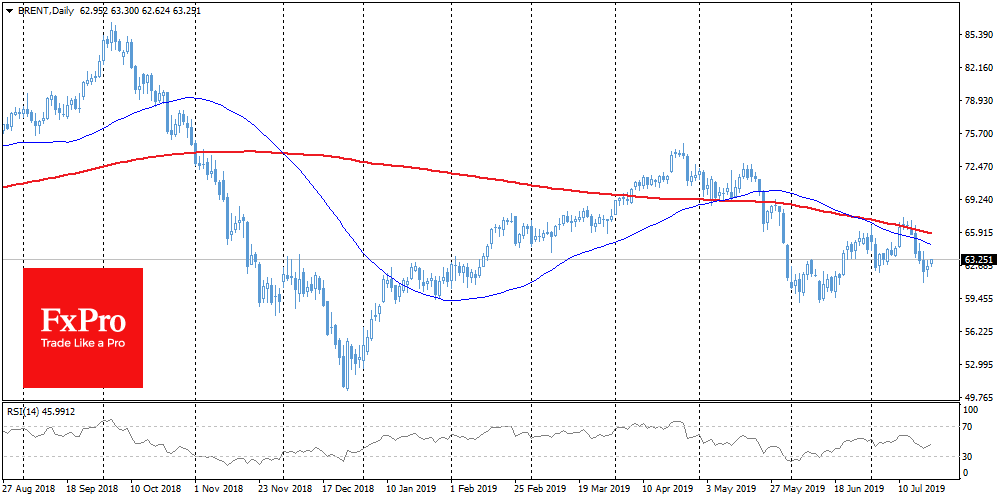
Brent
Oil is back on the agenda amid increased geopolitical tensions, following reports that Iran seized a British tanker. In addition, Libya announced the suspension of work at the largest field. These events brought fears of down-production to the markets, which helped the oil rate to return to growth. On Monday morning, Brent is trading above $63, rising to $61 after Thursday's slump. However, oil remains below the 50 and 200-day Moving Averages. It is considered to be a bearish signal, suggesting an increase in the chances of further decline.
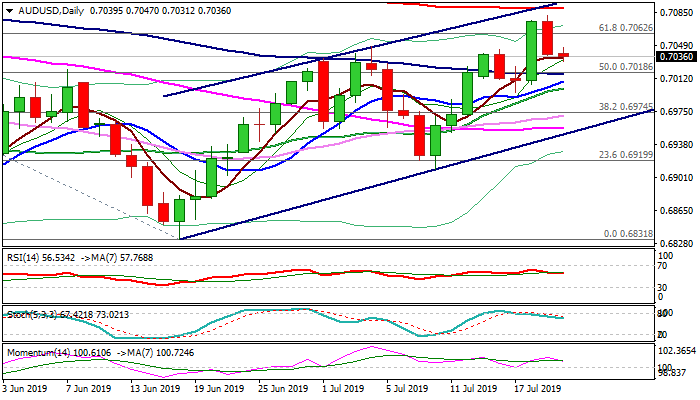
AUD/USD Outlook: Pullback Needs To Hold Above Key Supports At 0.7033/00 Zone To Keep Larger Bulls In Play
The Australian dollar stands at the back foot at the beginning of the week following Friday's close in red after bulls stalled on approach to 200DMA (0.7090).
Stronger US dollar on renewed safe-haven bid on Middle East tensions and lowered bets on more radical action from Fed this month, keep the Aussie in defensive mode.
Fresh weakness pressures top of thick daily cloud (0.7033) violation of which would risk test of next pivotal supports at 0.7016/00 zone (Fibo 38.2% of 0.6910/0.7082/10/20DMA's/psychological support).
South-heading momentum and stochastic support scenario, however, current easing will be seen as positioning of larger bulls off 0.6831 (18 June low) for renewed attack at 200DMA, while dips stay above 0.7000 handle.
Firm break below 0.7000 pivot would put bulls on hold for deeper correction and unmask supports at 0.6976 (Fibo 61.8%) and 0.6962 (bullish channel support line).
Res: 0.7047, 0.7062, 0.7090, 0.7117
Sup: 0.7016, 0.7000, 0.6976, 0.6962
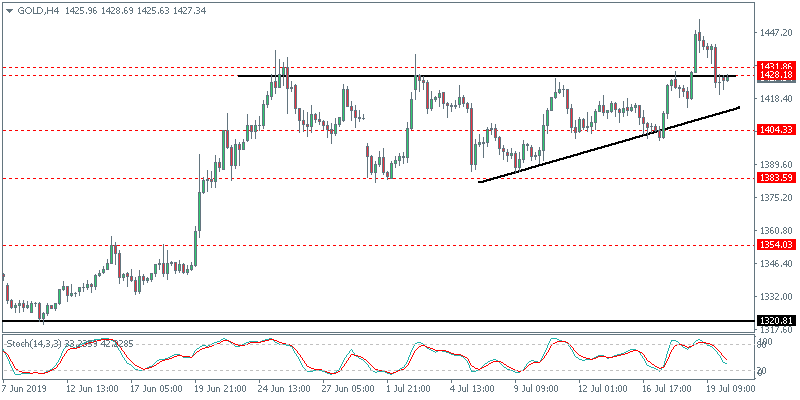
Gold Retreats Off New Six-Year Highs
The precious metal initially rose on an intraday basis to 1452.82, marking a new six-year high. However, the precious metal gave up the gains rather quickly, easing back to the recently breached resistance area. The declines came as investors tried to read the signals ahead of the FOMC meeting due in a week’s time.
Will XAUUSD Reverse Losses?
The XAUUSD reached the upside target of 1450 rather quickly. The reversal was also swift as gold prices settled below the key resistance area of 1431–1428 levels. The last session on Friday closed with a doji. A rebound off this support level could signal whether gold has further upside. Failure to post gains above the resistance area could signal a possible move lower.
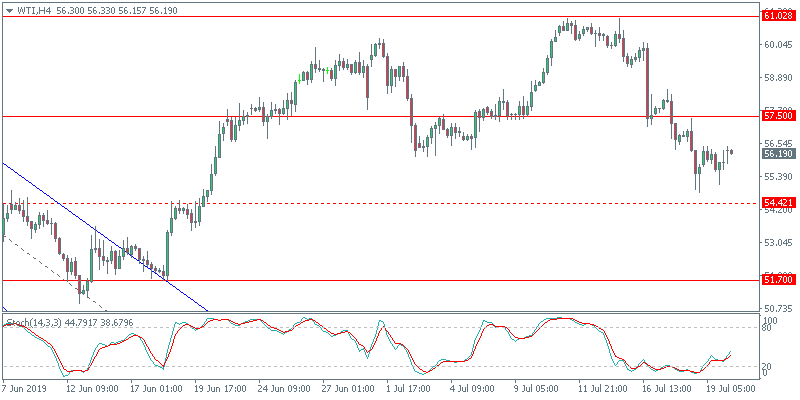
Crude Oil Attempts A Dead Cat Bounce
Oil prices, which were falling for the most part of the weak eased on Friday. The rebound, however, came on news that US warships had shot down an Iranian drone. Authorities in Tehran brushed aside the news as rumors. However, reports revealed that Tehran seized a British oil tanker in the Straits of Hormuz, escalating tensions with the US.
Can WTI Maintain the Momentum?
After breaking past the support level of 57.50, oil posted a steady decline. However, the reversal came just a few points above the support at 54.42. With the escalating tensions over the week, crude oil could be seen posting a rebound in the near term. The breached support at 57.50 could be tested for resistance.
Euro Holds Ahead Of ECB Meeting
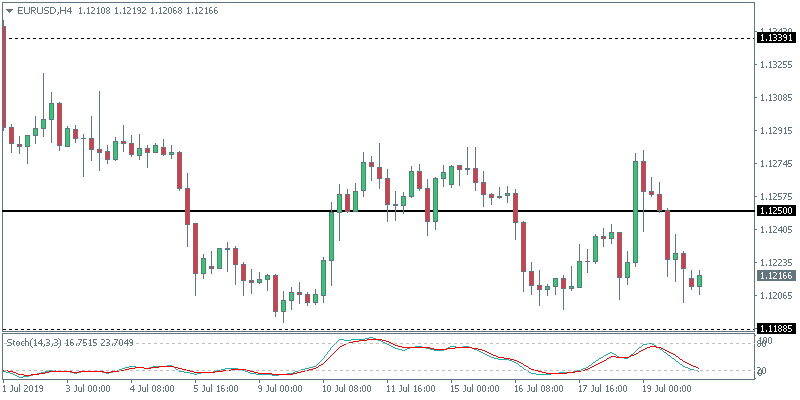
The euro currency was seen erasing the gains on Friday as the currency pair turned flat for the week. The direction in the EURUSD is dictated by both the ECB’s expected policy decisions as well as the Fed. On Friday, the UoM’s consumer sentiment survey showed expectations falling to 98.4 from 98.6 previously. But the EURUSD was muted by and large.
EURUSD to Hold the Sideways Range
The currency pair is expected to remain range-bound in the short term. Price action continues to remain flat as the currency pair hovers between 1.1250 and 1.1188. This flat price action could keep the currency pair waiting for further clues. We expect the sideways range to continue into Wednesday’s ECB meeting.
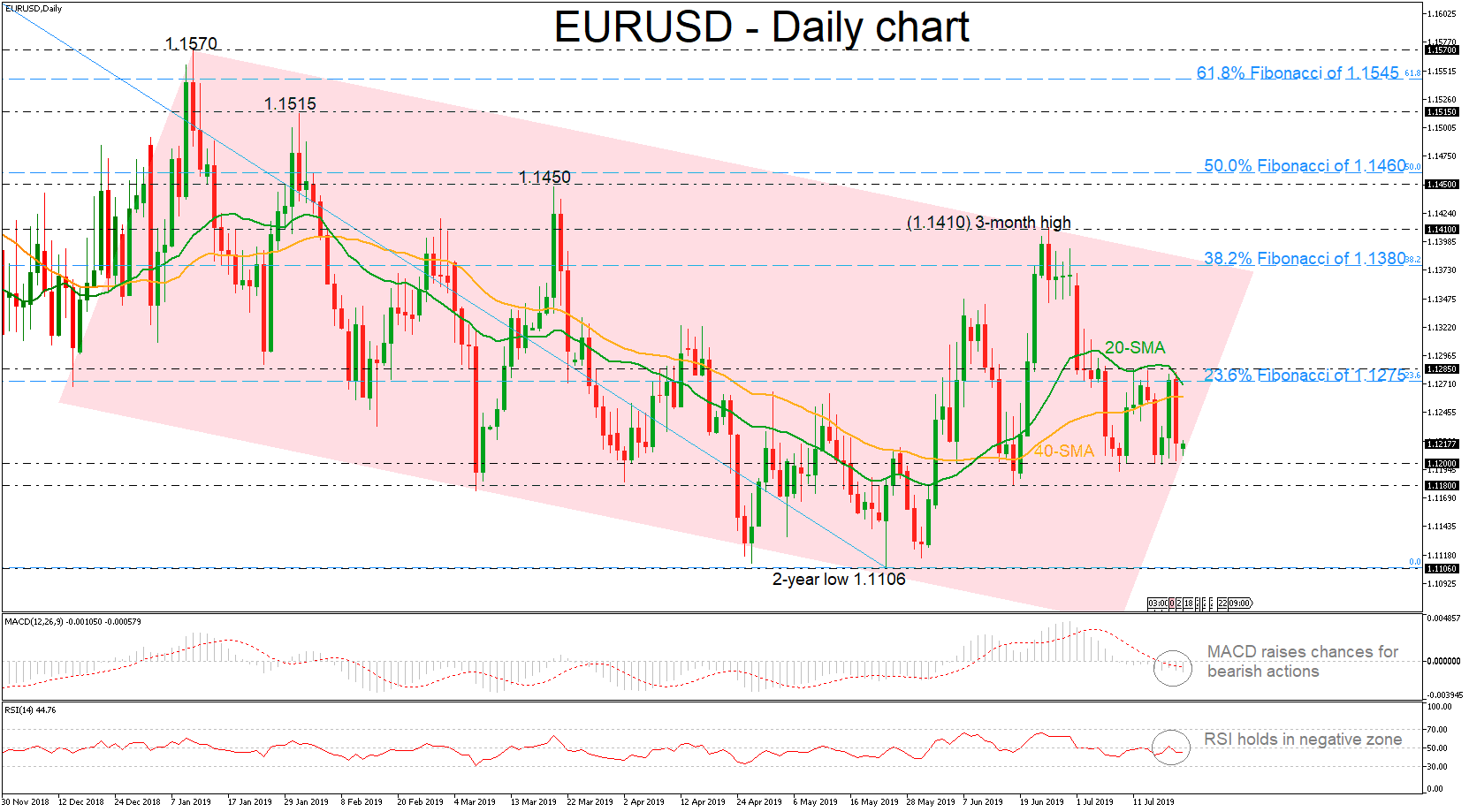
EURUSD Hovers Near 1.1200, Maintains Weak Bias In Near Term
EURUSD has been under pressure over the last three weeks as it failed several times to jump above the short-term simple moving averages (SMAs) and the 23.6% Fibonacci retracement level of the downleg from 1.1815 to 1.1106 near 1.1275.
Short-term momentum indicators are pointing to a continuation of the bearish bias. The RSI bounced off the neutral threshold of 50 and is edging lower, while the MACD oscillator is strengthening its movement to the downside below trigger and zero lines.
On the way down, the bears would likely pause near the 1.1200 handle again before meeting the 1.1180 support area. Traders could increase selling sentiment below the latter level, testing the two-year low of 1.1106, achieved on May 23.
On the other side, if the pair successfully surpasses the 1.1275 – 1.1285 resistance zone, it would take the market towards the 38.2% Fibonacci of 1.1380. A decisive close above this line could open the door for the 1.1410 high, penetrating the long-term descending channel.
In the bigger picture, this channel has been developing since January and only a significant jump above the 61.8% Fibonacci region of 1.1545 could shift the bearish outlook to bullish. However, in the very short-term, EURUSD is trading sideways within 1.1200 – 1.1285.
BTCUSD Watching $11,100
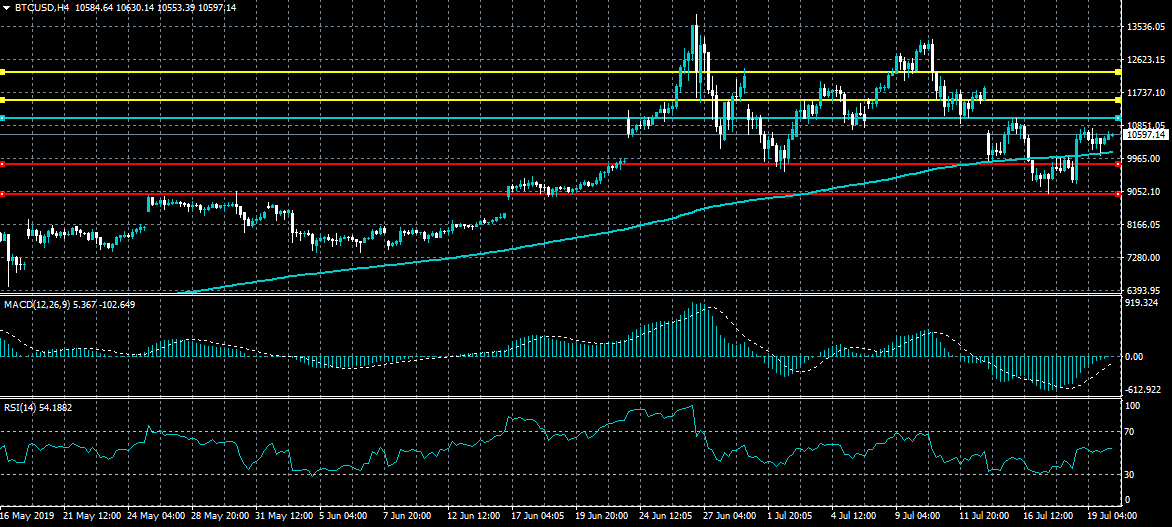
Bitcoin is holding onto the gains made over the weekend in early Monday trade after the BTCUSD pair briefly moved above the July 15th swing-high. A sustained move above the $11,100 level will help to turn the short-term sentiment towards the BTCUSD pair bullish, with the $11,600 to $12,000 region then coming into focus. Bears now need to force price under the $9,100 level and then keep the BTCUSD pair below this key former low.
The BTCUSD pair is only bullish while trading above the $9,900 level, key resistance is located at the $11,100 and $11,600 levels.
If the BTCUSD pair trades under the $9,900 level, sellers may test towards the $9,600 and $9,100 support levels.
USDJPY Holding Bear Attack
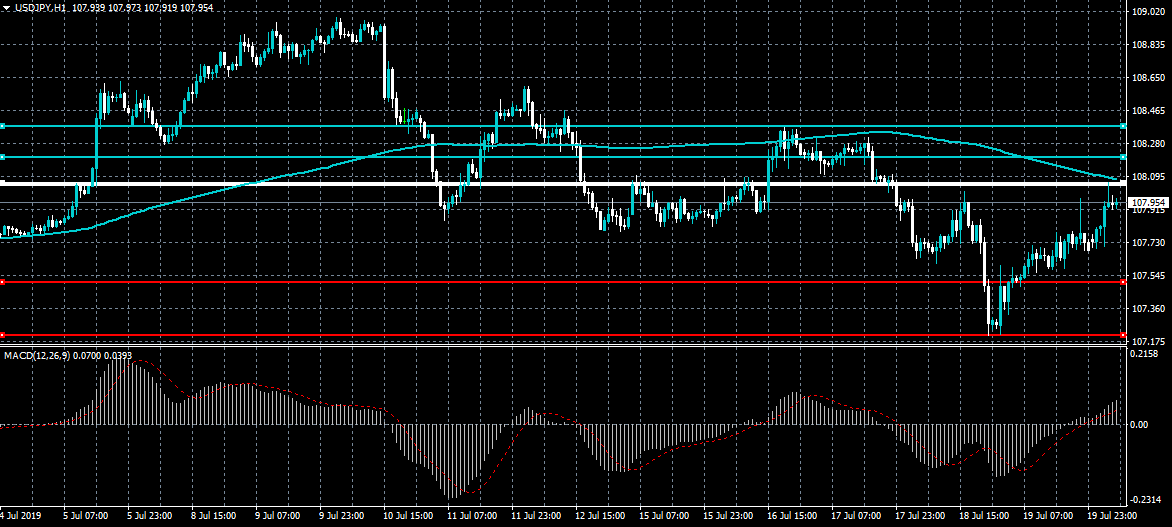
The US dollar has started the new trading week testing the 108.00 handle against the Japanese yen currency despite escalating geopolitical tension in the Strait of Hormuz. The USDJPY suffered a strong rejection from just below the 109.30 area last week, bears will be looking for a lower weekly high. Overall, USDJPY sellers are likely to target the 107.00 to 106.80 support zone.
The USDJPY pair is bearish while trading below the 108.00 level, key support is found at the 107.00 and 106.80 levels.
The USDJPY pair is only bullish while trading above the 108.00 level, key technical resistance is found at the 108.93 and 109.23 levels.