Sample Category Title
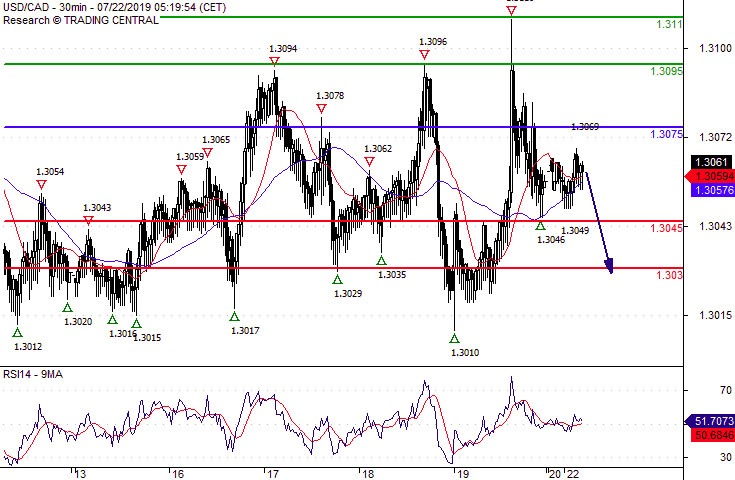
USD/CAD Under Pressure
Pivot (invalidation): 1.3075
Our preference Short positions below 1.3075 with targets at 1.3045 & 1.3030 in extension.
Alternative scenario Above 1.3075 look for further upside with 1.3095 & 1.3110 as targets.
Comment As Long as 1.3075 is resistance, look for choppy price action with a bearish bias.
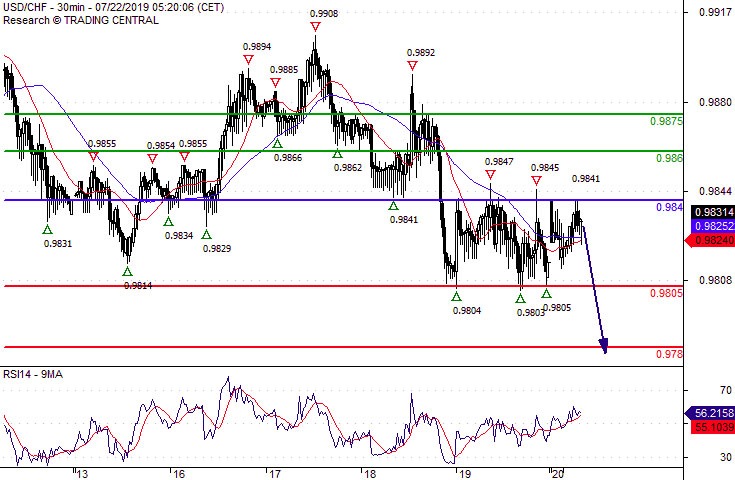
USD/CHF Caution
Pivot (invalidation): 0.9840
Our preference Short positions below 0.9840 with targets at 0.9805 & 0.9780 in extension.
Alternative scenario Above 0.9840 look for further upside with 0.9860 & 0.9875 as targets.
Comment Intraday technical indicators are mixed and call for caution.
EUR/JPY Daily Outlook
Daily Pivots: (S1) 120.69; (P) 120.98; (R1) 121.16; More....
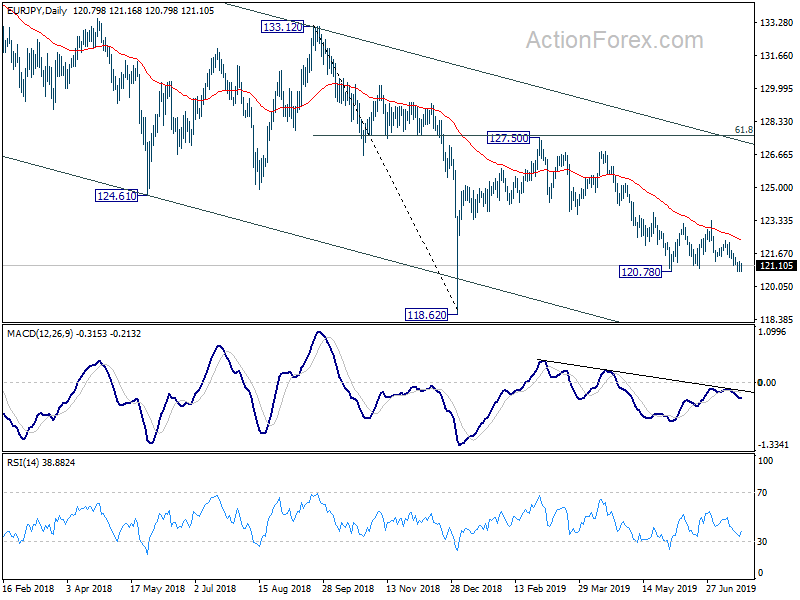
Intraday bias in EUR?JPY remains neutral for the moment. Larger decline from 127.50 could be ready to resume. Firm break of 120.78 will confirm and target 118.62 low. On the upside, break of 122.32 resistance will extend the consolidation from 120.78 with another rise towards 123.35 resistance instead.
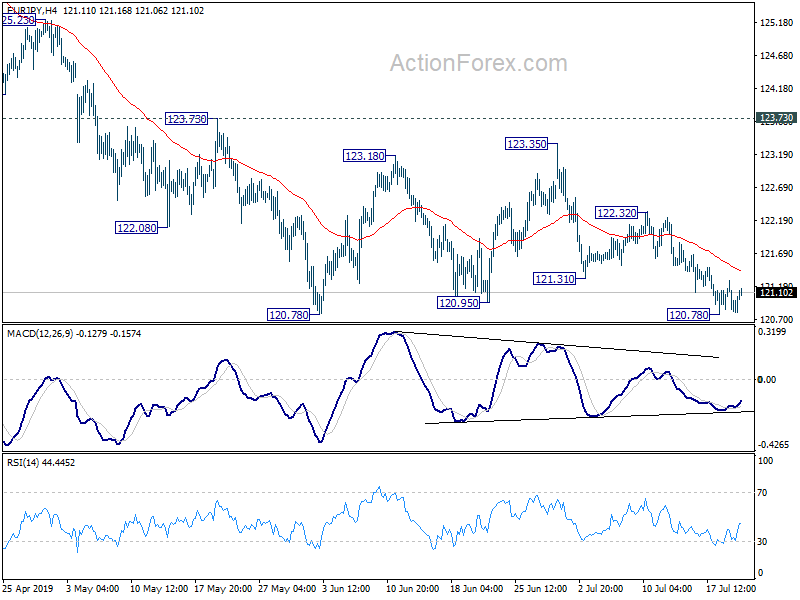
In the bigger picture, down trend from 137.49 is still in progress with the cross staying inside long term falling channel. Break of 118.62 will extend the fall to 109.48 (2016 low). On the upside, break of 127.50 resistance is needed to be the first sign of medium term reversal. Otherwise, outlook will remain bearish in case of strong rebound.
GBP/JPY Daily Outlook
Daily Pivots: (S1) 134.49; (P) 134.75; (R1) 134.94; More...
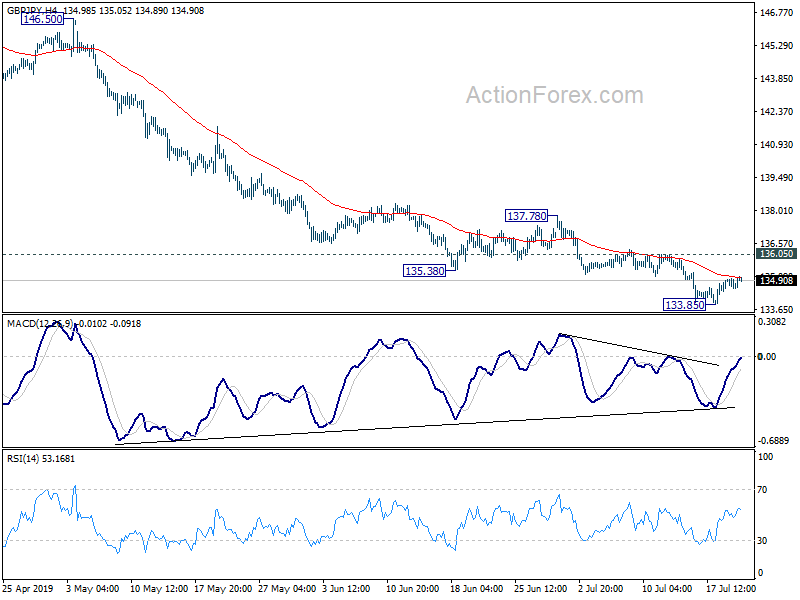
Intraday bias in GBP/JPY remains neutral for consolidation above 133.85 temporary low. Upside of recovery should be limited by 136.05 resistance to bring fall resumption. Break of 133.85 will extend the decline from 148.87 to retest 131.51 low. Though, break of 136.05 will indicate short term bottoming and bring stronger rebound to 137.78 resistance.
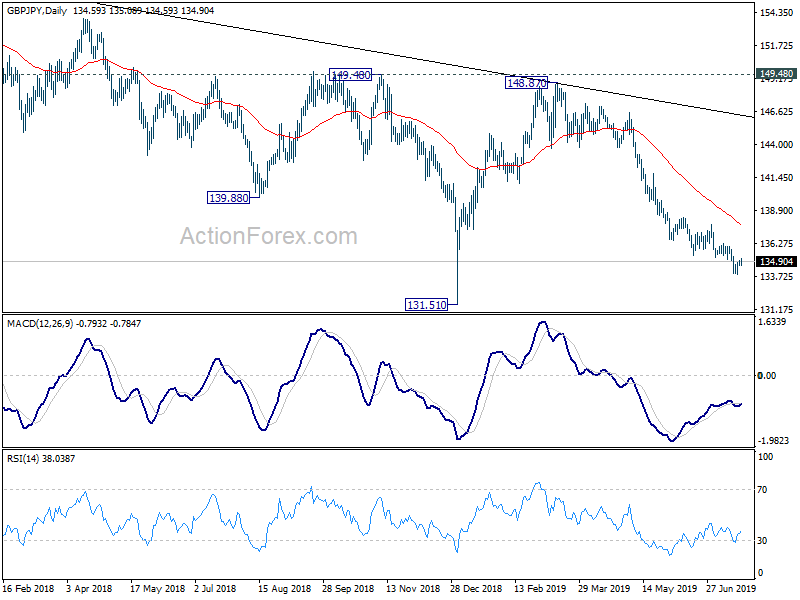
In the bigger picture, medium term fall from 156.59 (2018 high) is still in progress. Break of 131.51 will target 122.36 (2016 low). Structure of such decline is corrective looking so far, arguing that it's just the second leg of consolidation from 122.36. Thus, we'd expect strong support from 122.36 to contain downside to bring reversal.
USD/JPY The Upside Prevails
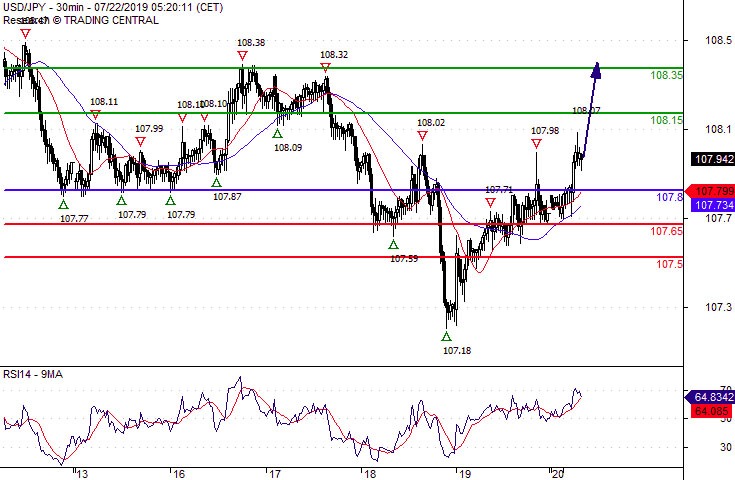
Pivot (invalidation): 107.80
Our preference Long positions above 107.80 with targets at 108.15 & 108.35 in extension.
Alternative scenario Below 107.80 look for further downside with 107.65 & 107.50 as targets.
Comment The RSI is bullish and calls for further upside.
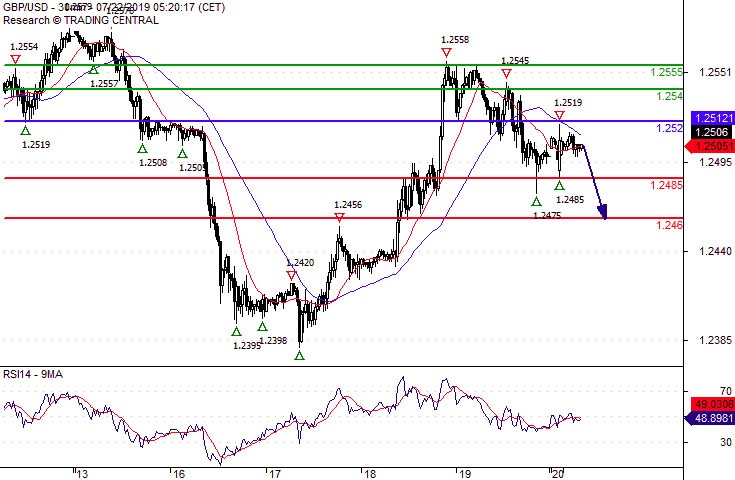
GBP/USD Key Resistance At 1.2520
Pivot (invalidation): 1.2520
Our preference Short positions below 1.2520 with targets at 1.2485 & 1.2460 in extension.
Alternative scenario Above 1.2520 look for further upside with 1.2540 & 1.2555 as targets.
Comment The index currently faces a challenging resistance area at 1.2520.
EUR/USD Key Resistance At 1.1230
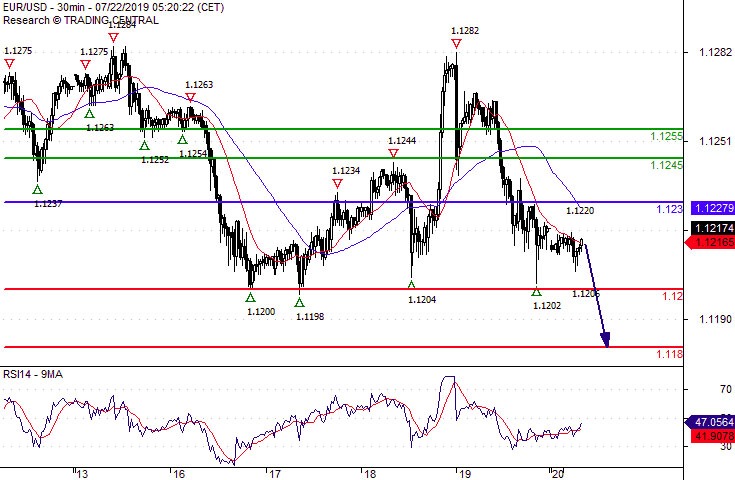
Pivot (invalidation): 1.1230
Our preference Short positions below 1.1230 with targets at 1.1200 & 1.1180 in extension.
Alternative scenario Above 1.1230 look for further upside with 1.1245 & 1.1255 as targets.
Comment As Long as the resistance at 1.1230 is not surpassed, the risk of the break below 1.1200 remains high.
EUR/USD Closed The Day At 1.1221
Markets
The clarifying statement by the NY Fed on early Friday to downplay William's previous comments (of aggressive easing) triggered a morning correction in core bonds. The (core) bond market treaded water afterwards. The U. of Michigan consumer confidence was too close to expectations. Fed's Rosengren (voter) was the last governor to speech (Friday evening) before the Fed blackout period kicks in. He said that he doesn't want to ease policy if the economy is doing "perfectly well". Rosengren is a known hawk, which might explain the limited impact of his comments on bonds. US yields rose by 6.4 bps (2-yr) to 3.1 bps (10-yr) on a daily basis. The German yield curve shifted south with yields changing about -1.5 bps across the curve. Peripheral spreads widened with Italy (-6 bps) underperforming on rumours that Lega's Salvini might trigger snap elections. We'll experience a classic Summer trading session today with zero data to inspire traders. If anything, the moderate risk-off climate due to rising geopolitical tensions (Iran) might cause some sentiment driven core bond buying. We don't expect a strong correction lower in yields however, with key central bank policy meetings looming. A soft expected ECB on Thursday might cause some outperformance of the Bund over Treasuries in the run up to Draghi's final performance.
The dollar rebounded as investors scaled back expectations for bold Fed easing on Friday after the NY Fed clarified that (dovish) comments from Fed Williams on Thursday shouldn't be interpreted as guidance for the outcome of the July Fed meeting. Uncertainty on the fate of the Italian government and tensions around Iran maybe were tentative euro negative/USD positive factors too. EUR/USD closed the day at 1.1221. USD/JPY finished at 107.71.
At the start of the week, the dollar remains well bid as some kind of market consensus is building that the Fed will probably cut rates by a cautious 25 bp next week. The eco calendar in the US and Europe is very thin today. FX traders will count down to the ECB policy decision on Thursday. The eco calendar is backloaded with EMU PMI's (Wednesday), the Ifo confidence (Thursday) and Q2 US GDP on Friday. (Geo)political topics (Italy, new UK PM, Iran) are a wildcard for (FX) trading. The risks both for the eco headlines and the impact of the political topic might be slightly USD supportive and/or euro negative. EUR/USD is nearing the bottom of recent 1.14/1.1181 consolidation pattern. A downside test looks likely. A break would open the door for the a retest of the key 1.11 support area.
EUR/GBP declined slightly further Friday, cautiously extending Thursday's sterling rebound. EUR/GBP closed at 0.8974. Cable lost some ground to close at 1.2502, but this move was mainly USD strength. Sterling investors await tomorrow's outcome of the vote within the conservative party on the successor of PM Theresa May. Markets will be eager to see the first steps of the new PM to unlock the Brexit stalemate. However, for now, it is difficult to seen any progress in the very short-term. In this context, a sustained sterling rebound will probably remain difficult. We expect EUR/GBP to hold close to the 0.90 barrier until some significant news on Brexit kicks in.
News Headlines
Iran captured a British oil tanker Friday, in response to Britain's seizure of an Irian vessel earlier this month. The move stokes fears of a potential oil supply disruption in the Strait of Hormuz. Brent oil prices rise more than 1.5% this morning to $62.5/barrel.
China will impose anti-dumping duties on some steel products coming from the EU, Japan, South Korea and Indonesia, it's Ministry of Commerce stated on Monday. The tariffs will range from 18.1% to 103.1%.
Japanese PM Shinzo Abe and his ruling coalition as expected won Sunday's upper house election for a sixth time. He fell short of a supermajority needed for a constitutional reform however. The yen weakened slightly, close to USD/JPY 108.
EUR/CHF Daily Outlook
Daily Pivots: (S1) 1.0992; (P) 1.1037; (R1) 1.1062; More...
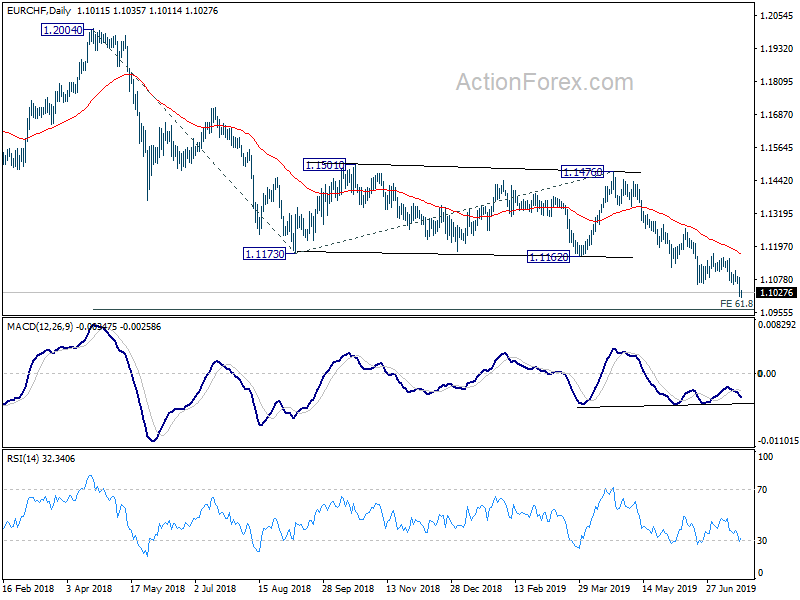
Intraday bias in EUR/CHF remains on the downside at this point. Current fall is part of the down trend form 1.2004. Further decline should be seen to 61.8% projection of 1.2004 to 1.1173 from 1.1476 at 1.0962. On the upside, break of 1.1154 resistance is needed to signal short term bottoming. Otherwise outlook will remain bearish in case of recovery.
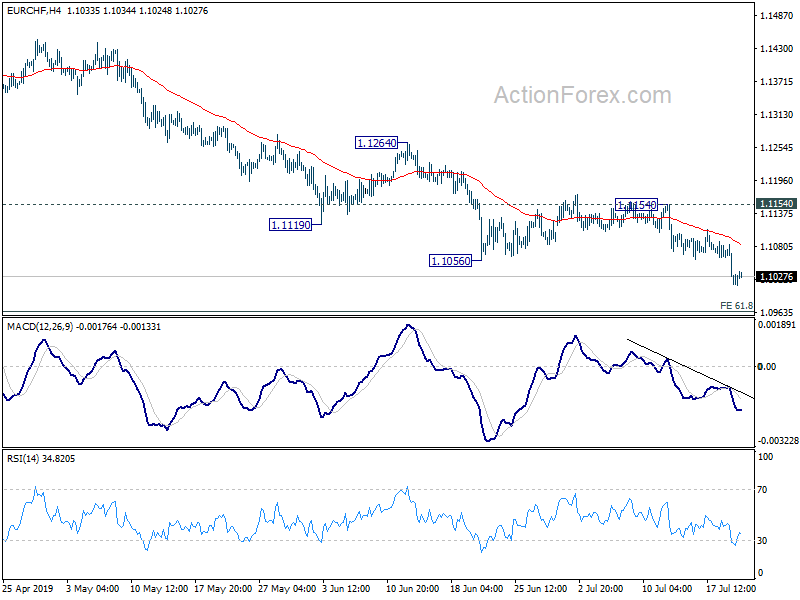
In the bigger picture, current development firstly suggests that down trend from 1.2004 is still in progress. More importantly, it's likely a long term down trend itself, rather than a correction. Outlook will remain bearish as long as 1.1476 resistance holds. EUR/CHF could target 1.0629 support and below.
ECB Preview: Warming Up For Draghi’s Grande Finale
- It is a matter of when and how rather than if ECB will ease monetary policy. After Draghi's dovish Sintra speech, lack of improvement in growth and inflation, and comments from ECB GC members, the case for further easing has strengthened.
- We expect the ECB to tweak forward guidance at the July meeting, setting the scene for a comprehensive easing package to be unveiled in September (depo rate cut, tiering, QE restart and forward guidance). We could already see the ECB tasking committees to examine the easing package including tiering (again).
- FI Markets may be disappointed at the July meeting for lacking details on new stimuli. However, we would expect any FI sell-off to be short-lived as focus turns to the expected easing at the September meeting. For FX, we expect the September meeting to be more pivotal than the July meeting
As leadership change at the helm of the ECB gets underway, both Mario Draghi's Sintra speech and the June minutes all but confirmed that Draghi's term will culminate in another big easing package. Economic data has remained lacklustre (see more below), and hence in a first step we expect the Governing Council (GC) to adjust the forward guidance at the 25 July meeting to include a reference to further easing similar to the wording “at present or lower levels” that was used up until June 2017. This should set the scene for a deposit rate cut, which we expect to be announced at the September meeting (we expect a 20bp rate cut), paired with a restart of the QE programme and extended forward guidance (see ECB Research - New ECB call - rate cut and restart of QE).
While a preference for further stimulus has been well signalled by various ECB members in recent weeks, for example Coeuré and Rehn, much debate continues to centre on the timing and design of the exact policy measures. We cannot rule out measures coming already at the July meeting, but overall find it premature (an ECB sources story, that suggested that GC members were in no rush for a July decision, supports our view).
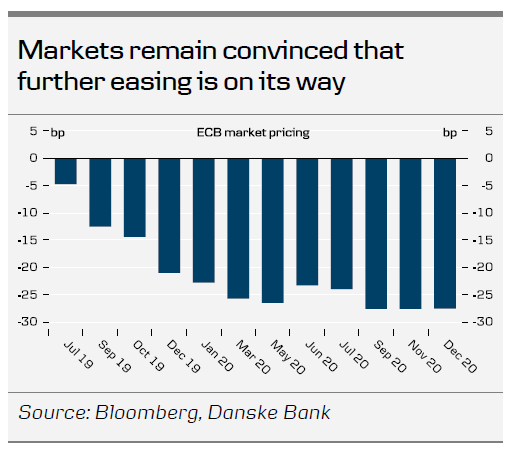
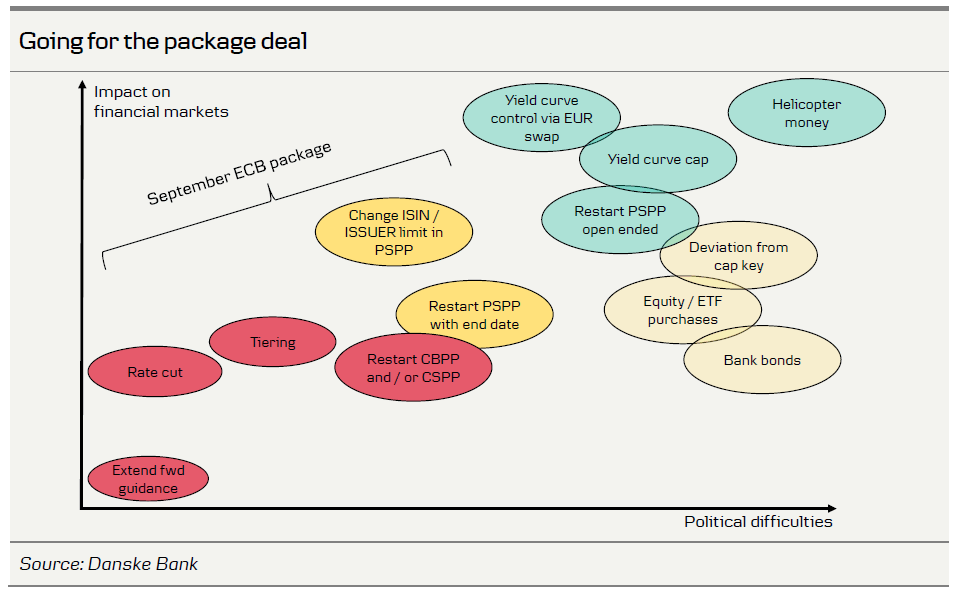
The lack of urgency was a message also borne out in the June minutes that showed discussion on concrete policy steps remained at a very preliminary stage (albeit were prior to Draghi's Sintra speech). Hence, our preference remains for an easing package only coming at the September meeting, alongside new staff projections. The uncertainty on design is high, but we see a QE restart as vital for the ECB's easing package. We view an easing package without a QE restart as falling short of providing sufficient reassurance and stimuli to the market. For our elaborate deliberations about the preference for a package deal including room for an ECB QE restart, see ECB Research: New ECB call - rate cut and restart of QE, 18 June 2019, and Government Bonds Weekly, 21 June 2019.
Regarding further alterations to the forward guidance, the June meeting also launched an interesting discussion amid the GC about the need to adopt a more “symmetrical” interpretation of the inflation target, i.e. where the ECB would tolerate inflation above the target to compensate for persistent undershooting in recent years. Although we think such a switch to a more state-dependent and less calendar-based forward guidance could help alleviate the risk of de-anchoring inflation expectations, we do not see such changes as imminent – and would also be highly dependent on whether markets believe the ECB could achieve an overshooting. However, last Thursday, Bloomberg reported that the GC already received a presentation on the effectiveness of the current target. Nevertheless, it could be the advent of a discussion that would get further traction under a Lagarde-led ECB (see ECB Research - Lagarde to take 'one of the most difficult' jobs).
Committees to look into tiering system
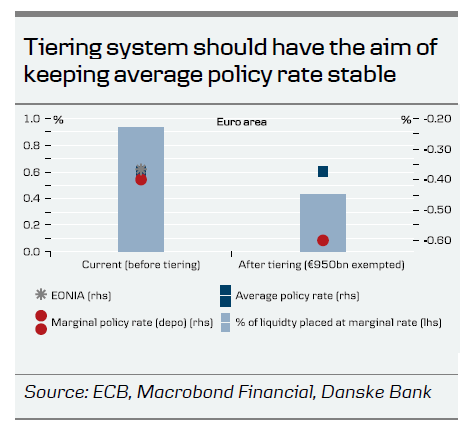
As the ECB mulls another rate cut, the introduction of a tiered deposit rate system continues to be an integral part of the discussion. At the June meeting, the ECB concluded that the benefits of the negative interest rate policy continue to outweigh the drawbacks, but it left the door open for ‘mitigating measures' should policy rates be decreased further in the future. Hence, as part of the policy package announced in September, we expect the ECB to introduce a tiering system. The aim would be to keep short-term money market rates (i.e. EONIA/€STR) close to the marginal rate (deposit rate) to ensure the transmission of easier financial conditions to the real economy. At the same time, to support banks' profitability, the system should be designed to ensure the average deposit rate banks pay to the ECB remains close to the current level of just shy of -40bp in order to minimise negative repercussions on lending rates.
A tiering system could be designed in a number of ways depending what the ECB wants to achieve. We doubt that work in the ECB on this complex topic has been finalised yet. A number of hurdles need to be taken into account, including how to tailor a tiering system to the heterogeneous European banking system, the impact on repo markets and the €STR/EONIA transition set for 1 October. Currently, we lean towards a solution that would mirror the Swiss approach, where a multiple of required reserves is exempt from the deposit rate, but the uncertainty is high, naturally. We note that to keep the average deposit rate faced by banks broadly unchanged after a 20bp cut, a quick back of the envelope calculation indicates around EUR950bn of excess reserves (more than 7x the current reserve requirement) would need to be exempted and allowed to be remunerated at the higher rate. Finally, we highlight that a tiered deposit rate system even risks adding upward pressure on money market rates if not designed and adopted by markets optimally. Hence, in light of the complexity of the issue, we think the ECB would tread carefully in rolling out a tiering system to avoid creating additional volatility in financial markets. This means a clear communication on tiering might only come sometime after the actual rate cut, i.e. at the October or December meetings, but that should not keep the GC from already tasking committees to look into the issue at the July meeting.
Economic outlook has not improved
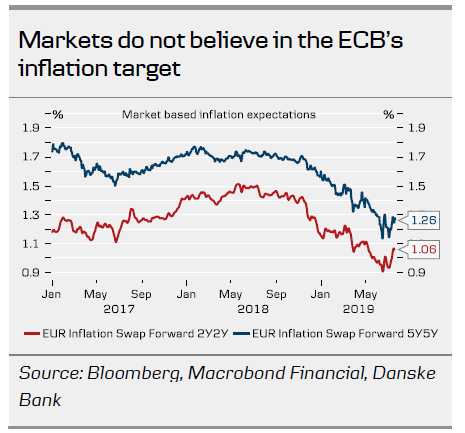
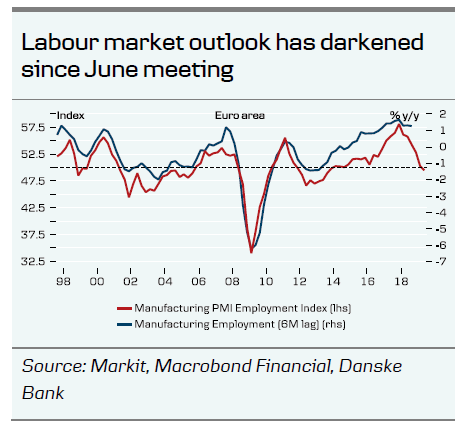
The ECB's hope for an improvement in economic data since the June meeting has proven elusive. The industrial sector is on track to return as a drag on growth in Q2 and PMIs and Ifo continue to tell a story of subdued growth. Furthermore, vulnerabilities have started to show in the so-far-robust labour market with business surveys now signalling that manufacturing employment growth will start to go into reverse in H2 19 (see also Euro Area Research - Catching up with reality). Core inflation continues to fluctuate around the 1% level and remains highly influenced by seasonal effects. Market-based inflation expectations have recovered to 1.26% - close to their post-Sintra peak - but they probably remain too low for the ECB to stay complacent about the fall in breakevens. That said, in a recent speech, board member Benoît Coeuré downplayed the relevance of market-based inflation expectations as a gauge of de-anchored inflation expectations, stressing that policymakers should focus instead on a broad set of inflation expectations indicators. Specifically, the ECB uses its survey of professional forecasters, which will be published the day after the ECB meeting. The GC will be aware of the outcome and will likely closely watch that result.
In his Sintra speech, Draghi highlighted that “In the absence of improvement, such that the sustained return of inflation to our aim is threatened, additional stimulus will be required.” Based on the latest macro data signals, the case for further easing measures is there. Whether it would do much to alleviate the current growth weakness and kick-start the economy is an altogether different question. Here, we remain sceptical, since borrowing costs are already very low and a lack of (external) demand rather than too-tight financial conditions remains the key issue. In that light, fiscal policy remains the most effective channel to brighten the euro area growth and inflation outlook in our view.
FX: Rate cuts are all that matter
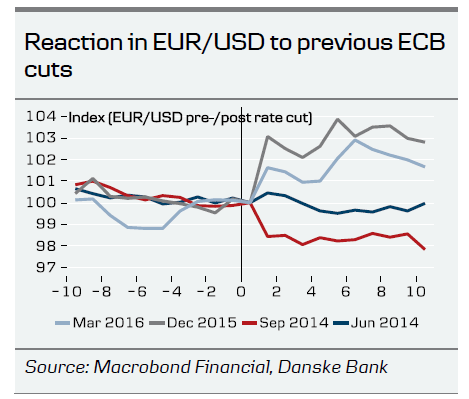
For the EUR, the outcome of the upcoming ECB meetings has become highly important. Our long-held view remains that what matters for the EUR is what the ECB can do to create inflation and in that light it is the rate cutting part of the easing package that really matters for FX markets (see FX Edge: The EUR and ECB – rate cuts are all that matter). A sizeable cut in the deposit rate (and 20bp is a bare minimum in our view) would force a greater share of excess liquidity on the market, help turn around inflation expectations and weaken the EUR. However, history has shown that market expectations have tended to exceed the ECB's eventual easing package announcement at the time of the ECB policy meetings. A tiering system might further erode the effect and push the EUR higher. Overall, we do not expect much market reaction in July, but rather consider the September meeting to be pivotal for the EUR.
Fixed income: Focus will soon be on September and FI rally to continue
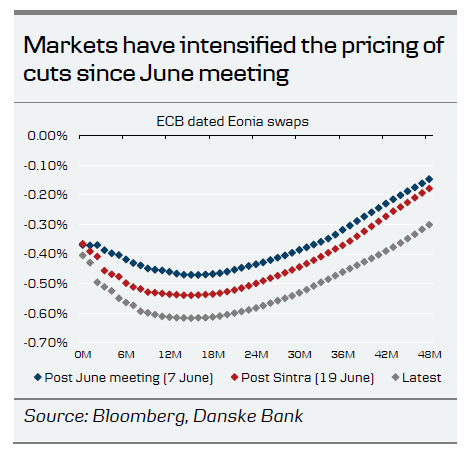
Last week, the market lowered the probability of an ECB cut at the July meeting and moved away from expecting a 50bp cut from the Fed. This pushed 10Y Bund yields (DBR 0.25% 02/29) to -0.25% from the -0.40% seen in early July. However, this week, the EGB rally has returned, pushing 10Y yields back to -0.32%.
There is risk that the ECB meeting might be an initial disappointment for the FI markets given no rate cut at this stage. However, we expect any FI sell-off to be shortlived. Given the change in forward guidance, market focus will quickly turn to the September meeting, we believe. Here, we expect the market to buy into our ‘big easing package' view.
All in all, we stick to the view that 10Y Bund yields will drop to -0.45% over the next 1-2 months. It also means that the hunt for carry or struggle to avoid negative yields is intensifying. Hence, we keep a positive view on periphery and semi-core. Our favourites remain Spain, Portugal and Finland in semi-core