

Sample Category Title
Market Morning Briefing: Dollar-Yen Is Trading Near Support At Current Levels
STOCKS
Equities continue to trade lower. The renewed concerns on the US-China trade war on one side and increasing hopes for a rate cut from the Fed later this month on the other side keeps the market little mixed and cautious. The near-term view remains negative for the Dow, DAX and Nikkei. Shanghai continues to consolidate while the Sensex and Nifty looks vulnerable for a fall.
Dow (27222.97, +3.12, +0.01%) dipped further as expected but has bounced from the day’s low of 27068. The near-term view remains negative for it to test 27000. We also reiterate to remain cautious as a break below 27000 will accelerate the fall to 26500 and even lower levels.
DAX (12227.85, -113.18, -0.92%) has dipped below 12250. As mentioned yesterday, the dip below 12250 has turned the outlook negative for a fall to 12000 in the near term.
Nikkei (21384.77, +338.53, +1.61%) has bounced sharply much above the resistance at 21350 mentioned yesterday. But the next resistance in the 21400-21450 region can cap the upside and keep the negative view intact to test 20900 and 20750 in the coming days.
Shanghai (2935.60, +34.42, +1.19%) bounced after testing 2900 and keeps the 2900-2950 sideways range intact as expected. Our bias remains bullish to see the index breaking this range above 2950 and rally to 3000 in the coming days.
Sensex (38897.46, -318.18, -0.81%) failed to sustain above 39000 and has negated the chances of testing 39500 on the upside. The dip below 39000 can now drag it to 38750 and 38500 as mentioned yesterday. The possibility of the fall extending to 38000 also cannot be ruled out.
Similarly, Nifty (11596.90, -90.60, -0.78%) has declined sharply failing to breach 11700. This has brought back the bearish view into the picture. While below 11700, Nifty can fall to 11500-11450 again and will remain vulnerable to test 11400 on the downside.
COMMODITIES
Almost all commodities are trading higher and look bullish for the very near term.
Brent (63.14) tested 62.50 in line with our expectation before bouncing from there while Nymex WTI (56.34) tested 55.75 on the downside before rising back from there. While immediate support near 62.5 and 55.75 holds, we could see some range trade in the next few sessions. Brent has scope of testing 62-60 in the longer run while Nymex has crucial support near 54.
Both Gold (1446.40) and Silver (16.49) are in a strong upward rally and has more room for further rise. If Gold managaes to break above 1450, it could continue to rise targeting 1500 in the medium term while Silver is trading at crucial weekly resistance at 16.50. It would be important to keep a watch on Silver to see if it faces stiff rejection from 16.50 or manages to break on the upside.
Copper (2.7630) rose sharply, breaking above 2.75, contrary to our expectation. If the rally continues, Copper could head towards upper resistance near 2.85/90 soon. Near term looks bullish while above 2.75.
FOREX
Dollar Index (96.97) has fallen as expected and could test 96.75 on the downside. /on the longer term charts there is scope for testing 96 in the medium term, but we would watch price action near 96.75 before turning bearish towards 96.
Euro (1.1267) has risen well and trades higher just now targeting 1.13. It would be important to see if 1.13 can push back the currency towards 1.12 or lower in the medium term. A break above 1.13, if seen would be crucial indicator of medium term bullishness for Euro.
Dollar-Yen (107.49) is trading near support at current levels. If the break below 107.50 sustains, the pair could test 107.30-107.00 levels in the near term before bouncing back from there.
Euro-Yen (121.12) is trading in very small and narrow range just above support near 121. Watch price action near current levels because a fall from here could be indicative of fresh bearishness in the medium term.
Aussie (0.7071) has resistance near 0.71 which if holds, could turn Aussie down towards 0.69 in the medium term.
Pound (1.2551) has risen sharply over the last 2-sessions and could move up towards 1.2620 in the near term. View is bullish while above 1.2400/2450.
USDCNY (6.8731) has been trading near current levels. There could be some chances of testing 6.89/90 before Yuan strengthens in the longer run.
USDINR (68.96) closed higher yesterday but could face a short dip from 69. The dip from 69, if seen could take it down towards 68.75 before the currency pair attempts another rise towards 69.25.
INTEREST RATES
The US Treasury yields have dipped further. One of the US Federal Reserve officials stating that the central bank should act quickly pulled the yields lower as it increased speculation for an immediate rate cut. However, another Fed official had clarified that the statement is just from an academic research and is not a hint on the central bank’s actual action.
The US Treasury yields were down across tenors with the very near-term falling the most. The 2Yr (1.78%) was down 5 bps while the 5Yr (1.79%), 10Yr (2.04%) and the 30Yr (2.56%) yields were down between 1 bps and 3 bps. As mentioned yesterday, the yields can dip further. The 30Yr can test 2.50% and the 10Yr can dip to 2%.
The German yields continue to trade subdued. The 2Yr (-0.77%) and 5Yr (-0.65%) dipped 1bps each. The 10Yr (-0.31%) remained stable while the 30Yr (0.27%) inched up by 1bps. The near-term view remains negative. The 30Yr can dip to 0.20% and the 10Yr can test -0.40% on the downside.
As expected, the 10Yr GoI (6.3868%) is managing to sustain above 6.25% and a corrective bounce to 6.50% looks likely in the near term.
Cliff Notes: June Employment Disappoints, Highlighting Risks for RBA
Key insights from the week that was.
For Australia, the June labour force survey was key this week. Offshore, China data and remarks from FOMC officials were most noteworthy.
Beginning with Australia’s labour force, employment growth disappointed in June, rising just 0.5k against the market’s expectation of 10k. As the participation rate held up at its historic high of 66%, the unemployment rate also remained unchanged at 5.2%. Interestingly, underemployment (those that are willing and able to work more than they currently do) instead fell in the month from 8.6% in May to 8.2% in June. This looks to be a one-off fall that reverses a similarly-sized rise in April.
For the economy overall, it is important to highlight that, at 5.2%, the unemployment rate is well above the RBA’s 4.5% full employment target. And, despite June’s reversal, underemployment is still materially above its post-GFC high. Further, the trend looks to be going the wrong way, employment growth having slowed from 2.9%yr at May to 2.4%yr in June on its way to 2.1%yr in the December quarter, according to the forward indicators. Our expectation is that employment growth will be weaker still in the period ahead, resulting in a drift higher in the unemployment rate. Note that it also seems consumers are increasingly aware of the labour market’s deterioration.
This weakening trend remains the focus of the RBA as they instead seek sustained strong employment growth which begets wage inflation so as to lay a foundation for a return to trend growth and inflation at target. While the July meeting minutes point to a pause for policy following June/July’s rate cuts, as highlighted by Chief Economist Bill Evans, by November enough pressure will have built on the RBA’s growth and inflation forecasts for the year ahead to justify another cut to 0.75%. Indeed, given the significance of the labour market in the RBA’s thinking and its weakening trend, we believe prospects for the next move being as early as September or October cannot be dismissed.
On July 31 the Q2 CPI for Australia is released. Our preview is now available. In short, we look for another soft outcome for trimmed mean core inflation of 0.3%, leaving the annual rate well below the 2-3%yr RBA target range at 1.5%yr. Released this week, New Zealand’s CPI provided no surprises, annual inflation soft at 1.7%yr. Our New Zealand team and the market continue to expect the RBNZ to cut in August.
Turning to China, GDP and the June monthly data round were received this week. GDP was as expected in Q2, annual growth decelerating to 6.2%. Support from net exports abated, putting the onus for growth more on domestic demand. While consumption has received support from tax cuts, it is evident in the PMI detail that employment growth is under pressure. As a result, for both the short and long-term, investment is critical. Momentum in real estate investment is strong, but public infrastructure and private business investment remain weak. The credit data points to local governments accumulating funding, and so a lift in infrastructure work can be expected shortly. However, private sector investment looks set to remain weak absent greater liquidity and reduced cost for banks, as well as strong encouragement by authorities to lend to these firms.
Then to the US. June retail sales confirmed that the US consumer remains in strong shape, with control group sales up 7.5% annualised for Q2 overall – the strongest outcome in 14 years. As long as the labour market and sentiment hold up, this should remain the case. In a speech which assessed ‘Monetary Policy in the Post-Crisis Era’, it was notable that Chair Powell again reiterated that, while the FOMC “expect growth in the United States to remain solid”, “Uncertainties about this outlook have increased”. This clearly reaffirms an intent to cut in July and again by year end, and to remain cognisant of the impact of risks on the US economy thereafter.
More broadly on the responsiveness of policy near the lower bound, New York Federal Reserve President Williams was very clear on the need for policy makers to be proactive. Simply, research points to a need to first “take swift action when faced with adverse economic conditions”, then to “keep interest rates lower for longer”, and finally to “adapt monetary policy strategies to succeed in the context of low r-star and the ZLB”. Practically speaking, with “only so much stimulus at your disposal, it pays to act quickly to lower rates at the first sign of economic distress”, and it is “better to take preventative measures than to wait for disaster to unfold”. Such comments were later reinforced by Fed Vice Chair Clarida who emphasised “You don't want to wait until the data turns decisively if you can afford to".
Having already been more than fully priced for a 25bp cut at the July meeting, the market moved to pricing 42bps after the Fedspeak. However, the NY Fed later released a special statement announcing that Williams' speech was “academic” and not about “specific policy action”. Pricing for the July meeting is now back to 37bps, reflecting roughly even odds between a 25bp or 50bp reduction.
Lastly on the UK, MPs passed an amendment 315-274 in order to prevent the next Prime Minister suspending Parliament in October to push through a no-deal Brexit. Such tactics had been touted by Boris Johnson’s campaign as one possibility to deliver on his “do or die” commitment to leave the EU on the October 31 deadline.
Johnson is the firm favourite to win the Conservative leadership ballot and become PM with results likely to be released this coming Tuesday. While he is popular among the Conservative’s voting base, last night’s parliament vote highlights the division between MPs.
Divisiveness between Johnson and European leaders is of course even more intense. That said, Irish Taoiseach Varadkar indicated this week that he is “willing to compromise” to avoid a hard border on the island of Ireland but conceded an agreement on “alternative arrangements” to the tabled backstop is unlikely before the current Brexit deadline. Indeed, The UK House of Commons rises for summer recess on July 25 and returns on September 3. From there, it is only six weeks until the EU Summit on October 17.
Daily Markets Broadcast
Wall Street rebounds on heightened Fed hopes
Dovish comments from the Fed’s Williams helped US indices rebound from early losses, with solid economic data also helping. The US shot down an Iranian drone in the Straits of Hormuz while UK parliament voted for a Brexit amendment that would make it more difficult for the PM to force through a no-deal Brexit.
US30USD Daily Chart
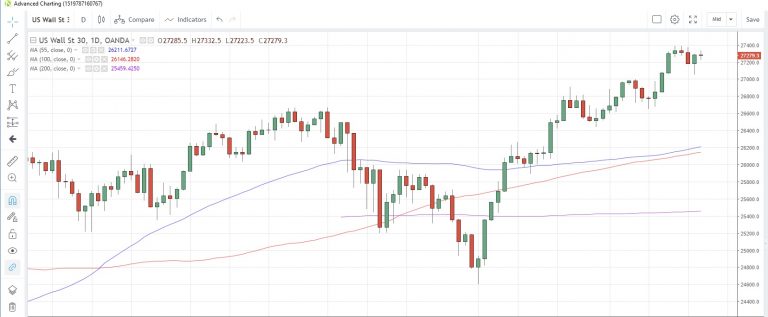
The US30 index rebounded from the week’s lows after Williams said the Fed should be aggressive when confronted with an adverse outlook. Speculation increased that a 50bps cut might be delivered at this month’s meeting
The 100-day moving average at 26,146 and the 55-day average at 26,211 continue to track each other higher
The Philadelphia Fed manufacturing survey surged this month, rising to 21.8, the highest in nine months. Today we see the Michigan consumer sentiment for July, which is seen improving to 98.5 from 98.2 in June.
DE30EUR Daily Chart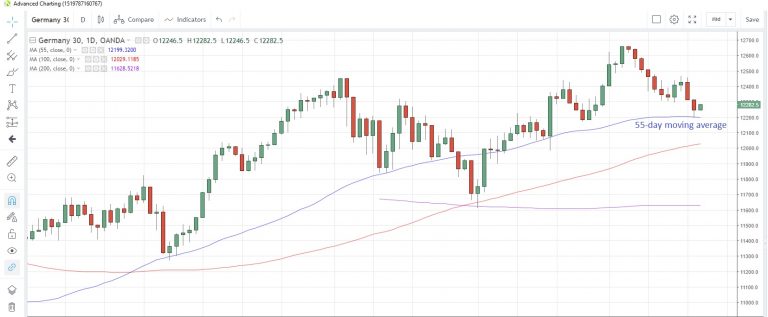
The Germany30 index fell for a second straight day yesterday amid weak earnings reports
The index fell to the lowest in just over three weeks, testing the 55-day moving average support at 12,202
Germany’s producer prices are expected to fall 0.2% m/m in June, the latest survey of economists suggests. That would be the lowest reading in six months.
WTICOUSD Daily Chart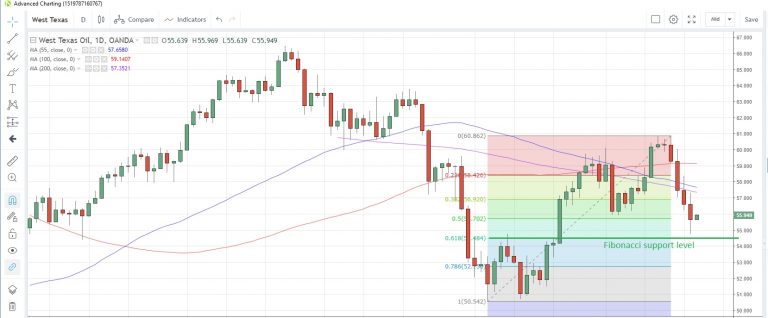
Crude oil prices fell for a fifth consecutive day yesterday, despite an increase in Middle East tensions after the US reported it had shot down an Iranian drone
WTI is heading toward the 61.8% Fibonacci retracement of the June-July rally, which is at $54.48
The EIA is revising its 2019 global oil demand to 1.1 million barrels per day (bpd) from its 1.2 million forecast just last month, adding that it may cut it further if the global economy, and especially China, shows further weakness.
Short-Term Outlook: All About Earnings, Trade, And Easing
Risk appetite is waning as earnings season picks up and as political posturing between the Chinese and Americans see no substantial progress on the trade front. US stocks have been unable to extend the record rally despite a relatively good start to earnings season that has seen a majority of companies deliver earnings beats. A mixed picture from transportation stocks will have followers of Dow Theory argue it will be difficult for US stocks to resume the record rally. Technology stocks got off to a bad start came from poor results (Netflix), continued crackdowns on unfair practices (Amazon) and regulatory scrutiny on Facebook’s Libra currency. Next Thursday, both Amazon and Google parent Alphabet will report earnings.
Safe-haven flows have been somewhat limited this week as markets eagerly await the Fed’s interest rate decision at the end of the month. Regarding FOMC expectations, the Fed fund future markets are now pricing a 25 basis rate cut on July 31st and an additional 50-basis point cuts for the remainder of the year.
Central Banks this week
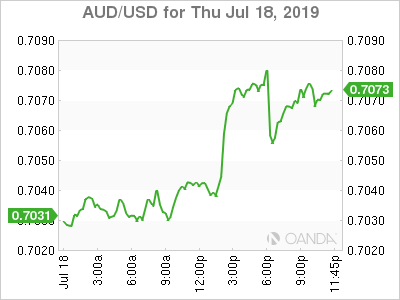
The Reserve Bank of Australia (RBA) July minutes signaled they could cut rates further if necessary. On July 2nd, the RBA delivered its second consecutive cut, bringing the cash target rate to 1.00%. The central bank is focused on the labor market and the recent string of data has seen nine straight months of growth. The Australian dollar softer to start the week, but has rebounded strongly as speculation rose the RBA would hold off on delivering a rate cut in August.
Bank of England policymakers continue to deliver rhetoric that support the argument that rates could rise if a smooth Brexit occurs. BOE Gov Carney this week highlighted that divergent outlooks are not unsurprising and that officials will explore how to best illustrate market sensitivities. The Treasury Committee also asked the BOE and Treasury to Brexit economic analysis that presented last November. The British pound rebounded off the lows of the week after no-deal Brexit risks eased after Parliament made it harder for PM front-runner Boris Johnson to suspend Commons in order to deliver a no-deal Brexit. Next Tuesday, we should find out if Boris Johnson becomes the new PM. 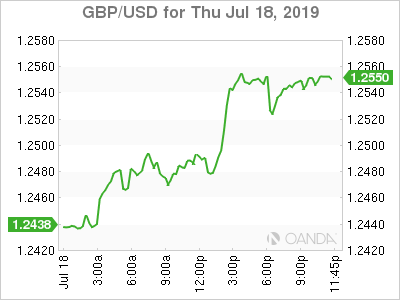
A wrath of Fed speak did little to dissuade expectations the Fed will cut rates at the end of the month. The key Fed takeaway came from the Beige Book which continued to put an emphasis on the effects of the trade war. Fed Chair Powell’s speech on monetary policy reiterated that the Fed will act as appropriate to sustain expansion. The dollar is surprisingly still pretty strong as a recent batch of better than expected labor, inflation and retail sales data pared back some rate cut expectations. 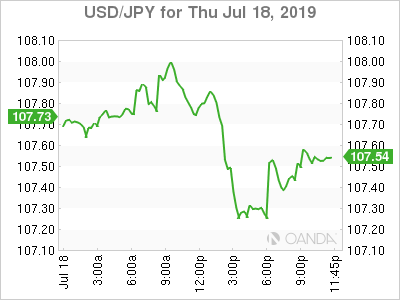
The ECB observed a quiet period ahead of next week’s rate decision. Press reports circulated that that they could revamp their inflation target, a move that would embolden policymakers to easy policy for much longer. 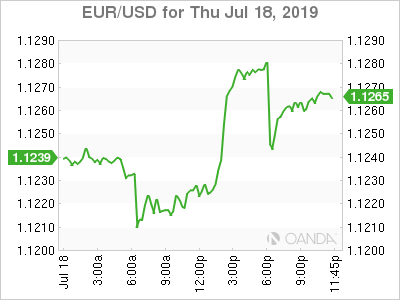
On Thursday, the South African central bank (SARB) cut interest rates for the first time since March last year. The decision was unanimous and the rand rallied as policymakers noted they expect a GDP rebound in Q2, thus avoiding a recession and that they did not consider a 50 basis point cut. They could loosen further down the road but for now it appears they are one and done. 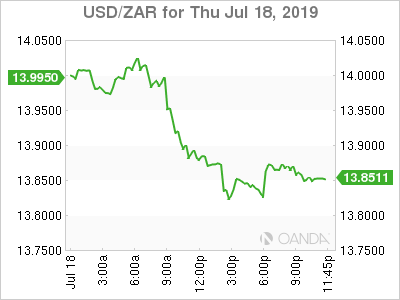
On Monday, Turkey's new central bank (CBRT)governor, Murat Uysal delivered his first interview since Erdogan fired governor Cetinkaya via presidential decree. Uysal noted there is room for maneuver in monetary policy” however vowed to preserve “a reasonable rate of real return” for investors. The bigger story for the lira was Trump's comment that he is not looking at sanctioning Turkey right now. Next week the Turkey's CBRT is expected to cut rates by 350 basis points. 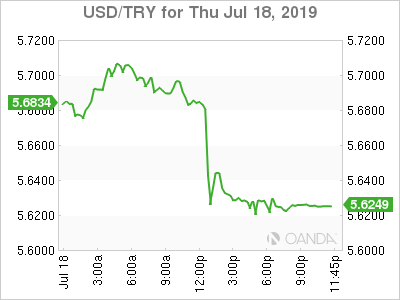
Thailand central bank (BOT) governor reiterated concerns on the baht's strength and that cutting policy rate may not have much impact. The BOT is expected to ease rules on money outflows and may cut bond supply. 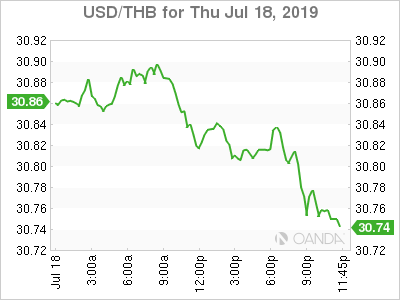
The Hong Kong government will shortly announce the replacement of the chief executive of the Hong Kong Monetary Authority. The current head, Norman Chan will retire on October 1st. It is expected for them to select someone internally that will keep the HKMA intervention efforts and maintaining the system that keeps the peg to the greenback. 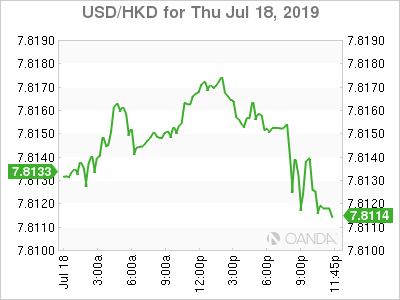
No major events came out of the Mexico central bank (Banxico), Sweden's Riksbank, Poland's central bank, Norway's Norges, and the Reserve Bank of India (RBI).
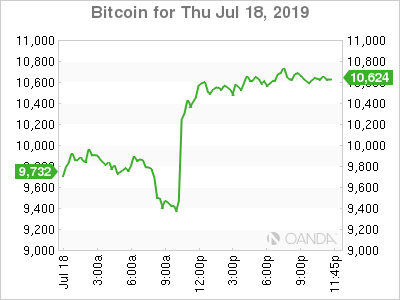
Bitcoin volatility to remain
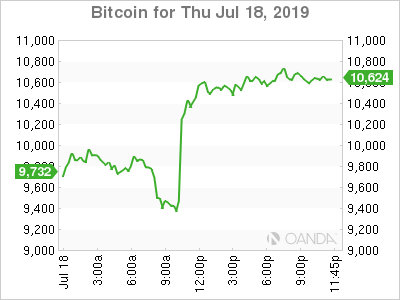
Bitcoin and other cryptocurrencies survived the Congressional grilling on Facebook's proposed digital currency offering. The digital coin space has already been enduring an increased regulatory environment, but the Facebook proposed offering has caught the attention of all US government leaders. Current laws limit the reach Congress currently has on Libra since they are not a bank. The SEC could deem Libra a security and regulate them. Bitcoin's rollercoaster ride continues with volatility easily to see moves towards $8000 and $14,000.
Iran
Oil prices are plummeting this week as optimism grows that we could see a de-escalation in tensions in the Persian Gulf and as Russia's largest pipeline operator, Transneft resumed full flows of supplies. Earlier on Thursday, Iran's Revolutionary Guard seized a foreign vessel. The situation however remains fluid as shortly after Iran offered they would accept enhanced inspections of its nuclear program if the US lifted their sanctions. The lack of trade progress between the US and China has also dealt a strong blow to the demand outlook for crude prices. While oil has now fallen below a couple of major support levels, geopolitical risks from Nigeria and Libya could see fresh disruptions to crude supply. It is unlikely we will see a quick agreement between the US and Iran.
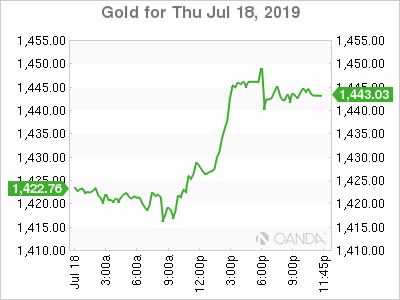
Commodities
Commodities are poised to benefit from global whirlwind of stimulus. The Fed is expected to deliver 75-basis point in cuts, the PBOC is expected to step up their efforts and possibly deliver RRR cuts, the ECB could resume cutting rates and restarting their bond buying program and the BOJ will extend their low interest rate pledge and support a government stimulus package later in the Fall. Gold has consolidated for much of the month, while silver has outperformed. Both precious metals are on the verge of major technical breakouts that could see significant momentum in the coming months.
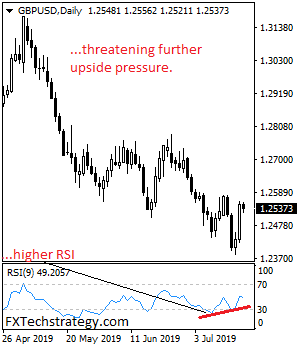
GBPUSD Corrective Bull Pressure Remains Intact
GBPUSD corrective bull pressure remains intact as we look for price extension. Support comes in at 1.2500 with a turn below that level shifting focus to the 1.2450 level. Further down, support resides at the 1.2400 level where a break will turn attention to the 1.2350 level. Further down, support lies at the 1.2300 level. On the upside, resistance stands at the 1.2550 with a turn above here allowing for additional strength to build up towards the 1.2600 level. Further out, resistance stands at the 1.2650 level followed by the 1.2700 level. On the whole, GBPUSD looks to recover further higher on correction.
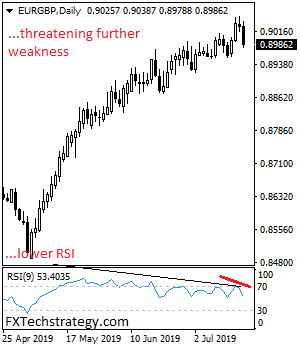
EURGBP Faces Price Sell-Off
EURGBP faces price selloff after rejecting higher prices on Wednesday. This development now leaves risk lower towards the 0.8950 zone. On the downside, support stands at the 0.8900 level where a violation will turn focus to the 0.8850 level. A break below here will aim at the 0.8800 level. Its daily RSI is bearish and pointing lower suggesting further weakness. Conversely, resistance lies at the 0.9050 level with a violation if seen turning risk towards the 0.9100 level. Further up, resistance comes in at 0.9150 level followed by the 0.9200 level. All in all, EURGBP remains biased to the downside on more weakness.
Eco Data 7/19/19
[php_everywhere instance="1"]
Fed Bullard: Trump moved trade uncertainty to front burner and thus an insurance cut is needed
In a CNN interview, St. Louis Fed President James Bullard said trade uncertainty used to be an issue that was on the "back burner". However, "the president moved it to the front burner". And now, "trade uncertainty is high and I don't see that declining anytime soon".
Bullard added that the economy is "slowing down" and warned "what if it slows more than we think, possibly because of a trade war?". A rate cut would "provide a bit of insurance against that".
Nevertheless, regarding a 50bps cut, Bullard said "I don't think we need to go that far" adding that "the critical thing here is to get inflation and inflation expectations better centered."
MARKET WRAP: Earnings Pulled Stocks Lower
*Netflix and MS pulled the markets lower *Gold maintained its level of 1400 despite some strong US economic data.
Stocks
- The S&P 500 continued to move lower on the back of weak earnings and gave up some of its gains from yesterday. It was down by 0.06% 15:31 London time.
- The UK 100 index moved lower despite a major news from the parliament in relation to Brexit. It lost 0.42%.
- The Stoxx 600 index lost further momentum today and dropped 0.05%.
Currencies
- The Dollar Spot Index retraced a little after important comments from the IMF and declined 0.03%.
- The Euro remained mostly flat but continued its downward trend. It traded at 1.1223 threatening the support level of 1.12.
- The British pound moved higher today as investors showed some optimism on Brexit. It moved higher 0.24% to $1.2422.
- The Japanese yen came back in power and gained 0.19% to 107.24 per dollar.
Bonds
- The yield on 10-year Treasuries continued to move higher and it gained one basis point to 2.06%.
- Germany’s 10-year yield weakened by one basis point to -0.23%.
- Britain’s 10-year yield fell by five basis points to 0.75
Commodities
- West Texas Intermediate crude moved lower despite heightened geopolitical tensions and sank 1.66% to $55.84 a barrel.
- Gold maintained its level of 1400 despite some strong US economic data. Price was down by 0.15% to $1,420 an ounce.
Sunset Market Commentary
Markets
Core bonds lose some ground today with US Treasuries underperforming. The Bund and US Note future treaded water in the opening stages of today’s session. The Bund set an intraday high around European noon after reports that the ECB is reviewing its inflation goal of “below, but close to 2% over the medium term.” The revamp would, according to sources, propose a symmetrical approach to the inflation target. The central bank might then keep monetary policy accommodative after a long period of below target inflation by allowing a temporary compensating inflation overshoot. The Bund’s uptick wasn’t met by follow-up buying. Core bonds even changed direction, with US Treasuries underperforming, following a stellar July Philly Fed Business Outlook. The indicator showed a similar rebound after a sharp June decline as the Empire Manufacturing Survey earlier this week. US yields increase by 1.8 bps (5-yr) to 3.1 bps (30-yr) at the time of writing. Changes on the German yield curve range between -1.4 bps (10-yr) and +0.2 bps (2-yr). Peripheral yield spreads vs Germany narrow by 3 bps (Spain) to 8 bps (Greece).
Today was expected to be a calm day for global (FX) trading. There were few data in the US and Europe. The day started in risk-off modus, but this risk off initially supported the euro and yen, not the dollar. Markets saw room for US yields to decline faster than core European yields. EUR/USD drifter higher to the 1.1240/45 area. USD/JPY dropped to the 108.65 area. At the end of the morning session, the gradual move on European interest rate and FX markets were unsettled by headlines that the ECB is studying a revamp of it policy framework (including its inflation targeting). Any conclusion is still far away, but markets concluded that policy stimulation could be cemented for even longer than what is already discounted. A less strict inflation target in theory is negative for the currency. EUR/USD dropped to 1.12 area. From there, some consolidation kicked as markets realized this is still a long and highly uncertain call. In an interview, US Treasury secretary Mnuchin said that there is no change in the dollar policy for now but that it could be considered in future. The comments were a bit too ambiguous to trigger a directional USD move. Remarkably, the dollar hardly profited from a very strong Philly Fed business outlook. EUR/USD is trading in the 1.1215/20 area. USD/JPY hovers just below 108.
Of late, sterling was on an almost persistent downward trajectory as investors feared the new UK PM could bring the country to a no-deal Brexit. Today the news flow turned a bit constructive and triggered a sterling short squeeze. Headlines from a BBC interview with EU Brexit negotiator Barnier suggested that the EU might be open to renegotiated the Irish backstop. Mid-morning the UK June retail sales also printed very strong at 1.0% M/M, reinforcing the sterling short squeeze. Later, the EU reaffirmed that the withdrawal agreement will not be renegotiated. However, the sterling rebound continued as the UK Parliament voted to support a measure to prevent the next PM suspending Parliament to facilitate a no deal Brexit. EUR/GBP dropped back below the 0.90 barrier (currently 0.8990 area). Cable rebounded to the high 1.24 area. Brexit noise will probably persist in the near future. Even so, the recent decline of sterling might be ready for a pause or could at least slow down.
News Headlines
Lega’s Salvini said today early elections are still possible after the Summer break, saying it is up to 5SM to decide whether the government would survive. Tensions between both coalition partners rose again after clashing on Wednesday over the election of Germany’s von der Leyen as president of the European Commission.
The South African central bank as expected slashed rates to 6.50% today. The SARB cut 2019 growth forecasts to 0.6% but beefed up estimates for 2020 (1.8%) and 2021 (2%). Inflation is expected at 4.4% this year (vs. 4.5% projected earlier), 5.1% in 2020 and 4.6% in 2021 with risks tilted to the upside. The South African rand advanced as some investors were betting on a 50 bps cut which governor Kganyago said was not discussed.