

Sample Category Title
AUD/USD Bounces Support Level
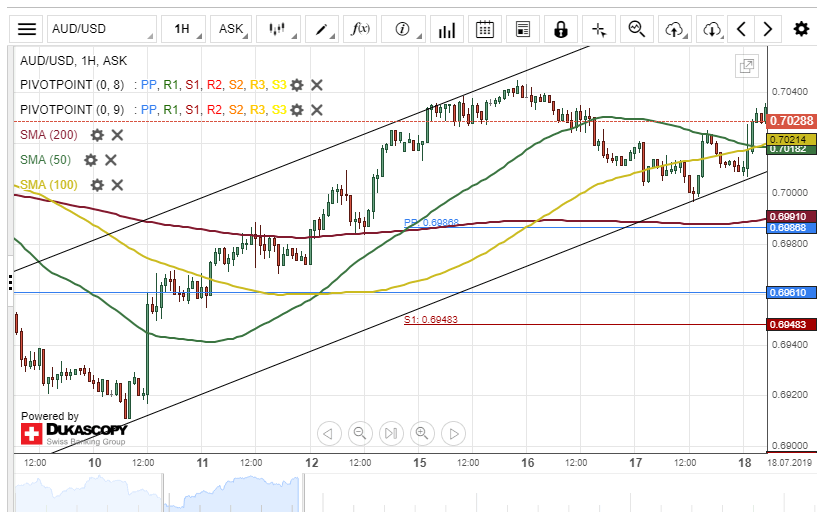
The Australian Dollar versus the US Dollar bounced off a psychological support level at 0.7000. The currency pair breached both the 50– and 100 –hour SMAs at 0.7019 during the morning hours of today's trading session.
As for the near future, it is likely that the AUD/USD exchange rate could continue to edge higher. The pair might aim for the upper boundary of an ascending channel pattern during the following trading session.
However, a resistance level formed by the weekly R1 at 0.7062 could hinder such movement today.
USD/CAD Stranded Between SMAs
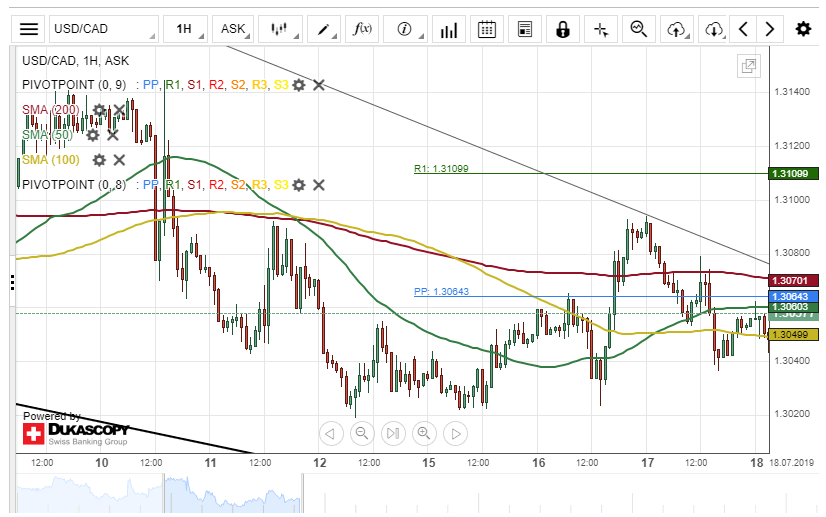
The US Dollar declined about 0.40% in value against the Canadian Dollar on Wednesday. The currency pair was pressured by the 200-hour simple moving average during yesterday's trading session.
The exchange rate was stranded between SMAs during the European trading session on Thursday. The 50-hour SMA at 1.3960 was providing resistance, while the 100-hour SMA was providing support for the pair at 1.3049.
By and large, a breakout could occur within this session. Most likely, the USD/CAD currency exchange rate will continue its southern movement during the following trading session.
NZD/USD Could Edge Higher
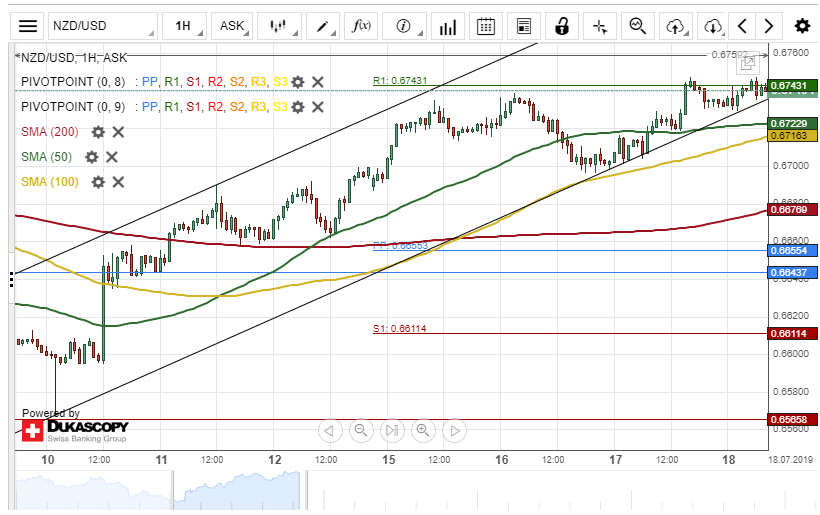
The New Zealand Dollar maintained the ascending channel pattern against the US Dollar on Wednesday. The currency pair appreciated about 47 base points during yesterday's trading session.
Given that the three SMAs are below the price level, it is likely that the exchange rate could continue to edge higher. The pair could aim for the weekly R2 at 0.6787 within this session.
A potential downside reversal could occur if the weekly R2 at 0.6787 holds during the following trading session.
EUR/USD Likely To Decline
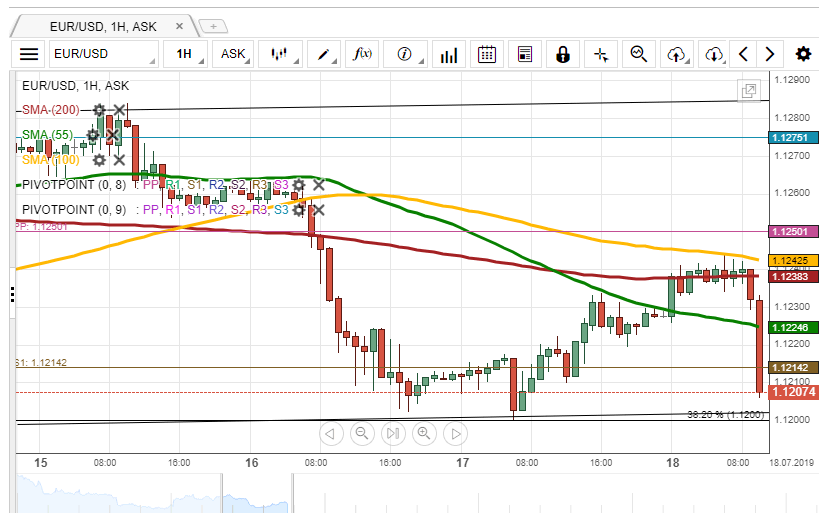
Yesterday, the EUR/USD currency pair reached the resistance formed by the 100– and 200-hour SMAs, located circa 1.1240. During Thursday's morning, the pair was testing it.
If the given moving averages hold, it is expected, that the exchange rate could reverse south in the nearest future. Note, that the rate could be supported by the 55-hour SMA, as well the weekly and monthly S1s in the 1.1214/1.1225 range.
It is unlikely, that bears could prevail in the market, and the pair could tumble lower than the 1.1200 mark due to the support formed by the Fibonacci 38.20% retracement and the lower boundary of the short-term ascending channel.
GBP/USD Tests Resistance Level
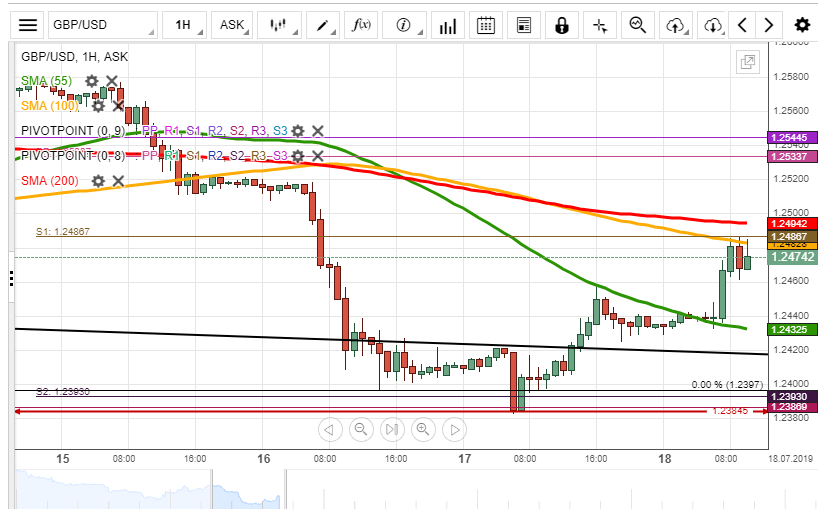
On Wednesday, the GBP/USD exchange rate reversed north from the descending trend line located at the 1.2393 mark. During today's morning, the rate was testing the resistance level formed by the 100– and 200-hour SMAs, as well the weekly S1 at 1.2487.
If the given resistance holds, it is expected, that the currency pair could reverse south. In this case, the pair has to surpass the 55-hour SMA, currently located at the 1.2432 mark.
Otherwise, it is likely, that the rate could maintain its growth. In this case, the pair could reach the resistance level formed by the weekly PP and the monthly S1 located circa the 1.2540 mark.
USD/JPY Revealed Descending Trend
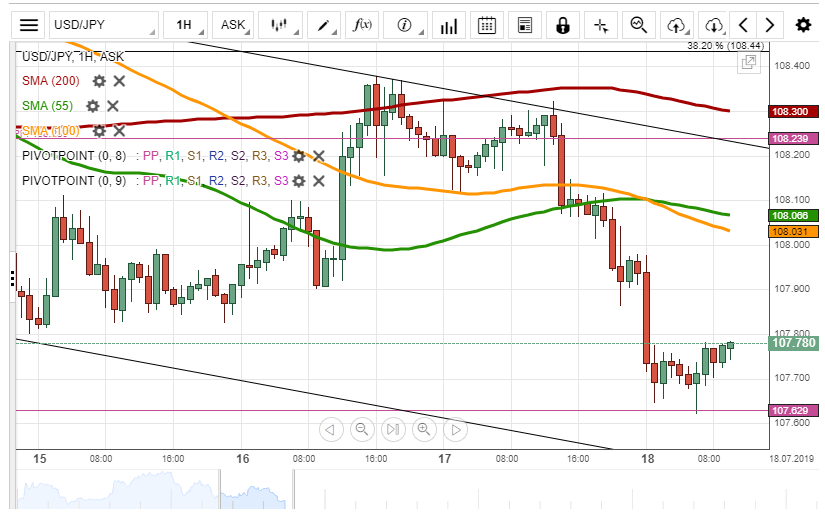
Yesterday, the USD/JPY currency pair tumbled to the 107.70 level. During Thursday's morning, the pair was trading at the given level.
On the one hand, the exchange rate could continue to go downwards, as it could target the lower boundary of the short-term descending channel located circa the 107.50 mark.
On the other hand, the pair could reverse north within the following trading hours. Note, that the rate has to surpass the monthly PP at 107.84. Also, it is unlikely, that the pair could jump higher than 108.10 due to the resistance of the 55– and 100-hour SMAs.
XAU/USD Might Decline
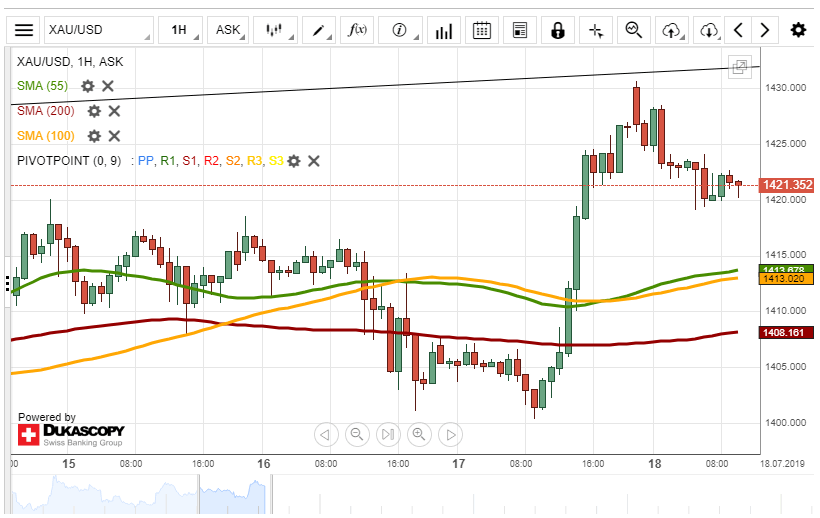
During the previous trading session, the XAU/USD exchange rate skyrocketed to the upper boundary of the short-term ascending channel at 1,431.00. During today's morning, the rate reversed south.
From a theoretical point of view, it is expected, that the price for gold could continue to decline. A possible downside target is the support cluster formed by the 55-, 100– and 200-hour SMAs, currently located in the 1,408.16/1,413.12 range.
On the other hand, the exchange rate could reverse north to re-test the upper channel line. It is unlikely, that the rate could exceed the 1,435.00 mark due to the upper boundary of the long-term ascending channel.
Japan Reduces Reliance To First Trade Partner
Trade data are here to confirm it: the dependence to China's exports is weighing on the Japanese manufacturing industry. In decline territory for the fourth straight month, exports to China dropped 10.1% in June, confirming a slowing Chinese economy following the release of 2Q GDP figure of 6.20% (prior: 6.40%), a 27 years low. Although the release of Japan's 2Q GDP is not expected before 9 August 2019, quarters-on-quarter data forecasts are pointing towards a fall between neutral to shrinkage of -0.20% (1Q: 0.60%). Yet the progressive improvement of trade with the US confirms that a US and Japan trade deal is nearing. JPY appreciation potential is high as global trade tensions concerns continue to boost demand for safe haven assets.
Japan's trade balance is down 19% to JPY 589.5 billion ($5.46 billion), with total exports falling 6.70% (prior: -7.80%), a seventh consecutive slump while imports came at -5.20% (prior: -1.50%). Therefore, the decline is mainly driven by Asian countries, including China whose demand for chip making and electronic equipment decreased by over 20%. Yet the continued appreciation of trade exports to the US to 4.80% in June (prior: 3.30%), a nine straight increase, confirms that both trade partners are ramping up trade talks. Indeed, since Donald Trump's state visit in Japan in May and threat of slapping tariffs of 25% on imported Japanese cars, both sides have been working on the opening of Japanese markets (i.e. agriculture imports) and reducing tariffs on Japanese auto parts, a solid win for Japanese automakers and US farmers. If a deal is found in September, when both President Donald Trump and Prime Minister Shinzo meet in New York, attention will turn to China, which will remain under pressure amid dragging trade talks with the US and improving bilateral trade conditions of its two largest business partners.
USD/JPY is currently trading at 107.77, approaching 108 short-term.
AUD Firms After Soft Employment Data
Australia's employment data for June came out and were characterised as quite soft. The unemployment rate remained unchanged at 5.2%, while the employment change figure dropped to a merely 0.5k. Never the less, analysts pointed out that the data may be soft yet the picture of the Australian market provided may not be dramatic enough for the RBA to provide further stimulus yet. The AUD experienced a slight positive effect, rising over the USD around 20 pips upon release. We could see the AUS/USD maintaining a sideways motion for the time being, however bullish tendencies could occur as a possible rate cut by the RBA seems to be postponed. AUD/USD bounced on the 0.7000 (S1) support line and maintained bullish tendencies especially after the release of the Australian employment data for June as another uncertainty was lifted from the AUD. We expect the AUD to maintain a sideways movement in the next days. It should be noted that there are indications of an upward trendline starting to form, yet, we would require more higher troughs and higher peaks, before switching in favour of a bullish bias. Should the bulls dictate the pair's direction, we could see the pair breaking the 0.7065 (R1) resistance line and aim for the 0.7115 (R2) resistance barrier. Should the bears take over, we could see the pair breaking the 0.7000 (S1) support line and aim for the 0.6925 (S2) support hurdle.
Bitcoin stabilises above 9350
Prices of Bitcoin and other major cryptocurrencies stabilized yesterday at some point showed even some bullish tendencies. The cryptocurrency's price action occurred despite US lawmakers grilling Facebook's crypto executive David Marcus. It was characteristic that US lawmakers asked for Facebook to agree to a moratorium before the issuing of Libra, so that the necessary regulations are enforced, yet Facebook's executive did not respond clearly. However it's not only the US authorities that are worried about Libra. The G7 meeting seems also to be in favor of regulatory problems being addressed first before Libra is launched. It was characteristic that the French finance minister stated that “the sovereignty of nations cannot be jeopardized”, according to media. We expect Bitcoin to remain under pressure, yet we tend to note that the cryptocurrency seems to have settled around the same flats when the whole story with Libra began mid-June. Bitcoin failed to clearly break the 9350 (S1) support line, practically bouncing on it. It should be noted that the price action has reached an almost 1 month low yesterday. We expect the cryptocurrency to maintain a sideways movement in the next days. It should be noted that there are indications of an upward trendline starting to form, yet, we would require more higher troughs and higher peaks, before switching in favour of a bullish bias. Should bitcoin come under the selling interest of the market, we could see it breaking the 9350 (S1) support line and aim for the 9680 (S2) support level. Should the cryptocurrencies long positions be favored, we could see Bitcoin's price action breaking the 10200 (R1) resistance lines, in search for higher grounds.
Other economic highlights, today and early tomorrow
Today, during the European session, we get UK's retail sales growth rates for June, while in the American session, we get from the US the Phille Fed Business Index for July. In tomorrow's Asian session, Japan's inflation rates are to be released. As for speakers Atlanta Fed president Bostic and NY Fed president Williams are scheduled to speak.
AUD/USD H4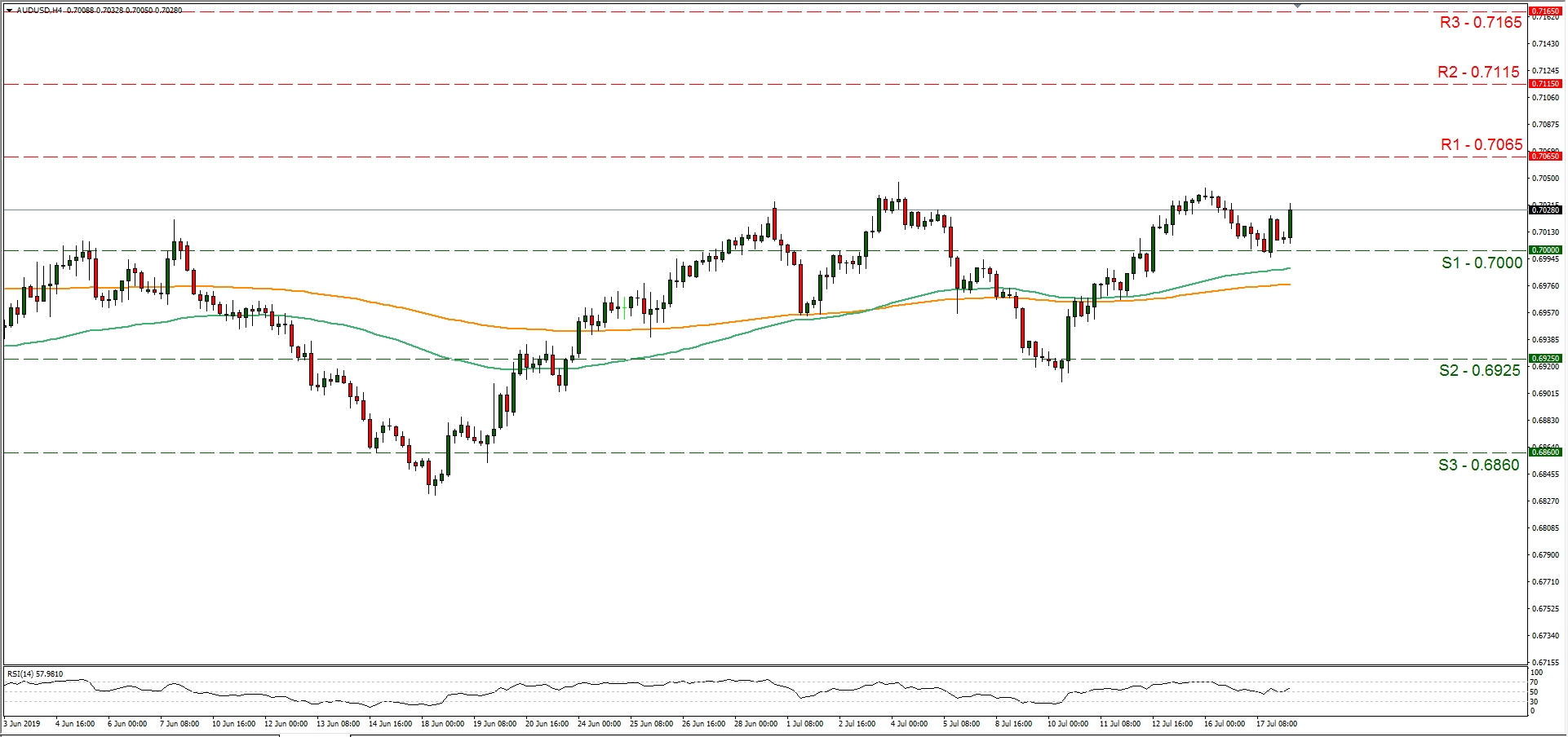
Support: 0.7000 (S1), 0.6925 (S2), 0.6860 (S3)
Resistance: 0.7065 (R1), 0.7115 (R2), 0.7165 (R3)
Bitcoin H4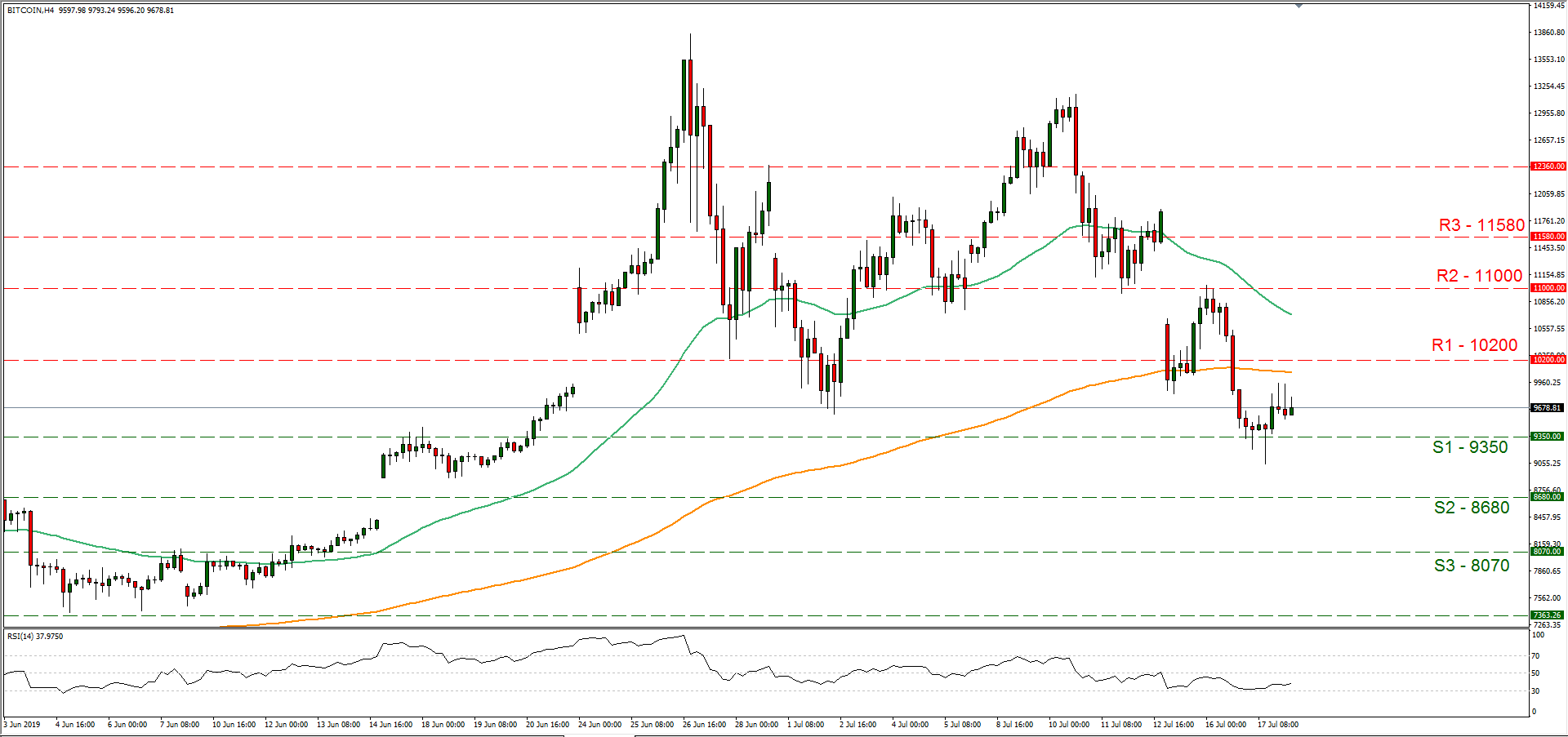
Support: 9350 (S1), 8680 (S2), 8070 (S3)
Resistance: 10200 (R1), 11000 (R2), 11580 (R3)
The Dollar Index Index Has Moved From Local Highs
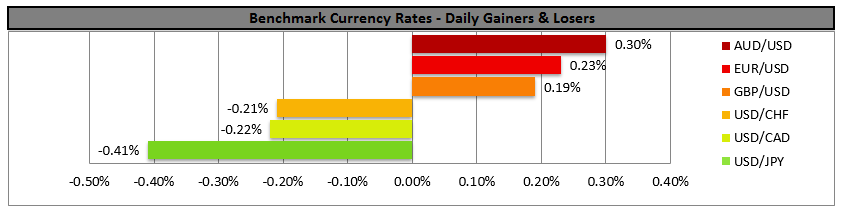
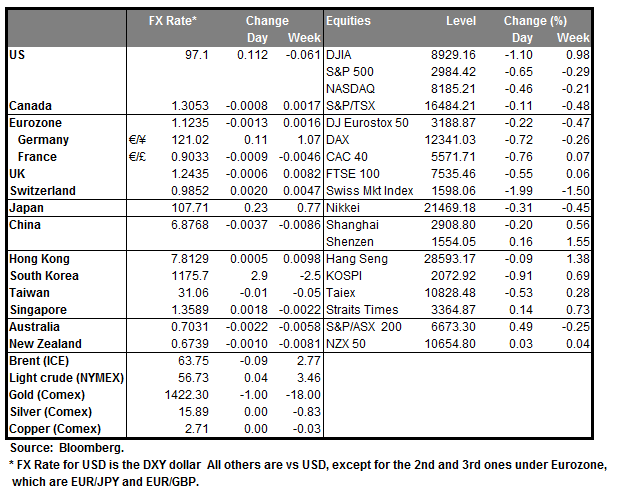
The US dollar is falling against a basket of major currencies amid weak economic reports, as well as a sharp drop in US government bond yields. Thus, the number of building permits issued in June fell to 1,220M instead of the forecasted value of 1,300M. The Fed's Beige Book was also published yesterday, having stated that the growth rate of economic activity in the United States remained modest. The yield of 10-year US government bonds has updated weekly lows. The pressure on the US currency is also put by prolonged trade negotiations between the United States and China. The US dollar index (#DX) closed yesterday in the red zone (-0.19%).
The British pound has recovered some losses against the US dollar. This movement is caused largely by technical factors. Investors have begun to partially fix positions on the pound after a long fall. Optimistic data on retail sales in the UK in June supports the pound. Financial market participants expect new information on Brexit. Earlier, the EU coordinator at the Brexit talks, Michel Barnier, noted that Britain would face serious consequences if it decided to break ranks with the EU.
The single currency has updated local highs against the US dollar. Yesterday, the consumer price index in the eurozone was published, the figure of which was 1.3% in June instead of 1.2%.
Also in the Asian trading session weak data on the labor market in Australia were published. Thus, the level of employment rose in June by only 0.5K instead of the forecasted value of 9.1K.
The "black gold" prices show a negative trend. At the moment, the WTI crude oil inventories are testing $56.65 a barrel.
Market Indicators
- Yesterday, the bearish sentiment was observed in the US stock markets: #SPY (-0.66%), #DIA (-0.42%), #QQQ (-0.49%).
- The yield on 10-year US government bonds fell significantly. Currently, the indicator is at the level of 2.04-2.05%.
The news feed 2019.07.18:
- The number of initial jobless claims in the US at 15:30 (GMT+3:00);
- Philadelphia Fed Manufacturing Index at 15:30 (GMT+3:00).