Sample Category Title
Fed To Cut Rates By 25Bp Or 50Bp On 31 July?
Market movers today
The data calendar brings no tier 1 releases in today's session. Hence, primary market focus will remain on the earnings season, resurfacing trade war concerns and, not least, FOMC speakers with the Fed's Bullard and Rosengreen set to speak today (see below).
Selected market news
Market sentiment turned swiftly positive yesterday as prominent FOMC board members of the New York Fed, Williams and Vice Chair Clarida, delivered very soft remarks highlighting the need for swift action before economic data actually turns for the worse. The remarks at first seemed very coordinated, driving a weaker USD, a drop in front US yields and a sharp rally in the August Fed funds futures, essentially leaving market pricing skewed towards a 50bp July cut rather than the consensus 25bp cut. Meanwhile, this morning, the New York Fed stressed that Williams had not tried to send a specific policy signal, leading to a rebound of more than half the initial drop in US 2Y swap rates, even if the USD FX gains were more modest with EUR/USD, for example, staying around 1.1260.
Where does this leave us in terms of the Fed and the forthcoming 31 July meeting? Yesterday's remarks were highly surprising given the Fed's communication earlier this week that seemed to want to limit market pricing of a 50bp July cut. Meanwhile, with little time until the one-week silent period, markets now have a 25bp July cut at 60% and a 50bp cut at 40% probability. We know that historically the Fed has not wanted to surprise markets at the meetings, leaving the coming sessions' FOMC comments crucial. For now, our call remains a 25bp cut at the 31 July meeting and an additional 50bp worth of cuts for the rest of the year. However, we must acknowledge the probability of this call getting modified towards a more aggressive July call if we get further very soft Fed remarks.
A Bloomberg story yesterday suggested that informal analysis has begun at the ECB about a potential revamp of the inflation target. This mirrors a discussion the Governing Council already started at the June meeting about the need to adopt a more "symmetrical" interpretation of the inflation target, i.e. where the ECB would tolerate inflation above the target to compensate for persistent undershooting in recent years. Although we think such a switch to a more state-dependent and less calendar-based forward guidance could help alleviate the risk of de-anchoring inflation expectations, as it strengthens the easing bias, we do not see such changes as imminent - and is also highly dependent on whether the markets believe the ECB could achieve an overshooting. For now, the ECB's prime focus should be on delivering a convincing easing package at the September meeting. Nevertheless, it could be the advent of a discussion that gains further traction under a Lagarde-led ECB.
Yesterday in the UK, a majority in the House of Commons passed an amendment making it harder for the government to prorogue Parliament in the run-up to the current Brexit date of 31 October. While this does not prevent a no deal Brexit outcome (it is still the default option from a legal point of view), it makes it more difficult for Boris Johnson (assuming he wins the leadership contest) to force a no deal Brexit through by sending Parliament home. Some 17 Conservative rebels voted against their own government (which did not include politicians such as Phillip Hammond), supporting our view that it is hard to find a majority for a no deal Brexit outcome. As we have highlighted several times, we may soon have a more pro-Brexit prime minister but it does not change the arithmetic in the Commons.
USD/JPY Bears Lose Control At 78.6% Fibonacci
The USD/JPY long-term direction could soon be decided. The breakout direction will be the decisive factor whether the price will enter into a long-term up or downtrend. For the moment, the current wave outlook is favoring the end of the wave 2 (pink) at the 78.6% Fibonacci retracement level after a bearish ABC (purple) pattern. A break above the resistance trend lines (red) could confirm that where a break below the 100% Fibonacci of wave 2 vs 1 invalidates this forecast.
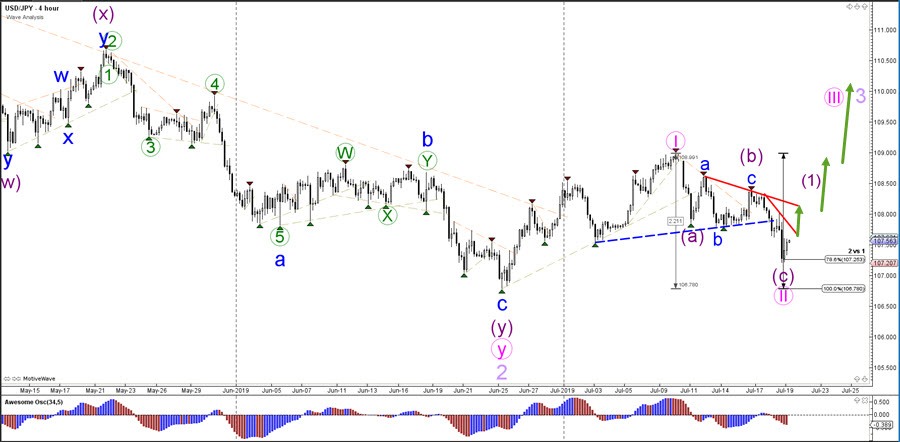
The USD/JPY seems to have completed 5 bearish waves (blue) at the most recent low, which in turn could complete wave C (purple) of wave 2 (pink). Currently, price action seems to be confirming a first bullish impulse (green waves) within a wave 1 (blue). If the price does complete 5 bullish waves, then an ABC retracement is likely to take place as part of a bearish correction in a wave 2.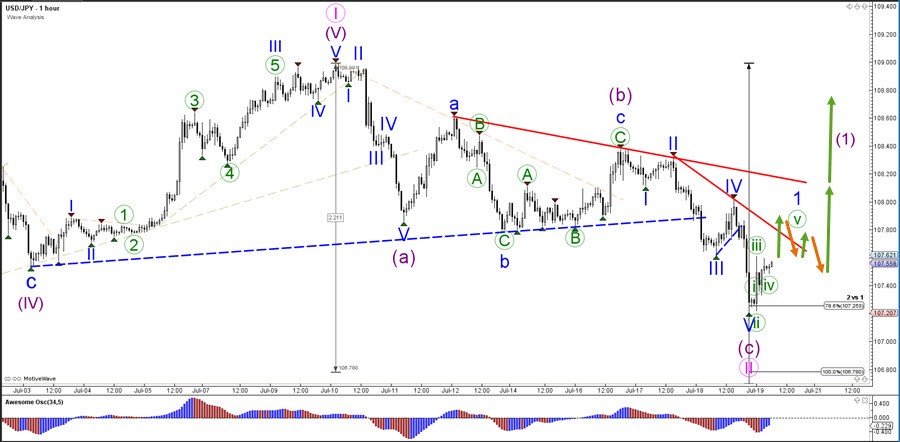
Chart Of The Day/ S&P 500 Futures (ES_F) Elliott Wave View: Correction Ended
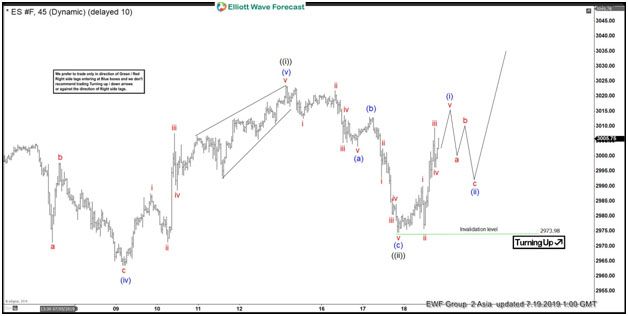
Elliott wave view in S&P 500 Futures (ES_F) shows a bullish sequence from December 26, 2018 low favoring the further upside. In the short-term chart below, the index ended the 5 waves rally from 6/13/2019 low within wave ((i)) at $3023.50 high. Down from there, the index corrected the rally from 6/13/2019 low in wave ((ii)) & made a 3 swings pullback. The pullback from the peak unfolded as Elliott wave zigzag structure where wave (a) ended the first leg in lesser degree 5 waves at $3003.25 low.
Up from there, wave (b) bounce ended at $3013 high. Wave (c) ended at $2974.76 low with another lesser degree 5 waves. Therefore completed the correction in wave ((ii)) pullback. However, a break above $3023.50 high seen at 7/15/2019 peak will remain to be seen to validate this bullish view & to avoid double correction lower from the peak. Above from $2974.76 low, the index is looking to extend higher 1 more push higher to become 5 waves impulse rally in wave (i). Afterwards, the index is expected to see a shorter-term pullback against $2974.76 low in 3, 7 or 11 swings within wave (ii) before more upside can be seen. We don’t like selling the index and a potential target from December 26, 2018 low will remain at 3377 – 3529 area to the upside.
ES_F 1 Hour Elliott Wave Chart
Euro Extends Its Gains In The Morning Session
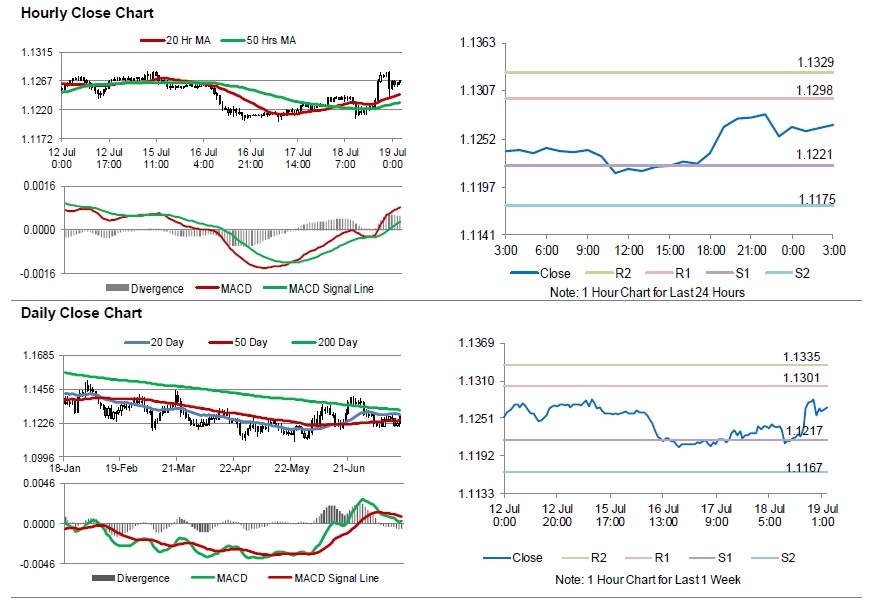
For the 24 hours to 23:00 GMT, the EUR rose 0.25% against the USD and closed at 1.1255.
In the US, data showed that the Philadelphia Fed manufacturing index climbed to a 1-year high level of 21.8 in July, surpassing market consensus for a rise to a level of 5.0. In the previous month, the index had recorded a level of 0.3. On the other hand, the nation’s leading indicator unexpectedly slid 0.3% on a monthly basis in June, declining to its lowest level since 2016 and defying market expectations for an advance of 0.1%. In the preceding month, the indicator had recorded a flat reading. Moreover, the US seasonally adjusted initial jobless claims rose to a level of 216.0K in the week ended 13 July 2019, in line with market anticipations and compared to a revised level of 208.0K in the prior week.
In the Asian session, at GMT0300, the pair is trading at 1.1268, with the EUR trading 0.12% higher against the USD from yesterday’s close.
The pair is expected to find support at 1.1221, and a fall through could take it to the next support level of 1.1175. The pair is expected to find its first resistance at 1.1298, and a rise through could take it to the next resistance level of 1.1329.
Looking forward, traders would keep an eye on Germany’s producer price index for June and Euro-zone’s current account balance for May, slated to release in a few hours. Later in the day, the US Michigan consumer sentiment index for July, will pique significant amount of investors’ attention.
The currency pair is trading above its 20 Hr and 50 Hr moving averages.
AUD/USD Daily Outlook
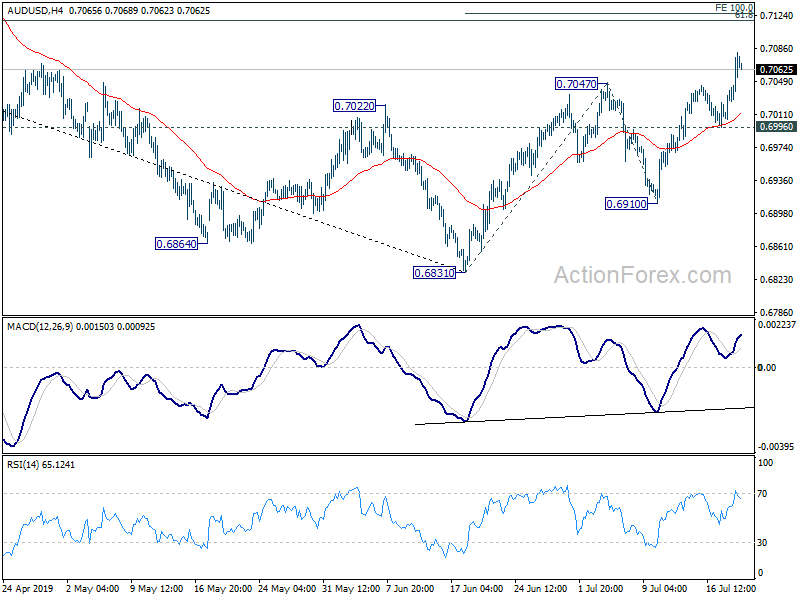
Daily Pivots: (S1) 0.7029; (P) 0.7053; (R1) 0.7100; More...
AUD/USD's rebound from 0.6831 resumed by taking out 0.7047 and reaches as high as 0.7082 so far. Intraday bias is back on the upside for 61.8% retracement of 0.7295 to 0.6831 at 0.7118, and possibly to 100% projection of 0.6831 to 0.7047 from 0.6910 at 0.7126. Sustained break there will indicate solid upside momentum for 0.7205 resistance next. ON the downside, break of 0.6996 will suggest that the rebound has completed and turn bias to the downside for 0.6910 support instead.
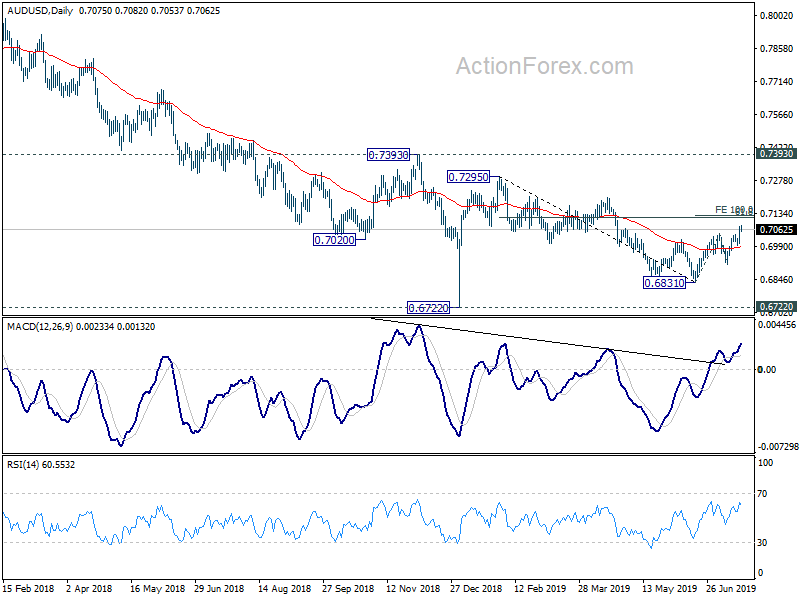
In the bigger picture, with 0.7393 key resistance intact, medium term outlook remains bearish. The decline from 0.8135 (2018 high) is seen as resuming long term down trend from 1.1079 (2011 high). Decisive break of 0.6826 (2016 low) will confirm this bearish view and resume the down trend to 0.6008 (2008 low). However, firm break of 0.7393 will argue that fall from 0.8135 has completed. And corrective pattern from 0.6826 has started the third leg, targeting 0.8135 again.
UK’s Retail Sales Surprisingly Advanced In June
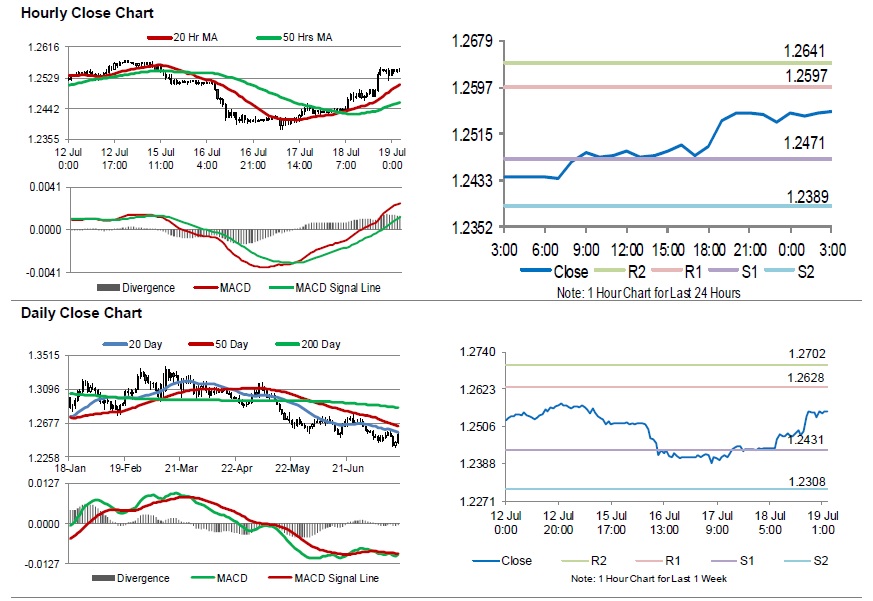
For the 24 hours to 23:00 GMT, the GBP rose 0.82% against the USD and closed at 1.2535.
On the data front, UK's retail sales unexpectedly rose 1.0% on a monthly basis in June, defying market expectations for a fall of 0.3%. In the prior month, retail sales had recorded a revised drop of 0.6%.
In the Asian session, at GMT0300, the pair is trading at 1.2554, with the GBP trading 0.15% higher against the USD from yesterday's close.
The pair is expected to find support at 1.2471, and a fall through could take it to the next support level of 1.2389. The pair is expected to find its first resistance at 1.2597, and a rise through could take it to the next resistance level of 1.2641.
Trading trend in the Sterling today, is expected to be determined by UK's public sector net borrowing for June, scheduled to release in a few hours.
The currency pair is trading above its 20 Hr and 50 Hr moving averages.
Dollar Dives as Dovish Fedspeaks Reinforce Rate Cut Bets
Dollar stabilizes in Asian session after steep decline overnight. Bets on Fed's rate cut this month jumped after dovish comments from some key Fed officials. It seems that Fed might choose not to listen to the solid economic data released recently, but opt for the path of insurance. Treasury yield also tumbled notably. Gold rides on the greenback's weakness and breaks 1440 handle.
Staying in the currency markets, Dollar is indeed not the worst performing one for the week so far. But Sterling is the weakest, followed by Euro and the Canadian. New Zealand Dollar is the strongest for the week, followed by Australian and the Yen. But the picture could still change before weekly close.
Technically, AUD/USD's break of 0.7047 resistance confirmed resumption of rise from 0.6831 for 0.7118 fibonacci level next. USD/CAD breached 1.3018 temporary low but couldn't sustain below 1.3052/68 cluster support yet, probably waiting for Canadian retail sales. EUR/USD is stuck in range of 1.1193/1285 despite yesterday's rebound, keeping near term outlook neural. GBP/USD is also held below 1.2579 resistance so far, keeping near term outlook bearish.
In Asia, major stock markets surge on expectations of Fed cut. Nikkei is up 1.96%. Hong Kong HSI is up 1.07%. China Shanghai SSE is up 0.77%. Singapore Strait Times is up 0.38%. Japan 10-year JGB yield is up 0.0023 at -0.133. Overnight, DOW rose 0.01%. S&P 500 rose 0.36%. NASDAQ rose 0.27%. 10-year yield dropped -0.023 to 2.038.
Bet on 50bps Fed cut surged after New York Fed Williams' comments
Dollar tumbled broadly as markets took New York Fed President John William's speech as indication of aggressive rate cut in the upcoming FOMC meeting on July 31. Fed fund futures now indicate 46.2% chance of -50bps cut, comparing to 34.3% a day ago and 19.9% a week ago. Overall, markets are still pricing 100% chance of easing then.
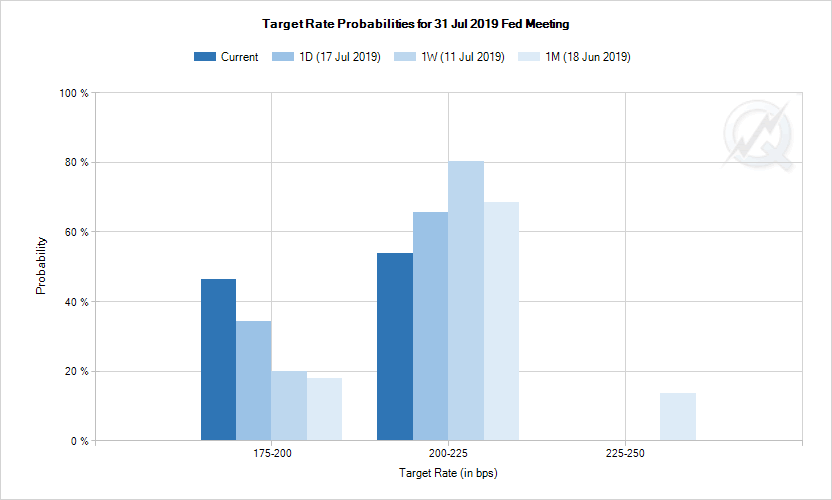
Williams said in a speech "Living Life Near the ZLB" (Zero Lower Bound), that when interest rates are in the vicinity of the ZLB, policymakers shouldn't "keep your powder dry". That is, they should "move more quickly to add monetary stimulus" to "vaccinate against further ills".
Also, he said "it's better to take preventative measures than to wait for disaster to unfold". And, "when you only have so much stimulus at your disposal, it pays to act quickly to lower rates at the first sign of economic distress."
Later, in an unusual step, a New York Fed spokesperson "clarified" Williams' comments. She said, "this was an academic speech on 20 years of research. It was not about potential policy actions at the upcoming FOMC meeting."
Fed Clarida: Don't wait until data turns decisively before cutting rates
Fed Vice Chair Richard Clarida also reinforced Williams' dovish comments. Clarida told Fox Business Network that "you don't need to wait until things get so bad to have a dramatic series of rate cuts." And, "you don't want to wait until data turns decisively if you can afford to."
Clarida reiterated that the US economy is "in a good place". But "we've had mixed data" and "disinflationary pressures, if anything, are more intense than I thought six weeks ago." He added, "we need to make a decision based on where we think the economy may be heading and, importantly, where the risks to the economy are lined up."
Fed Bullard: Trump moved trade uncertainty to front burner and thus an insurance cut is needed
In a CNN interview, St. Louis Fed President James Bullard said trade uncertainty used to be an issue that was on the "back burner". However, "the president moved it to the front burner". And now, "trade uncertainty is high and I don't see that declining anytime soon".
Bullard added that the economy is "slowing down" and warned "what if it slows more than we think, possibly because of a trade war?". A rate cut would "provide a bit of insurance against that".
Nevertheless, regarding a 50bps cut, Bullard said "I don't think we need to go that far" adding that "the critical thing here is to get inflation and inflation expectations better centered."
Japan CPI core slowed to 0.6%, lowest since July 2017
Japan CPI core (ex-fresh food) slowed to 0.6% yoy in June, down from 0.8% yoy and matched expectations. All items CPI was unchanged at 0.7% yoy, while CPI core-core (ex-fresh food and energy) was also unchanged at 0.5% yoy.
CPI core was the lowest reading since July 2017. No turnaround is expected in the near term. Instead, CPI core could be further dragged down by policy related factors, including mobile phone charges and education costs.
The dim inflation outlook highlights the pressure for BoJ to ramp up monetary stimulus. In particular, both Fed and ECB are expected to loosen up policy again later this week.
Looking ahead
Germany PPI, Eurozone current account and UK public sector net borrowing will be released in European session. Canada will release retail sales. US will release U of Michigan sentiment.
AUD/USD Daily Outlook
Daily Pivots: (S1) 0.7029; (P) 0.7053; (R1) 0.7100; More...
AUD/USD's rebound from 0.6831 resumed by taking out 0.7047 and reaches as high as 0.7082 so far. Intraday bias is back on the upside for 61.8% retracement of 0.7295 to 0.6831 at 0.7118, and possibly to 100% projection of 0.6831 to 0.7047 from 0.6910 at 0.7126. Sustained break there will indicate solid upside momentum for 0.7205 resistance next. ON the downside, break of 0.6996 will suggest that the rebound has completed and turn bias to the downside for 0.6910 support instead.
In the bigger picture, with 0.7393 key resistance intact, medium term outlook remains bearish. The decline from 0.8135 (2018 high) is seen as resuming long term down trend from 1.1079 (2011 high). Decisive break of 0.6826 (2016 low) will confirm this bearish view and resume the down trend to 0.6008 (2008 low). However, firm break of 0.7393 will argue that fall from 0.8135 has completed. And corrective pattern from 0.6826 has started the third leg, targeting 0.8135 again.
Economic Indicators Update
| GMT | Ccy | Events | Actual | Forecast | Previous | Revised |
|---|---|---|---|---|---|---|
| 23:30 | JPY | National CPI Core Y/Y Jun | 0.60% | 0.60% | 0.80% | |
| 4:30 | JPY | All Industry Activity Index M/M May | 0.30% | 0.30% | 0.90% | 0.80% |
| 6:00 | EUR | German PPI M/M Jun | -0.10% | -0.10% | ||
| 6:00 | EUR | German PPI Y/Y Jun | 1.50% | 1.90% | ||
| 8:00 | EUR | Eurozone Current Account (EUR) May | 21.2B | 20.9B | ||
| 8:30 | GBP | Public Sector Net Borrowing (GBP) Jun | 3.4B | 4.5B | ||
| 12:30 | CAD | Retail Sales M/M May | 0.30% | 0.10% | ||
| 12:30 | CAD | Retail Sales Ex Auto M/M May | 0.40% | 0.10% | ||
| 14:00 | USD | U. of Mich. Sentiment Jul P | 98.6 | 98.2 |
Japan’s Inflation Advanced As Estimated In June
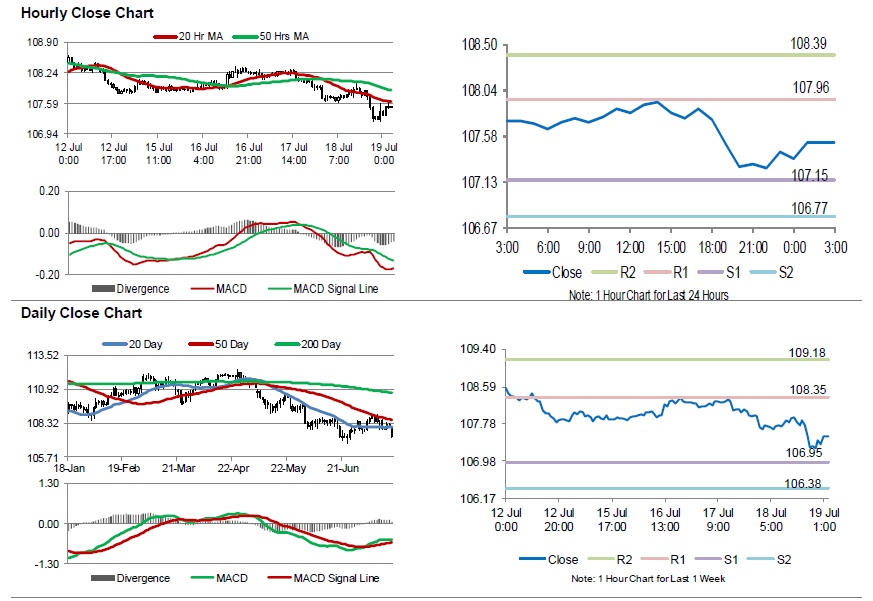
For the 24 hours to 23:00 GMT, the USD declined 0.50% against the JPY and closed at 107.42.
In the Asian session, at GMT0300, the pair is trading at 107.52, with the USD trading 0.09% higher against the JPY from yesterday's close.
Overnight data indicated that Japan's consumer price index (CPI) climbed 0.7% on an annual basis in June, meeting market expectations. The CPI had registered a similar rise in the prior month.
The pair is expected to find support at 107.15, and a fall through could take it to the next support level of 106.77. The pair is expected to find its first resistance at 107.96, and a rise through could take it to the next resistance level of 108.39.
In absence of key economic releases in Japan today, investor sentiment would be determined by global macroeconomic events.
The currency pair is trading below its 20 Hr and 50 Hr moving averages.
Switzerland’s Trade Surplus Expanded In June
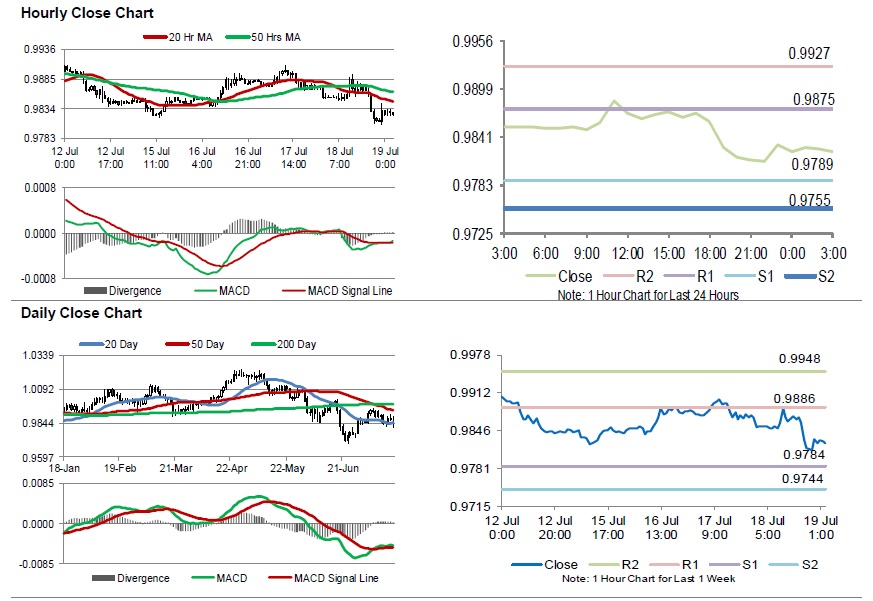
For the 24 hours to 23:00 GMT, the USD declined 0.42% against the CHF and closed at 0.9831.
In economic news, Switzerland's seasonally adjusted trade surplus widened to CHF3.25 billion in June, from a revised surplus of CHF1.52 billion in the prior month.
In the Asian session, at GMT0300, the pair is trading at 0.9824, with the USD trading 0.07% lower against the CHF from yesterday's close.
The pair is expected to find support at 0.9789, and a fall through could take it to the next support level of 0.9755. The pair is expected to find its first resistance at 0.9875, and a rise through could take it to the next resistance level of 0.9927.
With no macroeconomic releases in Switzerland today, investors would look forward to global macroeconomic releases for further direction.
The currency pair is trading below its 20 Hr and 50 Hr moving averages.
Loonie Trading On A Positive Footing In The Asian Session
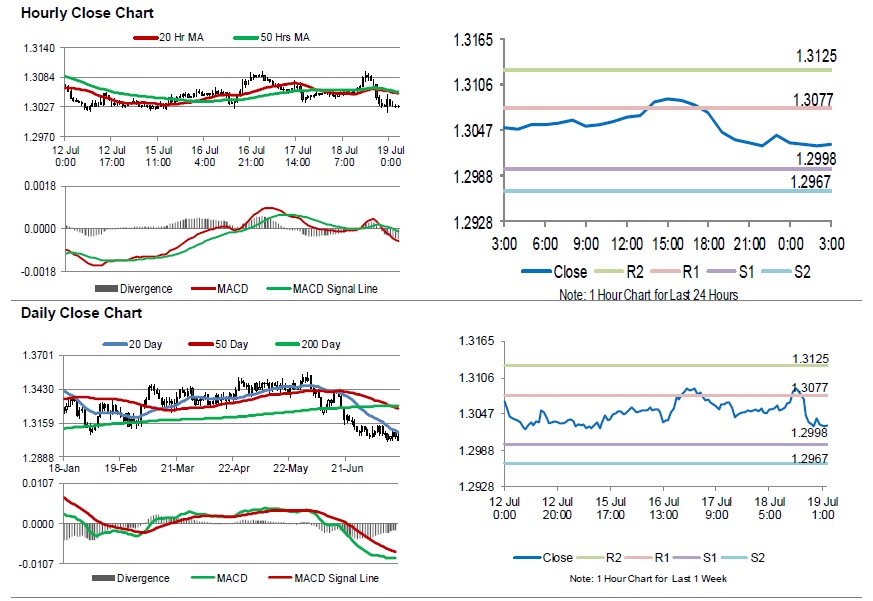
For the 24 hours to 23:00 GMT, the USD declined 0.10% against the CAD and closed at 1.3040.
In the Asian session, at GMT0300, the pair is trading at 1.3028, with the USD trading 0.09% lower against the CAD from yesterday’s close.
The pair is expected to find support at 1.2998, and a fall through could take it to the next support level of 1.2967. The pair is expected to find its first resistance at 1.3077, and a rise through could take it to the next resistance level of 1.3125.
Going ahead, investors would closely monitor Canada’s retail sales for May, slated to release later in the day.
The currency pair is trading below its 20 Hr and 50 Hr moving averages.