

Sample Category Title
GBPUSD Soft Bounce
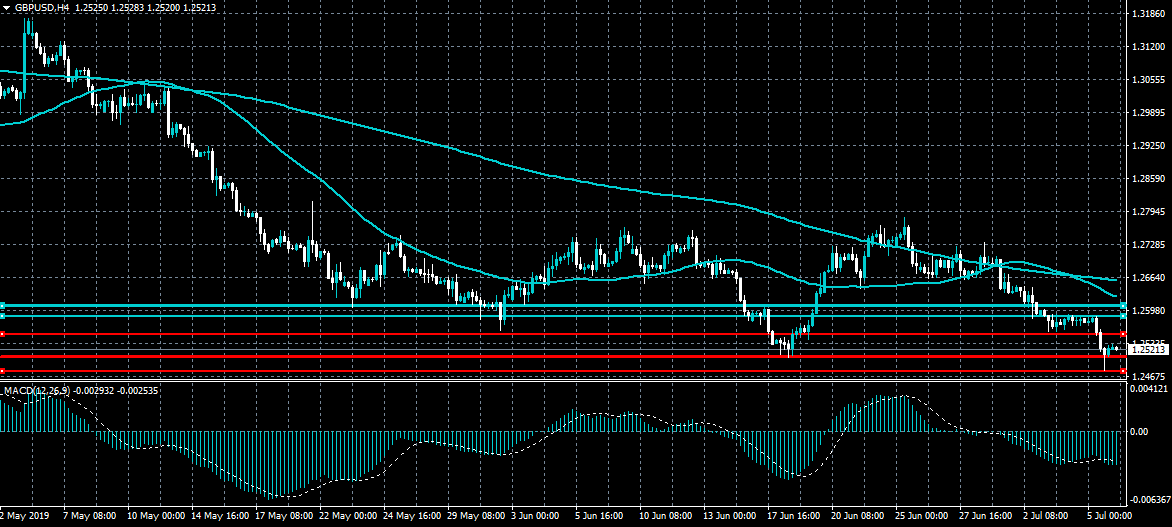
The British pound is attempting to recover above the 1.2500 level against the US dollar, after finding interim support from the 1.2480 level on Friday. The bullish inverted head and shoulders pattern has been invalidated on the lower time frames, although the multi-year low around the 1.2430 remains unbroken. The 1.2505 level is now the key daily and weekly pivot point to watch for the GBPUSD pair.
The GBPUSD pair is heavily bearish while trading below the 1.2505 level, key support is found at the 1.2480 and 1.2445 levels.
GBPUSD pair is only bullish while trading above the 1.2570 level, key resistance is found at the 1.2610 and 1.2660 levels.
EURUSD 1.1255 Key Pivot
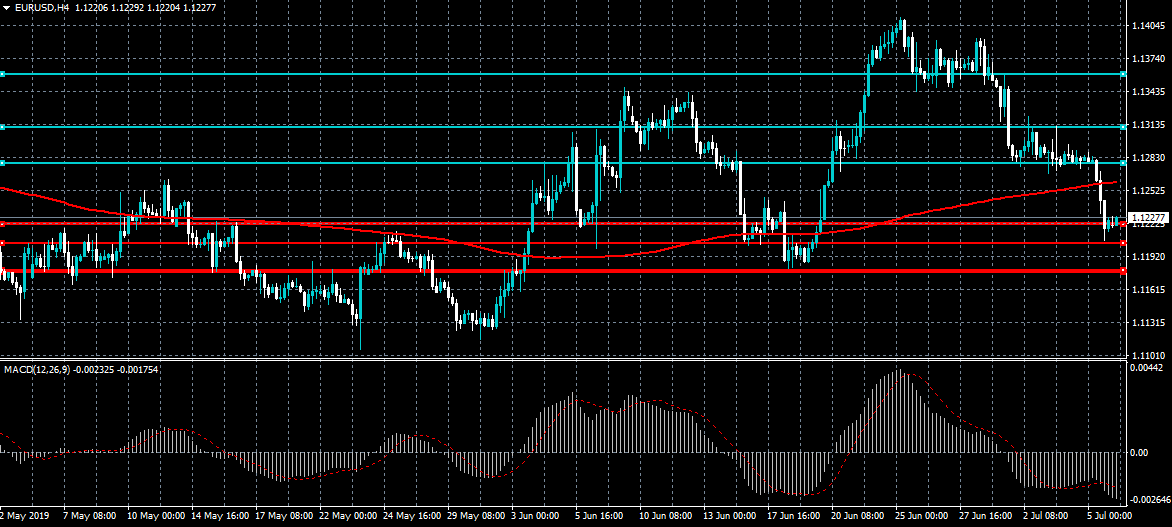
The euro has opened the new trading week with a bearish tone against the US dollar, following the strong Non-farm payrolls headline number last Friday. EURUSD sellers need to breach the 1.1205 level, while bulls need to move price back above the 1.1255 level encourage technical buying. A sustained move below the 1.1205 support level would be extremely bearish for the EURUSD.
The EURUSD pair is only bullish while trading above the 1.1255 level, key technical resistance is found at the 1.1280 and 1.1310 levels.
If the EURUSD pair trades below the 1.1205 level, key support is found at the 1.1170 and 1.1135 levels.
BTCUSD Awaiting Confirmation
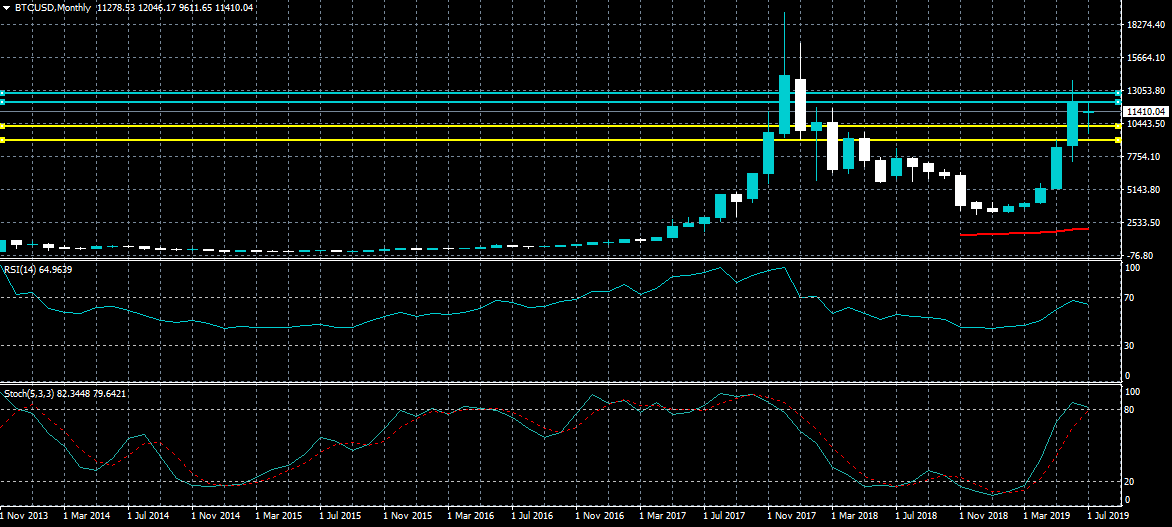
Bitcoin continues to trade in a large price range as traders await technical confirmation that a medium-term high has been reached. The BTCUSD pair has posted five consecutive months of trading gains, leaving traders cautious towards selling the number one cryptocurrency. A final technical test back towards the $12,500 and $13,000 resistance levels still remain possible this week.
The BTCUSD pair is only bullish while trading above the $10,500 level, key resistance is located at the $12,500 and $13,00 levels.
If the BTCUSD pair trades under the $10,500 level, sellers may test towards the $10,200 and $9,800 support levels.
Good Is Bad As Global Stocks Decline After Impressive US NFP
Asian stocks were subdued in early morning trading as investors continued to wonder about the future of US rate cuts. This happened after the impressive June jobs report, where the US added more than 224K jobs. This was much higher than the 160K the investors were expecting and the 75k jobs created in May this year. As a result, investors reduced their rate cuts expectations from three to two. In China, the Shanghai and Hang Seng indices declined by 75 and 11 points respectively. In Australia, the ASX declined by 75 points. In Europe and United States, futures too declined with the Stoxx and Dow falling by 13 and 40 points respectively.
The Japanese yen strengthened against the USD after the country released important economic data. In May, the core machinery orders declined by -3.7%, which was slightly better than the expected decline of -3.9%. In April, the machinery orders had increased by 2.5%. On a MoM basis, the orders declined by -7.8%, which was worse than the expected decline of -3.6%. In April, the orders had increased by 5.2%. In June, the country’s bank lending increased by an annualized rate of 2.3%, which was lower than the expected increase of 2.6%.
Today, investors will receive the German trade numbers. In May, the country’s exports are expected to have increased by 0.5%, which was slightly higher than the previous decline of -3.7%. The imports are expected to have increased by 0.3% while the trade surplus is expected to decline slightly to EUR 16.8 billion. Meanwhile, the industrial production is expected to have increased by 0.4%, which will be higher than the previous decline of 1.9%. These numbers are essential because Germany is the most important economy in the European Union.
EUR/USD
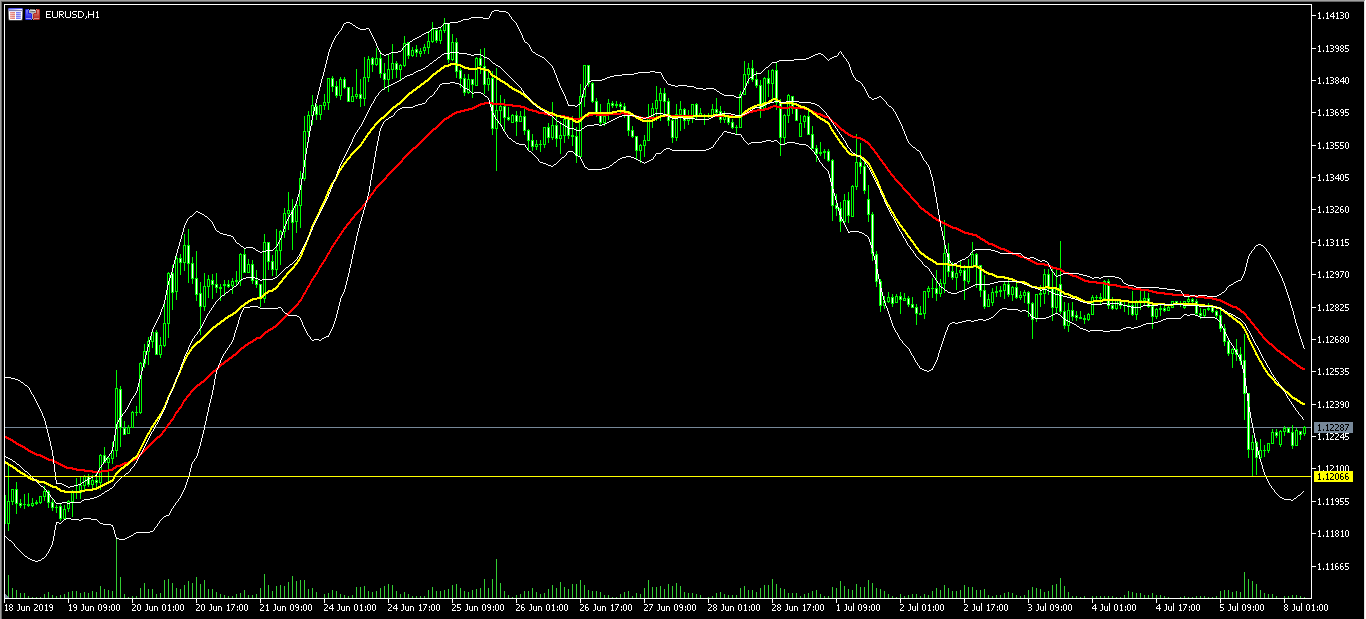
On Friday, the EUR/USD pair declined sharply after the US released the NFP data. The pair declined to a low of 1.1206. This was the lowest decline since June 20. This decline was a continuation of the downward trend that started on June 25. Today, the pair moved slightly upwards and is currently trading at 1.1227. On the hourly chart, this price is below the 25-day and 50-day moving average although volumes have been subdued. The price is along the middle line of the Bollinger Bands. The pair is likely to resume the downward trend to test levels below the 1.1200 support.
XAU/USD
The XAU/USD pair declined sharply on Friday after the impressive US jobs data. The pair declined to a low of 1386.50. Today, the pair moved up slightly in the Asian session and is currently trading at 1398. On the four-hour chart, the current price is between the important support of 1381 and the important resistance level of 1439. The RSI has moved slightly lower to the low of 40. The pair is likely remain to within this channel as traders wait for the Fed chair testimony scheduled for tomorrow.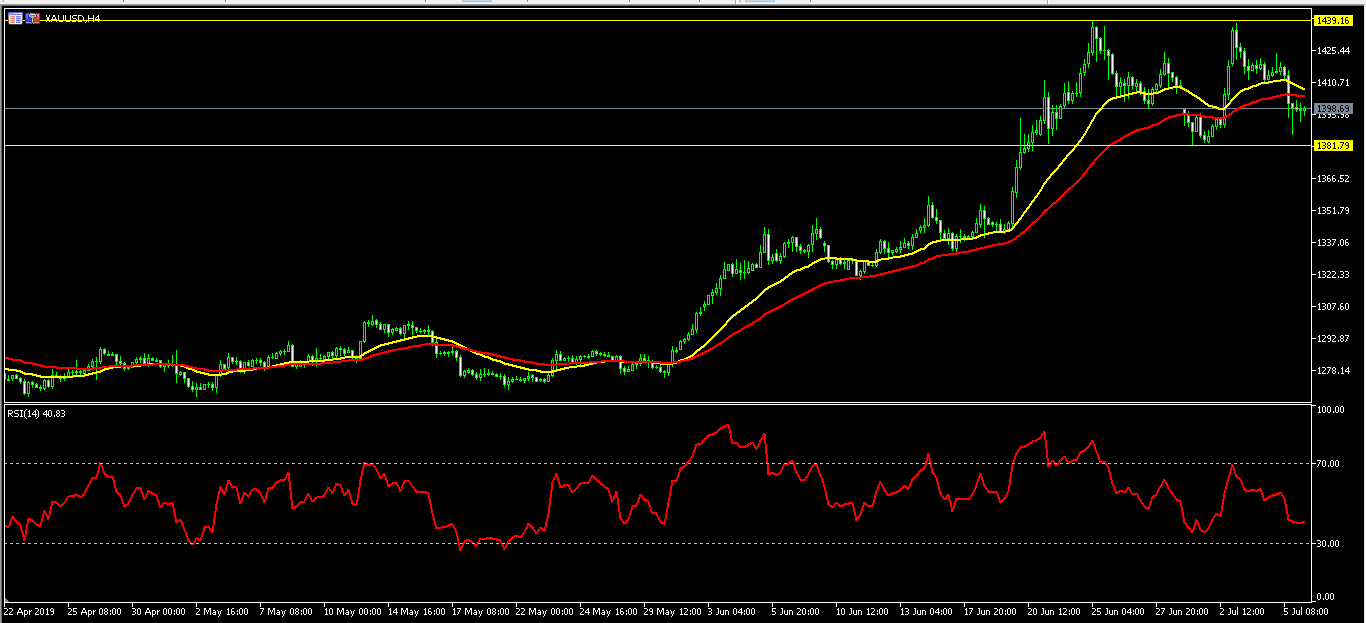
USD/JPY
The USD/JPY pair declined to a low of 108.36. This was lower than Friday’s high of 108.63. On the hourly chart, the price is above the 25-day and 50-day moving averages while the RSI has moved lower from a high of 88.89 to a low of 56. The accumulation/distribution indicator has continued to soar. The pair will likely move lower to test the important support of 108.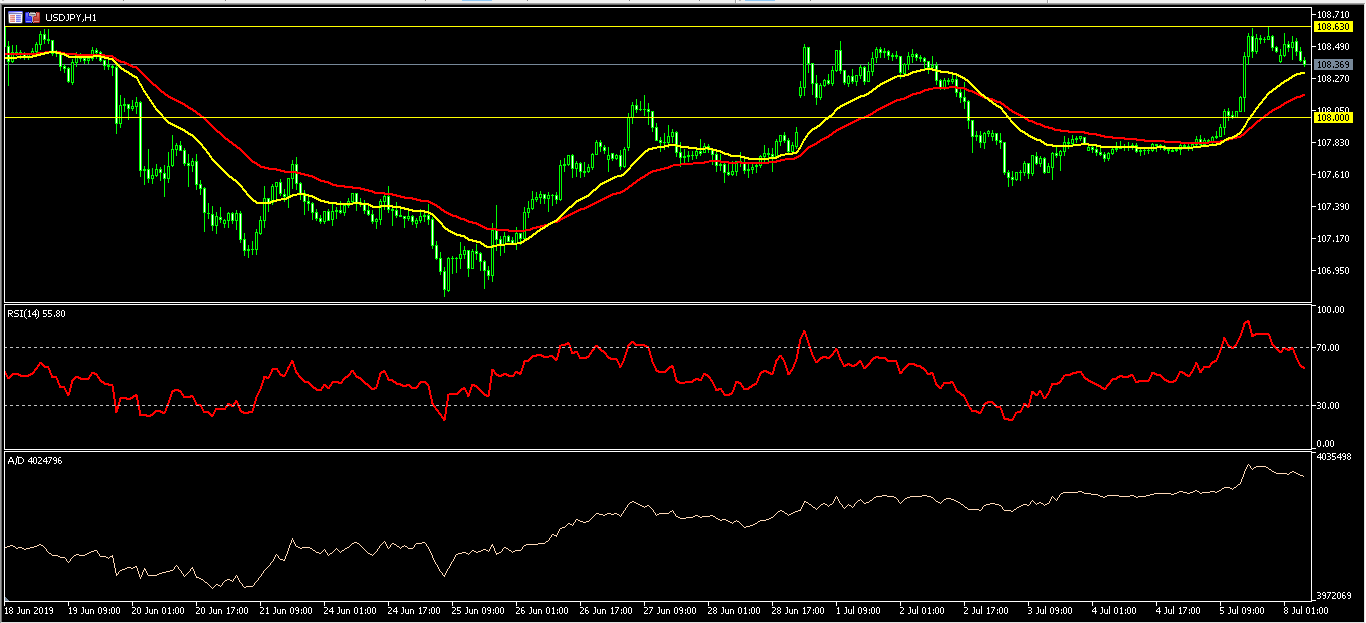
AUD/USD Daily Outlook
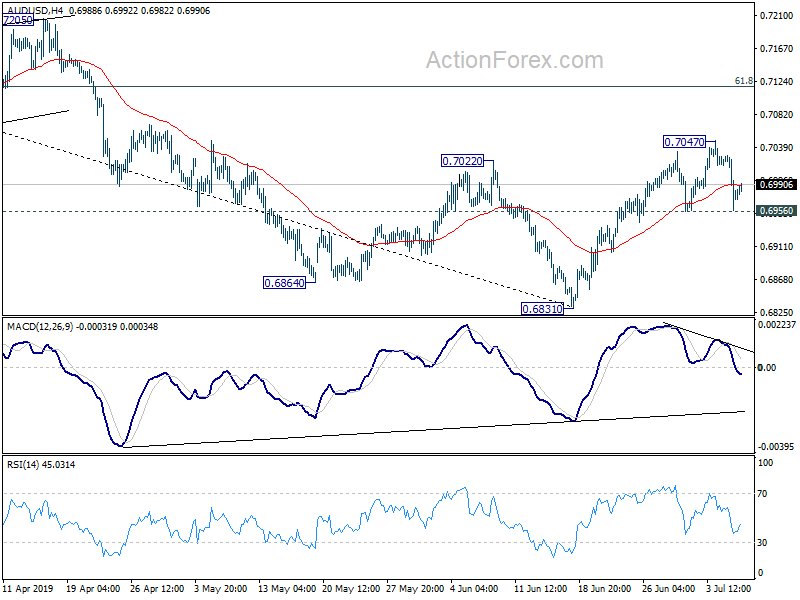
Daily Pivots: (S1) 0.6948; (P) 0.6989; (R1) 0.7020; More...
AUD/USD recovers ahead of 0.6956 minor support and intraday bias remains neutral first. On the upside, break of 0.7047 will resume the rebound from 0.6831 to 61.8% retracement of 0.7295 to 0.6831 at 0.7118. Sustained break will target 0.7295 resistance next. On the downside, break of 0.6956 support, however, will indicate completion of the rebound. Intraday bias will be turned back to the downside for retesting 0.6831 low.
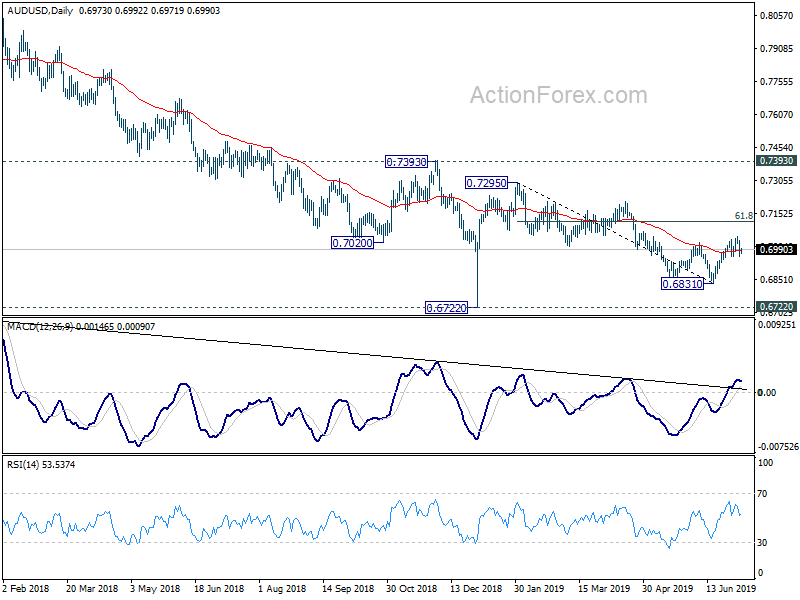
In the bigger picture, with 0.7393 key resistance intact, medium term outlook remains bearish. The decline from 0.8135 (2018 high) is seen as resuming long term down trend from 1.1079 (2011 high). Decisive break of 0.6826 (2016 low) will confirm this bearish view and resume the down trend to 0.6008 (2008 low). However, firm break of 0.7393 will argue that fall from 0.8135 has completed. And corrective pattern from 0.6826 has started the third leg, targeting 0.8135 again.
Dollar Paring Gains as Focus Turns to Fed Powell’s Testimony and FOMC Minutes
Asian markets tumble broadly, partly as reactions to Japan's export controls on certain Korean semiconductor materials. Also, the weakness is partly due to adjustment in expectations on Fed's rate cut this month, after Friday's solid US job data. Though, the currency markets are steadily mixed. Yen is one of the strongest among Australian and New Zealand Dollar. Sterling and Euro are among the weakest. Yet, Dollar is also soft, paring some of last week's gains. The greenback's fate will very much depends on Fed Chair Jerome Powell's testimony and FOMC Minutes scheduled for the week.
Technically, Dollar pairs will remain the major focuses today. In particular, EUR/USD is looking at 1.1181 support to confirm near term weakness for 1.1107 low. AUD/USD is looking at 0.6956 minor support to confirm completion of rebound form 1.6831. USD/JPY is still looking at 108.80 resistance to confirm near term reversal. USD/CAD is staying in tight range below 1.3145 minor resistance without confirming short term bottoming at 1.3037 yet.
In Asia, Nikkei closed down -0.98%. China Shanghai SSE closed down -2.58 at 2933.36, below 3000 handle. Hong Kong HSI is down -1.66%. Singapore Strait Times is down -1.20%. Japan 10-year JGB yield is up 0.0124 at -0.151.
BoJ: All nine regions expanding or recovering, but uncertainties heightened
In the quarterly Regional Economic Report, BoJ kept assessment of all nine regions unchanged. All nine regions reported that their economy had been "either expanding or recovering". Domestic demand had "continued on an uptrend", with a virtuous cycle from income to spending operating in both the corporate and household sectors. But, exports and production had been affected by the "slowdown in overseas economies".
Also, while the assessments were overall unchanged, "a somewhat increasing number of firms were pointing to heightening uncertainties over the outlook for overseas economies and their impacts, reflecting, for example, the U.S.-China trade friction."
BoJ Kuroda: Will make necessary policy adjustments to sustain the economy's momentum
BoJ Governor Haruhiko Kuroda told the central bank's regional branch managers that inflation is still expected to pick up gradually to 2% target. The economy is expected to continue expanding moderately as a trend, even though it's affected by overseas slowdown. But still, BoJ would maintain easing for as long as needed to hit stable target.
Kuroda reiterated that short- and long-term interest rate will be kept at current very low levels for extended period, "at least through around spring 2020". Also, monetary base will continue to expand, and QQE will be maintained under the yield curve control framework.
Also, Kuroda pledged that "the BOJ will make necessary policy adjustments to sustain the economy's momentum towards achieving its inflation target."
Released from Japan, machine orders dropped sharply by -7.8% mom in May versus expectation of -3.7% mom. Current account surplus narrowed to JPY 1.31T versus expectation of JPY 1.24T.
Wang: China can't shut out the world, world can't shut out China
Chinese Vice President Wang Qishan said in the World Peace Forum that "China's development can't shut out the rest of the world. The world's development can't shut out China". Without naming any country, he warned against "protectionism in the name of national security"
Wang also called on major powers to contribute more to global peace and stability. He added, "large countries must assume their responsibilities and set an example, make more contributions to global peace and stability, and broaden the path of joint development."
And he emphasized that "development is the key to resolving all issues". At the same time, Wang pledged that China will walk the path of peace, as "if there is no peaceful, stable international environment, there will be no development to talk of."
Wang is an extremely close ally of President Xi Jinping but rarely speaks in the public regarding public issues. It remains to be seen if he's speech was part of the campaign in stronger rhetorics in Sino-US relationships. Recently, China has warned that all punitive tariffs have to be removed to complete a trade deal. Also, it's reported that purchases of US agricultural products are tied to how Huawei ban would be lifted.
China foreign exchange reserves rose 0.6% to USD 3.119T
China's foreign exchange reserves rose USD 18.2B, or 0.6%, to USD 3.119T in June. Value of gold reserves rose from USD 79.83B to USD 87.27B. China's State Administration of Foreign Exchange noted that Dollar index dropped while asset prices in international markets rose in June, factored by global trade situation and monetary policy of major central banks. Combined together, exchange rate conversion and asset price changes contributed to the increase in the country's foreign exchange reserves.
SAFE also noted despite increased uncertainties, China's economy has been "generally stable and operating in a reasonable range". Supply and demand in the foreign exchange market has been "basically balance". Looking forward, China will continue to promote high-quality economic development and actively implement all-round opening up measures.
Resilience and sustainability of economic growth will be further enhanced. These will provide strong support for the stability of China's foreign exchange market, thus providing a solid foundation for maintaining the overall stability of foreign exchange reserves.
ECB Villeroy: Economic signals continuing slowdown, but also significant wage increase and job creation
ECB Governor Council member François Villeroy de Galhau hinted that the central bank could launch fresh stimulus before IMF Managing Director Christine Lagarde takes over Mario Draghi's job as ECB President. He noted that "If we speak about monetary policy we have several Governing Councils to come, in the next month, including with Mario Draghi. And if and when needed, there must be no doubt about our determination to act and our capacity to act."
Villeroy said policymakers look at the market, but emphasized "we are not market dependent, we are data dependent". And, "if we look at the economic signals there is a continuing slowdown but there also significant wage increases ... significant job creation on both sides of the Atlantic. So let us wait for our next Governing Council, and there are several to come, to assess the data and then to decide."
Meanwhile, he also pointed to trade tensions as the biggest uncertainty and threat to the global economy. However, "it's up to political leaders to reduce these uncertainties, which are sometimes self created. We cannot compensate for trade tensions."
Fed Powell, FOMC Minutes, ECB Accounts and BoC to highlight the week
Fed Chair Jerome Powell's testimony and FOMC minutes will be two major focuses this week. At this point, fed fund futures are still pricing in 100% chance of a 25bps July Fed cut, even though 50% bps cut is basically priced out. If Powell would like to correct such expectations, the testimony will be his ideal chance to explain that Fed is indeed not that desperate for the insurance cut. Also, while a total of eight policymakers penciled in rate cuts this year, the minutes could reveal how urgent they think the cuts are needed. Additionally, US CPI release could also be an important factor for Fed to consider.
Back on June 18, ECB President Mario Draghi opened the door for further easing in a speech. He "in the absence of improvement, such that the sustained return of inflation to our aim is threatened, additional stimulus will be required." And, the options on further measures were "raised and discussed" at ECB's last meting. Last week, Governor Council member Olli Rehn even issued a panic call as "further monetary stimulus is now needed until there is improvement in economic and inflation prospects". Expectations are now building up for ECB to act on July 25. This week's minutes of June meeting would reveal what were actually being discussed.
BoC is widely expected to keep policy rate unchanged at 1.75% this week. The case for easing faded after recent data continued to show broad-based pick-up in the economy. Also, WTI crude oil has already rebounded notably from last year's low of 42 and settled between 50/60. Headline inflation also picked up to 2.4% yoy, with core measures averaged at 2.1%. BoC would possibly shift towards a more neutral stance. But for now, due to external risks, there shouldn't be any case to turn hawkish yet.
BoE Governor Mark Carney sounded surprisingly dovish in a speech last week. He warned that "recent data also raise the possibility that the negative spillovers to the UK from a weaker world economy are increasing and the drag from Brexit uncertainties on underlying growth here could be intensifying.". UK GDP and productions data will be closely watched to verify Carney's view point.
Here are some highlights for the week:
- Monday: Japan current account, machine orders; German industrial production, trade balance, Eurozone Sentix investor confidence.
- Tuesday: Japan M2; Australia NAB business confidence; Swiss unemployment rate; UK BRC retail sales monitor; Canada housing starts, building permits.
- Wednesday: Japan PPI; China CPI, PPI; UK GDP, industrial and manufacturing productions, construction output, goods trade balance; BoC rate decision; Fed chair Powell testimony, FOMC minutes.
- Thursday: Australia inflation expectations, home loans; Japan tertiary industry index; German CPI final; ECB monetary policy accounts; Canada new housing price index; US CPI, jobless claims, Fed chair Powell testimony.
- Friday: New Zealand Business NZ manufacturing index; China trade balance; Eurozone industrial production; US PPI.
AUD/USD Daily Outlook
Daily Pivots: (S1) 0.6948; (P) 0.6989; (R1) 0.7020; More...
AUD/USD recovers ahead of 0.6956 minor support and intraday bias remains neutral first. On the upside, break of 0.7047 will resume the rebound from 0.6831 to 61.8% retracement of 0.7295 to 0.6831 at 0.7118. Sustained break will target 0.7295 resistance next. On the downside, break of 0.6956 support, however, will indicate completion of the rebound. Intraday bias will be turned back to the downside for retesting 0.6831 low.
In the bigger picture, with 0.7393 key resistance intact, medium term outlook remains bearish. The decline from 0.8135 (2018 high) is seen as resuming long term down trend from 1.1079 (2011 high). Decisive break of 0.6826 (2016 low) will confirm this bearish view and resume the down trend to 0.6008 (2008 low). However, firm break of 0.7393 will argue that fall from 0.8135 has completed. And corrective pattern from 0.6826 has started the third leg, targeting 0.8135 again.
Economic Indicators Update
| GMT | Ccy | Events | Actual | Forecast | Previous | Revised |
|---|---|---|---|---|---|---|
| 23:50 | JPY | Current Account (JPY) May P | 1.31T | 1.24T | 1.60T | |
| 23:50 | JPY | Machine Orders M/M May | -7.80% | -3.70% | 5.20% | |
| 5:00 | JPY | Eco Watchers Survey Current Jun | 44 | 43.8 | 44.1 | |
| 6:00 | EUR | German Industrial Production M/M May | 0.30% | 0.30% | -1.90% | -2.00% |
| 6:00 | EUR | German Trade Balance (EUR) May | 18.7B | 16.8B | 17.0B | 16.9B |
| 8:30 | EUR | Eurozone Sentix Investor Confidence Jul | 0.2 | -3.3 | ||
| 19:00 | USD | Consumer Credit (USD) May | 15.2B | 17.5B |
EURUSD Recovers Somewhat After Hitting 2-Week Low
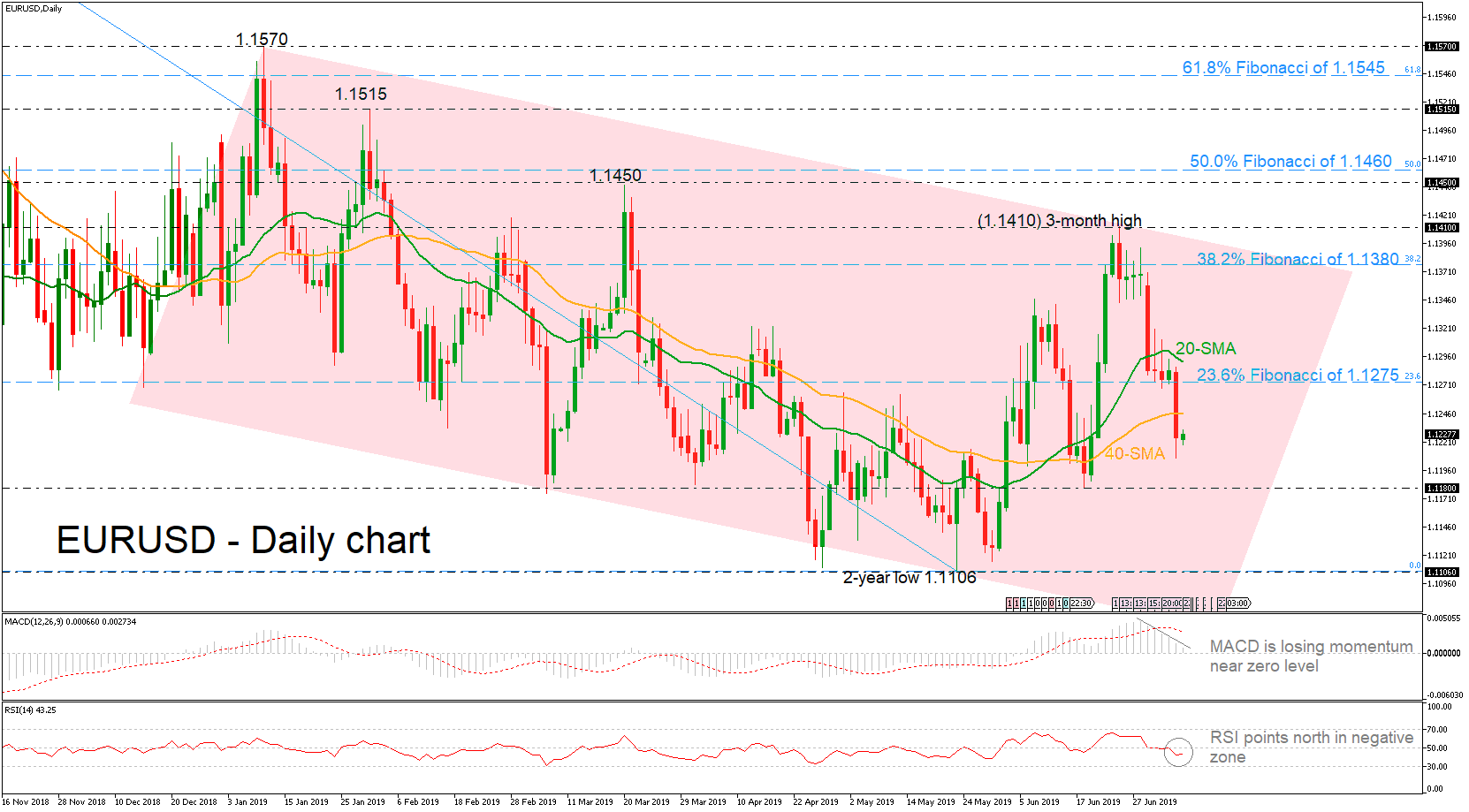
EURUSD has declined aggressively on Friday, completing a two-week low near 1.1200. The price tumbled back below the 23.6% Fibonacci retracement level of the downleg from 1.1815 to 1.1106, around 1.1275 as well as below the short-term moving averages.
From the technical point of view, the market is losing momentum again, after the strong pullback on the three-month high of 1.1410 confirmed by the technical indicators. The MACD is falling below its red trigger line and is hovering near the zero line. However, the RSI indicator is trying to recover in the negative territory as it is sloping marginally higher.
More declines could drive the price towards the immediate support level of 1.1180 and if there is a successful drop below this line would open the way for a test of the two-year low of 1.1106. In case of steeper losses could send EURUSD could reach the 1.0900 psychological level, registered on March 2017.
On the other side, if the price recovers somewhat and jumps above the 40-simple moving average (SMA) it could meet resistance at the 23.6% Fibo of 1.1275 and at the 20-SMA currently at 1.1290. More gains could pare the previous week’s losses, challenging the 38.2% Fibo of 1.1380.
Having a look at the bigger picture, EURUSD has been developing within a descending channel over the last five months and traders could still have their attention to the downside.
Currencies: Dollar Holding Strong Post-Payrolls
- Rates: Time for consolidation on core bond markets?
Better-than-expected June Payrolls spurred a profit taking move on core bond markets. The US 10-yr yield closed above 2.01% support. With main eco data released, a 25 bps July Fed rate cut fully discounted and Summer trading conditions kicking in, we might see some consolidation on core bond markets, halting the rally of previous months. - Currencies: Dollar holding strong post-payrolls
A strong US payrolls report provided the dollar with additional interest rate support Friday. The US currency may preserve recent gains ahead of Fed Powell's appearance before Congress later this week. However, calls from president Trump on the Fed to ease policy or on a too strong dollar might slow further USD gains
The Sunrise Headlines
- US stocks staged an intraday U-turn on Friday but retreated nonetheless. The S&P underperformed (-0.18%). Asian markets are performing poorly. South- Korea (-3.2%) underperforms amid increasing geopolitical tensions with Japan.
- Iran said it wants to hold talks with the EU in the coming days while also announcing it had exceeded the limits of uranium enrichment under the 2015 deal. The US is allowed to join the talks if it abandons the economic sanctions.
- President Erdogan sacked the central bank governor this weekend, a move that spurred investor concerns again over the central bank's independency. The Turkish lira slips about 2.5% in Asian trading hours.
- Greek snap elections yesterday turned out a victory for the opposition party. Mitsotakis' New Democracy had a lead of almost 40%, securing a parliamentary majority to pursue “fewer taxes, many investments […] and growth”.
- Japan will meet South-Korea to explain the (hi-tech) export restrictions it recently imposed after courts in the latter ruled that Japanese companies must compensate Koreans pushed into forced labour during the World Wars.
- Boris Johnson won a key endorsement from Home Secretary Javid, further adding to his chances for victory. A recent YouGov poll showed 74% of the Tories would back Johnson rather than Hunt. The actual voting starts today.
- Today's economic calendar is to provide few clues for trading. European data is of secondary importance. EU finance ministers meet to discuss (a.o.) the budgetary situation.
Currencies: Dollar Holding Strong Post-Payrolls
Dollar holding strong post payrolls.
The US labour market report was strong Friday, with net job growth at 224 000 printing much stronger than expected. Wage growth (3.1% Y/Y) disappointed again, but the report was strong enough for investors to conclude that a 50 bps Fed rate cut this month has become unlikely. US yields and the dollar jumped higher. EUR/USD closed at 1.1225 (from 1.1285). USD/JPY finished at 108.47 (from 107.82).
This morning, higher US yields are causing profit taking on EM/regional assets. Geopolitical issues (Iran, tensions between South Korea and Japan) also weigh on sentiment. The dollar preserves most of Friday's gains even as President Trump stepped up its critics on the Fed for not supporting US growth enough. EUR/USD hovers near 1.1225. USD/JPY is drifting lower as the yen attracts safe haven flows. The Turkish lira tumbled after President Erdogan unexpectedly replaced the central bank governor. EUR/TRY jumped to trade in the 6.45 area currently.
Today (and tomorrow) there are mostly second tier data scheduled in Europe and in the US. Markets look forward to Fed Powell's testimony before Congress on Wednesday and Thursday. The Fed president faces a difficult balancing act. He supports the idea of some pre-emptive Fed action, but the data suggest that there is no case yet for the Fed to act as aggressively as markets discount (and as president Trump wants). EUR/USD trading will probably be order-driven ahead of Powell's appearances. More pressure from president Trump on the Fed and/or explicit comments on a too strong dollar, might slow further USD gains. Even so, there is no immediate trigger available for a big EUR/USD rebound right now.
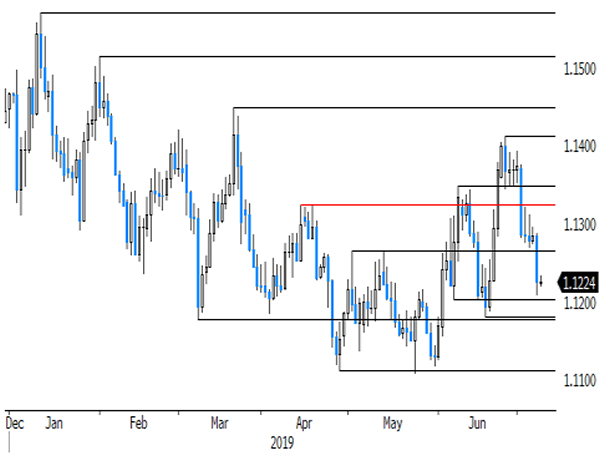
Last week, EUR/USD drifted lower in the 1.11/1.14 range, First support comes in at the 1.1181 (correction low). A break would open the way for a return to the year lows (1.1100/10 area). A rebound to the 1.13 would indicate an easing of the downside momtentum.
No change in the EUR/GBP trading pattern yet. The pair remains locked in a tight range close to, but below the 0.90 handle. The debate in the Conservative party on the appropriateness of a no-deal Brexit continues to take centre stage. The stalemate will probably persist, at least till the new party leader/PM will be in place. In this context, sterling will probably remain in the defensive, holding near recent lows.
EUR/USD: drifting lower in the 1.14/1.11 trading range as mar
BoJ: All nine regions expanding or recovering, but uncertainties heightened
In the quarterly Regional Economic Report, BoJ kept assessment of all nine regions unchanged. All nine regions reported that their economy had been "either expanding or recovering". Domestic demand had "continued on an uptrend", with a virtuous cycle from income to spending operating in both the corporate and household sectors. But, exports and production had been affected by the "slowdown in overseas economies".
Also, while the assessments were overall unchanged, "a somewhat increasing number of firms were pointing to heightening uncertainties over the outlook for overseas economies and their impacts, reflecting, for example, the U.S.-China trade friction."
Wang: China can’t shut out the world, world can’t shut out China
Chinese Vice President Wang Qishan said in the World Peace Forum that "China's development can't shut out the rest of the world. The world's development can't shut out China". Without naming any country, he warned against "protectionism in the name of national security"
Wang also called on major powers to contribute more to global peace and stability. He added, "large countries must assume their responsibilities and set an example, make more contributions to global peace and stability, and broaden the path of joint development."
And he emphasized that "development is the key to resolving all issues". At the same time, Wang pledged that China will walk the path of peace, as "if there is no peaceful, stable international environment, there will be no development to talk of."
Wang is an extremely close ally of President Xi Jinping but rarely speaks in the public regarding public issues. It remains to be seen if he's speech was part of the campaign in stronger rhetorics in Sino-US relationships. Recently, China has warned that all punitive tariffs have to be removed to complete a trade deal. Also, it's reported that purchases of US agricultural products are tied to how Huawei ban would be lifted.