Sample Category Title
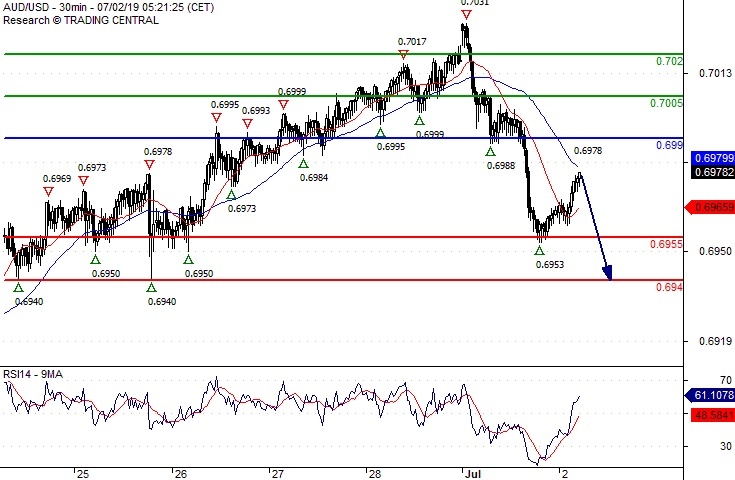
AUD/USD Key Resistance At 0.6990
Pivot (invalidation): 0.6990
Our preference Short positions below 0.6990 with targets at 0.6955 & 0.6940 in extension.
Alternative scenario Above 0.6990 look for further upside with 0.7005 & 0.7020 as targets.
Comment As Long as the resistance at 0.6990 is not surpassed, the risk of the break below 0.6955 remains high.
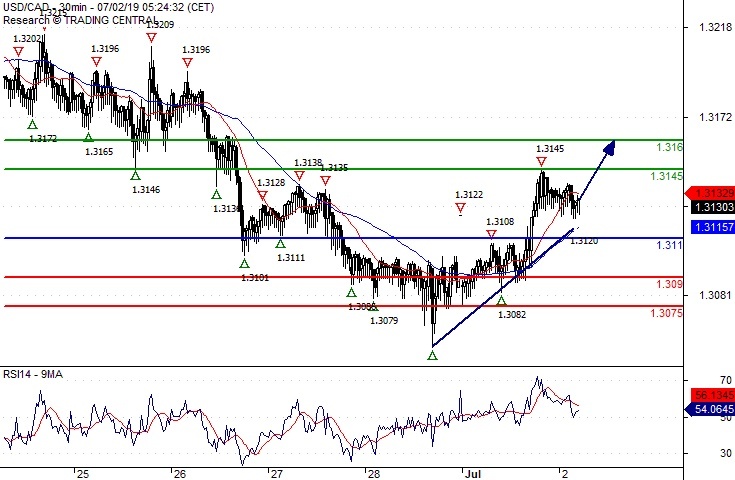
USD/CAD Towards 1.3160
Pivot (invalidation): 1.3110
Our preference nLong positions above 1.3110 with targets at 1.3145 & 1.3160 in extension.
Alternative scenario Below 1.3110 look for further downside with 1.3090 & 1.3075 as targets.
Comment The RSI calls for a bounce.
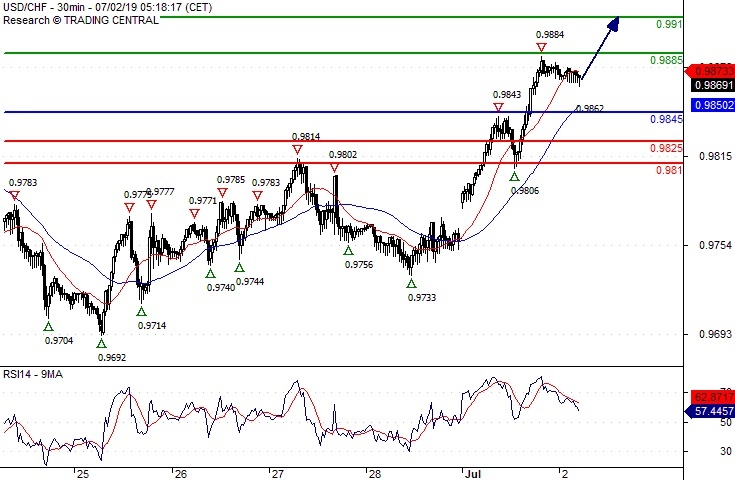
USD/CHF The Upside Prevails
Pivot (invalidation): 0.9845
Our preference Long positions above 0.9845 with targets at 0.9885 & 0.9910 in extension.
Alternative scenario Below 0.9845 look for further downside with 0.9825 & 0.9810 as targets.
Comment The RSI calls for a new upleg.
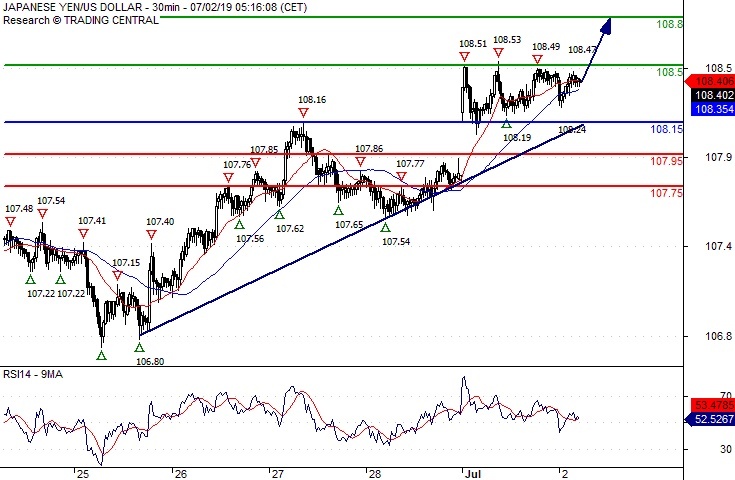
USD/JPY The Bias Remains Bullish
Pivot (invalidation): 108.15
Our preference Long positions above 108.15 with targets at 108.50 & 108.80 in extension.
Alternative scenario Below 108.15 look for further downside with 107.95 & 107.75 as targets.
Comment The RSI is above its neutrality area at 50%.
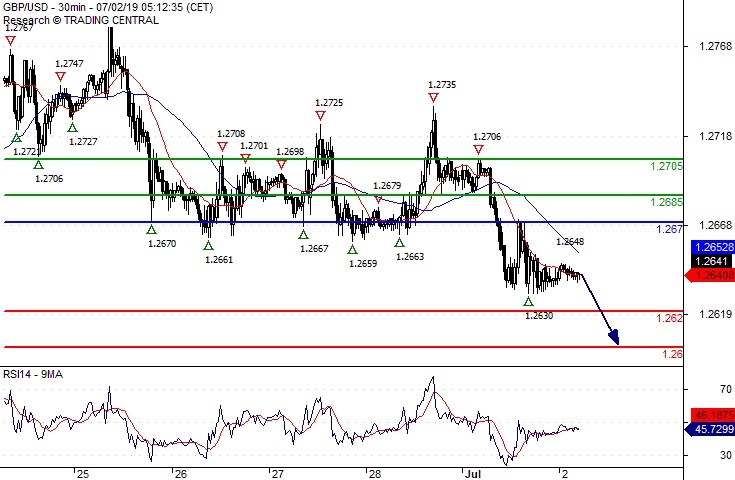
GBP/USD Expect 1.2600
Pivot (invalidation): 1.2670
Our preference Short positions below 1.2670 with targets at 1.2620 & 1.2600 in extension.
Alternative scenario Above 1.2670 look for further upside with 1.2685 & 1.2705 as targets.
Comment The RSI calls for a drop.
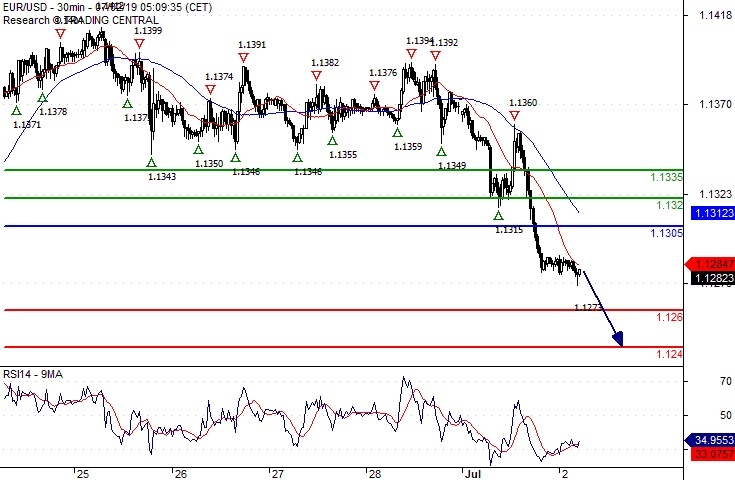
EUR/USD Under Pressure
Pivot (invalidation): 1.1305
Our preference Short positions below 1.1305 with targets at 1.1260 & 1.1240 in extension.
Alternative scenario Above 1.1305 look for further upside with 1.1320 & 1.1335 as targets.
Comment The RSI advocates for further decline.
GBPUSD Bears Back Into Play, Builds Base Around 20-SMA
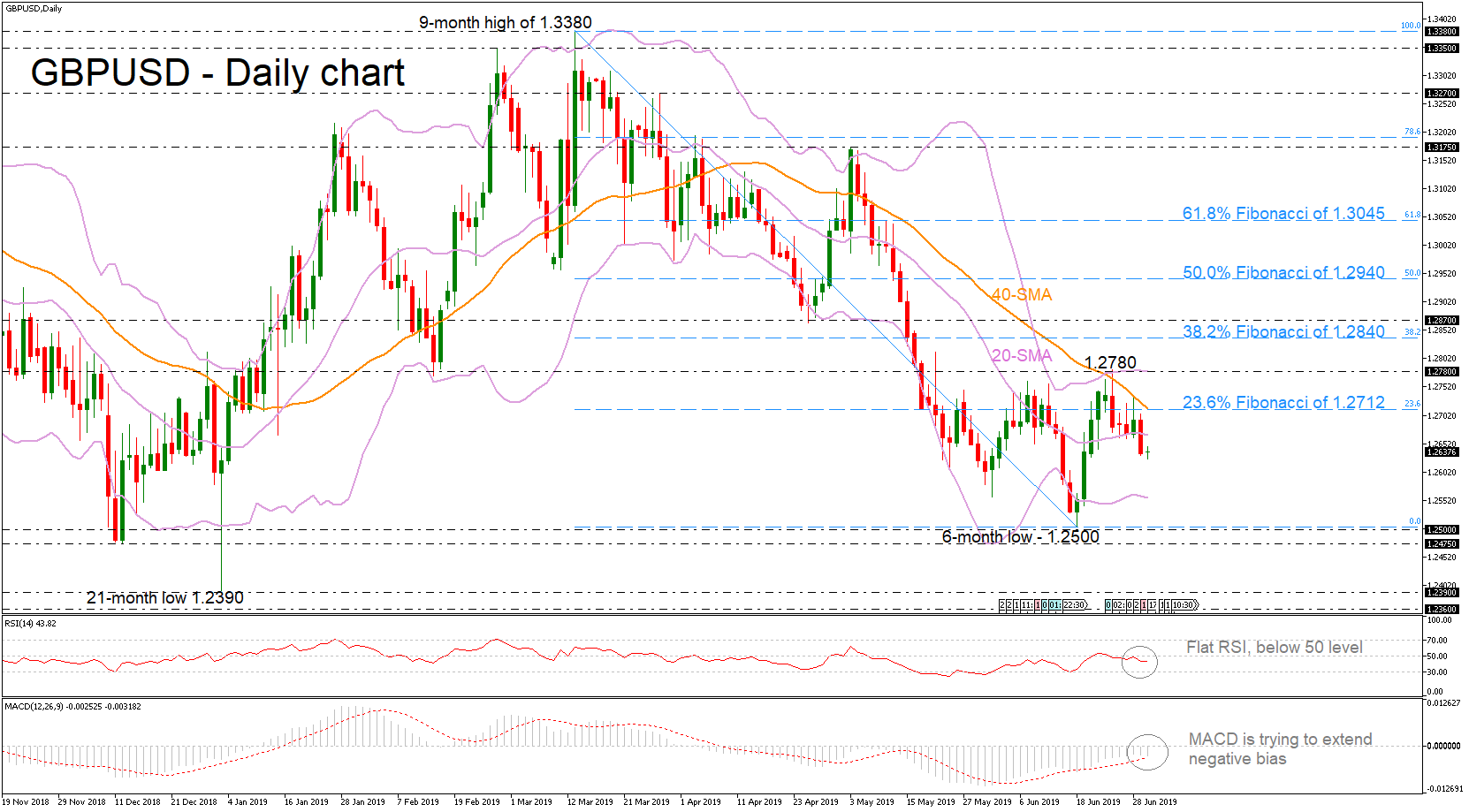
GBPUSD touched the upper Bollinger band around the 1.2780 resistance level in the previous week, driving the market lower, below the 40-day simple moving average (SMA) and the 23.6% Fibonacci retracement level of the downfall from 1.3380 to 1.2500 near 1.2712.
The pair continues the selling interest in the medium-term as it is confirmed by the technical indicators, which have been holding in the negative territory. The RSI is flattening below the 50 level and the MACD is trying to strengthen its negative bias below the zero line.
In case of more losses, the next support level is coming from the lower Bollinger band, currently at 1.2555 before flirting with the six-month low of 1.2500.
Alternatively, if the price shifts to the upside and surpasses the 40-SMA, it could find immediate resistance at the significant area of 1.2780. More bullish momentum could send cable until the 38.2% Fibonacci of 1.2840.
Overall, GBPUSD looks to be bearish in the short- and medium-term picture. Currently, the pair has been developing within the squeezed Bollinger bands, and a close beneath 1.2500 could open the way for more negative actions in the bigger view.
RBA Delivers July Rate Cut
The RBA cut the cash rate to 1% and signalled that they will continue to adjust monetary policy if needed.
As we expected, the Reserve Bank Board lowered the cash rate by 25bps to 1.00% at its July meeting. The motivation for this move is very much focussed on the labour market as was clearly indicated by the Governor’s recent speech.
In the decision statement, he pointed out that employment growth has been strong, the labour force participation rate is at a record level, the vacancy rate remains high, and there are reports of skill shortages in some areas. On face value, this would not be consistent with a concern about the labour market. But the Governor is now clearly focussing on spare capacity in the labour market, and that is measured by the unemployment rate, the underemployment rate, and wages growth. He believes that the Australian economy should be making more progress in reducing spare capacity and therefore a lower cash rate is consistent with that belief.
As we highlighted in our report last week, it seems likely that the RBA growth and inflation forecasts for 2020 that will be released in the August Statement on Monetary Policy, which will follow the August Board meeting, will be unchanged from the May forecasts of 2.75% for GDP growth and 2% for underlying inflation. This further emphasises the importance of the labour market in driving the policy response in June and July.
The critical final paragraph in the Governor’s Decision Statement leaves open the possibility of further stimulus. He notes that the Board “will continue to monitor developments in the labour market closely and adjust monetary policy if needed”. However, the degree of urgency that was certainly detected in the Governor’s recent speech and the June Board minutes appears to have eased. Consequently we remain comfortable with our view that there will be no follow up move in August.
Readers will be aware that Westpac was the first forecaster in the Bloomberg survey to call the cash rate below 1% (May 24). We predicted a final cash rate move to 0.75% by November, but highlighted that there were downside risks to 0.75%. Last week, we also noted that with the likely decision to cut in July, these downside risks had intensified. For now, we remain comfortable with our forecast that the next rate cut will occur in November, by which time the growth, inflation and labour market environment will not have improved sufficiently to satisfy the RBA. Indeed, by the November Statement on Monetary Policy, we expect that the RBA will have to lower its growth and inflation forecasts and raise its unemployment forecast for 2020, requiring a further policy response.
Critical issues between now and November will be evidence around the path of the unemployment rate, and the impact of this recent movement in the cash rate on financial conditions and the profile of the Australian dollar. The task of lowering the Australian dollar has recently been impacted by headwinds associated with general rate cuts by other major central banks around the world. However, without the RBA cuts, the Australian dollar may well have unhelpfully lifted.
As we noted last week, the intense focus on the labour market - where monthly updates are available - changes the historic pattern of policy adjustments. This has been exemplified in the June and July movements, and means that every month, certainly out to the end of 2019, will be live for policy. Issues that will also provide the RBA with reasons for caution will be around fiscal policy developments, particularly implications for household disposable income; the response of the housing market to the two rate cuts; and whether the consumer responds to tax cuts and lower rates with a robust spending appetite over the course of the second half of 2019.
Conclusion
When Westpac originally forecast two rate cuts in 2019 back in February, markets were only positioned for one cut by March 2020 and most major forecasters were still calling rates higher or on hold. We are therefore pleased to see that the forecast has proved to be correct. We were also the first forecaster to nominate a terminal cash rate lower than 1% (May 24), and that outlook has now been embraced by the market and most other forecasters. However with policy now in play at every Board meeting between now and the end of the year, uncertainties around specific timing are inevitable.
Our current view of one more cut this year by November has downside risks for potentially two, and developments over the next few months will determine that outcome. If the RBA were to lower the cash rate to 0.5% and still be dissatisfied with the excess spare capacity in the labour market then we expect that they will consider putting pressure on governments to loosen fiscal policy, as well as exploring other alternative policies that the RBA itself can embrace.
Currencies: EUR/USD Returns To The Middle Of The 1.11/1.14 Trading Range
- Rates: Limited upside for core bond yields
Yesterday's rise in core bond yields proved fragile and temporary as rates already decline again this morning. The trade truce won't alter the Fed's intentions in the near term and that's likely to be confirmed by Fed's Williams and Mester later today. Against the background of a backloaded eco calendar we expect core bond rates to have limited upside. - Currencies: EUR/USD returns to the middle of the 1.11/1.14 trading range
The dollar rebounded post G20 yesterday even as the rise in US yields remained modest. The ST picture for EUR/USD turned neutral again. Today, USD trading might be technical in nature with few important eco data on the agenda. The focus for USD trading will turn to other important US eco data later this week. EUR/GBP 0.90 still proves to be a strong resistance
The Sunrise Headlines
- WS advanced in the wake of the renewed US/Sino trade truce. The S&P 500 (+0.77%) set a new all-time high. Asian markets are mixed as investors ponder the recent trade developments. HK is catching up with the recent risk rally (+1.35%)
- The Reserve Bank of Australia cut rates for a second time this cycle from 1.25% to 1%. The central bank said it will adjust policy further if needed to support growth and inflation. AUD/USD (0.698) dipped but recovered soon.
- The USTR presented a list of another $4bn of EU goods the US could hit with import levies after publishing a $21bn worth list in April. The move fits in the ongoing WTO dispute with the EU over aviation (Boeing and Airbus) subsidies
- Italy's government agreed to limit the 2019 budget to 2.04% of GDP vs. the 2.4% earlier to avoid EU sanctions, according to a person familiar. Italy is counting on more revenues while also cutting social welfare spending.
- Iran said it had exceeded the 300kg stock limit of low-enriched uranium agreed under the 2015 nuclear deal. It has deliberately done so to force the EU, Russia and China to provide (economic) relief from the American sanctions.
- Premier Li said China will seek lower real rates to reduce funding costs for SME's and that it is working on a 2tn yuan tax cut as the economy is facing new downward pressure but ruled out “flood-like” stimulus.
- Today's event calendar eyes rather meagre with the few scheduled data releases only of secondary importance. Fed's Williams and Mester are to speak on the economy and monetary policy.
Currencies: EUR/USD Returns To The Middle Of The 1.11/1.14 Trading Range
EUR/USD returns to middle of the 1.11/1.14 range
The dollar profited of the new trade truce yesterday after the meeting between presidents Trump and Xi this weekend. Global equities rallied. US yields rose modestly, but it was enough to support a USD rebound. The EMU manufacturing PMI declined further in contraction territory (47.6), supporting the case for ECB easing. The US manufacturing ISM printed above consensus, but details were a bit mixed. Still, the dollar kept the benefit of the doubt. EUR/USD dropped below 1.13 to close at 1.1286. USD/JPY closed stronger at 108.45.
Overnight, Asian equities are trading mixed despite a record run (S&P) on WS. Rather harsh comments of president Trump on the US-China trade talks and the US expanding a list of EU products that might be hit by retaliatory tariffs illustrate that trade tensions persist. EUR/USD hovers in the 1.1280/90 area. USD/JPY lost a few ticks (108.35 area). The RBA cut its policy rate by 0.25 bp. It wants to support a faster reduction in unemployment and bring inflation back to target. Remarkably, the AUD rebounded slightly after the RBA decision (AUD/USD 0.6985).
Today, there are only second tier eco data in Europe and the US. Investors will look out whether the risk rebound continues. Even so, US yields are holding within reach of the recent lows. For now, markets don't see the new trade truce reducing the case for Fed easing. In theory, this can cap the topside of the dollar. Evidently, Europe has also pending issues (mediocre growth, political noise at the EU level and in some member states, lingering trade issues). After yesterday's decline, the ST EUR/USD picture turned neutral again. The pair returned to the middle of the 1.11/1.14 range. Today, trading might be technical in nature. Later this week, the US data (non-manufacturing ISM and payrolls Friday) might further shape investor expectations on future rate cuts. First support comes in at 1.1260 ahead of the 1.1181 correction low. A return above 1.1350 would suggest that a new upside test is possible.
EUR/GBP rebounded to the high 0.89 area yesterday, but reversed the gain later. That decline mirrored a similar EUR/USD drop at that time. Today, the construction PMI is expected in contraction territory. The contenders in the race for PM are debating whether to suspend the power of parliament to block a no-deal Brexit. Still, we expect any sterling rebound to stay limited if overall uncertainty on Brexit persists.
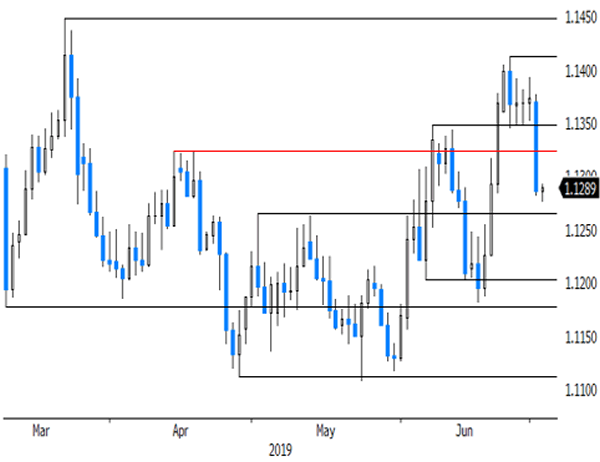
EUR/USD: dollar rebounds after G20.
Crude Oil Muted To OPEC Decision
The OPEC meeting is due to end today. However, Russia and Saudi Arabia, two of the leading oil producers declared on Monday that they will extend the current oil production cuts. OPEC is expected to maintain production at the current levels for up to nine months. The decision led to a muted response in the oil markets. WTI crude oil was down 0.61% on the day.
Is There Scope for Oil Prices to Rise?
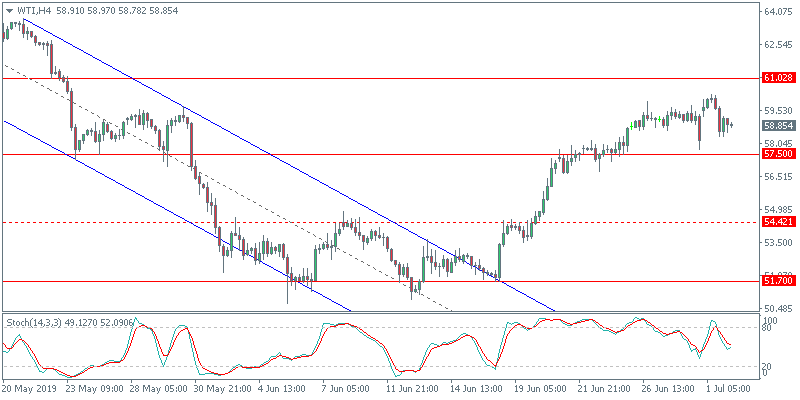
WTI Crude oil is seen currently trading within the range of 60 and 57.50. The recent reversal that came close to the $60.00 handle has led to oil prices slipping lower. However, the support level at 57.50 is yet to be tested. We expect to see oil establishing support near the 57.50 handle more firmly. This will keep the upside bias intact. However, in the short term, we expect oil to remain trading flat.