

Sample Category Title
US Threatens EU With Tariffs
The euro extended the declines on Monday, losing 0.62% on the day. The declines in the common currency came as the US dollar bounced back. Washington turned focus to the EU. President Trump threatened the EU with $4 billion in tariffs in retaliation to the EU subsidies on Airbus, a competitor to the US-based Boeing company. The US Trade Representative’s office published a list of 89 categories that could be hit by higher tariffs.
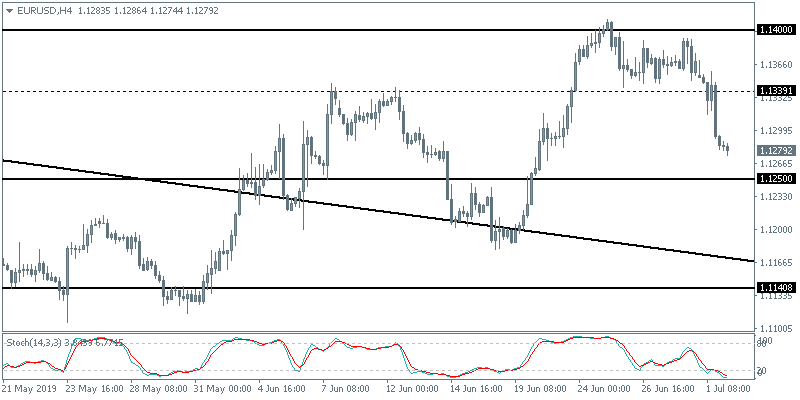
EURUSD to Extend Declines
The currency pair could maintain the downside momentum. Any near-term bounce could see new selling pressure building up. The recently breached support level at 1.1339 could be tested for resistance. To the downside, the lower support at 1.1250 will be the likely target. However, we do not expect the EURUSD to extend below this support level in the near term.
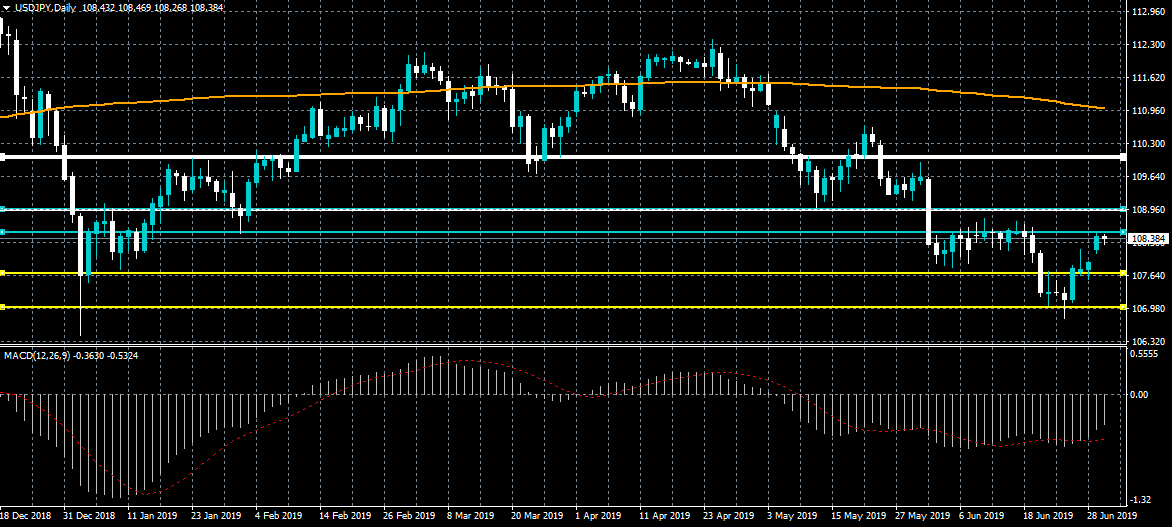
USDJPY 108.45 Breakout Needed
The greenback is once again firming against the Japanse yen currency, as the US dollar index climbs back above its key 200-day moving average. A sustained breakout above the 108.45 level is needed on an intraday basis to encourage further buying in the USDJPY pair. The key weekly upside targets for the USDJPY pair extended towards the 109.00 and 109.80 resistance levels.
The USDJPY pair is only bearish while trading below the 108.45 level, key support is found at the 108.00 and 107.70 levels.
If the USDJPY pair trades above the 108.45 level, key technical resistance is found at the 109.00 and 109.80 levels.
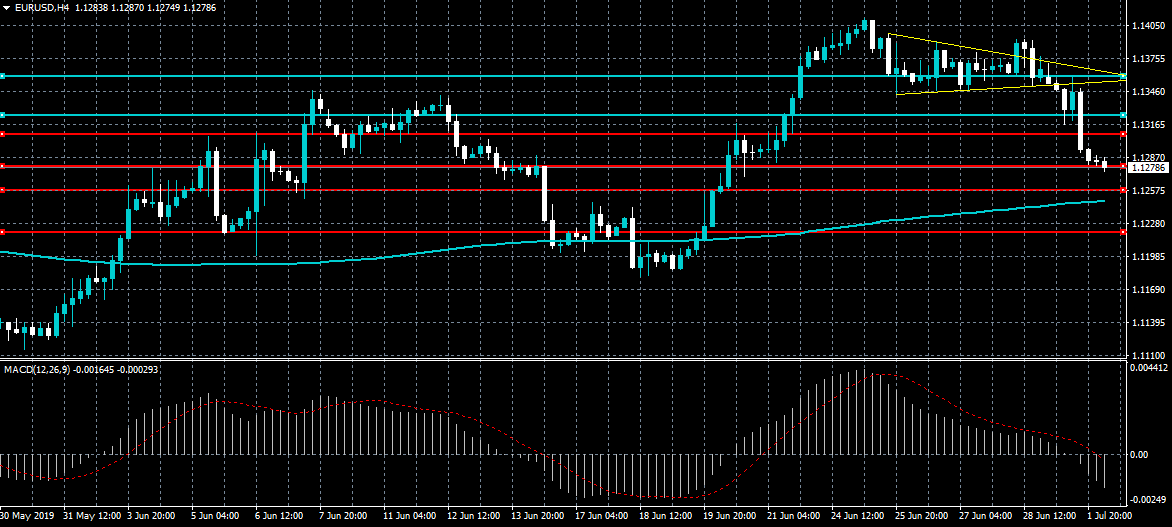
EURUSD Bearish Below 1.1321
The euro is back under pressure against the US dollar in early Tuesday trade, following slightly better Manufacturing data from the United States economy. The 1.1280 level is now key intraday support, with a sustained breakout under this level likely to spark weakness towards the 1.1255 level. The 1.1321 level now becomes the key intraday pivot point for the EURUSD pair.
The EURUSD pair is only bullish while trading above the 1.1321 level, key technical resistance is found at the 1.1355 and 1.1400 levels.
If the EURUSD pair trades below the 1.1321 level, key support is found at the 1.1280 and 1.1255 levels.
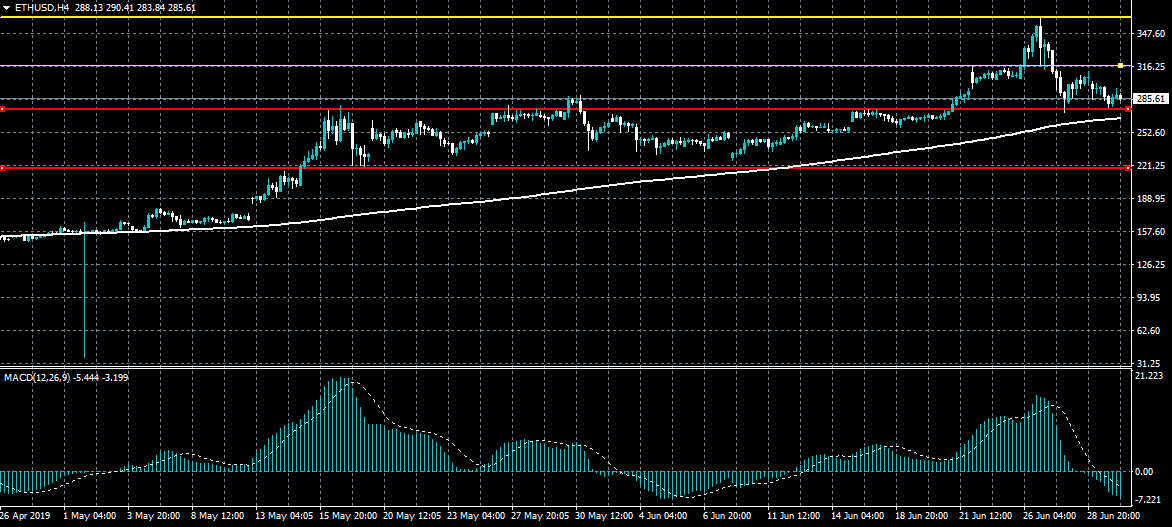
ETHUSD $265.00 Upcoming Support
Ethereum has started the new trading month poorly, with the second largest cryptocurrency slipping below the $300.00 support level. The four-hour time frame shows that a break under the $280.00 level exposes losses until at least the $265.00 level. Overall, a sustained move under the $265.00 level could trigger a much deeper bearish correction for the ETHUSD pair.
The ETHUSD pair is only bullish while trading above the $300.00 level, key resistance is found at the $316.00 and $325.00 levels.
If the ETHUSD pair trades below the $300.00 level, key support is found at the $280.00 and $265.00 levels.
Euro Declines As US Prepares $4 Billion Tariffs On European Goods
US stocks reached record highs yesterday as investors continued to cheer the truce between the US and China on trade. The truce was reached at the G20 meeting. In the rally, the biggest gainers were technology companies like Google and Qualcomm. These companies made major gains because of Trump’s decision to allow US companies to continue doing business with Huawei, a company that has spent more than $11 billion on US firms. While the truce provided relief to the markets, some analysts believe that a major trade deal will not happen any time soon because of the hardline positions by the two countries.
The euro declined in the Asian session after the United States Trade Representative (USTR) office recommended tariffs worth more than $4 billion on Europe. These tariffs were suggested because of the illegal subsidies the EU gives its airline companies like Airbus. The new tariffs will target products like olives, Scotch whiskey, and Italian cheese on top of the $21 billion tariffs that were announced in April this year. Europe will likely respond with its own tariffs, which will affect trade of the two regions. In 2018, the combined trade volume of Europe and United States was more than $1.2 trillion. Goods totaled more than $807 billion while services totaled more than $488 billion.
The Australian dollar rose after the country’s central bank released its interest rates decision. As expected, the bank lowered interest rates by 25 basis points to a new low of 1%. This was the second consecutive interest rates cut and is a reaction to the ongoing weakness in the global economy. In the accompanying statement, Governor Lowe said:
The outlook for the global economy remains reasonable. However, the uncertainty generated by the trade and technology disputes is affecting investment and means that the risks to the global economy are tilted to the downside. In most advanced economies, inflation remains subdued, unemployment rates are low and wages growth has picked up. The slowdown in global trade has contributed to slower growth in Asia. In China, the authorities have taken steps to support the economy, while continuing to address risks in the financial system.
EUR/USD
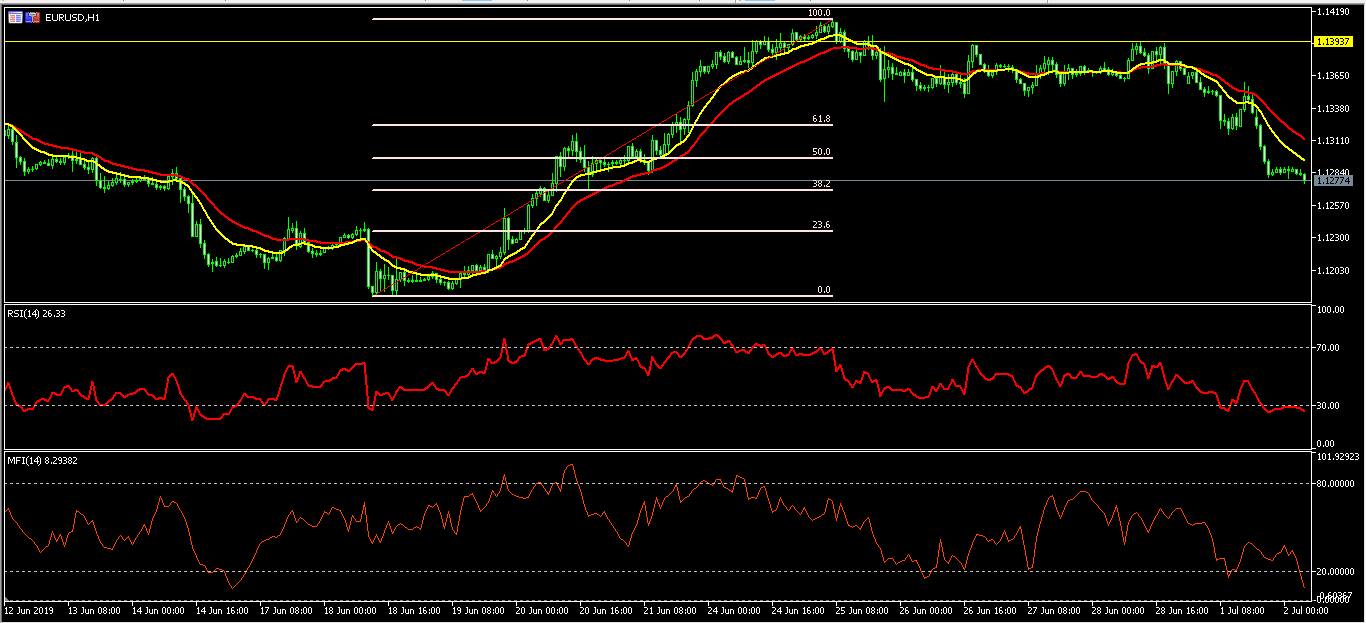
The EUR/USD pair declined sharply to a low of 1.1275, which was the lowest level since June 20. This was a continuation of a decline that started on June 28, when the pair formed a double bottom pattern as shown on the chart below. The price is below the 14-day and 28-day moving averages and slightly above the 38.2% Fibonacci Retracement level. The RSI remains below the oversold level. The same is true with the money flow index. The downward momentum is likely to continue moving lower to test the 23.6% Fibonacci Retracement level of 1.1230.
SPX500
The S&P index rose sharply to a record high of $2980 as traders rejoiced over the US-China truce. The upward trend was a continuation of a rally that started on December 20, when the index reached a low of $2338. On the daily chart, the momentum indicator has remained above the important level of 100. The price is above the 100-day and 50-day moving averages while the RSI has moved close to the overbought level of 70. In the next few days, the pair will likely reach the important psychological level of $3000.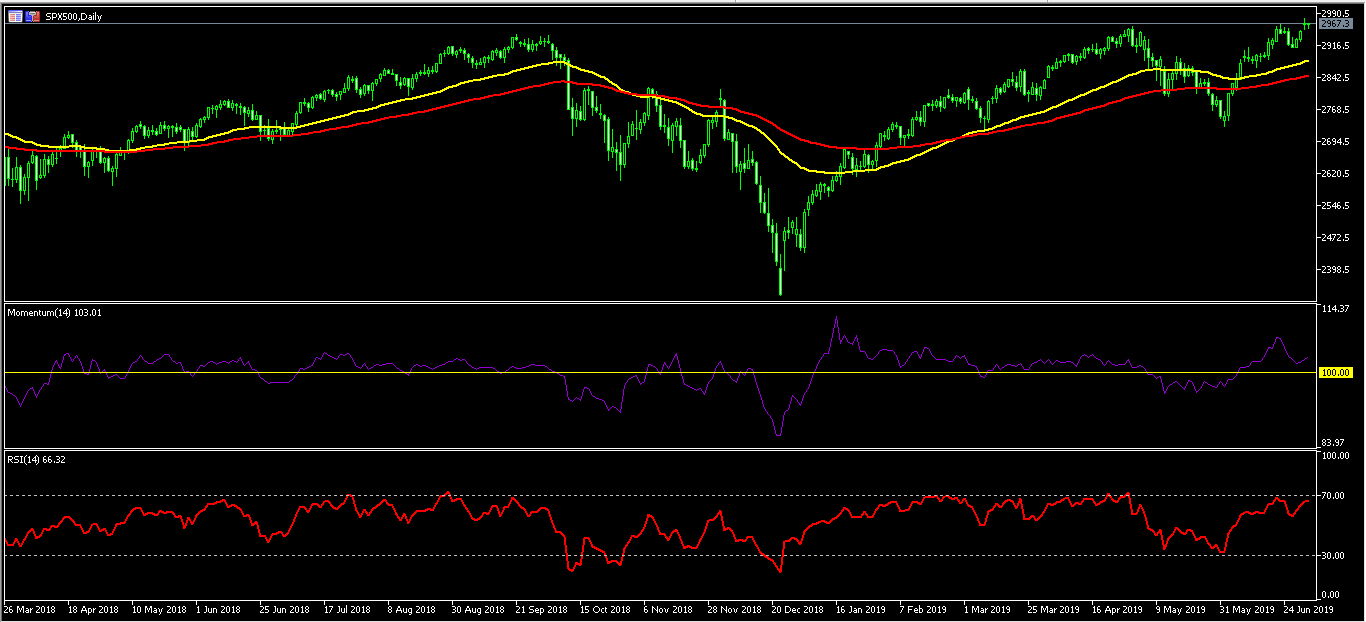
AUD/USD
The AUD/USD pair rose today after the dovish statement by the RBA. The reason the pair rose was that the rate cut was already priced-in by the market. The pair moved from yesterday’s close of 0.6955 to a high of 0.6985. On the hourly chart below, this price is slightly above the middle line of the Bollinger Bands and slightly below the important support line shown in yellow below. The pair’s RSI has moved from a low of 21 to the current 51. The pair will likely continue the upward trend to retest the previous high of 0.7000.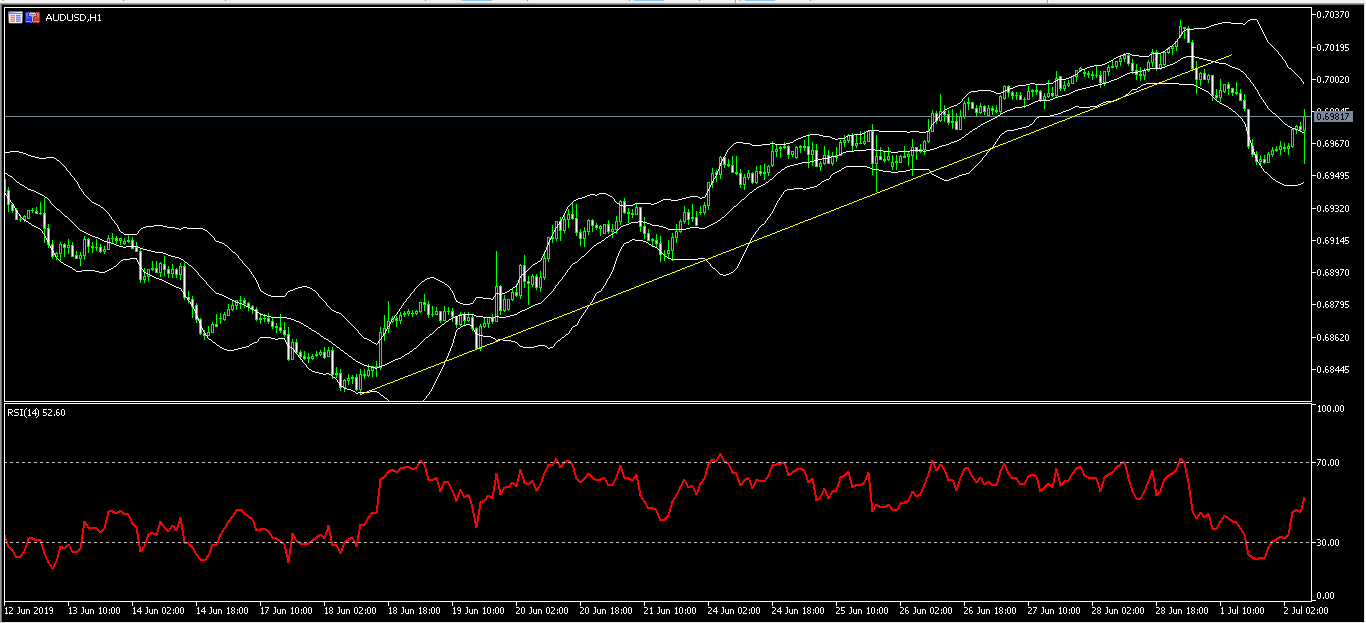
USTR proposes tariffs on additional USD 4B of EU products
Just days after agreeing to stop tariff escalation with China, US is now turning to EU. The US Trade Representative proposed tariffs on additional EU imports, as countermeasures to harm caused by EU aircraft subsidies. A "supplemental list" of 89 subheadings with approximate trade value of USD 4B was proposed. The list includes olives, Italian cheese and Scotch whiskey, etc.
That's additional to the USD 21B in EU imports published on April 12. A hearing will be held on the proposed additional products on August 5. But US could immediately impose increased duties on the products included in the initial list, if the WTO arbitrator issues a decision before the public comment period ends.
Beyond The Trade Ceasefire
Market movers today
In Brussels, EU leaders will resume their quest to fill the European top posts after they failed to do so at a marathon summit stretching from Sunday to Monday. Discussion continues to centre on the Dutch Socialist lead candidate Frans Timmermans for the Commission Presidency.
In the US, we have two interesting Fed speakers: Williams (voter, neutral) and Mester (voter, hawkish). It will be interesting to hear their take on the trade standoff between the US and China and if there are any hints about the July rate decision.
Overnight, we get service PMIs in Japan and China. For both countries, it should give us more information about how the domestically oriented part of the economy is doing (although in the case of China the service PMI is quite volatile). Like in Europe, the services sector has been more robust than the manufacturing sector.
In Denmark, we get the FX reserve figures. Danmarks Nationalbank has not intervened in the FX markets since January, even though the DKK has at times traded somewhat on the weak side. However, the DKK strengthened in June. Danmarks Nationalbank is also scheduled to release May's securities and foreign portfolio investment figures.
Selected market news
With the G20 meeting out of the way, market focus has returned to macro numbers to gauge how aggressive central banks will be in their easing steps in the coming months. In that light, yesterday's June manufacturing PMIs did not bring much to lighten the mood. Across Asia, the US and Europe, the message was one of shrinking factory activity in a sign that the global manufacturing cycle took another hit at the end of Q2. Japan's Tankan confidence index dropped to a three-year low, while the Chinese Caixin PMI fell back below the 50 threshold. In Europe, another marked decline in the periphery PMIs points to a clear risk that the manufacturing sector will return as a drag on growth in Q2 (see Euro Area Research - Catching up with reality ). In the US, the ISM manufacturing index fell back to the lowest level since October 2016 amid a sharp fall in new orders as the delayed impact from the tariff warfare is taking its toll on US companies.
After global stocks rallied following the US-China trade ceasefire over the weekend, the mood turned more sceptic about a fast turnaround in the global cycle following the lacklustre PMI signals and news that Washington is considering further tariffs worth EUR4bn on EU goods in retaliation for Airbus subsidies. 10Y German Bund yields dropped to a new all-time low of -0.35%, while the periphery fixed income markets saw further support from news that the Italian government is considering reigning in spending to avert EU budget sanctions. OPEC decided yesterday to extend output cuts by nine months. The decision was widely as expected after Saudi Arabia and Russia had agreed on this at a bilateral meeting over the weekend. Consequently, there was a limited impact on oil prices.
RBA Cuts Rates As Expected, Aussie Remains Higher
General Trend:
- REITS and Utilities outperform in Australia after rate cut, financials decline
- Automaker BYD rises over 3%, China President Xi said willing to support new energy auto sector
- HK gaming shares rise after monthly revenue data
- Nikkei-weighted Fast Retailing expected to report monthly sales after the equity close
- RBA cut rates as expected
- Markets now look ahead to upcoming comments from RBA Gov Lowe (5:30 AM EST or 9:30 GMT)
- China Premier Li: Will scrap ownership limits for securities companies and life insurance by 2020 (vs prior plan of 2021)
- China’s overnight repo rate declines below the PBOC IOER, PBOC noted current banking system liquidity is at relatively high level to absorb maturing reverse repos
- Additional protests have been reported in Hong Kong, President of HK Legislative Council said the repairs [related to protests] will take a long time
- USTR raises tariff threat related to the EU
Headlines/Economic Data
Australia/New Zealand
- ASX 200 opened +0.1%
- (AU) RESERVE BANK OF AUSTRALIA (RBA) CUTS CASH RATE TARGET BY 25BPS TO 1.00%; AS EXPECTED (2nd consecutive cut)
- (NZ) New Zealand Q2 Business Confidence Index: -34 v -29 prior (lowest since Mar 2009); Domestic Trading Index: -4 v -2 prior
- (NZ) New Zealand May Building Permits m/m: +13.2% v -8.0% prior
- SDA.AU Cuts FY19 EBITDA ~$140-150M (prior ~A$160-171M); Guides H1 underlying EBITDA $60-64M
Japan
- Nikkei 225 opened -0.1%
- (JP) Bank of Japan (BOJ) Q2 Tankan Company Survey of CPI Expectations: Cuts 3-year outlook to 1.0% from 1.1%; Maintains 1-yr and 5-year
- (JP) Japan end-June Monetary Base ¥523.2T v ¥511.8T prior; Y/Y: 4.0% v 3.6% prior
- (JP) Japan Economy Min Motegi: Tankan confirms Japan's non-manufacturing sector is strong; capital spending plans are strong and supporting demand
- (JP) Japan Fin Min Aso: Tankan shows non-manufacturing sentiment is improving; exports are slowing resulting in manufacturing slowdown; domestic fundamental remain solid; reiterates must raise sales tax in October
- (JP) Japan Cabinet Sec Suga: Japan's exports managed appropriately for security purposes
- (JP) Japan MoF sells ¥2.1T v ¥2.1T indicated in 0.1% 10-year JGBs: avg yield: -0.139% v -0.106% prior, bid to cover 3.92x v 3.99x prior
Korea
- Kospi opened -0.4%
- (JP) Follow up to Japan trade barrier to export of chip making supplies to South Korea: Under new rules Japanese companies must seek approval to export 3 semiconductor industry chemicals to South Korea; Japan Govt has indicated this process is likely to take ~3-months; typically South Korea chip makers keep 1-2 months of supply on hand – Nikkei
- (KR) US State Dept: US is not currently not preparing any new proposals for negotiations to dismantle North Korea's nuclear weapons program – Yonhap
- (KR) SOUTH KOREA JUN CPI M/M: -0.2% V -0.1%E; Y/Y: 0.7% V 0.8%E
China/Hong Kong
- Hang Seng opened +1.3%; Shanghai Composite opened -0.1%
- (CN) China Premier Li: China will not resort to competitive yuan devaluation, to keep yuan at reasonable and equilibrium level; will keep economic growth stable, to maintain prudent monetary policy, will not flood economy with excess liquidity - speaking at World Economic Forum
- (CN) US President Trump: New round of trade talks has started with China, expect that China President Xi will move on some of the disputed issues
- (CN) China military conducted antiship ballistic missile tests in the South China Sea over the weekend, expected to test again before the testing window closes Wednesday
- (HK) Hong Kong pro-democracy protesters have entered the Legislative Council building - financial press (later broken up and kicked out by police, many arrested)
- (CN) China PBOC Gov Yi Gang: Domestic economy growing close to potential; trade truce better than expected but outstanding issues remain - comments from Helsinki
- (CN) China PBoC Open Market Operation (OMO): Skips for the 7th consecutive; Net drains CNY90B v drain CNY150B prior
- (CN) China PBOC sets yuan reference rate: 6.8513 v 6.8716 prior
- (CN) China Commerce Ministry (MOFCOM) Official Chu Shijia: Number of companies moving supply chains out of China is small, shouldn't be overstated; trade war impact on the economy is manageable
North America
- (US) USTR proposes increased tariffs on EU products due to EU aircraft subsidies, proposes adding more tariffs to $4.0B of EU goods
Europe
- (RU) Russia Energy Min Novak: Russia will study proposal to change OPEC+ inventory target
- (UK) Parliament Speaker Bercow denies amendment that would block a no deal Brexit
- DBK.DE Reportedly considering lowering capital buffer to fund the company's overhaul – press
Levels as of 1:20 ET
- Nikkei 225, flat , ASX 200 +0.1%, Hang Seng +1.3%; Shanghai Composite -0.3%; Kospi -0.3%
- Equity Futures: S&P500 flat; Nasdaq100 flat, Dax flat; FTSE100 +0.2%%
- EUR 1.1291-1.1275; JPY 108.47-108.27 ; AUD 0.6987-0.6957 ;NZD 0.6682-0.6658
- Gold +0.3% at $1,393/oz; Crude Oil -0.2% at $58.98/brl; Copper +0.2% at $2.690/lb
XAU/USD Historic Bullish Breakout After A Decade Correction
The XAU/USD (gold) has completed the wave 1-2 (purple) pattern now that price is breaking above the resistance trend lines (dotted red). The bullish breakout is probably part of a larger wave 4-5 (red) pattern after price made a bullish bounce and reversal at the 50% Fibonacci level of wave 4 vs 3.
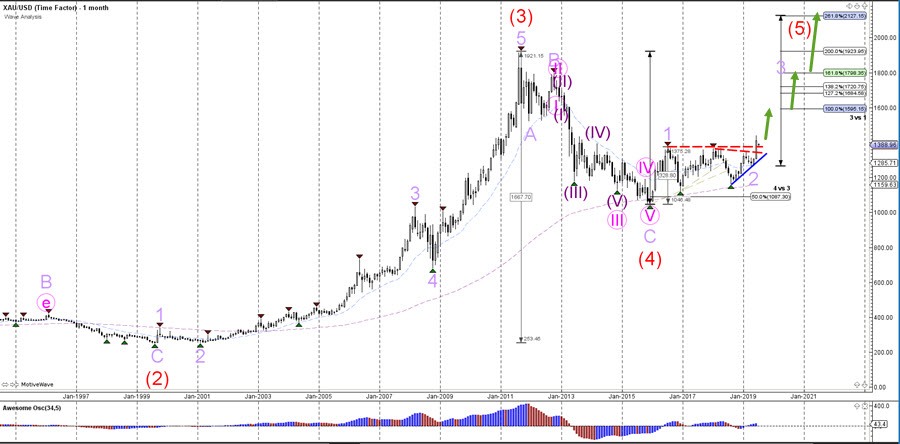
The XAU/USD has shown strong bullish momentum but currently price action is also moving down quickly. The upside is likely a bullish 5 wave pattern (purple), which in turn could complete a first wave 1 (pink). If that is the case, then the current pullback could be an ABC (purple) pattern within a wave 2 (pink). The wave B (purple) remains valid as long as price stays below the 100% Fib level of wave B vs A.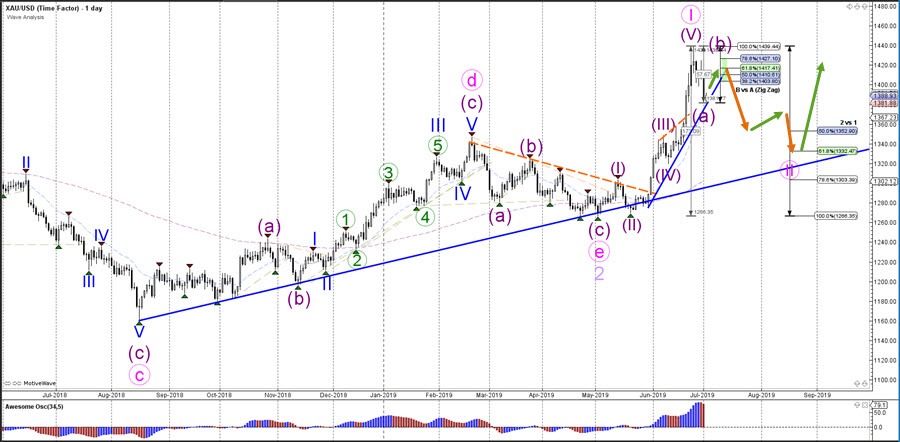
Trump: Trade negotiations with China essentially has already begun
Trump said that trade negotiations with China "essentially has already begun". And, negotiators were "speaking very much on phone they are also meeting". He remained optimistic and said "I think we have a good chance of making a deal".
Though, he emphasized that China has had a "big advantage"over the US in trade for "many years". Hence, "obviously you can't make a 50-50 deal. It has to be a deal that is somewhat tilted to our advantage."