

Sample Category Title
AUD continuing recovery as RBA maintains easing bias but doesn’t turn more dovish
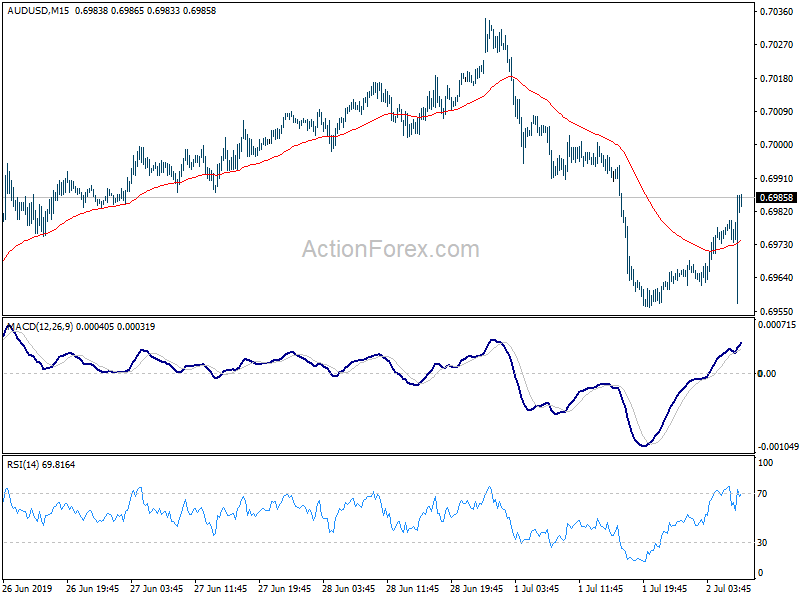
Australian Dollar recovered earlier today ahead of RBA rate decision. Some knee-jerk reactions were seen after RBA announced the highly anticipated 25 bps rate cut to 1.00%. But AUD/USD quickly found its footing as the accompanying statement revealed nothing special, and doesn't indicate a drastic dovish turn. While RBA opens the door for more rate cut ahead, upcoming developments, including new economic projections in August, would play an important part in deciding when the next cut would be delivered.
The most important part of the statement is that "the Board will continue to monitor developments in the labour market closely and adjust monetary policy if needed to support sustainable growth in the economy and the achievement of the inflation target over time". It's self-explanatory that RBA is open to further easing.
Globally, RBA maintained that outlook "remains reasonable". Domestically, RBA acknowledged the below trend 1.8% growth in Q1. But it noted that "central scenario for the Australian economy remains reasonable, with growth around trend expected." Consumption continues to be the main domestic uncertainty".
Employment growth has "continued to be strong". But again, " labour market outcomes suggest that the Australian economy can sustain lower rates of unemployment and underemployment." Inflation pressures "remain subdued". But inflation is expected to pick up to "around 2 per cent in 2020 and a little higher after that". On the positive side, RBA noted t some tentative signs that houses prices are "now stabilizing" in Sydney and Melbourne.
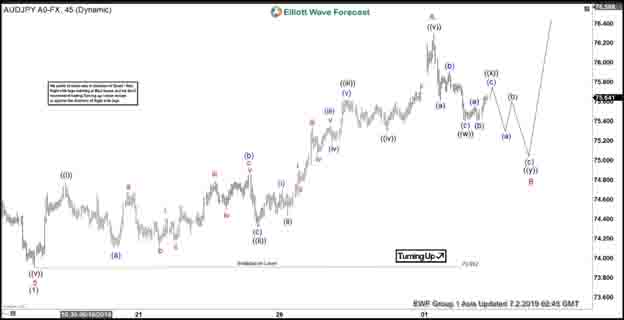
Elliott Wave View: AUD/JPY Should Remain Supported
Short term Elliott Wave view on AUDJPY suggests that the rally from June 18 low is unfolding as a zigzag Elliott Wave structure. A zigzag is an ABC structure with 5-3-5 subdivision. The rally from June 18 low ended wave A at 76.28 as a 5 waves impulse. Up from June 18 low, wave ((i)) ended at 74.77, and wave ((ii)) ended at 74.32. Pair then rallied higher again and ended wave ((iii)) at 75.62, then wave ((iv)) pullback ended at 75.3. Wave ((v)) of A ended at 76.28 and this ended the cycle from June 18 low.
Pair is currently correcting cycle from June 18 low within wave B. The internal of wave B is unfolding as a double zigzag Elliot Wave structure. Down from 76.28, wave ((w)) ended at 75.4 as a zigzag. While wave ((x)) bounce fails below 76.28, pair has scope to extend lower within wave ((y)) as another zigzag structure before ending wave B. Afterwards, pair should resume higher again. We don’t like selling the pair and expect buyers to appear and dips to be supported in 3, 7, or 11 swing as far as pivot at 73.9 low stays intact.
AUDJPY 1 Hour Elliott Wave Chart
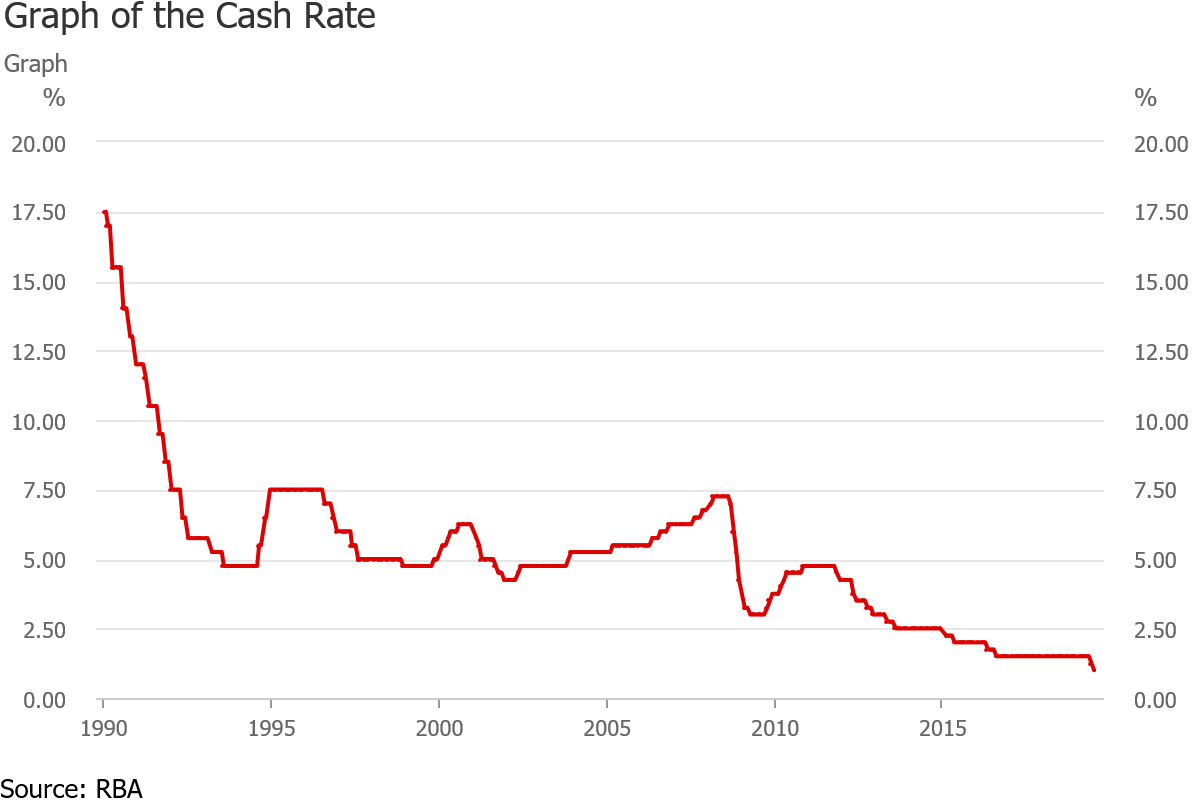
RBA cut interest rate to 1.00%, full statement
RBA cut interest rate by 25bps to 1.00% as widely expected.
Full statement below.
Statement by Philip Lowe, Governor: Monetary Policy Decision
At its meeting today, the Board decided to lower the cash rate by 25 basis points to 1.00 per cent. This follows a similar reduction at the Board's June meeting. This easing of monetary policy will support employment growth and provide greater confidence that inflation will be consistent with the medium-term target.
The outlook for the global economy remains reasonable. However, the uncertainty generated by the trade and technology disputes is affecting investment and means that the risks to the global economy are tilted to the downside. In most advanced economies, inflation remains subdued, unemployment rates are low and wages growth has picked up. The slowdown in global trade has contributed to slower growth in Asia. In China, the authorities have taken steps to support the economy, while continuing to address risks in the financial system.
Global financial conditions remain accommodative. The persistent downside risks to the global economy combined with subdued inflation have led to expectations of easing of monetary policy by the major central banks. Long-term government bond yields have declined further and are at record lows in a number of countries, including Australia. Bank funding costs in Australia have also declined, with money-market spreads having fully reversed the increases that took place last year. Borrowing rates for both businesses and households are at historically low levels. The Australian dollar is at the low end of its narrow range of recent times.
Over the year to the March quarter, the Australian economy grew at a below-trend 1.8 per cent. Consumption growth has been subdued, weighed down by a protracted period of low income growth and declining housing prices. Increased investment in infrastructure is providing an offset and a pick-up in activity in the resources sector is expected, partly in response to an increase in the prices of Australia's exports. The central scenario for the Australian economy remains reasonable, with growth around trend expected. The main domestic uncertainty continues to be the outlook for consumption, although a pick-up in growth in household disposable income is expected to support spending.
Employment growth has continued to be strong. Labour force participation is at a record level, the vacancy rate remains high and there are reports of skills shortages in some areas. There has, however, been little inroad into the spare capacity in the labour market recently, with the unemployment rate having risen slightly to 5.2 per cent. The strong employment growth over the past year or so has led to a pick-up in wages growth in the private sector, although overall wages growth remains low. A further gradual lift in wages growth is still expected and this would be a welcome development. Taken together, these labour market outcomes suggest that the Australian economy can sustain lower rates of unemployment and underemployment.
Inflation pressures remain subdued across much of the economy. Inflation is still, however, anticipated to pick up, and will be boosted in the June quarter by increases in petrol prices. The central scenario remains for underlying inflation to be around 2 per cent in 2020 and a little higher after that.
Conditions in most housing markets remain soft, although there are some tentative signs that prices are now stabilising in Sydney and Melbourne. Growth in housing credit has also stabilised recently. Demand for credit by investors continues to be subdued and credit conditions, especially for small and medium-sized businesses, remain tight. Mortgage rates are at record lows and there is strong competition for borrowers of high credit quality.
Today's decision to lower the cash rate will help make further inroads into the spare capacity in the economy. It will assist with faster progress in reducing unemployment and achieve more assured progress towards the inflation target. The Board will continue to monitor developments in the labour market closely and adjust monetary policy if needed to support sustainable growth in the economy and the achievement of the inflation target over time.
(RBA) Statement by Philip Lowe, Governor: Monetary Policy Decision
At its meeting today, the Board decided to lower the cash rate by 25 basis points to 1.00 per cent. This follows a similar reduction at the Board's June meeting. This easing of monetary policy will support employment growth and provide greater confidence that inflation will be consistent with the medium-term target.
The outlook for the global economy remains reasonable. However, the uncertainty generated by the trade and technology disputes is affecting investment and means that the risks to the global economy are tilted to the downside. In most advanced economies, inflation remains subdued, unemployment rates are low and wages growth has picked up. The slowdown in global trade has contributed to slower growth in Asia. In China, the authorities have taken steps to support the economy, while continuing to address risks in the financial system.
Global financial conditions remain accommodative. The persistent downside risks to the global economy combined with subdued inflation have led to expectations of easing of monetary policy by the major central banks. Long-term government bond yields have declined further and are at record lows in a number of countries, including Australia. Bank funding costs in Australia have also declined, with money-market spreads having fully reversed the increases that took place last year. Borrowing rates for both businesses and households are at historically low levels. The Australian dollar is at the low end of its narrow range of recent times.
Over the year to the March quarter, the Australian economy grew at a below-trend 1.8 per cent. Consumption growth has been subdued, weighed down by a protracted period of low income growth and declining housing prices. Increased investment in infrastructure is providing an offset and a pick-up in activity in the resources sector is expected, partly in response to an increase in the prices of Australia's exports. The central scenario for the Australian economy remains reasonable, with growth around trend expected. The main domestic uncertainty continues to be the outlook for consumption, although a pick-up in growth in household disposable income is expected to support spending.
Employment growth has continued to be strong. Labour force participation is at a record level, the vacancy rate remains high and there are reports of skills shortages in some areas. There has, however, been little inroad into the spare capacity in the labour market recently, with the unemployment rate having risen slightly to 5.2 per cent. The strong employment growth over the past year or so has led to a pick-up in wages growth in the private sector, although overall wages growth remains low. A further gradual lift in wages growth is still expected and this would be a welcome development. Taken together, these labour market outcomes suggest that the Australian economy can sustain lower rates of unemployment and underemployment.
Inflation pressures remain subdued across much of the economy. Inflation is still, however, anticipated to pick up, and will be boosted in the June quarter by increases in petrol prices. The central scenario remains for underlying inflation to be around 2 per cent in 2020 and a little higher after that.
Conditions in most housing markets remain soft, although there are some tentative signs that prices are now stabilising in Sydney and Melbourne. Growth in housing credit has also stabilised recently. Demand for credit by investors continues to be subdued and credit conditions, especially for small and medium-sized businesses, remain tight. Mortgage rates are at record lows and there is strong competition for borrowers of high credit quality.
Today's decision to lower the cash rate will help make further inroads into the spare capacity in the economy. It will assist with faster progress in reducing unemployment and achieve more assured progress towards the inflation target. The Board will continue to monitor developments in the labour market closely and adjust monetary policy if needed to support sustainable growth in the economy and the achievement of the inflation target over time.
Market Morning Briefing: Aussie Has Come Off Sharply To Test Support Near 0.695
STOCKS
Asians are trading mixed today. While the positive outcome of the US-China meeting over the weekend has boosted the sentiment, news on the US considering additional tariffs on the EU and China conducting anti-ship ballistic missile test may weigh on the markets in the near term. However, the broader picture continues to remain bullish and the rally is likely to continue in the global indices.
Dow (26717.43, +117.47, +0.44%) remains bullish to target 27200-27500 in the coming days. A strong break above 27000 can accelerate the rally. Support is in the 26500-26450 region which can limit the downside.
DAX (12521.38, +122.58, +0.99%) surged as expected to test our first target level of 12600 and has come-off from there. While above the support at 12450, DAX has the potential to target 12800 and even 13000 in the coming weeks.
Nikkei (21744.09, +14.12, +0.06%) has risen as expected to test the crucial resistance level of 21750. A strong rise past 21750 is needed for the current upmove to extend towards 22000 and 22250. s poised at a crucial juncture. A pull-back from current levels can drag the index to 21500 and 21350.
Shanghai (3041 3037.82, -7.09, -0.23%) is bullish to test 3080 and 3100 in the near term. Support is in the 3010-3000 zone. As mentioned yesterday, the current leg of upmove has the potential to the Shanghai up to 3200 over the medium term.
Sensex (39686.50, +291.86, +0.74%) and Nifty (11865.60, +76.75, +0.65%) bounced yesterday taking cues from other markets, but did not break their respective resistances at 39750 and 11900. The indices have to breach their resistance to gain momentum and target 40000-40500 (Sensex) and 12000-12150 (Nifty) on the upside. While below these resistances, the Sensex can trade sideways between 38900 and 39800 while the Nifty can remain range bound between 11600 and 11900.
COMMODITIES
OPEC agreed to an extension of the current 1.2 mln barrels per day production cut upto Mar'20, a nine month extension from July'19. This initially led to a rise in Crude prices but failed to sustian at those levels. Cude prices are trading lower today and day the markets await further details after the non-producers meeting due today.
Brent (64.9) tested 66.75 yesterday before coming off towards lower levels. Note that 67-69 is important technical resistance zone that is likely to hold for the medium term. For now 67 seems to be holding well.
Nymex WTI (58.89) has also come off from resistance near 60 and while that holds, prices could be pushed towards 56 in the near term.
There is scope of a re-test of immediate resistances in the next few sessions.
Gold (1393.3) has dipped slightly. We continue to look at support near 1390/80 from where a bounce back towards 1400+ levels is probable.
Silver (15.22) has come off from resistance near 15.50/60 and while that holds we could see some ranged movement within 15.5-15.0 region for the near term. Immediate support is seen near 15.
Copper (2.6860) has dropped sharply. Note that there is important resistances near 2.78 and 2.80 which is likely to hold in the medium term.
FOREX
Strength in the US Dollar yesterday paused gains for major currencies. News of an additional $4 billion tariffs over EU aircraft subsidies dragged Euro further. Aussie, Pound and Yuan could fall in the near term. Dollar Yen and Dollar-Rupee have some scope to rise in the near term but have important resistances above current levels.
Dollar Index (96.85) moved up yesterday and trades higher while support near 95.50 holds. A test of 97.25 on the upside looks possible in the near term before the index starts falling from there back towards current levels. Near ter, looks bullish.
Euro (1.1279) fell sharply to test lower support at current levels. Below 1.1280, there is support at 1.1250. A bounce from current levels or from 1.1250 is expected in the next 1-2 sessions that could take the pair higher towards 1.1300-1.1350 again.
Dollar-Yen (108.40) trades higher on stronger Dollar. The pair could face some resistance from 108.80-109.00 region in the near term from where a fall back towards 108 is possible.
Euro-Yen (122.30) tested 123.35 yesterday before falling sharply from there. Support near 121.0-121.5 is likely to hold in the medium term pushing the currency pair back to higher levels.
Aussie (0.6976) has come off sharply to test support near 0.695. If the current level holds, Aussie could start moving up again towards 0.7050. Failure to bounce back immediately would take Aussie towards 0.69 in the near term.
Pound (1.2641) also dipped on stronger Dollar and is heading towards support at 1.26. Broad sideways movement within 1.28-1.26 looks likely in the medium term.
USDCNY (6.8602) has bounced from 6.83 and while that holds, the pair could attempt to rise towards 6.89 again in the near term.
USDINR (68.89) could not sustain a rise above 69 yesterday and came down to close lower. There is some scope of re-attempting a rise towards 69.10/20 while the medium term outlook is bearish towards 68.60 on a break below 68.90/80 in the near term.
INTEREST RATES
Risk appetite in the market is giving a breather to the US yields. As mentioned yesterday, the US Yields can consolidate or may even see a slight corrective rally before the next leg of downmove begins. The German Bund yields on the other hand is under pressure as the fall seems to gather momentum.
The US Treasury yields have risen across tenor with the 2Yr (1.78%) moving up the most by 3 bps. The 5Yr (1.78%), 10Yr (2.02%) and the 30Yr (2.54%) were up 1 bps each. Our view remains the same. The 30Yr yield can consolidate between 2.53% and 2.60% within its overall downtrend in the near-term and then can eventually fall to 2.50% and 2.48%. The 10Yr on the other hand can trade sideways between 2% and 2.10%.
The German Yields were down across tenors. The 2Yr (-0.77%), 5Yr (-0.69%), 10Yr (-0.36%) and the 30Yr (0.24%) were down between 2 and 4 bps. The bearish view remains intact. The 5Yr can test 0.73% and the 10Yr can dip to -0.40% and -0.42% in the coming days.
The 10Yr GOI (7.0070%) was stuck between 7% and 7.05% for the second consecutive trading day thereby leaving the near-term outlook mixed. The yield can trade in a range between 6.90% and 7.10%. Within this range we expect it to break below 7% and fall to 6.90% in the near term. The broader view remains bearish for the 10Yr GOI to decline below 6.90% and target 6.80% and 6.75% over the medium term.
GBP/USD Showing Signs Of Short Term Weakness
Key Highlights
- The British Pound failed to settle above 1.2760 and recently declined against the US Dollar.
- GBP/USD is likely following a declining pattern and it could test the 1.2600 support area.
- The UK Manufacturing PMI in May 2019 declined further from 49.4 to 48.0.
- The UK Construction PMI in May 2019 might increase from 48.6 to 49.3.
GBPUSD Technical Analysis
This past week, the British Pound made another attempt to climb above the 1.2760 and 1.2780 resistance levels. However, the GBP/USD pair failed to continue higher, topped at 1.2783, and recently declined below 1.2700.
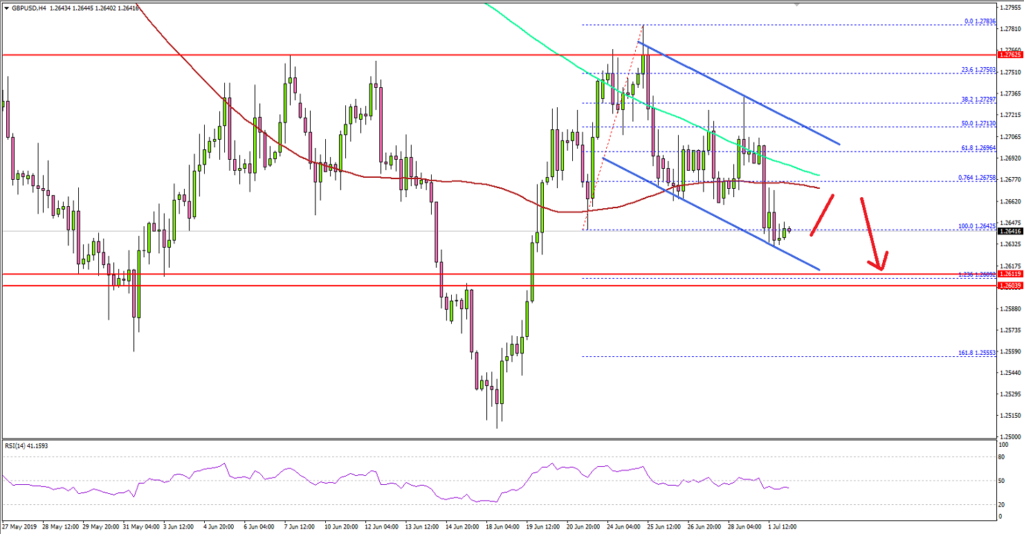
Looking at the 4-hours chart, the pair started a fresh decline from well above the 1.2750. It broke a few important supports near the 1.2720 level and the 100 simple moving average (red, 4-hours).
There was also a break below the last swing low near the 1.2642. It has opened the doors for more losses below the 1.2640 and 1.2620 levels.
The next major support is near the 1.2600 area plus the 1.236 Fib extension level of the last wave from the 1.2642 low to 1.2783 high. Once the pair revisits the 1.2600 support, it could start a fresh increase above the 1.2700 and 1.2720 levels.
On the upside, there are many important resistances near the 1.2700 level. There is also a connecting bearish trend line in place with resistance near 1.2695 on the same chart. Therefore, a successful close above the 1.2700 barrier is needed for a fresh increase in the near term.
Fundamentally, the UK Manufacturing PMI for May 2019 was released by both the Chartered Institute of Purchasing & Supply and the Markit Economics. The market was looking for a minor drop from the last reading of 59.4 to 49.2.
The actual result was disappointing, as the UK Manufacturing PMI declined to 48.0 and registered yet another contraction (lowest level since February 2013).
The report added:
The UK manufacturing sector continued to feel the reverberations of the unwinding of earlier pre-Brexit stockpiling activity during June. The already high stock levels at both manufacturers and their clients led to a scaling back of output and new order intakes, with demand from both domestic and export markets weakening.
Overall, GBP/USD seems to be struggling to gain bullish momentum. Therefore, it could slide towards the 1.2600 support before the bulls attempts another upward move.
Economic Releases to Watch Today
- German Retail Sales for May 2019 (MoM) – Forecast 0.5%, versus -2.0% previous.
- UK's Construction PMI for May 2019 – Forecast 49.3, versus 48.6 previous.
Daily Markets Broadcast
Stocks close off highs
US indices retreated from intra-day highs at the close yesterday, but not before the SPX500 index hit record highs. OPEC appears on the verge of extending production cuts for nine months. The Reserve Bank of Australia is expected to cut rates at a second consecutive meeting to bring the benchmark rate to 1.0%.
US30USD Daily Chart
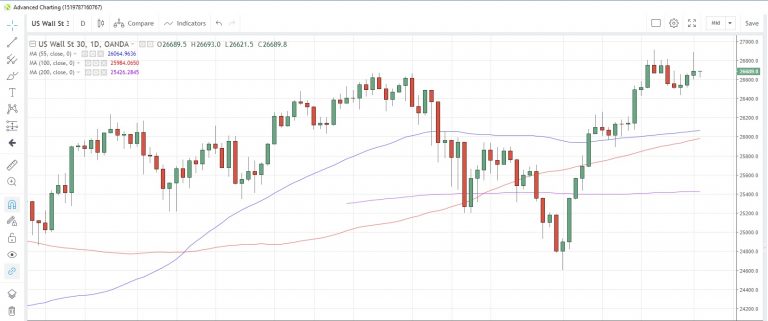
The US30 pared early gains yesterday after failing to overcome last month’s high. The index closed higher for the third consecutive day
The index probably still has eyes on the June high at 26.913 and the October high of 26,940
The June ISM manufacturing PMI came in better than expected, but was still lower than May. There are no major data releases today but Fed’s Williams is scheduled to speak.
DE30EUR Daily Chart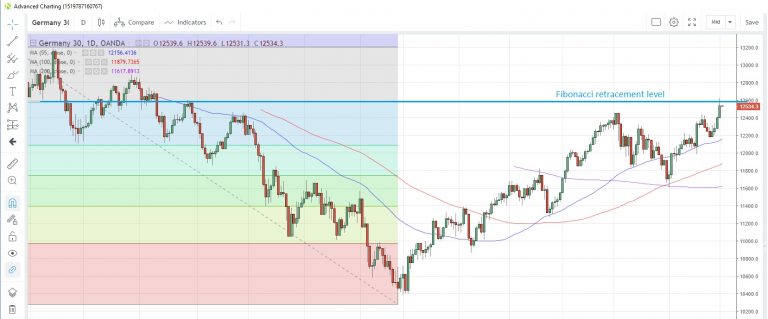
The Germany30 index touched an 11-month high yesterday despite softer economic data releases
The 78.6% Fibonacci retracement of the May-December drop last year at 12,581 was tested but held on a closing basis. The August 2018 high is at 12,599
June manufacturing PMI data came in below forecast in the Euro-zone, Germany, France, Italy and the UK. Today’s releases include German retail sales for May, which are seen rebounding to +0.5% m/m from -2.0%.
WTICOUSD Daily Chart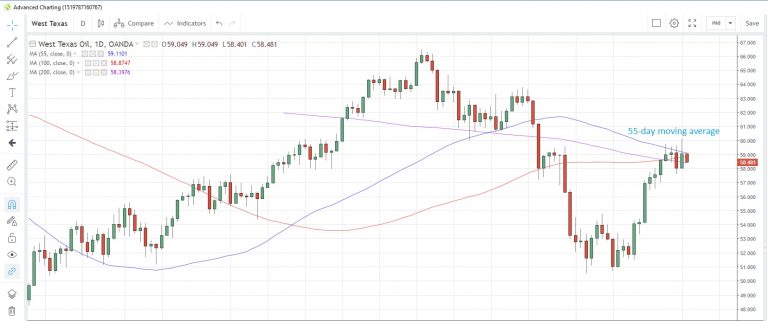
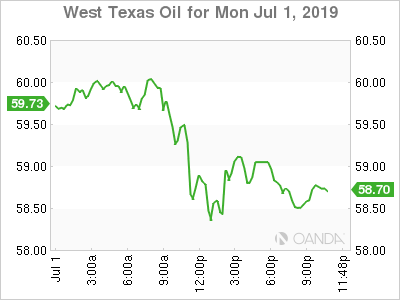
Crude oil prices rose yesterday after OPEC seemed set to agree on an extension of current production cuts for another nine months. The decision still needs to be ratified by non-OPEC allies today
WTI is testing the 55-day moving average at $59.11, which has held on a closing basis since May 21
Weekly crude oil stockpiles data from the American Petroleum Institute are due today. Last week saw a drawdown of 7.55 million barrels.
US Close – Record Highs, Strong Dollar, OPEC + Cuts Signal Extension, Bitcoin Falls
Much of Wall Street was maligned about both the developments that occurred during the start of the free agency window for the New York Knicks and to the outcome from the Trump-Xi meeting. Some traders are saying as we approach 2020 election mode, Trump on trade, would rather look good and lose than look bad and win. The US could fight for significant SOE reform here and leverage the Hong Kong situation, but it appears Trump will be happy to secure only additional purchases and delivering on reforms that the Chinese were eventually going to move forward on.
Markets ended well off their highs as investors weighed the lack of substance from the US-China trade truce that was reached this weekend. While not much progress was made on the remaining 10% that is needed to finalize a trade deal, China emerged as the clear winner. Trump secured additional agricultural purchases, while confirming no new tariffs on Chinese goods for the time being along with promises of softening restrictions on what goods could be sold to Huawei.
With most of the market pricing in some concessions regarding Huawei and to delay of the next round of tariffs on additional $300 billion worth of Chinese imports, stocks may see the next catalysts stem from deteriorating economic data that will support the arguments for the Fed to deliver a stronger commitment to easing and for the other major central banks to step up their efforts.
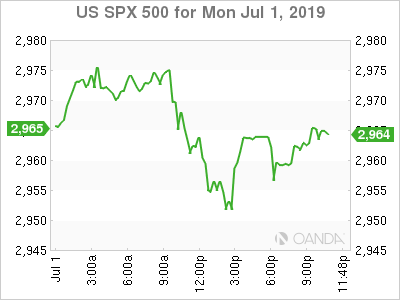
US stocks closed in record territory despite giving up half of its gains as the focus has shifted back to the falling expectations of earnings growth in the second quarter. Surveys and sentiment indicators are pointing to a only a slight gain with earnings, down from 3.5% seen a couple months ago and almost 7% at the beginning of the year. The dollar rallied mainly on euro weakness.
Oil
Oil traders are following the market adage of buying the rumor and selling the news. Crude prices were off to a strong start to the trading week after OPEC + signaled they will agree upon a nine-month extension of oil production cuts. At the end of last week, expectations were high for a six-month extension as weakening global demand and rising American output have hurt prices. Committing to an extension of production cuts beyond the next OPEC extraordinary meeting is pointless, which will likely occur before year end. Tomorrow, OPEC’s allies will need to approve the production cut extension, but with Russia signalling over the weekend they are on board, in theory Tuesday should go smoother than today.
Both WTI and Brent prices fell early in the afternoon as OPEC ministers struggled to deliver the OPEC + charter. The morning headlines all pointed to a positive outcome, but the hold up came from Iran, who stated they would not support the charter unless OPEC had a unanimous agreement. Oil prices turned negative on the day but then rallied off the lows after Iran approved the compromise on the OPEC + charter.
Crude prices should struggle in the short-term on a stronger dollar and despite OPEC + determination to rebalance the supply side as demand outlooks are waning due to softer than expected manufacturing data globally.
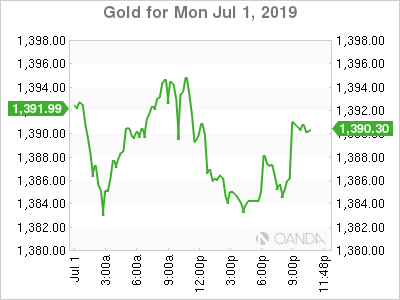
Gold
Gold is having its worst day since November 2016 as the US-China trade détente and surging US dollar gave little demand for havens. The yellow metal did rebound earlier in NY after the ISM manufacturing index in the US fell to lowest level since September 2016, following a trend of softer factory output data globally. It appears investors may be patient on this pullback that is occurring after making a six-year high last week. The markets may take a few days to process the lack of substance with the trade truce and ultimately gold will be supported on speculation the Fed along with the other major central banks will deliver more stimulus to fend off the global slowdown. The $1,360 an ounce level should provide major support for gold traders.
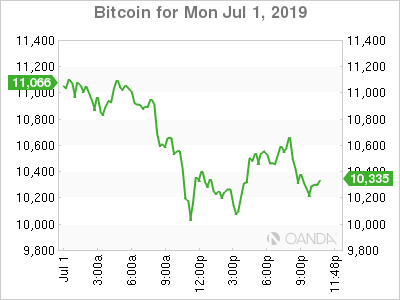
Bitcoin
Bitcoin is almost down 30% from last week’s high as interest for wobbles and skepticism grows for the meteoric rise to continue. The largest cryptocurrency is up over 270% since the start of the year and further adoption from other major institutions and possibly central banks should keep digital coins supported.
The recent slump has seen most of the Libra driven gains wiped away and the key gap mid-June gap nearly filled. In the short-term we could see initial support at current levels, with major support falling at the $9,000 level.
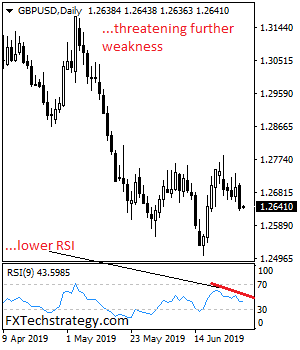
GBPUSD Backs Off Higher Prices With Eyes On 1.2600
GBPUSD backs off higher prices with eyes on 1.2600 on Monday. Support lies at 1.2600 as it looks for more weakness. Below that level will turn attention to the 1.2550 level. Further down, support comes in at the 1.2500 level where a break will turn focus to the 1.2450 level. Further down, support lies at the 1.2400 level. On the upside, resistance stands at the 1.2700 with a turn above here allowing for additional strength to build up towards the 1.2750 level. Further out, resistance stands at the 1.2800 level followed by the 1.2850 level. On the whole, GBPUSD retains downside pressure.
Eco Data 7/2/19
[php_everywhere instance="1"]