

Sample Category Title
USD/CHF Daily Outlook
Daily Pivots: (S1) 0.9707; (P) 0.9742; (R1) 0.9791; More...
Intraday bias in USD/CHF remains neutral for consolidation above 0.9695 temporary low. Upside of recovery should be limited by 0.9854 support turned resistance to bring fall resumption. On the downside, below 0.9659 will target 0.9587 fibonacci level. Nevertheless, break of 0.9854 will indicate short term bottoming and target 1.0014 resistance instead.
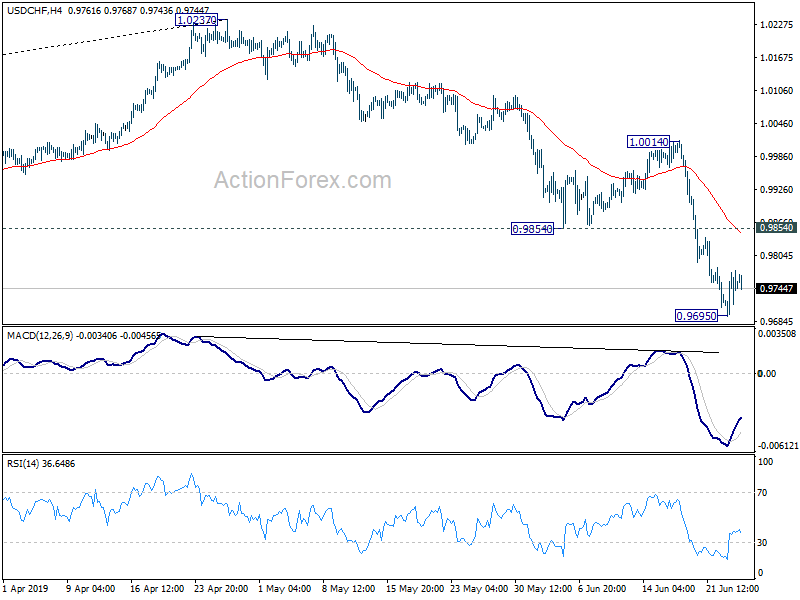
In the bigger picture, current development confirms that up trend from 0.9186 (2018 low) has completed at 1.0237 already. With 38.2% retracement of 0.9186 to 1.0237 at 0.9836 taken out, deeper fall should be seen to 61.8% retracement at 0.9587 and below. We'd pay attention to bottoming signal below 0.9587.
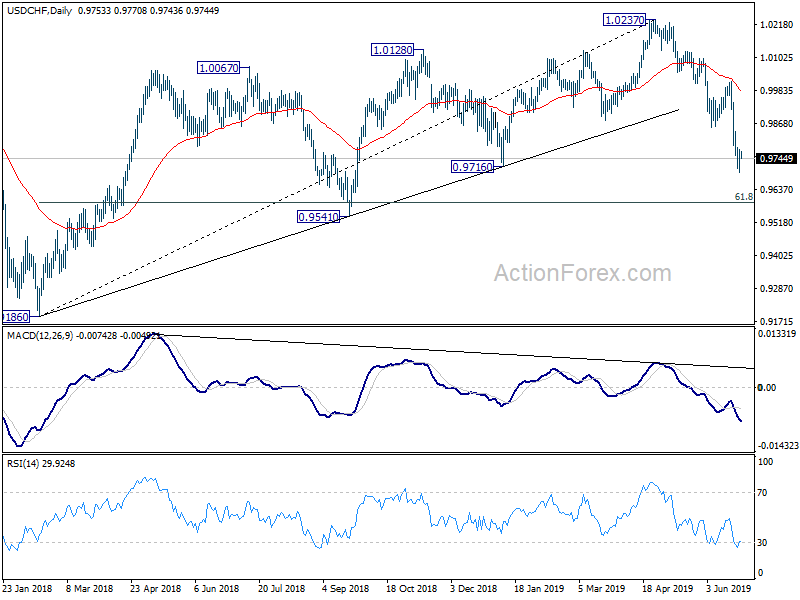
EURUSD 1.1360 Key
The euro has slipped back from the 1.1400 level against the US dollar following Federal Reserve Chair Jerome Powells speech on Tuesday. The EURUSD pair can weaken towards the 1.1260 level if sellers start to hold price below the important 1.1360 level. Bulls need to move price past the 1.1400 level to encourage technical buying towards at least the 1.1440 resistance level.
If the EURUSD pair trades above the 1.1360 level, key technical resistance is found at the 1.1440 and 1.1500 levels.
The EURUSD pair is only bearish while trading below the 1.1360 level, key support is found at the 1.1321 and 1.1260 levels.
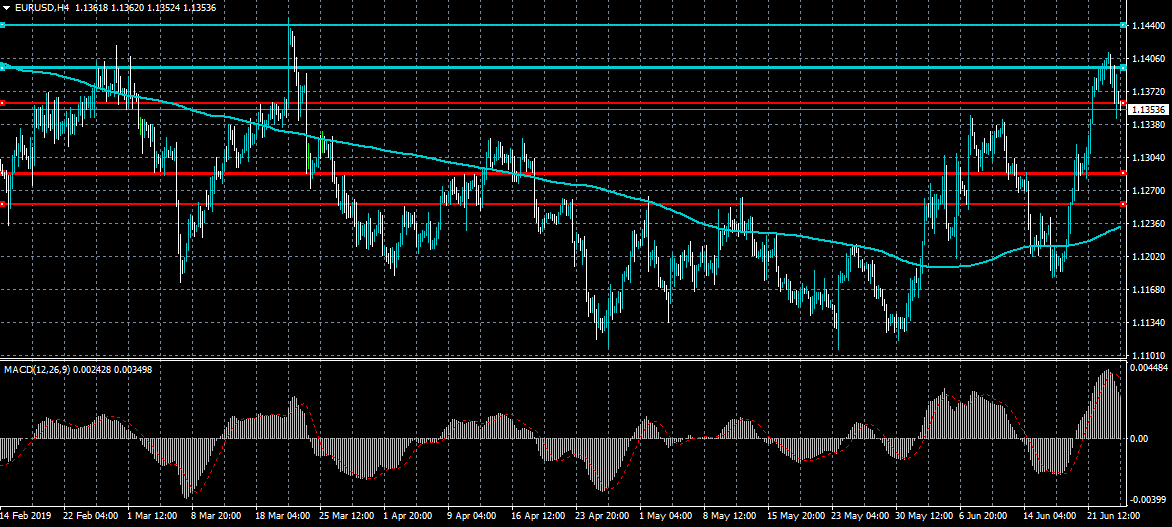
GBPUSD 1.2660 Bearish Pivot
The British pound has reversed sharply from the 1.2780 level against the US dollar as UK political woes once again force the pair lower. A sustained break of the pivotal 1.2660 level could send the GBPUSD pair back towards its former weekly trading low. Bulls need to move the pair back above the 1.2710 resistance level in order to encourage intraday bulls back into the market.
The GBPUSD pair is bullish while trading above the 1.2710 level, key resistance is found at the 1.2730 and 1.2780 levels.
If the GBPUSD pair trades below the 1.2710 level, key support is found at the 1.2660 and 1.2520 levels.
EUR/USD Daily Outlook
Daily Pivots: (S1) 1.1337; (P) 1.1375; (R1) 1.1405; More......
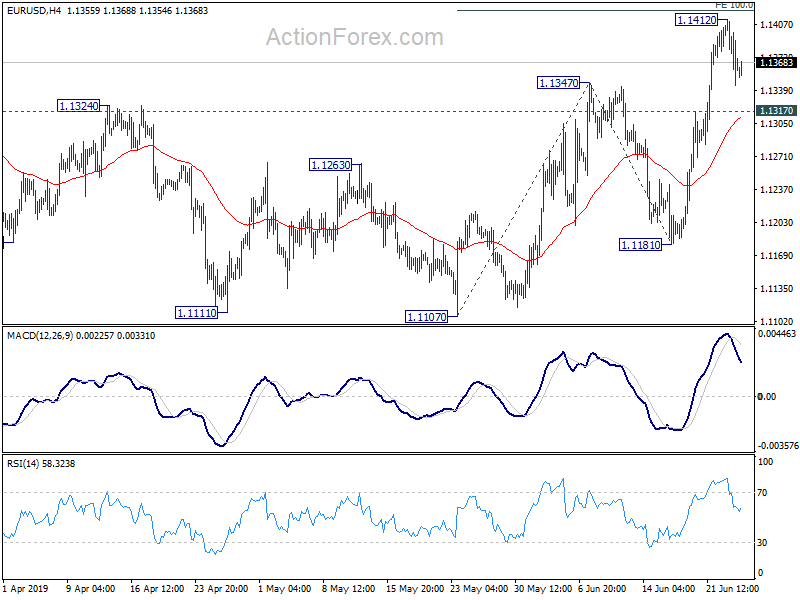
Intraday bias in EUR/USD remains neutral at this point. with 1.1317 minor support intact, another rise remains in favor. On the upside, break of 100% projection of 1.1107 to 1.1347 from 1.1181 at 1.1142 will pave the way to 161.8% projection at 1.1569 next. However, firm break of 1.1317 will be an early sign of completion of rise from 1.1107. Intraday bias will be turned back to the downside for 1.1181 support instead.
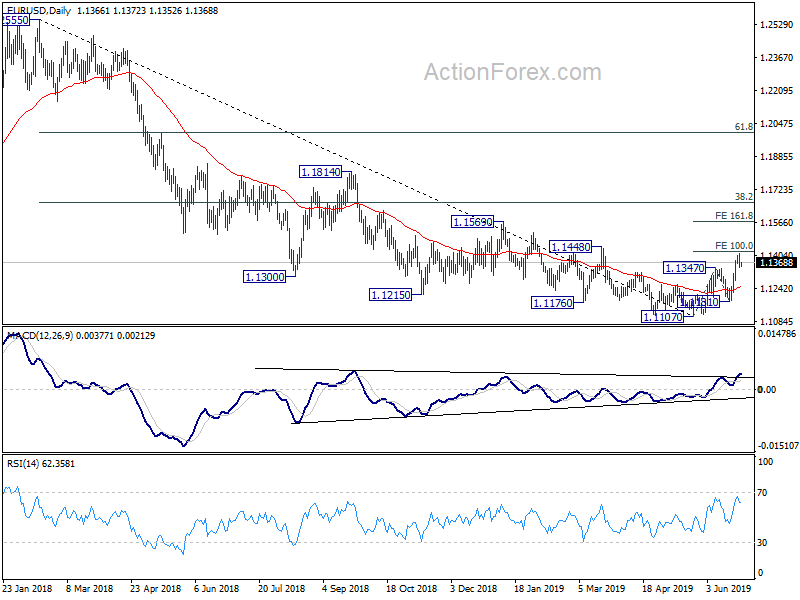
In the bigger picture, considering bullish convergence condition in daily and weekly MACD, a medium term bottom should be in place at 1.1107 after hitting 61.8% retracement of 1.0339 (2016 low) to 1.2555 (2018 high) at 1.1186. Further rise should be seen to 38.2% retracement of 1.2555 to 1.1107 at 1.1660. Reactions from there could indicate whether rebound from 1.1107 is a corrective rise or reversing medium term trend.
LTCUSD Correction Overdue
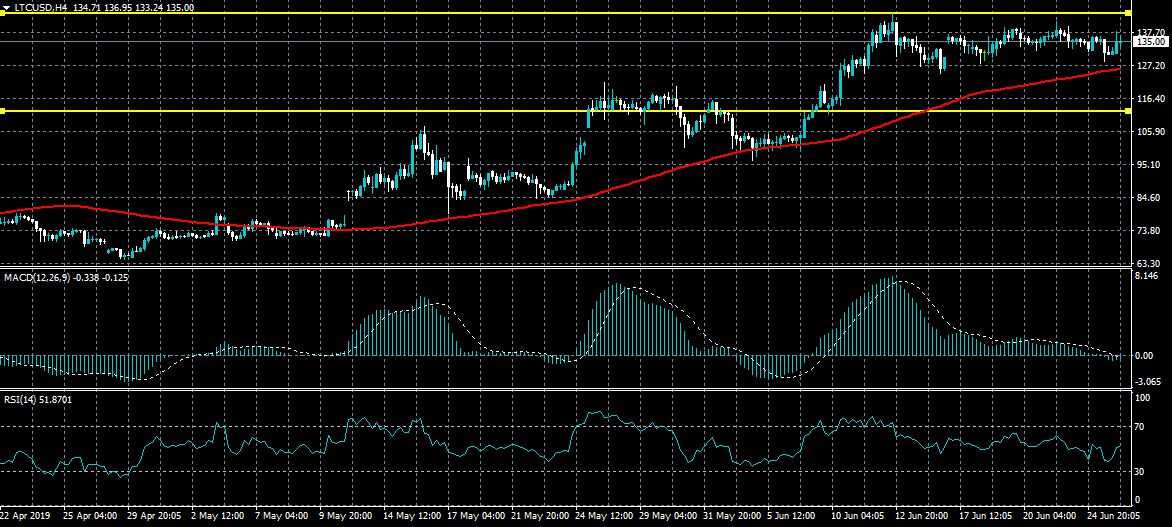
Litecoin is starting to struggle in early Wednesday trade as the cryptocurrency appear overdue for a much-needed technical correction. A sustained move below the $125.00 level should provoke technical selling in the LTCUSD pair toward at least the 110.00 support level. If bulls can break the $140.00 the LTCUSD pair offer relatively limited technical resistance until the $160.00 level.
The LTCUSD pair is only bullish while trading above the $125.00 level, key resistance is found at the $140.00 and $160.00 levels.
If the LTCUSD pair trades below the $125.00 level, key support is found at the $110.00 and $100.00 levels.
Kiwi Rises After Dovish Monetary Statement By RBNZ
The New Zealand dollar rose after the central bank delivered its interest rates decision. The bank left interest rates unchanged at 1.50% as was widely expected. As with the other central banks, officials warned that a rate cut would be necessary to stimulate the economy and caution from adverse economic risks. This rate decision came a day after the country’s statistics office reported that exports and imports had increased in May, leading to a higher trade surplus. The monetary statement said:
We expect low-interest rates and increased government spending to support a lift in economic growth and employment. Inflation is expected to rise to the 2 percent mid-point of our target range, and employment to remain near its maximum sustainable level.
The price of crude oil rose in overnight trading as investors continued their focus on the Iran and Washington tensions. In a tweet yesterday, Donald Trump threatened to obliterate Iran, if it dared to attack any American interests. He also blamed the country for its continued support of terror organizations in the Middle East. Investors also focused on the US inventories data released by the American Petroleum Institute (API). Data showed that in the past week, the inventories decreased by more than 7.55 million barrels. Later today, EIA data is expected to show that inventories declined by more than 2.45 million barrels.
Wall Street ended the day lower after Jerome Powell warned that the economy was facing significant headwinds. While he did not say it, the Fed Chair speech implied that members could slash interest rates in the July meeting. This will be the first meeting in more than ten years from the Fed. Historically, a recession happens shortly after the Fed starts the cycle of lowering interest rates. Investors were also reacting to the home sales data released yesterday. The number showed that the new home sales in May were at more than 626k, which was lower than April’s 679k. This was a 7.9% decline and the fourth straight month of declines. Later today, the US will release durable goods data.
EUR/USD
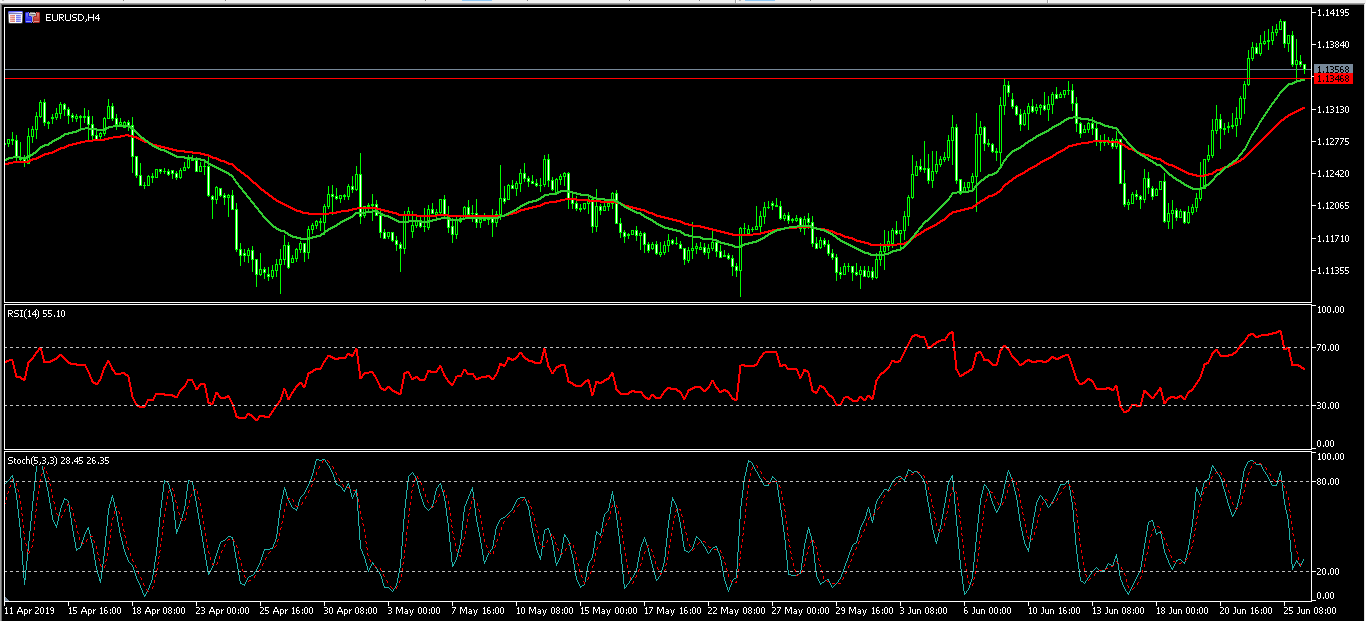
The EUR/USD pair was relatively unmoved in the Asian session. The pair is trading at 1.1356, which was slightly higher than yesterday’s low of 1.1345. On the hourly chart, the pair is slightly above the 25-day and 50-day moving averages. It is also slightly above the important support of 1.1345 reached yesterday. The RSI has moved from a high of 81 to the current 45 while the signal line of the stochastic indicator is close to the oversold level. The pair will likely resume the upward trend ahead of the durable goods data.
XBR/USD
The price of crude oil continued to rise after inventory data from the EIA. The pair reached a high of 65.15, which is along the 38.2% Fibonacci Retracement level. It is also above the 25-day and 50-day moving averages while the RSI has moved close to the overbought level. It’s likely that the pair will test the important resistance level of 66.85, which is also the 50% Fibonacci Retracement level.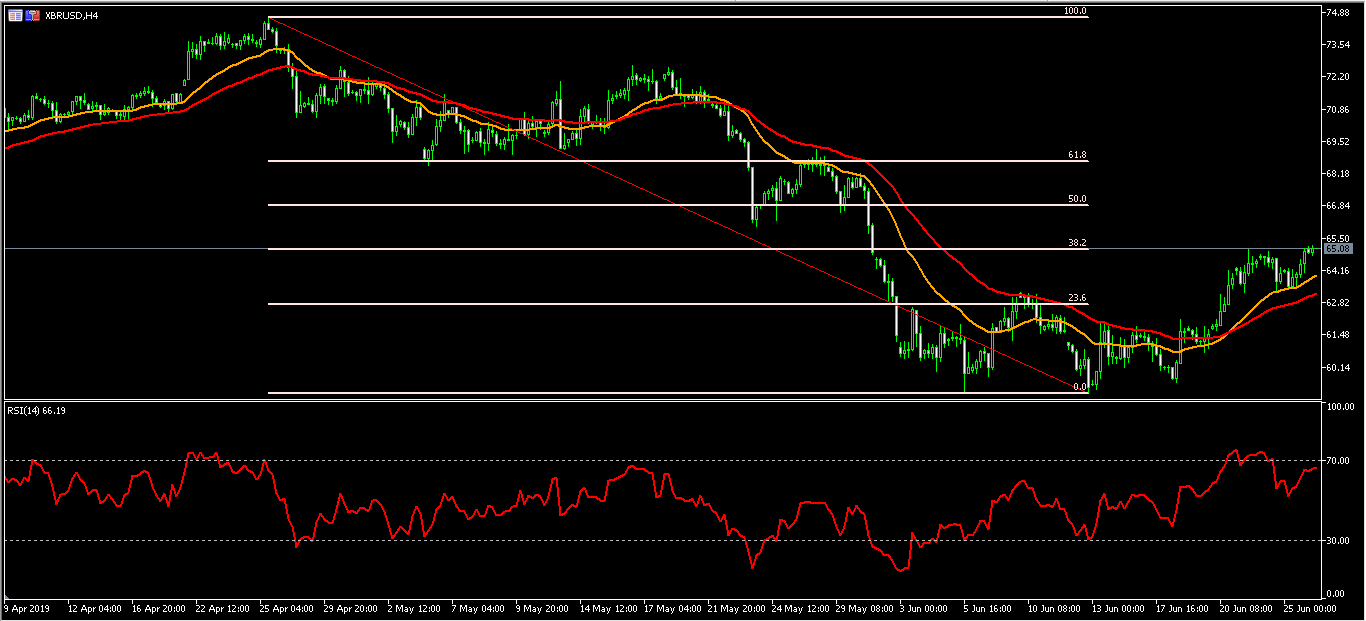
NZD/USD
The NZD/USD pair initially fell after a dovish statement by the RBNZ. It reached a low of 0.6592 and then started to move higher, reaching a high of 0.6660. On the hourly chart, the pair is trading above all the short and medium-term moving averages. It is also forming a cup and handle pattern. The RSI has moved to almost the overbought level of 70. The pair will likely continue moving higher until it tests the important resistance level of 0.6680.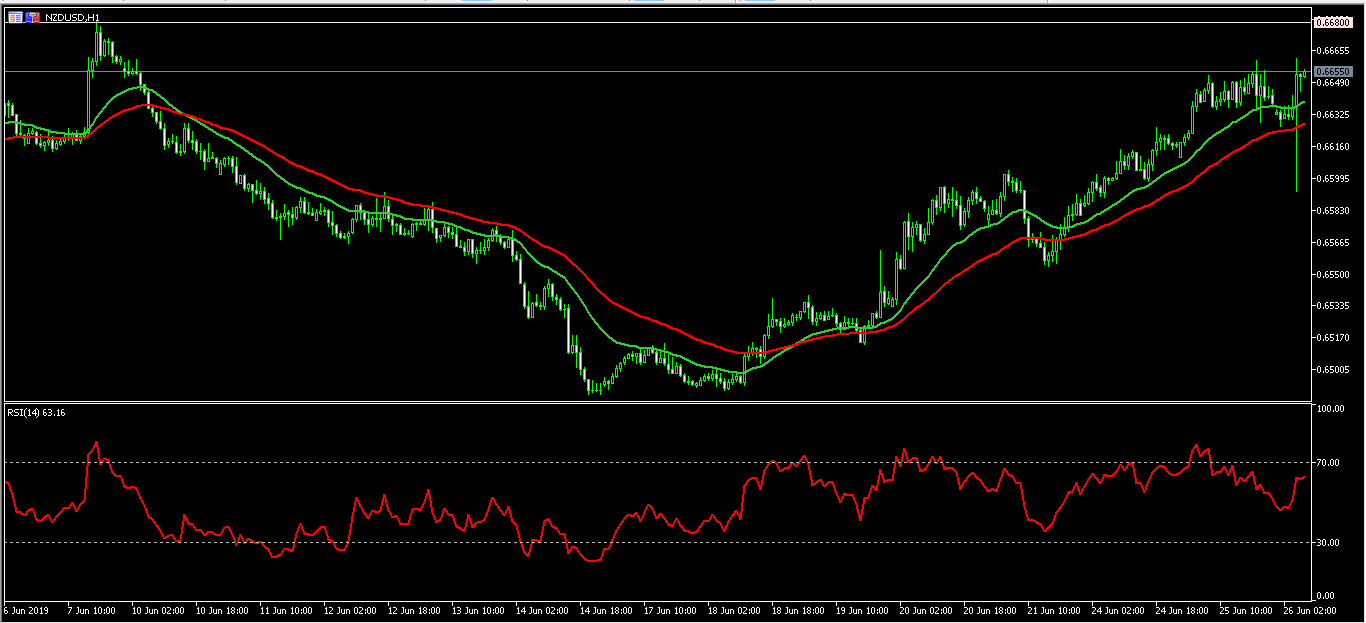
Currencies: EUR/USD Rally Takes A Breather, But Picture Remains Constructive
- R Rates: Fed Bullard puts 50 bps July rate cut scenario to bed
Comments by Fed Bullard – not the environment for a 50 bps rate cut – and Fed chair Powell – repeat that an ounce of prevention is worth more than a pound of cure – clearly point to a 25 bps rate cut in July. Consolidation or profit taking on core bonds is possible. Friday's PCE deflators and the G20 meeting or next high profile events. - Currencies: EUR/USD rally takes a breather, but picture remains constructive
EUR/USD couldn't sustain north of 1.14, triggering modest profit taking. The dollar gained some further ground as Fed governors Bullard and Powell downplayed the need for a 50 bps rate cut. Even so, the technical picture remains EUR/USD positive. We stay cautious on the dollar going into the G20 meeting later this week.
The Sunrise Headlines
- WS slipped up to -1.5% as Fed officials said risks to the downside have increased (Powell) but downplayed the case for a 50bp cut already in July (Bullard). Asian markets are trading mixed with Japan underperforming (-0.7%).
- The central bank of New Zealand kept rates stable at 1.50% but said that rate cuts further out might be warranted given the weakened economic outlook and increased downside risks related to trade, employment and inflation.
- The US is willing to put off (the threat of) tariffs on an additional $300 bln of Chinese imports as preparations to resume trade talks are ongoing. President Trump and Xi are expected to meet at the G20 summit later this week.
- Denmark's Social Democrat leader Frederiksen announced she has finalised terms to form a one-party minority government. Frederiksen will rely on the backing of three other left and centre-left parties to pass laws.
- The Chinese Beige Book's anecdotical evidence showed a modest improvement of the economy in Q2. Serious risks lie ahead though, referring to record inventories, increased shadow finance and surprise inflation pressures.
- The odds of Spanish repeat elections rise after the Socialists refused Podemos' demand to form a coalition, seeking to rule in minority instead. Resignations by Ciudadanos party members also added to the political deadlock just yesterday.
- Today's economic calendar eyes rather thin. The US publishes May durable goods orders. Several central bankers (Fed, ECB, BoE) are scheduled to speak. Italy and the US tap the bond market.
Currencies: EUR/USD Rally Takes A Breather, But Picture Remains Constructive
EUR/USD rally taking a breather, for now.
The recent EUR/USD up move fell prey to modest profit taking. EUR/USD couldn't sustain north of 1.14 as investors pondered the impact of geopolitical tensions and the upcoming G20 meeting. US consumer confidence was weak but with little impact. Later, the dollar gained some further ground as Fed dove Bullard downplayed the need for a 50 bp rate cut. Fed chair Powell took a balanced approach. The US economy is still in a good place, but risks have grown. He supports the idea of a pre-emptive rate cut. QE can still be used if necessary. The dollar reversed part of its earlier gains. EUR/USD closed at 1.1366. USD/JPY finished at 107.20.
This morning, Asian equities join the correction on WS yesterday. Investors are still awaiting the results of the G20 meeting, both with respect to the US-China trade conflict and the on other global issues. The dollar gains some further ground after Fed speakers downplayed the case for a 50 bp rate cut. EUR/USD is trading in the 1.1355/60 area. USD/JPY rebound back to the mid 107 area. The Reserve Bank of New-Zeeland left its policy rate unchanged but indicated that lower rates may still be needed. NZD/USD is trading in the 0.6650 area. There are few important data in Europe. The US durable orders are expected little changed/soft. The series is very volatile and probably won't change the market view on the economy or on monetary policy. So, investors will continue to adapt positions to prepare for the G20 and the next steps in the China-US trade talks.
Yesterday, EUR/USD corrected off the 1.14+ recent top. Even so, the picture remains EUR/USD constructive. We remain cautious on the dollar going into the G20 meeting as we assume that president Trump will reiterate its case that the dollar is too strong. EUR/USD 1.1448 remains the next technical reference on the charts.
Yesterday, EUR/GBP hovered up and down in the 0.8915/0.8965 area. However, in the end sterling weakness prevailed. Today, several BoE governors, including governor Carney will testify before Parliaments Treasury committee. Markets will look out whether the BoE will amend its tightening bias. Given lingering political uncertainty, there is no big case for a sustained sterling rebound. The EUR/GBP 0.90 barrier is coming within reach. EUR/GBP 0.9108 marks the early January peak. We expect EUR/GBP to hold rather strong.
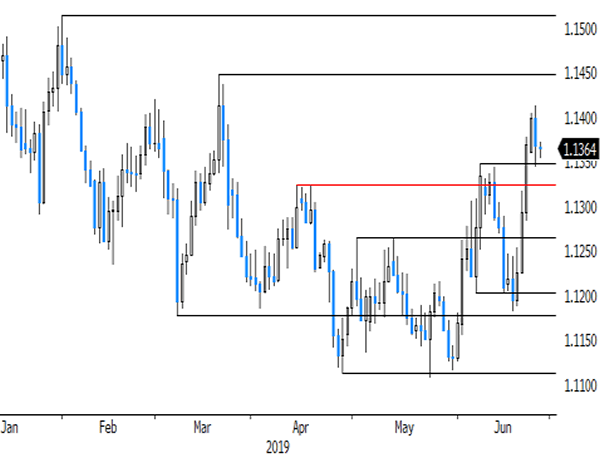
Dollar rebounds as Fed downplays 50 bp rate cut, but picture remains EUR/USD supportive going into G20 meeting
Hunt For Market Equilibrium Continues Amid Major Global Uncertainties
Markets are still searching for that equilibrium between anticipating the next Fed rate cut, while President Donald Trump and President Xi Jinping meet later this week at the G20 summit. The Dollar Index (DXY) has bounced off the 96 support level, which has offset recent gains seen in G10 and Asian currencies.
Fed Chair Jerome Powell on Tuesday repeated the central bank’s dovish bias, highlighting that “the case for somewhat more accommodative policy has strengthened”. Market’s reluctance to allow the DXY to remain below 96 for too long suggests that the Greenback should remain supported in light of the gloomier mood in the atmosphere of financial markets this week.There is also the perspective being offered following the Fed speeches that the Federal Reserve will not be cutting interest rates as soon as what has been priced into the market; therefore, this can also support the near-term outlook for the Dollar after a brutal week for the Greenback following last week’s Fed decision.Even though US economic growth is moderating, the prospects of incoming monetary policy stimulus may help buffer the resilience of the world’s largest economy, which should in turn prop up the Greenback.
Global stocks lose momentum ahead of Trump-Xi meeting
Equity marketsare losing momentum with Asian stocks following their US counterparts lower, as investors try and decipher what the crucial Trump-Xi meeting could mean for the global growth outlook for the rest of 2019. The outcome from this meeting could have major implications, not just for financial markets, but also for the global monetary policy bias.
Foreign investors could be prompted to move funds away from the developing world, should EM central banks lower their respective benchmark interest rates in hopes of offsetting headwinds from protracted US-China trade tensions. While the loosening of monetary policy should stimulate the domestic economy, it’s also expected to trigger outflows by foreign funds, depending on the interest rate differential at that point in time. Fund flows away from the EM universe could heap more downward pressure on the respective currencies.
Safe haven assets losing some of its appeal
Gold is shedding some of its gains, having dropped by more than two percent from its near-$1440 high on Tuesday to trade around the $1406 handle at the time of writing. The $1400 line remains a key psychological level for Bullion in assessing whether the risk aversion felt in the markets will be sustained.
US 10-year Treasury yields continue to test the two percent support level, while USDJPY is hovering above the 107 mark, as markets await the next catalyst that could move the risk barometer either way. While geopolitical tensions have intensified of late, it is just one of several global uncertainties that are featuring on investors’ radars. This weekend’s Trump-Xi meeting is poised to be the market’s litmus test for risk appetite going into the rest of the year.
USD/JPY Bullish Reversal After Completing Bearish Wave-C
The USD/JPY could be completing a larger bearish wave 2 (purple) pattern, which would indicate that a large bearish corrective price swing has ended and a new bullish swing could be starting. Although price is showing the first signs of a new bullish swing after breaking a local resistance trend line (dotted red), price still needs to break above the larger resistance trend line (red solid) of the downtrend channel. If price does push lower, then the 78.6% Fibonacci level of wave 2 vs 1 at 106.34 is expected to act as a support zone.
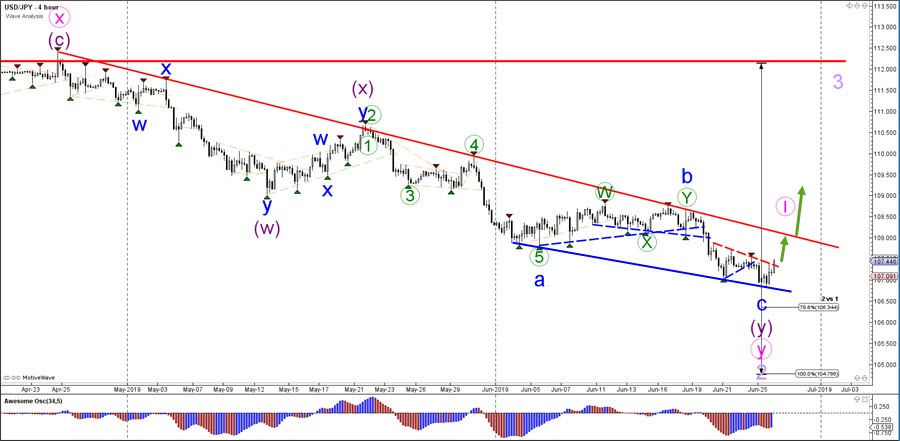 The USD/JPY seems to have completed the bearish wave C (blue) as we expected in the previous wave analysis of the USD/JPY. Price has made a wave 4 (green) correction, which was followed by a final push lower via wave 5 of wave C (blue). Currently price is moving higher and showing strong bullish impulsive price action, which could be a wave 3 (purple) pattern.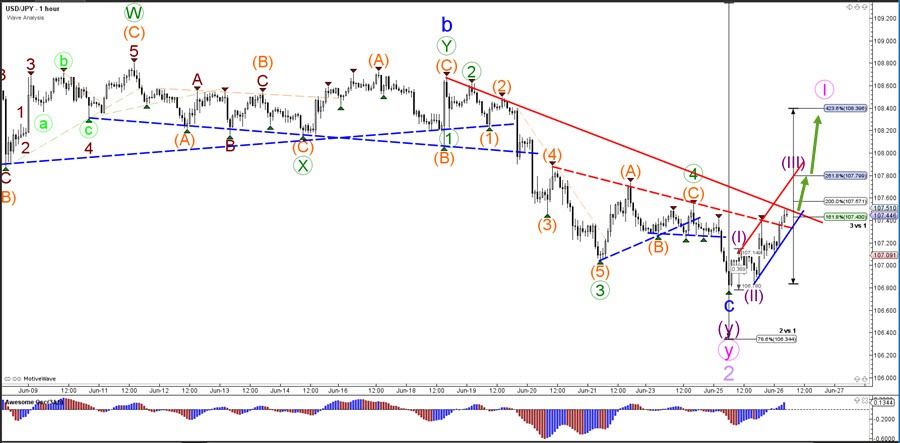
BoE Inflation Report Hearing Eyed
Stock markets are looking a little soft now heading into the G20 later in the week after Fed Chair Jerome Powell insisted that the Fed will be insulated from short-term political interests.
It's quite clear who that message was intended for but it's actually investors that it seems to have struck a nerve with. The impression that investors have got over the last week is that the Fed is prepared to cut rates and will start in July but these comments have thrown a spanner in the works. Interest rate expectations haven't changed too dramatically though but the odds of 50 basis points have halved.
This was also helped by Bullard's suggestion that 50 points may be overdone and 25 would be sufficient. Given he's one of the more dovish members, that sends quite a strong message. I still think markets are too dovish at the moment, almost trying to force the hand of the Fed. They may end up being successful to a point but the message we're getting from these latest comments is that they're may be expecting too much.
Low expectations ahead of BoE inflation report hearing
The inflation report hearing is typically quite a high profile event but unfortunately, just like the meeting last week, other events are likely to overshadow it on this occasion. Brexit has taken priority in many people's minds for some time but Theresa May's resignation has pushed it further down the list with traders now focused on the leadership race which is down to the final two.
The BoE's job seems pretty simple right now compared to what is has previously. Given the growing uncertainty both domestically and abroad, there seems little reason to be adjusting rates in the foreseeable future, something markets are on board with. One point of interest may be the suggestion last week that the markets were incorrectly pricing the prospect of rate hikes, which given that they're gradually pricing in a cut over the next year or so, hasn't changed. Carney may try to reinforce this message today, although it may fall on deaf ears again.