

Sample Category Title
Crude Oil: Oil Trading Higher, Ahead Of EIA’s Weekly Crude Oil Stockpiles Data
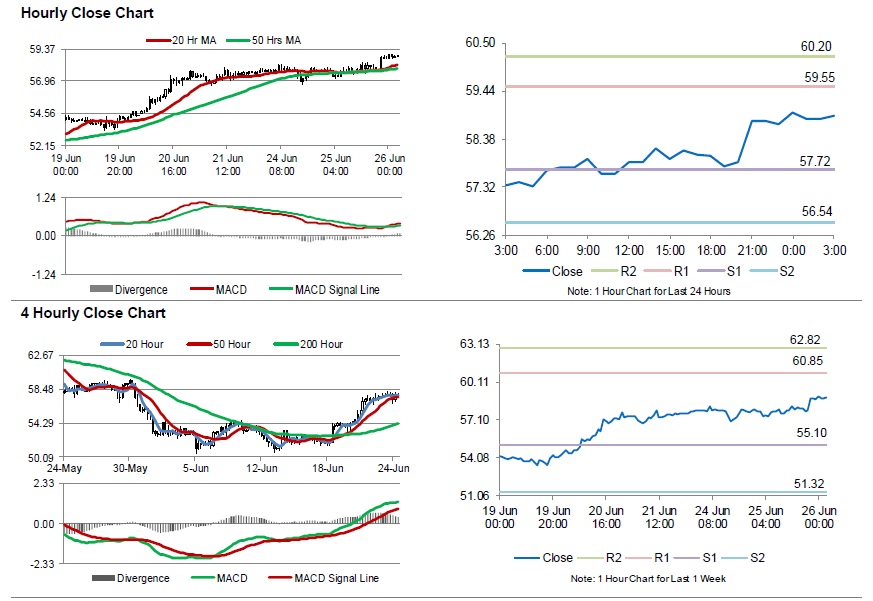
For the 24 hours to 23:00 GMT, Crude Oil rose 1.52% against the USD and closed at USD58.71 per barrel, after the American Petroleum Institute (API) reported that US crude oil inventories declined by 7.5 million barrels to 474.5 million barrels in the week ended 21 June 2019.
In the Asian session, at GMT0300, the pair is trading at 58.89, with oil trading 0.31% higher against the USD from yesterday's close.
The pair is expected to find support at 57.72, and a fall through could take it to the next support level of 56.54. The pair is expected to find its first resistance at 59.55, and a rise through could take it to the next resistance level of 60.20.
Crude oil is trading above its 20 Hr and 50 Hr moving averages.
GBP/USD Daily Outlook
Daily Pivots: (S1) 1.2645; (P) 1.2715; (R1) 1.2757; More....
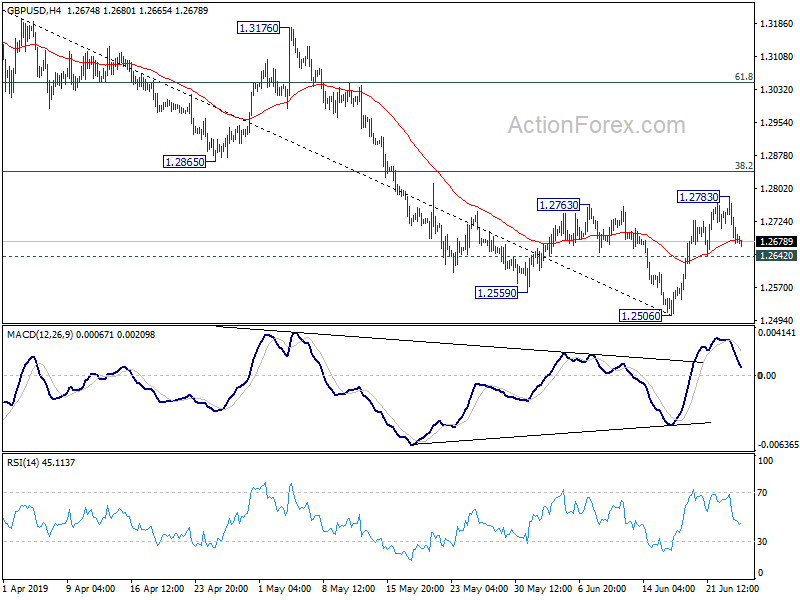
Intraday bias in GBP/USD is turned neutral with current retreat. Rebound from 1.2506 could still extend. But upside should be limited by 38.2% retracement of 1.3381 to 1.2506 at 1.2840. On the downside, break of 1.2642 minor support will turn intraday bias back to retest 1.2506 low. However, sustained break of 1.2840 will bring stronger rise to 61.8% retracement at 1.3047 next.
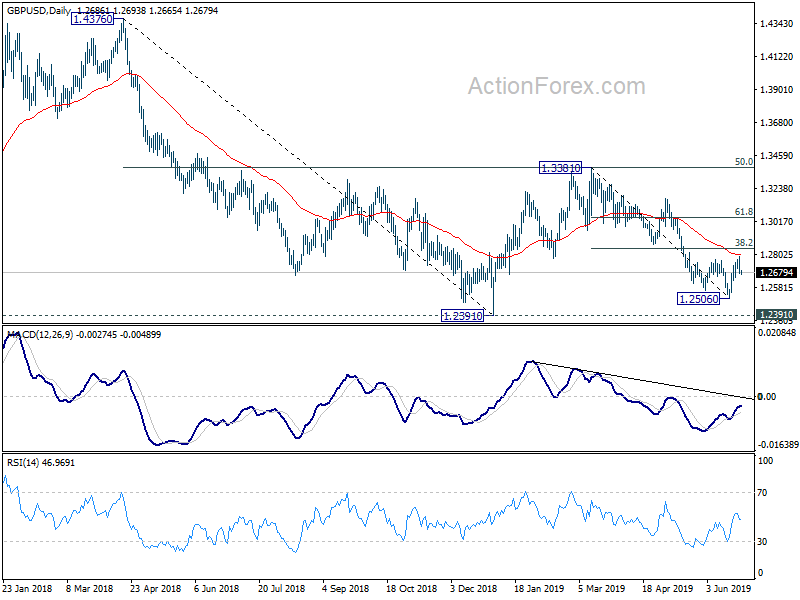
In the bigger picture, down trend from 1.4376 (2018 high) is still in progress. Break of 1.2391 would target a test on 1.1946 long term bottom (2016 low). For now, we don't expect a firm break there yet. Hence, focus will be on bottoming signal as it approaches 1.1946. In any case, medium term outlook will stay bearish as long as 1.3381 resistance holds, in case of strong rebound.
Dollar Rebounds as Fed Dismissed Aggressive Cut, NZD Rebounds Despite Dovish RBNZ
New Zealand rises broadly even though RBNZ hints on an August rate cut. The easing bias is actually well priced in and traders responds to the positive reference to the economy instead. Dollar also trying to extend yesterday's rebound as even the most dovish Fed official dismissed an aggressive 50bps cut in July. On the other hand, Yen is currently the softest one for today, followed by Sterling and then Swiss Franc. Focus will turn to US durable goods orders to see if Dollar could extend current rebound.
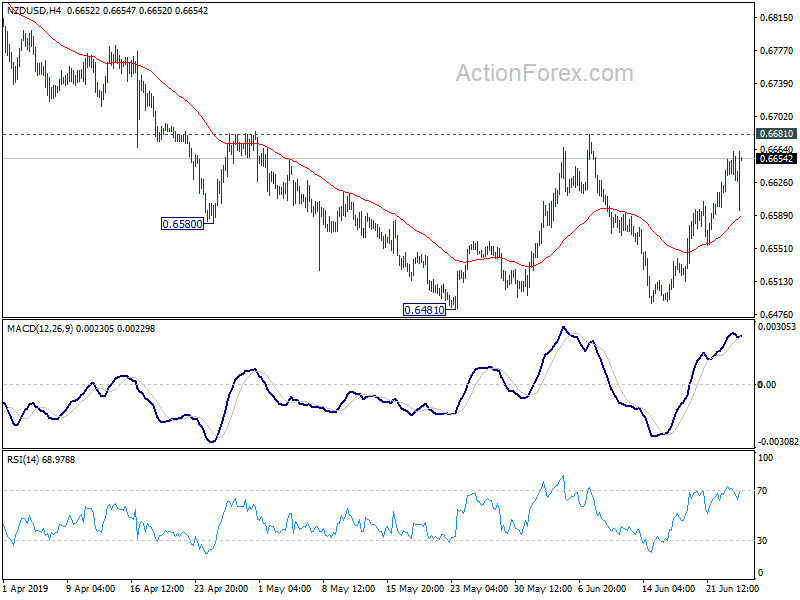
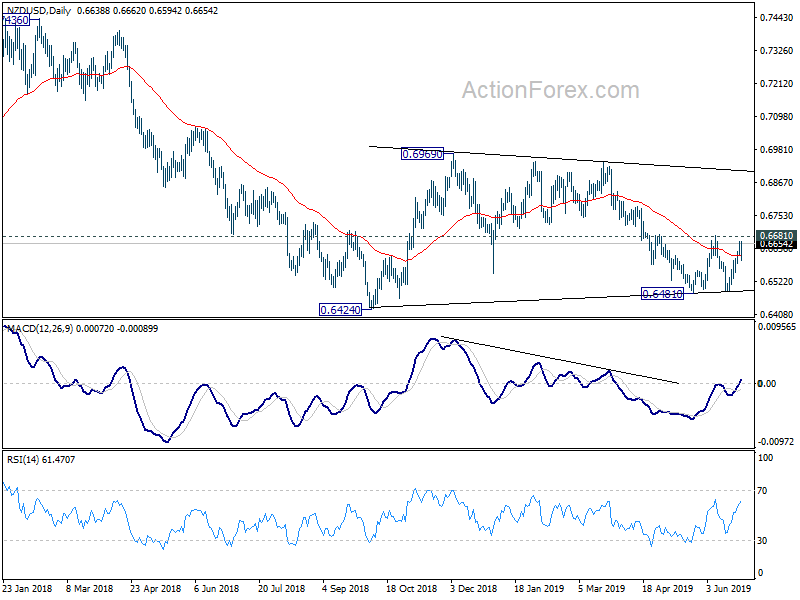
Technically, after some volatility, NZD/USD is staying below 0.6681 resistance and maintains near term bearish outlook. That is, another fall is still expected through 0.6481 low at a later stage. While Dollar rebounded, there is no confirmation of bottoming yet. As long as these levels holds, more downside will remain in favor in Dollar: 1.1317 support in EUR/USD, 1.2642 support in GBP/USD, 0.9854 resistance in USD/CHF, 107.73 resistance in USD/JPY, 0.6903 support in AUD/USD. Separately, 0.8975 resistance in EUR/GBP will be watched and break will indicate resumption of recent rise for 0.9101 key resistance.
In Asia, Nikkei closed down -0.68%. Hong Kong HSI is up 0.06%. China Shanghai SSE is down -0.37%. Singapore Strait Times is down -0.27%. Japan 10-year JGB yield is up 0.0103 at -0.141. Overnight, DOW dropped -0.67%. S&P 500 dropped -0.95%. NASDAQ dropped -1.51%. 10-year yield dropped -0.027 to 1.994.
Fed Bullard dismissed 50bps rate cut, Powell emphasized independence
Dollar rebounded notably overnight after St Louis Fed President James Bullard, the most dovish Fed official, dismissed a 50bps rate cut in July, in a Bloomberg interview. He said "just sitting here today I think 50 basis points would be overdone. And, "I don't think the situation really calls for that but I would be willing to go to 25. Though, Bullard emphasized that " I hate to pre-judge meetings – things can change by the time you get there – but if I was just going today that's what I would do."
Separately, Fed Chair Jerome Powell emphasized Fed's independence in a prepared speech. He said "the Fed is insulated from short-term political pressures—what is often referred to as our 'independence.' Congress chose to insulate the Fed this way because it had seen the damage that often arises when policy bends to short-term political interests. Central banks in major democracies around the world have similar independence."
On the economy, Powell said "the baseline outlook of my FOMC colleagues, like that of many other forecasters, remains favorable". But inflation would return to target "at a somewhat slower pace than we foresaw earlier in the year." And, " risks to this favorable baseline outlook appear to have grown." Hence, Fed will now "closely monitor the implications of incoming information for the economic outlook and will act as appropriate to sustain the expansion."
Powell also emphasized "we are also mindful that monetary policy should not overreact to any individual data point or short-term swing in sentiment. Doing so would risk adding even more uncertainty to the outlook."
When asked if a rate cut is needed this year, Richmond Fed President Thomas Barkin said "I don't know". Though, he warned there's a risk US could talk itself into a recession but added he saw no sign of this happening yet.
G20 said to call for free trade promotion, but refrain to mention protectionism
Japan's Ashai newspaper reported that G20 leaders would include "promotion of free trade" in the joint communique to be released as the summit in Osaka ends on June 29. The communique will emphasize free trade as as the core element of global growth, along with technological innovation such as economic digitization .
There are calls from Europe and other countries, for stronger languages against protectionism. However, the group will likely avoid the terms like "resisting protectionism" due to disagreement from US. Instead, Japan is opting for something in the middle as "promotion of free trade".
RBNZ hints on Aug rate cut, But NZD rebounds on positive references in statement
RBNZ left Official Cash Rate unchanged at 1.50% as widely expected. It also adopted an easing bias by repeatedly saying " a lower OCR may be needed". It's taken by a strong signal that another rate cut is underway in August. However, on the brighter side, RBNZ noted that "GDP growth had held up more than projected" in Q1. And "some of the factors supporting growth in the quarter would continue." Also, while risks are "tilted to the downside", resolution of trade tensions "could see uncertainty ease". New Zealand Dollar spiked lower after the release by quickly rebounded on the positive references.
Some suggested readings:
- Review Of The RBNZ's June OCR Review: Hinting Strongly
- RBNZ Holds But Keeps Door Open For A Cut In August | GBP/NZD, EUR/NZD
On the data front
German Gfk consumer sentiment for July dropped to 9.8, missed expectation of 10.0. UK will release BBA mortgage approvals. Meanwhile, US will release durable goods orders, goods trade balance and wholesale inventories.
GBP/USD Daily Outlook
Daily Pivots: (S1) 1.2645; (P) 1.2715; (R1) 1.2757; More....
Intraday bias in GBP/USD is turned neutral with current retreat. Rebound from 1.2506 could still extend. But upside should be limited by 38.2% retracement of 1.3381 to 1.2506 at 1.2840. On the downside, break of 1.2642 minor support will turn intraday bias back to retest 1.2506 low. However, sustained break of 1.2840 will bring stronger rise to 61.8% retracement at 1.3047 next.
In the bigger picture, down trend from 1.4376 (2018 high) is still in progress. Break of 1.2391 would target a test on 1.1946 long term bottom (2016 low). For now, we don't expect a firm break there yet. Hence, focus will be on bottoming signal as it approaches 1.1946. In any case, medium term outlook will stay bearish as long as 1.3381 resistance holds, in case of strong rebound.
Economic Indicators Update
| GMT | Ccy | Events | Actual | Forecast | Previous | Revised |
|---|---|---|---|---|---|---|
| 2:00 | NZD | RBNZ Official Cash Rate | 1.50% | 1.50% | 1.50% | |
| 6:00 | EUR | German GfK Consumer Confidence (JUL) | 9.8 | 10 | 10.1 | |
| 8:30 | GBP | BBA Mortgage Approvals May | 43.2K | 43.0K | ||
| 12:30 | USD | Durable Goods Orders May P | -0.10% | -2.10% | ||
| 12:30 | USD | Durables Ex Transportation May P | 0.10% | 0.00% | ||
| 12:30 | USD | Advance Goods Trade Balance (USD) May | -71.8B | -72.1B | ||
| 12:30 | USD | Wholesale Inventories M/M May P | 0.50% | 0.80% | ||
| 14:30 | USD | Crude Oil Inventories | -3.1M |
G20 said to call for free trade promotion, but refrain to mention protectionism
Japan's Ashai newspaper reported that G20 leaders would include "promotion of free trade" in the joint communique to be released as the summit in Osaka ends on June 29. The communique will emphasize free trade as as the core element of global growth, along with technological innovation such as economic digitization .
There are calls from Europe and other countries, for stronger languages against protectionism. However, the group will likely avoid the terms like "resisting protectionism" due to disagreement from US. Instead, Japan is opting for something in the middle as "promotion of free trade".
RBNZ hints on Aug rate cut, But NZD rebounds on positive references in statement
RBNZ left Official Cash Rate unchanged at 1.50% as widely expected. It also adopted an easing bias by repeatedly saying " a lower OCR may be needed". It's taken by a strong signal that another rate cut is underway in August. However, on the brighter side, RBNZ noted that "GDP growth had held up more than projected" in Q1. And "some of the factors supporting growth in the quarter would continue." Also, while risks are "tilted to the downside", resolution of trade tensions "could see uncertainty ease".
New Zealand Dollar spiked lower after the release by quickly rebounded on the positive references.
Some suggested readings:
- Review Of The RBNZ's June OCR Review: Hinting Strongly
- RBNZ Holds But Keeps Door Open For A Cut In August | GBP/NZD, EUR/NZD
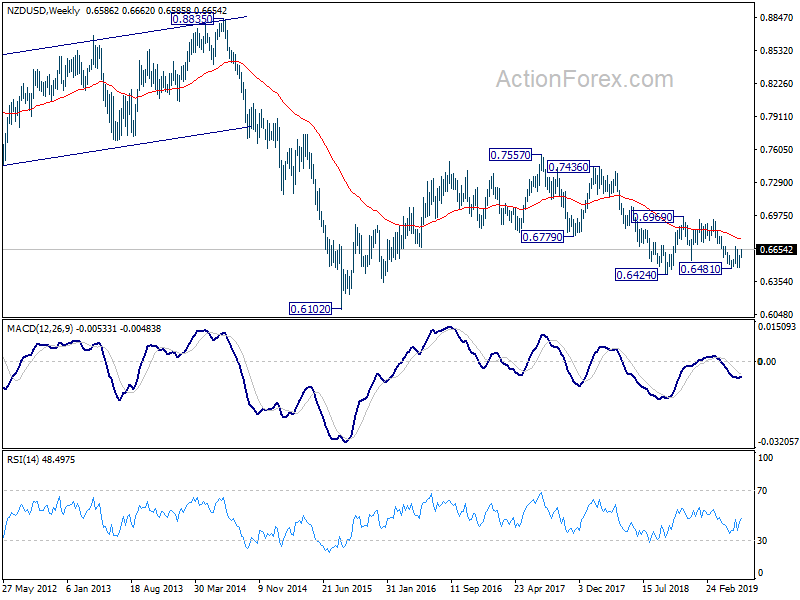
At this point, NZD/USD is staying in consolidation from 0.6481 and more sideway trading could be seen. But with 0.6681 resistance intact, further decline is expected through 0.6481 support to 0.6424. Decisive break there will resume larger down trend form 0.7557 to 0.6102 (2015 low). However, firm break of 0.6681 will extend the consolidation pattern fro 0.6424 with another rising leg, towards 0.6969 resistance, before completion and down trend resumption.
Review Of The RBNZ’s June OCR Review: Hinting Strongly
- The RBNZ kept the OCR on hold at 1.5%.
- However, it said that a lower OCR “may be needed” or “was likely” in different parts of the document.
- This was very blunt language, and is a strong signal for a cut in the future.
- The RBNZ remains mainly focussed on the global economy, and particularly the trend towards lower interest rates at overseas central banks. It is more ambivalent about the domestic economy.
- We remain happy to forecast an OCR cut at the August MPS meeting.
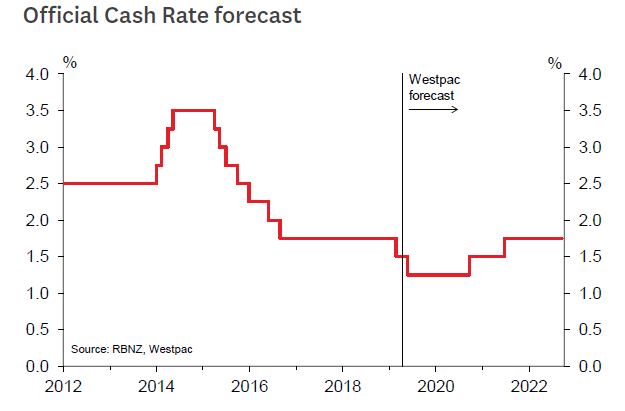
As expected, the Reserve Bank left the OCR unchanged at 1.5% at its June OCR Review.
However, the RBNZ strongly hinted that it could reduce the OCR to 1.25%. The press release repeatedly stated that the outlook had weakened, and twice said that “a lower OCR may be needed.”
The record of Monetary Policy Committee (MPC) meetings was stronger, stating that “members agreed that more support from monetary policy was likely to be necessary” (our emphasis). The MPC “discussed the merits” of an immediate cut, but decided against such a move, instead noting again that a lower OCR may be needed over time.
This is very blunt language from the RBNZ, which has tended to keep its signalling fairly ambiguous in recent times. For example, back in March the RBNZ's language was the innocuous-sounding “the more likely direction of our next OCR move is down.” That was followed by an actual OCR cut at the next meeting. By comparison, this is a very direct signal that the OCR is likely to head lower at some time.
The tone of the RBNZ's language leaves us happy with our call that the OCR will be cut in August. Markets are now pricing roughly a 75% chance of an OCR cut at that time, which seems about right to us.
The detail of the press release and record of meeting confirmed that the RBNZ remains heavily focussed on the global economy. The fact that the global economic outlook has weakened, and that downside risks have intensified, got plenty of column inches. The new feature was the RBNZ's claim that the global slowdown is affecting the New Zealand economy via confidence, for example by dampening business investment, as well as via trade and financial channels.
Meanwhile, the RBNZ's assessment of the domestic economy was more mixed, and was broadly in line with our own assessment of recent developments. The press release emphasised the negatives, but the record of meeting revealed that both positives and negatives were discussed.
GDP was stronger than the RBNZ expected, but the Committee discussed whether this would continue. That aligns with our own observation that some recent data has been quite weak
The housing market recently has been weaker than the RBNZ expected, but the RBNZ noted the impact that lower mortgage rates and the cancellation of capital gains tax could have. We interpret that to mean that the RBNZ is standing by its forecast of accelerating house price inflation, as are we.
The RBNZ acknowledged that increased government spending was a positive for the outlook, although they discussed the possibility that the spending will be delayed. Again, that accords with our own assessment that stimulatory fiscal policy is an important, and often overlooked, element of the monetary policy debate in New Zealand.
One interesting strand of thinking that remains in the RBNZ's commentary is capacity constraints, which were discussed in the context of the labour market and the construction sector. Our interpretation is that one or more members of the MPC remain worried about capacity constraints and the potential for inflation. However, the dominant theme was certainly downside risks, and the RBNZ was very explicit that the outlook for inflation and employment has weakened.
Over all, this was a fairly clear signal from the RBNZ that sets the scene for an August OCR cut, although it by no means seals the deal.
This statement was close to market expectations. However, interest rates and the exchange rate rose slightly simply because the small chance of an OCR cut today was removed from market pricing.
Full RBNZ Statement
Official Cash Rate unchanged at 1.5 percent
The Official Cash Rate (OCR) remains at 1.5 percent. Given the weaker global economic outlook and the risk of ongoing subdued domestic growth, a lower OCR may be needed over time to continue to meet our objectives. Domestic growth has slowed over the past year. While construction activity strengthened in the March 2019 quarter, growth in the services sector continued to slow. Softer house prices and subdued business sentiment continue to dampen domestic spending.
The global economic outlook has weakened, and downside risks related to trade activity have intensified. A number of central banks are easing their monetary policy settings to support demand. The weaker global economy is affecting New Zealand through a range of trade, financial, and confidence channels.
We expect low interest rates and increased government spending to support a lift in economic growth and employment. Inflation is expected to rise to the 2 percent mid-point of our target range, and employment to remain near its maximum sustainable level.
Given the downside risks around the employment and inflation outlook, a lower OCR may be needed. Meitaki, thanks.
Summary record of meeting
The Monetary Policy Committee agreed that the outlook for the economy has softened relative to the projections in the May 2019 Statement.
The Committee noted that inflation remains slightly below the mid-point of the inflation target and employment is broadly at its maximum sustainable level. The Committee agreed that a lower OCR may be needed to meet its objectives, given further deterioration in the outlook for trading-partner growth and subdued domestic growth.
Relative to the May Statement, the Committee agreed that the risks to achieving its consumer price inflation and maximum sustainable employment objectives are tilted to the downside.
The members noted that global economic growth had continued to slow. They discussed the recent falls in oil and dairy prices, and that several central banks are now expected to ease monetary policy to support demand.
The Committee discussed the ongoing weakening in global trade activity. A drawn out period of tension could continue to suppress global business confidence and reduce growth. Resolution of these tensions could see uncertainty ease.
The Committee discussed the trade, financial, and confidence channels through which slowing global growth and trade tensions affect New Zealand. The members noted in particular the dampening effect of uncertainty on business investment. Some members noted that lower commodity prices and upward pressure on the New Zealand dollar could see imported inflation remain soft
While global economic conditions had deteriorated, the Committee noted that domestic GDP growth had held up more than projected in the March 2019 quarter. The members discussed disparities in growth across sectors of the economy, with construction strong and services weak.
The members also discussed whether some of the factors supporting growth in the quarter would continue. The members noted two largely offsetting developments affecting the outlook for domestic growth: softer house price inflation and additional fiscal stimulus.
The Committee noted that recent softer house prices, if sustained, are likely to dampen household spending. The Committee also noted the recent falls in mortgage rates and the Government's decision not to introduce a capital gains tax.
The Committee noted that Budget 2019 incorporated a stronger outlook for government spending than assumed in the May Statement. The members discussed the impact on growth of any increase in government spending being delayed, for example due to timing of the implementation of new initiatives and current capacity constraints in the construction sector.
The members discussed the subdued nominal wage growth in the private sector and the apparent disconnect from indicators of capacity pressure in the labour market. The Committee discussed the possibility of this relationship re-establishing. Conversely, the continuing absence of wage pressure could indicate that there is still spare capacity in the labour market. Some members also noted that reduced migrant inflows could see wage pressure increase in some sectors.
The Committee discussed whether additional monetary stimulus was necessary given continued falls in global growth and subdued domestic demand. The members agreed that more support from monetary policy was likely to be necessary.
The Committee discussed the merits of lowering the OCR at this meeting. However, the Committee reached a consensus to hold the OCR at 1.5 percent. They noted a lower OCR may be needed over time.
(RBNZ) Official Cash Rate Unchanged at 1.50 Percent
The Official Cash Rate (OCR) remains at 1.5 percent. Given the weaker global economic outlook and the risk of ongoing subdued domestic growth, a lower OCR may be needed over time to continue to meet our objectives.
Domestic growth has slowed over the past year. While construction activity strengthened in the March 2019 quarter, growth in the services sector continued to slow. Softer house prices and subdued business sentiment continue to dampen domestic spending.
The global economic outlook has weakened, and downside risks related to trade activity have intensified. A number of central banks are easing their monetary policy settings to support demand. The weaker global economy is affecting New Zealand through a range of trade, financial, and confidence channels.
We expect low interest rates and increased government spending to support a lift in economic growth and employment. Inflation is expected to rise to the 2 percent mid-point of our target range, and employment to remain near its maximum sustainable level.
Given the downside risks around the employment and inflation outlook, a lower OCR may be needed.
Meitaki, thanks.
Summary Record of Meeting
The Monetary Policy Committee agreed that the outlook for the economy has softened relative to the projections in the May 2019 Statement.
The Committee noted that inflation remains slightly below the mid-point of the inflation target and employment is broadly at its maximum sustainable level. The Committee agreed that a lower OCR may be needed to meet its objectives, given further deterioration in the outlook for trading-partner growth and subdued domestic growth.
Relative to the May Statement, the Committee agreed that the risks to achieving its consumer price inflation and maximum sustainable employment objectives are tilted to the downside.
The members noted that global economic growth had continued to slow. They discussed the recent falls in oil and dairy prices, and that several central banks are now expected to ease monetary policy to support demand.
The Committee discussed the ongoing weakening in global trade activity. A drawn out period of tension could continue to suppress global business confidence and reduce growth. Resolution of these tensions could see uncertainty ease.
The Committee discussed the trade, financial, and confidence channels through which slowing global growth and trade tensions affect New Zealand. The members noted in particular the dampening effect of uncertainty on business investment. Some members noted that lower commodity prices and upward pressure on the New Zealand dollar could see imported inflation remain soft.
While global economic conditions had deteriorated, the Committee noted that domestic GDP growth had held up more than projected in the March 2019 quarter. The members discussed disparities in growth across sectors of the economy, with construction strong and services weak. The members also discussed whether some of the factors supporting growth in the quarter would continue.
The members noted two largely offsetting developments affecting the outlook for domestic growth: softer house price inflation and additional fiscal stimulus.
The Committee noted that recent softer house prices, if sustained, are likely to dampen household spending. The Committee also noted the recent falls in mortgage rates and the Government's decision not to introduce a capital gains tax.
The Committee noted that Budget 2019 incorporated a stronger outlook for government spending than assumed in the May Statement. The members discussed the impact on growth of any increase in government spending being delayed, for example due to timing of the implementation of new initiatives and current capacity constraints in the construction sector.
The members discussed the subdued nominal wage growth in the private sector and the apparent disconnect from indicators of capacity pressure in the labour market. The Committee discussed the possibility of this relationship re-establishing. Conversely, the continuing absence of wage pressure could indicate that there is still spare capacity in the labour market. Some members also noted that reduced migrant inflows could see wage pressure increase in some sectors.
The Committee discussed whether additional monetary stimulus was necessary given continued falls in global growth and subdued domestic demand. The members agreed that more support from monetary policy was likely to be necessary.
The Committee discussed the merits of lowering the OCR at this meeting. However, the Committee reached a consensus to hold the OCR at 1.5 percent. They noted a lower OCR may be needed over time.
EUR/USD Correcting Lower While USD/CHF Is Recovering
EUR/USD gained momentum and traded towards the 1.1410 level before correcting lower. USD/CHF declined close to the 0.9690 level and it is currently recovering.
Important Takeaways for EUR/USD and USD/CHF
- The Euro climbed higher in the past few days and broke the 1.1380 resistance against the US Dollar.
- There is a key bullish trend line forming with support near 1.1345 on the hourly chart of EUR/USD.
- USD/CHF declined heavily and traded to a new monthly low near the 0.9693 level.
- The pair is currently testing a major bearish trend line with resistance at 0.9765 on the hourly chart.
EUR/USD Technical Analysis
The Euro started a steady rise after forming a support base near the 1.1190 level against the US Dollar. The EUR/USD pair climbed above the 1.1240 and 1.1280 resistance levels. The pair even gained momentum above the 1.1350 resistance area.
Finally, the pair surged above the 1.1380 level and the 50 hourly simple moving average. It traded to a new monthly high at 1.1412 on FXOpen and recently started a downside correction.
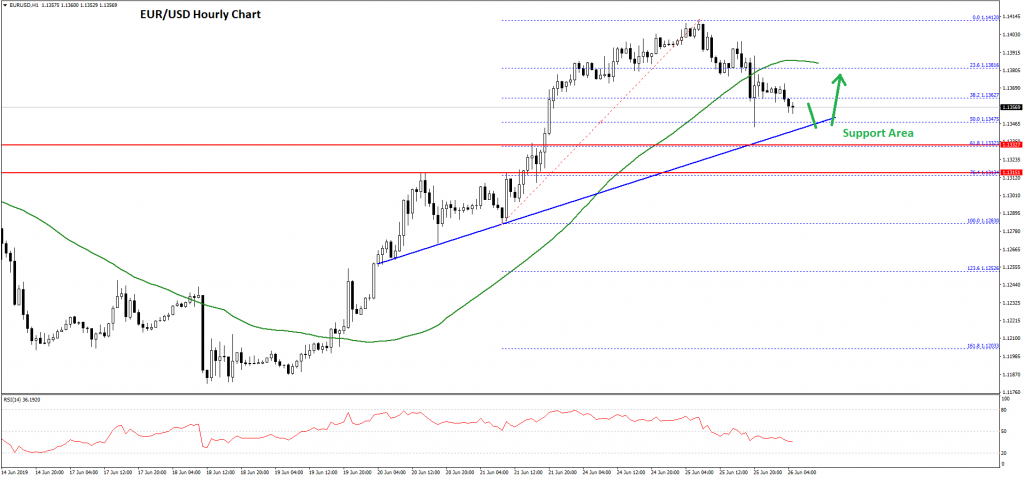
It broke the 1.1380 support plus the 23.6% Fib retracement level of the last wave from the 1.1283 low to 1.1412 high. There was a close below 1.1380 and the 50 hourly simple moving average.
However, the 1.1350 level is acting as a strong support. Moreover, the 50% Fib retracement level of the last wave from the 1.1283 low to 1.1412 high is acting as a support.
Additionally, there is a key bullish trend line forming with support near 1.1345 on the hourly chart of EUR/USD. If the pair fails to stay above the trend line support, there could be more losses.
The next key support is near the 1.1330 level, below which the pair might test the 1.1315 pivot level. On the upside, an initial resistance is near the 1.1380 level and the 50 hourly SMA. If there is a fresh increase above 1.1380, EUR/USD is likely to revisit the 1.1410 level in the near term.
USD/CHF Technical Analysis
The US Dollar started a significant downward move from well above the 1.0000 level against the Swiss franc. The USD/CHF pair broke the 0.9950 and 0.9920 support levels to move into a bearish zone.
The pair even broke the 0.9850 support and settled below the 50 hourly simple moving average. Finally, there was a break below the 0.9750 support and the pair traded as low as 0.9693.
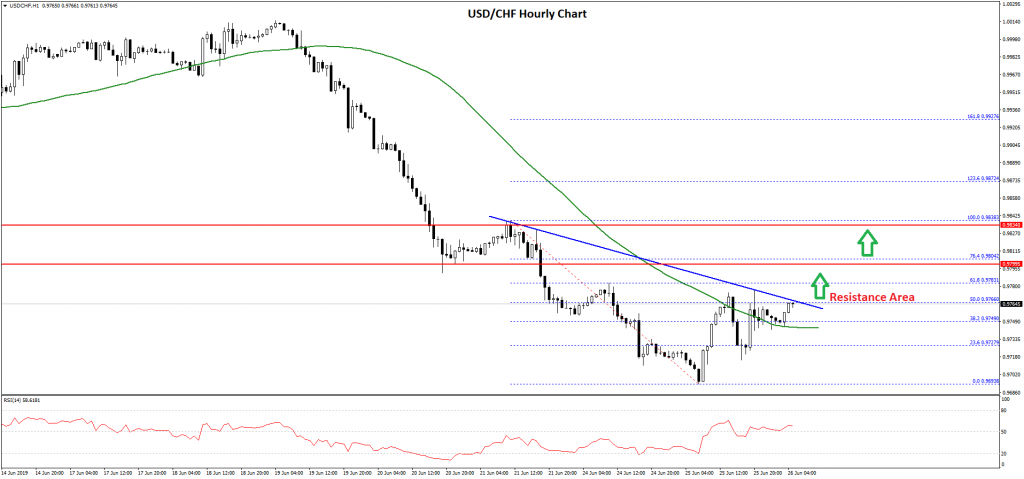
Recently, it started an upside correction above the 0.9700 and 0.9720 levels. There was a break above the 38.2% Fib retracement level of the last decline from the 0.9838 high to 0.9693 swing low.
Furthermore, there was a break above 0.9750 and the 50 hourly simple moving average. However, the pair is now facing a strong resistance near the 0.9765 level.
The 50% Fib retracement level of the last decline from the 0.9838 high to 0.9693 swing low is also acting as a hurdle for the bulls. There is also a major bearish trend line forming with resistance at 0.9765 on the hourly chart.
If USD/CHF clears the trend line resistance, there are chances of more gains in the near term. In the mentioned case, it could trade towards the 0.9800 or 0.9820 level.
Conversely, if there is no break above 0.9765 and 0.9770, the pair may perhaps slide again. An immediate support is near 0.9745, followed by the 0.9700 handle.
Market Morning Briefing: Dollar Index Has Bounced From 95.84
STOCKS
As mentioned yesterday, the equities are witnessing dips within their overall uptrend. The Fed Chairman Jerome Powell's comments yesterday that the central bank will wait and watch before cutting rates could just be a reason for the market to take out some profit. But there is nothing new in it. Powell had reiterated (at least a couple of times) the same in his press conference on June 19 which did not catch the attention of the market on that day the market but has dashed the hopes for an immediate rate cut just now. There is room for the indices to dip further for the next few sessions before the uptrend could resume.
Dow (26548.22, -179.32, -0.67%) has declined as expected and can test the key support level of 26450. A bounce from 26450 can take the index back to 26900 levels. But a break below 26450 will see the corrective fall extending towards 26250. The broader picture however is still bullish.
DAX (12228.44, -46.13, -0.38%) is heading towards its 12200-12170 support zone as expected. The possibility of the fall extending to 12150-12130 cannot be ruled out. But further fall below 12130 looks less likely as the broader picture continues to remain bullish and the index is likely to reverse higher again.
Nikkei (21080, -82.94, -0.39%) is bearish to test 21000 and 20900 in the near term. A break below 20900 will accelerate the fall to 20750.
Shanghai (2979.21, -2.86, -0.10%) fell to test 2950 yesterday as expected and has bounced from there. A sideways consolidation between 2950 and 3020 can be seen for some time. While above 2950 the outlook is bullish to test 3050 and 3100 in the coming weeks.
Nifty (11796.45, +0.83%) bounced thereby negating the fall to 11600 mentioned yesterday. It can test the resistance at 11850 and reverse lower again. We expect it to remain range bound between 11600-11850 for some time.
Sensex (39434.94, +0.80%) is continuing to hold above 39000. A key resistance is coming up near 39700 which can be tested in the near term. A strong break above it is needed to gain bullish momentum. A pull-back from there can drag the index lower again to 39000.
The price action in the Sensex and Nifty will need a close watch in the coming sessions to see if our broader bearish view is getting negated or not.
COMMODITIES
The American Petroleum Institute (API) reported a Crude draw of 7.55mln barrels for week ended 21st June pulling up Crude prices after a short dip seen yesterday during the day. While the EIA stock inventory data is due today and market expects a decline in the stockpile levels (expectation of -1.077mln barrels), we could see some uptick in Crude prices.
Brent (65.76) has moved up again after a short dip to levels near 64.50. Brent could move higher in the next few sessions to test 67 on the upside. As mentioned earlier, note that 67-69 is a crucial resistance zone for Brent indicating that further upside could be limited for the medium term.
Nymex WTI (58.84) is also trading higher and could be headed towards immediate resistance at 60 from where a fall looks likely.
Powell's statement yesterday that the interest rate cut in July that is widely expected by investors and economists is not a deal done, lead Gold to lose some gains. The unresolved US-China and US-Iran tensions and the fact that major central banks are moving their monetary policy to dovish and more accommodative stance, Gold could continue to act as safe heaven and could continue to see buying while prices May rally towards 1500. Gold (1416.40) is trading lower after almost testing 1450 on the upside. While the corrective dip is limited to 1400 on the downside, there is scope for a ride towards 1500 in the medium term.
Silver (15.27) has come down after testing resistance near 15.60/65 in line with our expectations. The fall is likely to be limited to 15 from where another bounce towards 15.25/50 is possible.
Copper (2.7275) is rising as expected and is headed towards our mentioned resistance near 2.75/80 from where a fall looks likely. Trend for the rest of the sessions this week look bullish
FOREX
Currency pairs across the globe are seeing a corrective move after facing immediate resistances/supports as mentioned in our earlier editions. Dollar has gained some strength leading to a corrective fall in major currencies. While Aussie looks bullish; Pound, Euro, Yen, Rupee and Yuan could trade weak against the Dollar for the next 1-2 sessions.
Dollar Index (96.28) has bounced from 95.84, above the immediate support at 95.50 and has managed to rise above 96. This is likely to be a corrective upmove targeting 96.50/70 from where another fall could be expected.
Euro (1.1356) fell as the US Dollar bounced but Euro could possibly limit the current fall to 1.1325 before again rising back towards 1.14 in the medium term.
Dollar-Yen (107.45) is sharply up after testing 106.78 yesterday. On the upside 107.80 could be important levels that could push back Dollar-Yen back towards 107.00. Note that for the longer term we may have scope of testing 106 on the downside which is a crucial support. Also the corrective fall in Gold has aided a sharp rise in Dollar-Yen.
Euro-Yen (122.01) faces immediate resistance at 122.5 which could hold for a few sessions. Overall while above 121, there is scope for a rise towards 123-124 on the upside. Euro-Yen looks bullish for the medium term.
Aussie (0.6964) has moved up to test our mentioned level near 0.6970 which if breaks on the upside could be bullish towards 0.70.
Pound (1.2683) tested 1.2784 yesterday before coming off from there. Note that 1.2790/1.2800 is a near term resistance and could hold for the next few sessions. Pound is likely to test 1.2630 before bouncing back towards 1.2780 again in the near term.
USDCNY (6.8857) is bouncing from levels near 6.8330 in line with the support mentioned near 6.85/80 on the 3-day candles. We could see the Yuan weaken towards 6.90 again in the near term.
USDINR (69.35) tested our mentioned support near 69.20 and bounced higher to close at 69.35 yesterday. We could see the rise to continue towards 69.50/60 today. Upside could be capped near 69.75 within the current upmove.
INTEREST RATES
Concerns of the global growth slow-down is continuing to weigh on the bond market. As such, both the US and German yields continue to fall. The 10Yr GOI can inch higher in the near-term within its overall downtrend and can consolidate sideways for some time before seeing a fresh fall.
The US 30Yr (2.53%), 10Yr (2.01%) and 5Yr (1.75%) yields fell yesterday while the 2Yr (1.76%) remains stable over the last few days. The outlook remains negative for the yields. The 30Yr can fall to 2.50% and 2.48% in the coming days. The 10Yr can test 1.98% and 1.95% on the downside in the near term.
The German 30Yr (0.24%), 10Yr (-0.33%), 5Yr (-0.66%) and 2Yr (-0.75%) has dipped across tenors. The near-term outlook is negative. The 30Yr can test 0.2% and even 0.1% in the coming days while the 10Yr can test -0.4%
The 10Yr GoI (7.0125%) continues to hover around 7%. The price action on the charts indicates that a rise to 7.05% and 7.10% is possible. The broader view remains the same. The 10Yr GOI can consolidate between 6.90% and 7.10% for some time before resuming its downtrend to 6.80%-6.75% in the coming weeks.
Gold Price Starts Downside Correction From $1,440
Key Highlights
- Gold price gained significantly above $1,400 and $1,420 against the US Dollar.
- A key bullish trend line is forming with support near $1,412 on the 4-hours chart of XAU/USD.
- The US New Home Sales in May 2019 declined 7.8% (MoM), whereas the forecast was +1.9%.
- The US Durable Goods Orders in May 2019 might increase 0.2%.
Gold Price Technical Analysis
After a successful close above the $1,400 resistance, gold price accelerated gains against the US Dollar. The price even broke the $1,420 resistance and traded close to $1,440 before correcting lower.
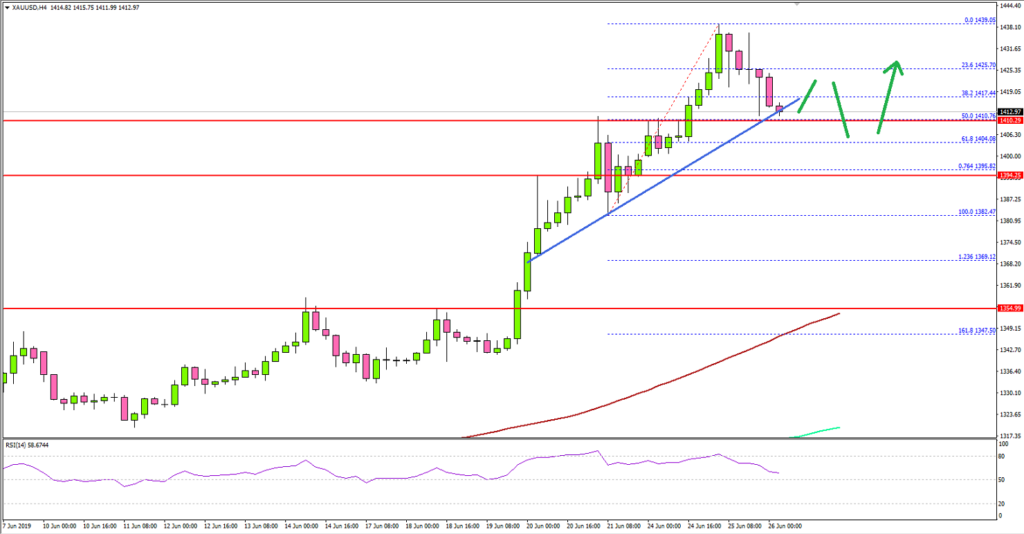
The 4-hours chart of XAU/USD indicates that the price settled nicely above the $1,425 level. It is now trading well above the 100 simple moving average (4-hours, red) and the 200 simple moving average (4-hours, green).
The last swing high was formed at $1,439 before the price corrected below the $1,430 level. There was a break below the 23.6% Fib retracement level of the last wave from the $1,382 low to $1,439 high.
However, the correction found support near the $1,412 level and the price stayed above the 50% Fib retracement level of the last wave from the $1,382 low to $1,439 high.
More importantly, there is a key bullish trend line forming with support near $1,412 on the 4-hours chart of XAU/USD. As long as the price is trading above the trend line, it could climb again above the $1,420 and $1,425 levels in the coming sessions. Conversely, it could slide towards the $1,400 support before a fresh increase.
Fundamentally, the US New Home Sales report for May 2019 was released by the US Census Bureau. The market was looking for a 1.9% rise in sales in May 2019, compared with the previous month.
However, the actual result was very disappointing since there was a 7.8% drop in sales. On the other hand, the last reading was revised up from -6.9% to -3.7%.
The report stated:
Sales of new single‐family houses in May 2019 were at a seasonally adjusted annual rate of 626,000. This is 7.8 percent (±14.7 percent) below the revised April rate of 679,000 and is 3.7 percent (±15.0 percent) below the May 2018 estimate of 650,000.
Overall, the US Dollar seems to be struggling to recover, resulting in positive moves in EUR/USD, GBP/USD and gold price.
Economic Releases to Watch Today
- US Durable Goods Orders May 2019 – Forecast +0.2% versus -2.1% previous.
- US Nondefense Capital Goods Orders Ex Aircraft May 2019 – Forecast +0.1% versus -1.0% previous.
- US Wholesale Inventories April 2019 (preliminary) – Forecast +0.5%, versus +0.8% previous.